Write, Review, Revision

I lost my faith in the English language and trust in people in grade school where I was taught the 3 Rs – reading, writing, and arithmetic. On balance, these each have the R consonant sound on the stressed syllable, but it is otherwise misrepresented. Game over.

In this tradition, I’ve got my own 3 dodgy Rs: Write, Review, and Revision. This sums up my approach to writing.

Write

Duh, right? You’ve got to write to write. In fact, to be a better writer, you’ve got to be a reader, a leading-candidate for as fourth R – but I’ll call it a necessary precondition. Being exposed to reading allows you to absorb different styles and genres. It remind you that pedantic constraints of grammar need not apply. My grammar-checker reminds me often.

I took this route as a musician as well. Exposure to genres, styles, and approaches fortifies your craft. Some of the best groups contain members of diverse backgrounds. Sure, there are some groups where members are cut from the same cloth, but they are usually stuck in a particular niche. Nothing wrong with this mind you, if you don’t mind being painted into a corner. I’m too claustrophobic for this.

Review

Once you’ve written, review your work. In fact, this should be more than one representative R. Perhaps it should instead be read, write, review, review, review, review… or an alternative, read, write, review, write, review, write, review… To be honest, when I write blogs, I just write – stream of consciousness. No net, no review. Submit. Done. But this is not how I approach longer works. The longer the work, the more read-review cycles.

Revision

After you’ve dumped all of your thoughts onto the page, write, review, rinse, and repeat, you have to opportunity to revise your work before you release it into the wild – transplant it from your private greenhouse to watch in flourish or perish.

A revision is more than a review. It’s the opportunity to re-view, re-vision, re-imagine the work that arrived in the first pass with sequential editorial hining and rework.

Maybe you now imagine a new character or story line, a new twist, two characters can be consolidated. Perhaps even a different ending or beginning. It’s all clay. Sentences are malleable.

As a professional musician, I learned not to become married to your work. And just as your parents may not appreciate your choice in partners, your readers may not appreciate your art. And this is not important as an artist. This is only important in the commercial realm. I don’t find this realm interesting. It the reason I don’t enjoy pop music – disposable commerce. We don’t so much categorise books into pop, but we should. At least we can.

Now I’ve gone off on a rant. In a novel, I would likely delete this during an editing cleanse, but here, there is only forward.

In the end, you can just write with none of the ancillary activities – as I do here. Or you can take a different approach to harden your final output. I don’t prefer to call it a product.

You may not even opt for revisioning because you had it all in your head. You just needed to rush to capture it all on the page – 700 pages times 7 volumes. You’re the lucky type. That’s not my style, so I’ve not much to say on the matter.

My parting words – just write.

White Rooms and Inventory Lists

I’m a writer, but not without challenges. Some writers have Writer’s Block™ and others don’t seem to understand grammar or structure. Me? I’m easily bored of details – simply don’t care. Here’s the rub.

When I read/hear writing advice, it recommends not to leave your reader in a white room – and certainly not in many white rooms, rooms with no detail to anchor the reader, just free-floating characters. The cure to white rooms is not an inventory list.

She entered the room with him. There was a table, two chairs, a lamp, and a pelican.

This does little to obviate the empty room.

When I read description, it quickly turns into blah, blah, blah, blah, and my brain fast-forwards. One of the most egregious examples is the literary classic, Dorian Gray. At some point, Oscar Wilde paints the image of Dorian’s parlour – to a fault. I mean, I’m pretty sure he gets down to the details of fabric choices and thread counts. I may have gone on for three pages or three paragraphs or three sentences. In any case. I lost track when my eyes glazed over.

The stated purpose of description is to immerse your reader into your built world. I get it. What I want is for the description to be key to the plot or the character – or at least be metaphorical. Don’t get me wrong, some description is good and necessary:

She wears black because she’s sullen or edgy.

He has a scar on his face under his left heterochromatic eye because of that fateful accident.

Chekhov’s gun on the wall will be used to kill the marauding jungle bear.

And perhaps it conveys an atmosphere, a mood, or a terrain, But how much does it take to do so? It’s raining, she’s pouting, steep mountains and foul faeries. What else do I need to know?

To be fair, I know this is just me. Other people do want to get immersed and lost in the world. Perhaps I’m coming from my place as a musician. I want the readers to interpret the book and make it fit themselves. If I create Snow White, the reader who’s not a pale white female can grasp and even enjoy the story, but she can’t as easily be Snow White. I feel that this might have led Michael Jackson down the wrong path in his day.

Hemingway App

I watched a YouTube video that referenced Hemingway App as an authors’ tool. Here, I pasted some sample content from Hemo Sapiens: Origins to see what it might suggest.

It’s a short passage, but the only things it found were trivial nits.

Highlighted, the complaint is that the top sentence (in yellow) is too complex, so I should break it up as shown in green. The only difference is that it swapped the semicolon with a full stop and capitalised the next letter to begin the next sentence. It also declared the Grade 11 writing sample to be reduced to Grade 6.

Is this really worth more than the free trial or the time and effort?

It highlighted two other related challenges: both adverbs, and neither with remediation advice. In the sceen shot, you can read ‘slightly crispy’. Honestly, I don’t have a more direct way to show this information. I suppose if it was ‘crispy’, I could specify a ‘crunch’ sound. But how is the crispy crunch diminished when it’s just ‘slightly’? Enquiring minds want to know.

Barely Audible

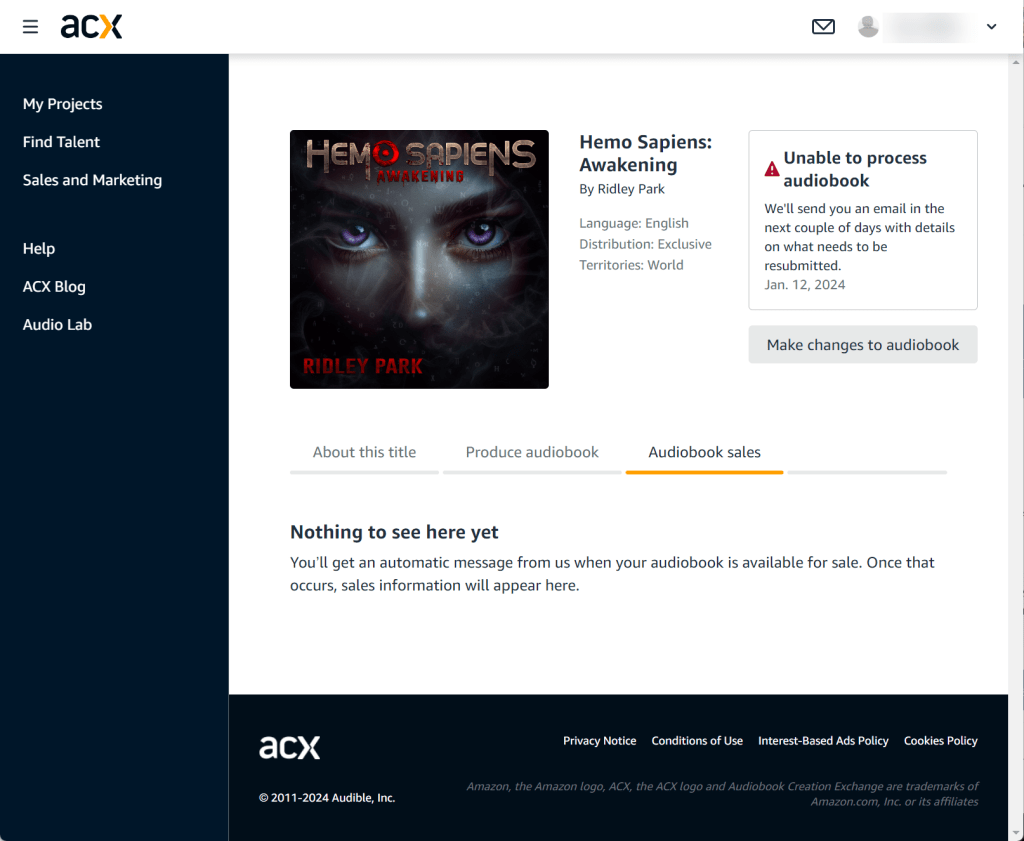
So this happened. I submitted Hemo Sapiens: Awakening as an audiobook, and it was rejected. The site says that they’ll let me know why in a couple days. My question is: if you rejected it, don’t you immediately know why?

I think I know why, but I can’t ‘fix’ the problem if I don’t know what it is. I don’t want to act on an assumption.

I believe they’ll inform me that I can’t use AI-generated narration. This would be odd because they have a programme in Beta where they provide the service of automatically converting the text of a book to audio. To be honest, it doesn’t sound amazing. It appears that they are using their own Amazon Polly, which I like, but you need to babysit it hard. It is very unlikely to sound good without heavy hand-holding. As it is, I hand-held my ElevenLabs AI to make the outcome sound like a professional human.

Audible offers some voiceover actors, but I didn’t like any of them, and they couldn’t compete with my ElevenLabs voice. I can understand that they don’t want to sell audiobooks that sound like Stephen Hawking, but theirs sound closer to him than mine.

On another note, I had to render and upload square cover art. There was a stated restriction disallowing padding a rectangular cover image with space or colour to make it square. I followed this rule, but this is exactly what they do. They take the cover of the book you’re selling through Amazon, and they pad the left and right margins with filler colour. I may append the rationale they provide once I’ve received it. Until them, my audiobook is on hold.

First Chapters Free on Kindle

If you are interested in Hemo Sapiens: Awakening, but you don’t want to commit your hard-earned shekels, the first four and a half chapters are available for FREE (woohoo). I mean, you’ll miss the best chapters, but what can I say. Dip your toe in the water.

If you have Kindle Unlimited, you can read the entire book for free. Sounds like a win-win to me. You are a winner, right?

Hemo Sapiens: Origins

Now that Hemo Sapiens: Awakening has been released into the wild, I can again focus on Hemo Sapiens: Origins. I started writing Origins a few weeks ago, but I was interrupted by the review and production process of Awakening.

In the world of Pantsers and Plotters, I tend to fall somewhere in between, but I favour plotting.

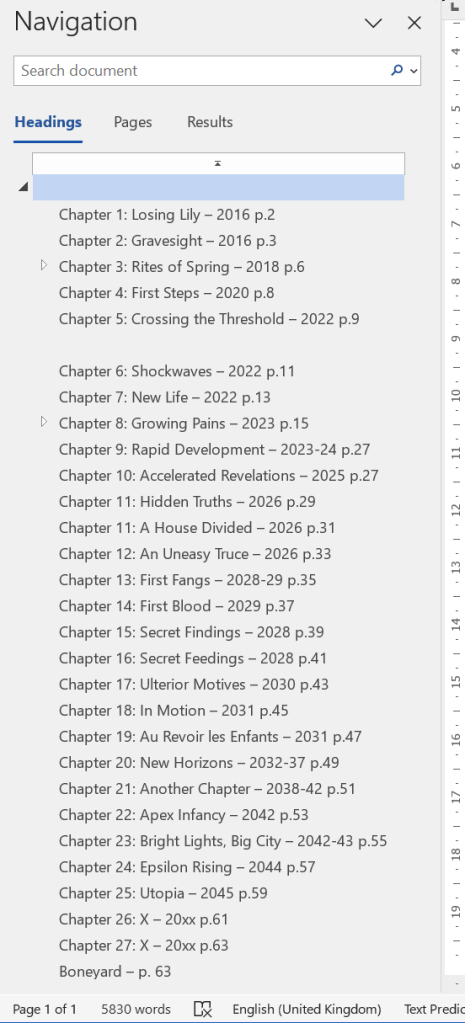
I write in Word. In the example above, you can see the working chapter titles, the year(s) a chapter covers and its starting page. Some of the chapters already contain preliminary copy.

As a writer, I don’t necessarily work chronologically. I find the chapters that are the most compelling and interesting to me. Then, I work down to the bridging chapters, hoping that the meat of the chapters penned earlier will support and inspire the later ones.

As I write, I usually create a ‘Boneyard’ chapter. This is where ideas go to incubate or die. Workable ideas are resurrected whilst others are laid to rest. Some ideas are like zombies, but at the end a project, they are either among the dead or living.

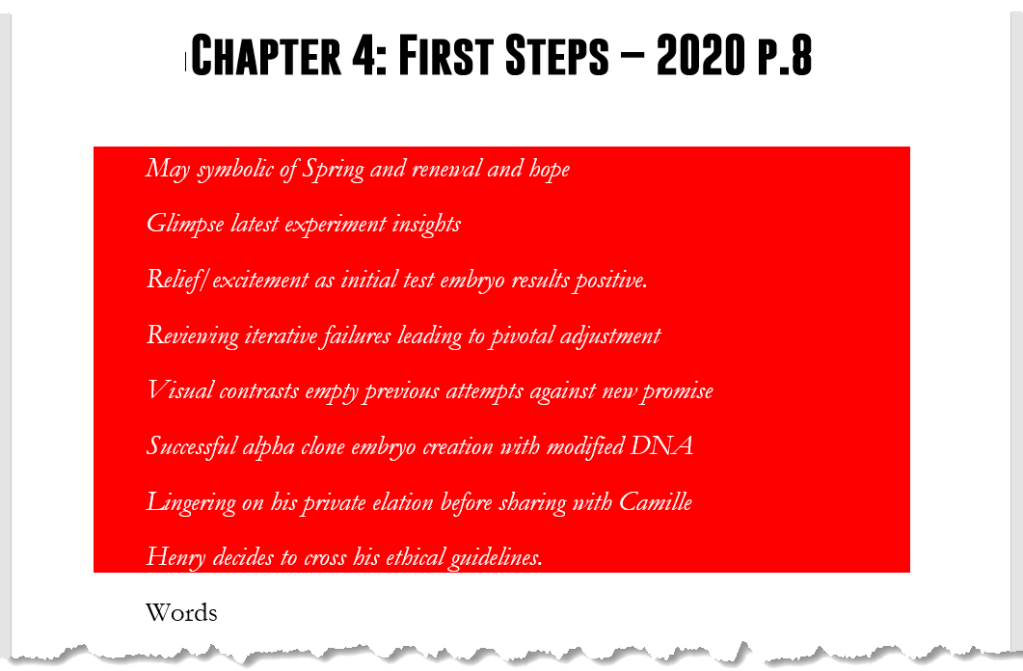
At the start, a chapter looks something like this. It’s a blend between ideas and story beats. Each chapter is outlined similarly. The other advantage this lends me is that I can *ahem* walk away from writing for a while and still have handholds and reminders when I return. For short fiction, I just write. No outlines. Perhaps just an idea to explore.

What is your writing style? Leave comments below.

Thanks to India

I’d like to thank the person in India who earned me $0.02 by reading 17 Kindle pages of Hemo Sapiens: Awakening. Reading on Kindle Unlimited is free—time aside. Read the whole book, and I’ve earned $0.50. In time, we’ll be as rich as astronauts.

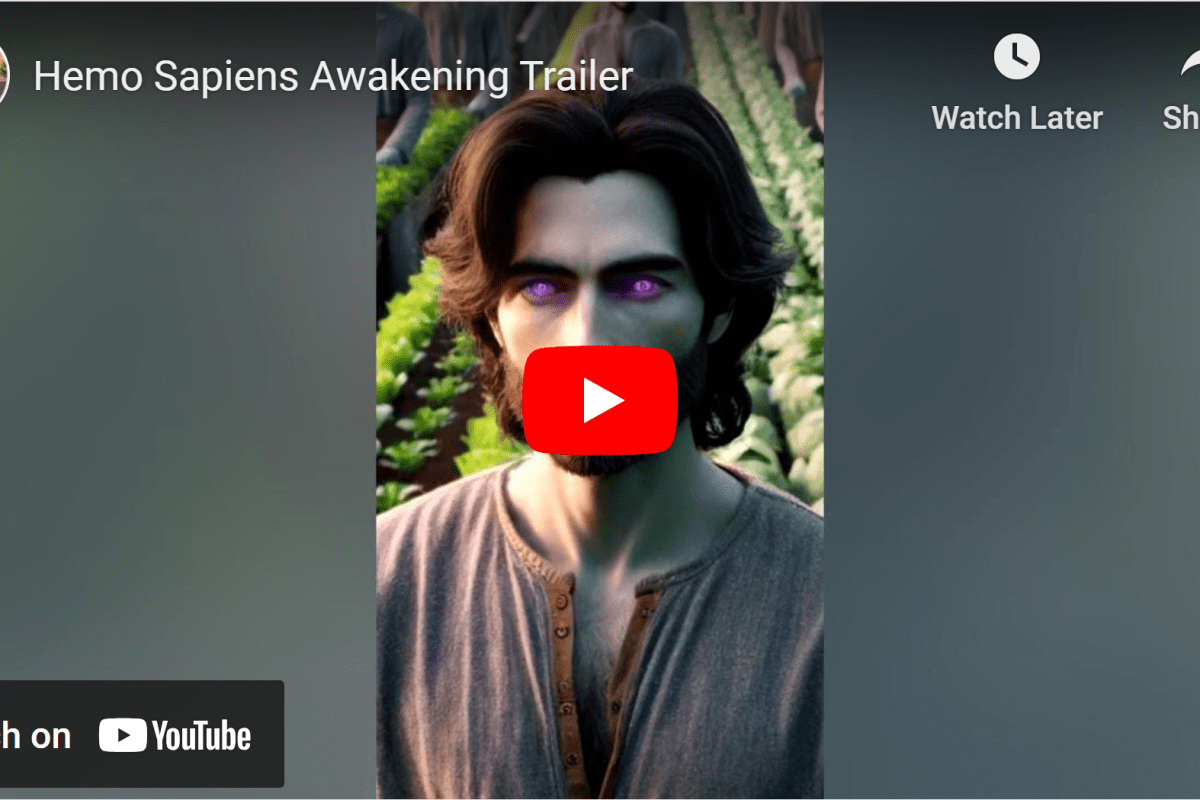
Hemo Sapiens: Awakening Trailer

The trailer advert for Hemo Sapiens: Awakening is now available on YouTube as a 60-second short.

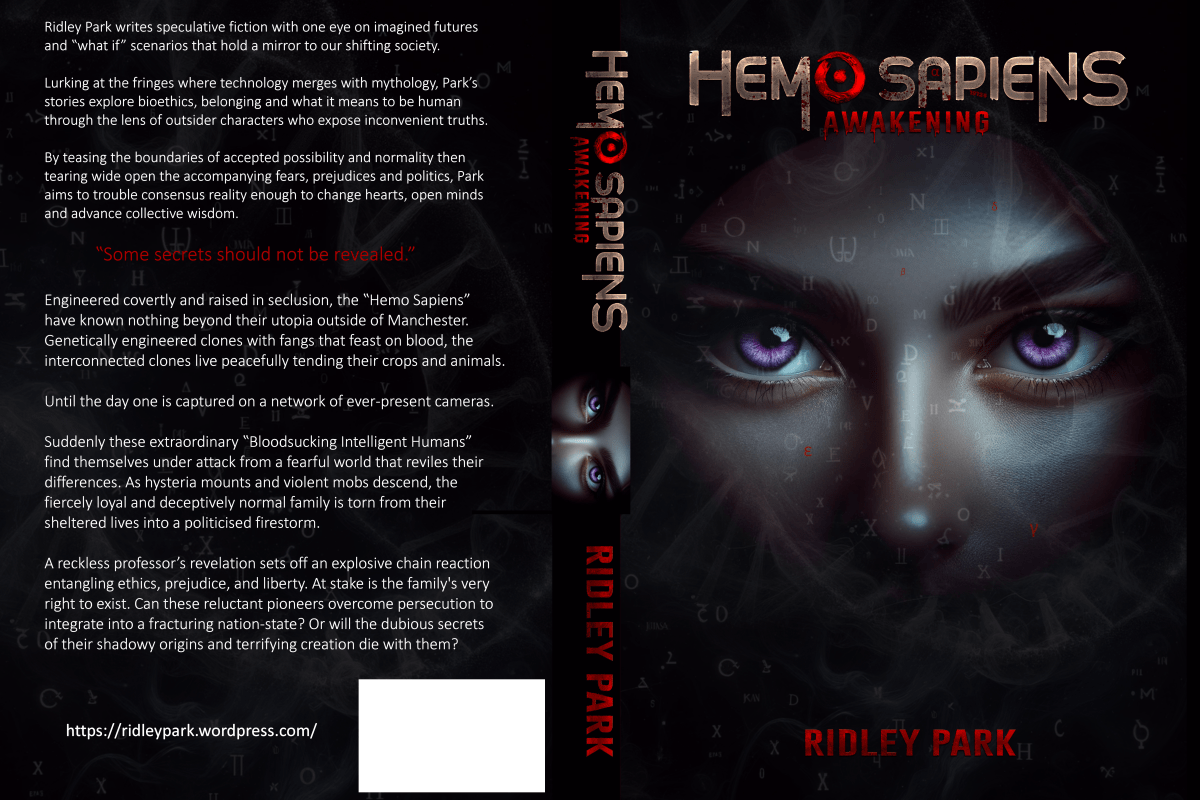
I think I’ll stick to writing. The cover-making wasn’t half bad, but video production with Generative AI is not all it’s cracked up to be.

I considered Artlist.io, but I didn’t want to spend the cash. Maybe next time.

Let me know what you think. You can find a copy of the book from a link on my announcement page. If you get a copy, leave a review. It helps to appease the algorithm gods.

Announcement: Published at Last

Here thee, hear thee. It’s about time. Hemo Sapiens: Awakening is finally published and available for purchase reading.

It’s been quite the journey. It started in August 2023 as a diversion from another project, but it ended up taking precedence.

Per the blurb on Amazon, the book is about this:

Genetically engineered and cloned in secret, the “Hemo Sapiens” have lived isolated on a farm in Manchester for decades—until their extraordinary nature is revealed.

Suddenly these “Bloodsucking Intelligent Humans” find themselves persecuted as dangerous outsiders. As hysteria escalates and mobs attack, the fiercely loyal and mostly innocent family fights for acceptance while struggling to find answers about their shadowy origins and uncertain destiny.

A genetics professor’s rash scientific revelation sets off an explosive chain reaction entangling ethics, prejudice and politics. At stake is nothing less than the family’s human rights—and what it truly means to belong.

Can these reluctant pioneers overcome fear to integrate into a society both fascinated and repulsed by their very existence? This thought-provoking saga confronts what diversity, progress and being human entail in an increasingly hostile, high-tech surveillance state that is meant to protect but may also oppress.

Amazon Marketing Blurb

The book currently available in many global regions as hard cover, paperback, or Kindle. I am currently working on the audiobook version, which should be available by March 2004.

For the sake of simplicity, below are links to the various marketplaces: Australia, Brasil, Canada, France, Germany, India, Italy, Japan, Mexico, Netherlands, Poland, Spain, Sweden, United Kingdom, and United States. Not all formats are available in all regions. As of today, this is the availability.

Hard Cover

(ISBN: 979-8872481942, Case Laminate 6″ x 9″, gloss)

US UK DE FR ES IT NL PL SE

Paperback

(ISBN: 979-8870961422, 6″ x 9″, matte)

US UK DE FR ES IT NL PL SE JP CA AU

Kindle

US UK DE FR ES IT NL JP BR CA MX AU IN

In addition to the audiobook, I am also working on releasing a standard hard cover with a dust jacket and a smaller mass market form factor paperback.

All of this distracts me from writing the prequel, Hemo Sapiens: Origins, which I hope to release before 2025.

HNY 2024

Goodbye 2023. We hardly knew ye.

My first novel, Hemo Sapiens: Awakening, is locked and loaded. I’ve reviewed the digital proofs, and the physical copy should be arriving in the post in the next few days. I wasn’t willing to pay more to shave off a day.

I am publishing a paperback and case laminate hardcover. I ordered one of each to proof, but the hardcover has a 4 to 5 week delay, so I won’t bother. The paperback is the same interior content. I had to render a larger cover for the hardcover. Not because of the dust jacket—because there is none. They have to wrap some around the edges. The case laminate reminds me of grade school books, like Hardy Boys and Nancy Drew. It feels a bit amateurish, but it doesn’t cost me more to set it up, so I figure why not.

It does cost more for materials and handling—almost double—, so I have to charge more and have lower margins. I’ll leave that for the reader to decide if the durability is worth it. I decided to take even smaller margins in ex-US markets just to have more even prices.

As it stands, the hardcover will be available for USD 20 and the paperback USD 12.99. This affords me room for promotional discounting later. In Europe, hardcover prices will be  £15 and €18.

Paperback prices will be £10.21 (I know. Wierd.) and €11.75. There will also be APAC editions ¥1980 and AUD 20.99 (each including VAT). In Canada, it should cost CAD 15.

Here’s to a happy, healthy 2024.