Psychic Distance

I was too clever by half. I am drafting a new project, likely to be a novella, and I wanted to try something different.

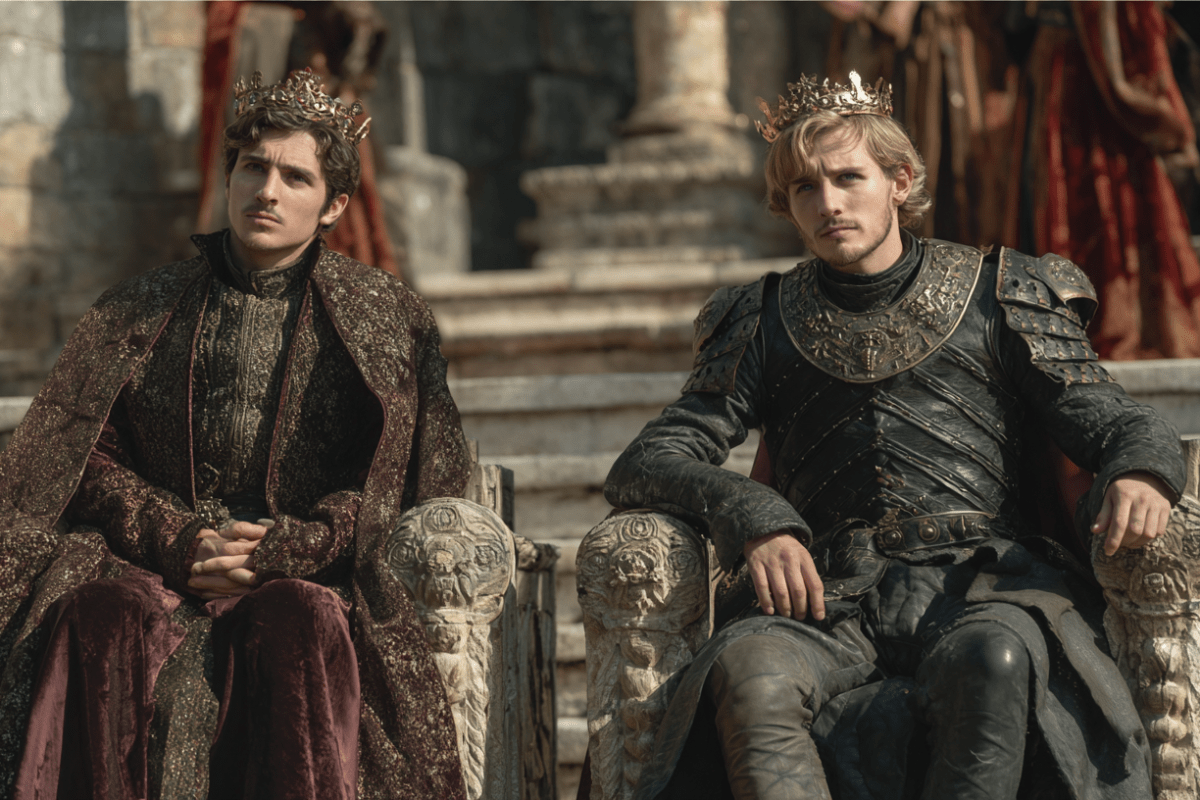
Before Claude dashed my hopes, I thought I was onto something novel. The working title is Two Kings. The device was to employ a camera-dolly metaphor from a third-person perspective. Distant scenes were captured even in a casual past tense, whilst close shots would be intimate, in the immediate present tense.

I imagined framing, focus, aperture, and focal length. Is it a wide establishing shot or macrophotography?

As I discovered, this technique was published in The Art of Fiction: Notes on Craft for Young Writers by John Gardner in 1991. In summary, it looks something like this:

LevelDescriptionTypical effect
FarHistorical, panoramic, formal, report-likeScope, authority, irony, myth, social structure
Medium-farCharacter viewed from outside, with some interpretationSocial legibility, behavioural reading
MediumCharacter’s feelings or attitudes stated plainlyOrdinary narrative access
CloseCharacter’s perceptions, assumptions, and pressure shape the proseImmediacy, sympathy, tension
Very closeSyntax and imagery approach thought, sensation, or psychic ruptureEmbodiment, panic, desire, shame, dissociation, revelation

I don’t wish to overshare his book, but this is the essence. I have since read the book and will incorporate some of it, including this, in this manuscript.

Former Presents – Preamble

1–2 minutes

Two days, and you’ve only managed this? 154 words? Are you serious?


A seat. A button at knee height. An old man in a wooden box. Cedar and something like warmth.

Fist against his chest. Pressing hard.

His breath hitches. Shoulders forward. The hand slips and claws. Comes back to his chest. He looks at the button. The look of a man who has forgotten what a thing is for.

Reaches for it. Stops.

He turns. The box creaks. Fingers on the latch. Misses it. Finds it. The seal breaks and the door swings out. Cooler air rushes across his face.

He doesn’t move.

Half turned. Arm outstretched. The button. The door. A correction only he understood.

The workshop beyond. Bench and lamp. Tools on their hooks. The quiet order of a room that had always been his. It would outlast him now by hours. Temperature settings on the outer panel. An LED timer gone dark.

A man in a box in a basement.

A father.

Indeed, I am.

My last two days were occupied outlining and annotating a short story or novellette, depending on how many words I muster. At this rate, short story is the easy bet. This is the opening scene.

This is somewhat experimental literary speculative fiction, but I am not a fan of genre constraints. This isn’t as experimental as some of my writing, but it is as philosophical.

I’m not sure that I’ll finish this manuscript anytime soon. I just decided to use the Easter holiday weekend as an excuse to ignore my academic writing, having just finished revising and publishing an essay I had originally published in February.

The basis is a secret. 🤫 Shhhh… It follows another academic essay, but as a publisher once insisted: nobody reads nonfiction. It’s boring. If you want to make a point, write fiction. It’s like warm water to a box of frogs.

I didn’t question him on the frogs.


Apparently, I should complete my Gravatar profile. If this is complete in the future, you’ll know I succeeded.

The Antilibrary: The Hidden Value of Unread Books

A social media connexion on another account shared this link with me, on the notion of anti-libraries. This is perfect for a writing (or reading) blog.

As Nassim Taleb shares in The Black Swan,

The library should contain as much of what you do not know as your financial means … allow you to put there. You will accumulate more knowledge and more books as you grow older, and the growing number of unread books on the shelves will look at you menacingly. Indeed, the more you know, the larger the rows of unread books. Let us call this collection of unread books an antilibrary.


As for me, it’s been too long since I’ve set aside time to write fiction, so many manuscripts remain unfinished and await time in my attention cycle.

If you are interested in what I am doing in general, check out Philosophics Blog.

Top (and Bottom) Books Read in 2025

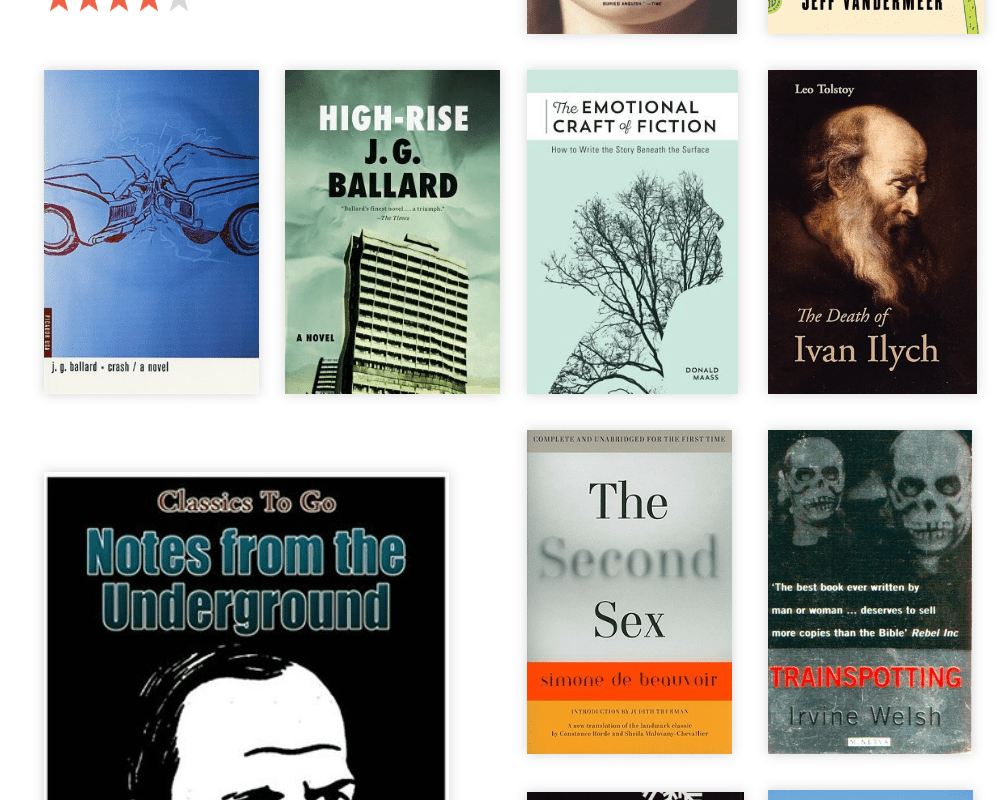
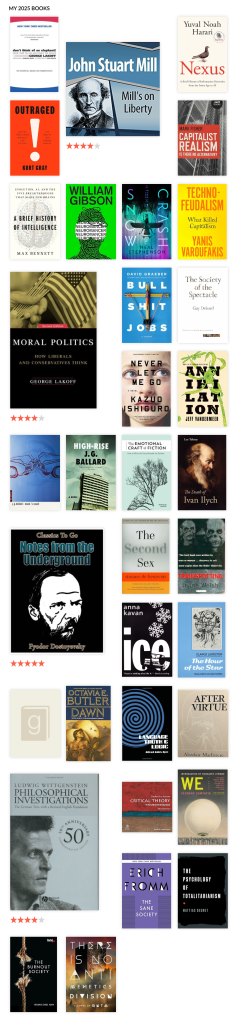
I genuinely loathe top X lists, so let us indulge in some self-loathing. I finished these books in 2026. As you can see, they cross genres, consist of fiction and non-fiction, and don’t even share temporal space. I admit that I’m a diverse reader and, ostensibly, writer. Instead of just the top 5. I’ll shoot for the top and bottom 5 to capture my anti-recommendations. Within categories are alphabetical.

Fiction

Never Let Me Go by Kazuo Ishiguro – A slow reveal about identity, but worth the wait.

Notes from Underground by Fyodor Dostoevsky – Classic unreliable narrator.

There Is No Antimemetics Division by QNTM (AKA Sam Hughes) – Points for daring to be different and hitting the landing.

Trainspotting by Irvine Welsh – Scottish drugs culture and bonding mates narrative.

We by Yevgeny Zamyatin – In the league of 1984 and Brave New World, but without the acclaim.

Nonfiction

Capitalist Realism by Mark Fisher – Explains why most problems are social, not personal or psychological. Follows Erich Fromm’s Sane Society, which I also read in 2025 and liked, but it fell into the ‘lost the trail’ territory at some point, so fell off the list.

Moral Politics by George Lakoff

Technofeudalism by Yanis Varoufakis – Explains why Capitalism is already dead on arrival.

NB: Some of the other books had great pieces of content, but failed as books. They may have been better as essays or blog posts. They didn’t have enough material for a full book. The Second Sex had enough for a book, but then poured in enough for two books. She should have quit whilst she was ahead.

Image: Books I read in 2025 on Goodreads.
Full disclosure: I don’t always record my reading on Goodreads, but I try.

Bottom of the Barrel

Crash by J.G. Ballard – Hard no. I also didn’t like High-rise, but it was marginally better, and I didn’t want to count an author twice.

Neuromancer by William Gibson – I don’t tend to like SciFi. This is a classic. Maybe it read differently back in the day. Didn’t age well.

Nexus by Yuval Harari – Drivel. My mates goaded me into reading this. I liked Sapiens. He’s gone downhill since then. He’s a historian, not a futurist.

Outraged by Kurt Gray – Very reductionist view of moral harm, following the footsteps of George Lakoff and Jonathan Haidt

Society of the Spectacle by Guy Debord – A cautionary tale on why writing a book on LSD may not be a recipe for success.

Honourable Mention

Annihilation by Jeff VernderMeer was also good, but my cutoff was at 5. Sorry, Jeff.

Propensity Kindle Promotion – Limited-Time Offer

1–2 minutes

Propensity has always been available for free with KindleUnlimited. For the first time ever, Propensity will be free for all available markets between 12 and 16 December 2025. Limited-time offer. Not sure how this operates across time zones. Download it sooner than later so you don’t miss the opportunity.

Propensity is also available in hardcover and paperback, as well as an audiobook. Scroll down to listen to chapter 1.

Also available at Barnes & Noble, if that’s your preference – hardcover and paperback.

I’m offering Propensity in the hope of getting some reviews and comments, whether here or on the site of purchase. Goodreads reviews are nice, too. You can be the first.

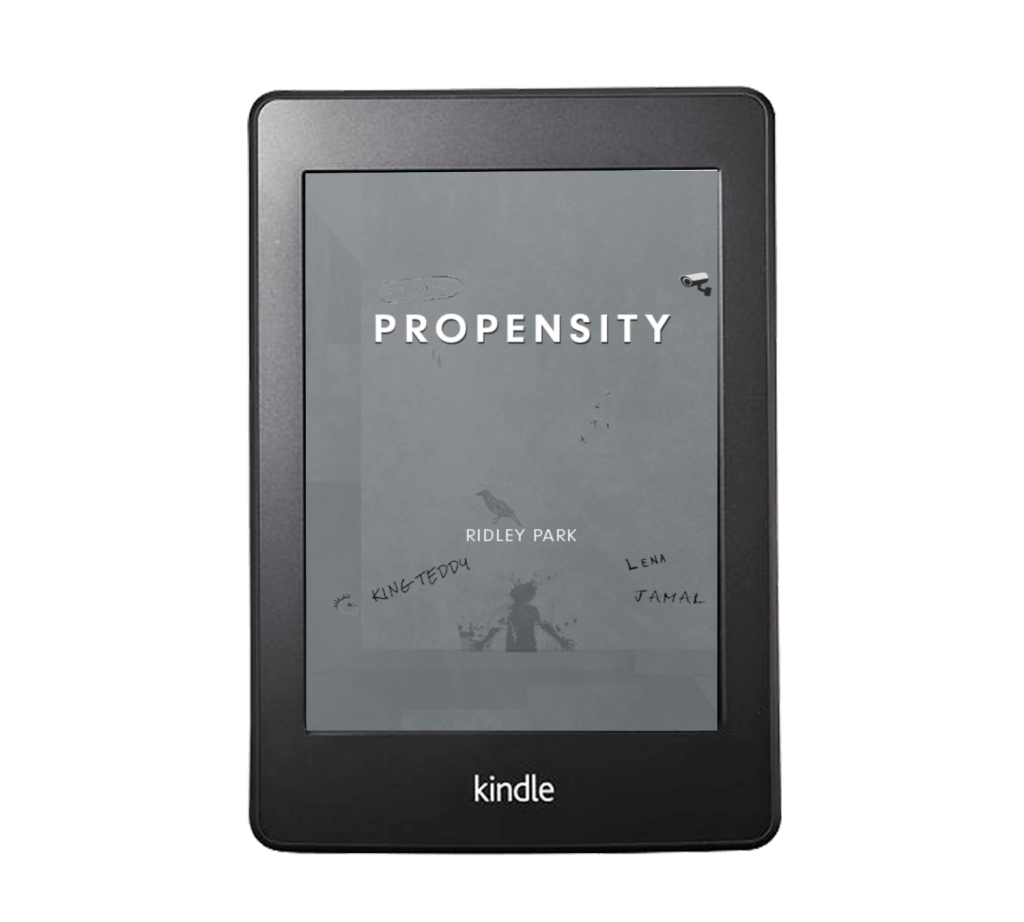
Image: Mockup of Propensity in a Kindle reader frame

Propensity is a story in three sections: Implementation, Drift, and Entropic. Google Gemini summarised each section; NotebookLM summarised those. Listen below.

Audio: NotebookLM podcast summary of Section I: Implementation
Audio: NotebookLM podcast summary of Section II: Drift
Audio: NotebookLM podcast summary of Section III: Entropic

A thematic trailer for Section I is also available. I hope to make more.

Video: 37-second Propensity Trailer – Act I

Audiobook: Propensity Excerpt: Section I – Implementation, Chapter 1: Calibration

Have any more questions? Visit the dedicated product page.

I feel I’ve stuffed this page, so it’s time to go.

Propensity – Video Trailer 1

Video: 37-second Propensity trailer.

I’ve finally given Propensity a trailer.
This short piece captures the first of the novel’s three movements – the ‘scientific’ phase, when everything still believes it’s under control. Except for this cover image, I used no AI. Except for the book covers, all assets – video clips and soundtrack – came from Motion Array

There may be another to follow, drawn from the second section, where control begins to crack. For now, consider this a visual prelude: thirty-two seconds of atmosphere, code, and quiet collapse.

Propensity is available in print and eBook in the usual places – online or at your local bookseller.

Also available as an audiobook. Listen to this sample on Spotify.

Thoughts on Solaris

I finished reading Lem’s Solaris and then was notified of a discussion about the book and the film adaptations.

I intended to draft a book review, but I may defer.

For now, I’ll note that the similarities between this and my own work are superficial. Both have philosophical perspectives, but Lem’s is much more psychological. This is nice, but it’s not where I tend to take things, and not so overtly.

What’s With the Violet Aliens?

🛸 A Closer Look at the Cover of Sustenance

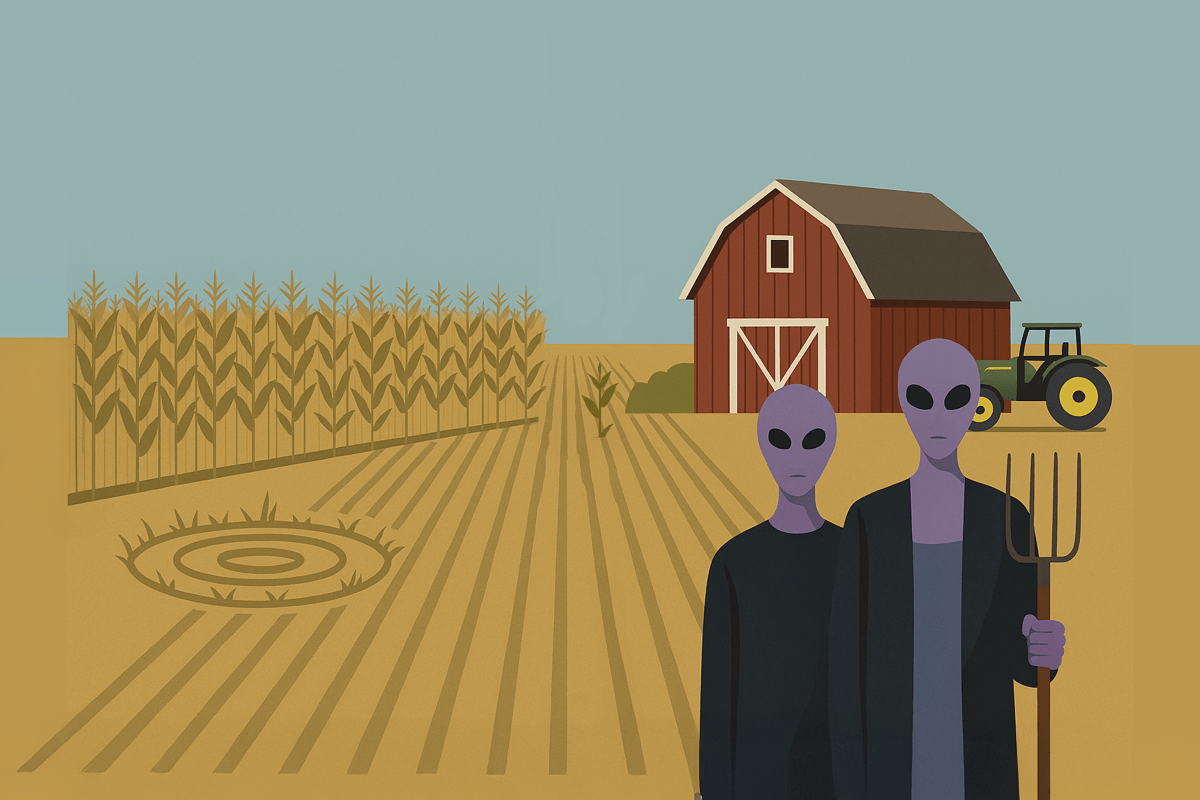
👽 People ask me: What’s with the aliens on the front cover of Sustenance?
Fair enough. Let’s talk about it.

Sustenance is set in Iowa – real, dusty, soybean-and-corn Iowa. I’ve spent months there. I’ve lived in the Midwest (including Chicago) for over a decade. The farms, the tractors, the gravel roads… they aren’t just set dressing. They’re part of the book’s DNA.

So, yes: we’ve got the requisite red barn, green tractor with yellow wheels (hi, John Deere 🚜), and a crop circle or two. The audiobook cover even features an alien peeking out of the barn – though logistics are holding that version back for now.

But those aliens…

If the composition feels familiar, it should.

The cover is a quiet parody of Grant Wood’s “American Gothic – a pitchfork-wielding farmer and his companion, stoic before their rural home. It’s one of the most recognisable paintings in American art, and I couldn’t resist twisting it just slightly. Grant was an Iowa boy.

I designed this cover using a flat vector art style, almost like cut paper or stylised children’s book illustrations. The sky is cyan, the land is beige, and everything is built in clean layers: barn, tractor, field, crop circle, and of course… two violet, large-eyed aliens striking a pose.

But no, this isn’t a literal scene from the book. You might encounter violet aliens in Sustenance, but you won’t find them standing around with pitchforks like interstellar Grant Wood impersonators. The image is meant to evoke the tone, not transcribe the events.

Why this style?

Because the story itself is quiet. Subtle. Set in the kind of place often overlooked or written off. The aliens aren’t invading with lasers. They’re… complicated. And the humans, well, aren’t always the best ambassadors of Earth.

The cover reflects that blend of satire, stillness, and unease.

Oh, and one last note:
🛑 No aliens were harmed in the writing of this book.

Autofiction Break

Three of the last four books I’ve read have been autofiction of one flavour or another.

I had never read Virginia Woolf’s A Room of One’s Own, but I picked it up after finishing The Hour of the Star by Clarice Lispector. The there was Trainspotting by Irvine Welsh.

I found Hour of the Star to be an interesting experiement, but I would have preferred a short story over a novelette. A Room of One’s Own is interesting and well-written, though the content resonates with me historically rather than personally. I’ve already written a bit on Trainspotting, which hit me quite close to home. I liked it the best but needed a change of scenery before engaging in its prequel, Skagboys. I need more motivation before I embark on a 500 page journey. I like Welsh’s writing, but it’s not an easy read, I I need more stamina or a break first.

I haven’t decided what to pick up next.

Done with Facebook

Graveyard cemetry

I’ve shut down my personal Facebook account. Inevitably, that dragged the Ridley Park page into the digital abyss with it. Collateral damage in the war against nonsense.

Why? Because I’ve grown tired of sparring with what amounts to a bot infestation masquerading as “content moderation.” My blog link – a single post flagged thirteen times as spam in a matter of seconds. Appealed to purported humans, twice denied. If those were humans, they were scarcely distinguishable from meat-based chatbots reciting policy incantations.

So, for now, Ridley’s gone dark on Facebook. That may change; I might spin up a Ridley-only account, but it will be out of necessity, not affection. Still, I’ve no taste for systems that feel more Kafka than community.

For the record, I shared the same post on LinkedIn. Here’s a screengrab:

Image: Screen capture of the offending post, qualifying as spam.

Until then, you’ll find me here and other social media suspects, unencumbered by algorithmic gatekeepers.

Comprehensive Links on Link Tree

https://linktr.ee/ridleypark

Did I miss any?