After watching a review of –All You Zombies–, a short story published in 1959 by Robert Heinlein, I found an online copy and read it. It’s about 9 pages long – an easy read. Here’s another audio version on YouTube.
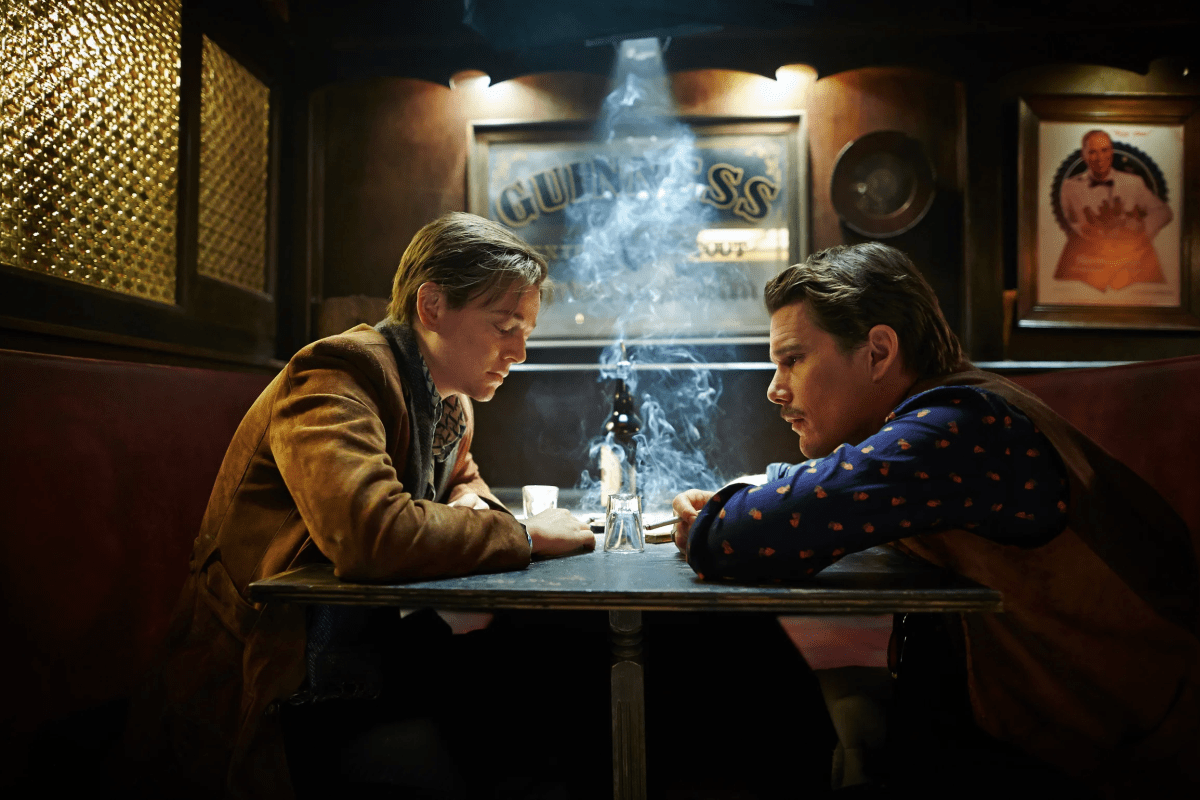
In essence, it’s a story of self-discovery masquerading as time-travel sci-fi. I found the premise of the short story to be better than the execution. Despite decent reception and reviews, I didn’t really like the movie. Full disclosure: I don’t tend to like many movies or television, so consider the source. The script and acting felt contrived and wooden. I feel it could have been done better. The direction didn’t help. Even so, it’s only about an hour and a half, so it could have been worse.
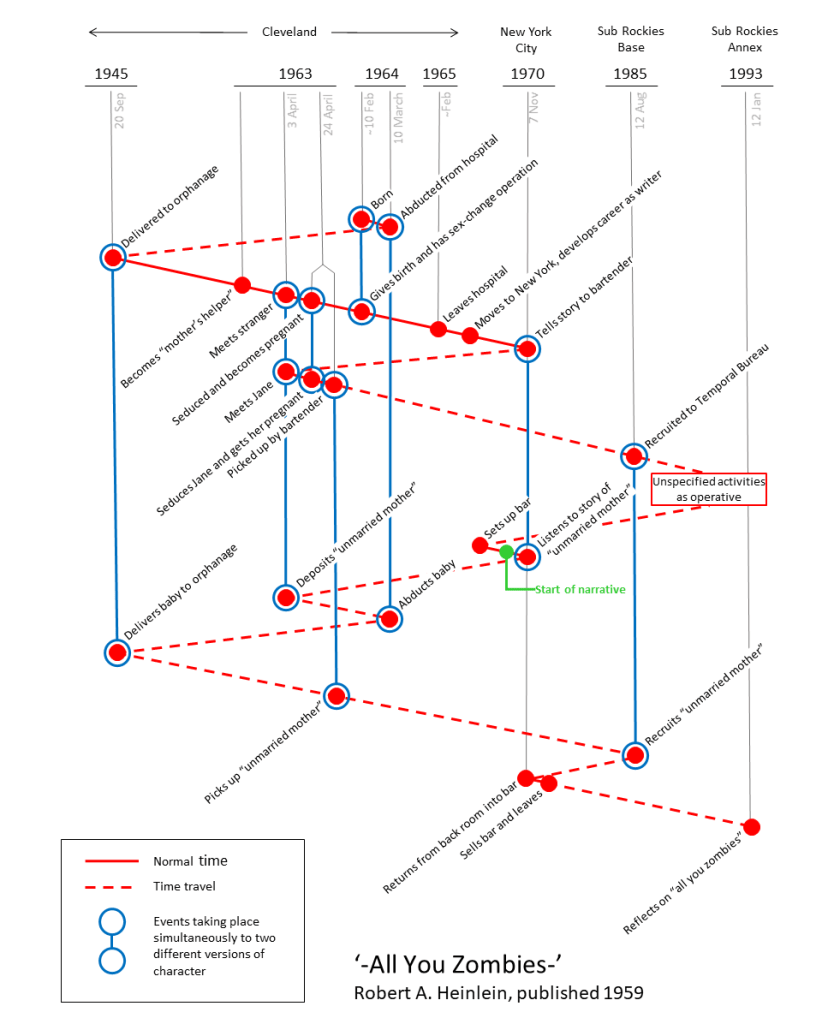
Image: Time locations in the story.
The Hooters released a song named All You Zombies in 1983, though with a different theme.
Mainly, I’ve been working on academic nonfiction, so I felt it was time to post something here, especially since my last (but yet to be published) project involved a manner of time travel as well.
I’ve just started this after hearing a positive review on YouTube. I discovered that Audible was offering it for free for members, so I took that route. About 15% in, I like the writing (and the narration). By and large, it is well-written, and I am interested to see where it leads. The weakest element seems to be the dialogue, so far. I am especially put off by the dialogue of the young girl, but some of the protagonist’s dialogue (and intercourse with the girl) doesn’t feel ‘authentic’; it feels rather contrived. Even so, I’d give it a 3.5 stars for now. I could see it getting to 4 by the time I’m done. Time will tell.
I’ve still got a ways to go. Rather than witter on further, I recommend listening to this bloke’s take on it. He’s undoubtedly more excited about it than I am, but I’d still recommend it at this point.
To be honest, I saw at least one negative review on YouTube, but I’ll read the book before I poison the well.
I guess I should complete my profile below. One day. Maybe soon.
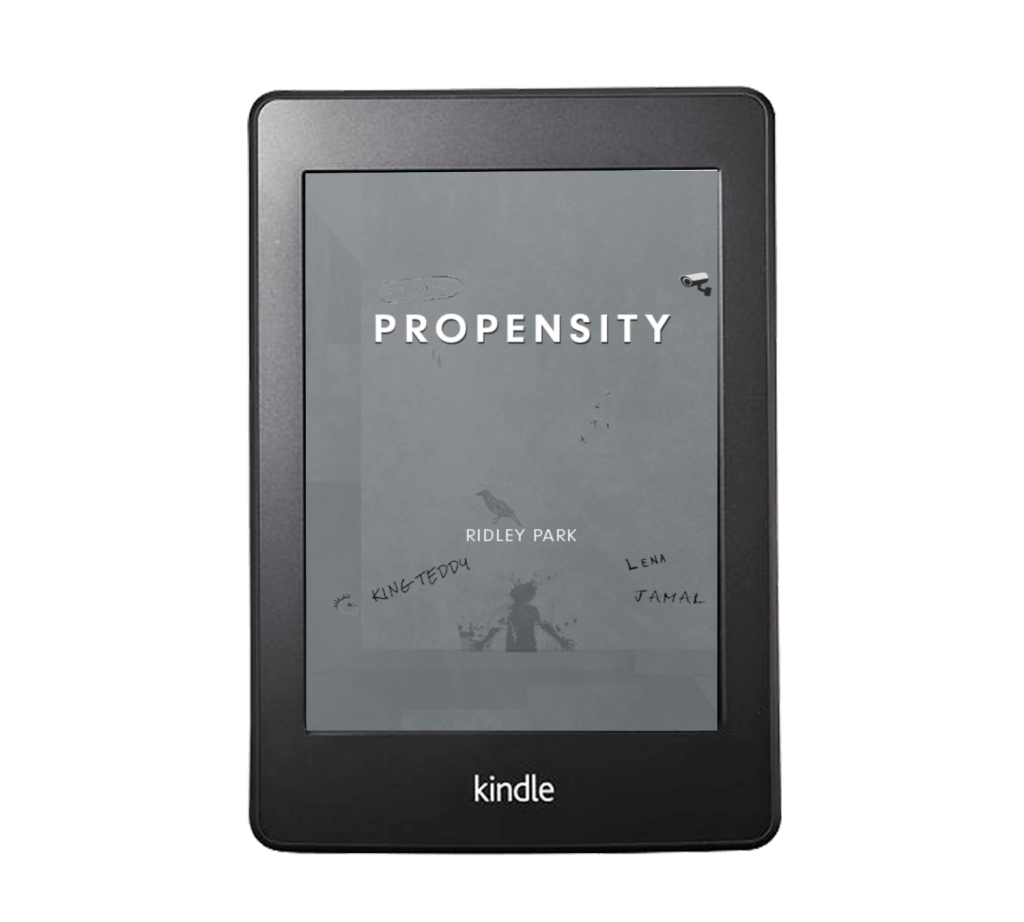
Propensity has always been available for free with KindleUnlimited. For the first time ever, Propensity will be free for all available markets between 12 and 16 December 2025. Limited-time offer. Not sure how this operates across time zones. Download it sooner than later so you don’t miss the opportunity.
Propensity is also available in hardcover and paperback, as well as an audiobook. Scroll down to listen to chapter 1.
Also available at Barnes & Noble, if that’s your preference – hardcover and paperback.
Summaries and a trailer are available below.
I’m offering Propensity in the hope of getting some reviews and comments, whether here or on the site of purchase. Goodreads reviews are nice, too. You can be the first.
Image: Mockup of Propensity in a Kindle reader frame
Propensity is a story in three sections: Implementation, Drift, and Entropic. Google Gemini summarised each section; NotebookLM summarised those. Listen below.
Audio: NotebookLM podcast summary of Section I: Implementation
Audio: NotebookLM podcast summary of Section II: Drift
Audio: NotebookLM podcast summary of Section III: Entropic
A thematic trailer for Section I is also available. I hope to make more.
I finished reading Lem’s Solaris and then was notified of a discussion about the book and the film adaptations.
I intended to draft a book review, but I may defer.
For now, I’ll note that the similarities between this and my own work are superficial. Both have philosophical perspectives, but Lem’s is much more psychological. This is nice, but it’s not where I tend to take things, and not so overtly.
I don’t want to develop a reputation as an AI apologist – I really don’t. But I do want to strip away the veneer humans so lovingly lacquer over themselves: the idea that art is some mystical emanation of a “soul,” accessible only to those blessed by the Muse and willing to suffer nobly in a garret.
Video: YouTube Short by Jonny Thompson of his interview with Rachel Barr
Rachel Barr argues that AI art can never be the same as human art, no matter how “perfect,” because AI has no feelings or drive. Cue the violins. These arguments always seem to hinge on metaphysical window-dressing. When Rachel says “we”, she’s not talking about humanity at large; she’s talking about herself and a very particular subset of humans who identify as artists. And when she invokes “masters”, the circle shrinks still further, to the cloistered guild who’ve anointed themselves the keepers of aesthetic legitimacy.
But here’s the bit they’d rather you didn’t notice: feelings and drive aren’t prerequisites for art. They’re just one of the many myths humans tell about art, usually the most flattering one. Strip away the Romantic varnish and art is often craft, habit, accident, repetition. A compulsive tic in oil paint. A mistake on the guitar that somehow worked. A poet bashing words together until something sticks.
And I say this not as a detached observer but as a writer, artist, and musician in my own right. I sympathise with the instinct to defend one’s turf, but I don’t need to steep myself in hubris to retain self-worth. My work stands or falls on its own. It doesn’t require a metaphysical monopoly.
So when someone insists AI art can never be “the same,” what they mean is it doesn’t flatter our myths. Because if an algorithm can spit out a perfect sonnet or an exquisite image without the tortured soul attached, then what have we been worshipping all this time? The art itself, or the halo around the artist?
Perhaps the real fear isn’t that AI art lacks feelings. It’s that human art doesn’t require them either. And that’s a blow to the species ego – an ego already so fragile it cracks if you so much as ask whether the Mona Lisa is just paint on a board.
Some novels are born in a lightning bolt. Needle’s Edge was forged in sediment: years of observations, contradictions, and lived experience settling into something that could no longer be ignored.
Video: Author Ridley Park Discusses Needle’s Edge
The video is intentionally, if not mercifully, short for all parties considered; it comes in under five minutes.
From the description:
Needle’s Edge is Ridley Park’s latest novel-in-progress, a raw, unvarnished work of literary realism with grit under its nails and philosophy in its bloodstream.
In this first episode of a new series on my writing process, I unpack the origins of Needle’s Edge: from life between the vantage point of an anthropologist and the poetry of Bukowski, to lived experience inside the worlds of sex work, addiction, and the quiet economies of trust and betrayal.
I reflect on the shift from speculative fiction to a tethered, reality-bound narrative, a story that rejects morality tales, subverts tropes, and meets its protagonist, Sarah, in the middle of her life before looping back to her beginnings. Along the way, he weaves in themes from Simone de Beauvoir, explores personae and code-switching, and interrogates the myths of middle-class respectability.
This is not a documentary – twenty years of lived history are compressed into five – but it’s true in its bones. Join me as he begins peeling back the layers of Needle’s Edge and the philosophy that drives it.
Ever wondered why my characters are displaced, disillusioned, or linguistically marooned? Why my fiction leans philosophical, post-structural, and just a touch anti-humanist?
In this short video, I explain the underlying motivations behind my stories—from Heidegger’s Geworfenheit to Galen Strawson’s Causa Sui, with detours through identity, agency, and the lies we call language.
This isn’t about world-building. It’s about world-dismantling.





 Ridley Park