Now that Hemo Sapiens: Awakening has been released into the wild, I can again focus on Hemo Sapiens: Origins. I started writing Origins a few weeks ago, but I was interrupted by the review and production process of Awakening.
In the world of Pantsers and Plotters, I tend to fall somewhere in between, but I favour plotting.
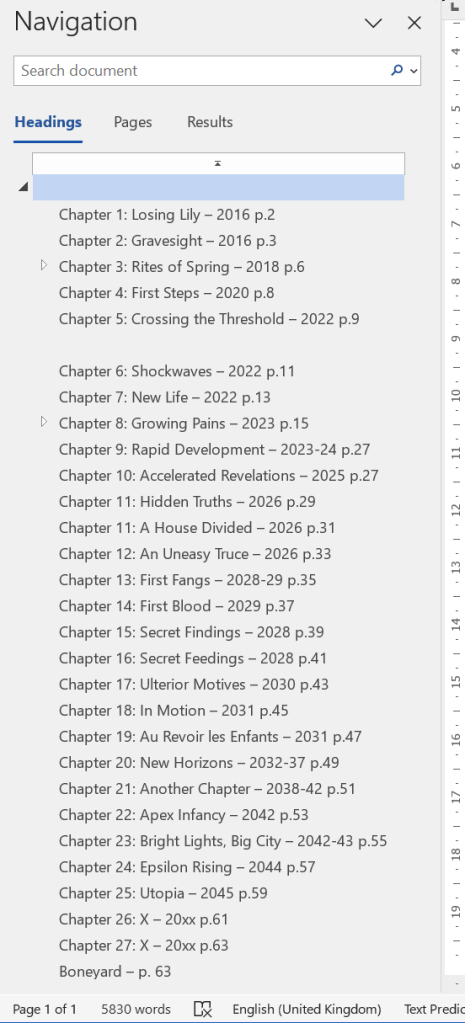
I write in Word. In the example above, you can see the working chapter titles, the year(s) a chapter covers and its starting page. Some of the chapters already contain preliminary copy.
As a writer, I don’t necessarily work chronologically. I find the chapters that are the most compelling and interesting to me. Then, I work down to the bridging chapters, hoping that the meat of the chapters penned earlier will support and inspire the later ones.
As I write, I usually create a ‘Boneyard’ chapter. This is where ideas go to incubate or die. Workable ideas are resurrected whilst others are laid to rest. Some ideas are like zombies, but at the end a project, they are either among the dead or living.
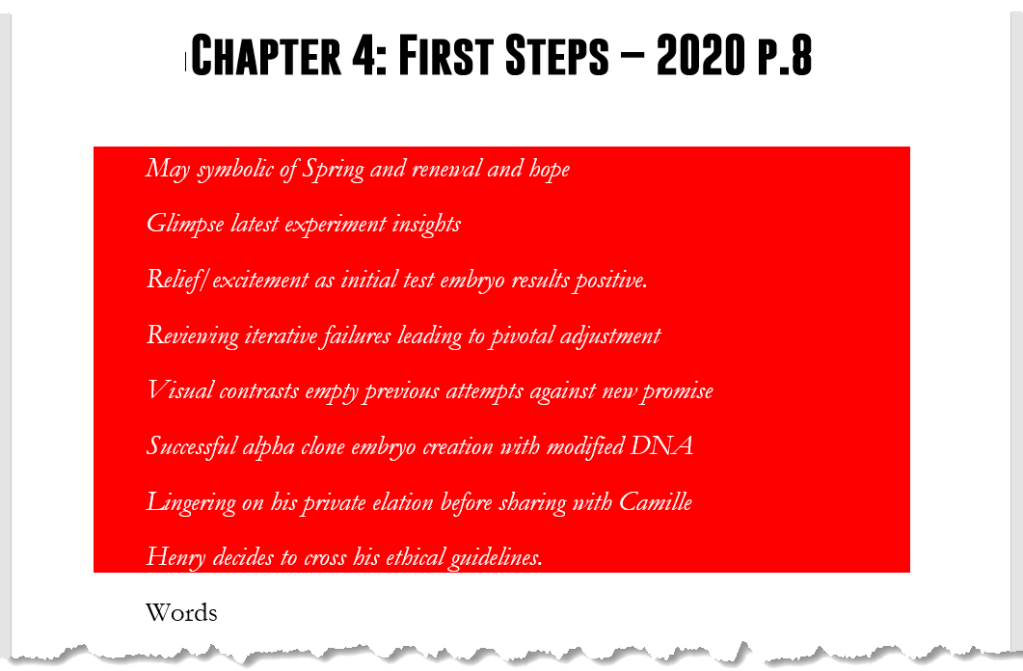
At the start, a chapter looks something like this. It’s a blend between ideas and story beats. Each chapter is outlined similarly. The other advantage this lends me is that I can *ahem* walk away from writing for a while and still have handholds and reminders when I return. For short fiction, I just write. No outlines. Perhaps just an idea to explore.
I’d like to thank the person in India who earned me $0.02 by reading 17 Kindle pages of Hemo Sapiens: Awakening. Reading on Kindle Unlimited is free—time aside. Read the whole book, and I’ve earned $0.50. In time, we’ll be as rich as astronauts.
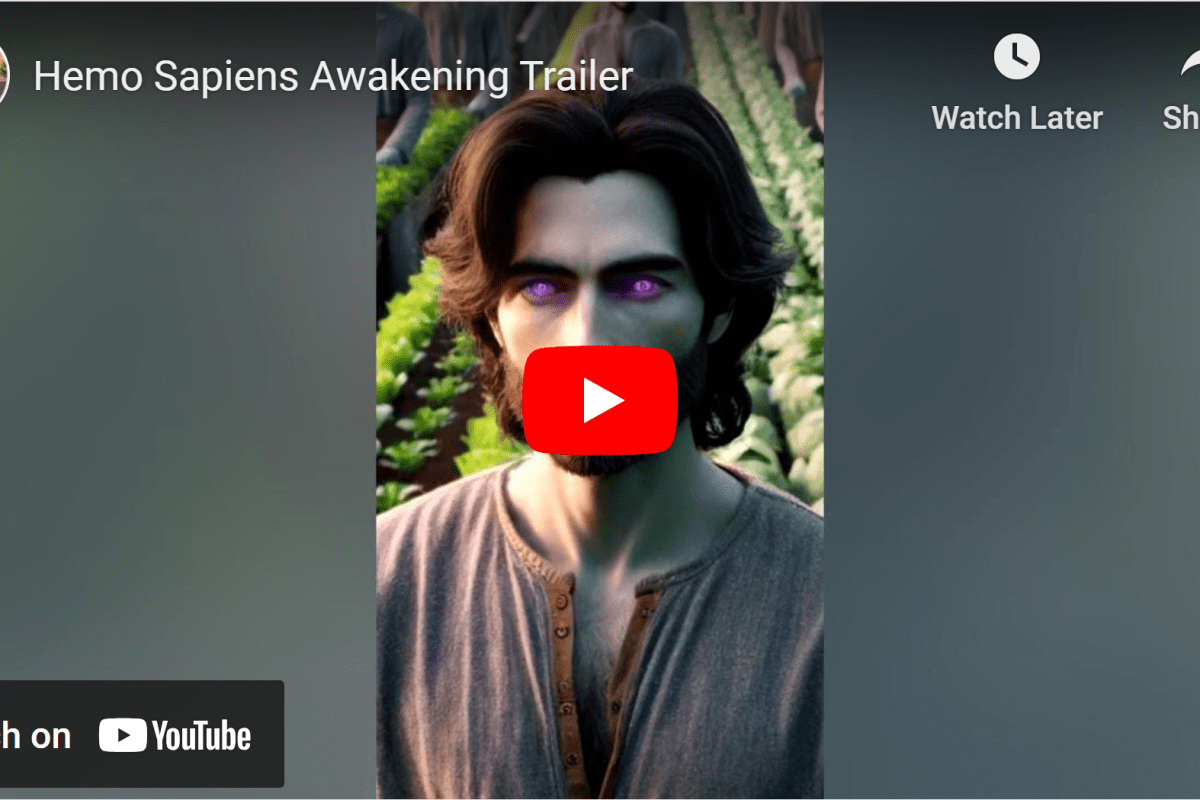
The trailer advert for Hemo Sapiens: Awakening is now available on YouTube as a 60-second short.
I think I’ll stick to writing. The cover-making wasn’t half bad, but video production with Generative AI is not all it’s cracked up to be.
I considered Artlist.io, but I didn’t want to spend the cash. Maybe next time.
Let me know what you think. You can find a copy of the book from a link on my announcement page. If you get a copy, leave a review. It helps to appease the algorithm gods.
Here thee, hear thee. It’s about time. Hemo Sapiens: Awakening is finally published and available for purchase reading.
It’s been quite the journey. It started in August 2023 as a diversion from another project, but it ended up taking precedence.
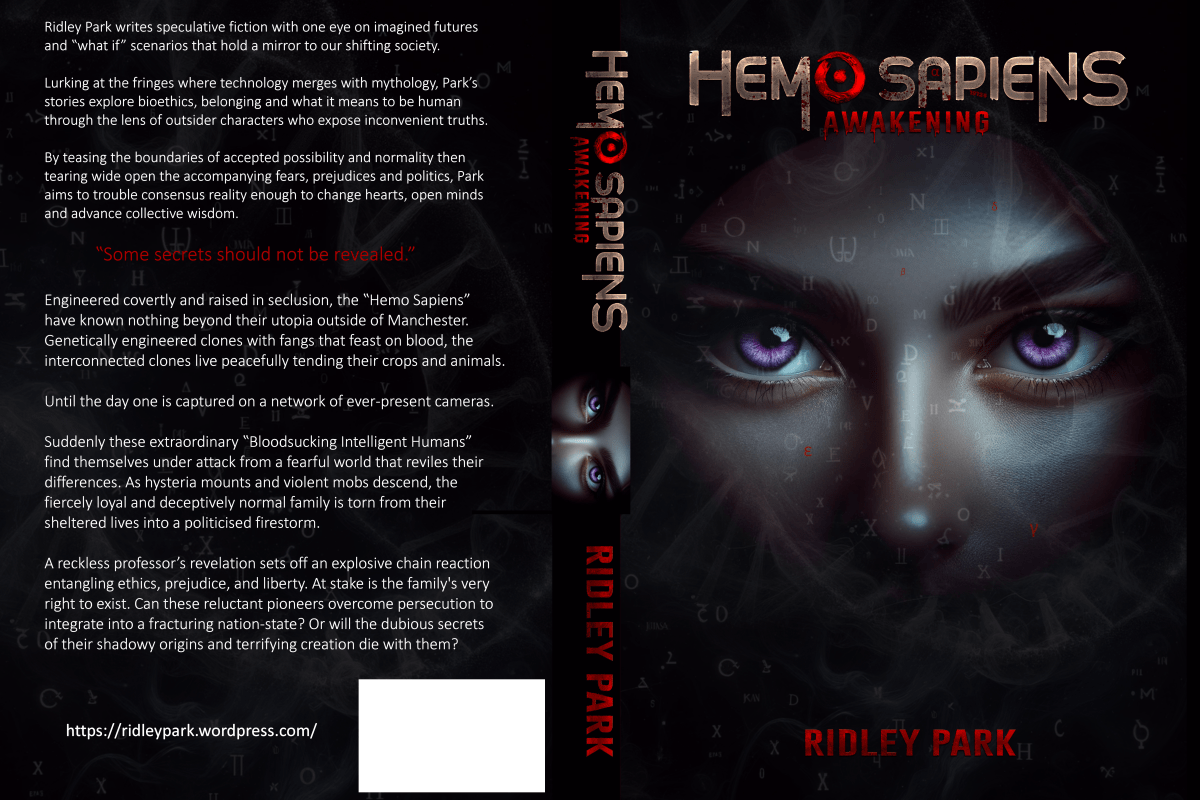
Per the blurb on Amazon, the book is about this:
Genetically engineered and cloned in secret, the “Hemo Sapiens” have lived isolated on a farm in Manchester for decades—until their extraordinary nature is revealed.
Suddenly these “Bloodsucking Intelligent Humans” find themselves persecuted as dangerous outsiders. As hysteria escalates and mobs attack, the fiercely loyal and mostly innocent family fights for acceptance while struggling to find answers about their shadowy origins and uncertain destiny.
A genetics professor’s rash scientific revelation sets off an explosive chain reaction entangling ethics, prejudice and politics. At stake is nothing less than the family’s human rights—and what it truly means to belong.
Can these reluctant pioneers overcome fear to integrate into a society both fascinated and repulsed by their very existence? This thought-provoking saga confronts what diversity, progress and being human entail in an increasingly hostile, high-tech surveillance state that is meant to protect but may also oppress.
Amazon Marketing Blurb
The book currently available in many global regions as hard cover, paperback, or Kindle. I am currently working on the audiobook version, which should be available by March 2004.
For the sake of simplicity, below are links to the various marketplaces: Australia, Brasil, Canada, France, Germany, India, Italy, Japan, Mexico, Netherlands, Poland, Spain, Sweden, United Kingdom, and United States. Not all formats are available in all regions. As of today, this is the availability.
Hard Cover
(ISBN: 979-8872481942, Case Laminate 6″ x 9″, gloss)
My first novel, Hemo Sapiens: Awakening, is locked and loaded. I’ve reviewed the digital proofs, and the physical copy should be arriving in the post in the next few days. I wasn’t willing to pay more to shave off a day.
I am publishing a paperback and case laminate hardcover. I ordered one of each to proof, but the hardcover has a 4 to 5 week delay, so I won’t bother. The paperback is the same interior content. I had to render a larger cover for the hardcover. Not because of the dust jacket—because there is none. They have to wrap some around the edges. The case laminate reminds me of grade school books, like Hardy Boys and Nancy Drew. It feels a bit amateurish, but it doesn’t cost me more to set it up, so I figure why not.
It does cost more for materials and handling—almost double—, so I have to charge more and have lower margins. I’ll leave that for the reader to decide if the durability is worth it. I decided to take even smaller margins in ex-US markets just to have more even prices.
As it stands, the hardcover will be available for USD 20 and the paperback USD 12.99. This affords me room for promotional discounting later. In Europe, hardcover prices will be £15 and €18.
Paperback prices will be £10.21 (I know. Wierd.) and €11.75. There will also be APAC editions ¥1980 and AUD 20.99 (each including VAT). In Canada, it should cost CAD 15.
There’s a park outside London where the trees keep secrets and the air hums with untold stories. Nigel, a chap with calloused hands and a life measured in paycheques, stumbles upon a moment that’ll unravel him. A purse, unguarded on a bench, whispers temptation. He’s no thief, just a man cornered by circumstance.
The park, draped in the solemnity of dusk, watches as Nigel succumbs. He lifts the cash, a weight heavier than coins, and returns the purse to its owner, an elderly lady scattering crumbs for birds, her gaze lost in yesterdays.
It begins as a murmur on the wind. “I know what you’ve done,” whispers a disembodied voice. Nigel whirls around, searches the empty park in vain. He shakes off the words as a trick of his fraying mind.
But the voice persists, insidious as poison, relentless as the tide. Nigel wanders the park’s paths, and the leaves hiss with recrimination while shadows seem to lean in, heavy with judgment.
Reality blurs, the line between guilt and madness thinning. Nigel confides in a mate over a pint, his voice taut with fear and disbelief. “I’m hearing things in the park, a voice saying ‘I seen what you done.’ But I can’t find where it comes from.” His words trip over themselves.
The whispers follow Nigel everywhere, rustles of feathers echoing each accusation. His desperation cresting, Nigel finally flees the park. But even as he runs, the voice pursues, wings beating in the darkness over his head.
In his panicked flight, Nigel fails to see the lorry barreling down the street. It connects with a sickening crunch, leaving his broken body splayed on the pavement.
“I know what you’ve done,” it declares, Nigel’s crime given feathered form. A final cosmic jest, as this guardian of the park delivers justice for his misdeed.
Quoth the parrot, “Nevermore.”
Sometimes you just get in the mood to write a short piece of nonsense. In this case, I liked the theme of a paranoid person haunted by a talking parrot. From there, I wanted to capture elements of Edgar Allen Poe’s Telltale heart and (obviously) The Raven with a bit of Dostoyevsky’s Crime and Punishment.
As usual, creating cover art is an adventure. I asked Dall-E to render an image of the elderly woman on a park bench with a wooded background and a parrot perched in a tree behind.
It decided on this. It was hilarious to me, so I kept it. NB: I did not ask for it to be rendered on a faux book cover. smh
Dall-E’s first take before I asked for the revision described above.
A challenge with beginning a story in media res and then writing a prequel, is that one is able to kick the creative can down the kerb and cross the bridge when you come to it. I’ve painted myself into a few corners, but exowombs, or artificial wombs, are one of them.
Being speculative fiction, I have some leeway, but I need to make some plausible connexions. Exowombs have existed for a few years now, but they are for premature infants and animals, so my literary licence needs to stretch that. To be honest, when I was contemplating things at a fifty-thousand-foot level, I was going from test tube to petri dish to incubator, but I overlooked the gestation bit. Oopsie. My bad.
This is not a work of hard science fiction, so I can take liberties there as well. I just hadn’t researched the current state of science until now. I’ve got a plot device in place, and it seems I’ve got some ideas for early concept and cover art that I can share here.
I rendered these with Dall-E 3. By default, it chose a green hue. I modified it to blue, and I wanted to see how it looked in violet to match their irises—this being an artistic rather than scientific choice. Bubbles in cylinders suspended with wires and tubes.
Violet Gestation Cylinders
Rendering these early can also help me to write descriptive prose with visual references. Dall-E seems to have a thing for spheroids, so I asked it for cylinders instead. I do like this one.
Blue Exowomb
My first correction got me to here. I like the metaphor of the egg membrane encasing the foetus in the tube.
Cylindrical Exowomb
Next, I wanted to envisage multiple cylinders with perspective, so I got these two.
Exowombs in Perspective
The problem I have is that it seems to be too large of a scale, but it’s still cool. We seem to have lost the egg-shaped membrane by now.
Industrial Production of Foetuses in Exowombs
Before settling on violet, I wanted to see what six across looked like. Dall-E’s maths skills are pretty dodgy, so this is what six looks like to it. You’ll notice that the violet render at the top does contain six.
Seven Exowombs in a Row
I don’t have much to say beyond sharing these images. I don’t want to give too much away, but I am excited to be writing Chapter 5 where these are relevant to the narrative in play.
What do you think of the images? Let me know in the comments.
I’ve just received my first Beta feedback from Hemo Sapiens: Awakening. I’ve hired three readers and engaged two, so I’ve got more to go.
As I wrote recently, I’ve been using AI to review my work, and I’ve been waiting for flesh and blood humans to give me their opinions.
My Beta reader is Enrico B from South Africa. My next reader is from the UK. I found them both on Fiverr.com, a site I’ve successfully used for music collaboration in the past. Although your results may vary, it’s a generally inexpensive way to get quality results. I hired Doni from Indonesia to design my title and subtitle.
Judge the quality for yourself. I happen to like it. I was going to commission the rest of the book cover, but I opted to do that myself.
Enrico provided me with a summary report as well as an annotated markup of my manuscript. Beta reading is not developmental editing or copyediting, so I wasn’t expecting line edits, but he did provide commentary on most chapters. In my case, his focus was on pacing and adding narration to fast-paced dialogue exchanges. In most cases, he advised my to slow my roll, but I’ll wait to see what the next reader writes. My style is rather curt and quick, and perhaps Enrico wants to savour a bit more. I feel that his advice is constructive. I just don’t know how much I’ll implement—probably at least a little.
My target goal for writing is about 1,000 words per day. It’s a goal I hit way more often than not. On a good day, I can reach 2,500 or more.
As a reference, I write in Word with pages formatted for a 6 x 9 form factor, so a page holds about 200 words, which equates 1,000 words to about 5 pages. Not too shabby. It puts 60,000 words at around 300 pages or 50,000 words — a small novel—at around 250.
Doing some more maths, at 1,000 words a page, one can ostensibly write a 60,000 word novel in about 2 months. Not bad, right?
You still need more time for editing, revisions, and so on, so 3 months per book of this size gets you 4 books a year. If you are writing tiny novels or novellas, then you might be able to double this. I ‘m not sure how sustainable this is, but maths doesn’t care about sustainability.
Some people think they can game the system and produce a novel a day with AI. The truth is that they can. The other truth is that the output will most likely suck. If you actually read the material critically, a person could not likely publish a book a day. A piss-poor book a week would probably be a challenge. A book a month or so might be within range — even more achievable for shorter fare.
This might be someone’s goal, but it’s not mine. My interest in writing to to write. It’s not about quantity or even commerce. My writing is not my livelihood. It’s an art. I’ve seen so many videos on YouTube given advice how to write and sell more books. Usually, this involved researching the marketplace and determining what’s hot. Is mystery hot this month? Write a mystery book. Need some ideas for books? AI will help.
I guess I just don’t come from that position. I watched a video the other day with a woman switching from offering low-content books on Amazon to some other business model. Her entire modus operandi is to make money online. Myself, I felt sorry for her. I know that two-thirds of people dislike their jobs, so she’s in good company. By that I mean, she might as well just pick some random money-making job because it’s probably as stupid as whatever else she’d be doing. The question is whether it’s worth it.
For me, I’ll stick with writing at least 1,000 words a day with the occasional doubling. Hopefully, I sell some books along the way. Time will tell.
In Hemo Sapiens: Origin, I am mixing French and English dialogues and tags. The challenge I am having is switch between the languages.
For example, see this passage:
« Où est maman ? » Camille asks Claire just as her parents come into view. « Maman » she exclaims, starting to weep again. « Papa. » She receives his hug.
French and English dialogue and speech markers work differently. I I were depicting large swathes of each language, I’d simply apply the specific language rules, but I am mixing it up, and that creates challenges. I haven’t seen any good examples how to present this.
Some obvious differences are the guillemets « » in French versus ‘ ‘ in English. In French, ? and ! are spaced after the sentence, and all content internal to guillemets is offset by leading and terminal spaces. Another big difference is that guillemets offset dialogue blocks whereas English uses speech marks to identify each speaker’s dialogue.
Referencing the example above—in English for English readers—, if I were to convey the content using French presentation rules, it might look something like this:
« Where’s mum ? Camille asks Claire just as her parents come into view.
— Mum, she exclaims, starting to weep again.
— Dad. She receives his hug. »
Notice that the entire block is enquoted. I’ve considered this, but I feel it will not track well for English readers, who are used to the speaker-reference convention.
Also, I really want to set off the French language content, and the guillemets serve that function.
Regarding dialogue, French and English punctuation rules are similar enough, but there aren’t many cases of a comma (virgule) following a speech mark given the convention. To my eyes, it looks better inside the marks, but it feels off. The Oxford English style guide suggests not even using commas to separate the dialogue from the tag, but I don’t see that much in the wild.
Again, referencing the example above, one can see how I am solving this at the moment.
At first, I indicate the French dialogue by guillemets and employ French punctuation rules followed by a dialogue tag and descriptive content.
« Où est maman ? » Camille asks Claire just as her parents come into view.
Next, I use the English format, but I replace quotation marks with guillemets. I’ve omitted the trailing comma—after ‘Maman’—in this example.
« Maman » she exclaims, starting to weep again.
Finally, since ‘Papa’ expresses a complete thought, I enclose the full stop within the guillemets. Rather than a dialogue tag, I opt for a stand-alone sentence.
« Papa. » She receives his hug.
When I write mixed language copy, I usually identify a foreign language in italics, but I didn’t choose to do this for French dialogue. Firstly, because I am already using italics for other foreign words, e.g. Latin; secondly, because these also depict internal dialogue/monologue, so I don’t want to create too many visual design patterns.
Has anyone else solved this problem? I’d love to know.
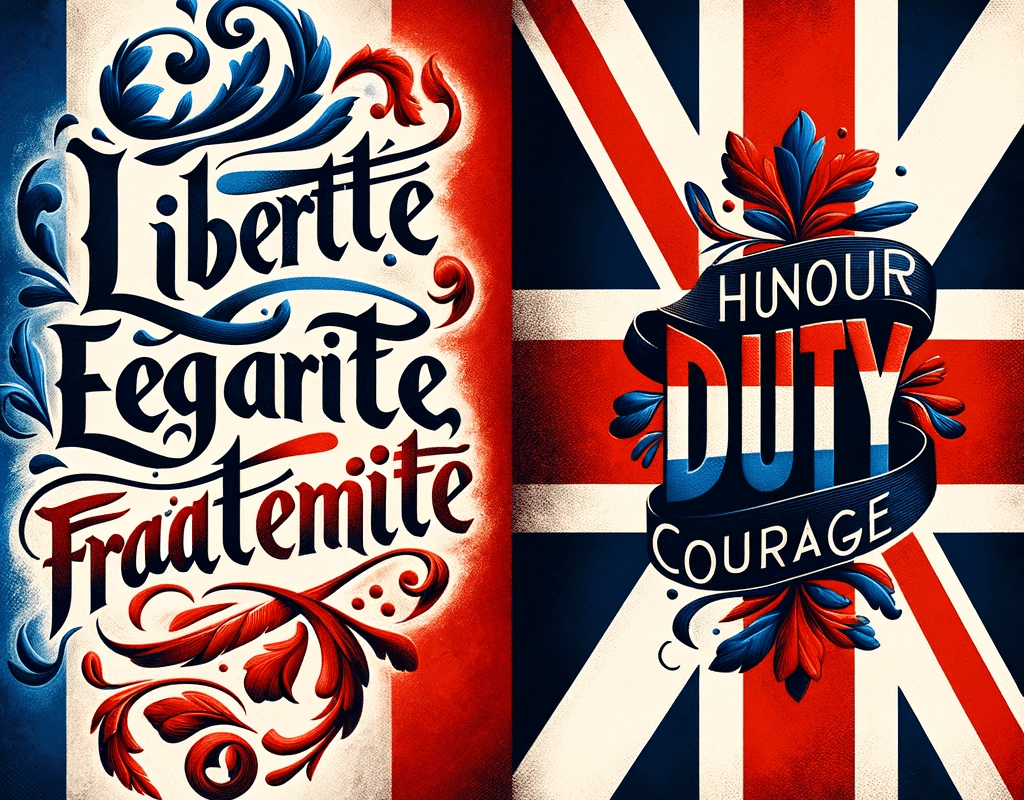
As for the cover image, Dall-E 3 still can’t quite figure out words and can’t spell in French or English. I share it if only for the absurdity of it. Here was my other choice:









 Ridley Park