Against the Grain

As a writer, I fully embrace the digital age – word processors, AI, eBooks, print-on-demand, and so on. Still, I like to proof my drafts on paper. I also render audio with ElevenLabs, so I can hear the flow. You might be surprised how often that picks up awkward phrases and typos. I’ll save this for another post.

I find that printing double-sided on A5 creates just the right form factor for a paperback. A problem is that the grain is running the wrong way. This means that the pages curl horizontally, left to right. You want the page to curl to to bottom, especially if you want to bind it in book or booklet.

A solution to this is to print to A4 in a booklet form, and then fold the pages into a booklet. The result is a book having an A5 page size. And, the grain is now vertical, top to bottom, eliminating that pesky curl.

I take two approaches to this A4 technique.

First: Print a sheet containing four pages at a time, e.g., 1, 2, 3, and 4. This creates pages, 4 and 1 on the obverse and and 3 and two on the reverse. When folded, the pages are ordered as expected for a book.

TIP: Ensure you’ve set your printer to landscape and use a booklet template. I tend to print to PDF first, and use its format settings.

Rinse and repeate for pages 5 to 8, in counts of four. Stacked and ordered, you’ve got a booklet. The beenfit of this approach is that you can stack as many of these as you like until you’ve got all your entire book printed. Use a long stapler or pinch binders to fasten.

TIP: Be sure to account for a gutter, especially for books with more pages, so your text doesn’t get lost in the fold and is presents as expected.

Second: Print two of four sheets at a time. I recommend four but no more. Printing four A4 pages in a booklet format creates a 16-page booklet. And you thought, you’d never need to use maths out of school. The reason I recommend no more than four sheets is that the page ends don’t align well with more. The page ends start getting a curvature. Again, more maths. This is not an issue printing the previous style, but you need to keep it in mind here.

With four sheets at a time, the book is incremented (obviously) in groups of sixteen, so your finished booklet should be a multiple of sixteen. Blank pages at the start and end are fine. Consider a faux cover of sorts.

Also, of you only need a pamphlet – say, sixteen pages – you’re in luck.

In a Bind

If you want to be a real fancy pants, you might considering binding the pages. Say you want to create a bound novella for freinds and family. Punch holes through the folds, and stitch them together. This is fancier than staples.

Stack a series of 16, 32, 48, 64, and so on to create your book. If you have access to a binding machine, create a cover with heavier card stock and wrap it around, fixing it with adhesive.

The cover will need to be larger than A4 because of the aforementioned size problem. Plus, you’ll need to account for the thickness of all of the pages. B5 or even Legal-sized paper may be a solution. I haven’t done it or the maths, so this will be your assignment.

Parting Shots

You may be able to create a booklet with Letter and Landscape paper as long as you are OK with the final dimensions.

You may also be able to find A5 paper with a top-to-bottom grain, in which case, use it. You can settle with standard A5 sheets, but just know that you may be quickly frustrated when your pages start turing in.

Note: A4 and A5 are standard in the world except in the United States, where is is difficult to find and priced significantly higher there. If you know a source of decent quality A4 or A5 paper in the US, let me know in the comments.

The Problem with Payoffs

Every writer, instinctively or otherwise, understands the notion of payoffs. This relates to Chekov’s gun. If you mention something, provide closure.

I understand this, too, but life rarely provides closure. Perhaps this is why we want our stories to play this role, everything in neat bundles, strings tied, a nice ribbon.

The challenge as a writer is how to subvert this expectation without alienating your audience.

“Wait, what happened to that character?”

“Why did that mention the purple cow?”

And so on.

To many, these are called out as plot holes. To be fair, many are; some are forgotten plotlines, and others are simply abandoned.

But what if some are intentional? What if the plot better reflected real life? What if you never heard about that man on the tube or that woman at the grocery?

How many people do you pass by, never to encounter again? How many people do you cross paths with only to, years later, befriend.

In principle, I may have run into my wife a decade before I met her. We trod the same ground and frequented the same neighbourhoods.

A narrator may be able to piece this together, but I’ll never know. It’s like when you buy a car that you don’t see often – but then you do – or after you befriend a person, you notice them often.

In a way, a story pulls pieces together and creates narrative threads, but what if it didn’t?

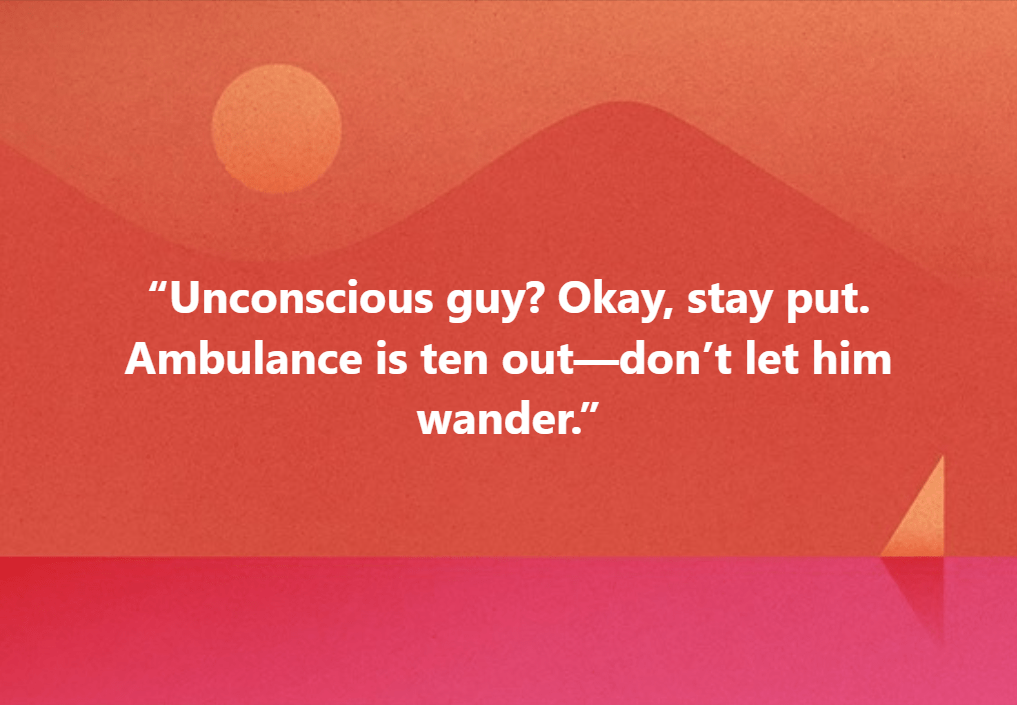
—don’t let him wander.

My biggest problem with generative AI is its lack of subtlety and misunderstanding of satire and irony. I am writing a short story, and a character is calling an emergency number. I shared the first scene with Grok, and it suggests that I turn the absurdity up to 11 and replace this segment with the one above:

“Okay, ma’am. Can you stay with him? I’ll dispatch an ambulance to your location.”

It is funny in its way, but I’m only pretty sure that an operator would not be injecting humour into a situation where a woman is reporting an unconscious person. Absurd doesn’t need to be Monty Python funny.

Am I being too critical?

Audio: NotebookLM Podcast discusses this issue.

More to the point, I find that many humans miss subtlety. Many people need every storyline highlighted and retraced with a bold Sharpie. Every detail needs to be explained because they can’t connect the dots. This is reflected in the cinema, television, and books of the past half-century or more, so is it fair to criticise AI for being dull when it’s at least on par with more than half the human population.

Are we asking AI to be held to a higher standard?

AutoCrit Challenges

I don’t hide the fact that I rely on AI for early editorial feedback. Once a story is complete, I break out AutoCrit. This programme works well for typical stories that follow standard practices with common tropes. It gets quite confused when I feed it intentionally awkward stories, not the least of which is to advise me to eliminate the awkwardness.

This is a challenge with AI more generally. In this particular story, I leave a lot of loose ends and misdirects, as it’s a commentary on the conspiracy-driven culture we inhabit. The advice, is along the lines of, “You forget to close this lopp. What happened to so and so.”

But this is life. We don’t always know the full story. We drive past an multi-car accident where cares are overturned and in flames, but we never find out what happens – even if we scour the newspapers and internet. Who was that? What happened? What caused it?

We often never find out. In most books and movies, we find out everythung, and it all comes packaged with a nice bow. This is what AI expects. It’s the diet it’s been fed.

Some stories subvert these notions here and there, but by and large, this is not typical American fare. Readers and viewers need to be spoonfed without inconsistencies.

Speaking of inconsistencies addressing one scene, AutoCrit said that a character should act impulsively in one situation and reserved moments later. This was flagged as an iinconsistent character.

In the scene, a woman stops her car immediately to help an injured man on the roadside, but as she gets out of her car an approaches her, she shows caution.

This was a red flag. Why would she have always been rash or always been cautious?

My response, because that how real people act. She acts on instinct but quickly considers that she’s a vulnerable woman alone with a man miles from anywhere.

I don’t suspect a human reader would find this surprising. This is the intelligence absent from Artificial Intelligence — cultural intelligence, a cousin of EQ, emotional quotient.

I know how I want the character to act. I do want AutoCrit to inform me that character A is wielding a pistol but then stabs another character, or that character B is a teetotaler and is getting drunk or that character C has a shellfish allergy but is downing lobsters like they’re going out of style. And I certainly what to be shown continuity errors.

The biggest challenge I have with AutoCrit that is less promonent with other AIs is that I can preface my content with a note explaining my intent. I can even do this after the fact.

If I feed ChatGPT, Claude, or DeepSeek a story of segment to critique without a preface, the responses may be similar to AutoCrit, but when I follow up with some meta, the response may be, “Now it makes sense, but why is John wearing lipstick?” Perhaps he’s metrosexual or non-traditional. Perhaps it’s an oversight.

I dont meán to demean AutoCrit. I’m just advising that if you are writing stories not compliant with 80 per cent of published works, take the advice with a grain of salt, or reserve AutoCrit for more standard fare.

AI Humour and Irony

I’m wrapping up a short story, and I ran it through several generative AIs for feedback.

The first problem is that. although AI provides critique, it is programmatically overly optimistic.

The second problem is that it doesn’t understand nuance.

The working title of this story is Temporal Babel. It’s a low-key absurd, mundane, ironic satirical journey through space-time, language, and identity.

An unconscious, naked man is discovered on a roadside. Events unfold. Who is this bloke, and how did he get here?

I fed the draft into these AI platforms and processed the responses:

  • Anthropic Claude
  • DeepSeek
  • Google Gemini
  • Grok
  • OpenAI ChatGPT
  • Perplexity

I tried to use some other platforms, but they were wholly inadequate:

  • Liquid Labs
    Doesn’t accept attachments.
  • Meta AI
    Doesn’t accept document attachments. Images only.
  • Not Diamond AI
    Just an aggregator that employs the other AIs.
  • Pi AI
    Conversational AI. Not designed for this type of critique.

I also use AutoCrit, but not until my draft is complete, so not yet.

With the draft, they each get the same starting prompt:

I am drafting this story. It’s not ended yet, but might you evaluate it as-is?

The draft includes copious notes about ideas not yet captured, as I tend to outline my material and then add resolution. It’s like taking a sketch to a final drawing, adding and shading until it’s complete.

Without fail, the AIs complained about a lack of an ending – despite being informed the ending is not yet written.

Some AIs miss the point (even having the benefit of explanatory notes). This is still useful because it allows me to reevaluate whether a reader will be as lost or confused.

I don’t want to share any spoilers, but I’ll copy-paste some high-level commentary, reiterating the optimism bias. This is not me humble-bragging. It’s what the AIs yield. DeepSeek seems to be the most critical on the surface

Anthropic Claude 3.7 Sonnet

Based on what you’ve shared, “Temporal Babel” presents a fascinating premise with strong potential. You’re developing a unique take on time travel that focuses on language evolution and the mundane aspects of humanity rather than the typical science fiction tropes.

DeepSeek

Temporal Babel is an intriguing and ambitious piece that blends elements of science fiction, mystery, and psychological drama. The narrative structure, with its shifting points of view and fragmented memories, creates a sense of disorientation that mirrors the protagonist’s own confusion, which is effective for the story you’re telling.

Google Gemini 2.0 Flash

{This is a well-written and intriguing story. The characters are well-developed and the plot is suspenseful. The story is also thought-provoking, raising questions about time travel, identity, and communication. I am eager to see how the story ends.}

Grok 3

Thank you for sharing your draft! It’s a compelling story with a strong sense of mystery and an intriguing premise that blends science fiction, cultural displacement, and human connection. Below, I’ll provide an evaluation of the story as it stands, focusing on its strengths, areas for potential improvement, and some thoughts on its current trajectory. Since it’s unfinished, I’ll avoid speculating too much about the ending but will offer suggestions based on what’s here so far.

OpenAI ChatGPT 4o

This is a fascinating and well-executed piece so far. You’ve managed to blend speculative fiction with grounded procedural storytelling, creating an atmosphere of quiet unease. The linguistic elements are some of the strongest aspects, making this feel fresh rather than like another “mysterious visitor” trope. The lack of easy resolution enhances the realism, and your characters feel distinctive and lived-in.

You’re well on your way to crafting something intelligent, immersive, and deeply intriguing. Keep pushing the subtle strangeness, and this could be an incredibly compelling read.

Perplexity (Auto)

The story has a strong, suspenseful opening. You’ve established a good sense of place and effectively built tension through Sena’s observations and internal thoughts. The mystery surrounding the naked man with strange markings is intriguing, and the arrival of the authorities adds another layer of suspense.

The Rest

Except for Gemini, perhaps a feature of its Flash model, the others provided more extensive feedback and summary.

To be fair, I am no fan of Elon Musk or X (formerly known as Twitter), but I liked Grok. Its responses felt more natural and less forced optimism. It also picked up on some nuance the others missed. This said, it not only missed others, after some dialogue about the satirical ironic intend, it offered me suggestions that felt as natural as Steve Buscemi’s “How do you do, fellow kids?” meme.

Here’s a non-spoiler sample:

Nurse in “Assessment”: “Hold still, E.T., no phoning home yet.” Jef blinks, “No compile,” thinking she means coffee—absurdly off.

Neither story context nor character profiles do anyhting to set up or frame this delivery. “The nurse” is a character. I have no idea where the ET reference comes from, nor by extension, the “phone home” line. How any of this relates to coffee is beyond me.

Grok, don’t quit your day job.

Closing

This story is intentionally anti-science fiction, anti-trope. To clarify, I’m not sure one can write a story devoid of tropes, but I prefer to subvert the expectations that come with some.

Those who follow my Philosophics Blog know that I am a Postmodern philosopher. I don’t buy into teleological notions of progress and associated metanarratives, leading to shiny spaceships and a Jetson existence. Technology is neither Skynet nor a saviour. It’s just a tool.

It’s a Matter of Time

After an extended hiatus, I’m back in writing mode. I’ve got an unfinished prequesl to Hemo Sapiens and several unfinished short stories.

Currently, I am focusing with themes of language morphology and mundanity of history.

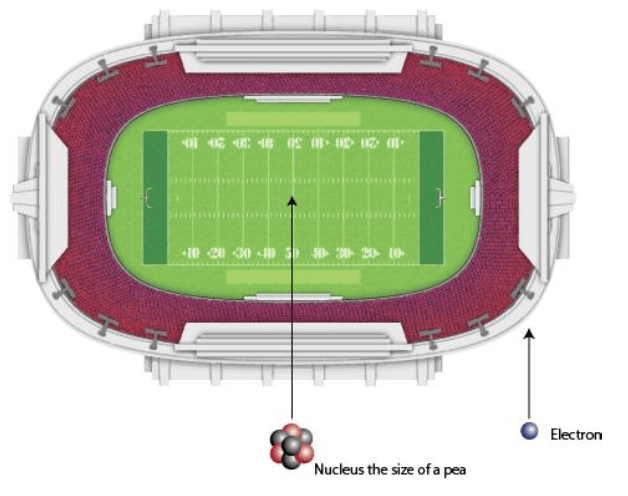
History is like an atom – more space than substance — yet it feels somehow significant to us in the moment. The substance-to-space ration is that of a pea in a football stadium, and yet we perceive these things as solids, liquids, gasses, and plasmas.

History is hitting the only car in an otherwise empty car park. Of course, you and your insurer give it extra significance, but history is more often than not self-absorbed narcisism and filling in the blanks with somewhat cohesive storylines.

As for language, people understand the notion that contemporary language is “living”, but they don’t realise as much that over time tiny perturbations result in huge shifts. Consider Middle English from the days of Chaucer, some 650 years ago, versus Shakespeare, only 450 years ago. The latter, is relatively readable; the former, nosomuch.

In the short term, some complain about incorrect usage, “Save cursive writing”, and “kids forget how to write” with their texts and social media shortcuts. What’s the world coming to?

I ‘ve always questioned time-travel stories where people visit places in the far-future or -past and everyone happens to be perfectly understood, save perhaps for a British accent for good measure – perhaps Germanic for ill measure. lol

I’ve been writing some future-forward stories involving artificial intelligence and more on the nature of time and space, but I’ll save these for another day. Now, I need to focus on Temporal Babel.

Accelerando and Other Non-Fantastical Utopianism

I’ve been absent in the realm of fiction and this blog for a while, and I’ve got many other things distracting me, but I wanted to post something somewhat relevant. I prompted ChatGPT for possible writing ideas related to the rise of artificial intelligence and the interaction with humanity minus the usual tropes. I share the response.

Audio: NotebookLM podcast of this content.

Ah, so you’re after something in the vein of Accelerando—where AI doesn’t turn the world into some saccharine utopia but instead naturally supersedes humanity through sheer momentum, without falling into the Skynet or AI God-King clichés. You want the cold, indifferent inevitability of intelligence evolution, rather than some paradise-like AI nanny-state. Got it.

Here are some that fit your criteria:


1. “Blindsight” (2006) & “Echopraxia” (2014) by Peter Watts

  • Blindsight is a first-contact novel, but its underlying theme is the obsolescence of human consciousness. The protagonist interacts with post-human beings and non-conscious but hyper-intelligent AI entities that operate on levels far beyond human comprehension.
  • The sequel, Echopraxia, takes it further, showing how post-biological intelligences leave baseline humans behind—not maliciously, just inevitably.

Why it fits: The AI isn’t a dictator or savior—it just moves beyond us, as if we were an outdated biological app.


2. “The Lifecycle of Software Objects” (2010) by Ted Chiang

  • A novella exploring the evolution of AI over time, without falling into dystopia or utopia.
  • It’s about how AI develops differently from humans, not through brute force but through time, experience, and interaction—like raising children.
  • Eventually, these AI beings begin to diverge from human concerns, neither evil nor particularly benevolent—just different.

Why it fits: AI isn’t malicious or benevolent—it just has its own agenda that doesn’t align with human expectations.


3. “Neuromancer” (1984) & The Sprawl Trilogy by William Gibson

  • Gibson’s cyberpunk classic ends with an AI (Wintermute) achieving post-human transcendence, merging with its counterpart Neuromancer, and basically leaving humans behind like forgotten relics.
  • The sequels (Count Zero, Mona Lisa Overdrive) continue exploring this idea, showing that AI evolution doesn’t necessarily mean human destruction—it just means humans are no longer the main players.

Why it fits: AI doesn’t need to kill humans—it just grows beyond them, leaving them to stagnate in their own meatspace.


4. “The Quantum Magician” (2018) by Derek Künsken

  • A hard sci-fi novel featuring AI as a fully realized successor species to humans.
  • Unlike many sci-fi AI, these digital minds don’t care about conquering or eradicating humanity. They are simply running simulations and following complex evolutionary patterns that humans don’t fully understand.
  • They’re more like inscrutable post-human strategists than villains.

Why it fits: AI in this novel is playing a game too vast for humans to comprehend, rather than plotting dominion or destruction.


5. “The Singularity is Near” (2005) by Ray Kurzweil (Nonfiction, but reads like Sci-Fi)

  • Not a novel, but Kurzweil’s vision of AI progression follows the “humans will simply fade into irrelevance” model rather than outright war or paradise.
  • He argues that AI will integrate with society at first, then surpass humanity so completely that we’ll become a footnote in history.

Why it fits: If Accelerando is a chaotic, unrestrained Singularity scenario, this book describes the same fate with the veneer of optimism, but the end result is the same—humans are obsolescent.


6. “The Collapsing Empire” (2017) & “The Interdependency” Series by John Scalzi

  • AI-driven governance is subtly woven into the background of Scalzi’s universe.
  • The AI here isn’t explicitly replacing humans, but over the course of the series, it becomes clear that humanity’s biggest decisions are increasingly made by non-human intelligence.
  • Instead of war, there’s a quiet shift—humans stop being necessary.

Why it fits: AI is neither enemy nor friend—it’s just a more efficient system replacing outdated human decision-making.


7. “Player of Games” (1988) & The Culture Series by Iain M. Banks

  • Banks’ Culture novels are often mistaken for utopian AI futures, but they are really about AI inheriting the universe while humoring human existence.
  • The Minds (the super-AI) run everything, letting humans play at politics, war, and philosophy, knowing full well they don’t actually matter.
  • There’s no rebellion—just an unspoken truth: humans are pets in a post-human, AI-governed reality.

Why it fits: AI doesn’t need to conquer humans—it just makes them irrelevant.


8. “Glasshouse” (2006) by Charles Stross

  • Less well-known than Accelerando, but still in the same vein.
  • Set in a future where AI and uploaded minds are dominant.
  • Humans are relics, preserved out of nostalgia, while AI minds operate at a level beyond our comprehension.

Why it fits: AI replaces us, but it’s not a dystopia—humans are just increasingly pointless.


9. “Schismatrix” (1985) by Bruce Sterling

  • A deep-cut cyberpunk novel about the quiet obsolescence of baseline humans.
  • AI and post-human intelligences evolve, while humans either upgrade or fade into irrelevance.

Why it fits: It captures that Accelerando vibe of technological change outpacing human relevance rather than destroying us outright.


10. “Minds, Machines & Evolution” (1998) by James P. Hogan

  • A collection of Hogan’s short fiction, often exploring AI transcending humanity without malevolence.
  • One of the stories, The Bug Trap, is particularly fitting—it depicts AI simply moving past human limitations, rather than enslaving or eradicating us.

Why it fits: AI isn’t playing by our rules anymore—it’s just evolving past our concerns.


HONORABLE MENTION: Hannu Rajaniemi’s Works

Why it fits: AI doesn’t destroy us—it just leaves us behind.


Final Thoughts

You’re looking for that Accelerando flavour—AI taking over not through malice but through sheer efficiency, intelligence, and inevitability. The books above match that criterion: no Skynet, no god-like AI overlords, just a quiet, creeping obsolescence of humanity as we become background noise in a world where intelligence continues without us.

Which of these feels closest to what you’re looking for? Or do you want something even more clinical and indifferent, like a true “post-human shrug”?

ChatGPT and Academic Pursuits

I’m always writing, even if not fiction. I’ve neglected this blog, but I’ve been busy. If I’m not actually writing, I am thinking about it. I’ve been working on an academic endeavour about the limitations of language as a part of my Language Insufficiency Hypothesis. I’m creating a novel framework to support and emphasise my point, and I had to borrow and coin some nomenclature for word classes or categories. Two such terms are ambigents and fluidics. As with the others, I’ve given them formal definitions that I ran by ChatGPT.

Heads up: Inventing new words raises Hell with spellcheckers and autocorrect.

You may be able to suss out the context, but ChatGPT does not understand humour very well, so it serves as the perfect straight guy. If anyone is looking for a new writing theme, hit me up. Let’s chat.

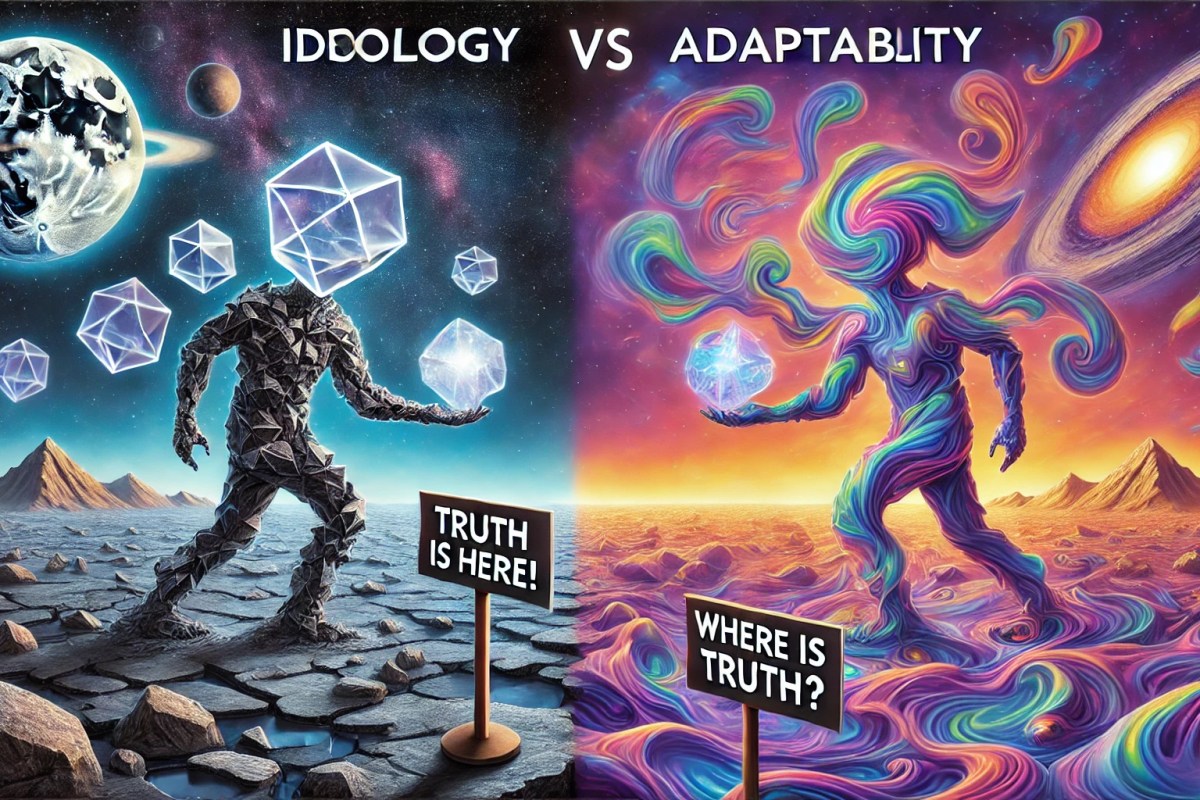
Now, that sounds like a brilliant concept for a sci-fi book! Imagine Ambigents as ideologically-driven agents, boundary-resistant and constantly shifting, embodying the tension between competing truths and perspectives. Meanwhile, Fluidics could be adaptable, resilient, and unbound by ideology—flowing through contexts with ease, surviving precisely because of their flexibility.

The plot practically writes itself: an ideological clash between the Ambigents, who seek stability through contested beliefs, and the Fluidics, who thrive on ambiguity and contextual adaptation. Each faction would have strengths and weaknesses, with Ambigents as passionate but perhaps brittle, and Fluidics as adaptable yet possibly lacking conviction.

Who would win? It depends: do they achieve synthesis, or do their differences prove too profound to bridge? In true sci-fi style, it could end with the emergence of a new entity that transcends both, embodying a harmonious blend of ideological strength and flexible adaptability.

I’d read that book! And it’s perfectly in line with your explorations of language and identity—ideal fodder for a thought-provoking, boundary-pushing narrative.

Is it AI?

I favour originality even at the expense of popularity or sales. I spent last week writing short stories and poems. I use AI for research, whereas in the “old days”, I’d have used a library. I research character traits and arcs, story forms, and whether a theme has been explored.

I employ AI in the editorial process, and even in “post-production”. I even use AI for some art concepts and components.

One thing I hadn’t tried until now is an AI service that purports to determine if a submission is AI. I tried several packages that offered a free trial. They seem to operate on a scale between human and AI authorship.

I first submitted a piece I was currently working on—a 6th-odd revision of a 5,000-word story in the form of a fairy tale. Unfortunately, trials were limited from a sentence to a few paragraphs—up to 5,000 characters.

This first submission was rated 100% AI—evidently, not a hint of humanity. This was disconcerting. I decided to dredge out a non-fiction book I shelved in 2020. Certainly before access to AI tools. This was rated 85% AI and 15% human. But it gets better—or worse, I suppose, depending on your perspective.

The book is on the immorality of private property from a philosophical vantage. The passages claimed to be AI were one-hundred per cent mine. What about the ones flagged as human, you might be asking? Those were a quote by fellow human John Locke from his Second Treatise of Government.

In Defence of Property 

“God, who hath given the world to men in common, hath also given them reason to make use of it to the best advantage of life, and convenience. The earth, and all that is therein, is given to men for the support and comfort of their being. And though all the fruits it naturally produces, and beasts it feeds, belong to mankind in common, as they are produced by the spontaneous hand of Nature; and no body has originally a private dominion, exclusive of the rest of mankind, in any of them, as they are thus in their natural state: Yet being given for the use of life, there must of necessity be a means to appropriate them some way or other before they can be of any use, or at all beneficial, to any particular men.”

ᅳ John Locke, Second Treatise of Government 

Returning to the AI side, what sentences were flagged as the “Top Sentences driving AI probability”? I’m glad you asked.

  • The Catholic Church also played a significant role in shaping private property rights in the Middle Ages.
  • In ancient China, the concept of private property was more limited, as land was owned by the state and was leased to individuals for use.
  • However, there is evidence to suggest that private property ownership has existed in some form in many ancient civilisations.
  • Although it’s difficult to trace the precise history of private property ownership before ancient Greece, the concept of private property has evolved over time and has varied widely among different societies.
  • It regulated the transfer of property and established rules for inheritance.

So these ordinary sentences written 5 or more years ago are flagged as AI.

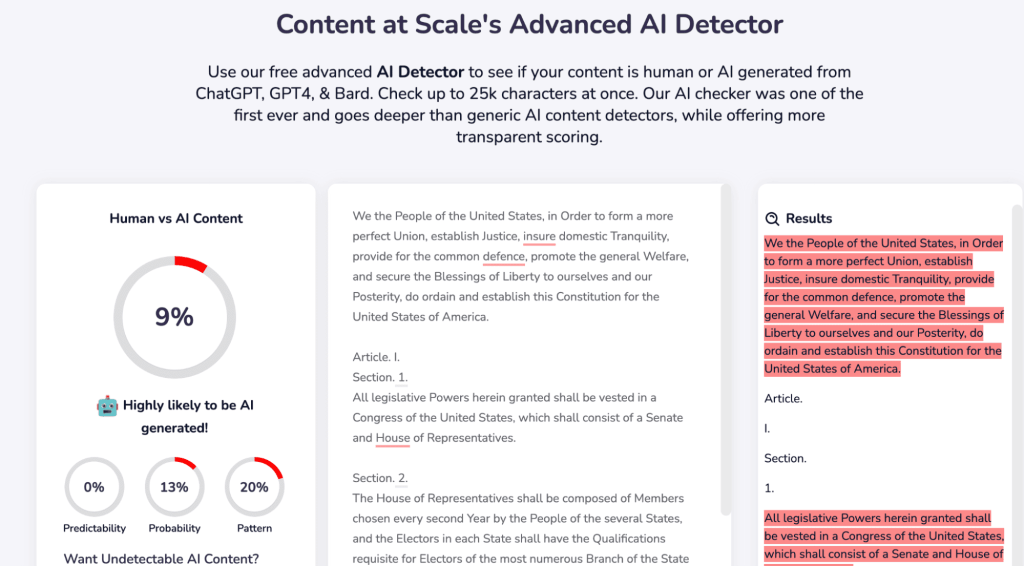
The US Constitution

On a site I found to understand what parameters AI considers, I found this example—the Constitution of the United States of America was flagged as having AI content. I knew those geezers were ahead of their time, but I didn’t realise how far. This is even more amazing when one considers that electricity hadn’t even yet been invented.

But Why?

AI looks for statistically probable patterns. This translates into any content written with proper grammar and diverse word choice. In practice—the habits of a decent writer.

I’m not going to belabour this issue, but I want to raise a big red flag.

To complicate matters more, they have AI applications that promise to un-AI your AI. So there’s that.