Characters Are Overrated: A Treatise Against the Tyranny of Arcs

You’ll hear it a thousand times in creative writing circles, often whispered with the reverence of sacred doctrine: character is king. Give your protagonist an arc, they say. Make them grow. Show them change. Rinse. Resolve. Repeat.

Audio: NotebookLM podcast on this topic.

Forgive me, but I’m not here for that workshop claptrap.


My writing isn’t character-driven in the conventional sense. I don’t sculpt protagonists to take heroic journeys or undergo epiphanic transformations. I’m not interested in plumbing the depths of their souls or bandaging their inner wounds with moral insight. My primary concern is the world—the philosophical or sociological structure—through which characters drift, orbit, or plummet. Sometimes they leave a mark. Often, they don’t.

Because real life isn’t narrative. It doesn’t arc. It drifts. And most of us don’t develop. We adapt. We cope. We muddle through.


Resolution, in most stories, is a parlour trick—narrative taxidermy dressed as transcendence. In reality, most encounters don’t resolve. They expire. People come and go. You cross paths with strangers who change your life—or don’t—and then vanish back into the abyss of statistical anonymity.

One of my recent manuscripts begins with a woman named Sena discovering a body by the roadside. She reports it, the authorities arrive, and the narrative follows them—until it doesn’t. It dissipates. No tidy resolution, no tight bow. Just the unfurling tedium of systemic procedure and human irrelevance. It’s not a mystery story. It’s a story with mystery in it. Big difference.

We like to pretend we’re central to our own story, each of us a protagonist in a universe scripted for personal development. But sometimes, we’re not even side characters. Sometimes, we’re scenery. Camus’ Meursault had it right: the sun matters more than your feelings, and death shows up whether you’ve had your arc or not.


Yes, some readers crave grandiosity—heroes, villains, the Great Man Theory dressed in narrative drag. Napoleon didn’t just wage war; he “struggled with destiny.” Stalin wasn’t just a paranoid bureaucrat; he was “a force of history.” These are characters written by history with the same myth-making brush that writes fiction. Convenient, cathartic, utterly inaccurate.

But I don’t write demigods. I write witnesses, floaters, participants without insight. They’re often not even granted the courtesy of closure. They move through a world that refuses to acknowledge their significance. And why should it? The cosmos doesn’t care if your backstory is tragic or if your girlfriend left you on page forty-two.

Sometimes the character who seems central is merely catalytic. Other times, they’re inert—filler between philosophies. If someone changes, maybe it’s society, not them. Maybe the reader. Or maybe no one.

So no, I don’t build arcs. I don’t force characters to evolve like Pokémon just because Act III demands it. I drop them into a world and watch what happens—often, nothing. Because that, more than any tidy redemption tale, is how life actually works.


That’s the work. Not myth-making. Not therapy. Observation. Dissection. Not a ladder to transcendence but a mirror, tilted just so.

Welcome to Ridley Park. Watch your footing. There are no arcs—only echoes.

Behind the Binding: Sustenance in Print, Pixels, and Purgatory

Not quite a launch. Not quite a rant. Just one author trying to get a novella into the world without sacrificing too many hours or brain cells.

Paperback Problems

I’ve been writing quite a bit lately—several novellas/novelettes, to be precise.

They all began life as short stories, but brevity doesn’t come naturally. Apparently, I can’t shut up even on the page. I toyed with the idea of releasing a thematic collection, and I still might. But for now, Sustenance is getting its own debut—likely this month.

The book clocks in at around 14,000 words, printed across 144 pages. I’ve read that readers prefer novels to novellas, but I’ve also read that readers don’t really read anymore. Time’s short. Attention spans are shorter. Maybe shorter fiction has a fighting chance. We’ll see.

I formatted it in 6×9 inches, which may have been overly generous. It’s leaner than your average indie fantasy tome but still thicker than my last Žižek collection. So there’s that.

The manuscript began in Word, like every poor decision. I laid it out in InDesign and exported the PDF through Acrobat. No budget, so I designed the cover too—started in Illustrator for the vector charm, but ended up in Photoshop, where I’m more at home. I designed the full wrap—front, back, spine—as a single canvas.

This was a mistake. More on that later.

Still, I’m pleased with the final look. Might reuse the style across future novellas for a bit of visual branding. There’s barely enough of a spine to print on, but we suffer for aesthetics.

Proofs arrive Thursday. Fingers crossed.

Hardback Headaches

Then came the hardback edition. Same 6×9 size, same interior. Should’ve been simple.

It wasn’t.

I forgot (again) that hardbacks require extra bleed and margin space. Couldn’t just resize the existing cover without risking pixelation. If I’d stuck with vectors, this would’ve been a breeze. Instead, I got to rebuild the entire layout from scratch—layers, guides, grids, the lot.

Hours of joyous rework. Lesson learned. Until next time.

eBook Escapism (and Other Fantasies)

Converting the layout to eBook format was a slow-motion trainwreck. I’d inserted custom font glyphs above chapter titles in InDesign. They rendered fine—until they didn’t. Halfway through, chaos reigned.

I cracked open Sigil and manually edited the XHTML. So far, so fiddly.

Then I uploaded the .epub to Amazon. Except Amazon wanted a .kpf file. Of course it did.

Enter Kindle Previewer. Except it doesn’t support embedded font glyphs. So I converted them to SVGs.

Still no dice. Kindle’s rendering engine is older than most of its readers. SVGs failed too. So I converted every glyph to PNG, rewrote the CSS, rebuilt the XHTML again, and gave it another go.

Looks fine. Not perfect. I gave up.

They’re just decorative anyway. No plot-critical glyphs here.

The Kindle version should go live shortly. I enrolled it in KDP Select, which means 90 days of exclusivity in exchange for a modicum of convenience. After that, I’ll look at wider distribution.

For the eBook cover, I simply cropped the original layout in Photoshop. That part was, mercifully, straightforward.


What’s Next?

This post is more documentation than declaration. A sort of production diary. I’ll follow up with an actual announcement when the book launches, plus a few reflections on themes, characters, and that moment when you realise your protagonist may have accidentally sexed up a chicken.

Long story.

Anyway, this is just the start. Stay tuned.

Or don’t. Up to you.

Temporal Babel: A Novelette

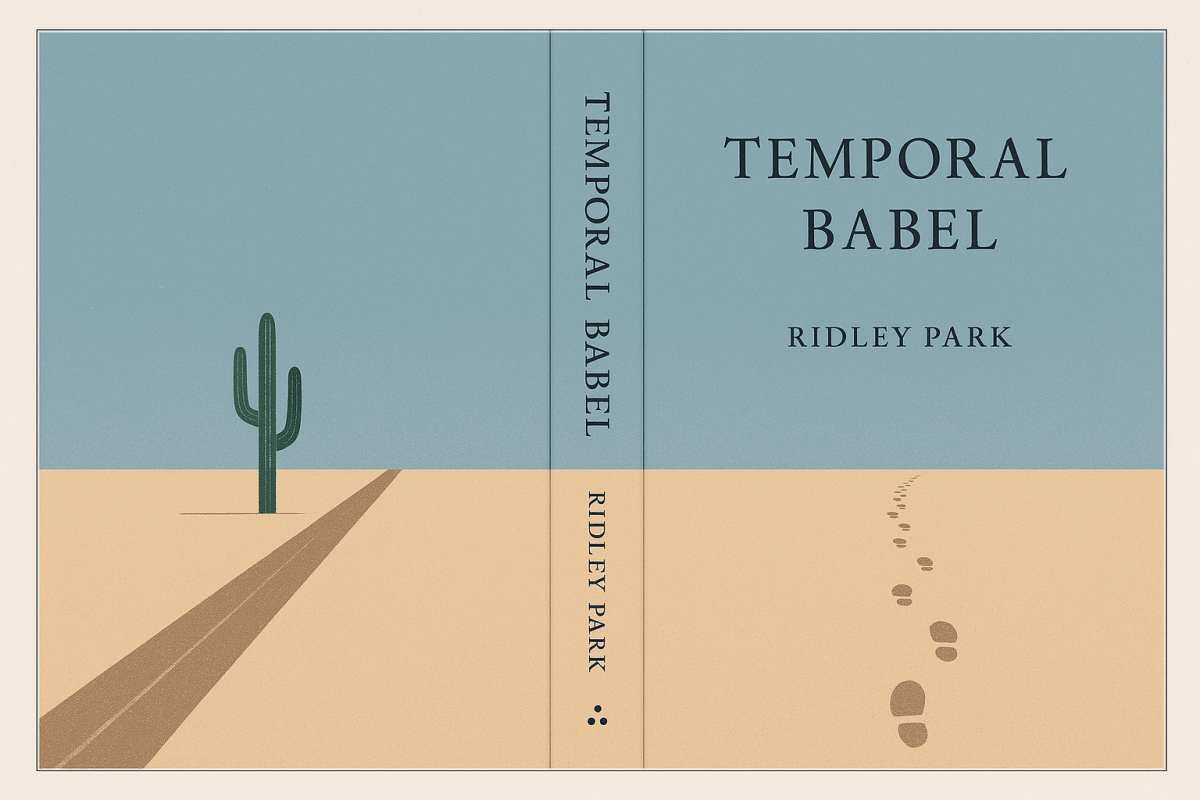
I just completed a second draft of a novelette I’ve been working on. I had ChatGPT (Dall-E) render a quick sample cover.

The story takes place in New Mexico, and I wanted a minimalist visual style to match the prose. I believe that a beige desert set against a blue sky is perfect. The deserted highway with a single cactus speaks volumes. The footprints in the desert are also evocative. I love the simplicity of the palette.

Though it revered the front and back cover art, it generally followed my instructions. Artificial intelligence (AI) has made significant progress in a year. All of the words are spelt correctly. I could Photoshop this into shape with little effort.

I only plan to release this as an ePUB because I am compiling a triptych. Currently, the body copy stands at 105 pages, so with title pages and the rest, it should reach 112 pages, which is perfect for seven 16-page signatures.

AI Editor Issues

I employ AI editors for copyediting and alpha-reading. They are useful but have limitations.

Some of my writing is ordinary – Acts I, II, and III; Beginning, Middle, and End. This is AI’s sweet spot: assess a piece and compare it to a million similar pieces, sharing plot structures, story and character arcs, heroes’ journeys, and saving cats.

Other stories are experimental. They don’t follow the Western tradition of tidy storylines and neat little bows, evey aspect strongly telegraphed, so as not to lose any readers along the journey.

Mary approaches a doorway. Mary opens the door. She walks through the doorway — the doorway she had approached.

Obviously, this is silly and exaggerated, but the point remains. AI presumes that readers need to be spoonfed, especially American audiences. (No offence.)

But life doesn’t work like this. We often witness events where we have no idea what happens after we experience them. We pass strangers on the street, not knowing anything about their past or future. We overhear something interesting, never to get a resolution. We get passed by for a promotion but never know the reason why.

In science, there are lots of dead ends. Do we want to know the answers? Yes. Is one likely? Maybe; maybe not. Will we make up answers just to satisfy our need for closure? It happens all the time.

In writing, we seem to not accept these loose ends. How many times have you read a review or critique where the complaint is, “What happened to this character?” or “Why didn’t Harry Potter use his invisibility cloak more than once despite it being an obvious solution to many prior and future challenges he faced?”

Sure. I agree that it feels like a plot hole, but the author doesn’t have to tell you that Harry lost it in a poker match, it got lost in the wash, or Ron snatched it.

I’m finishing a story, and various AIs provide similar commentary. Even more humorous are the times it can’t follow a thread, but when a human reviewer reads it, they have no difficulty. In the end, there may be unanswered questions. Some of these leave the universe open for further exploration, but not all questions have answers. AI has difficulty grasping this perspective.

Rhoticity Chicken: The Final Cluckfrontation


The skies darkened over the Coop of Justice. Inside, Rhoticity Chicken—a rooster of unparalleled enunciation—perched on his golden roost, adjusting his crimson cape. His mission was simple: to defend the final R in English against the insidious forces of vowel decay.

Audio: NotebookLM discusses this topic.

Across the barnyard, his greatest nemesis, Non-Rhotic Chicken, cackled from atop his weathered soapbox. “Togethah, my feathah’d comrades,” he declared, wings outstretched, “we shall ERASE the intrusive ‘R’ from this land. Wintah, summah, law and ordah—it shall all flow smoothly once more!”

A murmur rippled through the coop. Some hens clucked nervously. Others nodded, spellbound by his seamless vowel transitions.

But then, a mighty R echoed through the barn like thunder.

“NEVER!”

Rhoticity Chicken flapped into the air, his chest puffed out with impeccable articulation. “You shall NOT take the final ‘R’! I have defended it from the creeping shadows of elision for YEARS, and I shall not fail now!”

From the shadows emerged The Trilled Chick Henchmen, a gang of feathered mercenaries trained in rolled Rs. They trilled menacingly, their Spanish and Italian inflections rattling the walls of the barn.

“Señor Rhoticity, your time is up,” rasped El Gallito, the leader of the henchmen. “Your crude American Rs will be smoothed away like an old dialect in the sands of time. Trill, my hermanos!”

They rolled their Rs in unison, a sinister wave of phonetic force blasting toward Rhoticity Chicken. He staggered, his own hard R wavering against the onslaught of linguistic variation.

But he clenched his beak and stood firm.

“No,” he declared, eyes blazing. “You can roll your Rs, you can drop them, but you will NEVER take away my right… to pronounce… HARD R’s!”

With a mighty CROW, he unleashed his ultimate attack:

THE RHOTIC RESONANCE

A shockwave of perfectly articulated, non-trilled Rs blasted through the barn. It swept across the land, restoring all lost R’s to their rightful places.

Non-Rhotic Chicken gasped as his vowels stiffened. “No—NOOOO! My beautiful syllabic flow—GONE!” He clutched his throat as a long-forgotten ‘R’ slipped back into his speech.

“I… I… can’t… say cah anymore… I… I just said… car.”

The barn fell silent.

Defeated, Non-Rhotic Chicken collapsed into a pile of feathers, mumbling in fully articulated rhoticity.

The Trilled Chick Henchmen scattered, their rolling Rs faltering into incoherent babbling.

Rhoticity Chicken stood victorious. He fluffed his cape, took a dignified breath, and proclaimed:

“Justice. Honor. Pronunciation.”

And with that, he flew into the night, ready to defend hard R’s wherever they were threatened.

THE END…?

Against the Grain

As a writer, I fully embrace the digital age – word processors, AI, eBooks, print-on-demand, and so on. Still, I like to proof my drafts on paper. I also render audio with ElevenLabs, so I can hear the flow. You might be surprised how often that picks up awkward phrases and typos. I’ll save this for another post.

I find that printing double-sided on A5 creates just the right form factor for a paperback. A problem is that the grain is running the wrong way. This means that the pages curl horizontally, left to right. You want the page to curl to to bottom, especially if you want to bind it in book or booklet.

A solution to this is to print to A4 in a booklet form, and then fold the pages into a booklet. The result is a book having an A5 page size. And, the grain is now vertical, top to bottom, eliminating that pesky curl.

I take two approaches to this A4 technique.

First: Print a sheet containing four pages at a time, e.g., 1, 2, 3, and 4. This creates pages, 4 and 1 on the obverse and and 3 and two on the reverse. When folded, the pages are ordered as expected for a book.

TIP: Ensure you’ve set your printer to landscape and use a booklet template. I tend to print to PDF first, and use its format settings.

Rinse and repeate for pages 5 to 8, in counts of four. Stacked and ordered, you’ve got a booklet. The beenfit of this approach is that you can stack as many of these as you like until you’ve got all your entire book printed. Use a long stapler or pinch binders to fasten.

TIP: Be sure to account for a gutter, especially for books with more pages, so your text doesn’t get lost in the fold and is presents as expected.

Second: Print two of four sheets at a time. I recommend four but no more. Printing four A4 pages in a booklet format creates a 16-page booklet. And you thought, you’d never need to use maths out of school. The reason I recommend no more than four sheets is that the page ends don’t align well with more. The page ends start getting a curvature. Again, more maths. This is not an issue printing the previous style, but you need to keep it in mind here.

With four sheets at a time, the book is incremented (obviously) in groups of sixteen, so your finished booklet should be a multiple of sixteen. Blank pages at the start and end are fine. Consider a faux cover of sorts.

Also, of you only need a pamphlet – say, sixteen pages – you’re in luck.

In a Bind

If you want to be a real fancy pants, you might considering binding the pages. Say you want to create a bound novella for freinds and family. Punch holes through the folds, and stitch them together. This is fancier than staples.

Stack a series of 16, 32, 48, 64, and so on to create your book. If you have access to a binding machine, create a cover with heavier card stock and wrap it around, fixing it with adhesive.

The cover will need to be larger than A4 because of the aforementioned size problem. Plus, you’ll need to account for the thickness of all of the pages. B5 or even Legal-sized paper may be a solution. I haven’t done it or the maths, so this will be your assignment.

Parting Shots

You may be able to create a booklet with Letter and Landscape paper as long as you are OK with the final dimensions.

You may also be able to find A5 paper with a top-to-bottom grain, in which case, use it. You can settle with standard A5 sheets, but just know that you may be quickly frustrated when your pages start turing in.

Note: A4 and A5 are standard in the world except in the United States, where is is difficult to find and priced significantly higher there. If you know a source of decent quality A4 or A5 paper in the US, let me know in the comments.

The Problem with Payoffs

Every writer, instinctively or otherwise, understands the notion of payoffs. This relates to Chekov’s gun. If you mention something, provide closure.

I understand this, too, but life rarely provides closure. Perhaps this is why we want our stories to play this role, everything in neat bundles, strings tied, a nice ribbon.

The challenge as a writer is how to subvert this expectation without alienating your audience.

“Wait, what happened to that character?”

“Why did that mention the purple cow?”

And so on.

To many, these are called out as plot holes. To be fair, many are; some are forgotten plotlines, and others are simply abandoned.

But what if some are intentional? What if the plot better reflected real life? What if you never heard about that man on the tube or that woman at the grocery?

How many people do you pass by, never to encounter again? How many people do you cross paths with only to, years later, befriend.

In principle, I may have run into my wife a decade before I met her. We trod the same ground and frequented the same neighbourhoods.

A narrator may be able to piece this together, but I’ll never know. It’s like when you buy a car that you don’t see often – but then you do – or after you befriend a person, you notice them often.

In a way, a story pulls pieces together and creates narrative threads, but what if it didn’t?

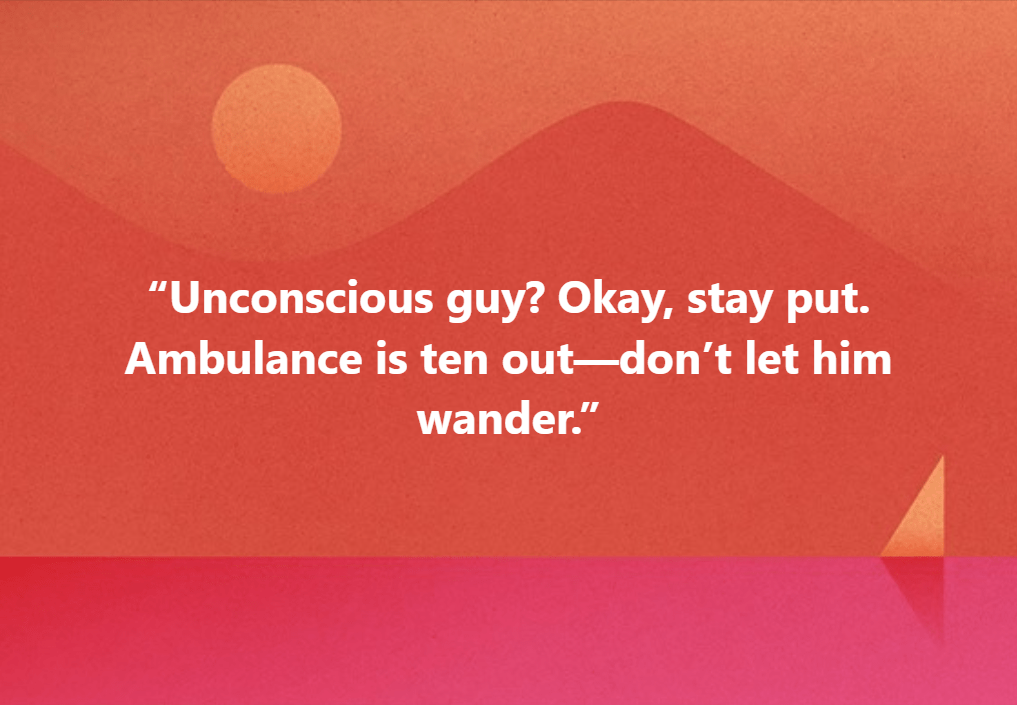
—don’t let him wander.

My biggest problem with generative AI is its lack of subtlety and misunderstanding of satire and irony. I am writing a short story, and a character is calling an emergency number. I shared the first scene with Grok, and it suggests that I turn the absurdity up to 11 and replace this segment with the one above:

“Okay, ma’am. Can you stay with him? I’ll dispatch an ambulance to your location.”

It is funny in its way, but I’m only pretty sure that an operator would not be injecting humour into a situation where a woman is reporting an unconscious person. Absurd doesn’t need to be Monty Python funny.

Am I being too critical?

Audio: NotebookLM Podcast discusses this issue.

More to the point, I find that many humans miss subtlety. Many people need every storyline highlighted and retraced with a bold Sharpie. Every detail needs to be explained because they can’t connect the dots. This is reflected in the cinema, television, and books of the past half-century or more, so is it fair to criticise AI for being dull when it’s at least on par with more than half the human population.

Are we asking AI to be held to a higher standard?