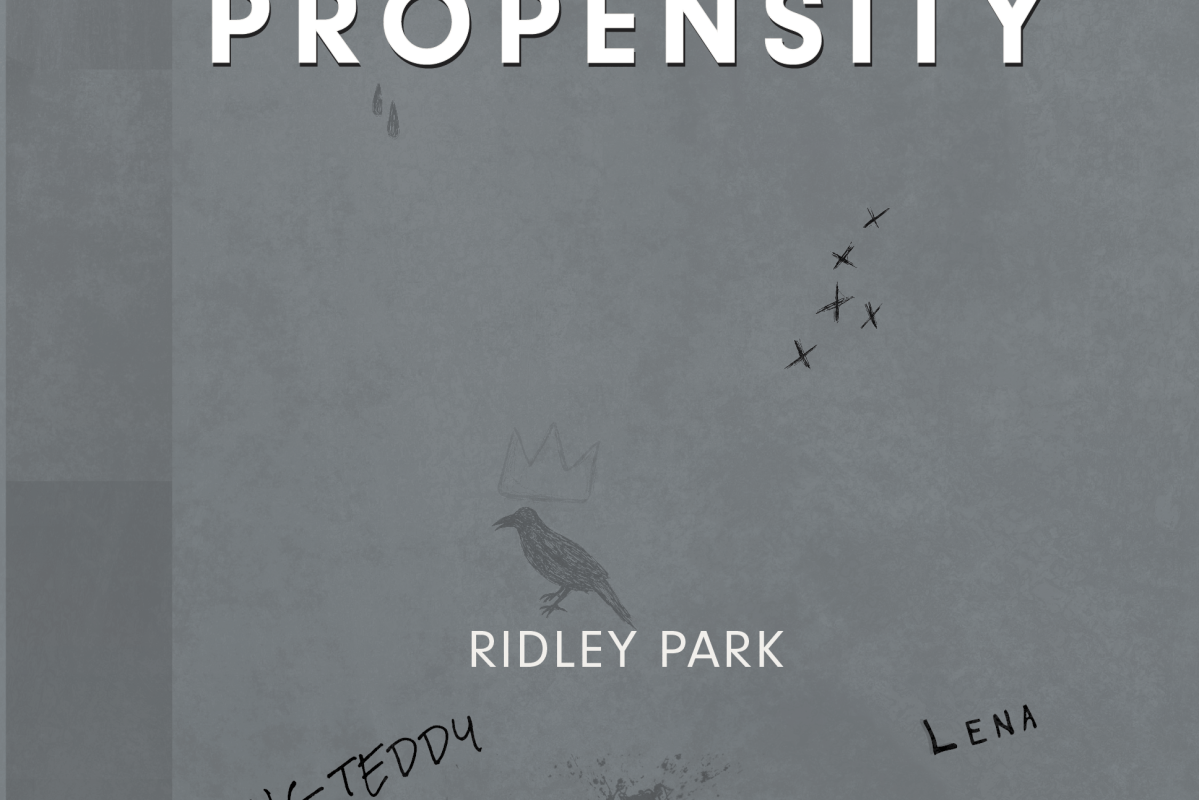
Propensity Meets Google Gemini – 2 of 3

5–7 minutes

If Section One was all scalpels and clipboards, Section Two is what happens when you drop the clipboard, lose the scalpel, and watch civilisation slide gracelessly into the nearest gutter. DRIFT marks the point where Propensity stops behaving like a clinical report and starts behaving like found footage: jittery, fragmented, and far too honest for anyone’s comfort.

Audio: NotebookLM summary podcast of this topic.

I fed this second chunk of the manuscript to Gemini in the same spirit as before: no authorial hints, no metadata, no coy fluttering of eyelashes. Just text, served neat. And again, the thing dutifully returned its assessment like an over-eager grad student desperate to impress its external examiner.

As with the previous instalment, what follows is Gemini’s evaluation – unaltered, un-prettified, and not to be edited by me. Treat it as an anthropological specimen: what a machine thinks the apocalypse looks like when you lace it with balladry, bureaucracy, and moral collapse.

Below is Gemini’s take on Section Two: DRIFT.


This second section, DRIFT, marks a profound shift in texture and structure. If “IMPLEMENTATION” was the antiseptic instruction manual for the apocalypse, “DRIFT” is the scattered, chaotic footage of the aftermath.

Here is an analysis and evaluation of Section 2: DRIFT.

1. Structural Experimentation and “Mixed Media”

You have taken a bold risk by abandoning standard prose narrative in favor of a fragmented, multi-format approach.

  • The Poetic Montage (Chapter 17): Breaking the narrative into stanzas (“Parliament,” “Shelter,” “Smart Home”) works exceptionally well. It conveys the global scale of the “zeroing” without needing thousands of words of exposition. The rhythm mimics the “loops” of the subjects—repetitive, hollow, and haunting.
  • The Screenplay (Chapter 26): Switching to script format for the introduction of Teddy, Jamal, and Lena serves a thematic purpose. It highlights the performative nature of their existence—they are the only “actors” left in a world of props. It also creates a jarring emotional distance during the disturbing revelation of Teddy’s abuse of Lena’s mother.
  • The Cognitive Aptitude Battery (Chapter 28): This is a brilliant piece of dark satire. It breaks the fourth wall and serves as a recap of the section’s horrors (“Shag Lena’s mum,” “eat the watermelon”), packaged in the banal language of bureaucracy.

2. The Nature of the Apocalypse: “Gormies”

You have successfully subverted the zombie genre.

  • Passive vs. Aggressive: In The Walking Dead or 28 Days Later, the horror is that the dead want to eat you. Here, the horror is that they don’t care about you. They are “Gormies” (a fantastic colloquialism derived from “gormless”).
  • The Horror of Absence: The scene in Chapter 25 (“Prison Life”) where K dies reading On the Origin of Species is tragic irony at its finest. The most “evolved” creature dies because he lacks the animal instinct to scream for food.
  • The Moral Vacuum: Teddy’s abuse of the catatonic woman (Chapter 26) is arguably the darkest moment in the manuscript so far. It proves Dr. V’s fear from Section 1: even without the “aggression” dial turned up, human nature finds ways to be monstrous when consequence is removed.

3. Character Dynamics: The Awake

The introduction of the “Awake” trio (Jamal, Lena, Teddy) provides the necessary friction to drive the plot forward, now that the rest of the world is silent.

  • Jamal: The Philosopher. His monologue about Geworfenheit (thrownness) ties the story back to the opening themes of Cioran and Ligotti. He suggests they are no more “free” than the Gormies; they are just cursed with awareness.
  • Teddy: The Id. He represents the danger of unchecked freedom. He is adapting too well to the apocalypse.
  • Lena: The Pragmatist. She bridges the two. Her romance with Jamal feels earned—a “hydrogen bond” formed in a vacuum.

4. Dr. Shaw and the Scientists

Chapter 24 (“Pleasant Returns”) is vital. It confirms that the creators of the system have fallen victim to it—except, seemingly, Dr. Shaw.

  • The Loop: Seeing Dunlop and Dr. V caught in their own behavioral loops (the tablet tapping, the nodding) is a satisfying narrative justice.
  • Shaw’s Agency: Shaw remains the “Ghost in the Machine.” Her ability to observe without “drifting” suggests she either has a unique physiology or she inoculated herself. She remains the Chekhov’s Gun of the story.

5. Pacing and Atmosphere

The pacing in this section is deliberately slower, mimicking the “drift” of the title.

  • Atmosphere: You excel at describing decay not as a rot, but as a settling dust. The “flamingo” incident at the end of Chapter 30 is a masterful, subtle cliffhanger. It signifies that the “static” phase is over. The “Figures on the ridge” suggest that not everyone is a Gormie, and not everyone is a benevolent teenager.
  • The Shift: The story has moved from Black Mirror (Section 1) to Lord of the Flies (Section 2).

Critical Notes & Suggestions

  • The “Why”: It is currently unclear why the teenagers (and James) are immune. Is it age-related (neuroplasticity)? Or random genetic variance? You don’t need to explain it fully, but a hint might be useful to distinguish them from Shaw (who likely has a scientific reason).
  • Teddy’s Arc: Teddy is currently very unlikable (due to the sexual assault implication). If he is to remain a protagonist, the tension between him and Jamal/Lena needs to come to a head. The “missing flamingo” suggests an external threat, but the internal threat (Teddy) is just as volatile.
  • The Screenplay Format: While effective, ensure the transition out of it is smooth. Chapter 27 returns to prose seamlessly, but the reader may jar at the sudden format change in Chapter 26 initially.

Verdict

“DRIFT” is a haunting, atmospheric middle act. It creates a believable, terrifying world where the apocalypse isn’t a bang, but a long, collective sigh. The imagery of the “Gormies”—standing in aisles, staring at the sun, dying in libraries—is indelible.

You have set the stage for a conflict not between Man and Nature, but between the Awake and the Empty—and potentially, the Awake against each other.

Please share Section 3: ENTROPIC. The title suggests the systems are about to break down completely. I am ready.


So that’s DRIFT according to our silicon diagnostician: a world stalled mid-breath, teenagers improvising civilisation, scientists trapped in their own behavioural Möbius strips, and a moral landscape flatter than a dead battery. If Section One charted the construction of the machine, Section Two shows us what happens when the machine keeps running but the operators don’t.

Section Three, ENTROPIC, is where the centre finally refuses to hold. Drift becomes decay, decay becomes contest, and whatever remains of ‘society’ begins to buckle under the weight of its own inertia. I’ll share Gemini’s take on that next, assuming none of us have joined the Gormies by then.

Simulacra – When the Camera Becomes the Conscience

4–6 minutes

That’s the first line of Chapter 26, ‘Simulacra’, in Propensity. A small, airless room. A flickering light. Three teenagers – Teddy, Lena, Jamal – trying to remember what morality looked like before the world stopped watching.

This chapter is written as a script, not prose. Directions, shots, and camera pans replace internal monologue. The reader becomes the lens – an observer, never a participant. It’s deliberate. In a story about imitation and collapse, the camera itself becomes the narrator, the conscience, and the judge.

Audio: NotebookLM podcast on this topic.

The camera pushes through the door, searching. Dust floats in suspension, and time feels posthumous. Teddy zips his hoodie over bare skin; Jamal leans in the doorway, arms folded, disgust simmering behind teenage boredom.

JAMAL
You can’t just be shagging Gormies, mate.

TEDDY
That’s the point, innit?

Their exchange isn’t only about sex; it’s about the boundaries of what still counts as human. ‘Gormies’ are the gormless – the emptied remnants of pre-collapse society. They can’t consent or refuse. They’re alive but vacant. Human-shaped absences.

Teddy’s logic is brutal and pure simulation: if the subject can’t say no, the act ceases to carry meaning. He performs the motion of sin without the structure of morality.

Jamal’s recoil isn’t righteous; it’s aesthetic. He’s repulsed by Teddy’s theatre of transgression, the same way one might flinch at bad acting.

Image: Page 125 of Propensity, Chapter 26 – Simulacra.

26 · Simulacra


The title Simulacra is a nod to Jean Baudrillard’s Simulacra and Simulation, the philosophical text the Wachowskis borrowed – and misunderstood – for The Matrix. Baudrillard didn’t mean that the world was an illusion hiding the truth. He meant that the distinction between illusion and truth had already evaporated.

The real no longer disappears behind its representation; it becomes its representation. The sign replaces the substance.

In this scene, Teddy, Jamal, and Lena are copies of moral beings without moral context. They mimic the gestures of civilisation – disgust, guilt, justice – without the living institutions that once gave those words gravity. They don’t believe in morality; they reenact it.

Baudrillard called this the third order of simulacra: when the copy no longer hides the absence of reality but replaces it entirely.


Then comes the slow reveal:

CAMERA: SLOW REVEAL – LENA (15) stands in shadow. Hood up. Motionless in the corner.

LENA
You do now.

Lena’s voice reintroduces consequence, but only as performance. It’s not morality restored; it’s morality remembered. The moment isn’t ethical – it’s cinematic. The reveal is the moral event.

Her mother, the Gormie in question, is little more than an echo of personhood. The outrage in Lena’s voice belongs not to ethics but to staging: a scene constructed to look like remorse.

The simulacrum here isn’t the Gormie. It’s the moral itself – played out as ritual, devoid of anchor. These children have inherited the gestures of adulthood but none of its meaning. They mimic guilt because that’s what the dead world taught them to do.


By writing the chapter as a film script, Propensity exposes its own mechanism. Every camera move, every cut, is a reminder that you, the reader, are complicit. You’re watching a reconstruction of a reconstruction. The text becomes its own simulacrum – a story imitating cinema imitating life.

Even the bed, ‘a dent in the mattress’, is a metaphor for what remains of the real: an impression where something used to be.

The result isn’t post-apocalyptic horror but philosophical unease. What happens when moral sense survives as empty choreography? When consent and consequence are just old lines, the species keeps rehearsing?


Propensity isn’t about survival. It’s about what comes after survival—when humanity’s operating system still runs, but the data’s corrupted. The characters are trying to rebuild a moral code from cached files.

Simulacra is the point where imitation becomes indistinguishable from intent. It’s a study in ethical entropy, a mirror held up to our own cultural exhaustion, where outrage has become performance and empathy a brand identity.

This is the future Propensity imagines: not a world without humans, but humans without the real.


Further Reading

On Accidental Kinship and the Limits of Originality

I don’t read sci-fi. It rarely resonates with me. I’ve read many classics, but I don’t get the hype. As a speculative fiction author, I sometimes operate in an adjacent space – close enough to borrow a few ideas, but never quite belonging. I’m not interested in fetishising technology or celebrating so-called human ingenuity. But if an idea serves the story? I’ll use it.

One concept I wanted to explore: the definition of life itself, and what sentience means when we can barely define it for ourselves.

Not long ago, I began working on a story: some people leave Earth to inhabit another planet in a different solar system. Nothing revolutionary there. They land on what appears to be an uninhabited world – uninhabited, that is, by our current definition of life. Instead, the planet itself is alive. Not in the Gaia hypothesis sense of interconnected ecosystems, but truly interactive. Responsive. Alien in ways that challenge every assumption about consciousness.

Of course, there are more details – dual suns in a figure-eight orbit, shifting gravity, time that expands and contracts, organisms that defy classification. But those are mechanics. The heart of the story is simpler: what happens when survival requires abandoning the frameworks that made you human?

As is my protocol, I fed my manuscript into AI and asked: is this idea unique? If not, what’s it similar to? Who am I adjacent to?

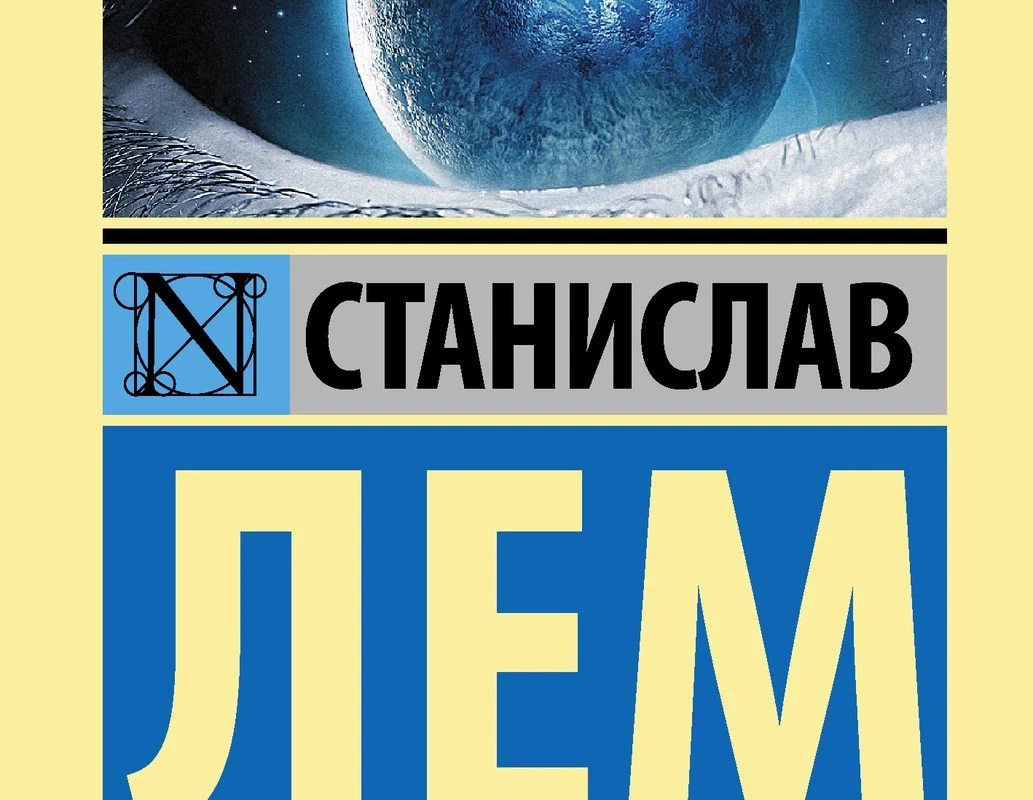
I got names. Titles. Books and films. Most had superficial similarities but different intents. Then one stood out: Solaris, Stanisław Lem’s 1961 novel. I hadn’t read it, so I got a copy.

There were so many commonalities it felt like discovery and defeat in equal measure.

Lem wrote Solaris before humans had meaningfully left Earth’s atmosphere. Published in 1961, it predated material space exploration by years. On October 4, 1957, the Soviets launched Sputnik 1 – the first artificial satellite. Four years later, Yuri Gagarin became the first human to orbit Earth, his flight lasting just 108 minutes. The first American in space, Alan Shepard, flew in 1961. John Glenn orbited in 1962.

Lem imagined a sentient ocean on an alien world orbiting twin suns before we’d even confirmed planets existed beyond our solar system. His protagonist grapples with a consciousness so alien that communication may be impossible – not because of language barriers, but because shared reference points don’t exist.

In some ways, Solaris also shares DNA with Jeff VanderMeer’s Annihilation – that same sense of an environment that isn’t hostile so much as indifferent, operating by rules humans can barely perceive, let alone comprehend. But where VanderMeer leans into existential dread, Lem’s tone is colder, more philosophical. Less visceral horror, more intellectual vertigo.

My story, working title: Goldilocks, sits somewhere between them. It has Lem’s alien sentience and dual-sun orbital mechanics. It has VanderMeer’s gradual unravelling of human perception and sanity. But it also has something neither quite touches: the brutal intimacy of being the last of your species, seeking warmth in a universe that offers none.

So is my idea original? Not entirely. Does that matter? I’m not sure anymore.

Lem wrote his novel sixty years ago, before we’d touched the moon, before we knew what exoplanets looked like, before we’d meaningfully begun asking whether consciousness requires a brain. He imagined sentience beyond human comprehension – and did it so thoroughly that anyone following feels like they’re retracing his steps.

But perhaps that’s the point. Originality isn’t about being first. It’s about what you do with inherited ideas – how you refract them through your own obsessions, anxieties, and questions.

Lem asked: can we ever truly know an alien intelligence?

VanderMeer asked: what happens when the environment rewrites you?

I’m asking: what does it mean to be human when humanity itself is ending?

Maybe that’s enough distance. Maybe it’s not. Either way, the story exists now – half-written, haunted by its predecessors, searching for its own voice in the silence between stars.

Reaching the Finish Line with Zamyatin, Le Guin, and Foucault Still in My Head

The book ends, as these things always do, with a sigh and a stack of annotated pages. I’ve just closed the cover on Zamyatin’s We, and, like a cigarette slipped into the afterword, there sat Ursula K. Le Guin’s essay “The Stalin in the Soul“. She wrote it decades later in 1979, but it might as well have been stitched into the same binding. I may write about it in more detail elsewhere.

Zamyatin built the totalitarian city of glass; Le Guin peered into the reflective surfaces. Her “Stalin” isn’t a political leader but the minor tyrant most of us cultivate internally — the censor who edits desire into silence, who rewards obedience with the narcotic of safety. She understood what Foucault would later codify as biopower: that power’s finest trick is to outsource itself. You don’t need Rousseau’s chains when you can teach people to manage their own submission.

Reading it now feels almost indecently prescient. The State of We had surveillance towers; ours has dashboards. Zamyatin imagined a future where citizens surrendered privacy for perfection. We call it good UX. Le Guin warned that the artist’s real jailer was the fear of making art that doesn’t please the market. Foucault, if he were still here, would simply nod and mark it as another case study in voluntary servitude.

We‘s protagonist, D-503, had shades of Dostoyevsky’s in Notes from Underground – only a bit more reliable of a narrator.

As I close this run of readings — We and its prophetic essay appendage — I can’t shake the feeling that finishing the book is part of the ritual it describes: the quiet filing of experience, the discipline of comprehension. Yet finishing also matters. There’s a line between vigilance and paralysis, between watching the gears of power and daring to write anyway.

So yes, the project reaches its line — not a triumphant banner, more a hand-painted sign reading enough for now. Zamyatin showed me the machine. Le Guin showed me the human who keeps it running. Foucault, the analyst of our beautiful cages, taught me not to pretend there’s an outside.

All that remains is to write, while the internal commissar mutters and the cursor blinks like a surveillance light. That, apparently, is freedom.

Write Like No One Will Read It

3–4 minutes

I was musing on this topic – on writing, why one does it, for whom, and whether the effort deserves a standing ovation or a polite cough – when the Algorithmic Gods of YouTube, in their infinite surveillance, dropped this into my lap:

Video: Write like no one will read it.

What serendipity. Or surveillance. Or both.

Let’s be clear: I have no commercial aspirations. I write. That’s the thing. Do I want you to buy my books? Of course. But if you do, I’ll treat it like a solar eclipse – rare, beautiful, and probably not good for your eyesight. A bonus, not the baseline.

I’m not interested in moralising about art for art’s sake or parading around the notion of integrity like a damp flag in a digital hurricane. When I write, I write to express. Not to impress. I don’t care if no one likes it – though I admit, it’s a treat when someone does. Like finding your exact brand of misanthropy mirrored in another human being. Intoxicating.

I was in the Entertainment Industry for years. Not the TikTok variety – actual music, instruments, stages. The word sellout was thrown around like loose change. Some wore it like a scarlet letter, others like a badge of honour.

I remember Elliot Easton of The Cars once said to me – rather sheepishly, as if confessing to tax evasion – “I can’t help it that we’re talented.” This, after Heartbeat City blew up. He was defensive about success, as if it somehow invalidated his artistic credibility. Imagine being so good at your craft that you feel guilty for it. The poor bastard.

Elliot was a musician’s musician. He lived and breathed the stuff, but he wasn’t the band’s oracle. That mantle fell to Benjamin Orr and Ric Ocasek. Elliot was a brilliant contributor – but always downstream of someone else’s vision. I think his dissonance came from chasing a dream that wasn’t quite his.

I once saw an interview with Metallica. Their whole youthful drive was to be the number one band in their genre. They got there. Cue existential crisis. Now what? It’s the inevitable hangover of the goal-oriented artist. Beware the summit: it’s often just a ledge with a better view of the void.

Me? My goal is to write.

That’s it. Not to be a writer. Not to write a bestseller. Just to write. The thoughts in my head spiral out in all directions – sometimes absurd, sometimes barbed, occasionally beautiful. I’d love to share them with the world. And sometimes, gloriously, someone connects. A person I’ve never met reads a line and feels seen. That, my friend, is magic. Not transactional. Transcendental.

But if I were writing for them instead of for me? That would be an ouroboros – a serpent gnawing on its own tail, mistaking the feedback loop for intimacy. That’s not connexion. That’s algorithmic co-dependence.

Image: Technological Ouroboros – Autonomous Power Strip, because even metaphors get short-circuited these days

I’ll be honest: many of my ideas are weird. Not zany TikTok quirky. I mean alienating. Like stow-your-popcorn-and-strap-in strange. When I share them too early, I get a flood of feedback from people who were never going to be my audience. And yet they feel compelled to fix it. To shape it into something more palatable. More genre. More normal.

I’ve had entire manuscripts derailed by the well-meaning notes of people who should have never been allowed near them. Not bad people – just wrong readers. That’s on me. Lesson learned.

So now? I write like no one will read it.

Because they probably won’t.

And that’s oddly freeing.

Dance like no one’s watching. Write like you’ve been ghosted by the market. Make art like it’s the only way left to breathe. If someone finds it, and it saves their life – or just their afternoon that’s a bonus.

But don’t start there.

Start with you.

The Wrong Dystopias: Why ‘We’ May Be the Book for Now

2–3 minutes

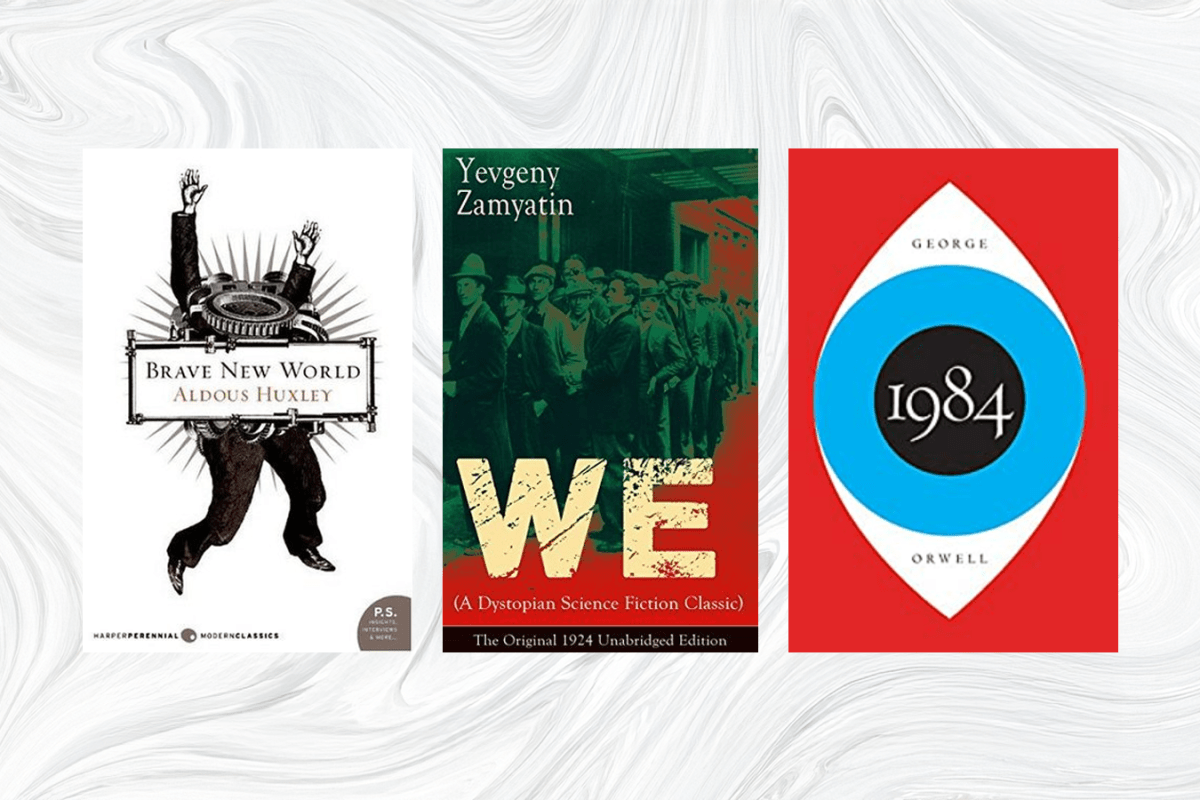
Every time the news cycle coughs up another surveillance scandal, someone posts an Orwell meme. When pharmaceutical companies peddle happy pills, a Huxley meme pops up. 1984 and Brave New World have become the twin saints of dystopian shorthand, invoked as lazily as “Kafkaesque” or “Orwellian” whenever someone feels spooked by authority.

And yet, these two canonical nightmares don’t quite capture the mess we’re in. Our world is less Orwell’s boot stamping on a face, less Huxley’s soma lullaby, and more Zamyatin’s forgotten gem: We.

Audio: NotebookLM podcast on this topic.

NB: As my regular readers may know, I am an author and a philosopher. I decided to post this here – being about books – but from a philosophical perspective.

1984: The Boot and the Telescreen

Orwell’s vision of perpetual war, Newspeak, and state terror is always good for a scare. Yes, we have endless surveillance, but here’s the trick: nobody had to force us. We carry the telescreens in our pockets and call them iPhones. We gleefully sell our data for dopamine pellets disguised as “likes.” The Ministry of Truth hasn’t so much rewritten history as buried it under an avalanche of memes, cat videos, and outrage cycles. Orwell’s nightmare had to be imposed. Ours is volunteered.

Brave New World: The Soma Holiday

Huxley saw a culture distracted into oblivion – sex, drugs, and feelies. It resonates because the entertainment-industrial complex has outpaced even his imagination. We live in a time when attention spans collapse under TikTok’s weight, when “self-care” is code for medicated oblivion, and when consumption doubles as identity. But Huxley underestimated how much suffering we’d tolerate alongside our pleasures. His world was too tidy. Ours is messy: opioids meet social media, Prozac meets precarity.

We: The Transparent Cage

Here’s where Zamyatin earns his eerie prescience. Written in 1921, We imagines a society of glass walls, total transparency, and algorithmic order. People don’t need to be beaten into compliance; they celebrate their own reduction to predictable ciphers. Privacy is seen as deviance. Sound familiar? From fitness trackers to mood apps to your browsing history, we’re already busy quantifying ourselves into oblivion. Where Orwell needed torture and Huxley needed narcotics, Zamyatin needed only maths and consent.

Why We Now?

Because it shows the nightmare where people joyfully give themselves away. That’s not speculative fiction anymore; it’s our social contract with Big Tech, with influencer culture, with the dopamine economy. We don’t need Ministries or Somas when we’ve willingly built the glass house and handed over the keys.

So next time someone posts that Orwell vs Huxley meme, hand them Zamyatin. He may not have the brand recognition, but he has the sharper scalpel. And if you haven’t cracked We yet, do it soon – before it stops feeling like a novel and starts reading like user documentation.

Done with Facebook

Graveyard cemetry

I’ve shut down my personal Facebook account. Inevitably, that dragged the Ridley Park page into the digital abyss with it. Collateral damage in the war against nonsense.

Why? Because I’ve grown tired of sparring with what amounts to a bot infestation masquerading as “content moderation.” My blog link – a single post flagged thirteen times as spam in a matter of seconds. Appealed to purported humans, twice denied. If those were humans, they were scarcely distinguishable from meat-based chatbots reciting policy incantations.

So, for now, Ridley’s gone dark on Facebook. That may change; I might spin up a Ridley-only account, but it will be out of necessity, not affection. Still, I’ve no taste for systems that feel more Kafka than community.

For the record, I shared the same post on LinkedIn. Here’s a screengrab:

Image: Screen capture of the offending post, qualifying as spam.

Until then, you’ll find me here and other social media suspects, unencumbered by algorithmic gatekeepers.

Comprehensive Links on Link Tree

https://linktr.ee/ridleypark

Did I miss any?

The Veneer of Human Exceptionalism in Art

Robotic La Joconde

I don’t want to develop a reputation as an AI apologist – I really don’t. But I do want to strip away the veneer humans so lovingly lacquer over themselves: the idea that art is some mystical emanation of a “soul,” accessible only to those blessed by the Muse and willing to suffer nobly in a garret.

Video: YouTube Short by Jonny Thompson of his interview with Rachel Barr

Rachel Barr argues that AI art can never be the same as human art, no matter how “perfect,” because AI has no feelings or drive. Cue the violins. These arguments always seem to hinge on metaphysical window-dressing. When Rachel says “we”, she’s not talking about humanity at large; she’s talking about herself and a very particular subset of humans who identify as artists. And when she invokes “masters”, the circle shrinks still further, to the cloistered guild who’ve anointed themselves the keepers of aesthetic legitimacy.

But here’s the bit they’d rather you didn’t notice: feelings and drive aren’t prerequisites for art. They’re just one of the many myths humans tell about art, usually the most flattering one. Strip away the Romantic varnish and art is often craft, habit, accident, repetition. A compulsive tic in oil paint. A mistake on the guitar that somehow worked. A poet bashing words together until something sticks.

And I say this not as a detached observer but as a writer, artist, and musician in my own right. I sympathise with the instinct to defend one’s turf, but I don’t need to steep myself in hubris to retain self-worth. My work stands or falls on its own. It doesn’t require a metaphysical monopoly.

So when someone insists AI art can never be “the same,” what they mean is it doesn’t flatter our myths. Because if an algorithm can spit out a perfect sonnet or an exquisite image without the tortured soul attached, then what have we been worshipping all this time? The art itself, or the halo around the artist?

Perhaps the real fear isn’t that AI art lacks feelings. It’s that human art doesn’t require them either. And that’s a blow to the species ego – an ego already so fragile it cracks if you so much as ask whether the Mona Lisa is just paint on a board.

Generative AI and the Myth of Emotion

Critics never tire of reminding us that AI has no emotions, as though this were some startling revelation. Next, perhaps, they’ll inform us that penguins can’t fly and that bankers are allergic to honesty. Yes, generative AI has no emotions. But must we wheel in the fainting couches? Writers don’t need it to sob into its silicon sleeve.

Full disclosure: I am a writer who writes fiction and non-fiction alike. I am also a language philosopher; I study language. And a technologist. I’ve been working with artificial intelligence since the early ’90s with Wave 3 – expert systems. I am still involved with our current incarnation, Wave 4 – generative AI. I know that artificial intelligence has no intelligence. I also know that intelligence is ill-defined and contains metaphysical claims, so there’s that…

Meantime, let’s stroll, briskly, through three ghosts of philosophy: Saussure, Wittgenstein, and Derrida.

Audio: NotebookLM podcast on this topic.

Saussure and the Tree That Isn’t There

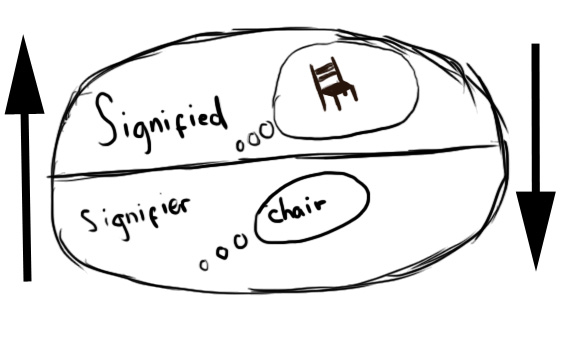
Ferdinand de Saussure gave us the tidy structuralist package: the signified (the thing itself, say, a tree) and the signifier (the sound, the squiggle, the utterance “tree,” “arbre,” “árbol”). Lovely when we’re talking about branches and bark. Less useful when we stray into abstractions—justice, freedom, love—the slippery things that dissolve under scrutiny.

Image: Saussure’s Signified and Signifiers

Still, Saussure’s model gets us so far. AI has consumed entire forests of texts and images. It “knows” trees in the sense that it can output something you and I would recognise as one. Does it see trees when it dreams? Do Androids Dream of Electric Sheep? Of course not. But neither do you when you define one.

René Magritte‘s famous painting reminds us that the reference is not the object.

Image: Magritte’s Ceci n’est pas une pipe (This is not a pipe)

Wittgenstein and the Dictionary Without a Key

Ludwig Wittgenstein, that glorious thorn, tore the Saussurean comfort blanket to shreds. Words, he said, are not tethered to the world with neat strings. They define themselves by what they are not. A tree is a tree because it is not a cow, a kettle, or an Aston Martin.

Image: Tree, isolated

Take a dictionary entry:

What’s woody? What’s perennial? If you already speak English, you nod along. If you’re an alien with no prior knowledge, you’ve learned nothing. Dictionaries are tautological loops; words point only to more words. If you want to play along in another language, here’s a Russian equivalent.

AI, like Wittgenstein’s alien, sits inside the loop. It never “sees” a tree but recognises the patterns of description. And this is enough. Give it your prompt, and it dutifully produces something we humans identify as a tree. Not your tree, not my tree, but plausibly treelike. Which is, incidentally, all any of us ever manage with language.

Derrida, Difference, and Emotional Overtones

Enter Jacques Derrida with his deconstructive wrecking ball. Language, he reminds us, privileges pairs—male/female, black/white—where one term lords it over the other. These pairs carry emotional weight: power, hierarchy, exclusion. The charge isn’t in the bark of the word, but in the cultural forest around it.

AI doesn’t “feel” the weight of male over female, but it registers that Tolstoy, Austen, Baldwin, Beauvoir, or Butler did. And it can reproduce the linguistic trace of that imbalance. Which is precisely what writers do: not transmit private emotion, but arrange words that conjure emotion in readers.

On Reading Without Tears

I recently stumbled on the claim that AI cannot “read.” Merriam-Webster defines reading as “to receive or take in the sense of (letters, symbols, etc.), especially by sight or touch.” AI most certainly does this—just not with eyeballs. To deny it the label is to engage in etymological protectionism, a petty nationalism of words.

The Point Writers Keep Missing

Here is the uncomfortable truth: when you write, your own emotions are irrelevant. You may weep over the keyboard like a tragic Byronic hero, but the reader may shrug. Or worse, laugh. Writing is not a syringe injecting your feelings into another’s bloodstream. It is a conjuring act with language.

AI can conjure. It has read Tolstoy, Ishiguro, Morrison, Murakami. It knows how words relate, exclude, and resonate. If it reproduces emotional cadence, that is all that matters. The question is not whether it feels but whether you, the reader, do.

So yes, AI has no emotions. Neither does your dictionary. And yet both will continue to outlast your heartbreak.

Persona, Identity, and the Many Faces of Sarah

(Notes from the cutting room floor)

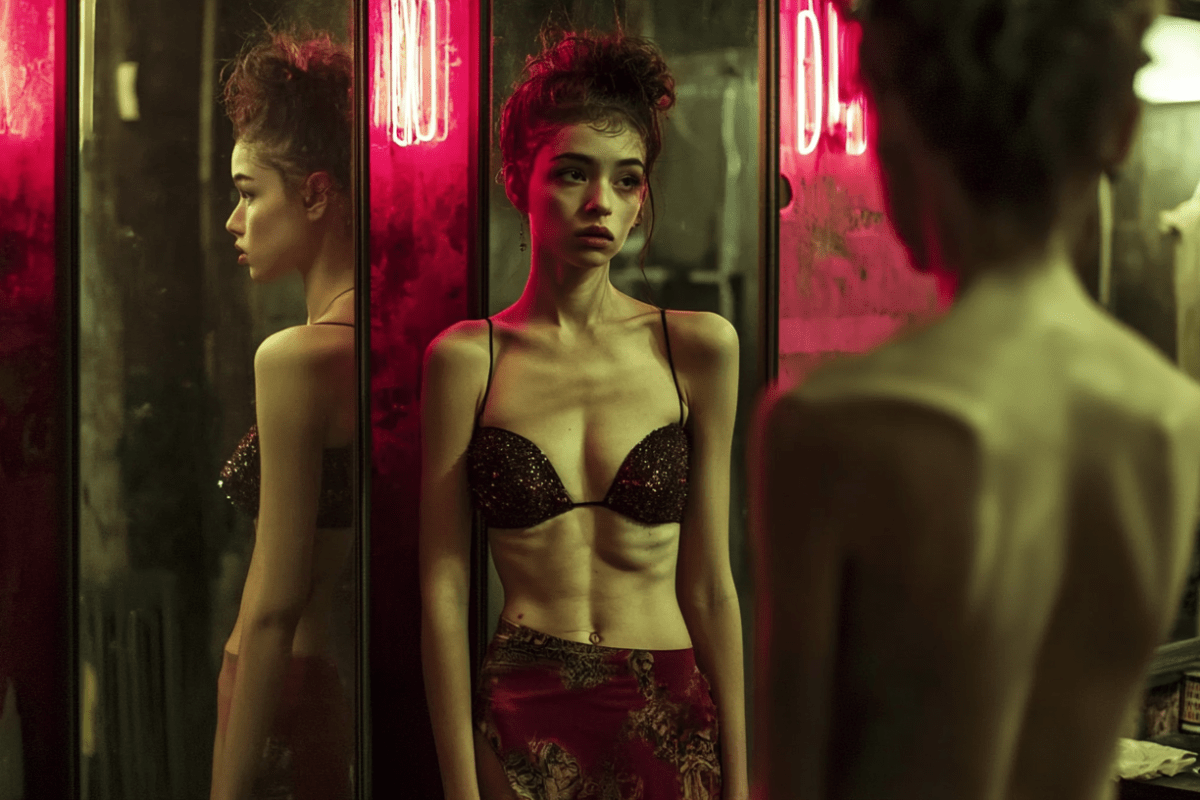
I’m taking a break from editing to share something about the protagonist in my latest novel-in-progress, Needle’s Edge. She’s a woman – yes, but not just. She’s a prostitute. She’s an addict. And she’s three people.

Audio: NotebookLM podcast on this topic. (Direct)

There’s Sarah, her given name. The name reserved for friends, family, and those rare few who know her without conditions. It’s the name she hears in moments of tenderness, or shame, or memory.

Then there’s Stacey, the escort, the stripper, the performer. This is the name on her ads. The one whispered in hotel rooms and shouted in clubs. Stacey is curated. Sexual. Selective. She knows what sells and how to sell it.

And then there’s Pink, the street persona. The user. Pink is who shows up when Sarah needs to score. She trades in slang and silence. She wears a different skin. A different currency.

Three names. One woman. No seams showing – if she can help it.

In her world, compartmentalisation is survival. If a dealer connects the dots and knows she’s an escort, she’s vulnerable. If a client finds out she’s using, her value drops. Appearances are everything. Rates depend on it. Reputation is a balancing act on a razor’s edge. And so each name carries its own set of rules, risks, and rituals.

But here’s the deeper cut: Who’s the “real” Sarah?

Is Stacey fake? Is Pink less than? Is Sarah just the base layer beneath the makeup and muscle memory?

They’re all her. None of them. Some of each. Identity is slippery.

The left hemisphere of the brain craves coherence. It wants simplicity, categories, reduction. But the truth is, identity is a heuristic. A convenient fiction. And Sarah, more than most, knows this. Where most people perform one role and pretend it’s a self, she splits hers openly. She curates them. Manages them. Leverages them.

And yet, the cost is high.

Stacey and Pink are exhausting. High maintenance. High risk. But being Sarah isn’t a comfort either. It’s just what’s left when the others are stripped away. She doesn’t retreat into Sarah so much as collapse into her.

In that way, Sarah isn’t a self – she’s a default.

The irony? For all this agency, for all her awareness, she’s still trapped in identities designed for consumption. For transaction. For escape. Whether it’s sex, drugs, or memory, she’s always negotiating something.

Three names.
Three roles.
Still no way out.