I’ve just started this after hearing a positive review on YouTube. I discovered that Audible was offering it for free for members, so I took that route. About 15% in, I like the writing (and the narration). By and large, it is well-written, and I am interested to see where it leads. The weakest element seems to be the dialogue, so far. I am especially put off by the dialogue of the young girl, but some of the protagonist’s dialogue (and intercourse with the girl) doesn’t feel ‘authentic’; it feels rather contrived. Even so, I’d give it a 3.5 stars for now. I could see it getting to 4 by the time I’m done. Time will tell.
I’ve still got a ways to go. Rather than witter on further, I recommend listening to this bloke’s take on it. He’s undoubtedly more excited about it than I am, but I’d still recommend it at this point.
To be honest, I saw at least one negative review on YouTube, but I’ll read the book before I poison the well.
I guess I should complete my profile below. One day. Maybe soon.
Propensity has always been available for free with KindleUnlimited. For the first time ever, Propensity will be free for all available markets between 12 and 16 December 2025. Limited-time offer. Not sure how this operates across time zones. Download it sooner than later so you don’t miss the opportunity.
Propensity is also available in hardcover and paperback, as well as an audiobook. Scroll down to listen to chapter 1.
Also available at Barnes & Noble, if that’s your preference – hardcover and paperback.
Summaries and a trailer are available below.
I’m offering Propensity in the hope of getting some reviews and comments, whether here or on the site of purchase. Goodreads reviews are nice, too. You can be the first.
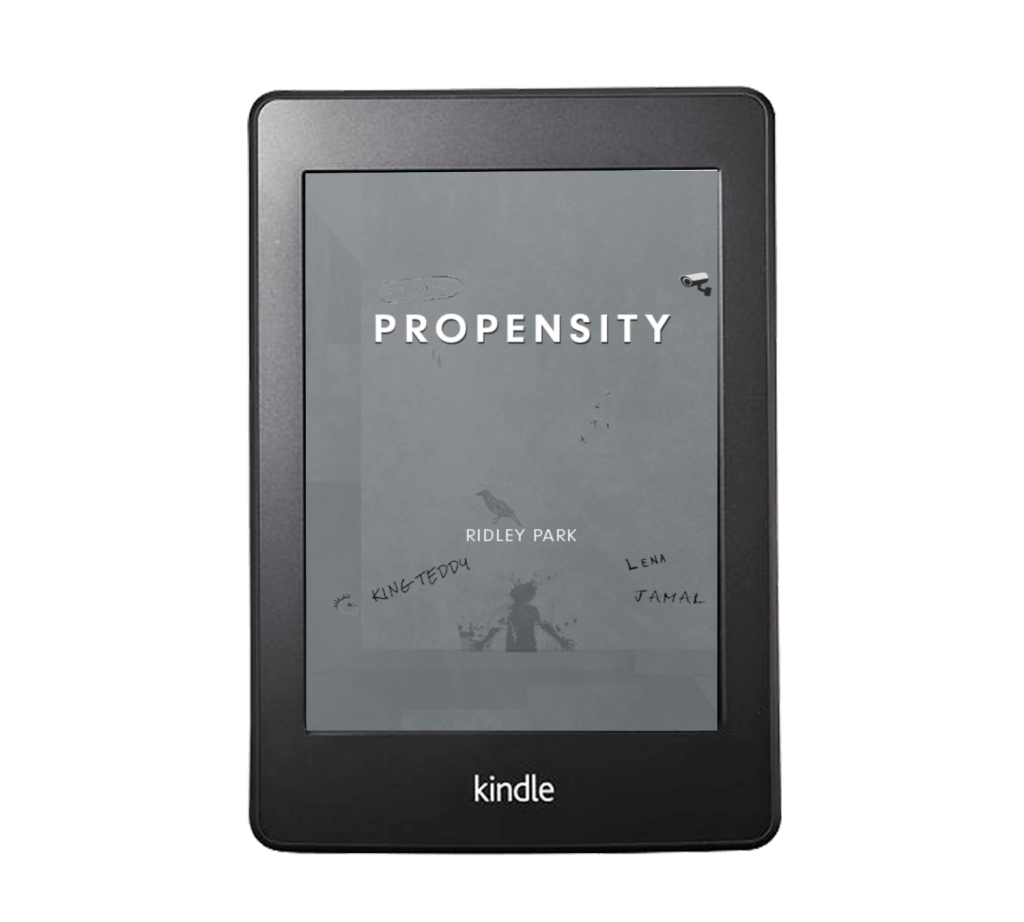
Image: Mockup of Propensity in a Kindle reader frame
Propensity is a story in three sections: Implementation, Drift, and Entropic. Google Gemini summarised each section; NotebookLM summarised those. Listen below.
Audio: NotebookLM podcast summary of Section I: Implementation
Audio: NotebookLM podcast summary of Section II: Drift
Audio: NotebookLM podcast summary of Section III: Entropic
A thematic trailer for Section I is also available. I hope to make more.
Ridley Park has not been dead, merely sleeping like a hungover deity ignoring its worshippers. As has become my regrettable habit, most of my creative energy has been siphoned into non-fiction projects, leaving the poor world deprived of my fictional offerings and my blog gathering dust like an abandoned cathedral.
But fate – or more accurately, an algorithm – shoved a book into my face with all the subtlety of a street preacher: There Is No Antimemetics Division. Hard science fiction, horror, and something about antimemes. Naturally, I pressed Play Sample instead of behaving like a responsible adult and reading the summary. Antimemetic sounded deliciously unwholesome. Straight down the hatch.
Image: Advert with an author pic for this book.
I’m only into Chapter Two, so don’t expect a full exegesis yet. This is merely a field report from the early trenches.
I bought the Audible version, because audiobooks are the only thing keeping me sane through workouts, where otherwise, one contemplates mortality and the price of groceries. As the sample ran, I learned two things:
Parts of the narrative are redacted.
They did not redact to protect state secrets or Jeffrey Epstein’s ghost.
No – it’s a stylistic device. A textual blackout. Beeps, static, corrupted passages like intercepted voicemail from a doomed expedition. Being partial to experimental prose, I took it as a dare. My brain applauded.
The effect reminded me of Irvine Welsh’s Filth – not in theme, but in the editorial scars, the moth-eaten structure. Welsh, more widely known for Trainspotting, does chaos like astrophysicists do numbers. Obfuscation as aesthetic. Disorder as design. The connection may be superficial, but it’s one worth pocketing.
The title earns its relevance quickly: certain ideas spread like plague; others erase themselves on contact. Antimemes – cognitive black holes. Information that cannot be held without dissolving. A story that fights the mind that reads it.
Hard sci-fi rarely offers such structural mischief. I’m morbidly delighted to see where the horror emerges, when the narrative begins to eat its own memory like a recursive ouroboros.
More to come, once I descend deeper into the antimemetic labyrinth.
And yes – lest anyone call the coroner – I am still writing.
People keep hurling accusations of AI-assisted writing as though it’s the new literary scarlet letter. Apparently, if a sentence lands too cleanly or an argument isn’t held together with chewing gum and vibes, someone’s bound to whisper that silicon fingers were involved. It’s all very witch-trial chic.
Video: My minion scribing this blog post. I want to teach it how to use a typewriter.
I’ve written about this on Philosophics. Not the tired panic about ‘machines stealing our jobs’, nor the hand-wringing about entry-level writers having their ladders kicked away. That’s a separate tragedy. My post digs into the moral melodrama over authorship itself, where a whiff of algorithmic contribution is treated like doping at the Olympics. As if writing were a pole-vault and not, you know, communication.
The whole spectacle reveals more about our Enlightenment hang-ups than about the technology. We still cling to this myth that pure, unadulterated human genius trickles from the fingertips of a lone, caffeinated scribe. Anything less than “authenticity” gets branded synthetic, corrupt, impure. It’s the same script modernism’s been peddling forever, only now the villain has LEDs.
Anyway, if you’ve got the stomach for a short polemic on why these accusations miss the point entirely, here it is:
I finished reading Lem’s Solaris and then was notified of a discussion about the book and the film adaptations.
I intended to draft a book review, but I may defer.
For now, I’ll note that the similarities between this and my own work are superficial. Both have philosophical perspectives, but Lem’s is much more psychological. This is nice, but it’s not where I tend to take things, and not so overtly.
I was musing on this topic – on writing, why one does it, for whom, and whether the effort deserves a standing ovation or a polite cough – when the Algorithmic Gods of YouTube, in their infinite surveillance, dropped this into my lap:
Video: Write like no one will read it.
What serendipity. Or surveillance. Or both.
Let’s be clear: I have no commercial aspirations. I write. That’s the thing. Do I want you to buy my books? Of course. But if you do, I’ll treat it like a solar eclipse – rare, beautiful, and probably not good for your eyesight. A bonus, not the baseline.
I’m not interested in moralising about art for art’s sake or parading around the notion of integrity like a damp flag in a digital hurricane. When I write, I write to express. Not to impress. I don’t care if no one likes it – though I admit, it’s a treat when someone does. Like finding your exact brand of misanthropy mirrored in another human being. Intoxicating.
I was in the Entertainment Industry for years. Not the TikTok variety – actual music, instruments, stages. The word sellout was thrown around like loose change. Some wore it like a scarlet letter, others like a badge of honour.
I remember Elliot Easton of The Cars once said to me – rather sheepishly, as if confessing to tax evasion – “I can’t help it that we’re talented.” This, after Heartbeat City blew up. He was defensive about success, as if it somehow invalidated his artistic credibility. Imagine being so good at your craft that you feel guilty for it. The poor bastard.
Elliot was a musician’s musician. He lived and breathed the stuff, but he wasn’t the band’s oracle. That mantle fell to Benjamin Orr and Ric Ocasek. Elliot was a brilliant contributor – but always downstream of someone else’s vision. I think his dissonance came from chasing a dream that wasn’t quite his.
I once saw an interview with Metallica. Their whole youthful drive was to be the number one band in their genre. They got there. Cue existential crisis. Now what? It’s the inevitable hangover of the goal-oriented artist. Beware the summit: it’s often just a ledge with a better view of the void.
Me? My goal is to write.
That’s it. Not to be a writer. Not to write a bestseller. Just to write. The thoughts in my head spiral out in all directions – sometimes absurd, sometimes barbed, occasionally beautiful. I’d love to share them with the world. And sometimes, gloriously, someone connects. A person I’ve never met reads a line and feels seen. That, my friend, is magic. Not transactional. Transcendental.
But if I were writing for them instead of for me? That would be an ouroboros – a serpent gnawing on its own tail, mistaking the feedback loop for intimacy. That’s not connexion. That’s algorithmic co-dependence.
Image: Technological Ouroboros – Autonomous Power Strip, because even metaphors get short-circuited these days
I’ll be honest: many of my ideas are weird. Not zany TikTok quirky. I mean alienating. Like stow-your-popcorn-and-strap-in strange. When I share them too early, I get a flood of feedback from people who were never going to be my audience. And yet they feel compelled to fix it. To shape it into something more palatable. More genre. More normal.
I’ve had entire manuscripts derailed by the well-meaning notes of people who should have never been allowed near them. Not bad people – just wrong readers. That’s on me. Lesson learned.
So now? I write like no one will read it.
Because they probably won’t.
And that’s oddly freeing.
Dance like no one’s watching. Write like you’ve been ghosted by the market. Make art like it’s the only way left to breathe. If someone finds it, and it saves their life – or just their afternoon that’s a bonus.
I don’t want to develop a reputation as an AI apologist – I really don’t. But I do want to strip away the veneer humans so lovingly lacquer over themselves: the idea that art is some mystical emanation of a “soul,” accessible only to those blessed by the Muse and willing to suffer nobly in a garret.
Video: YouTube Short by Jonny Thompson of his interview with Rachel Barr
Rachel Barr argues that AI art can never be the same as human art, no matter how “perfect,” because AI has no feelings or drive. Cue the violins. These arguments always seem to hinge on metaphysical window-dressing. When Rachel says “we”, she’s not talking about humanity at large; she’s talking about herself and a very particular subset of humans who identify as artists. And when she invokes “masters”, the circle shrinks still further, to the cloistered guild who’ve anointed themselves the keepers of aesthetic legitimacy.
But here’s the bit they’d rather you didn’t notice: feelings and drive aren’t prerequisites for art. They’re just one of the many myths humans tell about art, usually the most flattering one. Strip away the Romantic varnish and art is often craft, habit, accident, repetition. A compulsive tic in oil paint. A mistake on the guitar that somehow worked. A poet bashing words together until something sticks.
And I say this not as a detached observer but as a writer, artist, and musician in my own right. I sympathise with the instinct to defend one’s turf, but I don’t need to steep myself in hubris to retain self-worth. My work stands or falls on its own. It doesn’t require a metaphysical monopoly.
So when someone insists AI art can never be “the same,” what they mean is it doesn’t flatter our myths. Because if an algorithm can spit out a perfect sonnet or an exquisite image without the tortured soul attached, then what have we been worshipping all this time? The art itself, or the halo around the artist?
Perhaps the real fear isn’t that AI art lacks feelings. It’s that human art doesn’t require them either. And that’s a blow to the species ego – an ego already so fragile it cracks if you so much as ask whether the Mona Lisa is just paint on a board.
Zach Cregger wrote Weapons. He also directed it, produced it, and composed the soundtrack. This blog is about writing, so let’s stay with that. In a recent interview with Perri Nemiroff at Fandango, he described how the story emerged almost by accident:
Video: Perri Nemiroff Interviews Cast and Director of Weapons
Perri asks Zach how he got the idea for the story:
I didn’t have an idea for the movie when I started writing
— Zach Cregger
I was like, “Okay, little girl telling a story— takes place at a school. Kids go to school. Follow a teacher. Class is empty. Why? I don’t know. Let’s find out.”
And then two sentences later – because the kids all ran out the night before.
Okay, that’s a hook I like. So, I knew… I have a good question. So then, I probably wrote 50 pages before I even knew what the answer was going to be, honestly.
So, you know, I got the teacher, I got the angry dad, and they’re kind of doing their cat and mouse sort of a thing, and then… I got this cop, and… it wasn’t until about the midpoint where I had… what it was.
And that was a really good moment for me because I was like, “This might not ever be a thing. I might not have anything here.”
You know, if I don’t have a good answer, there’s no reason to watch this movie.
That’s pantsing in its purest form — starting with a question and running fifty pages before you even know if there’s an answer. Discovery writing at its most precarious: equal parts exhilaration and existential dread.
Personally, I lean hybrid. Sometimes I pants a draft until it coughs up a structure; other times I start with scaffolding and let the innards misbehave. But the dead ends always loom. I’ve euthanised countless ideas that failed to evolve, rather than stitching them together with some lazy deus ex contrivance. (Television thrives on that sort of duct-taped plotting, which is precisely why I don’t bother with it.)
Anyway, I have not seen this movie. I am not a fan of horror, but every now and then I sample what’s out there. I might check this out to see how well it delivers.








 Ridley Park