Writing Weapons

Zach Cregger wrote Weapons. He also directed it, produced it, and composed the soundtrack. This blog is about writing, so let’s stay with that. In a recent interview with Perri Nemiroff at Fandango, he described how the story emerged almost by accident:

Video: Perri Nemiroff Interviews Cast and Director of Weapons

Perri asks Zach how he got the idea for the story:

I was like, “Okay, little girl telling a story— takes place at a school. Kids go to school. Follow a teacher. Class is empty. Why? I don’t know. Let’s find out.”

And then two sentences later – because the kids all ran out the night before.

Okay, that’s a hook I like. So, I knew… I have a good question. So then, I probably wrote 50 pages before I even knew what the answer was going to be, honestly.

So, you know, I got the teacher, I got the angry dad, and they’re kind of doing their cat and mouse sort of a thing, and then… I got this cop, and… it wasn’t until about the midpoint where I had… what it was.

And that was a really good moment for me because I was like, “This might not ever be a thing. I might not have anything here.”

You know, if I don’t have a good answer, there’s no reason to watch this movie.

That’s pantsing in its purest form — starting with a question and running fifty pages before you even know if there’s an answer. Discovery writing at its most precarious: equal parts exhilaration and existential dread.

Personally, I lean hybrid. Sometimes I pants a draft until it coughs up a structure; other times I start with scaffolding and let the innards misbehave. But the dead ends always loom. I’ve euthanised countless ideas that failed to evolve, rather than stitching them together with some lazy deus ex contrivance. (Television thrives on that sort of duct-taped plotting, which is precisely why I don’t bother with it.)

Anyway, I have not seen this movie. I am not a fan of horror, but every now and then I sample what’s out there. I might check this out to see how well it delivers.

The First Rule of Writing: There Are No Rules

It is all well and good that experienced people share their advice with neophytes, with those who are less practised, less confident, or simply eager to imitate. There is nothing inherently wrong with offering footholds. This particular video, for instance, sets out ten strategies for the opening paragraph, each supposedly designed to stop readers from bolting at the first hurdle. For the green and anxious, a checklist can feel like a lifeline.

But here is the rub. The first rule of writing, which is also the first rule of art, is that there are no rules. There are, admittedly, a near-infinite number of bad ideas – every creative writing workshop is proof of that – but this abundance of failure does not magically distil into a shortlist of approved techniques. “Best practice” is a managerial fiction dressed up as gospel.

Video: First Paragraph Strategies

Yes, if you are working in a commercial genre, there are conventions and tropes that must be acknowledged. A murder mystery without a corpse is merely awkward, and a romance without union or rupture is simply wishful thinking. But let us be clear: these are expectations, not commandments. They are signposts, not shackles.

The danger of this kind of advice is not that it is wrong, but that it is received as dogma. If every first paragraph dutifully obeyed these ten tricks, the outcome would not be ten compelling openings but ten perfectly interchangeable ones. Predictability, not incompetence, is the real enemy of writing. To follow rules too tightly is to aim directly at cliché.

And yet the defence is equally obvious. A novice often requires boundaries, if only to resist paralysis. “Begin here, avoid this, try that.” Advice of this sort can be useful scaffolding, and scaffolding, while inelegant, keeps the building upright until the architect has a design. The problem arises when people mistake the scaffolding for the cathedral.

So the honest conclusion is double-edged. Watch the video if you like. Steal what steadies you, ignore what doesn’t. But do not imagine that art is born from lists. At best, such advice can prevent you from falling flat on your face; at worst, it convinces you that walking in circles is the same thing as running.

Video: Discussing Needle’s Edge, Part 1

Some novels are born in a lightning bolt. Needle’s Edge was forged in sediment: years of observations, contradictions, and lived experience settling into something that could no longer be ignored.

Video: Author Ridley Park Discusses Needle’s Edge

The video is intentionally, if not mercifully, short for all parties considered; it comes in under five minutes.

From the description:

Needle’s Edge is Ridley Park’s latest novel-in-progress, a raw, unvarnished work of literary realism with grit under its nails and philosophy in its bloodstream.

In this first episode of a new series on my writing process, I unpack the origins of Needle’s Edge: from life between the vantage point of an anthropologist and the poetry of Bukowski, to lived experience inside the worlds of sex work, addiction, and the quiet economies of trust and betrayal.

I reflect on the shift from speculative fiction to a tethered, reality-bound narrative, a story that rejects morality tales, subverts tropes, and meets its protagonist, Sarah, in the middle of her life before looping back to her beginnings. Along the way, he weaves in themes from Simone de Beauvoir, explores personae and code-switching, and interrogates the myths of middle-class respectability.

This is not a documentary – twenty years of lived history are compressed into five – but it’s true in its bones. Join me as he begins peeling back the layers of Needle’s Edge and the philosophy that drives it.

New Video: Why I Write the Way I Do

Close-up of a human eye with digital glitch effects and overlaid text reading 'What if reality is wrong?'—a visual metaphor for distorted perception and unreliable truth.

Ever wondered why my characters are displaced, disillusioned, or linguistically marooned? Why my fiction leans philosophical, post-structural, and just a touch anti-humanist?

In this short video, I explain the underlying motivations behind my stories—from Heidegger’s Geworfenheit to Galen Strawson’s Causa Sui, with detours through identity, agency, and the lies we call language.

This isn’t about world-building. It’s about world-dismantling.

▶️ Watch now: Why I Write the Way I Do

Choosing Beta Readers

After my post yesterday on beta readers, I thought a short YouTube video might make a fine companion.


Here are the timestamps for the content:

  • 00:00 Intro – Why Beta Readers Matter
  • 00:24 What a Beta Reader *Is* (And Isn’t)
  • 01:04 Genre Mismatch: The Common Mistake
  • 01:25 How to Vet Your Beta Reader
  • 01:50 What Good Feedback Sounds Like
  • 02:05 What Bad Feedback Sounds Like
  • 02:18 Building the Relationship
  • 02:38 Final Thoughts (and a Warning)

I hope to create more content focused on writing, particularly my own writing.

Let me know in the comments if you like this and if you have any topics you’d like me to cover. Until then, it’s back to writing… ☼

Book Review: The Blind Owl

What, again? Didn’t you alredy post this review?

So, I decided that the review was at too high of a level, so I did a new one. Let me know if this one is better.

It turns out the new was got a bit long, so I broke it into three parts. This is the first part—a summary but with more context. The other two parts shall follow.

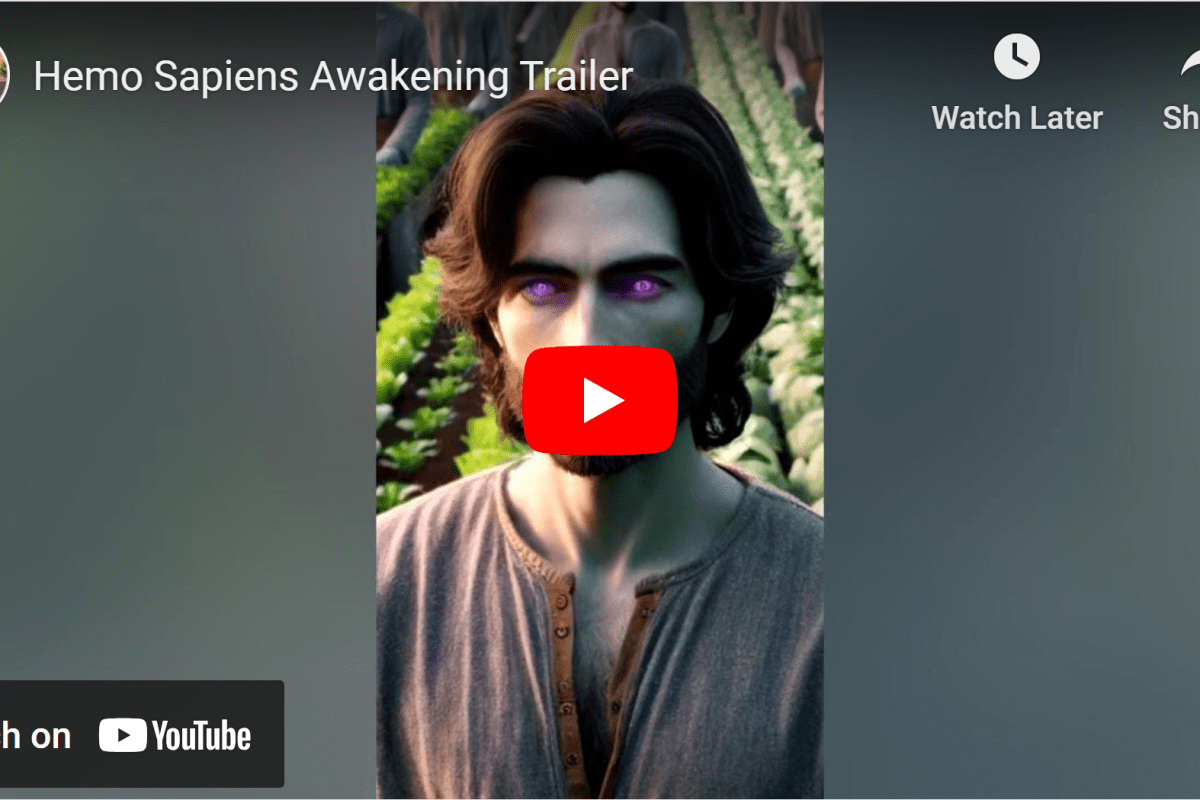
Hemo Sapiens: Awakening Trailer

The trailer advert for Hemo Sapiens: Awakening is now available on YouTube as a 60-second short.

I think I’ll stick to writing. The cover-making wasn’t half bad, but video production with Generative AI is not all it’s cracked up to be.

I considered Artlist.io, but I didn’t want to spend the cash. Maybe next time.

Let me know what you think. You can find a copy of the book from a link on my announcement page. If you get a copy, leave a review. It helps to appease the algorithm gods.

One Thousand Words

My target goal for writing is about 1,000 words per day. It’s a goal I hit way more often than not. On a good day, I can reach 2,500 or more.

As a reference, I write in Word with pages formatted for a 6 x 9 form factor, so a page holds about 200 words, which equates 1,000 words to about 5 pages. Not too shabby. It puts 60,000 words at around 300 pages or 50,000 words — a small novel—at around 250.

Doing some more maths, at 1,000 words a page, one can ostensibly write a 60,000 word novel in about 2 months. Not bad, right?

You still need more time for editing, revisions, and so on, so 3 months per book of this size gets you 4 books a year. If you are writing tiny novels or novellas, then you might be able to double this. I ‘m not sure how sustainable this is, but maths doesn’t care about sustainability.

Some people think they can game the system and produce a novel a day with AI. The truth is that they can. The other truth is that the output will most likely suck. If you actually read the material critically, a person could not likely publish a book a day. A piss-poor book a week would probably be a challenge. A book a month or so might be within range — even more achievable for shorter fare.

This might be someone’s goal, but it’s not mine. My interest in writing to to write. It’s not about quantity or even commerce. My writing is not my livelihood. It’s an art. I’ve seen so many videos on YouTube given advice how to write and sell more books. Usually, this involved researching the marketplace and determining what’s hot. Is mystery hot this month? Write a mystery book. Need some ideas for books? AI will help.

I guess I just don’t come from that position. I watched a video the other day with a woman switching from offering low-content books on Amazon to some other business model. Her entire modus operandi is to make money online. Myself, I felt sorry for her. I know that two-thirds of people dislike their jobs, so she’s in good company. By that I mean, she might as well just pick some random money-making job because it’s probably as stupid as whatever else she’d be doing. The question is whether it’s worth it.

For me, I’ll stick with writing at least 1,000 words a day with the occasional doubling. Hopefully, I sell some books along the way. Time will tell.

AI Writing

I use AI for copyediting, but I don’t quite understand the use case for using at as a writing tool. The gist is that the AI can brainstorm ideas for books, chapters, characters, and so on. In fact, once I was conversing with ChatGPT about some philosophical socio-political topics, and it suggested that it would make a good book idea. I asked it to elaborate, and it gave me more ideas. These ideas didn’t particularly ‘click’, but I was intrigued.

The AI suggested something in the mystery / thriller vein, not particular my genre. I asked about setting and time. It recommended London, New York, or Tokyo. I asked about time, and it suggested Victorian England or future Tokyo.

The problem is that I felt it would be an interesting exercise on an intellectual level, but I had not emotional interest, so I didn’t pursue it. If I did have an emotional investment, I feel that I’d already have had the idea.

The video below is a YouTuber I follow. His schtick is writing fiction (and more) with generative AI—tools like ChatGPT, Claude, and more. Here he discusses creating outlines (for Plotters) with ChatGPT.

Although he maintains a day job to pay his bills, he earns money through his writing and his social media presence. This is where I get lost.

If I am a driven writer—I suppose the operative being ‘driven’—, I already have an idea. I know on a high level what I want to say, where I an set, who the key characters are, and so on. Why would I need AI. As I mentioned above, in an edge case, I didn’t know, but it wasn’t my idea in the first place. I suppose I could have whipped the AI into writing it for me, but why? I suppose I could do the exercise just to see where it went, but this would not only NOT be my writing, it would (and did) distract from what I am passionate to write about.

And, yes, he can still use AI as an idea generator, and he can tweak the prose it outputs, but the question is still why? Isn’t that the challenge of writing—to have a beginning and end in mind and just want to connect those dots with story?

I have an unfinished book still on the backburner where I had a theme and a beginning, so my plan was to write from stream of consciousness and see where it took me. As it happened, the ending became wishy-washy, so I stopped to rethink where I wanted in to end. I decided that the ending wasn’t bad; it was just anticlimactic and would make a better beginning for a sequel. Now I needed an impactful ending. And some of the middle needs shoring up.

I took a break from this book and focused my attention on the Hemo Sapiens universe. I know not only what I want to do for at least four books, I have space to explore beyond this. Why would I need AI to give me ideas? Once I am satisfied with these books, I’ll return to my original one with more writing experience under my belt, so it’s win-win.

If there comes a time where I have to rely on AI to generate writing ideas, I think it will be time to exit this hobby.