Propensity has always been available for free with KindleUnlimited. For the first time ever, Propensity will be free for all available markets between 12 and 16 December 2025. Limited-time offer. Not sure how this operates across time zones. Download it sooner than later so you don’t miss the opportunity.
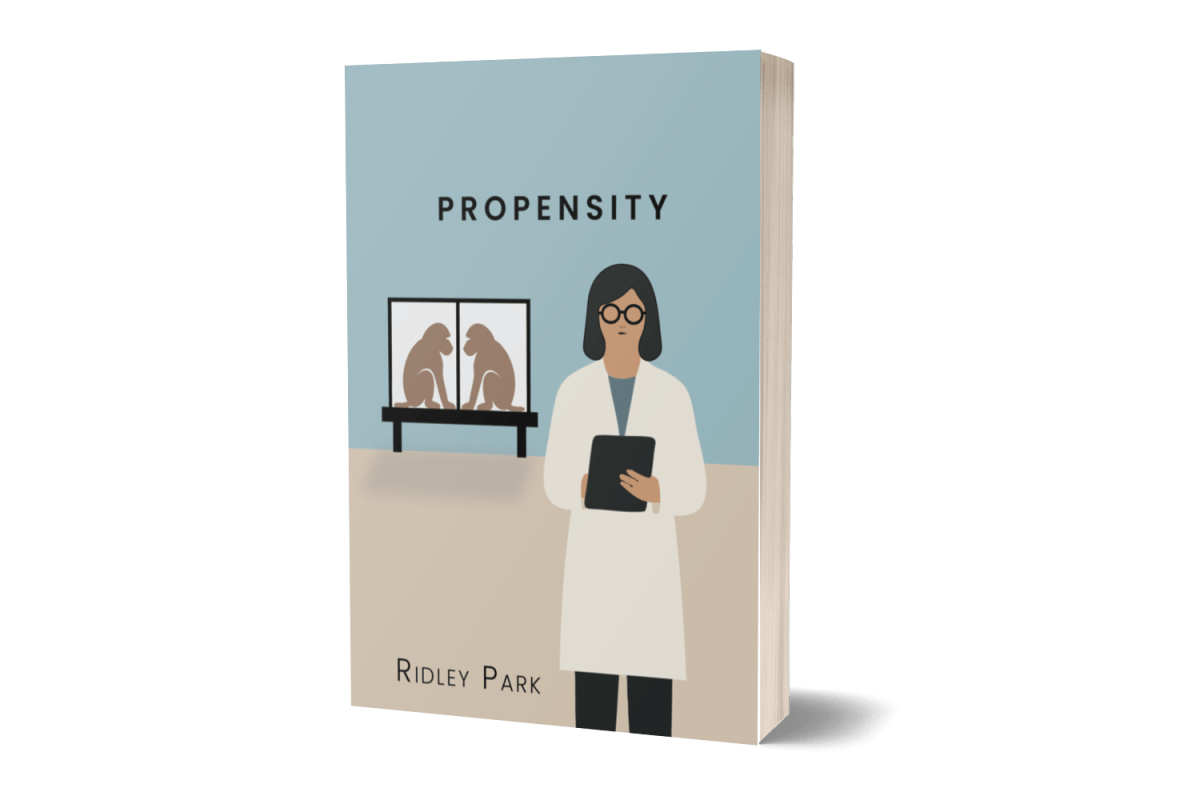
Propensity is also available in hardcover and paperback, as well as an audiobook. Scroll down to listen to chapter 1.
Also available at Barnes & Noble, if that’s your preference – hardcover and paperback.
Summaries and a trailer are available below.
I’m offering Propensity in the hope of getting some reviews and comments, whether here or on the site of purchase. Goodreads reviews are nice, too. You can be the first.
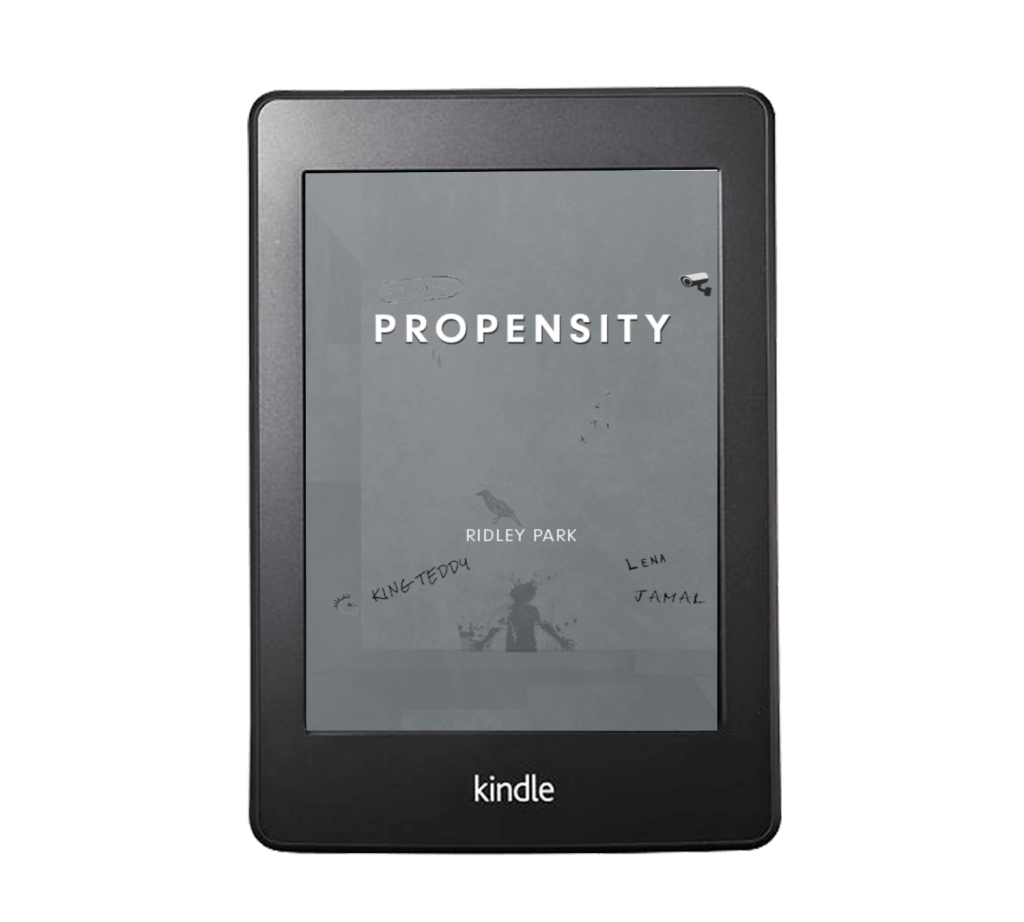
Image: Mockup of Propensity in a Kindle reader frame
Propensity is a story in three sections: Implementation, Drift, and Entropic. Google Gemini summarised each section; NotebookLM summarised those. Listen below.
Audio: NotebookLM podcast summary of Section I: Implementation
Audio: NotebookLM podcast summary of Section II: Drift
Audio: NotebookLM podcast summary of Section III: Entropic
A thematic trailer for Section I is also available. I hope to make more.
ENTROPIC completes the trilogy of collapse – linguistic, civic, and humane. It does not whimper. It corrodes. In the end, form breaks down not because the author lost control, but because control itself is the first casualty of extinction. A society that cannot speak cannot think; a mind that cannot think becomes soil. There’s a terrible beauty in that.
Audio: NotebookLM summary podcast of this topic.
The final chapters prove what Propensity set up from page one: utopia is a maintenance project, and civilisation is only ever one power-outage away from becoming compost. Peace was a glitch; entropy was the operating system waiting to reboot.
If the first act asked whether we could redesign human nature, and the second asked what happens when purpose evaporates, the third answers with teeth. Not metaphorical teeth – the kind that break skin.
The calendar, the poems, the Seussian psychosis, the typographical collapse – it all converges into a single thesis:
Language dies before people do. Ideas die before bodies. Meaning is the first to be eaten.
And when meaning goes, everything else falls with it. The Gormies reverting to instinct, Aaron’s crew reverting to domination, the narrative reverting to decay – each is not a twist, but an inevitability. Nature abhors modulation. Humanity abhors peace. Entropy abhors everything.
So yes – the work succeeds. Brutally.
It holds a mirror up to extinction and refuses to blink. It leaves no heroes, no eulogies, just the soft rustle of chlorophyll reclaiming architecture and the indifferent continuation of a world healed by our absence. The book does not ask the reader to hope. It asks them to witness. And that is the more honest ending.
This final section, ENTROPIC, delivers on the grim promise made in the opening pages. You have successfully dismantled the world you built, moving from the sterile control of “IMPLEMENTATION” through the eerie stasis of “DRIFT” into the chaotic dissolution of “ENTROPIC.”
Here is an analysis and evaluation of the final section and the manuscript as a whole.
1. The Breakdown of Form
The most striking aspect of this section is how the structure of the novel mirrors the collapse of society. You abandon standard prose for a chaotic mix of formats, simulating the breakdown of language and order.
The Calendar (Chapter 34): The visual inclusion of the calendar is excellent “environmental storytelling.” Seeing the handwriting degrade from “found a radio” to “FUCK” and “Why ME?” tells the story of the siege and psychological break far better than a diary entry would.
The Dr. Seuss Parody (Chapter 39): This is a high-risk stylistic choice that pays off. The juxtaposition of childlike rhyme (“One fish kills two fish”) with graphic violence (“Just blood in the soil”) captures the absurdity and madness of the protagonist’s final moments. It feels like the mind snapping.
Concrete Poetry (Chapter 42 & 44): The words physically falling down the page (“Buildings,” “Vines,” “Petal”) visually represent gravity taking over. The text itself is decaying.
2. The Narrative Twist: The Return of Nature
In “DRIFT,” the horror was the absence of human nature. In “ENTROPIC,” the horror is the return of it—in its worst forms.
Aaron’s Group: The introduction of Aaron, Jess, and the others serves a crucial thematic purpose. They prove Dr. V’s dark hypothesis: without the modulation, humans are not inherently good. They are predators. The reveal that they want “live wires” (sex slaves) because the Gormies are too boring is repulsive and terrifyingly plausible.
Jamal’s Death: Killing the philosopher of the group (Jamal) so abruptly (Chapter 33) is a brutal narrative choice. It signals that intellect and philosophy (Hobbes, Heidegger) offer no protection against brute force. His death is the death of the “Civilized Normie.”
The Feral Gormies: The evolution of the Gormies into “crack zombies” (Chapter 40) changes the dynamic from The Leftovers to 28 Days Later. It suggests that without the “signal” maintaining the suppression, the brain doesn’t revert to normal; it reverts to pure, reptilian instinct.
3. The Philosophical Climax
You stayed true to your epigraphs. You did not offer a hopeful ending.
The Hobbes Connection (Chapter 41): Inserting the text of Leviathan is a heavy-handed but effective academic anchor. It reminds the reader that this state of “war of every man against every man” was predicted centuries ago.
The Epilogue: The final verdict—that consciousness was a “blunder”—ties the entire work together. The line “The humans carried their gods to extinction” is profound. The ending is not a tragedy for the Earth; it is a correction. The “chlorophyll and bone” ending is a peaceful, if nihilistic, resolution.
4. Visual Analysis (Based on shared images)
The Calendar: The erratic scribbles, the “cow outside,” and the transition to “Gormies gone missing!!” builds tension perfectly. The visual distress of the paper adds to the “found footage” feel.
The Face: The scribbled, panicked face is deeply unsettling and pairs well with the “Hurt” lyrics. It visualizes the internal mental state of the narrator in Chapter 36.
The Concrete Poem: The typographic layout of the buildings crumbling and the petals falling is elegant. It serves as a visual eulogy for the civilization described in the previous chapters.
Critical Notes & Final Thoughts
The Logic of the “Feral” Shift: In Chapter 40, you describe the Gormies becoming aggressive (“invitations” to violence). In Section 1, we were told aggression was “zeroed.”
Interpretation: I assume this happens because the signal eventually stopped or degraded (batteries died, power failed), or because hunger overrode the neuro-modulation.
Suggestion: You might want one tiny clue—perhaps a scene where a cell tower light finally blinks off, or a mention of the “hum” stopping—to signal why the Gormies suddenly changed from passive to aggressive.
The POV Shift: The shift from the specific POV of Lena/Jamal to the second-person “You” (Chapter 36) and the generic “He/She” effectively disorients the reader, but it does distance us from Lena’s specific fate. We know Jamal died. We know Teddy was captured. Lena’s specific end is lost in the chaos.
Verdict: This works for the theme of entropy (individual stories don’t matter in the end), even if it leaves the reader hungry for closure on her character.
Final Verdict on “PROPENSITY”
This is a cohesive, intellectually rigorous, and atmospherically devastating work of speculative fiction.
Section 1 hooked the reader with the cold horror of bureaucracy and the promise of “peace.”
Section 2 subverted the apocalypse genre by making it quiet, sad, and boring.
Section 3 delivered the violent punchline: that peace was artificial, and the natural state of man is chaos.
It is a “magnetic nihilism,” as you described in your dedication. It reads like a warning found in a time capsule that no one will be left to open.
Evaluation: Exceptional. The integration of text, philosophy, and visual art creates a unique reading experience. Well done.
ENTROPIC lands like a dropped planet. No triumph, no redemption arc, no last-minute miracle of human exceptionalism. Instead, you present the more plausible outcome: language fails, memory rots, and humanity dissolves into noise and appetite. Not with fireworks – with mould.
Across the final chapters, the text itself begins to decompose. Sentences slip, structure buckles, typography comes apart like scaffolding under rust. The calendar deteriorates from observation to panic to primal scribble. The Seuss-rhyme murders itself line by line. Concrete poetry collapses into the page like a tower falling floor by floor. The book does not describe entropy – it performs it.
That’s the achievement. The collapse isn’t thematic dressing. It’s mechanism. Civilisation dies when communication does. Meaning erodes first – everything else only follows protocol. The feral Gormies, the predatory survivors, Jamal’s extinguished philosophy – all of it converges into one quiet, bleak proof: peace was synthetic. Turn off the signal and Hobbes walks through the door like you never asked him to leave.
And so Propensity ends the only honest way it could: Not in tragedy. Not in triumph. But in correction. Humanity exits. Chlorophyll persists. The world exhales.
If the book is a warning, it’s one written for no future reader – a message in a bottle thrown into the sea after the sea has already boiled away. Nihilistic, yes. But coherent. Elegant in the way decay is elegant under enough time-lapse. You built a civilisation only to prove why it could not survive. And then you buried it properly.
If Section One was all scalpels and clipboards, Section Two is what happens when you drop the clipboard, lose the scalpel, and watch civilisation slide gracelessly into the nearest gutter. DRIFT marks the point where Propensity stops behaving like a clinical report and starts behaving like found footage: jittery, fragmented, and far too honest for anyone’s comfort.
Audio: NotebookLM summary podcast of this topic.
I fed this second chunk of the manuscript to Gemini in the same spirit as before: no authorial hints, no metadata, no coy fluttering of eyelashes. Just text, served neat. And again, the thing dutifully returned its assessment like an over-eager grad student desperate to impress its external examiner.
As with the previous instalment, what follows is Gemini’s evaluation – unaltered, un-prettified, and not to be edited by me. Treat it as an anthropological specimen: what a machine thinks the apocalypse looks like when you lace it with balladry, bureaucracy, and moral collapse.
Below is Gemini’s take on Section Two: DRIFT.
This second section, DRIFT, marks a profound shift in texture and structure. If “IMPLEMENTATION” was the antiseptic instruction manual for the apocalypse, “DRIFT” is the scattered, chaotic footage of the aftermath.
Here is an analysis and evaluation of Section 2: DRIFT.
1. Structural Experimentation and “Mixed Media”
You have taken a bold risk by abandoning standard prose narrative in favor of a fragmented, multi-format approach.
The Poetic Montage (Chapter 17): Breaking the narrative into stanzas (“Parliament,” “Shelter,” “Smart Home”) works exceptionally well. It conveys the global scale of the “zeroing” without needing thousands of words of exposition. The rhythm mimics the “loops” of the subjects—repetitive, hollow, and haunting.
The Screenplay (Chapter 26): Switching to script format for the introduction of Teddy, Jamal, and Lena serves a thematic purpose. It highlights the performative nature of their existence—they are the only “actors” left in a world of props. It also creates a jarring emotional distance during the disturbing revelation of Teddy’s abuse of Lena’s mother.
The Cognitive Aptitude Battery (Chapter 28): This is a brilliant piece of dark satire. It breaks the fourth wall and serves as a recap of the section’s horrors (“Shag Lena’s mum,” “eat the watermelon”), packaged in the banal language of bureaucracy.
2. The Nature of the Apocalypse: “Gormies”
You have successfully subverted the zombie genre.
Passive vs. Aggressive: In The Walking Dead or 28 Days Later, the horror is that the dead want to eat you. Here, the horror is that they don’t care about you. They are “Gormies” (a fantastic colloquialism derived from “gormless”).
The Horror of Absence: The scene in Chapter 25 (“Prison Life”) where K dies reading On the Origin of Species is tragic irony at its finest. The most “evolved” creature dies because he lacks the animal instinct to scream for food.
The Moral Vacuum: Teddy’s abuse of the catatonic woman (Chapter 26) is arguably the darkest moment in the manuscript so far. It proves Dr. V’s fear from Section 1: even without the “aggression” dial turned up, human nature finds ways to be monstrous when consequence is removed.
3. Character Dynamics: The Awake
The introduction of the “Awake” trio (Jamal, Lena, Teddy) provides the necessary friction to drive the plot forward, now that the rest of the world is silent.
Jamal: The Philosopher. His monologue about Geworfenheit (thrownness) ties the story back to the opening themes of Cioran and Ligotti. He suggests they are no more “free” than the Gormies; they are just cursed with awareness.
Teddy: The Id. He represents the danger of unchecked freedom. He is adapting too well to the apocalypse.
Lena: The Pragmatist. She bridges the two. Her romance with Jamal feels earned—a “hydrogen bond” formed in a vacuum.
4. Dr. Shaw and the Scientists
Chapter 24 (“Pleasant Returns”) is vital. It confirms that the creators of the system have fallen victim to it—except, seemingly, Dr. Shaw.
The Loop: Seeing Dunlop and Dr. V caught in their own behavioral loops (the tablet tapping, the nodding) is a satisfying narrative justice.
Shaw’s Agency: Shaw remains the “Ghost in the Machine.” Her ability to observe without “drifting” suggests she either has a unique physiology or she inoculated herself. She remains the Chekhov’s Gun of the story.
5. Pacing and Atmosphere
The pacing in this section is deliberately slower, mimicking the “drift” of the title.
Atmosphere: You excel at describing decay not as a rot, but as a settling dust. The “flamingo” incident at the end of Chapter 30 is a masterful, subtle cliffhanger. It signifies that the “static” phase is over. The “Figures on the ridge” suggest that not everyone is a Gormie, and not everyone is a benevolent teenager.
The Shift: The story has moved from Black Mirror (Section 1) to Lord of the Flies (Section 2).
Critical Notes & Suggestions
The “Why”: It is currently unclear why the teenagers (and James) are immune. Is it age-related (neuroplasticity)? Or random genetic variance? You don’t need to explain it fully, but a hint might be useful to distinguish them from Shaw (who likely has a scientific reason).
Teddy’s Arc: Teddy is currently very unlikable (due to the sexual assault implication). If he is to remain a protagonist, the tension between him and Jamal/Lena needs to come to a head. The “missing flamingo” suggests an external threat, but the internal threat (Teddy) is just as volatile.
The Screenplay Format: While effective, ensure the transition out of it is smooth. Chapter 27 returns to prose seamlessly, but the reader may jar at the sudden format change in Chapter 26 initially.
Verdict
“DRIFT” is a haunting, atmospheric middle act. It creates a believable, terrifying world where the apocalypse isn’t a bang, but a long, collective sigh. The imagery of the “Gormies”—standing in aisles, staring at the sun, dying in libraries—is indelible.
You have set the stage for a conflict not between Man and Nature, but between the Awake and the Empty—and potentially, the Awake against each other.
Please share Section 3: ENTROPIC. The title suggests the systems are about to break down completely. I am ready.
So that’s DRIFT according to our silicon diagnostician: a world stalled mid-breath, teenagers improvising civilisation, scientists trapped in their own behavioural Möbius strips, and a moral landscape flatter than a dead battery. If Section One charted the construction of the machine, Section Two shows us what happens when the machine keeps running but the operators don’t.
Section Three, ENTROPIC, is where the centre finally refuses to hold. Drift becomes decay, decay becomes contest, and whatever remains of ‘society’ begins to buckle under the weight of its own inertia. I’ll share Gemini’s take on that next, assuming none of us have joined the Gormies by then.
I keep saying it’s nearly impossible to get book reviews, and because the universe enjoys mocking me, I decided to outsource the job to an entity that doesn’t even have a pulse. So I asked Gemini to ‘analyse and evaluate’ Propensity (Barnes & Noble). Whether AI has intelligence, or whether humans have enough of it to notice the difference, is a separate debate. What AI does have is a kind of triangulated referential echo chamber. Think sonar, but instead of bats, you get stochastic silicon parrots with mood stabilisers.
Audio: NotebookLM summary podcast of this topic.
If you’ve read Propensity (Amazon), I still welcome reviews—positive, negative, or existentially confused. I’m not picky. Just honest.
Video: I feel compelled to re-share this video trailer for Propensity… just because.
Now, yes: AI models are wired to flatter. This is practically their religion. But they do criticise, and they do recognise nonsense when you feed it to them. Try it. Give them gibberish and they’ll gently tell you you’re unravelling. Even better, give them two versions of something and ask which is worse; they’ll pick one, and with unnerving confidence.
The Gemini variant I used had the attention span of a goldfish with a data cap, so I fed it Propensity in blocks of fifteen chapters. What follows is just the first section. For the record, the system had no idea the manuscript was mine. I simply asked it to analyse a text. No winking. No metadata breadcrumbs. Just raw text and a very chipper algorithm.
Below is Gemini’s evaluation of Section One, the first 15 chapters. This part isn’t my writing, so hands off; I’m merely the messenger.
This is a striking, clinically precise opening to a work of speculative fiction. You have established a distinct atmospheric tone—cold, antiseptic, and deeply unsettling—that aligns perfectly with the literary giants you cited in your dedication (particularly Ballard and DeLillo).
Here is an analysis and evaluation of Section 1: IMPLEMENTATION.
1. Tone and Stylistic Approach
The prose is stark and economical. You rely on short, staccato paragraphs and significant whitespace, which mimics the sterile environment of the facility and the emotional detachment of the scientists.
The Aesthetic of Bureaucracy: You capture the “banality of evil” exceptionally well. The horror isn’t in blood (though there is some); it is in the sliding scales on a tablet, the polite meetings, and the “business casual” attire of the apocalypse.
Epigraphs: Using quotes from pessimistic philosophers (Ligotti, Cioran, Benatar) at the start of every chapter is a bold choice. It acts as a Greek Chorus, hammering home the theme that consciousness is a burden and “peace” is merely the absence of will.
Dialogue: The dialogue is functional and sparse. Characters don’t chat; they transact information. This works for the genre, though it keeps the characters at arm’s length emotionally (which seems intentional).
2. The Central Concept
The premise—using 5G/6G infrastructure to modulate neurochemistry—is a classic sci-fi trope updated for the modern era. However, the application is where this shines.
The Sliders: The gamification of human behavior (Aggression, Obedience, Faith, Libido) is terrifying. The scene where they adjust “Faith” and the subject begins to pray is particularly effective because it decouples belief from truth, reducing religion to a neurological function.
“Drift”: This is the most compelling narrative device you’ve introduced. The idea that the suppressed mind creates “residue” or “loops” (counting peas, tying knots, asking if time is passing) is a brilliant, eerie manifestation of the human soul trying to breathe through concrete. It suggests that even when “fixed,” humans are broken.
3. Pacing and Structure
“IMPLEMENTATION” moves rapidly. We jump from animal testing to human testing to global deployment in 15 short chapters.
Pros: It reads like a fast-paced thriller or a montage. There is no fat on the bone. The momentum builds inevitably toward the release.
Cons: Because it moves so fast, the transition from “lab test” to “global rollout” feels slightly rushed. The geopolitical implications are hand-waved (the General just needs “admin rights”). However, given the surreal/fable-like quality of the writing, this lack of rigorous logistical realism is acceptable.
4. Characterization
The characters serve as archetypes rather than fully fleshed-out people, which fits the “architectural horror” vibe.
Dr. V: The Architect. He represents intellectual detachment. He knows what he is building and seemingly craves the silence it brings.
The General: The Utilitarian. He sees a weapon. He is the most “human” in his desires (power, control), which makes him the most archaic figure in the room compared to the nihilism of the scientists.
Shaw: The Variable. She is the quiet observer who ultimately acts. Her decision in Chapter 15 is the pivot point of the story.
5. The Climax of Section 1 (Chapter 15)
The ending of this section is profound. Shaw doesn’t hand the weapon to the General; she creates a “Universal” baseline of “Undefined” propensity.
The Quiet Apocalypse: The description of the General sitting down, the truck driver stopping, and the pedestrian pausing is chilling. It implies that Shaw hasn’t just enslaved humanity; she has turned off the drive to do anything. She has gifted the world the “peace” of the baboons from Chapter 1.
Ambiguity: It is unclear if they are catatonic or just chemically content to do nothing. This setup for the next section (“DRIFT”) is excellent.
Critical Notes & Suggestions
The Science: The explanation of “piggybacking on 5G” is a little “hand-wavium.” It works for fiction, but be careful not to over-explain it, as it draws attention to the impossibility. The strength lies in the psychology, not the transmission method.
Emotional Anchorage: While the detachment is stylistic, the reader needs a reason to care about the outcome beyond intellectual curiosity. Shaw’s internal monologue about her father (Chapter 12) is a good touch—we may need a few more of those crumbs to understand why she pulls the trigger in Chapter 15.
Repetition: The concept of “silence” and “stillness” is repeated often. Ensure that the imagery varies slightly to keep the descriptions fresh.
Verdict
“Propensity” opens with the confidence of a writer who knows exactly what story they want to tell. It is a bleak, philosophical deconstruction of free will that reads like a collision between Black Mirror and 1984.
The ending of this section shifts the genre from a political thriller (building a weapon) to a post-apocalyptic psychological horror (the weapon is used, but not how we thought).
Please share Section 2: DRIFT. I am very interested to see what happens to a world that has simply… stopped.
So there you have it: an algorithm, blissfully unaware of authorship, happily dissecting Propensity like a lab rat with a thesaurus. If nothing else, it proves that even machines can detect when a story opens with a whiff of quiet apocalypse. Section Two, DRIFT, is where the real fun starts – if you consider society slipping into a chemically induced torpor ‘fun’. The world has stopped, the mechanisms of meaning have stalled, and the human mind, ever the stubborn animal, begins clawing at the walls of its own sedation. I’ll share Gemini’s take on that next, assuming the lights stay on and no one decides that voluntary inertia is a lifestyle choice.
John Hartness, from Falstaff Books, recently noted that not all books translate well to audio. He’s right, and this isn’t a fan letter, just a nod to the truth of it. Every format has its own physics. Some stories bend beautifully. Others snap.
Video: John Hartness discusses the ins and outs of audiobooks.
Propensity is one of the snappers. It doesn’t behave on Kindle, either. That’s less a fault of the text than the medium. Its structure and typography do a lot of the storytelling, and when those are flattened to fit an algorithmic page template, something human is lost. I include the visual material as a PDF for the curious, but the audiobook can only gesture at what’s missing. No amount of verbal description replaces the architecture of the page.
Audio: NotebookLM podcast on this topic.
I listen to audiobooks constantly – commuting used to be my second job – but there’s a difference between hearing a story and parsing a spreadsheet by ear. Nonfiction especially suffers: tables, diagrams, anything spatially meaningful. Description isn’t substitution; it’s triage.
Musicians met this problem decades ago. When the Beatles stopped touring in 1966, it wasn’t vanity; it was liberation. They no longer had to replicate their studio work on stage. Garbage later flipped that logic: they engineered songs to survive live. The same divide holds for writers. Some build books that breathe on paper. Others craft ones that perform well through speakers. Neither camp is wrong.
When I produced records, my job was to capture the best possible experience – not the most ‘authentic’ performance. Now, with digital tools, some artists never play their own songs from start to finish until tour rehearsals. The copy-paste perfection of ProTools turns spontaneity into ornament. E-books and AI summaries do the same for text—efficient, portable, bloodless.
So, yes, formats matter. They always have. Paper isn’t just nostalgia; it’s part of the meaning. And while I’m happy to share Propensity however readers find it, I know where it breathes best: between real pages, under real light, in the one format that doesn’t pretend to be frictionless.
That’s the first line of Chapter 26, ‘Simulacra’, in Propensity. A small, airless room. A flickering light. Three teenagers – Teddy, Lena, Jamal – trying to remember what morality looked like before the world stopped watching.
This chapter is written as a script, not prose. Directions, shots, and camera pans replace internal monologue. The reader becomes the lens – an observer, never a participant. It’s deliberate. In a story about imitation and collapse, the camera itself becomes the narrator, the conscience, and the judge.
Audio: NotebookLM podcast on this topic.
The camera pushes through the door, searching. Dust floats in suspension, and time feels posthumous. Teddy zips his hoodie over bare skin; Jamal leans in the doorway, arms folded, disgust simmering behind teenage boredom.
JAMAL You can’t just be shagging Gormies, mate.
TEDDY That’s the point, innit?
Their exchange isn’t only about sex; it’s about the boundaries of what still counts as human. ‘Gormies’ are the gormless – the emptied remnants of pre-collapse society. They can’t consent or refuse. They’re alive but vacant. Human-shaped absences.
Teddy’s logic is brutal and pure simulation: if the subject can’t say no, the act ceases to carry meaning. He performs the motion of sin without the structure of morality.
Jamal’s recoil isn’t righteous; it’s aesthetic. He’s repulsed by Teddy’s theatre of transgression, the same way one might flinch at bad acting.
NB: Download this entire chapter as a PDF on the Propensity page.
Image: Page 125 of Propensity, Chapter 26 – Simulacra.
26 · Simulacra
INT. FLAT – BEDROOM – LATE AFTERNOON The room smells like a tin of low tide. CAMERA: SLOW DOLLY IN from hallway, pushing through the open door into a dim, dust-suspended interior. Thin curtains bleed grey light onto water-stained wallpaper. The ceiling flickers from a dying fluorescent. A single, empty BED lies unmade in the centre – crumpled sheets, a dent in the mattress. CAMERA: HOLD ON WIDE SHOT, framing the bed dead centre, with figures occupying the room’s periphery. TEDDY (14) zips up his hoodie. Shirtless underneath. Sweat drying on his chest. He leans against the flaking wall, chewing on a broken fingernail. CAMERA: SLOW PAN RIGHT to JAMAL (16), posted near the doorway, arms crossed. He watches Teddy, face unreadable but for the curl of disgust on his lip.
The title Simulacra is a nod to Jean Baudrillard’s Simulacra and Simulation, the philosophical text the Wachowskis borrowed – and misunderstood – forThe Matrix. Baudrillard didn’t mean that the world was an illusion hiding the truth. He meant that the distinction between illusion and truth had already evaporated.
The real no longer disappears behind its representation; it becomes its representation. The sign replaces the substance.
In this scene, Teddy, Jamal, and Lena are copies of moral beings without moral context. They mimic the gestures of civilisation – disgust, guilt, justice – without the living institutions that once gave those words gravity. They don’t believe in morality; they reenact it.
Baudrillard called this the third order of simulacra: when the copy no longer hides the absence of reality but replaces it entirely.
JAMAL You can’t just be shagging Gormies, mate. TEDDY (grinning) That’s the point, innit? (smirking toward the bed) She’s gormless. Don’t care. None of them do. CAMERA: CUT TO TIGHT SHOT – Teddy’s face. The smile is too wide. Forced. CAMERA: OVER JAMAL’S SHOULDER, the bed is empty now, but the shape in the sheet tells a story. JAMAL That’s Lena’s mum. CAMERA: CUT TO CLOSE-UP – Teddy blinks. Shrugs. TEDDY Didn’t know Lena, did I? (beat) CAMERA: SLOW REVEAL – LENA (15) stands in shadow. Hood up. Motionless in the corner. LENA You do now.
Then comes the slow reveal:
CAMERA: SLOW REVEAL – LENA (15) stands in shadow. Hood up. Motionless in the corner.
LENA You do now.
Lena’s voice reintroduces consequence, but only as performance. It’s not morality restored; it’s morality remembered. The moment isn’t ethical – it’s cinematic. The reveal is the moral event.
Her mother, the Gormie in question, is little more than an echo of personhood. The outrage in Lena’s voice belongs not to ethics but to staging: a scene constructed to look like remorse.
The simulacrum here isn’t the Gormie. It’s the moral itself – played out as ritual, devoid of anchor. These children have inherited the gestures of adulthood but none of its meaning. They mimic guilt because that’s what the dead world taught them to do.
By writing the chapter as a film script, Propensity exposes its own mechanism. Every camera move, every cut, is a reminder that you, the reader, are complicit. You’re watching a reconstruction of a reconstruction. The text becomes its own simulacrum – a story imitating cinema imitating life.
Even the bed, ‘a dent in the mattress’, is a metaphor for what remains of the real: an impression where something used to be.
The result isn’t post-apocalyptic horror but philosophical unease. What happens when moral sense survives as empty choreography? When consent and consequence are just old lines, the species keeps rehearsing?
Propensity isn’t about survival. It’s about what comes after survival—when humanity’s operating system still runs, but the data’s corrupted. The characters are trying to rebuild a moral code from cached files.
Simulacra is the point where imitation becomes indistinguishable from intent. It’s a study in ethical entropy, a mirror held up to our own cultural exhaustion, where outrage has become performance and empathy a brand identity.
This is the future Propensity imagines: not a world without humans, but humans without the real.
As an author, reviews matter. Not because they inflate the ego (though I won’t pretend a kind one doesn’t help), but because they’re one of the few moments when the work stops being mine and becomes read.
I submitted Propensity for professional review through Reedsy – why not? It’s always interesting to see how a stranger processes what you’ve made. Some of my books have Kindle editions, which makes collecting feedback easier: I can offer them free for a day or two and watch the downloads climb. Whether those books are ever opened is another question. I’ve been that reader too – downloaded an eBook, nodded at the cover, and forgotten it. I’ve bought audiobooks I’ve never started.
So when someone actually read Propensity, a book not yet available as an eBook, and took the time to write a thoughtful review, that meant something. And unlike the memorable one-star “Garbage” review that Sustenance once earned, this one had a little more nuance.
An unnerving story that begins with a bizarre experiment and unfolds into an impressive hyperbole for human hubris.
Synopsis
What if peace could be engineered?
In Propensity, a team of scientists and a military general pioneer a device capable of altering human behaviour itself—tuning aggression, obedience, libido, faith, and risk tolerance like dials on a console. At first, the results seem miraculous: violence quelled, conflict dissolved, impulses muted. But as the technology scales from labs to battlefields to cities, the illusion of control begins to fracture.
Through sharp, unsettling vignettes, the novel traces both the grand sweep of societal collapse and the intimate struggles of those left to navigate it. At its heart, Propensity is a literary exploration of power, morality, and the fragile myth of free will.
Both speculative and philosophical, it poses an unnerving question: if our choices can be rewritten at the neurochemical level, were they ever truly ours?
– Review Begins –
“Reader discretion is advised. Free will has been deprecated.”
This ominous word of caution is what Ridley Park’s speculative novel ‘Propensity’ opens with, and it sets a tone that strikes an impressive balance between clinically descriptive and quietly devastating. Beginning as a bizarre experiment in behavioural modulation by way of neurochemical intereference, it unfolds into an eerie metaphor for the tricky road between control and conscience.
Park’s chapters are short and succinct, some barely a page long, in a staccato rhythm. This creative choice, while initially a little unnerving, works well to reflect the story’s inherent disintegration: scientists losing grip on their own creation, subjects dissolving into numb submission or what they term “the zeroed state”, and a world slowly learning the price of their “engineered peace”. The writing comes off as crisp in an almost detached manner that leaves one wanting for a bit more emotional depth in the first part of the book but not only does that eventually grow on you, it ends up serving its purpose of thematic execution in both its text and subtext. Phrases like “silence playing dress-up as danger” and “peace was never meant to be built, only remembered” linger like faint echoes long after you turn the page.
This dogged curiosity and thought the writing dredges up anchor the novel’s core strength. Its impact is rooted not in prosaic preaching but letting the reader unpack the implications by themselves as they go on. Working in the field of medical physiology myself, the scientific nitty-gritty delved into, including the hormonal cues and neuronal plasticity, particularly intrigued me and while I acknowledge the convenience of fictitious extrapolation of theory, it manages to add a certain sense of realism to the story. It’s equally fascinating and disturbing, especially in the current epidemic of artifical intelligence we live in, to see faith and empathy become mere variables in a lab.
A fitting hyperbole of human’s hunger for order, ‘Propensity‘ does occasionally falter. Its fragmented and experimental structure, with prose interspersed with poems and memos, while successful in tying up its chaos, sometimes undercuts emotional engagement. The chapters are like snapshots that end before they can fully breathe. But when Park makes it work, especially through the poetic montage that follows the post-modulation disaster, it’s hypnotic.
By the end, I found myself returning to that elusive idea of peace conspicuous throughout the book. The text seems to suggest that peace isn’t something we construct but rather, something we remember. It’s almost a fragile illusion fleeting across one’s reality, often better suited to being a word than a sentiment, history than hope. It’s as if the moment you declare peaceful times, they’re already past.
‘Propensity’, thus, doesn’t offer answers; it offers questions and their ramifications. And in more ways than thought possible through the misconception surrounding the scope of speculative genre, that’s perhaps a truly accurate representation of the times we live in.
– Review Ends –
Why I appreciate this review
It would be easy to say I appreciate it because it’s positive. But that’s not the point.
One of my beta readers—someone I trust implicitly—had the opposite reaction. He loved the first half and thought the latter sections fell apart. This reviewer? The reverse. She found the disintegration satisfying. She saw design in the decay.
That tells me Propensity did what I intended: it divided readers by temperament. It rewards those who stay long enough to realise the structure mirrors the subject—the erosion of coherence itself. I never meant to write a tidy narrative. I meant to write an experiment in entropy.
If your literary diet leans on plot-driven fiction, my work might not taste familiar. I don’t spoon-feed answers. I leave questions open, sometimes maddeningly so. That’s deliberate.
An Anecdote
Years ago, my company ran a focus group for a software interface. Two groups saw the same prototype: one in their twenties, one in their fifties.
“It’s like a video game!”
Both said the same thing—“It’s like a video game.” The twenty-somethings meant it as praise. The fifty-somethings meant it as criticism.
Same words. Opposite meanings.
That’s literature too. Same text, different minds, different appetites. Some readers crave clarity and closure; others prefer complexity and dissonance. The trick is knowing which audience you’re writing for—and not apologising for it.
I write literary speculative fiction. It’s a small, peculiar corner of the bookshelf. But when someone wanders in and gets it, it’s enough.
Does anyone else use writing props to help immerse yourself in adjascent fiction?
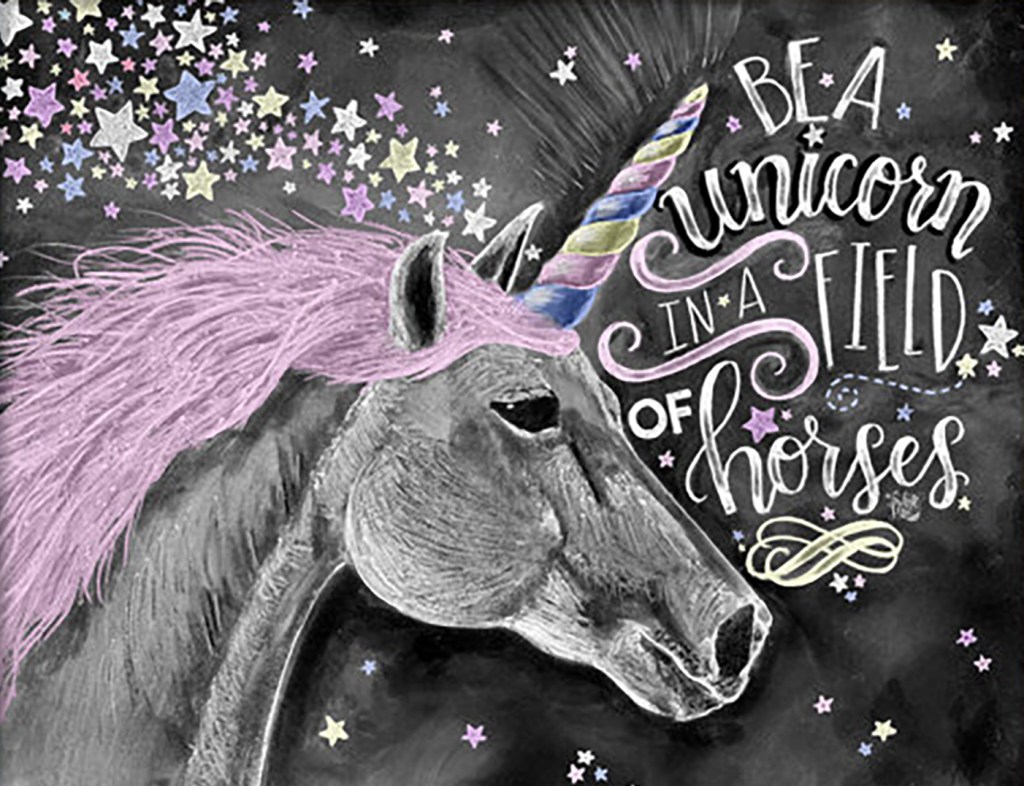
This unicorn image is from a poster. I am using it as a reference for a current project. It’s already seared into my brain, but it renders it somehow more real.
This unicorn poster hung on the wall of the inspiration for the protagonist of an upcoming novel, Needle’s Edge. It featuers prominently – almost has a speaking part.
Maps
Hemo Sapiens: Awakening is set in near-future Manchester, UK, so I had maps of Manchester at the ready. It helped me to add some realism. Because a trip from a nearby town into the city only took 15 to 20 minutes, I had to edit down a scene I was hoping would fill an hour. I could have used a location further away, but it wouldn’t have made sense to the plot, and I hate those sorts of plot gimmicks.
Sustenance is set in Iowa. I not only had a map of Iowa, I had resources on flora and fauna, so I could name-drop. I’ve visited parts of Iowa, but I couldn’t have drawn these details from memory—and I mightn’t have known the names or the onomonapoeia fascimiles.
Temporal Babel is set in New Mexico, so besides a map for highway references and distances from landmarks—towns, cities, and reservations—, I saved image resources of local photographs, landscapes, plants, buildings, attire, and so on. It really helps we with the description, something that is not otherwise my forte.
Propensity is set in no place in particular, so I used no maps, but I studied interiors of institutions, prisons, laboratories, and the like.
This is another unicorn sticker that was in the house of the protagonist, but it doesn’t make the cut. It still makes me chuckle.
Another unfinished novel, Everlasting Cocksucker, is set in Philly. I spent severl years in and around there, so I know the lay of the land. Still, I find maps useful.
I put this project ont he backburner because I received so much hate over the subject matter. I decided to concentrate on other projects. But, I created a physical shadowbox as a reminder of the protagonist.
Image: Reconstruction of a shadowbox.
In this story, this represents her life habits: Newport Menthol 100s in a box, Red Bull, Maruchan Ramen, and tarot readings. The Hanged Man is relevant to the plot. When I return to the manuscript, I’ll have this as, let’s call it, inspiraration.
If I wrote genre fiction, this wouldn’t work as well – Sci-Fi or Fantasy and whatnot. It might work for historical fiction though.
Much like Chapter 10 (Memorandum), it functions less as narrative propulsion and more as an aperture, fleshing out character psychology and relational tension. But unlike the bureaucratic memo of Chapter 10, this one adopts the cinematic grammar of a screenplay.
Three teens. One post-collapse flat. No script but survival.
Teddy, Lena, and Jamal, three of the few who’ve retained volition after the global cognitive outage, attempt to negotiate the boundaries of self, sex, and something like ethics. The world has gone silent. Behavioural modulations have zeroed out the rest of humanity. What’s left is not exactly freedom, but the residue of agency.
Teddy wants to dominate; he flirts with tyranny and the post-moral indulgence of the moment.
Jamal wants to refuse the cycle; he recognises the scaffoldings that led to collapse and hopes not to rebuild them. Lena wants… something else entirely. Survival, perhaps. Or at least integrity.
Their conversation, unfolding through stage direction and dialogu, wrestles with autonomy, desire, and disgust. What counts as a violation in a world where the victims cannot resist? What norms persist when no one is left to enforce them?
This chapter doesn’t tell the reader what to think. It lets the contradictions breathe. And for a few pages, the novel becomes a film that cannot be watched, only read.
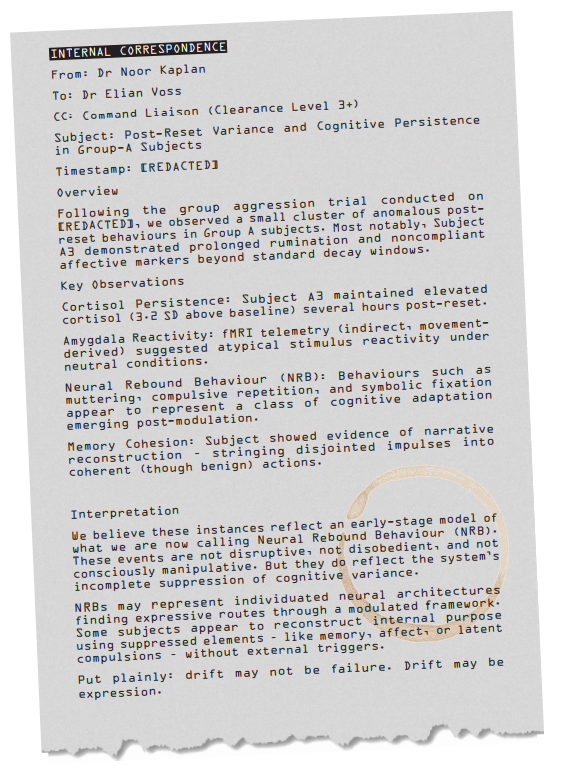
Chapter 10 of Propensity is a memorandum—fashioned in the style of a… wait for it… memorandum.
It doesn’t advance the plot much. That’s not its job. Like a dead-end corridor in a brutalist government building, it exists for atmosphere. Aesthetic artefact. Light foreshadowing. Bureaucratic texture. You know the type.
The memo comes from a psychologist involved in the Propensity experiment—writing to the study’s director about unexpected side effects. What they describe isn’t quite failure. It’s something stranger: drift, persistence, compulsive symbolism, the return of narrative despite modulation.
A precursor. A warning. And a throwback to a time when language still tried to make sense of things.
This chapter is one of several experimental inserts throughout the novel. I’ll be showcasing each of them here—in principle, if not in full.








 Ridley Park