I Return From My Fictional Sabbatical (With Antimemes in Tow)

2–3 minutes

Ridley Park has not been dead, merely sleeping like a hungover deity ignoring its worshippers. As has become my regrettable habit, most of my creative energy has been siphoned into non-fiction projects, leaving the poor world deprived of my fictional offerings and my blog gathering dust like an abandoned cathedral.

But fate – or more accurately, an algorithm – shoved a book into my face with all the subtlety of a street preacher: There Is No Antimemetics Division. Hard science fiction, horror, and something about antimemes. Naturally, I pressed Play Sample instead of behaving like a responsible adult and reading the summary. Antimemetic sounded deliciously unwholesome. Straight down the hatch.

Image: Advert with an author pic for this book.

I’m only into Chapter Two, so don’t expect a full exegesis yet. This is merely a field report from the early trenches.

I bought the Audible version, because audiobooks are the only thing keeping me sane through workouts, where otherwise, one contemplates mortality and the price of groceries. As the sample ran, I learned two things:

  1. Parts of the narrative are redacted.
  2. They did not redact to protect state secrets or Jeffrey Epstein’s ghost.

No – it’s a stylistic device. A textual blackout. Beeps, static, corrupted passages like intercepted voicemail from a doomed expedition. Being partial to experimental prose, I took it as a dare. My brain applauded.

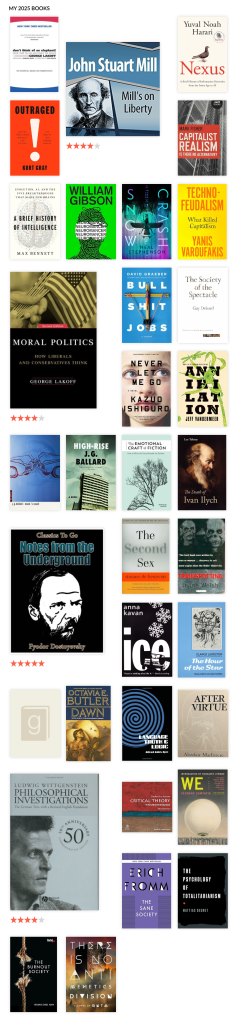
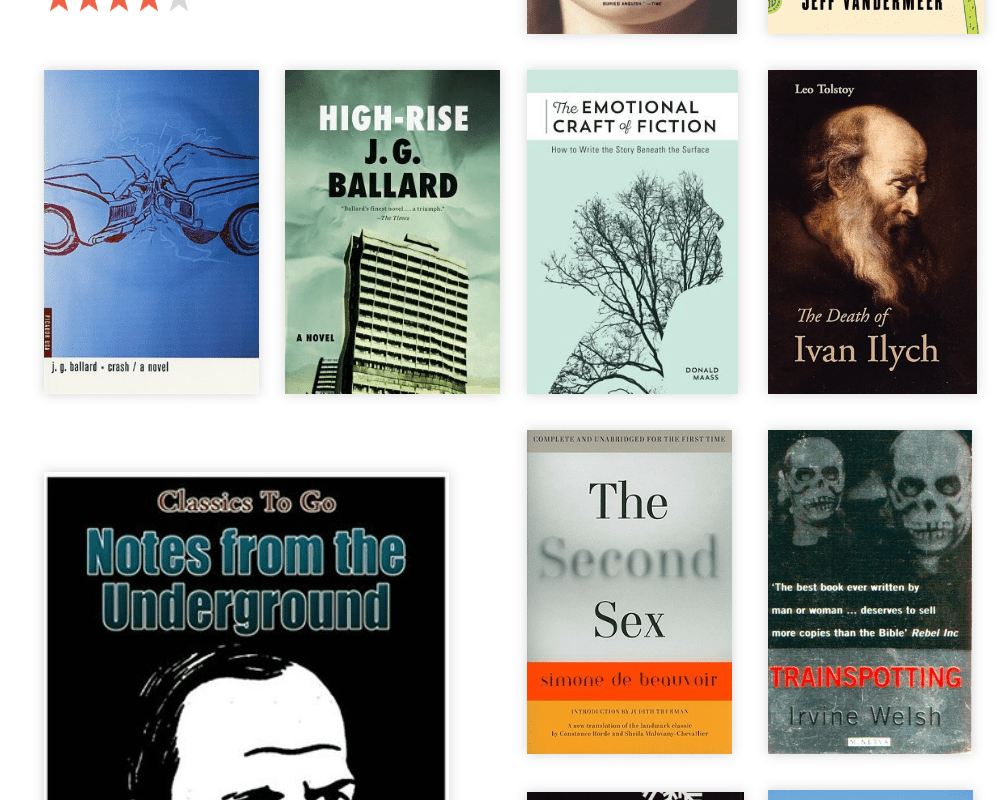
The effect reminded me of Irvine Welsh’s Filth – not in theme, but in the editorial scars, the moth-eaten structure. Welsh, more widely known for Trainspotting, does chaos like astrophysicists do numbers. Obfuscation as aesthetic. Disorder as design. The connection may be superficial, but it’s one worth pocketing.

The title earns its relevance quickly: certain ideas spread like plague; others erase themselves on contact. Antimemes – cognitive black holes. Information that cannot be held without dissolving. A story that fights the mind that reads it.

Hard sci-fi rarely offers such structural mischief. I’m morbidly delighted to see where the horror emerges, when the narrative begins to eat its own memory like a recursive ouroboros.

More to come, once I descend deeper into the antimemetic labyrinth.

And yes – lest anyone call the coroner – I am still writing.


I happened upon this short film of the story whilst seeking a cover image.

Rave Reviews

1–2 minutes

“I’d rather get reviews than sales.”

Yes, I actually said that. Possibly whilst caffeinated.

I was chatting with a mate about book sales, and it slipped out: I’d rather get reviews than sales. Not that I’d turn down either. But priorities matter.

Priority One: Write

The first goal is to write. I wrote for years before publishing a single page. The ideas pile up in my head like unwashed dishes, and writing is how I clear the sink. I write for myself. Call it narcissism if you must – but it’s a productive narcissism.

Priority Two: Be Read

Then comes the hope of being read. A sale is not a reader. Someone might buy your book and never open it. They might read it and hate it. They might toss it into the void. I just want to know.

Last month, I gave away over a hundred copies of Sustenance. Four reviews. One was one-star – she loathed it. Good. At least I know. The other ninety-nine? A mystery. For all I know, they’re gathering digital dust on forgotten hard drives. To be fair, I’ve got thousands of neglected downloads myself, so no judgment. Still, if you did read it, I’d love to hear what you thought. Leave a review.

Priority Three: Money (the tedious bit)

I’m not a consumerist, nor a fan of money-based systems. Unfortunately, that’s the system we’ve got, so yes – I still appreciate sales. But sales without engagement are hollow victories.

Reviews (the absurd bit)

Some people email me their thoughts instead of posting reviews. Lovely, but invisible. I can’t quote a private email without looking like a fraud. I could always fake one —

“King Charles absolutely loved Hemo Sapiens.”

But alas, he never said that. (He should.)

Anyway… that’s all I’ve got. Back to writing.

Should You Make an Audiobook?

1–2 minutes

John Hartness, from Falstaff Books, recently noted that not all books translate well to audio. He’s right, and this isn’t a fan letter, just a nod to the truth of it. Every format has its own physics. Some stories bend beautifully. Others snap.

Video: John Hartness discusses the ins and outs of audiobooks.

Propensity is one of the snappers. It doesn’t behave on Kindle, either. That’s less a fault of the text than the medium. Its structure and typography do a lot of the storytelling, and when those are flattened to fit an algorithmic page template, something human is lost. I include the visual material as a PDF for the curious, but the audiobook can only gesture at what’s missing. No amount of verbal description replaces the architecture of the page.

Audio: NotebookLM podcast on this topic.

I listen to audiobooks constantly – commuting used to be my second job – but there’s a difference between hearing a story and parsing a spreadsheet by ear. Nonfiction especially suffers: tables, diagrams, anything spatially meaningful. Description isn’t substitution; it’s triage.

Musicians met this problem decades ago. When the Beatles stopped touring in 1966, it wasn’t vanity; it was liberation. They no longer had to replicate their studio work on stage. Garbage later flipped that logic: they engineered songs to survive live. The same divide holds for writers. Some build books that breathe on paper. Others craft ones that perform well through speakers. Neither camp is wrong.

When I produced records, my job was to capture the best possible experience – not the most ‘authentic’ performance. Now, with digital tools, some artists never play their own songs from start to finish until tour rehearsals. The copy-paste perfection of ProTools turns spontaneity into ornament. E-books and AI summaries do the same for text—efficient, portable, bloodless.

So, yes, formats matter. They always have. Paper isn’t just nostalgia; it’s part of the meaning. And while I’m happy to share Propensity however readers find it, I know where it breathes best: between real pages, under real light, in the one format that doesn’t pretend to be frictionless.

Reaching the Finish Line with Zamyatin, Le Guin, and Foucault Still in My Head

The book ends, as these things always do, with a sigh and a stack of annotated pages. I’ve just closed the cover on Zamyatin’s We, and, like a cigarette slipped into the afterword, there sat Ursula K. Le Guin’s essay “The Stalin in the Soul“. She wrote it decades later in 1979, but it might as well have been stitched into the same binding. I may write about it in more detail elsewhere.

Zamyatin built the totalitarian city of glass; Le Guin peered into the reflective surfaces. Her “Stalin” isn’t a political leader but the minor tyrant most of us cultivate internally — the censor who edits desire into silence, who rewards obedience with the narcotic of safety. She understood what Foucault would later codify as biopower: that power’s finest trick is to outsource itself. You don’t need Rousseau’s chains when you can teach people to manage their own submission.

Reading it now feels almost indecently prescient. The State of We had surveillance towers; ours has dashboards. Zamyatin imagined a future where citizens surrendered privacy for perfection. We call it good UX. Le Guin warned that the artist’s real jailer was the fear of making art that doesn’t please the market. Foucault, if he were still here, would simply nod and mark it as another case study in voluntary servitude.

We‘s protagonist, D-503, had shades of Dostoyevsky’s in Notes from Underground – only a bit more reliable of a narrator.

As I close this run of readings — We and its prophetic essay appendage — I can’t shake the feeling that finishing the book is part of the ritual it describes: the quiet filing of experience, the discipline of comprehension. Yet finishing also matters. There’s a line between vigilance and paralysis, between watching the gears of power and daring to write anyway.

So yes, the project reaches its line — not a triumphant banner, more a hand-painted sign reading enough for now. Zamyatin showed me the machine. Le Guin showed me the human who keeps it running. Foucault, the analyst of our beautiful cages, taught me not to pretend there’s an outside.

All that remains is to write, while the internal commissar mutters and the cursor blinks like a surveillance light. That, apparently, is freedom.

Write Like No One Will Read It

3–4 minutes

I was musing on this topic – on writing, why one does it, for whom, and whether the effort deserves a standing ovation or a polite cough – when the Algorithmic Gods of YouTube, in their infinite surveillance, dropped this into my lap:

Video: Write like no one will read it.

What serendipity. Or surveillance. Or both.

Let’s be clear: I have no commercial aspirations. I write. That’s the thing. Do I want you to buy my books? Of course. But if you do, I’ll treat it like a solar eclipse – rare, beautiful, and probably not good for your eyesight. A bonus, not the baseline.

I’m not interested in moralising about art for art’s sake or parading around the notion of integrity like a damp flag in a digital hurricane. When I write, I write to express. Not to impress. I don’t care if no one likes it – though I admit, it’s a treat when someone does. Like finding your exact brand of misanthropy mirrored in another human being. Intoxicating.

I was in the Entertainment Industry for years. Not the TikTok variety – actual music, instruments, stages. The word sellout was thrown around like loose change. Some wore it like a scarlet letter, others like a badge of honour.

I remember Elliot Easton of The Cars once said to me – rather sheepishly, as if confessing to tax evasion – “I can’t help it that we’re talented.” This, after Heartbeat City blew up. He was defensive about success, as if it somehow invalidated his artistic credibility. Imagine being so good at your craft that you feel guilty for it. The poor bastard.

Elliot was a musician’s musician. He lived and breathed the stuff, but he wasn’t the band’s oracle. That mantle fell to Benjamin Orr and Ric Ocasek. Elliot was a brilliant contributor – but always downstream of someone else’s vision. I think his dissonance came from chasing a dream that wasn’t quite his.

I once saw an interview with Metallica. Their whole youthful drive was to be the number one band in their genre. They got there. Cue existential crisis. Now what? It’s the inevitable hangover of the goal-oriented artist. Beware the summit: it’s often just a ledge with a better view of the void.

Me? My goal is to write.

That’s it. Not to be a writer. Not to write a bestseller. Just to write. The thoughts in my head spiral out in all directions – sometimes absurd, sometimes barbed, occasionally beautiful. I’d love to share them with the world. And sometimes, gloriously, someone connects. A person I’ve never met reads a line and feels seen. That, my friend, is magic. Not transactional. Transcendental.

But if I were writing for them instead of for me? That would be an ouroboros – a serpent gnawing on its own tail, mistaking the feedback loop for intimacy. That’s not connexion. That’s algorithmic co-dependence.

Image: Technological Ouroboros – Autonomous Power Strip, because even metaphors get short-circuited these days

I’ll be honest: many of my ideas are weird. Not zany TikTok quirky. I mean alienating. Like stow-your-popcorn-and-strap-in strange. When I share them too early, I get a flood of feedback from people who were never going to be my audience. And yet they feel compelled to fix it. To shape it into something more palatable. More genre. More normal.

I’ve had entire manuscripts derailed by the well-meaning notes of people who should have never been allowed near them. Not bad people – just wrong readers. That’s on me. Lesson learned.

So now? I write like no one will read it.

Because they probably won’t.

And that’s oddly freeing.

Dance like no one’s watching. Write like you’ve been ghosted by the market. Make art like it’s the only way left to breathe. If someone finds it, and it saves their life – or just their afternoon that’s a bonus.

But don’t start there.

Start with you.

Sci-Fi, Fantasy, and the Politics of Imagination

1–2 minutes

As I’ve been working through Octavia Butler’s Dawn, I’ve realised why science fiction as a genre rarely resonates with me. It isn’t the aliens or the starships; it’s the scaffolding. Sci-Fi carries the weight of the Modernist project – questions posed and quickly answered, problems rationally explained, the reader guided toward the “lesson.” It feels like indoctrination: tidy, didactic, instructional.

Companion piece on Philosophics Blog
Audio: NotebookLM podcast summarising this topic.

Fantasy, strangely enough, I tolerate even less. Where science fiction pushes forward, fantasy looks backward. Sci-Fi imagines the future of the Modern experiment: technology, politics, survival scenarios, all with a rationalist bent. Fantasy imagines the past of the same experiment: kings, bloodlines, prophecies, destiny. One proclaims progress, the other tradition, but both insist on role conformity.

This struck me as almost political: science fiction reads like fodder for Liberals and Progressives, those who believe we can build better systems if only we’re clever enough. Fantasy, meanwhile, often aligns with a Conservative ethos – a return to order, hierarchy, and providence, just with dragons and spells thrown in. Both are catechisms of Modernity, just oriented in opposite directions.

It may just be me. I don’t identify with the Modern project, and so the genres that proselytise it – looking forward or looking back – leave me cold. I prefer literature that unsettles, that leaves silence where there might have been certainty, that lets ambiguity breathe. But for many, Sci-Fi and Fantasy provide something else entirely: reassurance.

Thank You for Sustenance Reviews

Sustenance (available here) was free for everyone on Kindle on 8 and 9 September. My goal was to provide access to the book for exposure with the hope of getting ratings and reviews. It’s still early, but I’d like to report that over 100 people downloaded the Kindle version. Now, I’ll share some details.

  • The Kindle version was downloaded 106 times in the past two days.
  • Some read it from their KindleUnlimited accounts
  • Some bought physical copies
  • Some people rated the book; some even left reviews on Amazon or Goodreads

The ratings and reviews are mixed, but all are welcome. Few people rate books; even fewer review them, so I appreciate the effort.

I got 3 ratings and 2 reviews on Amazon: ⭐⭐⭐⭐⭐, ⭐⭐⭐⭐, and ⭐. A one-star review. Thanks for that, too.

The ⭐rating didn’t leave a review, so I don’t know why they didn’t like it. I don’t know what types of books they read or this is exatcly what they prefer – they just didn’t like this. Still, at least they took the time to do it.

As a former statistician who has worked with survey data, I find this to be similar – most people don’t respond to surveys. Most people don’t engage in call-in shows. Most often, the people who respond either love or hate the topic so much that they feel compelled to broadcast their opinions. The people who say “meh” won’t even bother.

KindleUnlimited notwithstanding, I have no idea how people engage with a book. I have purchased and downloaded more books than I can read in a lifetime – probably multiple lifetimes. Sometimes, I just want to have access to a classic in case the mood strikes me; sometimes a book comes into view, and I convince myself that when I have the time, I might read it. I have no way of knowing.

Image: Sustenance Trope Board

I’m guilty of some single-star ratings without leaving a review, so I am in no position to point fingers. Sometimes a book seems bad that you want to warn the world, but you don’t want to expend more time on the endeavour that you already have.

I took this screengrab of 1-star ratings from Goodreads – some have reviewers, others don’t.

Image: 1-Star Reviews

Only one of these books is non-fiction, though I might argue that point, hence the single star.

One Ayn Rand was a class assignment. The other was someone telling me that I hadn’t judged her best work. In this case, her best work is one star, so I can skip anything else. Ditto for the Bible – complete dreck.

Authority, I only recently read. it was part of a trilogy. The other two books got 4 and 3 stars, so I’ll consider this one a dud. I’m not in good company, as it rated worse than the other two on average, yet still managed a 3.55. Some people liked it.

The last one was a class assignment for my son that I read with him. His rating matched mine. How it became an assignment is just testimony that there is no accounting for taste.

Also, as a public service, I’d be willing to bet that if you liked these books, you won’t like mine.

Octavia Butler’s Dawn

On the topic of rating— I am midway through Dawn. It’s mid. I was asked why I hadn’t read it as part of the dystopian Venn, so I picked it up. To be fair, I thought several of the stories on the Venn were mid themselves, classics or otherwise. Perhaps I’ll write a separate post on that someday.

Honestly, I’d give Dawn 2 stars. However, I also know that Sci-Fi is not a genre that resonates with me, so I’ll be generous and give it a star because it may just be my personal bias of not relating to Sci-Fi that’s the problem, and the book might be better received by fans of that genre. Offhand, the only fiction genres I dislike worse than Sci-Fi are Fantasy and Romance.

Aside from being Sci-Fi, it reads like YA fiction. There’s nothing inherently wrong with YA, but I am clearly not its target demographic. Other than that, it’s serviceable, but I prefer to read content that’s more complex and layered, not spoonfed to me.

Conclusion

Anyway, I’ve derailed this thread, but I wanted to clarify how I approach rating books and want to thank those of you who have taken the time on Sustenance. If you haven’t yet, I’d appreciate any rating from 1 to 5. Reviews earn extra karma points.

Free for Two Days Only: Sustenance (Kindle Edition)

1–2 minutes

On 7–8 September 2025, the Kindle version of my novella Sustenance will be available free to everyone on Amazon. (It’s always free if you’re a KindleUnlimited member, but these two days open it up to all readers.)

So what is Sustenance?

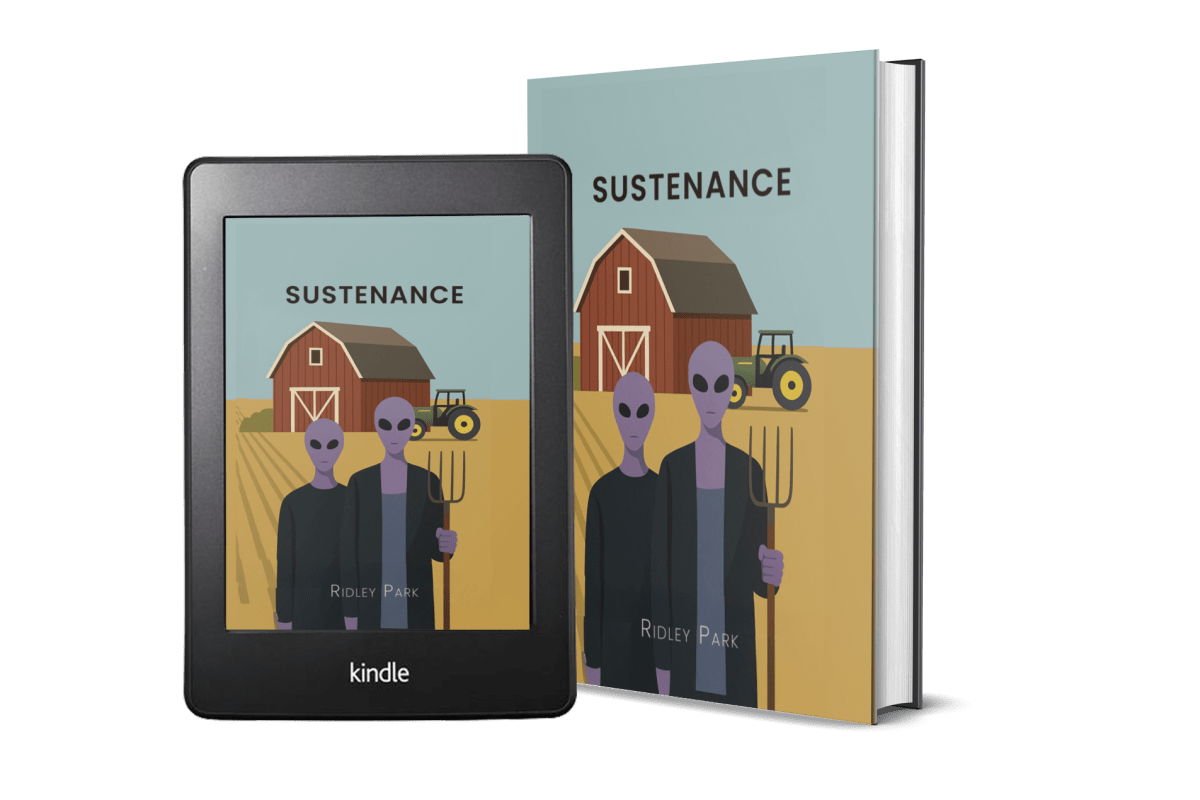
It’s a novella that begins with the dust and grit of rural Iowa – soybean fields, rusted trucks, a small town where everyone knows your name (and your secrets). At first glance, it reads like plainspoken realism, narrated by a local mechanic who insists he’s just a “regular guy.” But then the ground literally shifts. A crash. Figures glimpsed by firelight in the woods. Naked, violet-skinned beings who don’t laugh, don’t sleep, don’t even breathe.

What follows is not your usual alien-invasion story. It’s quieter, stranger, and more unsettling. The encounters with the visitors aren’t about lasers or spaceships – they’re about language, culture, and the limits of human understanding. What happens when concepts like property, law, or even woman and man don’t translate? What does it mean when intimacy itself becomes a site of misunderstanding?

Sustenance is for readers who:

  • Gravitate toward literary fiction with a speculative edge rather than straight genre beats.
  • Appreciate the mix of the banal and the uncanny – the smell of corn dust giving way to the shock of alien otherness.
  • Are interested in themes of language, power, misunderstanding, and human self-deception.
  • Enjoy writers like Jeff VanderMeer, Margaret Atwood, Octavia Butler, or Denis Johnson – voices that blur realism, philosophy, and estrangement.

This isn’t a story that offers tidy answers. It lingers, provokes, and resists easy moral closure. Think of it less as a sci-fi romp and more as a philosophical fable wrapped in small-town dust and cicada-song.

This version of the book is available in these Kindle storefronts:
United States, United Kingdom, Germany, France, Spain, Italy, Netherlands, Japan, Brazil, Canada, Mexico, Australia, and India

For more details, visit the Sustenance page.

📚 Grab your free Kindle copy on 7–8 September 2025.

Autofiction Break

Three of the last four books I’ve read have been autofiction of one flavour or another.

I had never read Virginia Woolf’s A Room of One’s Own, but I picked it up after finishing The Hour of the Star by Clarice Lispector. The there was Trainspotting by Irvine Welsh.

I found Hour of the Star to be an interesting experiement, but I would have preferred a short story over a novelette. A Room of One’s Own is interesting and well-written, though the content resonates with me historically rather than personally. I’ve already written a bit on Trainspotting, which hit me quite close to home. I liked it the best but needed a change of scenery before engaging in its prequel, Skagboys. I need more motivation before I embark on a 500 page journey. I like Welsh’s writing, but it’s not an easy read, I I need more stamina or a break first.

I haven’t decided what to pick up next.

Ice by Anna Kavan – Five Chapters In

1–2 minutes

Five chapters down, and Anna Kavan’s Ice is already proving itself to be less a novel than a feverish novelette-length hallucination. It hits differently than the sprawling sagas I’ve been chewing through – leaner, sharper, like a shard of frozen glass pressed against the skin.

This isn’t realism. If you try to read it as realist narrative you’ll only tie yourself in knots, muttering that the protagonist keeps chasing a girl he half-admits isn’t even there. He catches glimpses, shadows, phantoms – and follows them anyway. Contrived? Yes, if you expect logic. Coherent? Absolutely, if you treat it as dream grammar, where compulsion replaces causality and the world obeys obsession more than physics.

The point-of-view is the real hall of mirrors. Not so much “unreliable narrator” as unreliable perspective: the voice flickers, sometimes inside his skull, sometimes inside hers, sometimes perched like an outside observer. As in a dream, identities blur. The supposed rescuer blurts out sadistic fantasies, sounding alarmingly like the blue-eyed Warden he claims to oppose. It’s less “out of character” than a reminder that character itself is already compromised.

So, no, you can’t hold this text to the rules of straight narrative. You have to read it the way you stumble through a nightmare: half-convinced, half-sceptical, fully captive.

Where it all leads? I’ve got perhaps seventy pages left to find out. For now, I’m letting the ice close over me, listening for the crunch of those imaginary bones.


EDIT: I’ve finished Ice and left a review on Goodreads. tl;dr: I gave it a 3 of 5 stars. ⭐⭐⭐ It was good. Mercifully it was short. As it reads like a dream sequence, there are no stakes. From the start, I wasn’t heavily invested in what happened to the protagonist nor the subject of his attrction. There were some good scenes, but not enough for me to give it more than a 3.