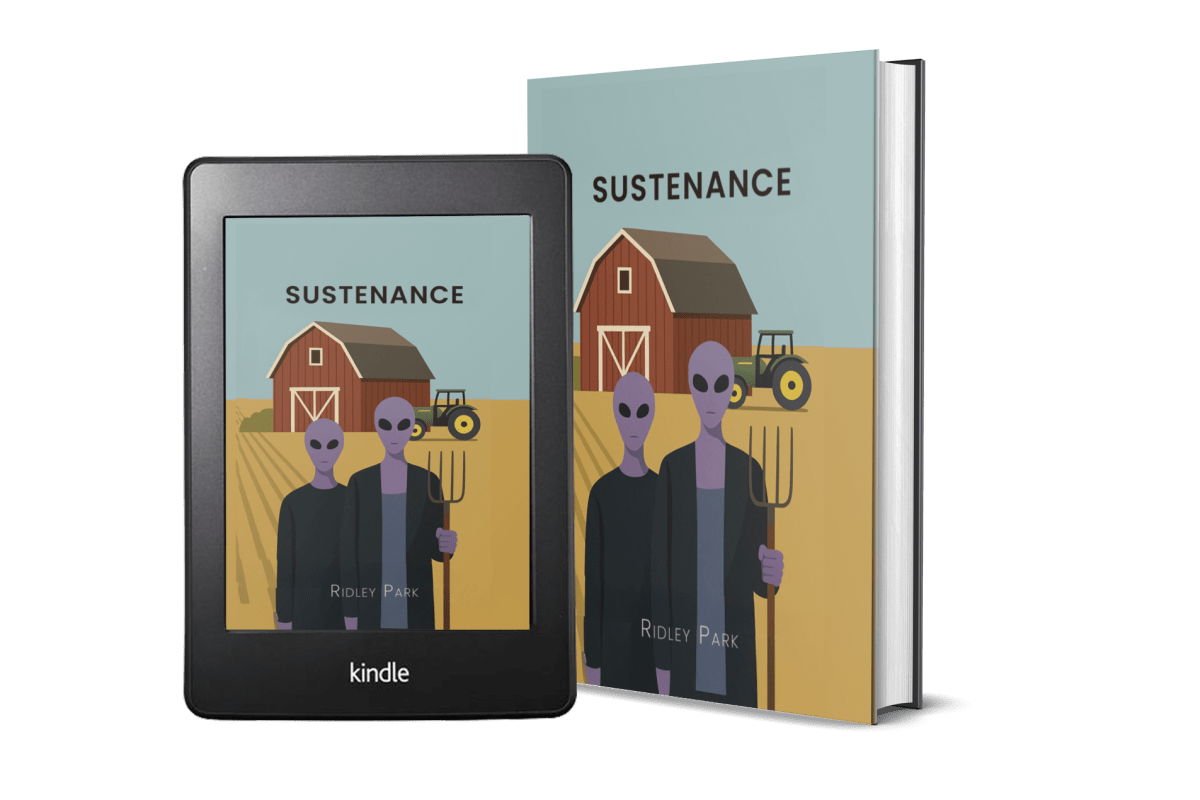
Free for Two Days Only: Sustenance (Kindle Edition)

1–2 minutes

On 7–8 September 2025, the Kindle version of my novella Sustenance will be available free to everyone on Amazon. (It’s always free if you’re a KindleUnlimited member, but these two days open it up to all readers.)

So what is Sustenance?

It’s a novella that begins with the dust and grit of rural Iowa – soybean fields, rusted trucks, a small town where everyone knows your name (and your secrets). At first glance, it reads like plainspoken realism, narrated by a local mechanic who insists he’s just a “regular guy.” But then the ground literally shifts. A crash. Figures glimpsed by firelight in the woods. Naked, violet-skinned beings who don’t laugh, don’t sleep, don’t even breathe.

What follows is not your usual alien-invasion story. It’s quieter, stranger, and more unsettling. The encounters with the visitors aren’t about lasers or spaceships – they’re about language, culture, and the limits of human understanding. What happens when concepts like property, law, or even woman and man don’t translate? What does it mean when intimacy itself becomes a site of misunderstanding?

Sustenance is for readers who:

  • Gravitate toward literary fiction with a speculative edge rather than straight genre beats.
  • Appreciate the mix of the banal and the uncanny – the smell of corn dust giving way to the shock of alien otherness.
  • Are interested in themes of language, power, misunderstanding, and human self-deception.
  • Enjoy writers like Jeff VanderMeer, Margaret Atwood, Octavia Butler, or Denis Johnson – voices that blur realism, philosophy, and estrangement.

This isn’t a story that offers tidy answers. It lingers, provokes, and resists easy moral closure. Think of it less as a sci-fi romp and more as a philosophical fable wrapped in small-town dust and cicada-song.

This version of the book is available in these Kindle storefronts:
United States, United Kingdom, Germany, France, Spain, Italy, Netherlands, Japan, Brazil, Canada, Mexico, Australia, and India

For more details, visit the Sustenance page.

📚 Grab your free Kindle copy on 7–8 September 2025.

Autofiction Break

Three of the last four books I’ve read have been autofiction of one flavour or another.

I had never read Virginia Woolf’s A Room of One’s Own, but I picked it up after finishing The Hour of the Star by Clarice Lispector. The there was Trainspotting by Irvine Welsh.

I found Hour of the Star to be an interesting experiement, but I would have preferred a short story over a novelette. A Room of One’s Own is interesting and well-written, though the content resonates with me historically rather than personally. I’ve already written a bit on Trainspotting, which hit me quite close to home. I liked it the best but needed a change of scenery before engaging in its prequel, Skagboys. I need more motivation before I embark on a 500 page journey. I like Welsh’s writing, but it’s not an easy read, I I need more stamina or a break first.

I haven’t decided what to pick up next.

Ice by Anna Kavan – Five Chapters In

1–2 minutes

Five chapters down, and Anna Kavan’s Ice is already proving itself to be less a novel than a feverish novelette-length hallucination. It hits differently than the sprawling sagas I’ve been chewing through – leaner, sharper, like a shard of frozen glass pressed against the skin.

This isn’t realism. If you try to read it as realist narrative you’ll only tie yourself in knots, muttering that the protagonist keeps chasing a girl he half-admits isn’t even there. He catches glimpses, shadows, phantoms – and follows them anyway. Contrived? Yes, if you expect logic. Coherent? Absolutely, if you treat it as dream grammar, where compulsion replaces causality and the world obeys obsession more than physics.

The point-of-view is the real hall of mirrors. Not so much “unreliable narrator” as unreliable perspective: the voice flickers, sometimes inside his skull, sometimes inside hers, sometimes perched like an outside observer. As in a dream, identities blur. The supposed rescuer blurts out sadistic fantasies, sounding alarmingly like the blue-eyed Warden he claims to oppose. It’s less “out of character” than a reminder that character itself is already compromised.

So, no, you can’t hold this text to the rules of straight narrative. You have to read it the way you stumble through a nightmare: half-convinced, half-sceptical, fully captive.

Where it all leads? I’ve got perhaps seventy pages left to find out. For now, I’m letting the ice close over me, listening for the crunch of those imaginary bones.


EDIT: I’ve finished Ice and left a review on Goodreads. tl;dr: I gave it a 3 of 5 stars. ⭐⭐⭐ It was good. Mercifully it was short. As it reads like a dream sequence, there are no stakes. From the start, I wasn’t heavily invested in what happened to the protagonist nor the subject of his attrction. There were some good scenes, but not enough for me to give it more than a 3.

From Less Than Zero to Trainspotting: The Cinematic Pasteurisation of Addiction

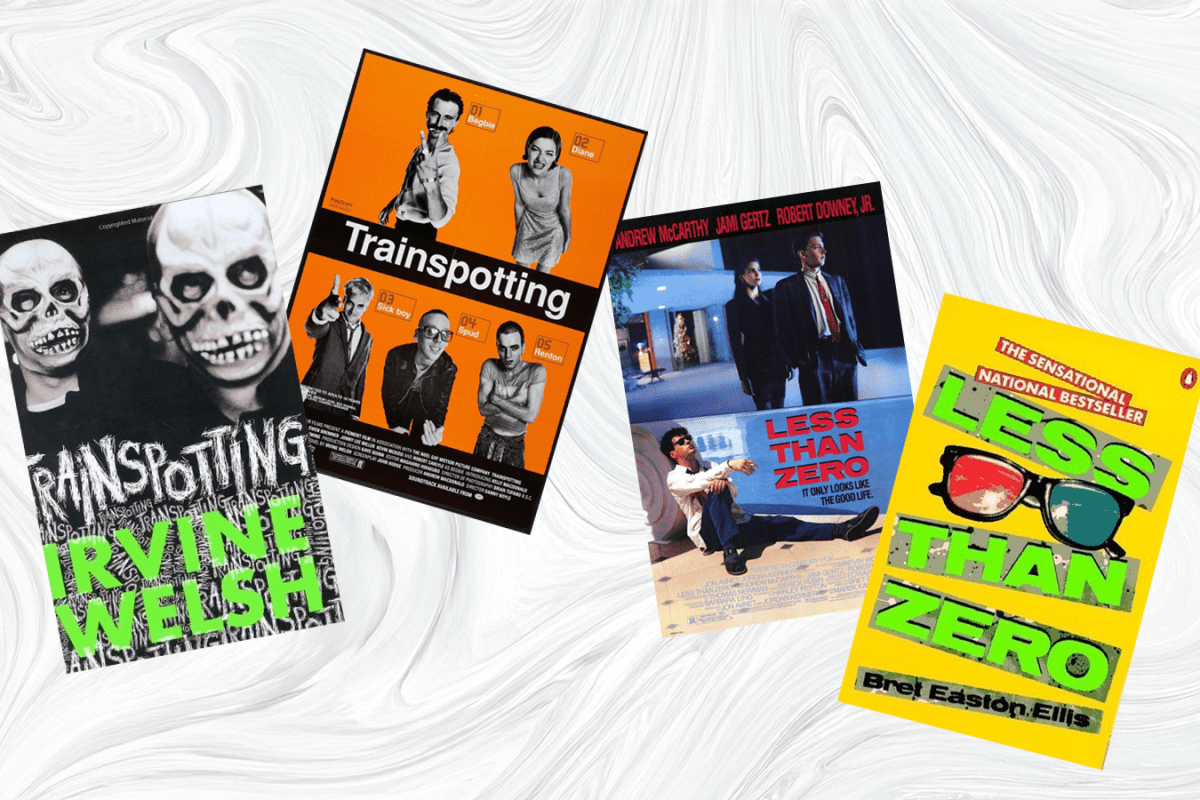
Film has an extraordinary talent for turning jagged, difficult novels into cultural smoothies. Hand Hollywood a text about drugs, despair, and the grotesque collapse of youth, and it will hand you back something fit for a date night. Less Than Zero was gutted. Trainspotting was diluted. Both survived, after a fashion, but only one crawled back out with its bones still rattling.

Audio: NotebookLM podcast on this topic.

Ellis’s Less Than Zero was a flatline pulse of Californian ennui, a catalogue of hollow gestures in which the children of wealth consume themselves into oblivion. The backdrop was Reaganism in full bloom—an America drunk on consumerism, cocaine, and the fantasy of eternal prosperity. The kids in Ellis’s Los Angeles aren’t rebelling; they’re marinating in the very ideology that produced them. The film, by contrast, became a tepid morality play, complete with Robert Downey Jr.’s photogenic martyrdom. The void was swapped for a sermon: drugs are bad, lessons have been learned, and the Reaganite dream remains intact.

Welsh’s Trainspotting was messier, darker, harder to pasteurise. His junkies live in Thatcher’s Britain, where industry has collapsed, communities have rotted, and heroin fills the crater where meaningful work and social support once stood. Addiction is not just chemical but political: it is Thatcher’s neoliberalism rendered in track marks. Boyle’s film kept the faeces, the dead baby, the violence—but also imposed coherence, Renton as protagonist, a redemption arc, and that chirpy “Choose Life” coda. Welsh’s episodic chaos was welded into a three-act rave, all set to Underworld and Iggy Pop. Diluted, yes, but in a way that worked: a cocktail still intoxicating, even if the glass had been sanitised.

And yet, here’s the perennial fraud: drug films always get high wrong. No matter how grim the setting, the “junkie experience” is rendered as theatre, actors impersonating a template someone else once performed badly. The reality of heroin use is crushingly dull: twenty minutes of near-unconsciousness, slack faces, dead time. But you can’t sell tickets to drool and silence. So we get Baudrillard’s simulacrum: a copy of a copy of an inaccurate performance, dressed up as reality. McGregor’s manic sprint to “Born Slippy.” Downey’s trembling collapse. Junkies who look good on screen, because audiences demand their squalor to be cinematic.

And here’s where readers outpace viewers. Readers don’t need their despair blended smooth. They can sit with a text for days, grappling with jagged syntax, bleak repetitions, and moral vacuums. Viewers get two hours, max, and the thing must be purréd into something digestible. Of course, not all books are intellectual, and not all films are pap. But the balance is clear: readers wrestle, viewers swallow. One is jagged nourishment, the other pasteurised baby food.

So Less Than Zero becomes a sermon that spares Reagan’s dream, Trainspotting becomes a rave-poster that softens Thatcher’s wreckage, and audiences leave the cinema convinced they’ve glimpsed the underbelly. What they’ve really consumed is a sanitised simulation, safe for bourgeois digestion. The true addict, the tedious, unconscious ruin of the body, is nowhere to be found, because no audience wants that reality. They want the thrill of transgression without the boredom of truth.

And that, finally, is the trick: cinema gives you Reagan’s children and Thatcher’s lost boys, but only after they’ve been scrubbed clean and made photogenic. Literature showed us the rot; film sells us the simulacrum. Choose Life, indeed.

Trainspotting Takes Over

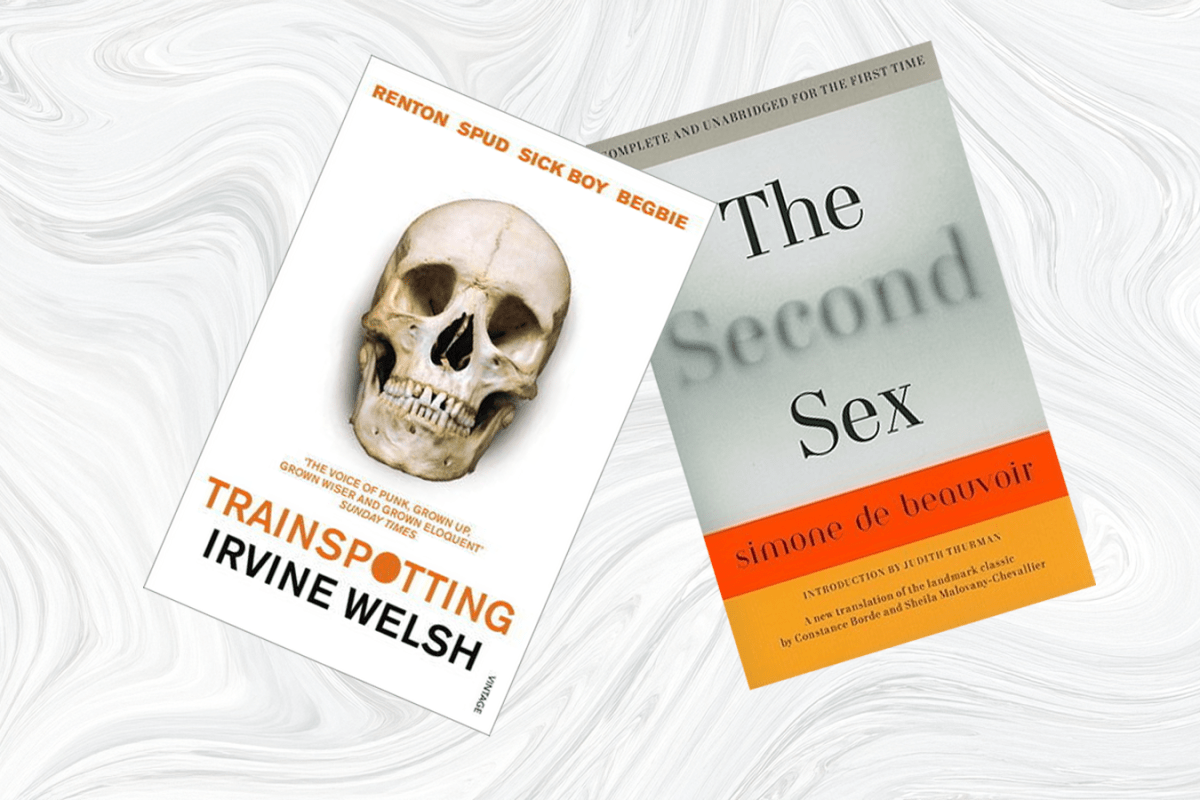
I’ve just finished Simone de Beauvoir’s The Second Sex – all 800 pages of it – and have now started Irvine Welsh’s Trainspotting. Both are classics in their own way. I’ll review Second Sex properly on my Philosophics Blog, but here I want to think about Trainspotting in relation to my current manuscript, Needle’s Edge.

Interestingly, Trainspotting was a ChatGPT recommendation. I fed in my draft of Needle’s Edge and this was one of the books it said my work resembled. Two chapters in, I see the connexion. First, the subject matter – drugs and addiction. Second, the rawness of the experience.

There are differences, of course. Trainspotting is rooted in Leith, Scotland; Needle’s Edge belongs to the East Coast of the United States – Delaware and Philadelphia. Welsh draws heavily on dialect and vernacular, with a narrative voice that’s linguistically dense and aurally charged. In Needle’s Edge, the style is pared down. Sentence fragments, middle dots instead of full stops, and an intentional “lower” register mirror the protagonist’s fractured perception and limited resources.

That gap in register creates a different authorial challenge. With every edit pass, I find myself policing intrusions of my vocabulary into her voice. Welsh, by contrast, can deploy a broader lexicon and trust the dialectal texture to keep it authentic. Listening to Trainspotting, I’m struck by how words and turns of phrase leap out – sometimes apt for Needle’s Edge, but often just a shade too polished for Stacey’s world.

Both texts orbit around environments that resist glamour. Welsh’s squat flats and pubs are grimy and feral; Needle’s Edge’s motel rooms and sidewalks are littered with fast-food wrappers, orange caps, and fading unicorn posters. Addiction erodes bodies in both stories, but the textures differ – Scotland’s industrial gray versus the East Coast’s cheap motels and suburban detritus.

As for the film version of Trainspotting, I saw it long ago and remember almost nothing. The novel isn’t refreshing my memory either; it feels like a separate creature altogether. Which is fitting: both Trainspotting and Needle’s Edge are less about plot than about capturing a lived texture, a rhythm of voices and environments that mainstream narratives usually discard.

Books Read in 2025 (So Far)

Some bloke on social media posted to celebrate hitting his 10-book milestone for the year. It made me reflect on my own. I don’t keep a running tally, but I do use Goodreads, so I reviewed my list. I share it here. Evidently, I’ve read 22 so far. In all honesty, I cheated, because I won’t finish The Second Sex until later this evening or tomorrow morning. Sue me.

The Second Sex —Simone de Beauvoir
In its day, I may be given this 4 stars. NONFICTION. Today, perhaps 3, but it’s a seminal work, so I’ll give it 3½.

Notes from Underground —Fyodor Dostoevsky
5 stars. FICTION. Perhaps 4½, rounded up. This came with Apropos of the Wet Snow, where it all falls apart (in a satisfying way).

The Death of Ivan Ilych —Leo Tolstoy
4 stars. FICTION. Led me to Notes from Underground.

The Emotional Craft of Fiction: How to Write the Story Beneath the Surface —Donald Maass
4 stars. NONFICTION. Not quite up my street, but I found it useful.

High-Rise —J.G. Ballard
3 stars. FICTION. This was another ChatGPT suggestion*. Meh.

Crash —J.G. Ballard
3 stars. FICTION. This was a ChatGPT suggestion*. Generous 3. Probably a 2½ if I’m being honest.

Acceptance —Jeff VanderMeer
3 stars. FICTION. This was not as good as Annihilation, but it got the bad taste of Authority out of my mouth. It closed the loop in the Southern Reach universe.

Authority —Jeff VanderMeer
1 star. FICTION. This was horrible. I wanted to read more about the Southern Reach universe. This prequel should have been an email.

Annihilation —Jeff VanderMeer
4 stars. NONFICTION. This was a ChatGPT suggestion*. I liked it. Much better than the movie with Natalie Portman.

Never Let Me Go —Kazuo Ishiguro
4 stars. NONFICTION. This was a ChatGPT suggestion*. It took a few chapters to see where this was going, but it was worth the wait.

Moral Politics: How Liberals and Conservatives Think —George Lakoff
4 stars. NONFICTION. This is simultaneously dated and relevant, if a bit reductionist. Still worth a read.

The Society of the Spectacle —Guy Debord
2 stars. NONFICTION. Probably only 1½. Very little worthwhile content.

Bullshit Jobs: A Theory —David Graeber
4 stars. NONFICTION. A generous 4, but the idea has relevance.

Technofeudalism: What Killed Capitalism —Yanis Varoufakis
4 stars. NONFICTION. A deserved 4.

Snow Crash —Neal Stephenson
4 stars. FICTION. This was a ChatGPT suggestion*. Not dated, per se, but naïve, written in the early 1990s.

Neuromancer —William Gibson
2 stars. FICTION. This was a ChatGPT suggestion*. Evidently started the Cyberpunk genre. Not a Gibson fan.

A Brief History of Intelligence: Evolution, AI, and the Five Breakthroughs That Made Our Brains —Max Solomon Bennett
4 stars. FICTION. I liked this when I read it. Honestly, I don’t remember much about it.

Capitalist Realism: Is There No Alternative? —Mark Fisher
4 stars. NONFICTION. As relevant as when it was published in 2009.

Outraged: Why We Fight About Morality and Politics and How to Find Common Ground —Kurt Gray
3 stars. NONFICTION. Reductionist and derivative. Follows on the coattails of Jonathan Haight. Not a fan… of either.

Nexus: A Brief History of Information Networks from the Stone Age to AI —Yuval Noah Harari
3 stars. NONFICTION. Reductionist. In a different league than Sapiens. Some mates recommended I read this. ChatGPT has given me better choices.

On Liberty —John Stuart Mill
4 stars. NONFICTION. Pleasantly surprised.

Don’t Think of an Elephant! Know Your Values and Frame the Debate: The Essential Guide for Progressives —George Lakoff.
3 stars. NONFICTION. This is Moral Politics stripped down for mass consumption. Read the full version.

Abandonned

The Left Hand of Darkness —Ursula K. Le Guin
3 stars. FICTION. This was a ChatGPT suggestion*. Read 8 or 9 chapters. Didn’t realise it was #7 in a series. Was OK. Not a Sci-Fi fan. Love her short stories.

Measure What Matters —John Doerr
2 stars. NONFICTION. Business self-help pablum. Hard pass.

English after RP —Geoff Lindsey
3 stars. NONFICTION. I liked this book and the author, but I can’t justify completing a linguistics reference book at this time. Maybe later.

* ChatGPT recommendations stem from my feeding draft manuscripts and prompting who it reads like.

She’s Come Undone – Spoilers

She’s Come Undone is a novel published in 1992, written by Wally Lamb, no relation to Shaun the Sheep.

I haven’t read She’s Come Undone, and it’s unlikely that I ever will. I read a social media post where the author supplanted The Crossing by Cormac McCarthy as his top book. These don’t appear to be the same genre, so don’t ask me how the list was structured. Perhaps books about bears. Does She’s Come Undone have any passages on bears – prequel to The Revenant? We may never find out.

The reason this blog post exists is that I was reading the reviews on Goodreads – 3.91 of 5 stars. So, I read some reviews. This woman offered only one star and swore she’d have given fewer if she could. Odd, how zeros don’t carry the same weight. They act more like NULLs than zeroes. Sad, that.

Evidently, some commenters were furious at her revealing the spoiler. I share her defence here. For those who have yet to watch Citizen Kane, I warn you of the spoiler in her response. Read on at your own risk.

Addendum: Every so often, someone comes along and flags this review as having spoilers. Complaining about spoilers in this review is, not to put too fine a point on it, really stupid. Most of the plot points I mention here are either in the actual cover copy of the book, in the Goodreads summary, or occur somewhere within the first ten pages or so. The rest are so vague (e.g., hooking up with a bad boyfriend — a plot point that probably occurs in some form in, oh, half of the books ever written) that if you consider them “spoilers,” I’m not really sure why you read book reviews at all.

Further addendum: If you’re about to complain about spoilers in this review, please see comment 55 below. If you’re that hysterical about spoilers, maybe stop reading online reviews before you read the book. Also, the book was published 25 years ago and I think the statute of limitations has really run on this one. Rosebud was his sled!!

Authors Talking to Authors Whilst the Readers Are Elsewhere

There’s a peculiar little ecosystem out there called the author’s forum. You’ve probably seen it – digital watering holes where writers congregate to swap tips, trade war stories, and, inevitably, flog their latest magnum opus like a Victorian street hawker with a sack of dubious oysters.

Don’t get me wrong: I don’t begrudge other writers their moment in the sun. We all want our roses sniffed. But here’s the problem: I’m not looking for fellow gardeners. I’m looking for bees. Readers. Pollinators of stories. The ones who carry your words away, let them germinate somewhere else, and maybe if you’re very lucky leave a little honey in return.

Instead, these forums are like a row of market stalls where every vendor is shouting, “Buy my book!” at every other vendor. It’s a deafening loop of mutual advertising in which no one is actually in the market to buy anything. Imagine a cocktail party where everyone is giving a TED Talk at the same time. You can’t even taste the hors d’oeuvres for the noise.

Yes, there’s theoretical overlap; writers are often readers, and some might genuinely enjoy a novel by an unknown author. But the ratio is wildly off. Authors’ forums are not where most readers live. And when you do find a forum of book lovers, they’re usually busy discussing the books they’re already reading, not soliciting a cold pitch from a stranger waving around their unrecognised genius.

Bookseller and library forums? Same issue, just with a corporate gloss. They’re less like communities and more like speed dating events where every participant turns up with a PowerPoint presentation and a sales target.

I suppose it’s a rite of passage for indie authors: you wander into these places thinking you’ve found the gates to literary Shangri-La, only to discover you’ve walked into a multi-level marketing convention where everyone’s selling the same product in slightly different packaging.

So, I’ll keep my profile there, post occasionally and drop in to wave, but I know the audience I’m after isn’t there. The real trick, as ever, is finding the places where the readers live, and learning how to be interesting enough that they might actually care.

Until then, I’ll save my breath. And my roses.

High Horses and Low Bars: AI, Literature, and the Pretence of Purity

The hand-wringing over AI-assisted writing has become the new parlour game for those with literary pretensions. You’ve heard the refrain: It’s not real art. It’s cheating. It’s not proper literature. The pearl-clutchers imagine themselves defending the sanctity of the novel against an onslaught of silicon scribblers, as though Wordsworth himself might be weeping in a Lake District grave at the indignity of a chatbot helping you outline Chapter Three.

Audio: NotebookLM podcast about this topic

Here’s the problem: most art isn’t high art, and most writing isn’t literature. Perhaps yours, possibly mine, but most books sold today don’t even aspire to qualify as literature except in the broadest of terms – having been read. The majority of books on the shelf, those stacked to the rafters in airport WHSmiths and sprawled across the Kindle top-sellers list, are to literature what chicken nuggets are to fine dining. Perfectly enjoyable, but you don’t see Heston Blumenthal demanding they be served in a Michelin-starred tasting menu.

And that’s fine. Truly. Because the vast majority of readers aren’t combing through your prose for transcendence or stylistic innovation. They’re not here to wrestle with postmodern irony or wrest meaning from a fragmented narrative. They’re here to escape the tedium of their commute, to zone out after a long day, to gobble up familiar tropes like comfort food. Sometimes they want plot, sometimes they want romance, sometimes they want dragons and space marines and improbably muscular men named Rafe. What they don’t want is a lecture on the ontological integrity of the creative process.

The AI panic brigade, however, would have you believe that unless your novel was forged through the arduous labour of pen and paper, or at least a keyboard, with the requisite quota of caffeine and self-loathing, it cannot possibly be authentic. To which I say: nonsense. We’ve been “cheating” for centuries. Typewriters. Word processors. Spellcheck. Thesauruses. Collaborative editing. Ghostwriting. For heaven’s sake, most of your favourite “high art” authors had assistants, editors, or outright amanuenses polishing their sentences into the very state of grace you now venerate.

There’s also the small matter of motive. Very few writers are chasing pure artistic expression, many are chasing rent money, Amazon rankings, or a book deal that might finally cover their overdraft. That’s not cynicism, that’s survival. And survival has never given a toss about whether the means of production are sufficiently Romantic for the sensibilities of the literati.

If anything, AI merely exposes the uncomfortable truth: most writing is a craft, not a sacrament. It’s a process of assembling words into a functional, sometimes moving, occasionally transcendent arrangement. And like all crafts, it has tools. Some tools are chisels, some are typewriters, and now some happen to be algorithms with more patience than your average beta reader.

So, if someone wants to use AI to crank out the next mass-market thriller, let them. It’s not threatening literature because it was never in literature to begin with. And if they want to use it to experiment, to push boundaries, to hybridise forms, that’s art too. High or low, it all ends up in the same place: on a page, waiting for someone to care enough to read it.

On Goodreads, Social Media, and Not Giving a Toss About What You’re Reading

I watched this video this morning: Why I Quit Goodreads. Apparently, people are fleeing Goodreads like it’s a sinking ship. Frankly, I didn’t realise they’d ever boarded.

Video: Why I Quit Goodreads by Alison Reads Books

I’ve used Goodreads for years. Not out of love – habit. I was on another platform before Amazon bought both and quietly euthanised the lesser one. So, like any good digital serf, I migrated. Goodreads never really improved. But that’s not what this post is about.

Audio: NotebookLM podcast on this topic.

The woman in the video, Alison, recounts how she got sucked into the vortex of reading-as-performance. A treadmill of trending titles, five-star pressure, and dopamine farming. In short: social media with spines. She, like me, identifies as an introvert. Social media, she says, offered connection on her terms.

Fine. But here’s where we part ways: I don’t read what’s popular. I read like I write: deliberately, slowly, and mostly alone. I don’t care what the hive is reading. I don’t follow BookTok. I’m not hunting genre tropes like Pokémon. I’m not even watching telly.

That’s not snobbery. That’s filtration.

Yes, I read Tolstoy and Dostoevsky, not because they’re trending, but because they have staying power. I read Beauvoir and Foucault, not because they’re fashionable, but because they dismantle the very notion of fashion.

Ironically, AI has been more useful to me than Goodreads ever was. I ask it about tropes, continuity, and which authors my work resembles. Sometimes, it throws out a name I don’t know. So I investigate. If I see a resonance, great; I might lean in or veer away. Not because I want to copy, but because “originality” is a fairytale. Everything is recombinant DNA, literary or otherwise.

I’ve read friend recommendations. Mixed results. Often disastrous. I don’t care how many millions adore The Hunger Games, or William Gibson, or Taylor bloody Swift. That’s not an insult; it’s a mismatch. Their work just doesn’t speak to me. And that’s the point of art, it’s not for everyone.

Because of this, I’ve grown wary of recommendations. I no longer approach them with hope; I approach them like a suspicious mushroom in a stranger’s risotto.

So why do I still use Goodreads? To track what I’ve read and, occasionally, write reviews…for myself. If others find those reviews useful, great. If Goodreads’ recommendation engine serves up a gem, brilliant; but it rarely does. Algorithms don’t understand headspace. They see pattern, not mood.

I might binge Dostoevsky and Tolstoy one week, but that doesn’t mean I want a Russian lit syllabus. After Notes from Underground and The Death of Ivan Ilych, I finally cracked open The Second Sex – a book that’s loomed on my TBR like a monument.

Sometimes reading fuels my writing. Sometimes it stalls it. But unlike Alison, I never needed Goodreads to tell me who I am as a reader. And I sure as hell don’t need social media to validate my literary tastes.

If you’re quitting Goodreads because it became too performative, maybe you were never using it for the right reasons. Or maybe, like most platforms, it just stopped being fun once everyone else showed up.


About the cover image: “photo of a stereotypical punk rocker anarchist reading a book in a crowd of people staring at their mobile phones”

I’m not sure this Midjourney render captures much of the essence of my prompt, but there it is.