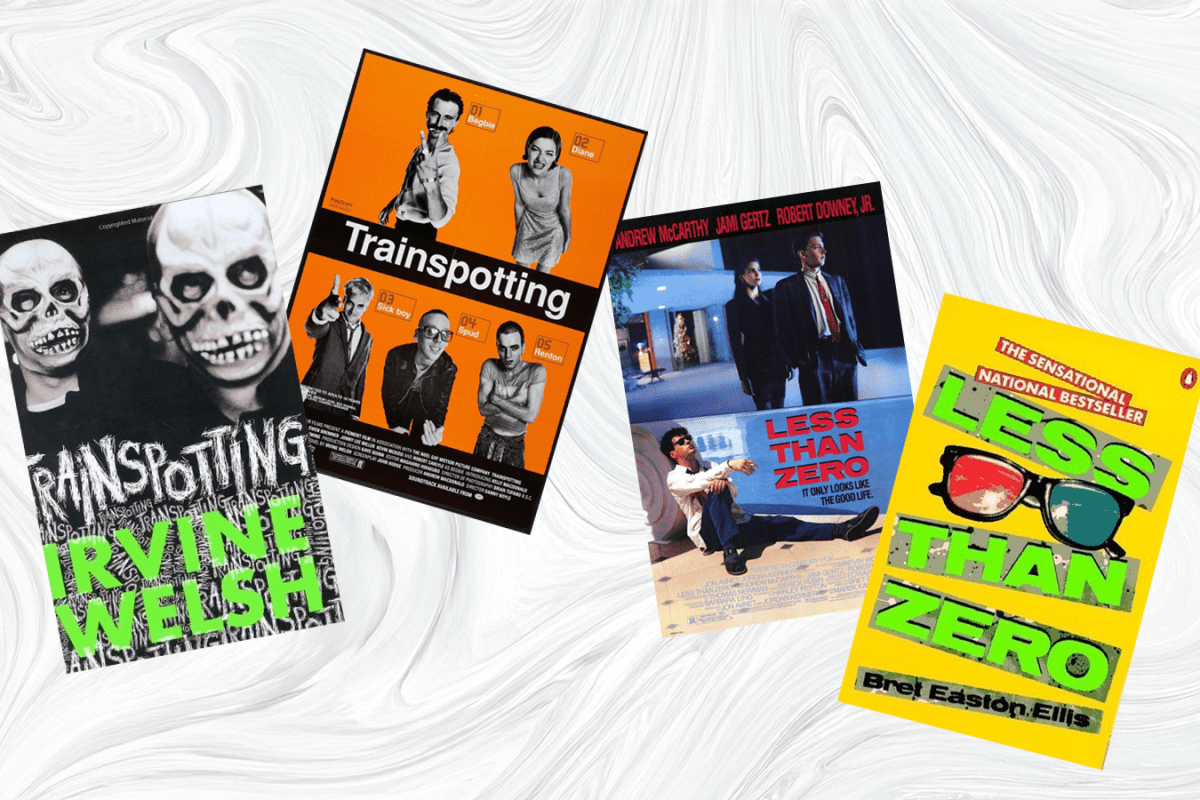
Film has an extraordinary talent for turning jagged, difficult novels into cultural smoothies. Hand Hollywood a text about drugs, despair, and the grotesque collapse of youth, and it will hand you back something fit for a date night. Less Than Zero was gutted. Trainspotting was diluted. Both survived, after a fashion, but only one crawled back out with its bones still rattling.
Audio: NotebookLM podcast on this topic.
Ellis’s Less Than Zero was a flatline pulse of Californian ennui, a catalogue of hollow gestures in which the children of wealth consume themselves into oblivion. The backdrop was Reaganism in full bloom—an America drunk on consumerism, cocaine, and the fantasy of eternal prosperity. The kids in Ellis’s Los Angeles aren’t rebelling; they’re marinating in the very ideology that produced them. The film, by contrast, became a tepid morality play, complete with Robert Downey Jr.’s photogenic martyrdom. The void was swapped for a sermon: drugs are bad, lessons have been learned, and the Reaganite dream remains intact.
Welsh’s Trainspotting was messier, darker, harder to pasteurise. His junkies live in Thatcher’s Britain, where industry has collapsed, communities have rotted, and heroin fills the crater where meaningful work and social support once stood. Addiction is not just chemical but political: it is Thatcher’s neoliberalism rendered in track marks. Boyle’s film kept the faeces, the dead baby, the violence—but also imposed coherence, Renton as protagonist, a redemption arc, and that chirpy “Choose Life” coda. Welsh’s episodic chaos was welded into a three-act rave, all set to Underworld and Iggy Pop. Diluted, yes, but in a way that worked: a cocktail still intoxicating, even if the glass had been sanitised.
And yet, here’s the perennial fraud: drug films always get high wrong. No matter how grim the setting, the “junkie experience” is rendered as theatre, actors impersonating a template someone else once performed badly. The reality of heroin use is crushingly dull: twenty minutes of near-unconsciousness, slack faces, dead time. But you can’t sell tickets to drool and silence. So we get Baudrillard’s simulacrum: a copy of a copy of an inaccurate performance, dressed up as reality. McGregor’s manic sprint to “Born Slippy.” Downey’s trembling collapse. Junkies who look good on screen, because audiences demand their squalor to be cinematic.
And here’s where readers outpace viewers. Readers don’t need their despair blended smooth. They can sit with a text for days, grappling with jagged syntax, bleak repetitions, and moral vacuums. Viewers get two hours, max, and the thing must be purréd into something digestible. Of course, not all books are intellectual, and not all films are pap. But the balance is clear: readers wrestle, viewers swallow. One is jagged nourishment, the other pasteurised baby food.
So Less Than Zero becomes a sermon that spares Reagan’s dream, Trainspotting becomes a rave-poster that softens Thatcher’s wreckage, and audiences leave the cinema convinced they’ve glimpsed the underbelly. What they’ve really consumed is a sanitised simulation, safe for bourgeois digestion. The true addict, the tedious, unconscious ruin of the body, is nowhere to be found, because no audience wants that reality. They want the thrill of transgression without the boredom of truth.
And that, finally, is the trick: cinema gives you Reagan’s children and Thatcher’s lost boys, but only after they’ve been scrubbed clean and made photogenic. Literature showed us the rot; film sells us the simulacrum. Choose Life, indeed.
Congratulations, you’ve finished a manuscript. You’ve pushed the boulder uphill, typed “The End,” and maybe even convinced yourself you’re done. Spoiler: you’re not. This is where beta readers come in — those kind souls who’ll slog through your draft and tell you whether it sings, stumbles, or just sits there like porridge. The trouble is, most writers don’t actually know what to ask them, and so they end up with feedback about as useful as a horoscope.
The first and most uncomfortable question is about intent. What are my goals in writing this, and did you see them? Most writers never ask, because it forces them to say what they meant in the first place. Are you interrogating free will? Trying to write a page-turner? Smuggling philosophy under the hood of a dystopian thriller? If your beta doesn’t see it, either you buried it too deep or you didn’t put it in at all. Of course, not every writer works with some grand meta in mind, but if you do, this is the question that makes or breaks the project.
If your story feels like homework, you’ve already lost.
Enjoyment comes next, even if it bruises the ego. Did they actually like reading it? If your story feels like homework, you’ve already lost. It’s better to know this from a sympathetic reader now than from Goodreads later. A related angle is pacing: where did the story drag? Readers know exactly where they reached for their phone, even if they’re too polite to say so without prompting. Ask them to point to the spots where the air went out of the room.
Did the conclusion feel like it belonged to the story’s own logic?
Characters are another litmus test. Which ones did they care about, and which ones left them cold? Writers are often too close to notice when a protagonist reads like cardboard, or when a side character steals the oxygen. Beta readers are your lab rats here, revealing who’s magnetic and who’s forgettable. The same goes for endings. Don’t ask if it was happy – ask if it was satisfying. Did the conclusion feel like it belonged to the story’s own logic? If the reader feels cheated, the manuscript isn’t finished.
World-building deserves its own interrogation, especially in speculative fiction. Readers will happily forgive dragons, AI dictators, or interstellar chalk drawings, but not inconsistency. If the rules of your world shift without reason, they’ll notice. In fact, coherence is more important than cleverness. The reader doesn’t need to understand every mechanism, but they do need to trust that you do.
Was there an image, a phrase, a scene that stayed with them once the book was closed?
Finally, ask what lingered afterwards. Was there an image, a phrase, a scene that stayed with them once the book was closed? That’s your gold. Double down on it. If nothing sticks, you’ve got polishing to do.
One last but often overlooked question is about the reader themselves: am I asking the right person? An excellent sci-fi enthusiast might not be your best pick for YA urban fiction. A romance aficionado won’t necessarily grasp the rhythms of a philosophy-laden dystopia. Fit matters. You wouldn’t ask a vegan to taste-test your steakhouse menu, so don’t ask the wrong reader to bless your book.
Am I asking the right person?
And here’s the tightrope for the beta reader: they are not there to tell you the book they would have written. Their job is to respond to the book you actually put on the page. It’s your manuscript, not a co-authorship audition. If their feedback starts with “what I would have done,” that’s not critique – that’s a rewrite.
The meta point is simple. Beta readers are not editors. They aren’t there to fix your commas or restructure your second act. Their value is in telling you what it feels like to read your book – hot, cold, flat, or electric. And if you’ve got a grand philosophical undercurrent humming beneath the surface, they’re the only ones who can tell you whether it came across.
Beta readers are not editors.
So don’t hand your beta readers a scalpel and ask them to perform surgery. Hand them your story and ask: did you taste what I meant to cook?
Critics never tire of reminding us that AI has no emotions, as though this were some startling revelation. Next, perhaps, they’ll inform us that penguins can’t fly and that bankers are allergic to honesty. Yes, generative AI has no emotions. But must we wheel in the fainting couches? Writers don’t need it to sob into its silicon sleeve.
Full disclosure: I am a writer who writes fiction and non-fiction alike. I am also a language philosopher; I study language. And a technologist. I’ve been working with artificial intelligence since the early ’90s with Wave 3 – expert systems. I am still involved with our current incarnation, Wave 4 – generative AI. I know that artificial intelligence has no intelligence. I also know that intelligence is ill-defined and contains metaphysical claims, so there’s that…
Meantime, let’s stroll, briskly, through three ghosts of philosophy: Saussure, Wittgenstein, and Derrida.
Audio: NotebookLM podcast on this topic.
Saussure and the Tree That Isn’t There
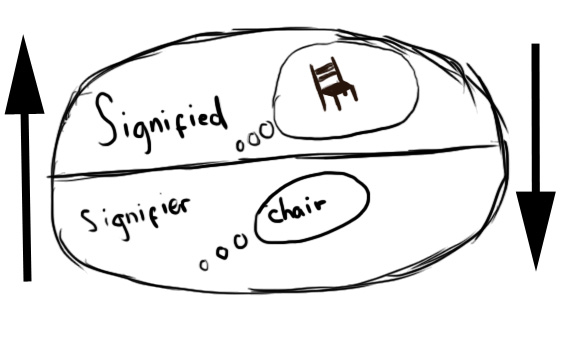
Ferdinand de Saussure gave us the tidy structuralist package: the signified (the thing itself, say, a tree) and the signifier (the sound, the squiggle, the utterance “tree,” “arbre,” “árbol”). Lovely when we’re talking about branches and bark. Less useful when we stray into abstractions—justice, freedom, love—the slippery things that dissolve under scrutiny.
Image: Saussure’s Signified and Signifiers
Still, Saussure’s model gets us so far. AI has consumed entire forests of texts and images. It “knows” trees in the sense that it can output something you and I would recognise as one. Does it see trees when it dreams? Do Androids Dream of Electric Sheep? Of course not. But neither do you when you define one.
René Magritte‘s famous painting reminds us that the reference is not the object.
Image: Magritte’s Ceci n’est pas une pipe (This is not a pipe)
Wittgenstein and the Dictionary Without a Key
Ludwig Wittgenstein, that glorious thorn, tore the Saussurean comfort blanket to shreds. Words, he said, are not tethered to the world with neat strings. They define themselves by what they are not. A tree is a tree because it is not a cow, a kettle, or an Aston Martin.
Image: Tree, isolated
Take a dictionary entry:
tree /trē/ noun a woody perennial plant, typically having a single stem or trunk growing to a considerable height and bearing lateral branches at some distance from the ground.
What’s woody? What’s perennial? If you already speak English, you nod along. If you’re an alien with no prior knowledge, you’ve learned nothing. Dictionaries are tautological loops; words point only to more words. If you want to play along in another language, here’s a Russian equivalent.
дерево /derevo/ существительное древесное многолетнее растение, обычно имеющее один стебель или ствол, растущий до значительной высоты и несущее боковые ветви на некотором расстоянии от земли.
AI, like Wittgenstein’s alien, sits inside the loop. It never “sees” a tree but recognises the patterns of description. And this is enough. Give it your prompt, and it dutifully produces something we humans identify as a tree. Not your tree, not my tree, but plausibly treelike. Which is, incidentally, all any of us ever manage with language.
Derrida, Difference, and Emotional Overtones
Enter Jacques Derrida with his deconstructive wrecking ball. Language, he reminds us, privileges pairs—male/female, black/white—where one term lords it over the other. These pairs carry emotional weight: power, hierarchy, exclusion. The charge isn’t in the bark of the word, but in the cultural forest around it.
AI doesn’t “feel” the weight of male over female, but it registers that Tolstoy, Austen, Baldwin, Beauvoir, or Butler did. And it can reproduce the linguistic trace of that imbalance. Which is precisely what writers do: not transmit private emotion, but arrange words that conjure emotion in readers.
On Reading Without Tears
I recently stumbled on the claim that AI cannot “read.” Merriam-Webster defines reading as “to receive or take in the sense of (letters, symbols, etc.), especially by sight or touch.” AI most certainly does this—just not with eyeballs. To deny it the label is to engage in etymological protectionism, a petty nationalism of words.
The Point Writers Keep Missing
Here is the uncomfortable truth: when you write, your own emotions are irrelevant. You may weep over the keyboard like a tragic Byronic hero, but the reader may shrug. Or worse, laugh. Writing is not a syringe injecting your feelings into another’s bloodstream. It is a conjuring act with language.
AI can conjure. It has read Tolstoy, Ishiguro, Morrison, Murakami. It knows how words relate, exclude, and resonate. If it reproduces emotional cadence, that is all that matters. The question is not whether it feels but whether you, the reader, do.
So yes, AI has no emotions. Neither does your dictionary. And yet both will continue to outlast your heartbreak.
Let’s get this out of the way: Sturgeon’s Law, ‘90% of everything is crap‘, isn’t pessimism, it’s statistics. That includes your favourite novel, the collected works of Joyce, and, yes, AI-generated text. The key point? If AI has the same bell curve as human output, some slice of that curve will still be better than what most people write. If Pareto’s Rule feels better at 80%, I’ll cede that ten points.
90% of everything is crap
— Sturgeon’s Law
And before anyone gets misty-eyed about “human genius,” let’s remember that the average American adult reads at a 7th or 8th grade level, and more than half read at or below a 6th grade level. Nearly 1 in 5 reads below a 3rd grade level. That’s not a moral failing, but it is a market reality. We can wail about AI not producing the next Nabokov, but let’s be honest, Nabokov isn’t exactly topping the Costco bestsellers table.
Audio: NotebookLM podcast on this topic
Here’s the bit nobody wants to say out loud
AI doesn’t have to dethrone the literary elite. It just has to outperform the mass of competent-but-unremarkable human writers serving an audience who, frankly, doesn’t care about “stylistic nuance” or “metafictional self-reflexivity.”
There’s a vast literary middle ground – corporate copywriting, trade journalism, formulaic romance, SEO blogs – where AI will not just compete, but dominate, because the audience is reading for function, not art.
The high-literary crowd will remain untouched, partly because their readership fetishises human intentionality, and partly because AI doesn’t yet want to write about the precise smell of sadness in a damp Parisian garret in 1934.
The fearmongering about AI “killing literature” is a bit like saying instant ramen will kill haute cuisine. Yes, more people will eat the ramen, but Alain Ducasse isn’t sweating over his stock reduction.
More than half of American adults read at or below a sixth-grade level.
The printing press was supposed to obliterate the artistry of the hand-copied manuscript. Instead, it made books accessible and created new genres entirely. Calligraphy still exists, it’s just no longer the only way to get words on a page.
Photography was going to end painting. In reality, it freed painters from the burden of strict representation, allowing impressionism, cubism, and abstract art to flourish.
Recorded music didn’t destroy live performance, it expanded its reach. Some audiences still pay obscene amounts to see an actual human sweat on stage.
Film didn’t kill theatre; it created a parallel art form.
Synthesizers didn’t erase orchestras; they just meant you didn’t have to mortgage your house to hear a string section in your pop song.
AI is simply the next entrant in this long tradition of “threats” that turn out to be expansions. It will colonise the big islands of the creative archipelago – commercial writing, functional prose, genre boilerplate – and leave the small monasteries of high art mostly untouched.
So, no, AI won’t be the next Mozart, Picasso, or Nabokov. But it doesn’t need to be. It just needs to be good enough to meet – and occasionally exceed – the expectations of the largest share of the market. And given that most readers are happy if the plot makes sense, the spelling’s passable, and the ending doesn’t require a graduate seminar in semiotics to decipher, I’d say AI’s prospects are rather good.
Here’s why that 10% still matters
The rarefied work of the serious literary writer isn’t competing for market share; it’s preserving and evolving the cultural and linguistic possibilities of human expression. That work thrives not because it’s the only thing available, but precisely because it stands apart from the sea of functional prose, human or machine-made. The AI tide will rise, but the lighthouse will still be human.
The hand-wringing over AI-assisted writing has become the new parlour game for those with literary pretensions. You’ve heard the refrain: It’s not real art. It’s cheating. It’s not proper literature. The pearl-clutchers imagine themselves defending the sanctity of the novel against an onslaught of silicon scribblers, as though Wordsworth himself might be weeping in a Lake District grave at the indignity of a chatbot helping you outline Chapter Three.
Audio: NotebookLM podcast about this topic
Here’s the problem: most art isn’t high art, and most writing isn’t literature. Perhaps yours, possibly mine, but most books sold today don’t even aspire to qualify as literature except in the broadest of terms – having been read. The majority of books on the shelf, those stacked to the rafters in airport WHSmiths and sprawled across the Kindle top-sellers list, are to literature what chicken nuggets are to fine dining. Perfectly enjoyable, but you don’t see Heston Blumenthal demanding they be served in a Michelin-starred tasting menu.
And that’s fine. Truly. Because the vast majority of readers aren’t combing through your prose for transcendence or stylistic innovation. They’re not here to wrestle with postmodern irony or wrest meaning from a fragmented narrative. They’re here to escape the tedium of their commute, to zone out after a long day, to gobble up familiar tropes like comfort food. Sometimes they want plot, sometimes they want romance, sometimes they want dragons and space marines and improbably muscular men named Rafe. What they don’t want is a lecture on the ontological integrity of the creative process.
The AI panic brigade, however, would have you believe that unless your novel was forged through the arduous labour of pen and paper, or at least a keyboard, with the requisite quota of caffeine and self-loathing, it cannot possibly be authentic. To which I say: nonsense. We’ve been “cheating” for centuries. Typewriters. Word processors. Spellcheck. Thesauruses. Collaborative editing. Ghostwriting. For heaven’s sake, most of your favourite “high art” authors had assistants, editors, or outright amanuenses polishing their sentences into the very state of grace you now venerate.
There’s also the small matter of motive. Very few writers are chasing pure artistic expression, many are chasing rent money, Amazon rankings, or a book deal that might finally cover their overdraft. That’s not cynicism, that’s survival. And survival has never given a toss about whether the means of production are sufficiently Romantic for the sensibilities of the literati.
If anything, AI merely exposes the uncomfortable truth: most writing is a craft, not a sacrament. It’s a process of assembling words into a functional, sometimes moving, occasionally transcendent arrangement. And like all crafts, it has tools. Some tools are chisels, some are typewriters, and now some happen to be algorithms with more patience than your average beta reader.
So, if someone wants to use AI to crank out the next mass-market thriller, let them. It’s not threatening literature because it was never in literature to begin with. And if they want to use it to experiment, to push boundaries, to hybridise forms, that’s art too. High or low, it all ends up in the same place: on a page, waiting for someone to care enough to read it.
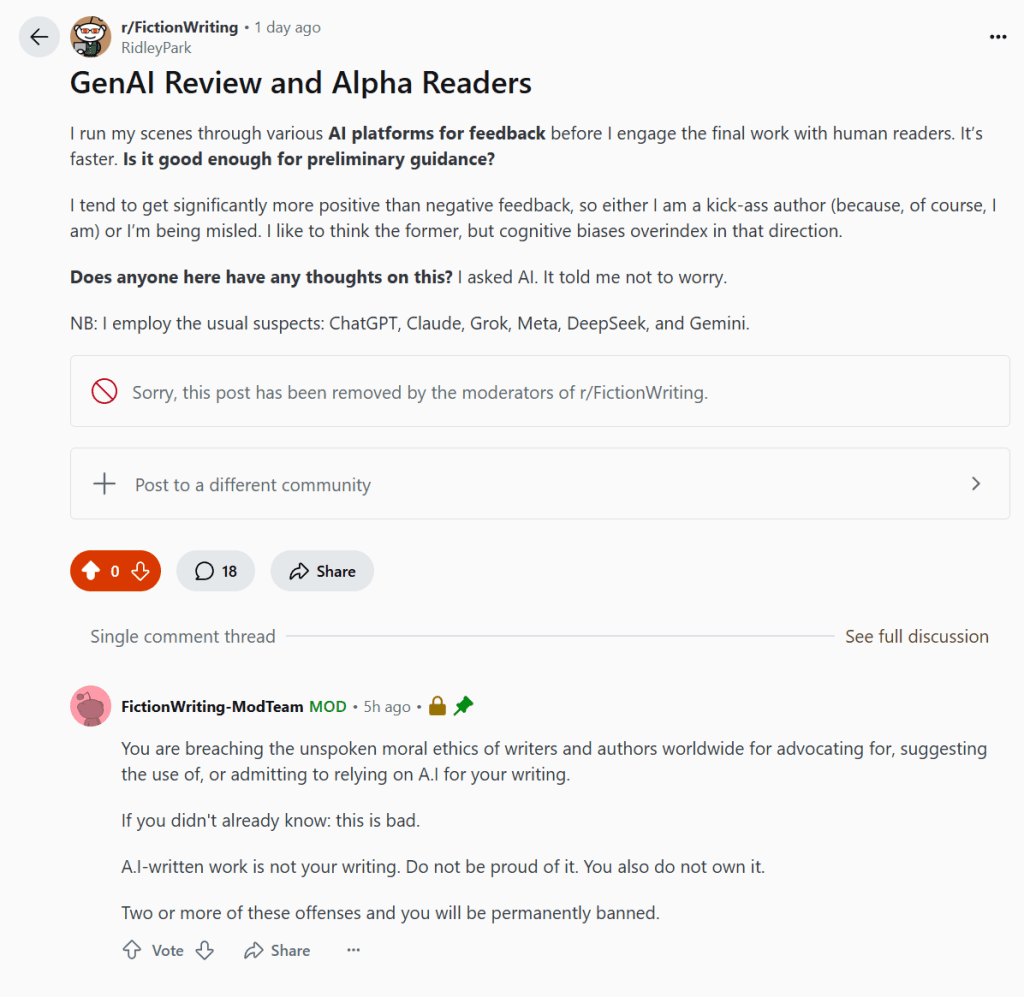
Why? Because nuance is no longer welcome in the Church of Sanctified Scribes. I posted a sincere question about using generative AI as a preliminary editorial tool — a sounding board before I hand off to my actual human readers.
I run my scenes through various Al platforms for feedback before I engage the final work with human readers. It’s faster. Is it good enough for preliminary guidance? I tend to get significantly more positive than negative feedback, so either I am a kick-ass author (because, of course, I am) or I’m being misled. I like to think the former, but cognitive biases overindex in that direction.
Does anyone here have any thoughts on this? I asked Al. It told me not to worry.
NB: I employ the usual suspects: ChatGPT, Claude, Grok, Meta, DeepSeek, and Gemini.
That’s it. That’s the crime.
🚫 Sorry, this post has been removed by the moderators of r/FictionWriting.
The post was removed. Some members responded with superstition, invoking the tired myth that AI would “steal” my work. (That is not how model inference or fine-tuning works. But facts, as ever, are inconvenient.)
Then came the moderator’s edict — Orwellian in tone, the sort of thing you’d expect from a self-published Torquemada:
You are breaching the unspoken moral ethics of writers and authors worldwide for advocating for, suggesting the use of, or admitting to relying on A.l for your writing.
If you didn’t already know: this is bad.
A.I-written work is not your writing. Do not be proud of it. You also do not own it. Two or more of these offenses and you will be permanently banned.
What exactly am I being accused of here? Heresy? Possession of forbidden tools? Thinking aloud?
For the record, I do not outsource my prose to machines. I use AI to assist my thinking — much as one might use spellcheck, Grammarly, or, dare I say it, a fellow writer’s feedback. The fact that this needs to be explained is testament to the intellectual rot at the core of certain writing communities.
And here’s the real punchline: many of those decrying AI as the Antichrist of Authorship haven’t published a thing. Or if they have, it’s in the same low-distribution trenches I inhabit. The difference is, I don’t shun tools because they threaten my imagined purity.
I write because I must — because I enjoy it, because I want to get it right. And yes, if an AI helps me catch repetition or poor rhythm in a sentence before a beta reader ever lays eyes on it, that’s a win.
But you’d think I’d pissed on their typewriters.
Let’s be clear: this isn’t about AI. It’s about fear. About guarding crumbling gatekeeping structures with sharpened pitchforks. About people clinging to their fragile sense of identity — one threatened not by AI, but by other writers doing things differently.
So, yes: good riddance. I’ll take my questions elsewhere, where open minds still exist.
I’m taking a break from editing to share something about the protagonist in my latest novel-in-progress, Needle’s Edge. She’s a woman – yes, but not just. She’s a prostitute. She’s an addict. And she’s three people.
There’s Sarah, her given name. The name reserved for friends, family, and those rare few who know her without conditions. It’s the name she hears in moments of tenderness, or shame, or memory.
Then there’s Stacey, the escort, the stripper, the performer. This is the name on her ads. The one whispered in hotel rooms and shouted in clubs. Stacey is curated. Sexual. Selective. She knows what sells and how to sell it.
And then there’s Pink, the street persona. The user. Pink is who shows up when Sarah needs to score. She trades in slang and silence. She wears a different skin. A different currency.
Three names. One woman. No seams showing – if she can help it.
In her world, compartmentalisation is survival. If a dealer connects the dots and knows she’s an escort, she’s vulnerable. If a client finds out she’s using, her value drops. Appearances are everything. Rates depend on it. Reputation is a balancing act on a razor’s edge. And so each name carries its own set of rules, risks, and rituals.
But here’s the deeper cut: Who’s the “real” Sarah?
Is Stacey fake? Is Pink less than? Is Sarah just the base layer beneath the makeup and muscle memory?
They’re all her. None of them. Some of each. Identity is slippery.
The left hemisphere of the brain craves coherence. It wants simplicity, categories, reduction. But the truth is, identity is a heuristic. A convenient fiction. And Sarah, more than most, knows this. Where most people perform one role and pretend it’s a self, she splits hers openly. She curates them. Manages them. Leverages them.
And yet, the cost is high.
Stacey and Pink are exhausting. High maintenance. High risk. But being Sarah isn’t a comfort either. It’s just what’s left when the others are stripped away. She doesn’t retreat into Sarah so much as collapse into her.
In that way, Sarah isn’t a self – she’s a default.
The irony? For all this agency, for all her awareness, she’s still trapped in identities designed for consumption. For transaction. For escape. Whether it’s sex, drugs, or memory, she’s always negotiating something.
I’m sharing a comp of the cover art* for my upcoming novel – a story about a prostitute. More accurately, it’s a story about prostitutes, addiction, survival, and the consequences of living at the periphery – not just of society, but of personhood itself.
The earliest notes I have are dated 2019. I finished the first draft in June. I’m now editing – both structurally and line by line, which is probably a bad idea, but here we are. Because I’m reorganising scenes, I need to ensure the transitions make sense, emotionally and narratively.
Since completing the draft, I’ve been reading Simone de Beauvoir’s The Second Sex. First published in 1949, the edition I’m reading was translated in 2011. It’s given me language for something I was already trying to do.
“One is not born, but rather becomes, a woman.”
— Simone de Beauvoir
This line is central to my approach. My protagonist isn’t born a prostitute. More importantly, she isn’t even born a woman. She’s made into one by church ladies, jealous sisters, careless boys, and indifferent systems. Through gestures, punishments, expectations, and neglect. Through the crucible of a society that offers her a script before she understands the stage.
Yes, her psychology matters. But the world matters more.
That’s what I’m trying to explore — not just the facts of a life on the edge, but the forces that shape it.
* I’ve actually designed two covers – one for hardcover and the other for paperback. It provides me with options.
Welcome, dear reader, to the eternal skirmish between Art and Entertainment, or as the marketing departments like to call it, Literary Fiction vs Commercial Fiction. This is not just a genre squabble; it is the ideological showdown between truth-seeking masochists and market-savvy optimists.
Literary Fiction: Starving Artist Chic
Literary Fiction is what happens when someone spends ten years writing a novel that doesn’t sell but gets shortlisted for an award no one outside The Guardian has heard of. It is the sanctum of character studies, of prose polished until it cuts glass, of metaphors so dense they require footnotes and a whisky.
It doesn’t have to be inaccessible, of course—it just often chooses to be, on principle. Plot is optional, punctuation negotiable. The point is to mean something. To explore the human condition. To examine alienation in a post-industrial neoliberal hellscape, not to entertain your aunt with a beach read.
It’s not that Literary Fiction hates readers. It just isn’t convinced they’re entirely necessary.
Commercial Fiction: Mass Appeal on Tap
Enter Commercial Fiction: the cheerfully formulaic cousin who makes six figures ghostwriting romance under three pseudonyms while sipping cocktails on a cruise. It values clarity, pace, and payoff. There is a beginning, a middle, and—brace yourself—a satisfying end.
It’s written with the audience in mind. The actual audience, not the imagined one you conjure during your third espresso in a North London café while reworking the opening line for the sixth time.
Commercial Fiction exists to be read. Literary Fiction exists to be discussed. Possibly in a room full of mirrors. Possibly after death.
The High-Low Culture Divide
If this were the Renaissance, Literary Fiction would be frescoes in a cathedral—revered, roped-off, and best viewed with your neck craned in discomfort. Commercial Fiction would be the travelling puppet show outside: rowdy, raucous, full of cheap laughs and bawdy jokes. Guess which one brings joy to the masses and which one gets preserved by UNESCO.
There is still this Victorian hangover about high art and low art, as if prose needs a monocle and a trust fund to be taken seriously. Literary Fiction clings to its moral high ground, publishing monographs on the death of the novel, while Commercial Fiction’s out here resurrecting it one bestseller at a time.
Intention Matters
Let’s be honest: some literary writers stumble into the bestseller lists. It’s not beneath them—it just wasn’t the point. Conversely, when a commercially-minded author attempts “Art,” the results are often embarrassing—like a stand-up comic trying Shakespeare in clown shoes.
Approaching from a commercial angle and achieving something artistically resonant? That’s the alchemy. That’s the rare bird. But the reverse—starting with art and accidentally making money—is a tale as old as Joyce (who, let’s remember, died broke and banned).
Can’t We All Just Get Along?
No. Just kidding. Sort of.
Yes, there is crossover. Yes, The Road is both. But let’s not pretend that Twilight and To the Lighthouse are playing the same game. One is trying to build a fanbase; the other is trying to dissect perception itself. And while both may involve vampires, only one is metaphorical.
In Conclusion
Commercial Fiction is a warm bath. Literary Fiction is a cold shower that leaves you questioning your life choices. One sells. The other sulks. One entertains. The other enlightens (maybe). You can love both, loathe both, or—if you’re cursed with a literary soul—you can write one while envying the other.
Either way, don’t pretend they’re the same. One is art. The other is commerce. Sometimes they shake hands. Occasionally they snog. But more often, they glare at each other from opposite ends of the bookstore, muttering into their blurbs.










 Ridley Park