What’s With the Violet Aliens?

🛸 A Closer Look at the Cover of Sustenance

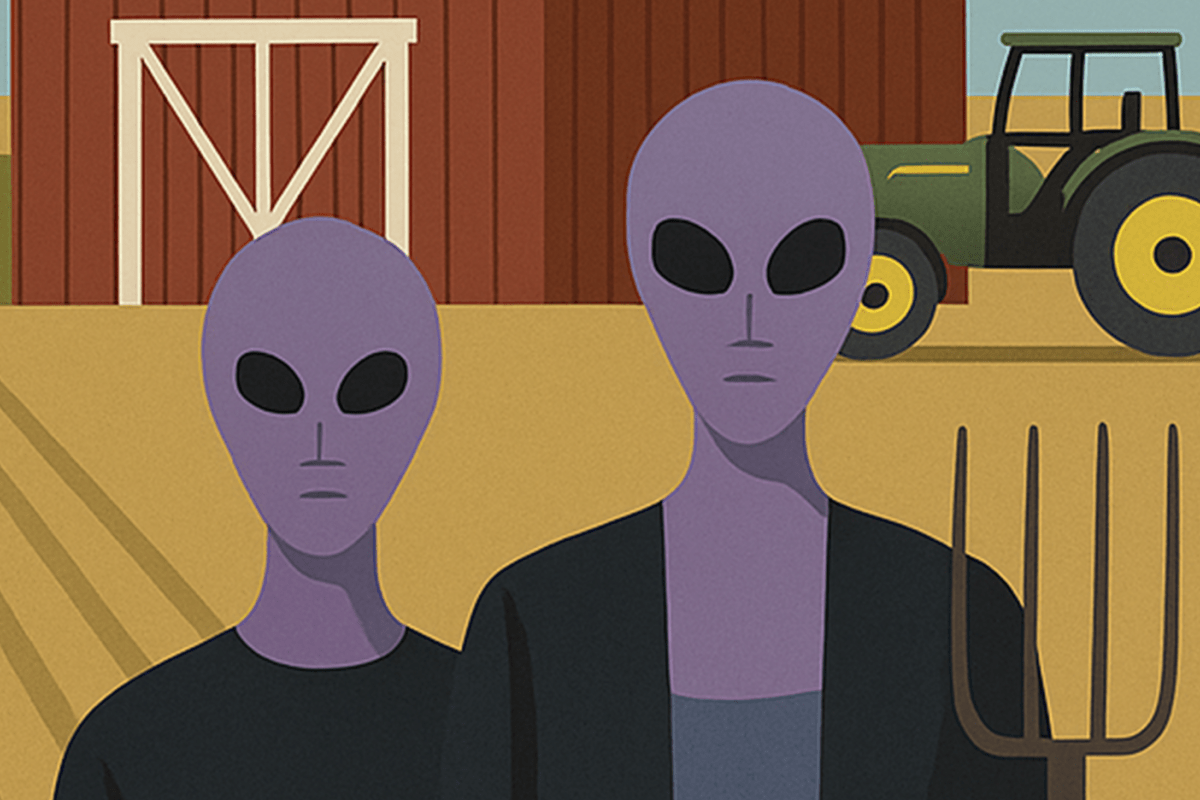
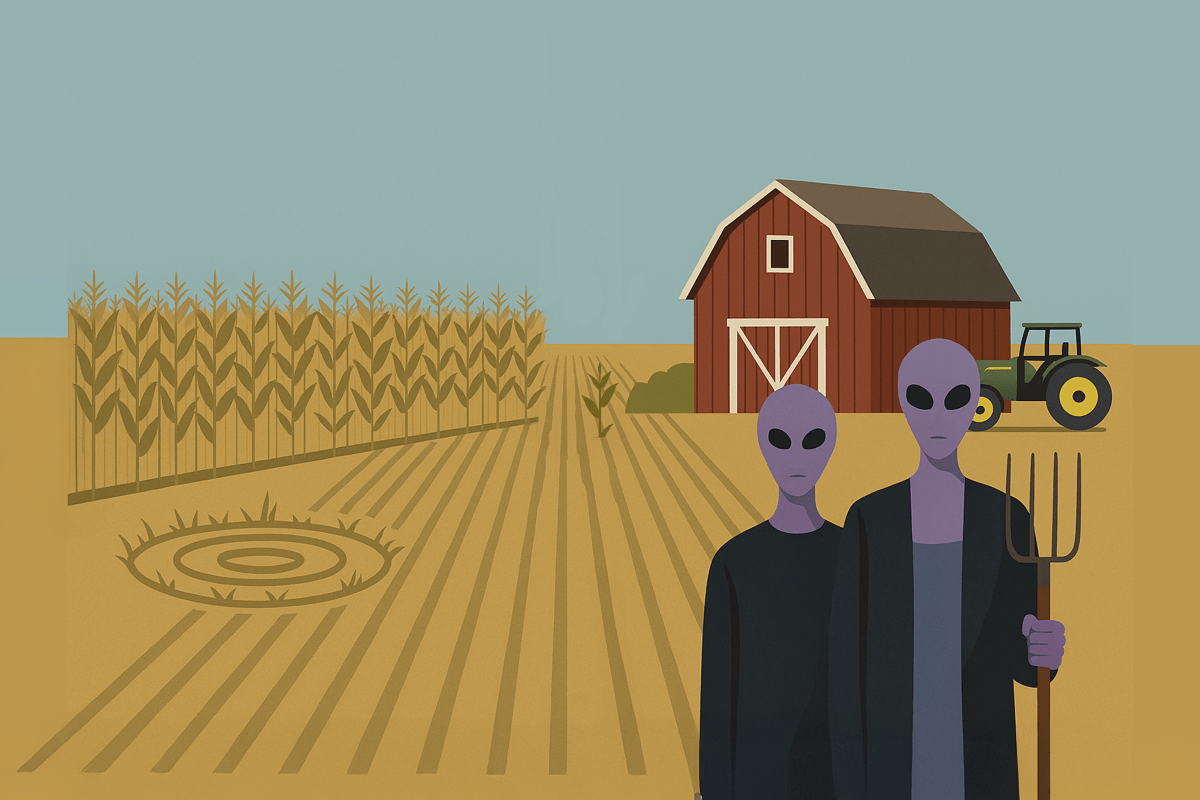
👽 People ask me: What’s with the aliens on the front cover of Sustenance?
Fair enough. Let’s talk about it.

Sustenance is set in Iowa – real, dusty, soybean-and-corn Iowa. I’ve spent months there. I’ve lived in the Midwest (including Chicago) for over a decade. The farms, the tractors, the gravel roads… they aren’t just set dressing. They’re part of the book’s DNA.

So, yes: we’ve got the requisite red barn, green tractor with yellow wheels (hi, John Deere 🚜), and a crop circle or two. The audiobook cover even features an alien peeking out of the barn – though logistics are holding that version back for now.

But those aliens…

If the composition feels familiar, it should.

The cover is a quiet parody of Grant Wood’s “American Gothic – a pitchfork-wielding farmer and his companion, stoic before their rural home. It’s one of the most recognisable paintings in American art, and I couldn’t resist twisting it just slightly. Grant was an Iowa boy.

I designed this cover using a flat vector art style, almost like cut paper or stylised children’s book illustrations. The sky is cyan, the land is beige, and everything is built in clean layers: barn, tractor, field, crop circle, and of course… two violet, large-eyed aliens striking a pose.

But no, this isn’t a literal scene from the book. You might encounter violet aliens in Sustenance, but you won’t find them standing around with pitchforks like interstellar Grant Wood impersonators. The image is meant to evoke the tone, not transcribe the events.

Why this style?

Because the story itself is quiet. Subtle. Set in the kind of place often overlooked or written off. The aliens aren’t invading with lasers. They’re… complicated. And the humans, well, aren’t always the best ambassadors of Earth.

The cover reflects that blend of satire, stillness, and unease.

Oh, and one last note:
🛑 No aliens were harmed in the writing of this book.
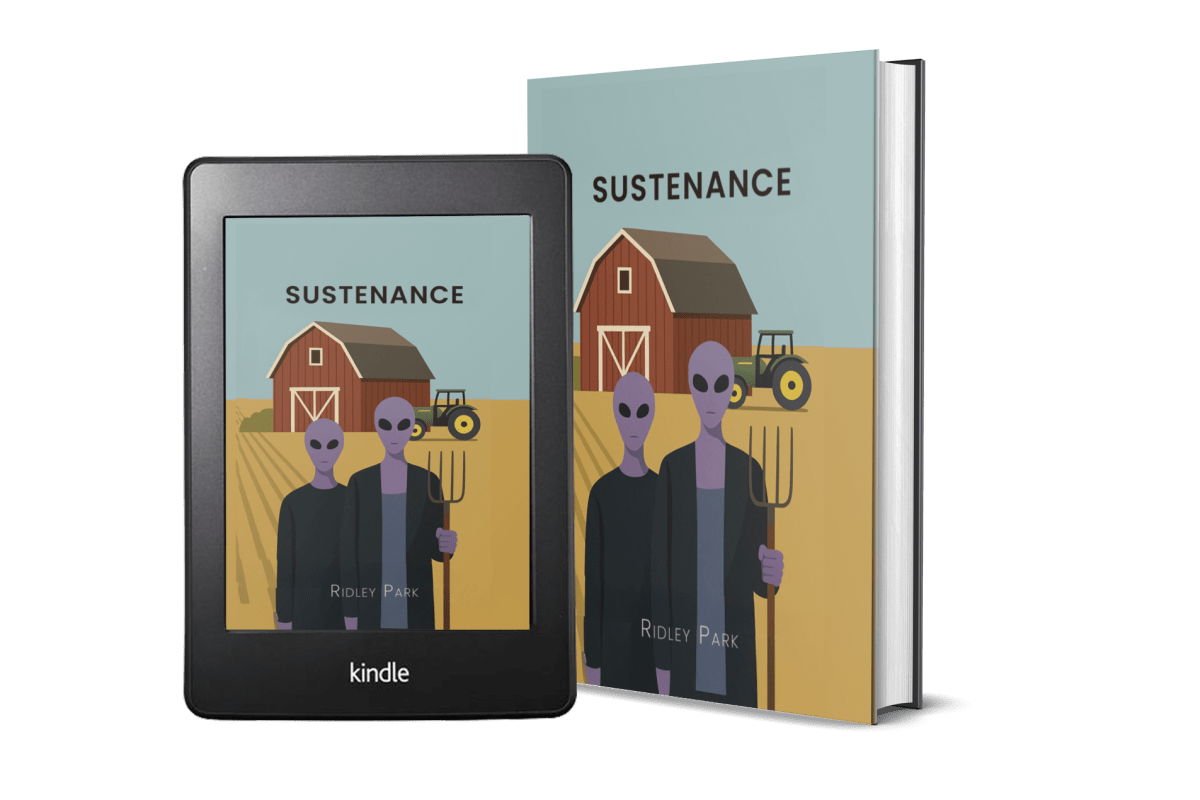
Free for Two Days Only: Sustenance (Kindle Edition)

1–2 minutes

On 7–8 September 2025, the Kindle version of my novella Sustenance will be available free to everyone on Amazon. (It’s always free if you’re a KindleUnlimited member, but these two days open it up to all readers.)

So what is Sustenance?

It’s a novella that begins with the dust and grit of rural Iowa – soybean fields, rusted trucks, a small town where everyone knows your name (and your secrets). At first glance, it reads like plainspoken realism, narrated by a local mechanic who insists he’s just a “regular guy.” But then the ground literally shifts. A crash. Figures glimpsed by firelight in the woods. Naked, violet-skinned beings who don’t laugh, don’t sleep, don’t even breathe.

What follows is not your usual alien-invasion story. It’s quieter, stranger, and more unsettling. The encounters with the visitors aren’t about lasers or spaceships – they’re about language, culture, and the limits of human understanding. What happens when concepts like property, law, or even woman and man don’t translate? What does it mean when intimacy itself becomes a site of misunderstanding?

Sustenance is for readers who:

  • Gravitate toward literary fiction with a speculative edge rather than straight genre beats.
  • Appreciate the mix of the banal and the uncanny – the smell of corn dust giving way to the shock of alien otherness.
  • Are interested in themes of language, power, misunderstanding, and human self-deception.
  • Enjoy writers like Jeff VanderMeer, Margaret Atwood, Octavia Butler, or Denis Johnson – voices that blur realism, philosophy, and estrangement.

This isn’t a story that offers tidy answers. It lingers, provokes, and resists easy moral closure. Think of it less as a sci-fi romp and more as a philosophical fable wrapped in small-town dust and cicada-song.

This version of the book is available in these Kindle storefronts:
United States, United Kingdom, Germany, France, Spain, Italy, Netherlands, Japan, Brazil, Canada, Mexico, Australia, and India

For more details, visit the Sustenance page.

📚 Grab your free Kindle copy on 7–8 September 2025.

Autofiction Break

Three of the last four books I’ve read have been autofiction of one flavour or another.

I had never read Virginia Woolf’s A Room of One’s Own, but I picked it up after finishing The Hour of the Star by Clarice Lispector. The there was Trainspotting by Irvine Welsh.

I found Hour of the Star to be an interesting experiement, but I would have preferred a short story over a novelette. A Room of One’s Own is interesting and well-written, though the content resonates with me historically rather than personally. I’ve already written a bit on Trainspotting, which hit me quite close to home. I liked it the best but needed a change of scenery before engaging in its prequel, Skagboys. I need more motivation before I embark on a 500 page journey. I like Welsh’s writing, but it’s not an easy read, I I need more stamina or a break first.

I haven’t decided what to pick up next.

Ice by Anna Kavan – Five Chapters In

1–2 minutes

Five chapters down, and Anna Kavan’s Ice is already proving itself to be less a novel than a feverish novelette-length hallucination. It hits differently than the sprawling sagas I’ve been chewing through – leaner, sharper, like a shard of frozen glass pressed against the skin.

This isn’t realism. If you try to read it as realist narrative you’ll only tie yourself in knots, muttering that the protagonist keeps chasing a girl he half-admits isn’t even there. He catches glimpses, shadows, phantoms – and follows them anyway. Contrived? Yes, if you expect logic. Coherent? Absolutely, if you treat it as dream grammar, where compulsion replaces causality and the world obeys obsession more than physics.

The point-of-view is the real hall of mirrors. Not so much “unreliable narrator” as unreliable perspective: the voice flickers, sometimes inside his skull, sometimes inside hers, sometimes perched like an outside observer. As in a dream, identities blur. The supposed rescuer blurts out sadistic fantasies, sounding alarmingly like the blue-eyed Warden he claims to oppose. It’s less “out of character” than a reminder that character itself is already compromised.

So, no, you can’t hold this text to the rules of straight narrative. You have to read it the way you stumble through a nightmare: half-convinced, half-sceptical, fully captive.

Where it all leads? I’ve got perhaps seventy pages left to find out. For now, I’m letting the ice close over me, listening for the crunch of those imaginary bones.


EDIT: I’ve finished Ice and left a review on Goodreads. tl;dr: I gave it a 3 of 5 stars. ⭐⭐⭐ It was good. Mercifully it was short. As it reads like a dream sequence, there are no stakes. From the start, I wasn’t heavily invested in what happened to the protagonist nor the subject of his attrction. There were some good scenes, but not enough for me to give it more than a 3.

Notes from the Underground

★★★★★ – “I Am a Sick Man. I Am a Spiteful Man. I Am, Apparently, Hilarious.”

Dostoevsky’s Notes from Underground is a masterclass in misanthropic soliloquy — part philosophical treatise, part psychological farce, and altogether one of the most darkly entertaining monologues I’ve ever had the guilty pleasure of eavesdropping upon. It’s a screaming match between Enlightenment rationality and the petty, pulsing irrationality of actual human life — and guess who wins? (Hint: not the utopians.)

Audio: NotebookLM podcast on this topic.

The first part, a searing, feverish diatribe, reads like the diary of a man who’s been locked in a room with too much Hegel and not enough human contact. It’s Dostoevsky’s pre-emptive strike against every social engineer who’s ever said, “Well, surely man will behave if we just fix the plumbing.” The Underground Man begs to differ — loudly, neurotically, and with an almost Shakespearean flourish of self-abuse.

But it’s the second part — Apropos of the Wet Snow — where things truly fall gloriously apart. Here the theoretical gives way to the tragically tangible. Our narrator, more unhinged by the page, lurches into society like a moth into a bonfire — vengeful, humiliated, self-aware to the point of paralysis. His disastrous encounter with Liza is almost unbearable in its sincerity and cruelty, a pas de deux of hope and destruction that left me squirming and spellbound.

What surprised me most was the humour. Not the cheap slapstick of caricature, but the agonising, close-to-the-bone absurdity that arises when a man is too clever to be functional and too self-aware to change. The Underground Man doesn’t just dig his hole — he drafts blueprints, writes footnotes, and criticises the soil quality.

As a companion read, Tolstoy’s The Death of Ivan Ilych provides a poignant counterpoint. Where Tolstoy charts the steady, ghastly march of bourgeois conformity towards a deathbed revelation, Dostoevsky gives us a man already buried in his psyche, clawing at the dirt and calling it philosophy. Ivan Ilych dies trying to make sense of his life; the Underground Man lives trying to make death of sense itself.

Together, they are a fine Russian reminder that being alive is no guarantee of being well — or even remotely rational.

Midway Through Ivan (No, the Other One)

Halfway through The Death of Ivan Ilych. Not to be confused with One Day in the Life of Ivan Denisovich, though honestly, Russian literature does love an Ivan in crisis. I used to binge on it – more Dostoyevsky than Tolstoy, if we’re keeping score – but there’s something about the philosophical dread that still hits like a cold slap.

Ivan’s recently been promoted and is busy feathering his little bourgeois nest:

In reality it was just what is usually seen in the houses of people of moderate means who want to appear rich, and therefore succeed only in resembling others like themselves…”

Damask. Polished bronze. Pretentious plants. It’s all there in Chapter 3—a catalogue of aspirational mediocrity. And here’s the kicker: he thinks it’s exceptional. That’s the tragicomic punchline of late capitalism, isn’t it? Everyone desperate to be unique by copying the same IKEA showroom.

The wallpaper may change, but the existential wallpaper paste remains the same. Conformity with delusions of grandeur.

🛸 SUSTENANCE Has Landed

A note from Ridley Park on language, consent, and the limits of knowing.

Well, this one’s live.

Sustenance has officially launched.

Audio: NotebookLM podcast on the book Sustenance.

If Propensity was about engineered peace through probabilistic compliance, Sustenance asks what happens when understanding itself breaks down—and nothing you think is mutual, is.

No war. No invasion. No end-of-days. Just a quiet landing. And a failure to translate.

The Premise

A group of non-human beings arrive—not in conquest, not in friendship, but in continuity. They are not like us. They do not see like us. They don’t even mean like us.

There is no universal translator.
No welcome committee.

Just humans—interpreting through projection, desire, and confusion.

And aliens—operating by a logic that doesn’t require interpretation.

The Themes


Sustenance explores what happens when:

  • Language fails and nothing fills the gap
  • Consent becomes guesswork
  • Culture is mistaken for nature
  • Property has no meaning, and law no parallel
  • Sex isn’t private, sacred, violent—or even especially enjoyable
  • Memory becomes narrative, and narrative becomes defence
  • Contact isn’t miraculous—it’s awkward, biological, and quietly irreversible

This is a story about misunderstanding. Not just what others mean—but who we are when we assume we understand anything at all.

The Tone

Think Arrival but rural. Annihilation without the shimmer.

A bit of VanderMeer. A hint of Flannery O’Connor. The cornfields are real. The discomfort is earned.

No apocalypse.

Just a failure to process.

And maybe, something new inside the gap that opens when the old stories no longer apply.

Why Write This?

Because contact doesn’t have to be violent to be destabilising.

Because not all miscommunication is linguistic—some is anatomical.

Because the most alien thing we can encounter is ourselves, misinterpreted.

Because I wanted to write a story where the question isn’t “what do they want?” but “what have we already assumed?”

Now Available

Sustenance is available now in hardcover, paperback, and Kindle.

If you read it—thank you. If you don’t, that’s fine.

The misunderstanding will continue regardless.

📘 More about the book →

Ridley Park
Possibly a person. Possibly a place. Possibly both.

Behind the Binding: Sustenance in Print, Pixels, and Purgatory

Not quite a launch. Not quite a rant. Just one author trying to get a novella into the world without sacrificing too many hours or brain cells.

Paperback Problems

I’ve been writing quite a bit lately—several novellas/novelettes, to be precise.

They all began life as short stories, but brevity doesn’t come naturally. Apparently, I can’t shut up even on the page. I toyed with the idea of releasing a thematic collection, and I still might. But for now, Sustenance is getting its own debut—likely this month.

The book clocks in at around 14,000 words, printed across 144 pages. I’ve read that readers prefer novels to novellas, but I’ve also read that readers don’t really read anymore. Time’s short. Attention spans are shorter. Maybe shorter fiction has a fighting chance. We’ll see.

I formatted it in 6×9 inches, which may have been overly generous. It’s leaner than your average indie fantasy tome but still thicker than my last Žižek collection. So there’s that.

The manuscript began in Word, like every poor decision. I laid it out in InDesign and exported the PDF through Acrobat. No budget, so I designed the cover too—started in Illustrator for the vector charm, but ended up in Photoshop, where I’m more at home. I designed the full wrap—front, back, spine—as a single canvas.

This was a mistake. More on that later.

Still, I’m pleased with the final look. Might reuse the style across future novellas for a bit of visual branding. There’s barely enough of a spine to print on, but we suffer for aesthetics.

Proofs arrive Thursday. Fingers crossed.

Hardback Headaches

Then came the hardback edition. Same 6×9 size, same interior. Should’ve been simple.

It wasn’t.

I forgot (again) that hardbacks require extra bleed and margin space. Couldn’t just resize the existing cover without risking pixelation. If I’d stuck with vectors, this would’ve been a breeze. Instead, I got to rebuild the entire layout from scratch—layers, guides, grids, the lot.

Hours of joyous rework. Lesson learned. Until next time.

eBook Escapism (and Other Fantasies)

Converting the layout to eBook format was a slow-motion trainwreck. I’d inserted custom font glyphs above chapter titles in InDesign. They rendered fine—until they didn’t. Halfway through, chaos reigned.

I cracked open Sigil and manually edited the XHTML. So far, so fiddly.

Then I uploaded the .epub to Amazon. Except Amazon wanted a .kpf file. Of course it did.

Enter Kindle Previewer. Except it doesn’t support embedded font glyphs. So I converted them to SVGs.

Still no dice. Kindle’s rendering engine is older than most of its readers. SVGs failed too. So I converted every glyph to PNG, rewrote the CSS, rebuilt the XHTML again, and gave it another go.

Looks fine. Not perfect. I gave up.

They’re just decorative anyway. No plot-critical glyphs here.

The Kindle version should go live shortly. I enrolled it in KDP Select, which means 90 days of exclusivity in exchange for a modicum of convenience. After that, I’ll look at wider distribution.

For the eBook cover, I simply cropped the original layout in Photoshop. That part was, mercifully, straightforward.


What’s Next?

This post is more documentation than declaration. A sort of production diary. I’ll follow up with an actual announcement when the book launches, plus a few reflections on themes, characters, and that moment when you realise your protagonist may have accidentally sexed up a chicken.

Long story.

Anyway, this is just the start. Stay tuned.

Or don’t. Up to you.

Book Review: The Blind Owl

What, again? Didn’t you alredy post this review?

So, I decided that the review was at too high of a level, so I did a new one. Let me know if this one is better.

It turns out the new was got a bit long, so I broke it into three parts. This is the first part—a summary but with more context. The other two parts shall follow.