As I’ve been working through Octavia Butler’s Dawn, I’ve realised why science fiction as a genre rarely resonates with me. It isn’t the aliens or the starships; it’s the scaffolding. Sci-Fi carries the weight of the Modernist project – questions posed and quickly answered, problems rationally explained, the reader guided toward the “lesson.” It feels like indoctrination: tidy, didactic, instructional.
Fantasy, strangely enough, I tolerate even less. Where science fiction pushes forward, fantasy looks backward. Sci-Fi imagines the future of the Modern experiment: technology, politics, survival scenarios, all with a rationalist bent. Fantasy imagines the past of the same experiment: kings, bloodlines, prophecies, destiny. One proclaims progress, the other tradition, but both insist on role conformity.
This struck me as almost political: science fiction reads like fodder for Liberals and Progressives, those who believe we can build better systems if only we’re clever enough. Fantasy, meanwhile, often aligns with a Conservative ethos – a return to order, hierarchy, and providence, just with dragons and spells thrown in. Both are catechisms of Modernity, just oriented in opposite directions.
It may just be me. I don’t identify with the Modern project, and so the genres that proselytise it – looking forward or looking back – leave me cold. I prefer literature that unsettles, that leaves silence where there might have been certainty, that lets ambiguity breathe. But for many, Sci-Fi and Fantasy provide something else entirely: reassurance.
Sustenance (available here) was free for everyone on Kindle on 8 and 9 September. My goal was to provide access to the book for exposure with the hope of getting ratings and reviews. It’s still early, but I’d like to report that over 100 people downloaded the Kindle version. Now, I’ll share some details.
The Kindle version was downloaded 106 times in the past two days.
Some read it from their KindleUnlimited accounts
Some bought physical copies
Some people rated the book; some even left reviews on Amazon or Goodreads
The ratings and reviews are mixed, but all are welcome. Few people rate books; even fewer review them, so I appreciate the effort.
I got 3 ratings and 2 reviews on Amazon: ⭐⭐⭐⭐⭐, ⭐⭐⭐⭐, and ⭐. A one-star review. Thanks for that, too.
The ⭐rating didn’t leave a review, so I don’t know why they didn’t like it. I don’t know what types of books they read or this is exatcly what they prefer – they just didn’t like this. Still, at least they took the time to do it.
As a former statistician who has worked with survey data, I find this to be similar – most people don’t respond to surveys. Most people don’t engage in call-in shows. Most often, the people who respond either love or hate the topic so much that they feel compelled to broadcast their opinions. The people who say “meh” won’t even bother.
KindleUnlimited notwithstanding, I have no idea how people engage with a book. I have purchased and downloaded more books than I can read in a lifetime – probably multiple lifetimes. Sometimes, I just want to have access to a classic in case the mood strikes me; sometimes a book comes into view, and I convince myself that when I have the time, I might read it. I have no way of knowing.
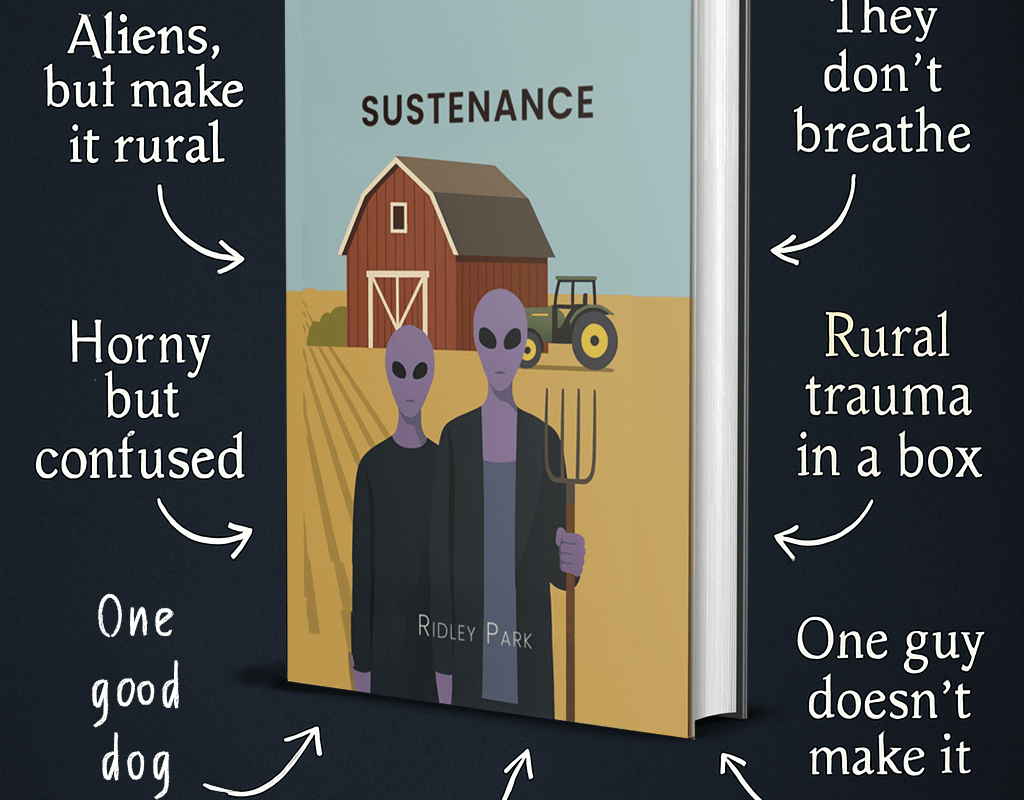
Image: Sustenance Trope Board
I’m guilty of some single-star ratings without leaving a review, so I am in no position to point fingers. Sometimes a book seems bad that you want to warn the world, but you don’t want to expend more time on the endeavour that you already have.
I took this screengrab of 1-star ratings from Goodreads – some have reviewers, others don’t.
Image: 1-Star Reviews
Only one of these books is non-fiction, though I might argue that point, hence the single star.
One Ayn Rand was a class assignment. The other was someone telling me that I hadn’t judged her best work. In this case, her best work is one star, so I can skip anything else. Ditto for the Bible – complete dreck.
Authority, I only recently read. it was part of a trilogy. The other two books got 4 and 3 stars, so I’ll consider this one a dud. I’m not in good company, as it rated worse than the other two on average, yet still managed a 3.55. Some people liked it.
The last one was a class assignment for my son that I read with him. His rating matched mine. How it became an assignment is just testimony that there is no accounting for taste.
Also, as a public service, I’d be willing to bet that if you liked these books, you won’t like mine.
Octavia Butler’s Dawn
On the topic of rating— I am midway through Dawn. It’s mid. I was asked why I hadn’t read it as part of the dystopian Venn, so I picked it up. To be fair, I thought several of the stories on the Venn were mid themselves, classics or otherwise. Perhaps I’ll write a separate post on that someday.
Honestly, I’d give Dawn 2 stars. However, I also know that Sci-Fi is not a genre that resonates with me, so I’ll be generous and give it a star because it may just be my personal bias of not relating to Sci-Fi that’s the problem, and the book might be better received by fans of that genre. Offhand, the only fiction genres I dislike worse than Sci-Fi are Fantasy and Romance.
Aside from being Sci-Fi, it reads like YA fiction. There’s nothing inherently wrong with YA, but I am clearly not its target demographic. Other than that, it’s serviceable, but I prefer to read content that’s more complex and layered, not spoonfed to me.
Conclusion
Anyway, I’ve derailed this thread, but I wanted to clarify how I approach rating books and want to thank those of you who have taken the time on Sustenance. If you haven’t yet, I’d appreciate any rating from 1 to 5. Reviews earn extra karma points.
I began reading Octavia Butler’s Dawn, and it raised some interesting* philosophical questions.
In the early chapters of Dawn, an alien declares that humanity has “committed mass suicide.” Sartre insists, “Inaction is still a choice.” Howard Zinn reminds us, “You can’t be neutral on a moving train.” Each collapses complexity into the fiction of agency, a story that props up Modernist notions of responsibility and blame. But what if agency itself is an unnecessary fiction? I’ve explored this tension in a new essay on my Philosophics blog:
On 7–8 September 2025, the Kindle version of my novella Sustenance will be available free to everyone on Amazon. (It’s always free if you’re a KindleUnlimited member, but these two days open it up to all readers.)
So what is Sustenance?
It’s a novella that begins with the dust and grit of rural Iowa – soybean fields, rusted trucks, a small town where everyone knows your name (and your secrets). At first glance, it reads like plainspoken realism, narrated by a local mechanic who insists he’s just a “regular guy.” But then the ground literally shifts. A crash. Figures glimpsed by firelight in the woods. Naked, violet-skinned beings who don’t laugh, don’t sleep, don’t even breathe.
What follows is not your usual alien-invasion story. It’s quieter, stranger, and more unsettling. The encounters with the visitors aren’t about lasers or spaceships – they’re about language, culture, and the limits of human understanding. What happens when concepts like property, law, or even woman and man don’t translate? What does it mean when intimacy itself becomes a site of misunderstanding?
Sustenance is for readers who:
Gravitate toward literary fiction with a speculative edge rather than straight genre beats.
Appreciate the mix of the banal and the uncanny – the smell of corn dust giving way to the shock of alien otherness.
Are interested in themes of language, power, misunderstanding, and human self-deception.
Enjoy writers like Jeff VanderMeer, Margaret Atwood, Octavia Butler, or Denis Johnson – voices that blur realism, philosophy, and estrangement.
This isn’t a story that offers tidy answers. It lingers, provokes, and resists easy moral closure. Think of it less as a sci-fi romp and more as a philosophical fable wrapped in small-town dust and cicada-song.
This version of the book is available in these Kindle storefronts: United States, United Kingdom, Germany, France, Spain, Italy, Netherlands, Japan, Brazil, Canada, Mexico, Australia, and India
I found Hour of the Star to be an interesting experiement, but I would have preferred a short story over a novelette. A Room of One’s Own is interesting and well-written, though the content resonates with me historically rather than personally. I’ve already written a bit on Trainspotting, which hit me quite close to home. I liked it the best but needed a change of scenery before engaging in its prequel, Skagboys. I need more motivation before I embark on a 500 page journey. I like Welsh’s writing, but it’s not an easy read, I I need more stamina or a break first.
This particular meme has been making the rounds like a drunk uncle at a wedding – loud, colourful, and convinced it’s profound. A Venn diagram, no less! Four big circles stuffed with dystopias, slapped together as if geometry itself conferred wisdom. Most of them are books, a few are films, and one – Gattaca – is glaring at me because I haven’t seen it. That omission alone feels like a character flaw. I might grit my teeth and watch it just to close the loop, though it doesn’t exactly scream, “Pour a glass of wine and enjoy.”
DISCLAIMER: This is not a political post.
Image: Venn Diagram
Here’s the thing: as art, it’s rather lovely. As a piece of intellectual cartography? It’s rubbish. It pretends to classify but in fact it merely collages. Orwell is pressed up against Burgess, Atwood rubs shoulders with Logan’s bloody Run, and in the middle sits Animal Farm, as if pigs with clipboards are somehow the Rosetta Stone of dystopia.
And yet – if you squint just so, tilt your head like a dog hearing a harmonica, you can just about see some tenuous ligatures:
Surveillance and conditioning: 1984, Clockwork Orange, and The Matrix all insist that the human mind is clay to be moulded by boot, syringe, or simulation.
Reproduction and regulation: Brave New World, The Handmaid’s Tale, and yes, Gattaca (apparently) fret endlessly over who gets to breed, who gets culled, and whose DNA deserves a future.
Bodies as resource: Soylent Green, Brazil, Gattaca again – people ground down into spreadsheets, rations, or literal mince.
The veneer of civilisation: Lord of the Flies and Animal Farm showing us that civilisation is just papier-mâché over the swamp.
But let’s be honest: the diagram isn’t actually saying this. It’s just four intersecting blobs, with titles hurled in like darts at a pub quiz. The apparent “structure” is nothing more than meme-magic – order conjured out of chaos to make you nod gravely as you scroll by.
So yes: as art, it works. As a Venn diagram, it’s a travesty. And maybe that’s the deeper joke. We live in an age where every complexity gets crushed into an infographic, every horror squeezed into a digestible meme. Which, if you think about it, is itself a bit dystopian.
As per my recent post, I need a sanity break. I’ve been editing Needle’s Edge all day. Each time I hit a milestone, I consider drafting a blog post, but then I choose to persist. Not this time.
I’ve been untangling the spaghetti of a misplaced – or rather, overextended – pregnancy. It had stretched on for too long, so I weeded out contradictory events. Some of these had dependencies, so I relocated or eliminated them to preserve flow.
In the process, I re-oriented her conception date and reset any foreshadowing that tied into it. To keep myself honest, I started tracking her progress in the manuscript with markers: <p=X>. With each time-specific event, I increment X.
So far, I’ve reviewed 24 sequential scenes, not counting the half-dozen relocated ones I had to rework just enough to maintain continuity. This leaves the protagonist at 29 weeks. That also meant pruning irrelevant references, for instance, cutting any mention of pregnancy before it even began.
Being a typical human pregnancy, my target is 38 to 40 weeks. That leaves me with another 10-odd weeks to rummage through. Once I’ve untangled the draft, I still need to return for line edits, colour, and shape.
Editing is often pitched as polishing, but sometimes it’s surgery. Today, I’ve been elbows-deep in the operating theatre.
Editing Needle’s Edge has taken longer than the time it took to draft the damned thing. Typical, I suppose, but demoralising all the same. Drafting is a rush; editing is a grind. In video game parlance, this is the endless dungeon crawl. Kill the same mob again and again, collect marginal XP, and hope that –eventually – you level up.
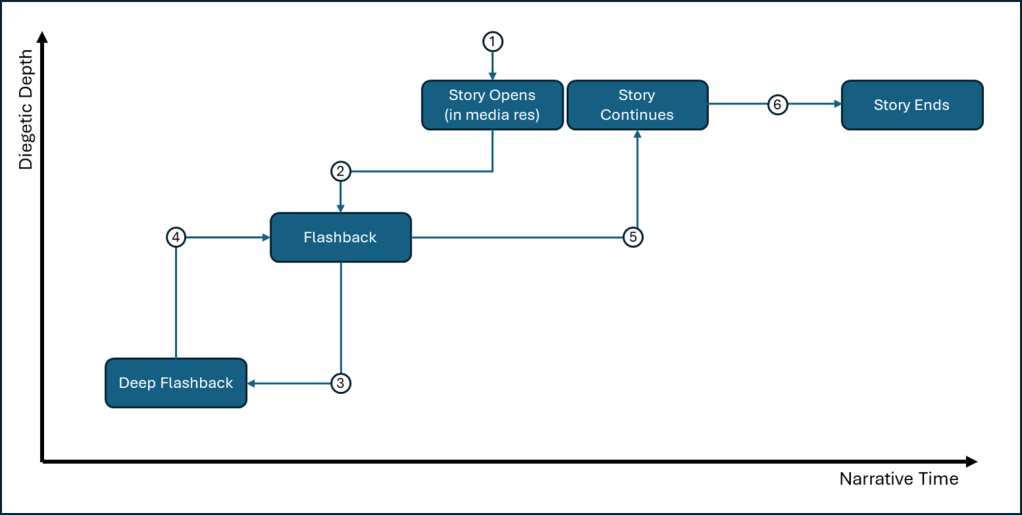
Recently, I wrestled with the narrative structure, which was starting to feel like Inception with a side order of Russian dolls. Flashbacks within flashbacks within flashbacks. I diagrammed it, mostly to convince myself I hadn’t lost the plot (see exhibit A, below).
Image: Chronological and Sequential Timeline Abstraction
Here’s the lay of the land—without spoilers, of course. The story begins [1] in medias res, with Sarah-slash-Stacey already entrenched in her daily grind. Then comes [2] the flashback, showing how she arrived there. Midway through, we plunge into [3] a deep flashback of her childhood, before [4] snapping back to the mid-flashback, then finally [5] rejoining the present-day storyline until [6] the bitter – or possibly bittersweet – end.
Naturally, I subvert as many tropes as I can, though no one can write a tropeless story any more than they can write one without words. (I’m sure some post-structuralist is trying right now, but God help their readers.)
The hardest part wasn’t constructing the labyrinth but finding my way out again – reengaging with the present-day thread after chapters of detour without resorting to that televisual clanger: “We now return to our regularly scheduled programming.”
Editing a book like this is less polishing and more archeology: chiselling away sediment, brushing off centuries of dust, desperately hoping not to snap the artefact in half. With luck, the grind pays off. If not, at least I’ll have a lovely flowchart to show for it.
Fresh from my recent post on movies that are better than books, I now consider books and movies with symbiotic or synergistic energy – better together.
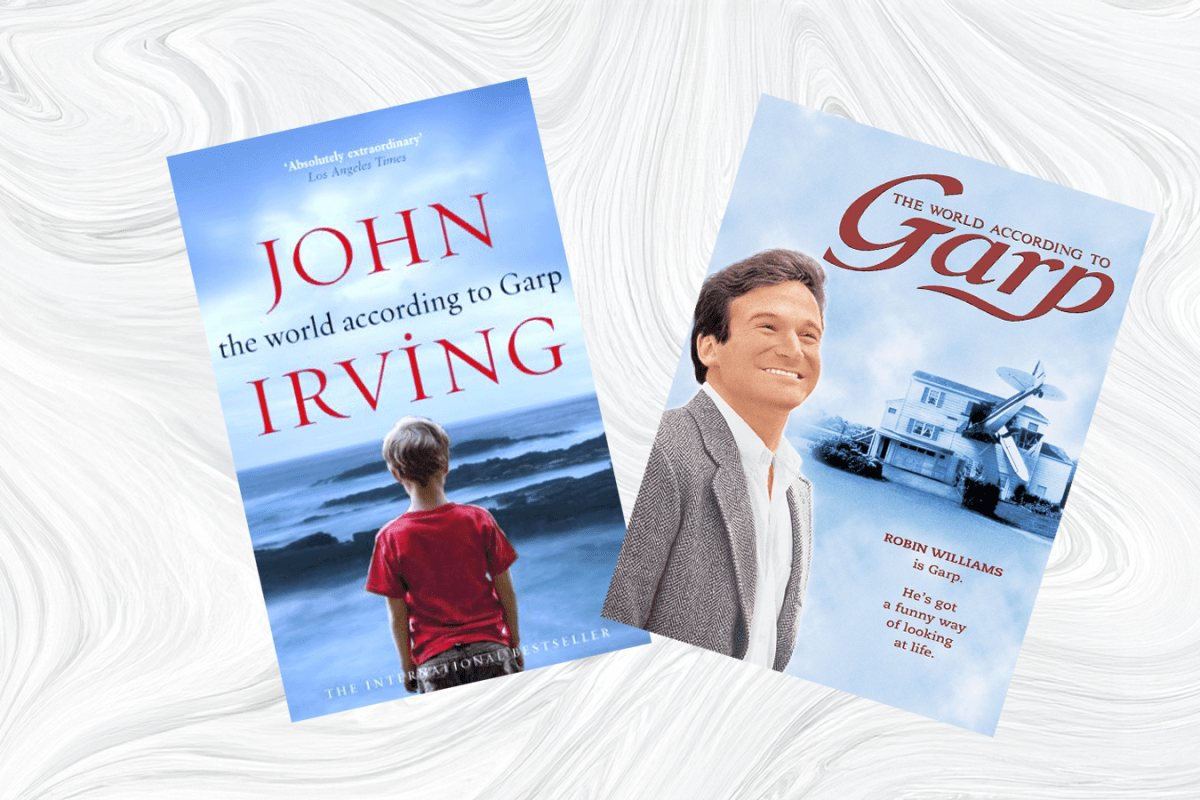
I first stumbled onto this realisation with The World According to Garp. Hearing that the film was about to be released, I bought the book; it was decent. I saw the movie when it came out; it was decent.
The book (John Irving, 1978) is sprawling, grotesque, and digressive, with moments of brilliance scattered through longueurs.
The film (1982), with Robin Williams and Glenn Close, trims away nuance for two hours of cinematic shorthand.
Alone, each feels middling. Together, they fill the gaps. The novel provides texture and detail; the film provides embodiment and immediacy. It’s like puzzle pieces snapping together.
We tend to frame it as a duel: book versus movie, page versus screen. One must be superior, the other a pale imitation. But occasionally, the two work in tandem, not rivals, but co-conspirators. Taken alone, each may be “just okay.” Together, they form a whole greater than their parts. Notice that the IMDB scores are lower for movies that are better than books, due to the synergistic effects.
Disclaimer: I didn’t like these uniformly, but my thesis still holds. Moreover, film is not typically my preferred medium.
Here are a few other book–film pairings that work this way:
McEwan’s metafictional games on the page feel cerebral. Wright’s film, with its Dunkirk tracking shot and that infamous green dress, floods the senses. Together they fuse thought and feeling.
Proulx’s prose is spare, devastating in its restraint. Ang Lee’s film opens the silences into landscape and longing. Neither feels whole without the other.
Mitchell’s Russian-doll narratives dazzle but drag; the Wachowskis’ intercutting dazzles but confuses. Together they hint at the ambition neither medium alone quite nails.
I publicly confess that I didn’t really like either version of Cloud Atlas. A mate suggested I read the book ahead of the film. It was convoluted and mid. Ditto for the film, but for different reasons. I felt that the concept was nice; it simply didn’t translate. YMMV.
Golding’s allegory sometimes feels over-determined. Brook’s film, shot with actual boys descending into ferality, restores the anthropology behind the allegory.
IMDB Rating: 6.9/10
Why Symbiosis Matters
When book and film complete one another, it challenges the false binary of better or worse. Sometimes, the text supplies what the film cannot: detail, psychology, interior voice. Sometimes the film supplies what the text cannot: embodiment, atmosphere, a world you can see.
Instead of competition, the relationship becomes conversation.
So perhaps the real question isn’t “Which is better?” but “Which needs the other to feel complete?”
What pairings have you found where book and film together elevate each other beyond what either could manage alone?