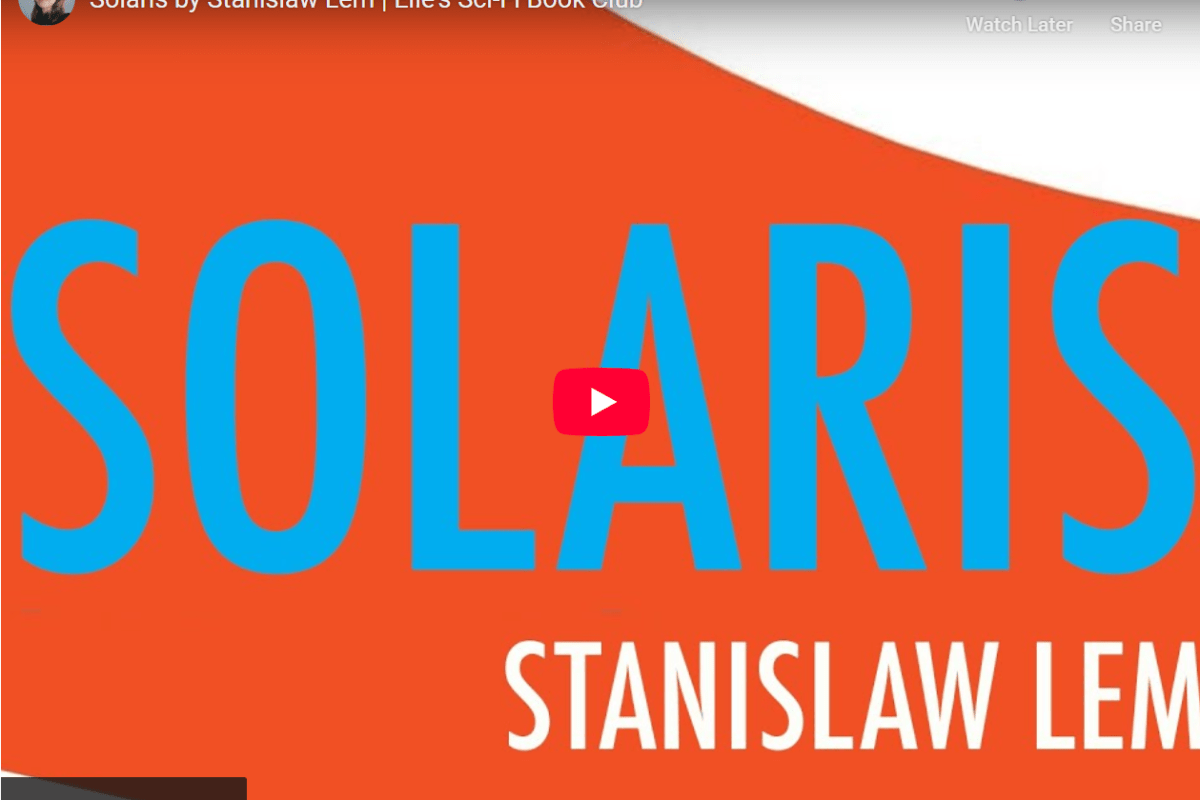
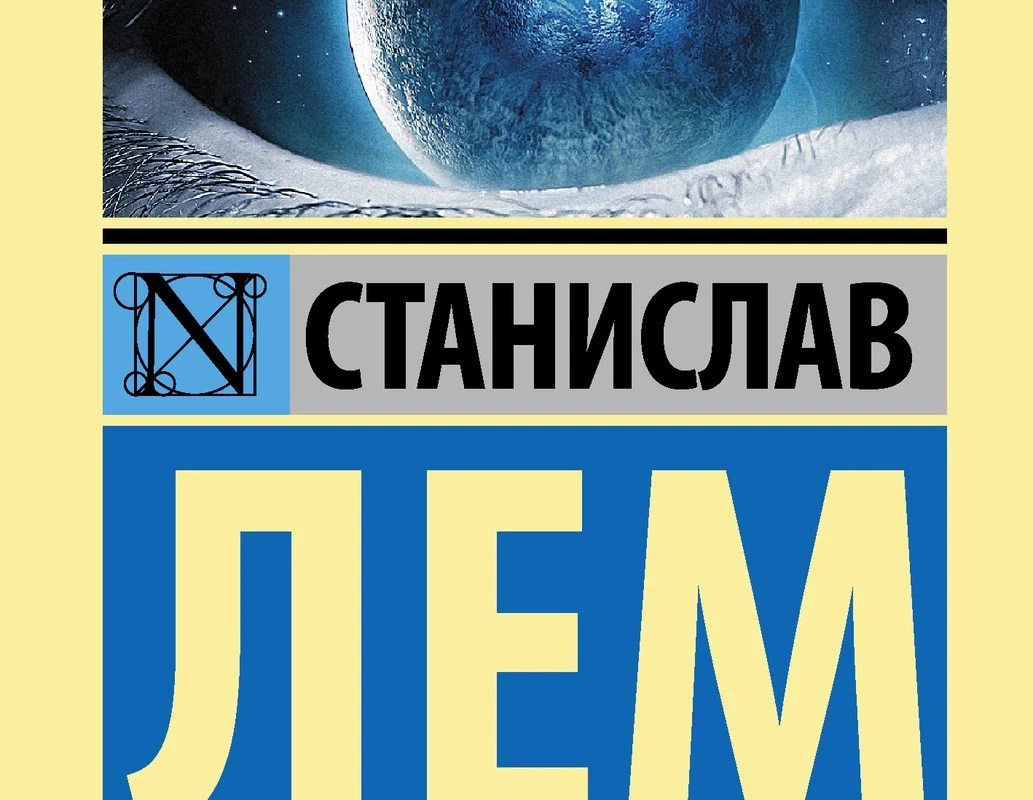
I finished reading Lem’s Solaris and then was notified of a discussion about the book and the film adaptations.
I intended to draft a book review, but I may defer.
For now, I’ll note that the similarities between this and my own work are superficial. Both have philosophical perspectives, but Lem’s is much more psychological. This is nice, but it’s not where I tend to take things, and not so overtly.
I don’t read sci-fi. It rarely resonates with me. I’ve read many classics, but I don’t get the hype. As a speculative fiction author, I sometimes operate in an adjacent space – close enough to borrow a few ideas, but never quite belonging. I’m not interested in fetishising technology or celebrating so-called human ingenuity. But if an idea serves the story? I’ll use it.
One concept I wanted to explore: the definition of life itself, and what sentience means when we can barely define it for ourselves.
Not long ago, I began working on a story: some people leave Earth to inhabit another planet in a different solar system. Nothing revolutionary there. They land on what appears to be an uninhabited world – uninhabited, that is, by our current definition of life. Instead, the planet itself is alive. Not in the Gaia hypothesis sense of interconnected ecosystems, but truly interactive. Responsive. Alien in ways that challenge every assumption about consciousness.
Of course, there are more details – dual suns in a figure-eight orbit, shifting gravity, time that expands and contracts, organisms that defy classification. But those are mechanics. The heart of the story is simpler: what happens when survival requires abandoning the frameworks that made you human?
As is my protocol, I fed my manuscript into AI and asked: is this idea unique? If not, what’s it similar to? Who am I adjacent to?
I got names. Titles. Books and films. Most had superficial similarities but different intents. Then one stood out: Solaris, Stanisław Lem’s 1961 novel. I hadn’t read it, so I got a copy.
There were so many commonalities it felt like discovery and defeat in equal measure.
Lem wrote Solaris before humans had meaningfully left Earth’s atmosphere. Published in 1961, it predated material space exploration by years. On October 4, 1957, the Soviets launched Sputnik 1 – the first artificial satellite. Four years later, Yuri Gagarin became the first human to orbit Earth, his flight lasting just 108 minutes. The first American in space, Alan Shepard, flew in 1961. John Glenn orbited in 1962.
Lem imagined a sentient ocean on an alien world orbiting twin suns before we’d even confirmed planets existed beyond our solar system. His protagonist grapples with a consciousness so alien that communication may be impossible – not because of language barriers, but because shared reference points don’t exist.
In some ways, Solaris also shares DNA with Jeff VanderMeer’s Annihilation – that same sense of an environment that isn’t hostile so much as indifferent, operating by rules humans can barely perceive, let alone comprehend. But where VanderMeer leans into existential dread, Lem’s tone is colder, more philosophical. Less visceral horror, more intellectual vertigo.
My story, working title: Goldilocks,sits somewhere between them. It has Lem’s alien sentience and dual-sun orbital mechanics. It has VanderMeer’s gradual unravelling of human perception and sanity. But it also has something neither quite touches: the brutal intimacy of being the last of your species, seeking warmth in a universe that offers none.
So is my idea original? Not entirely. Does that matter? I’m not sure anymore.
Lem wrote his novel sixty years ago, before we’d touched the moon, before we knew what exoplanets looked like, before we’d meaningfully begun asking whether consciousness requires a brain. He imagined sentience beyond human comprehension – and did it so thoroughly that anyone following feels like they’re retracing his steps.
But perhaps that’s the point. Originality isn’t about being first. It’s about what you do with inherited ideas – how you refract them through your own obsessions, anxieties, and questions.
Lem asked: can we ever truly know an alien intelligence?
VanderMeer asked: what happens when the environment rewrites you?
I’m asking: what does it mean to be human when humanity itself is ending?
Maybe that’s enough distance. Maybe it’s not. Either way, the story exists now – half-written, haunted by its predecessors, searching for its own voice in the silence between stars.
As an author, reviews matter. Not because they inflate the ego (though I won’t pretend a kind one doesn’t help), but because they’re one of the few moments when the work stops being mine and becomes read.
I submitted Propensity for professional review through Reedsy – why not? It’s always interesting to see how a stranger processes what you’ve made. Some of my books have Kindle editions, which makes collecting feedback easier: I can offer them free for a day or two and watch the downloads climb. Whether those books are ever opened is another question. I’ve been that reader too – downloaded an eBook, nodded at the cover, and forgotten it. I’ve bought audiobooks I’ve never started.
So when someone actually read Propensity, a book not yet available as an eBook, and took the time to write a thoughtful review, that meant something. And unlike the memorable one-star “Garbage” review that Sustenance once earned, this one had a little more nuance.
An unnerving story that begins with a bizarre experiment and unfolds into an impressive hyperbole for human hubris.
Synopsis
What if peace could be engineered?
In Propensity, a team of scientists and a military general pioneer a device capable of altering human behaviour itself—tuning aggression, obedience, libido, faith, and risk tolerance like dials on a console. At first, the results seem miraculous: violence quelled, conflict dissolved, impulses muted. But as the technology scales from labs to battlefields to cities, the illusion of control begins to fracture.
Through sharp, unsettling vignettes, the novel traces both the grand sweep of societal collapse and the intimate struggles of those left to navigate it. At its heart, Propensity is a literary exploration of power, morality, and the fragile myth of free will.
Both speculative and philosophical, it poses an unnerving question: if our choices can be rewritten at the neurochemical level, were they ever truly ours?
– Review Begins –
“Reader discretion is advised. Free will has been deprecated.”
This ominous word of caution is what Ridley Park’s speculative novel ‘Propensity’ opens with, and it sets a tone that strikes an impressive balance between clinically descriptive and quietly devastating. Beginning as a bizarre experiment in behavioural modulation by way of neurochemical intereference, it unfolds into an eerie metaphor for the tricky road between control and conscience.
Park’s chapters are short and succinct, some barely a page long, in a staccato rhythm. This creative choice, while initially a little unnerving, works well to reflect the story’s inherent disintegration: scientists losing grip on their own creation, subjects dissolving into numb submission or what they term “the zeroed state”, and a world slowly learning the price of their “engineered peace”. The writing comes off as crisp in an almost detached manner that leaves one wanting for a bit more emotional depth in the first part of the book but not only does that eventually grow on you, it ends up serving its purpose of thematic execution in both its text and subtext. Phrases like “silence playing dress-up as danger” and “peace was never meant to be built, only remembered” linger like faint echoes long after you turn the page.
This dogged curiosity and thought the writing dredges up anchor the novel’s core strength. Its impact is rooted not in prosaic preaching but letting the reader unpack the implications by themselves as they go on. Working in the field of medical physiology myself, the scientific nitty-gritty delved into, including the hormonal cues and neuronal plasticity, particularly intrigued me and while I acknowledge the convenience of fictitious extrapolation of theory, it manages to add a certain sense of realism to the story. It’s equally fascinating and disturbing, especially in the current epidemic of artifical intelligence we live in, to see faith and empathy become mere variables in a lab.
A fitting hyperbole of human’s hunger for order, ‘Propensity‘ does occasionally falter. Its fragmented and experimental structure, with prose interspersed with poems and memos, while successful in tying up its chaos, sometimes undercuts emotional engagement. The chapters are like snapshots that end before they can fully breathe. But when Park makes it work, especially through the poetic montage that follows the post-modulation disaster, it’s hypnotic.
By the end, I found myself returning to that elusive idea of peace conspicuous throughout the book. The text seems to suggest that peace isn’t something we construct but rather, something we remember. It’s almost a fragile illusion fleeting across one’s reality, often better suited to being a word than a sentiment, history than hope. It’s as if the moment you declare peaceful times, they’re already past.
‘Propensity’, thus, doesn’t offer answers; it offers questions and their ramifications. And in more ways than thought possible through the misconception surrounding the scope of speculative genre, that’s perhaps a truly accurate representation of the times we live in.
– Review Ends –
Why I appreciate this review
It would be easy to say I appreciate it because it’s positive. But that’s not the point.
One of my beta readers—someone I trust implicitly—had the opposite reaction. He loved the first half and thought the latter sections fell apart. This reviewer? The reverse. She found the disintegration satisfying. She saw design in the decay.
That tells me Propensity did what I intended: it divided readers by temperament. It rewards those who stay long enough to realise the structure mirrors the subject—the erosion of coherence itself. I never meant to write a tidy narrative. I meant to write an experiment in entropy.
If your literary diet leans on plot-driven fiction, my work might not taste familiar. I don’t spoon-feed answers. I leave questions open, sometimes maddeningly so. That’s deliberate.
An Anecdote
Years ago, my company ran a focus group for a software interface. Two groups saw the same prototype: one in their twenties, one in their fifties.
“It’s like a video game!”
Both said the same thing—“It’s like a video game.” The twenty-somethings meant it as praise. The fifty-somethings meant it as criticism.
Same words. Opposite meanings.
That’s literature too. Same text, different minds, different appetites. Some readers crave clarity and closure; others prefer complexity and dissonance. The trick is knowing which audience you’re writing for—and not apologising for it.
I write literary speculative fiction. It’s a small, peculiar corner of the bookshelf. But when someone wanders in and gets it, it’s enough.
The book ends, as these things always do, with a sigh and a stack of annotated pages. I’ve just closed the cover on Zamyatin’s We, and, like a cigarette slipped into the afterword, there sat Ursula K. Le Guin’s essay “The Stalin in the Soul“. She wrote it decades later in 1979, but it might as well have been stitched into the same binding. I may write about it in more detail elsewhere.
Zamyatin built the totalitarian city of glass; Le Guin peered into the reflective surfaces. Her “Stalin” isn’t a political leader but the minor tyrant most of us cultivate internally — the censor who edits desire into silence, who rewards obedience with the narcotic of safety. She understood what Foucault would later codify as biopower: that power’s finest trick is to outsource itself. You don’t need Rousseau’s chains when you can teach people to manage their own submission.
Reading it now feels almost indecently prescient. The State of We had surveillance towers; ours has dashboards. Zamyatin imagined a future where citizens surrendered privacy for perfection. We call it good UX. Le Guin warned that the artist’s real jailer was the fear of making art that doesn’t please the market. Foucault, if he were still here, would simply nod and mark it as another case study in voluntary servitude.
We‘s protagonist, D-503, had shades of Dostoyevsky’s in Notes from Underground – only a bit more reliable of a narrator.
As I close this run of readings — We and its prophetic essay appendage — I can’t shake the feeling that finishing the book is part of the ritual it describes: the quiet filing of experience, the discipline of comprehension. Yet finishing also matters. There’s a line between vigilance and paralysis, between watching the gears of power and daring to write anyway.
So yes, the project reaches its line — not a triumphant banner, more a hand-painted sign reading enough for now. Zamyatin showed me the machine. Le Guin showed me the human who keeps it running. Foucault, the analyst of our beautiful cages, taught me not to pretend there’s an outside.
All that remains is to write, while the internal commissar mutters and the cursor blinks like a surveillance light. That, apparently, is freedom.
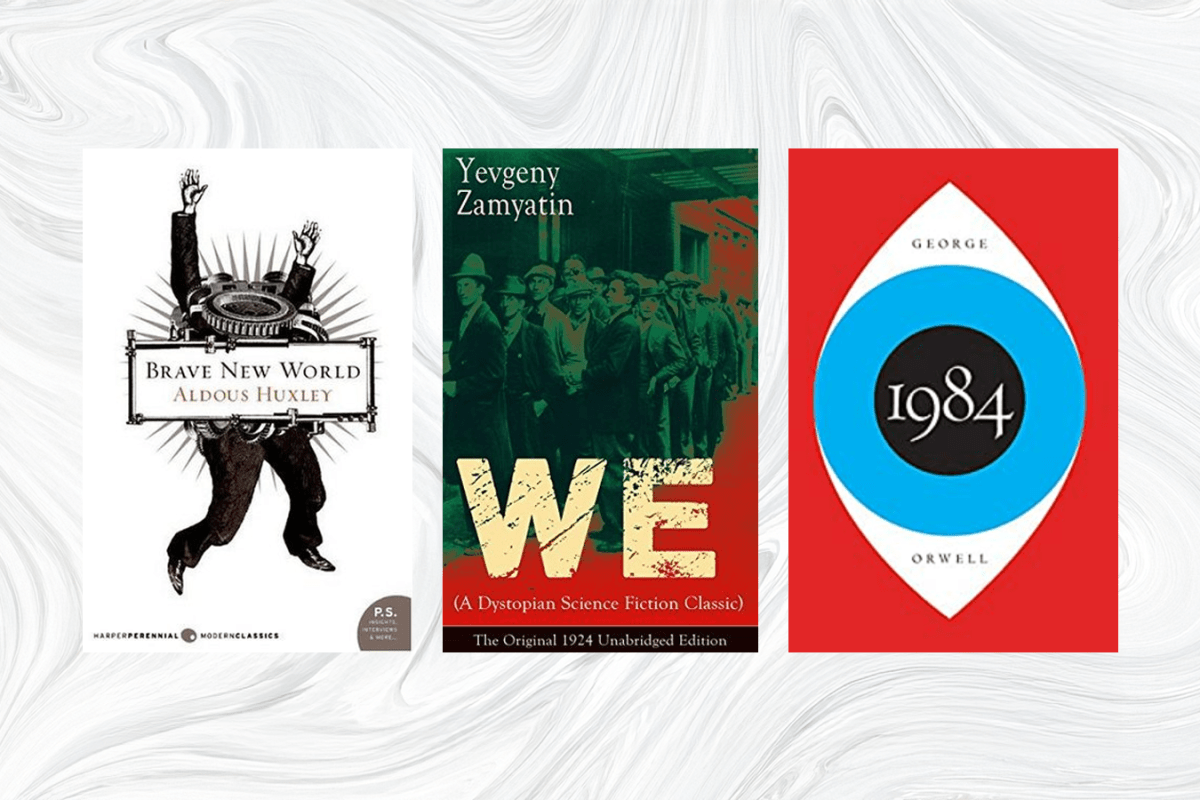
Every time the news cycle coughs up another surveillance scandal, someone posts an Orwell meme. When pharmaceutical companies peddle happy pills, a Huxley meme pops up. 1984 and Brave New World have become the twin saints of dystopian shorthand, invoked as lazily as “Kafkaesque” or “Orwellian” whenever someone feels spooked by authority.
And yet, these two canonical nightmares don’t quite capture the mess we’re in. Our world is less Orwell’s boot stamping on a face, less Huxley’s soma lullaby, and more Zamyatin’s forgotten gem: We.
Audio: NotebookLM podcast on this topic.
NB: As my regular readers may know, I am an author and a philosopher. I decided to post this here – being about books – but from a philosophical perspective.
1984: The Boot and the Telescreen
Orwell’s vision of perpetual war, Newspeak, and state terror is always good for a scare. Yes, we have endless surveillance, but here’s the trick: nobody had to force us. We carry the telescreens in our pockets and call them iPhones. We gleefully sell our data for dopamine pellets disguised as “likes.” The Ministry of Truth hasn’t so much rewritten history as buried it under an avalanche of memes, cat videos, and outrage cycles. Orwell’s nightmare had to be imposed. Ours is volunteered.
Brave New World: The Soma Holiday
Huxley saw a culture distracted into oblivion – sex, drugs, and feelies. It resonates because the entertainment-industrial complex has outpaced even his imagination. We live in a time when attention spans collapse under TikTok’s weight, when “self-care” is code for medicated oblivion, and when consumption doubles as identity. But Huxley underestimated how much suffering we’d tolerate alongside our pleasures. His world was too tidy. Ours is messy: opioids meet social media, Prozac meets precarity.
We: The Transparent Cage
Here’s where Zamyatin earns his eerie prescience. Written in 1921, We imagines a society of glass walls, total transparency, and algorithmic order. People don’t need to be beaten into compliance; they celebrate their own reduction to predictable ciphers. Privacy is seen as deviance. Sound familiar? From fitness trackers to mood apps to your browsing history, we’re already busy quantifying ourselves into oblivion. Where Orwell needed torture and Huxley needed narcotics, Zamyatin needed only maths and consent.
Why We Now?
Because it shows the nightmare where people joyfully give themselves away. That’s not speculative fiction anymore; it’s our social contract with Big Tech, with influencer culture, with the dopamine economy. We don’t need Ministries or Somas when we’ve willingly built the glass house and handed over the keys.
So next time someone posts that Orwell vs Huxley meme, hand them Zamyatin. He may not have the brand recognition, but he has the sharper scalpel. And if you haven’t cracked We yet, do it soon – before it stops feeling like a novel and starts reading like user documentation.
As I’ve been working through Octavia Butler’s Dawn, I’ve realised why science fiction as a genre rarely resonates with me. It isn’t the aliens or the starships; it’s the scaffolding. Sci-Fi carries the weight of the Modernist project – questions posed and quickly answered, problems rationally explained, the reader guided toward the “lesson.” It feels like indoctrination: tidy, didactic, instructional.
Fantasy, strangely enough, I tolerate even less. Where science fiction pushes forward, fantasy looks backward. Sci-Fi imagines the future of the Modern experiment: technology, politics, survival scenarios, all with a rationalist bent. Fantasy imagines the past of the same experiment: kings, bloodlines, prophecies, destiny. One proclaims progress, the other tradition, but both insist on role conformity.
This struck me as almost political: science fiction reads like fodder for Liberals and Progressives, those who believe we can build better systems if only we’re clever enough. Fantasy, meanwhile, often aligns with a Conservative ethos – a return to order, hierarchy, and providence, just with dragons and spells thrown in. Both are catechisms of Modernity, just oriented in opposite directions.
It may just be me. I don’t identify with the Modern project, and so the genres that proselytise it – looking forward or looking back – leave me cold. I prefer literature that unsettles, that leaves silence where there might have been certainty, that lets ambiguity breathe. But for many, Sci-Fi and Fantasy provide something else entirely: reassurance.
Sustenance (available here) was free for everyone on Kindle on 8 and 9 September. My goal was to provide access to the book for exposure with the hope of getting ratings and reviews. It’s still early, but I’d like to report that over 100 people downloaded the Kindle version. Now, I’ll share some details.
The Kindle version was downloaded 106 times in the past two days.
Some read it from their KindleUnlimited accounts
Some bought physical copies
Some people rated the book; some even left reviews on Amazon or Goodreads
The ratings and reviews are mixed, but all are welcome. Few people rate books; even fewer review them, so I appreciate the effort.
I got 3 ratings and 2 reviews on Amazon: ⭐⭐⭐⭐⭐, ⭐⭐⭐⭐, and ⭐. A one-star review. Thanks for that, too.
The ⭐rating didn’t leave a review, so I don’t know why they didn’t like it. I don’t know what types of books they read or this is exatcly what they prefer – they just didn’t like this. Still, at least they took the time to do it.
As a former statistician who has worked with survey data, I find this to be similar – most people don’t respond to surveys. Most people don’t engage in call-in shows. Most often, the people who respond either love or hate the topic so much that they feel compelled to broadcast their opinions. The people who say “meh” won’t even bother.
KindleUnlimited notwithstanding, I have no idea how people engage with a book. I have purchased and downloaded more books than I can read in a lifetime – probably multiple lifetimes. Sometimes, I just want to have access to a classic in case the mood strikes me; sometimes a book comes into view, and I convince myself that when I have the time, I might read it. I have no way of knowing.
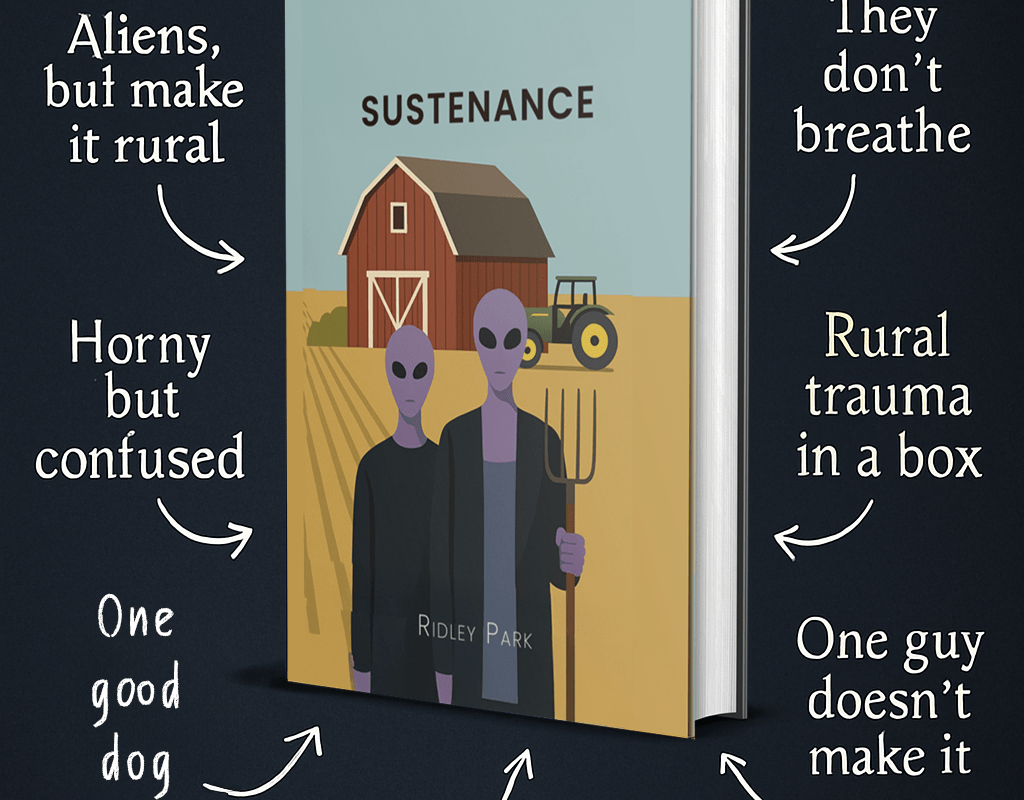
Image: Sustenance Trope Board
I’m guilty of some single-star ratings without leaving a review, so I am in no position to point fingers. Sometimes a book seems bad that you want to warn the world, but you don’t want to expend more time on the endeavour that you already have.
I took this screengrab of 1-star ratings from Goodreads – some have reviewers, others don’t.
Image: 1-Star Reviews
Only one of these books is non-fiction, though I might argue that point, hence the single star.
One Ayn Rand was a class assignment. The other was someone telling me that I hadn’t judged her best work. In this case, her best work is one star, so I can skip anything else. Ditto for the Bible – complete dreck.
Authority, I only recently read. it was part of a trilogy. The other two books got 4 and 3 stars, so I’ll consider this one a dud. I’m not in good company, as it rated worse than the other two on average, yet still managed a 3.55. Some people liked it.
The last one was a class assignment for my son that I read with him. His rating matched mine. How it became an assignment is just testimony that there is no accounting for taste.
Also, as a public service, I’d be willing to bet that if you liked these books, you won’t like mine.
Octavia Butler’s Dawn
On the topic of rating— I am midway through Dawn. It’s mid. I was asked why I hadn’t read it as part of the dystopian Venn, so I picked it up. To be fair, I thought several of the stories on the Venn were mid themselves, classics or otherwise. Perhaps I’ll write a separate post on that someday.
Honestly, I’d give Dawn 2 stars. However, I also know that Sci-Fi is not a genre that resonates with me, so I’ll be generous and give it a star because it may just be my personal bias of not relating to Sci-Fi that’s the problem, and the book might be better received by fans of that genre. Offhand, the only fiction genres I dislike worse than Sci-Fi are Fantasy and Romance.
Aside from being Sci-Fi, it reads like YA fiction. There’s nothing inherently wrong with YA, but I am clearly not its target demographic. Other than that, it’s serviceable, but I prefer to read content that’s more complex and layered, not spoonfed to me.
Conclusion
Anyway, I’ve derailed this thread, but I wanted to clarify how I approach rating books and want to thank those of you who have taken the time on Sustenance. If you haven’t yet, I’d appreciate any rating from 1 to 5. Reviews earn extra karma points.
I began reading Octavia Butler’s Dawn, and it raised some interesting* philosophical questions.
In the early chapters of Dawn, an alien declares that humanity has “committed mass suicide.” Sartre insists, “Inaction is still a choice.” Howard Zinn reminds us, “You can’t be neutral on a moving train.” Each collapses complexity into the fiction of agency, a story that props up Modernist notions of responsibility and blame. But what if agency itself is an unnecessary fiction? I’ve explored this tension in a new essay on my Philosophics blog:
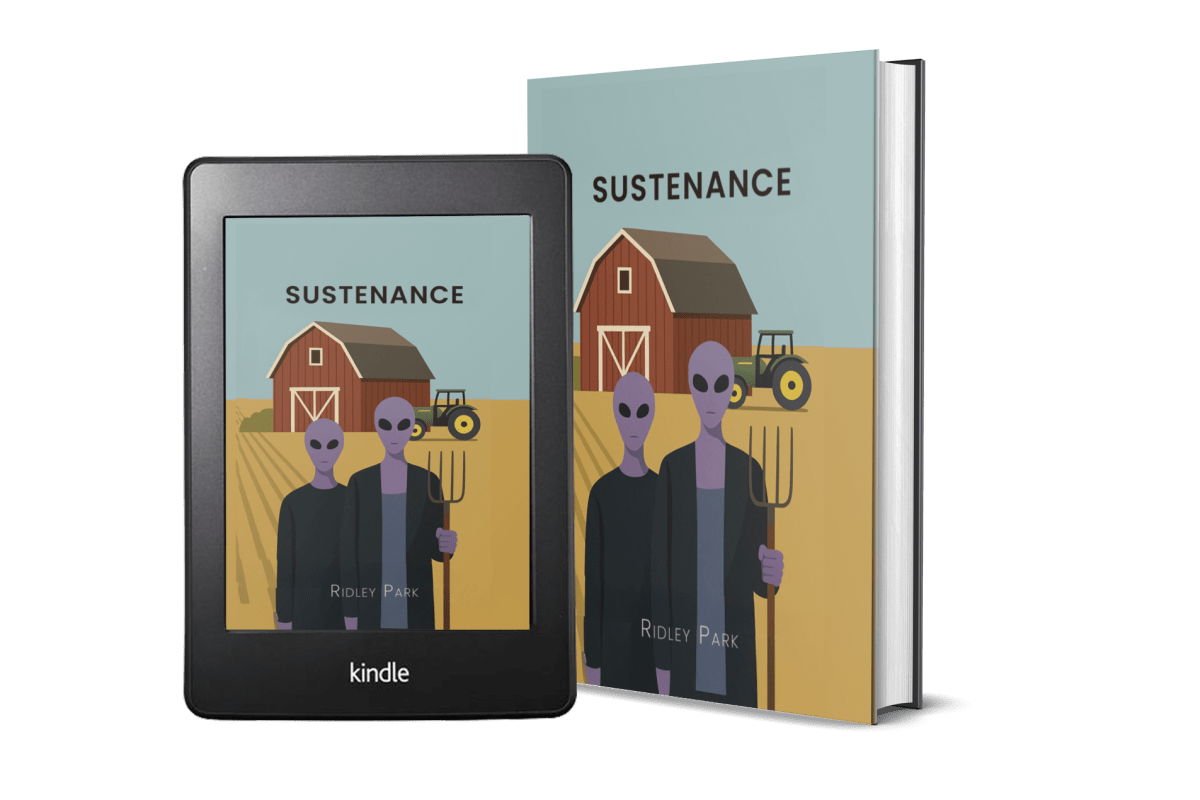
On 7–8 September 2025, the Kindle version of my novella Sustenance will be available free to everyone on Amazon. (It’s always free if you’re a KindleUnlimited member, but these two days open it up to all readers.)
So what is Sustenance?
It’s a novella that begins with the dust and grit of rural Iowa – soybean fields, rusted trucks, a small town where everyone knows your name (and your secrets). At first glance, it reads like plainspoken realism, narrated by a local mechanic who insists he’s just a “regular guy.” But then the ground literally shifts. A crash. Figures glimpsed by firelight in the woods. Naked, violet-skinned beings who don’t laugh, don’t sleep, don’t even breathe.
What follows is not your usual alien-invasion story. It’s quieter, stranger, and more unsettling. The encounters with the visitors aren’t about lasers or spaceships – they’re about language, culture, and the limits of human understanding. What happens when concepts like property, law, or even woman and man don’t translate? What does it mean when intimacy itself becomes a site of misunderstanding?
Sustenance is for readers who:
Gravitate toward literary fiction with a speculative edge rather than straight genre beats.
Appreciate the mix of the banal and the uncanny – the smell of corn dust giving way to the shock of alien otherness.
Are interested in themes of language, power, misunderstanding, and human self-deception.
Enjoy writers like Jeff VanderMeer, Margaret Atwood, Octavia Butler, or Denis Johnson – voices that blur realism, philosophy, and estrangement.
This isn’t a story that offers tidy answers. It lingers, provokes, and resists easy moral closure. Think of it less as a sci-fi romp and more as a philosophical fable wrapped in small-town dust and cicada-song.
This version of the book is available in these Kindle storefronts: United States, United Kingdom, Germany, France, Spain, Italy, Netherlands, Japan, Brazil, Canada, Mexico, Australia, and India






 Ridley Park