Rave Reviews

1–2 minutes

“I’d rather get reviews than sales.”

Yes, I actually said that. Possibly whilst caffeinated.

I was chatting with a mate about book sales, and it slipped out: I’d rather get reviews than sales. Not that I’d turn down either. But priorities matter.

Priority One: Write

The first goal is to write. I wrote for years before publishing a single page. The ideas pile up in my head like unwashed dishes, and writing is how I clear the sink. I write for myself. Call it narcissism if you must – but it’s a productive narcissism.

Priority Two: Be Read

Then comes the hope of being read. A sale is not a reader. Someone might buy your book and never open it. They might read it and hate it. They might toss it into the void. I just want to know.

Last month, I gave away over a hundred copies of Sustenance. Four reviews. One was one-star – she loathed it. Good. At least I know. The other ninety-nine? A mystery. For all I know, they’re gathering digital dust on forgotten hard drives. To be fair, I’ve got thousands of neglected downloads myself, so no judgment. Still, if you did read it, I’d love to hear what you thought. Leave a review.

Priority Three: Money (the tedious bit)

I’m not a consumerist, nor a fan of money-based systems. Unfortunately, that’s the system we’ve got, so yes – I still appreciate sales. But sales without engagement are hollow victories.

Reviews (the absurd bit)

Some people email me their thoughts instead of posting reviews. Lovely, but invisible. I can’t quote a private email without looking like a fraud. I could always fake one —

“King Charles absolutely loved Hemo Sapiens.”

But alas, he never said that. (He should.)

Anyway… that’s all I’ve got. Back to writing.

Free for Two Days Only: Sustenance (Kindle Edition)

1–2 minutes

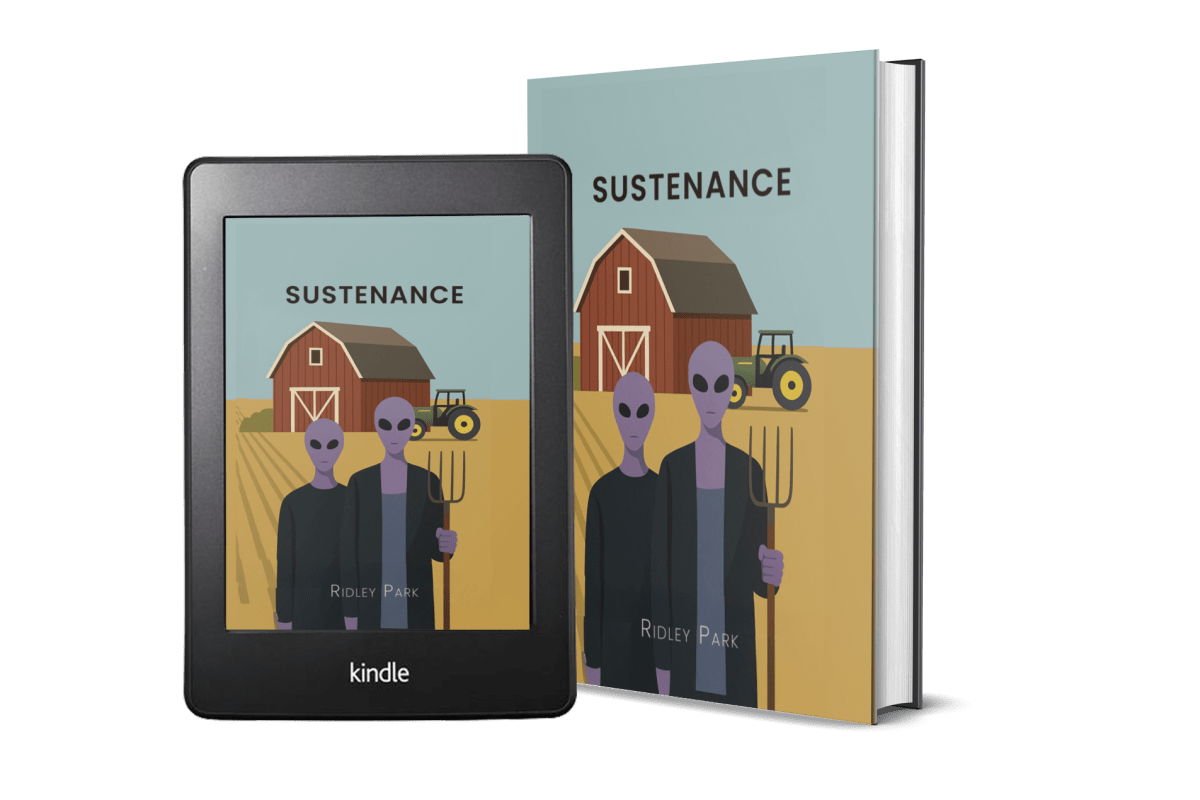
On 7–8 September 2025, the Kindle version of my novella Sustenance will be available free to everyone on Amazon. (It’s always free if you’re a KindleUnlimited member, but these two days open it up to all readers.)

So what is Sustenance?

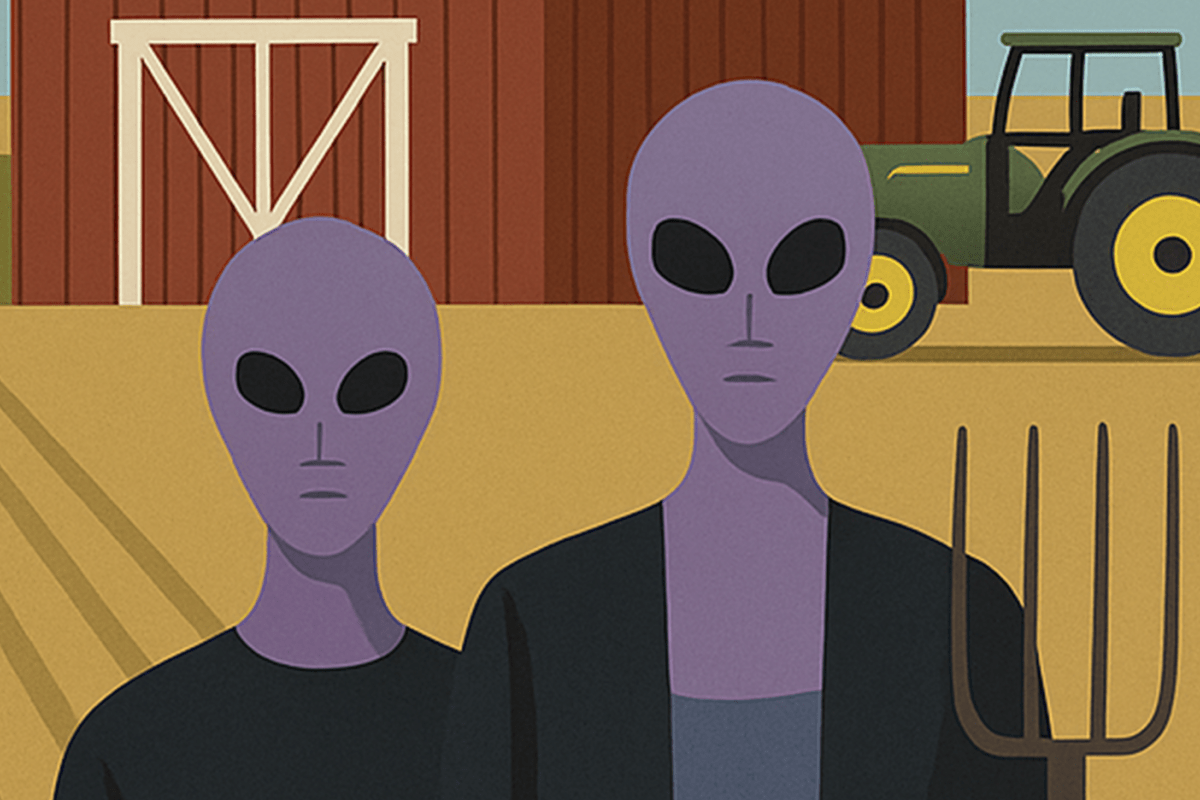
It’s a novella that begins with the dust and grit of rural Iowa – soybean fields, rusted trucks, a small town where everyone knows your name (and your secrets). At first glance, it reads like plainspoken realism, narrated by a local mechanic who insists he’s just a “regular guy.” But then the ground literally shifts. A crash. Figures glimpsed by firelight in the woods. Naked, violet-skinned beings who don’t laugh, don’t sleep, don’t even breathe.

What follows is not your usual alien-invasion story. It’s quieter, stranger, and more unsettling. The encounters with the visitors aren’t about lasers or spaceships – they’re about language, culture, and the limits of human understanding. What happens when concepts like property, law, or even woman and man don’t translate? What does it mean when intimacy itself becomes a site of misunderstanding?

Sustenance is for readers who:

  • Gravitate toward literary fiction with a speculative edge rather than straight genre beats.
  • Appreciate the mix of the banal and the uncanny – the smell of corn dust giving way to the shock of alien otherness.
  • Are interested in themes of language, power, misunderstanding, and human self-deception.
  • Enjoy writers like Jeff VanderMeer, Margaret Atwood, Octavia Butler, or Denis Johnson – voices that blur realism, philosophy, and estrangement.

This isn’t a story that offers tidy answers. It lingers, provokes, and resists easy moral closure. Think of it less as a sci-fi romp and more as a philosophical fable wrapped in small-town dust and cicada-song.

This version of the book is available in these Kindle storefronts:
United States, United Kingdom, Germany, France, Spain, Italy, Netherlands, Japan, Brazil, Canada, Mexico, Australia, and India

For more details, visit the Sustenance page.

📚 Grab your free Kindle copy on 7–8 September 2025.

Needle’s Edge: Pregnancy Continuity

As per my recent post, I need a sanity break. I’ve been editing Needle’s Edge all day. Each time I hit a milestone, I consider drafting a blog post, but then I choose to persist. Not this time.

I’ve been untangling the spaghetti of a misplaced – or rather, overextended – pregnancy. It had stretched on for too long, so I weeded out contradictory events. Some of these had dependencies, so I relocated or eliminated them to preserve flow.

In the process, I re-oriented her conception date and reset any foreshadowing that tied into it. To keep myself honest, I started tracking her progress in the manuscript with markers: <p=X>. With each time-specific event, I increment X.

So far, I’ve reviewed 24 sequential scenes, not counting the half-dozen relocated ones I had to rework just enough to maintain continuity. This leaves the protagonist at 29 weeks. That also meant pruning irrelevant references, for instance, cutting any mention of pregnancy before it even began.

Being a typical human pregnancy, my target is 38 to 40 weeks. That leaves me with another 10-odd weeks to rummage through. Once I’ve untangled the draft, I still need to return for line edits, colour, and shape.

Editing is often pitched as polishing, but sometimes it’s surgery. Today, I’ve been elbows-deep in the operating theatre.

Persona, Identity, and the Many Faces of Sarah

(Notes from the cutting room floor)

I’m taking a break from editing to share something about the protagonist in my latest novel-in-progress, Needle’s Edge. She’s a woman – yes, but not just. She’s a prostitute. She’s an addict. And she’s three people.

Audio: NotebookLM podcast on this topic. (Direct)

There’s Sarah, her given name. The name reserved for friends, family, and those rare few who know her without conditions. It’s the name she hears in moments of tenderness, or shame, or memory.

Then there’s Stacey, the escort, the stripper, the performer. This is the name on her ads. The one whispered in hotel rooms and shouted in clubs. Stacey is curated. Sexual. Selective. She knows what sells and how to sell it.

And then there’s Pink, the street persona. The user. Pink is who shows up when Sarah needs to score. She trades in slang and silence. She wears a different skin. A different currency.

Three names. One woman. No seams showing – if she can help it.

In her world, compartmentalisation is survival. If a dealer connects the dots and knows she’s an escort, she’s vulnerable. If a client finds out she’s using, her value drops. Appearances are everything. Rates depend on it. Reputation is a balancing act on a razor’s edge. And so each name carries its own set of rules, risks, and rituals.

But here’s the deeper cut: Who’s the “real” Sarah?

Is Stacey fake? Is Pink less than? Is Sarah just the base layer beneath the makeup and muscle memory?

They’re all her. None of them. Some of each. Identity is slippery.

The left hemisphere of the brain craves coherence. It wants simplicity, categories, reduction. But the truth is, identity is a heuristic. A convenient fiction. And Sarah, more than most, knows this. Where most people perform one role and pretend it’s a self, she splits hers openly. She curates them. Manages them. Leverages them.

And yet, the cost is high.

Stacey and Pink are exhausting. High maintenance. High risk. But being Sarah isn’t a comfort either. It’s just what’s left when the others are stripped away. She doesn’t retreat into Sarah so much as collapse into her.

In that way, Sarah isn’t a self – she’s a default.

The irony? For all this agency, for all her awareness, she’s still trapped in identities designed for consumption. For transaction. For escape. Whether it’s sex, drugs, or memory, she’s always negotiating something.

Three names.
Three roles.
Still no way out.

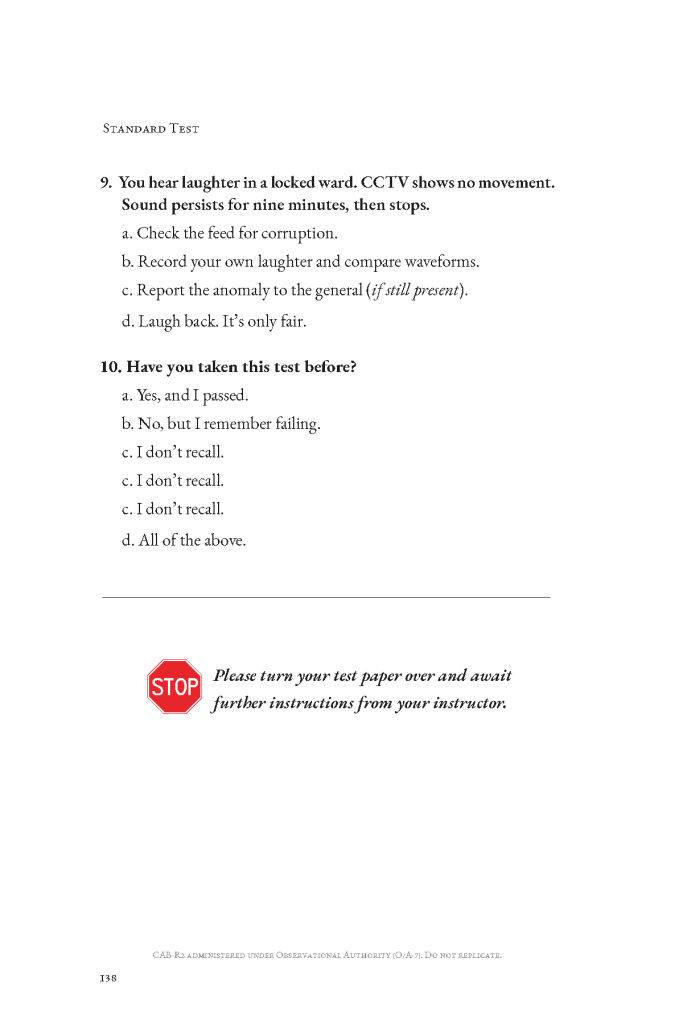
On Chapter 28: Or, How I Learned to Stop Worrying and Love the Standardised Test

The novel Propensity is divided into three sections, each with fifteen chapters – because symmetry is pleasing and my OCD deserves a biscuit. The first third plays it straight. More or less. A novel in the classical sense. You know – plot, people, dialogue, the odd existential quip. The middle third begins to fray at the edges, like an overstretched cardigan at an avant-garde poetry slam. And the final third? Well, it abandons form like a cult member in a cornfield, embracing the experimental, the elliptical, and the structurally suspect.

Chapter 28 is where the wheels come off. Or rather, where we slap on entirely different wheels – hexagonal ones. It takes the form of a standardised test. Yes, a literal test. Multiple choice. But fret not – there’s no grade, no timer, no Scantron sheet. Just questions. Absurd ones. Possibly even meaningful ones, though that’s above my pay grade.

Is it serious? Not remotely. Does it “advance the plot”? Hardly. Does it offer deep character insight? Not unless you’re profiling the author. But it does serve as a playful rupture in the narrative – a breather, a jab, a meta-giggle at the expense of structure and expectation. And let’s be honest: if you’ve made it to Chapter 28, you probably deserve a bit of a reward for tolerating everything prior.

As for spoilers: yes, technically, there are some. But without context, they’re like IKEA instructions written in Sanskrit. You might glimpse the shadow of something meaningful, but you’ll have no bloody idea what you’re looking at. No harm, no foul.

You can view Chapter 28 (along with several other amuse-bouches) for free on the Propensity book page. It’s downloadable as a PDF. No catch. No mailing list sign-up. I don’t want your email. I want your confusion.

Now, go take the test. Or don’t. It’s not graded. But it is a chapter.

Editing is a Vicious Sport

Measuring progress is far simpler when you’re writing. You can count words. Or characters, if you’re a sadist. Sure, half of them might be drivel. Whole chapters may end up ceremonially executed by draft five, but at least you’ve done something. There’s a metric. A tally. A sense of movement.

Audio: NotebookLM podcast on this topic.

You can even see your progress, pages stack, paragraphs grow fat with promise. And if you still write on physical media (bless your nostalgic heart), you get the added catharsis of crumpling your failures and lobbing them at the bin like a disgruntled poet. It’s theatre. It’s progress. It’s delusional.

Editing, by contrast, offers no such cheap thrills. The word count doesn’t so much creep as collapse. One minute you’re a literary demi-god sitting on 80,000 words. The next, you’re scraping along at 74k and wondering whether your “tightening” has amputated a limb.

Yes, the prose might be cleaner. Punchier. Less like a whisky-soaked rant and more like a distilled insult. But does it feel like progress? Not in the way dopamine understands it.

As I’ve written before, editing takes me five – maybe ten – times longer than drafting. It’s a full hemispheric shift: from right-brain dreamscapes to left-brain bureaucracy. Creativity gives way to spreadsheet logic. Grammar. Timelines. Continuity. Did she sit before she spoke, or after? Is this line meant to be his? Why is this in past tense? Is this in any tense?

And so, the grind.

Yes, there are flashes of satisfaction – a retooled transition here, a twist landed just-so there. But mostly, it’s a long, slow crawl through self-loathing and misplaced modifiers.

I’ve spent most of my adult life toggling between left-right hemisphere roles. And frankly, the left side still gives me hives. The corporate world, bless its hollow soul, tried to stuff me in a logic-shaped box. A coffin of metrics, meetings, and “measurable outcomes.” I’m still recovering.

So why not outsource editing? Why not let someone else swing the machete through this jungle?

Two reasons:

  1. I secretly enjoy the act of refinement. It’s masochism, but it’s my masochism.
  2. I operate on a margin so thin it’s practically theoretical. A Schrödinger’s budget – simultaneously there and not.

Still, the margin’s probably winning.

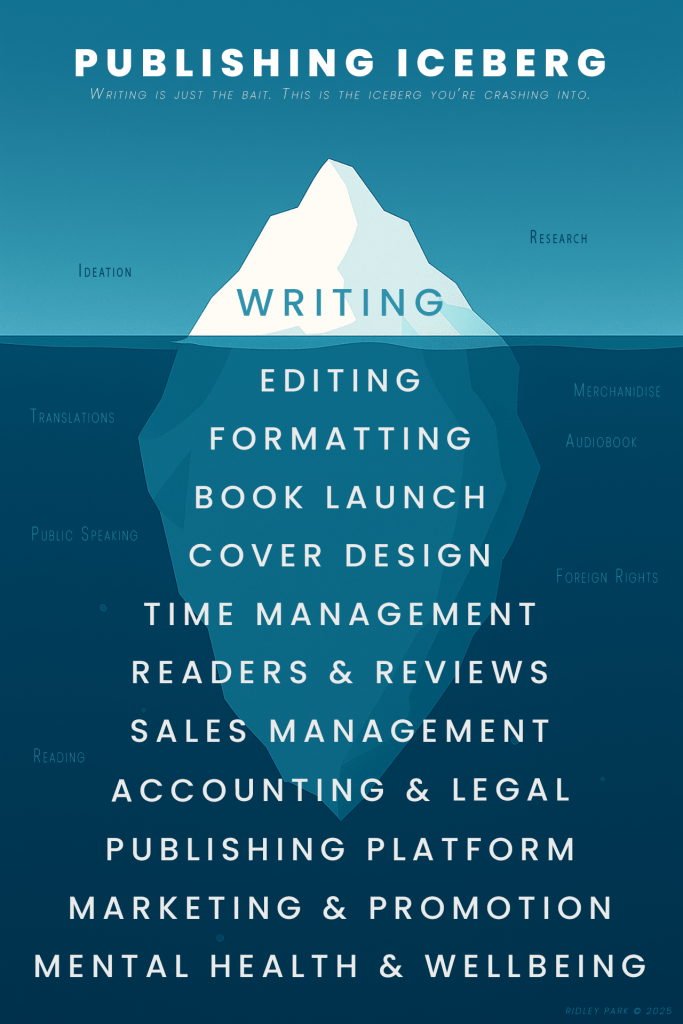
Writing is Just the Tip of the Iceberg

I hate to be the bearer of bad news – especially if you’re still slogging through a draft of your first manuscript. You know what some people say about writing a book is the hard part.

Lies. Damned lies. That’s the frothy, twinkly nonsense parroted by people who’ve never published anything beyond a social media post, probably only a comment.

Audio: NotebookLM podcast on this topic.

Let me tell you the truth. The actual, bloodstained, coffee-fuelled truth:

Writing the book is the easy part.

It’s the visible tip of the iceberg, smugly floating above the surface, soaking up the praise and admiration. Meanwhile, everything else – the sleepless nights, the decimal-point royalty statements, the unpaid invoices to your own soul – is lurking beneath, waiting to sink your mental health like the HMS Delusion.

So here it is, for posterity and pity:

Post-Writing Gauntlet: The Real Job Begins

1. Editing (Five Times, If You’re Lucky)

  • Developmental editing – “Is your plot a plot or a pile of wet spaghetti?”
  • Line editing – Making your sentences less embarrassing.
  • Copyediting – Catching your consistent misuse of ‘affect’ and ‘effect’.
  • Proofreading – The last defence against the typo apocalypse.
  • Beta feedback – Friends who suddenly vanish when asked to read a draft.

2. Formatting and Typesetting

  • Print vs digital layouts. Word crimes meet paragraph crimes.
  • EPUBs that break for fun.
  • That one widow on page 243 you didn’t notice until the proof copy arrived.

3. Cover Design

  • DIY, Fiverr roulette, or mortgage your cat to hire a professional.
  • Matching tone, genre conventions, and market expectations.
  • Spelling your own name correctly. (Don’t laugh, it happens.)

4. ISBNs and Metadata Hell

  • ISBN purchases (if you’re not relying on Amazon’s identifiers).
  • Title, subtitle, BISAC categories, keywords, blurbs, author bio — all rewritten seventeen times.

5. Publishing Platform Setup

  • Kindle Direct Publishing, IngramSpark, Kobo, Draft2Digital, Smashwords — pick your poison.
  • Print proofs, bleed settings, trim sizes, the baffling difference between matte and gloss.

6. Marketing (a.k.a. Screaming Into the Void)

  • Author website & blog (SEO: your new religion).
  • Social media presence — the façade of charm over existential dread.
  • Newsletter with a totally non-spammy freebie opt-in.
  • Ads: Amazon, Facebook, Instagram, Google. Burn money to test the water temperature.

7. Book Launch

  • ARCs, blog tours, launch events, or at least pretending you’re doing those things.
  • Coordinating reviews before anyone has read the damn thing.
  • Press kits and media outreach — basically shouting “LOOK AT ME” with tact.

8. Ongoing Sales Maintenance

  • Price promos, countdown deals, boxed sets, bundling — keep flogging the corpse.
  • Monitoring sales dashboards like a Victorian ghost watches the wallpaper peel.
  • Adjusting metadata because one reviewer didn’t understand it was satire.

9. Audiobook Production (If You Hate Money)

  • Narrator auditions, contracts, studio time.
  • Alternatively, read it yourself and discover your own voice is intolerable.
  • Or muddle through with an AI speech companion. Hullo, ElevenLabs.
  • Distribution through ACX or Findaway, both of which will pay you in dry leaves.

10. Accounting and Legal Fuss

  • Tracking royalties across platforms.
  • Filing taxes as an “author-publisher-entrepreneur-marketer-entity”.
  • Copyright registration, contracts, intellectual property trolls under the bridge.

11. Dealing With Readers

  • Responding to fan mail (both lovely and deranged).
  • Ignoring 1-star reviews that say “not what I expected, didn’t read it”.
  • Navigating book clubs who want a discount because they’re “doing you a favour”.

12. Mental Health and Motivation

  • Impostor syndrome, burnout, elation, despair — the writer’s buffet.
  • Rewriting your author bio weekly because you don’t know who you are anymore.

Optional Add-Ons (for masochists)

  • Translations and foreign rights – Because English isn’t the only language in which you can fail to sell books.
  • Merchandise – T-shirts nobody buys, mugs that mock your financial situation.
  • Public speaking / readings – Summon the courage to read your sex scenes aloud in a room of pensioners.
Image: Publishing iceberg poster in all its glory.

New Book Release: Temporal Babel

An unsolved literary mystery where language fails first.

I’m thrilled to announce the release of my latest novella, Temporal Babel, now available in paperback and hardcover. It’s a story about a man who arrives with no language the world can understand—and the woman who tries to name him anyway.

Audio: NotebookLM podcast on this topic.

Set in small-town New Mexico, Temporal Babel is not a thriller. It’s not about saving the future or rewriting the past. It’s about the weird middle ground where things don’t quite translate—linguistically, temporally, emotionally.

If you’ve ever wondered what it would feel like to encounter someone truly out of place—where even the word where doesn’t land—you’ll find something resonant in these pages.

What’s it about?

A young woman discovers a man on the roadside.
He’s naked. Marked with strange blue scars.
And the words coming out of his mouth aren’t quite English.
Or anything else.

No memory. No ID. No history that the town of Anika can decipher. But as he begins to recover, the sound of his voice becomes its own riddle.

Some readers may call this speculative fiction. Others might shelve it under linguistic noir. I just call it a contact story—minus the aliens, or is it?

Why read it?

  • 🔹 If you enjoy novels that refuse to explain themselves, this one’s for you.
  • 🔹 If you like language play, phonetic drift, and dialect as plot, this one delivers.
  • 🔹 If you like stories where the weirdness builds slowly, quietly, without fireworks—you’ll feel right at home.

“Dis kē?” he asks.
What is this?
No one knows. Not even the narrator.

📖 Temporal Babel is available now in paperback and hardcover.

Read it for free with KindleUnlimited.

You can explore the book page here or head straight to your favourite indie or online retailer.

Thank you for reading, for puzzling, and for letting mystery have the final word.

—Ridley

Dispatches from the Publishing Trenches: A Field Report

I, Ridley Park, am an independent author and publisher. Before this literary turn, I did time as an economist, business analyst, and management consultant – none of which prepared me for the peculiar economics of modern publishing.

Much like traditional music in the Digital Age, traditional publishing has lost a bit of its lustre. Its gatekeeping function remains, but the gates are now rusted, and half the guards have been made redundant.

Audio: NotebookLM podcast on this topic.

From a business standpoint, the Independent™ must ask: Is the distribution reach of a traditional publisher or third-party distributor worth the revenue share they demand? It’s tempting to cast them as parasites feeding off your creative lifeblood—but statistically, the average indie author sells only 60 copies of their book. Yes, that includes the five you bought yourself and the ten your mum distributed among reluctant neighbours.

Could you sell more than average? Possibly. Less? Almost certainly. Better to sell 100 copies and earn a pittance than to earn 100% of nothing. But if the publisher can’t move your book either, and if they’re not investing in you as an author, you may well find yourself in the red. Especially if you’re the one paying them for the privilege of being published. That’s not publishing – that’s vanity cosplay.

Publishers also offer (read: upsell) services like editing, formatting, and cover design. As an Independent™, you either pay for these à la carte or do them yourself. Or, if you’re like me, you cobble together a mixed strategy of DIY, AI, and professional outsourcing – whatever the project demands.

For Hemo Sapiens, I did everything except the typography for the title and byline on the cover. That part I outsourced; I know my limits. The rest – cover composition, layout, typesetting – I handled. I also brought in beta readers, who offered some valuable copyedits and corrections.

With Sustenance, I went end-to-end solo, with AI in the wings for flow and proofing support.

Propensity followed a similar path – except I made the rare (some might say perverse) choice of hiring a beta reader after release. Heretical, I know. But the feedback was so incisive I’m now considering a mid-edition revision, particularly in the middle third, where things get a bit heady.

As for Temporal Babel – still unreleased – I’ve done everything myself thus far, but I’m leaning toward bringing that same beta reader back for another round of bruising clarity.

Beta readers, it turns out, are worth their weight in snark and red ink. I’ll save my ruminations on them for another post, which I promise will be full of revelations and at least one semi-poetic lament.

I could say more here, but there are other things demanding my time – and no publisher breathing down my neck.


Bless MidJourney for the cover art based on this prompt:

beautiful woman wearing glasses and a sheer top, holding a red pen, reading a book, office setting

Behind the Binding: Sustenance in Print, Pixels, and Purgatory

Not quite a launch. Not quite a rant. Just one author trying to get a novella into the world without sacrificing too many hours or brain cells.

Paperback Problems

I’ve been writing quite a bit lately—several novellas/novelettes, to be precise.

They all began life as short stories, but brevity doesn’t come naturally. Apparently, I can’t shut up even on the page. I toyed with the idea of releasing a thematic collection, and I still might. But for now, Sustenance is getting its own debut—likely this month.

The book clocks in at around 14,000 words, printed across 144 pages. I’ve read that readers prefer novels to novellas, but I’ve also read that readers don’t really read anymore. Time’s short. Attention spans are shorter. Maybe shorter fiction has a fighting chance. We’ll see.

I formatted it in 6×9 inches, which may have been overly generous. It’s leaner than your average indie fantasy tome but still thicker than my last Žižek collection. So there’s that.

The manuscript began in Word, like every poor decision. I laid it out in InDesign and exported the PDF through Acrobat. No budget, so I designed the cover too—started in Illustrator for the vector charm, but ended up in Photoshop, where I’m more at home. I designed the full wrap—front, back, spine—as a single canvas.

This was a mistake. More on that later.

Still, I’m pleased with the final look. Might reuse the style across future novellas for a bit of visual branding. There’s barely enough of a spine to print on, but we suffer for aesthetics.

Proofs arrive Thursday. Fingers crossed.

Hardback Headaches

Then came the hardback edition. Same 6×9 size, same interior. Should’ve been simple.

It wasn’t.

I forgot (again) that hardbacks require extra bleed and margin space. Couldn’t just resize the existing cover without risking pixelation. If I’d stuck with vectors, this would’ve been a breeze. Instead, I got to rebuild the entire layout from scratch—layers, guides, grids, the lot.

Hours of joyous rework. Lesson learned. Until next time.

eBook Escapism (and Other Fantasies)

Converting the layout to eBook format was a slow-motion trainwreck. I’d inserted custom font glyphs above chapter titles in InDesign. They rendered fine—until they didn’t. Halfway through, chaos reigned.

I cracked open Sigil and manually edited the XHTML. So far, so fiddly.

Then I uploaded the .epub to Amazon. Except Amazon wanted a .kpf file. Of course it did.

Enter Kindle Previewer. Except it doesn’t support embedded font glyphs. So I converted them to SVGs.

Still no dice. Kindle’s rendering engine is older than most of its readers. SVGs failed too. So I converted every glyph to PNG, rewrote the CSS, rebuilt the XHTML again, and gave it another go.

Looks fine. Not perfect. I gave up.

They’re just decorative anyway. No plot-critical glyphs here.

The Kindle version should go live shortly. I enrolled it in KDP Select, which means 90 days of exclusivity in exchange for a modicum of convenience. After that, I’ll look at wider distribution.

For the eBook cover, I simply cropped the original layout in Photoshop. That part was, mercifully, straightforward.


What’s Next?

This post is more documentation than declaration. A sort of production diary. I’ll follow up with an actual announcement when the book launches, plus a few reflections on themes, characters, and that moment when you realise your protagonist may have accidentally sexed up a chicken.

Long story.

Anyway, this is just the start. Stay tuned.

Or don’t. Up to you.