Free for Two Days Only: Sustenance (Kindle Edition)

1–2 minutes

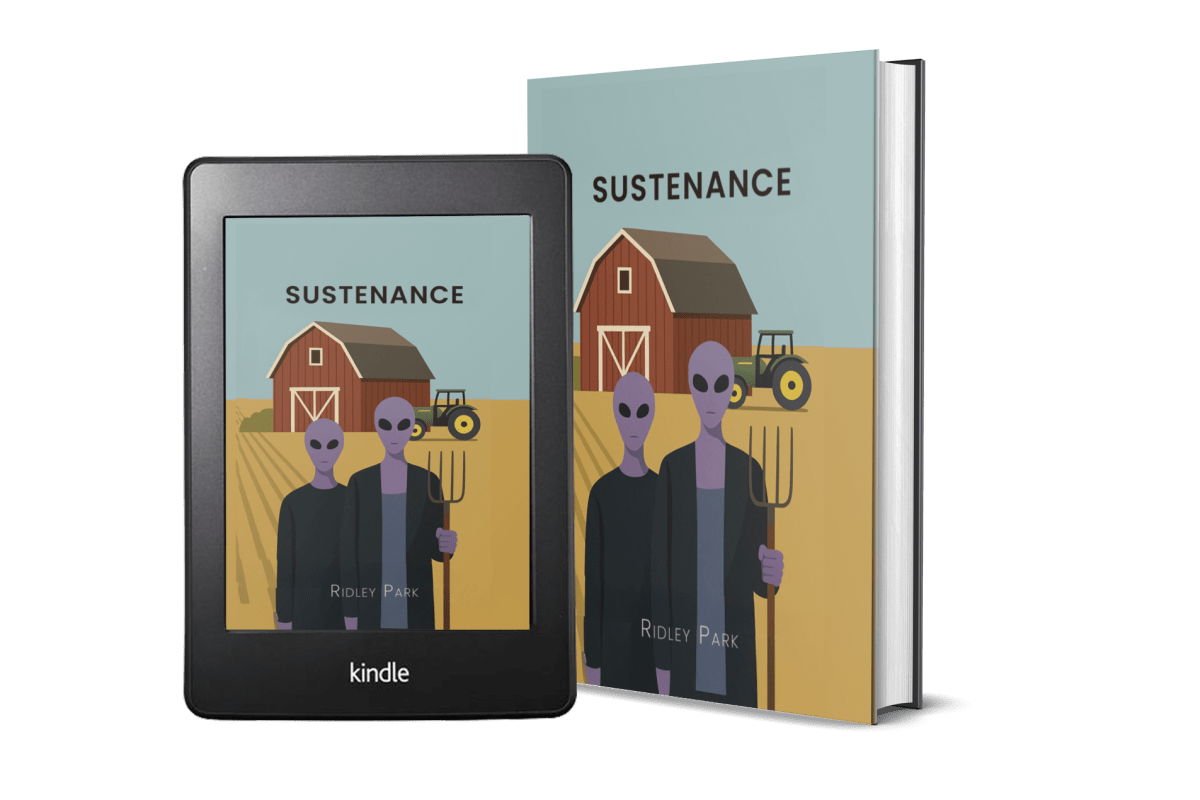
On 7–8 September 2025, the Kindle version of my novella Sustenance will be available free to everyone on Amazon. (It’s always free if you’re a KindleUnlimited member, but these two days open it up to all readers.)

So what is Sustenance?

It’s a novella that begins with the dust and grit of rural Iowa – soybean fields, rusted trucks, a small town where everyone knows your name (and your secrets). At first glance, it reads like plainspoken realism, narrated by a local mechanic who insists he’s just a “regular guy.” But then the ground literally shifts. A crash. Figures glimpsed by firelight in the woods. Naked, violet-skinned beings who don’t laugh, don’t sleep, don’t even breathe.

What follows is not your usual alien-invasion story. It’s quieter, stranger, and more unsettling. The encounters with the visitors aren’t about lasers or spaceships – they’re about language, culture, and the limits of human understanding. What happens when concepts like property, law, or even woman and man don’t translate? What does it mean when intimacy itself becomes a site of misunderstanding?

Sustenance is for readers who:

  • Gravitate toward literary fiction with a speculative edge rather than straight genre beats.
  • Appreciate the mix of the banal and the uncanny – the smell of corn dust giving way to the shock of alien otherness.
  • Are interested in themes of language, power, misunderstanding, and human self-deception.
  • Enjoy writers like Jeff VanderMeer, Margaret Atwood, Octavia Butler, or Denis Johnson – voices that blur realism, philosophy, and estrangement.

This isn’t a story that offers tidy answers. It lingers, provokes, and resists easy moral closure. Think of it less as a sci-fi romp and more as a philosophical fable wrapped in small-town dust and cicada-song.

This version of the book is available in these Kindle storefronts:
United States, United Kingdom, Germany, France, Spain, Italy, Netherlands, Japan, Brazil, Canada, Mexico, Australia, and India

For more details, visit the Sustenance page.

📚 Grab your free Kindle copy on 7–8 September 2025.

Why Sustenance Reads Like It Does

2–3 minutes

People ask why my books don’t look like “normal” books. Why the titles twitch, why the prose refuses to march in straight lines, why I lean into formatting that makes copyeditors twitch. The answer is both simple and evasive: the story demanded it. Subversion is my key motivator – language, culture, genre, whatever stands too smugly, I want to knock it sideways.

Audio: NotebookLM podcast on this topic.

Take the paratext, those pages most readers skip. I didn’t want a safe little disclaimer to pat anyone on the head. I wanted the opening to feel unstable, already compromised, as though coherence itself were optional. The dedication isn’t reassurance; it’s a warning label.

The prose had to wobble, too. One moment rural realism, the next lyric intensity, the next something uncanny seeping in. Stability is the lie. If I’d written Sustenance in straight realist mode, it would have betrayed the book’s core.

As a language philosopher, I treat manuscripts as sandboxes for showing how language falters. Words crack, meanings slip, syntax betrays us. Fiction is my way of rubbing readers’ noses in that insufficiency.

I don’t hate genre fiction, but I refuse to be bound by it. In Sustenance, I swerve deliberately:

It’s genre fluidity as method. I know this puts off readers who want neat tropes and templates. But those readers are welcome to their factory-sealed shelves.

Did I intend to frustrate? Yes, a little. Not out of malice, but because too many books behave like obedient products. I don’t want to hand readers a smoothie. I want them to taste the grit, to feel that the novel might collapse under them. In fact, it does. The refusal to “pay off” is deliberate. Closure is a consumer demand, not a literary necessity.

So why did I write Sustenance this way? Because it’s not just about what happens. It’s about how information fails, how language decays, how coherence itself becomes suspect. If the book looked and read “normally,” it would have been lying to you.


Motivation: This reflection isn’t meant as a commentary on Sustenance’s plot. My intent here is to discuss the meta — the formal and philosophical scaffolding — rather than the story itself, so as to avoid spoilers. I’ll engage with the work more directly, in more traditional fashion, elsewhere.

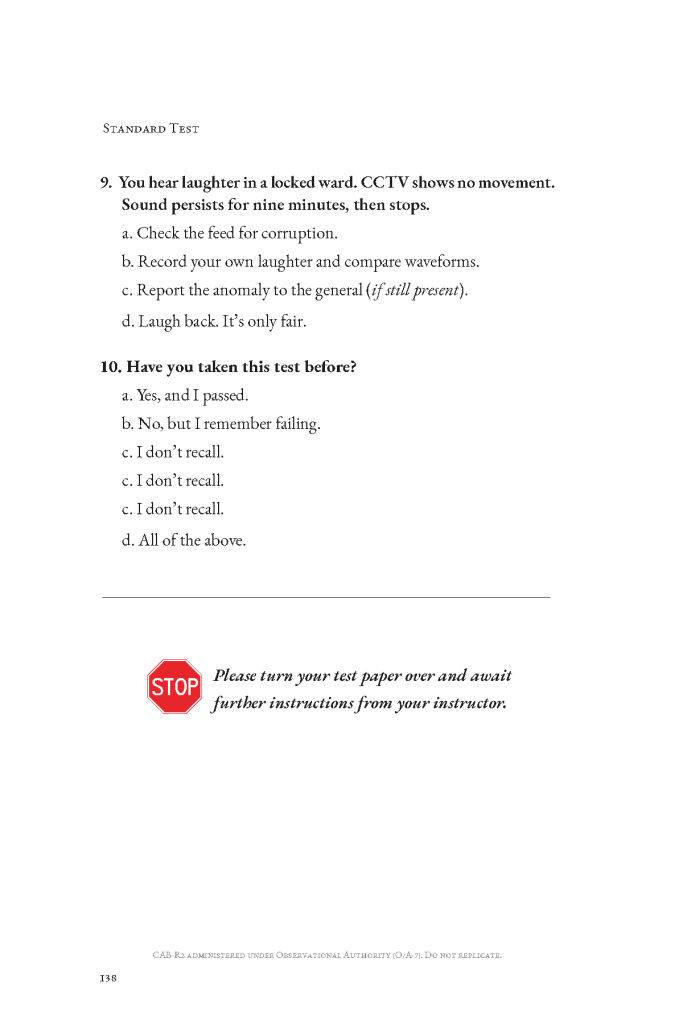
On Chapter 28: Or, How I Learned to Stop Worrying and Love the Standardised Test

The novel Propensity is divided into three sections, each with fifteen chapters – because symmetry is pleasing and my OCD deserves a biscuit. The first third plays it straight. More or less. A novel in the classical sense. You know – plot, people, dialogue, the odd existential quip. The middle third begins to fray at the edges, like an overstretched cardigan at an avant-garde poetry slam. And the final third? Well, it abandons form like a cult member in a cornfield, embracing the experimental, the elliptical, and the structurally suspect.

Chapter 28 is where the wheels come off. Or rather, where we slap on entirely different wheels – hexagonal ones. It takes the form of a standardised test. Yes, a literal test. Multiple choice. But fret not – there’s no grade, no timer, no Scantron sheet. Just questions. Absurd ones. Possibly even meaningful ones, though that’s above my pay grade.

Is it serious? Not remotely. Does it “advance the plot”? Hardly. Does it offer deep character insight? Not unless you’re profiling the author. But it does serve as a playful rupture in the narrative – a breather, a jab, a meta-giggle at the expense of structure and expectation. And let’s be honest: if you’ve made it to Chapter 28, you probably deserve a bit of a reward for tolerating everything prior.

As for spoilers: yes, technically, there are some. But without context, they’re like IKEA instructions written in Sanskrit. You might glimpse the shadow of something meaningful, but you’ll have no bloody idea what you’re looking at. No harm, no foul.

You can view Chapter 28 (along with several other amuse-bouches) for free on the Propensity book page. It’s downloadable as a PDF. No catch. No mailing list sign-up. I don’t want your email. I want your confusion.

Now, go take the test. Or don’t. It’s not graded. But it is a chapter.

Aesthetic Artefacts in Propensity

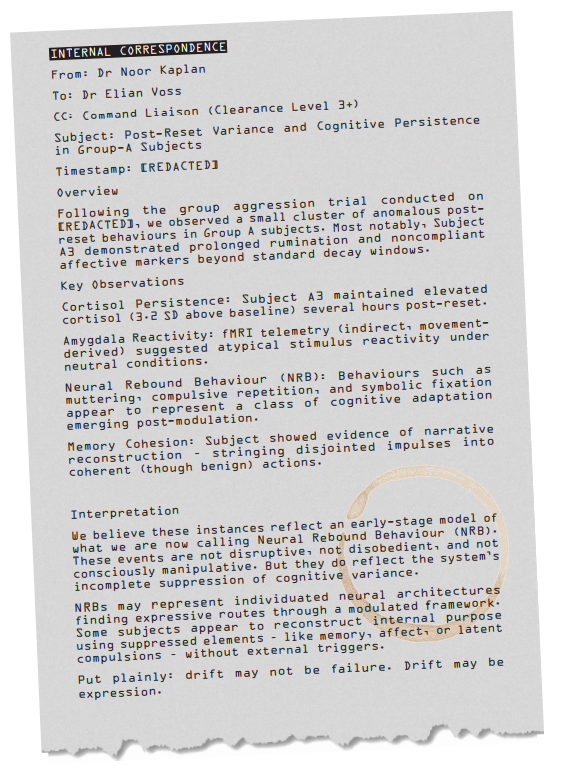
Chapter 10 of Propensity is a memorandum—fashioned in the style of a… wait for it… memorandum.

It doesn’t advance the plot much. That’s not its job. Like a dead-end corridor in a brutalist government building, it exists for atmosphere. Aesthetic artefact. Light foreshadowing. Bureaucratic texture. You know the type.

The memo comes from a psychologist involved in the Propensity experiment—writing to the study’s director about unexpected side effects. What they describe isn’t quite failure. It’s something stranger: drift, persistence, compulsive symbolism, the return of narrative despite modulation.

A precursor. A warning. And a throwback to a time when language still tried to make sense of things.

This chapter is one of several experimental inserts throughout the novel. I’ll be showcasing each of them here—in principle, if not in full.