I’m sharing a comp of the cover art* for my upcoming novel – a story about a prostitute. More accurately, it’s a story about prostitutes, addiction, survival, and the consequences of living at the periphery – not just of society, but of personhood itself.
The earliest notes I have are dated 2019. I finished the first draft in June. I’m now editing – both structurally and line by line, which is probably a bad idea, but here we are. Because I’m reorganising scenes, I need to ensure the transitions make sense, emotionally and narratively.
Since completing the draft, I’ve been reading Simone de Beauvoir’s The Second Sex. First published in 1949, the edition I’m reading was translated in 2011. It’s given me language for something I was already trying to do.
“One is not born, but rather becomes, a woman.”
— Simone de Beauvoir
This line is central to my approach. My protagonist isn’t born a prostitute. More importantly, she isn’t even born a woman. She’s made into one by church ladies, jealous sisters, careless boys, and indifferent systems. Through gestures, punishments, expectations, and neglect. Through the crucible of a society that offers her a script before she understands the stage.
Yes, her psychology matters. But the world matters more.
That’s what I’m trying to explore — not just the facts of a life on the edge, but the forces that shape it.
* I’ve actually designed two covers – one for hardcover and the other for paperback. It provides me with options.
Measuring progress is far simpler when you’re writing. You can count words. Or characters, if you’re a sadist. Sure, half of them might be drivel. Whole chapters may end up ceremonially executed by draft five, but at least you’ve done something. There’s a metric. A tally. A sense of movement.
Audio: NotebookLM podcast on this topic.
You can even see your progress, pages stack, paragraphs grow fat with promise. And if you still write on physical media (bless your nostalgic heart), you get the added catharsis of crumpling your failures and lobbing them at the bin like a disgruntled poet. It’s theatre. It’s progress. It’s delusional.
Editing, by contrast, offers no such cheap thrills. The word count doesn’t so much creep as collapse. One minute you’re a literary demi-god sitting on 80,000 words. The next, you’re scraping along at 74k and wondering whether your “tightening” has amputated a limb.
Yes, the prose might be cleaner. Punchier. Less like a whisky-soaked rant and more like a distilled insult. But does it feel like progress? Not in the way dopamine understands it.
As I’ve written before, editing takes me five – maybe ten – times longer than drafting. It’s a full hemispheric shift: from right-brain dreamscapes to left-brain bureaucracy. Creativity gives way to spreadsheet logic. Grammar. Timelines. Continuity. Did she sit before she spoke, or after? Is this line meant to be his? Why is this in past tense? Is this in any tense?
And so, the grind.
Yes, there are flashes of satisfaction – a retooled transition here, a twist landed just-so there. But mostly, it’s a long, slow crawl through self-loathing and misplaced modifiers.
I’ve spent most of my adult life toggling between left-right hemisphere roles. And frankly, the left side still gives me hives. The corporate world, bless its hollow soul, tried to stuff me in a logic-shaped box. A coffin of metrics, meetings, and “measurable outcomes.” I’m still recovering.
So why not outsource editing? Why not let someone else swing the machete through this jungle?
Two reasons:
I secretly enjoy the act of refinement. It’s masochism, but it’s my masochism.
I operate on a margin so thin it’s practically theoretical. A Schrödinger’s budget – simultaneously there and not.
I’m editing what I expect will become my next novel. Editing, for me, is a fundamentally different headspace than writing. When I’m drafting – especially when pantsing – I lean into a stream-of-consciousness flow. Iain McGilchrist might call this right-hemisphere activity. I don’t steer so much as ride shotgun, scribbling while the character drives.
Audio: NotebookLM podcast on this topic.
(Side note: I’ll share the tentative cover art soon, but this post is about process.)
Editing, by contrast, is all left hemisphere – angles, order, logic, connection. When I’m writing, I don’t worry if a detail makes sense. That’s future-me’s problem. In this project, future-me discovered that the protagonist had been pregnant for over thirteen months, undertaking activities most wouldn’t attempt in that state. In a nonlinear story, this might slip past many readers – but not past my editorial self. I mentioned this in a prior post.
I used to devour writing advice, but I don’t write like other people. Most advice seems geared toward genre fiction. I’m not opposed to that, but I lean literary and experimental. Templates don’t work for me.
I know the Hero’s Journey. I’ve read Save the Cat. But I don’t write about heroes – or even anti-heroes. That’s not the kind of story I’m telling, nor the kind I usually read.
I don’t much care about strong characters for their own sake. I care about what they allow me to explore philosophically. That said, this project is different. The main character is strong. So are the secondaries. And while it’s still fiction, it’s rooted in real people and events – compressed, reshaped, but recognisable.
I’ve condensed two decades of experience into a seven-year arc across ~200 pages. The first three years are flashbacks, brushed in for colour. The rest unfolds more or less in sequence. This time, I didn’t give myself free rein. There are rails. And while I occasionally jump them, I still need to land somewhere coherent.
The structure is a four-phase design. The book opens in media res and stays there for a few chapters. Then we rewind. And rewind again. Eventually, the timeline catches up, and the final half moves more linearly.
To tame this beast, I turned to spreadsheets. I built a plot matrix – numbering each section twice: narrative order (as written) and chronological order (as lived). I had to find the earliest flashbacks and stitch the rest together like some temporal jigsaw. It felt like Inception at times. Where am I? What layer is this?
From there, I started tracking time: days, weeks, months. That’s when I uncovered the 13-month pregnancy. Realistic for an elephant, not a human.
The root problem? I sequenced the conception too late and compressed the birth too early. I also omitted two earlier pregnancies to streamline the plot. To fix it, I reinstated one and used it to restore character depth that had been left on the cutting room floor. It worked – but it added new complications. Now I’m back in spreadsheet land, scanning for widows and orphans – narrative orphans, I mean – where scenes dangle or disconnect.
This is where editing diverges from writing. Writing is dreaming. Editing is retelling. And retelling demands coherence. Dreams ignore time, cause, and logic. Retelling insists on them: this happened before that, and then…
So-called “plotters” operate almost entirely in the left hemisphere. Structure first. Logic forward. Details coloured in after. It’s a valid approach – but one with fewer degrees of freedom. Creative constraints come with the template. You still get unique results, but you’ve narrowed the space. Stephen King’s version would differ wildly from JK Rowling’s – but both would be channelled through the same scaffolding.
You can argue that creativity happens in the choosing of the structure. Fair. But unless you’ve invented something truly novel, you’ve still chosen from a shelf of precedents. The story begins where freedom ends.
Does anyone else use writing props to help immerse yourself in adjascent fiction?
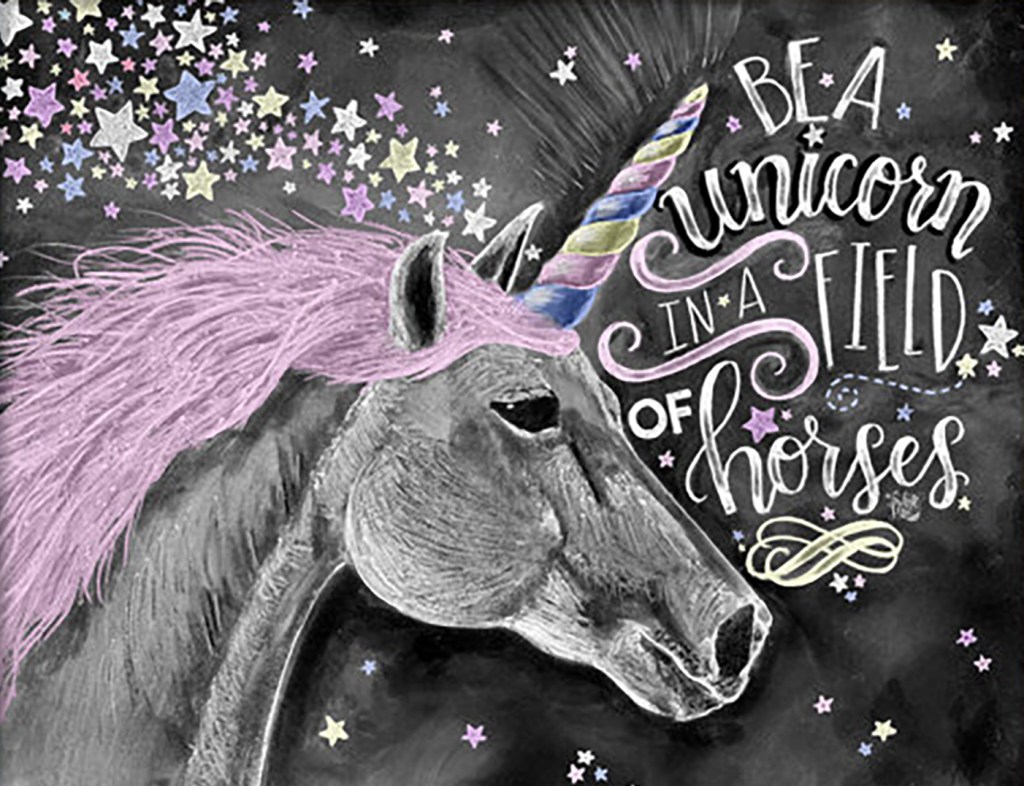
This unicorn image is from a poster. I am using it as a reference for a current project. It’s already seared into my brain, but it renders it somehow more real.
This unicorn poster hung on the wall of the inspiration for the protagonist of an upcoming novel, Needle’s Edge. It featuers prominently – almost has a speaking part.
Maps
Hemo Sapiens: Awakening is set in near-future Manchester, UK, so I had maps of Manchester at the ready. It helped me to add some realism. Because a trip from a nearby town into the city only took 15 to 20 minutes, I had to edit down a scene I was hoping would fill an hour. I could have used a location further away, but it wouldn’t have made sense to the plot, and I hate those sorts of plot gimmicks.
Sustenance is set in Iowa. I not only had a map of Iowa, I had resources on flora and fauna, so I could name-drop. I’ve visited parts of Iowa, but I couldn’t have drawn these details from memory—and I mightn’t have known the names or the onomonapoeia fascimiles.
Temporal Babel is set in New Mexico, so besides a map for highway references and distances from landmarks—towns, cities, and reservations—, I saved image resources of local photographs, landscapes, plants, buildings, attire, and so on. It really helps we with the description, something that is not otherwise my forte.
Propensity is set in no place in particular, so I used no maps, but I studied interiors of institutions, prisons, laboratories, and the like.
This is another unicorn sticker that was in the house of the protagonist, but it doesn’t make the cut. It still makes me chuckle.
Another unfinished novel, Everlasting Cocksucker, is set in Philly. I spent severl years in and around there, so I know the lay of the land. Still, I find maps useful.
I put this project ont he backburner because I received so much hate over the subject matter. I decided to concentrate on other projects. But, I created a physical shadowbox as a reminder of the protagonist.
Image: Reconstruction of a shadowbox.
In this story, this represents her life habits: Newport Menthol 100s in a box, Red Bull, Maruchan Ramen, and tarot readings. The Hanged Man is relevant to the plot. When I return to the manuscript, I’ll have this as, let’s call it, inspiraration.
If I wrote genre fiction, this wouldn’t work as well – Sci-Fi or Fantasy and whatnot. It might work for historical fiction though.
I hate to be the bearer of bad news – especially if you’re still slogging through a draft of your first manuscript. You know what some people say about writing a book is the hard part.
Lies. Damned lies. That’s the frothy, twinkly nonsense parroted by people who’ve never published anything beyond a social media post, probably only a comment.
Audio: NotebookLM podcast on this topic.
Let me tell you the truth. The actual, bloodstained, coffee-fuelled truth:
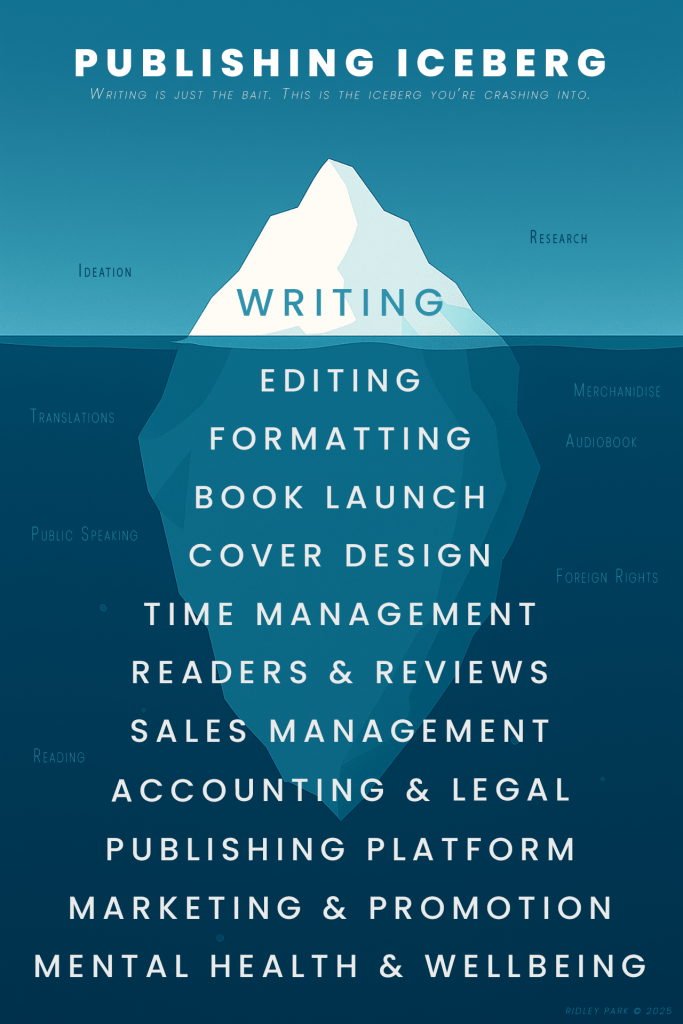
Writing the book is the easy part.
It’s the visible tip of the iceberg, smugly floating above the surface, soaking up the praise and admiration. Meanwhile, everything else – the sleepless nights, the decimal-point royalty statements, the unpaid invoices to your own soul – is lurking beneath, waiting to sink your mental health like the HMS Delusion.
So here it is, for posterity and pity:
Post-Writing Gauntlet: The Real Job Begins
1. Editing (Five Times, If You’re Lucky)
Developmental editing – “Is your plot a plot or a pile of wet spaghetti?”
Line editing – Making your sentences less embarrassing.
Copyediting – Catching your consistent misuse of ‘affect’ and ‘effect’.
Proofreading – The last defence against the typo apocalypse.
Beta feedback – Friends who suddenly vanish when asked to read a draft.
2. Formatting and Typesetting
Print vs digital layouts. Word crimes meet paragraph crimes.
EPUBs that break for fun.
That one widow on page 243 you didn’t notice until the proof copy arrived.
3. Cover Design
DIY, Fiverr roulette, or mortgage your cat to hire a professional.
Matching tone, genre conventions, and market expectations.
Spelling your own name correctly. (Don’t laugh, it happens.)
4. ISBNs and Metadata Hell
ISBN purchases (if you’re not relying on Amazon’s identifiers).
Title, subtitle, BISAC categories, keywords, blurbs, author bio — all rewritten seventeen times.
5. Publishing Platform Setup
Kindle Direct Publishing, IngramSpark, Kobo, Draft2Digital, Smashwords — pick your poison.
Print proofs, bleed settings, trim sizes, the baffling difference between matte and gloss.
6. Marketing (a.k.a. Screaming Into the Void)
Author website & blog (SEO: your new religion).
Social media presence — the façade of charm over existential dread.
Newsletter with a totally non-spammy freebie opt-in.
Ads: Amazon, Facebook, Instagram, Google. Burn money to test the water temperature.
7. Book Launch
ARCs, blog tours, launch events, or at least pretending you’re doing those things.
Coordinating reviews before anyone has read the damn thing.
Press kits and media outreach — basically shouting “LOOK AT ME” with tact.
I was feeling smug. Fourth revision pass. Plot matrix built. Columns for chapter, scene, POV, date, time, location, word count, and emotional arc – because I’m that kind of monster. I even added colour-coding.
And it worked. Mostly.
After pruning and polishing, it finally felt ready to ship. Just a couple cosmetic tweaks. A trim here, a varnish there. Run a lint roller over the dialogue. Call it done.
Except.
The matrix – traitorous little bastard – exposed a structural fault so elegant I’d almost admired it. The problem? Pregnancy. Not mine, the protagonist’s. (Let’s not get ahead of ourselves.)
Turns out, I’d compressed over a decade of real-life events into two years of narrative space. Bold. Efficient. Reckless. I’d wrung out the filler, reshuffled a few puzzle pieces, and declared the thing plausible.
Only it wasn’t.
When I sorted the scenes chronologically, the matrix coughed. The story broke like a cheap lawn chair. There she was: visibly pregnant while also, somehow, gallivanting about in scenes that would’ve required a different physiology entirely. Not an Olympian, but the metaphor holds.
And that’s when it hit me: time may be a flat circle, but gestation is not. No amount of POV tricks or narrative backflips can make a third-trimester body do first-trimester things. Biology, the ultimate killjoy.
So now I’m doing surgery. Not delicate surgery, either. I’m sawing out whole sections, rebuilding connective tissue, and laying down scar tissue where the timeline used to be. I’ll need new plot scaffolding to support the pregnancy and its repercussions. It’s fine. It’s good. It’s hell.
This is revision. We go in thinking we’re buffing up the finish, only to discover we paved over a sinkhole.
I’ve got a bone to pick with Claire Fraise, dammit. I’ve lost 2 days I’ll never get back — including the time it’s taking me to create this post.
Claire shared a YouTube video on using plot grids for your writing process. Being me and heeding her advice, I decided to create a plot grid – I call it a plot matrix; same thing – for a project I am editing.
Video: What is a plot grid?
I should probably create a video response, but I didn’t have even more time to lose.
Full Disclosure: By lose time, I don’t want to imply by any means that this is wasted time.
Since the plot matrix I created is for an unpublished manuscript, I decided to create one for the first chapter of my published book, Sustenance. It contains two sections or scenes.
Audio: NotebookLM podcast on this topic.
I’ll share the process I used and reference the Excel document I created. Download it if you’d like to follow along.
After the explanations, I’ll discuss how I use ChatGPT to help me with this, as well as some challenges you may wish to be aware of.
Below is a screenshot of a portion of the plot matrix.
Image: Portion of plot matrix
I’ll start by sharing the column headers and a brief explanation of what each means. Some should be obvious, but I’ll describe them as well.
Narrative Order: The order a scene appears in the manuscript.
Chronological Order: The sequence in which events occur in story-time, enabling tracking of flashbacks or non-linear jumps.
Sentiment: A numerical indicator of the scene’s emotional tone, from deeply negative (–5) to strongly positive (+5).
Chapter: The chapter or section title in which the scene appears.
Plot Points: A summary of key events, revelations, or decisions that occur in the scene.
Time: When the scene takes place, whether exact or relative (e.g., “early morning,” “flashback,” “six months later”).
Primary Characters in Scene: The characters actively driving or anchoring the scene.
Secondary Characters in Scene: Important but less central characters who influence or are present in the scene.
Minor Characters in Scene: Tertiary figures mentioned or briefly appearing without narrative weight.
Word Count: The number of words in the scene, useful for pacing and balance.
Emotional Beat/Theme: The scene’s dominant emotional tone or thematic current (e.g., betrayal, longing, discovery).
Emotional State: The internal condition or affective register of the POV character(s) during the scene.
Scene Function: What the scene accomplishes narratively (e.g., exposition, climax, setup, reversal).
Character Arc: How a character is developing, stagnating, or regressing within the scene.
External Stakes: The tangible, real-world risks or consequences present in the scene.
Internal Stakes: The emotional, psychological, or relational consequences at play.
Needs Clarification?: A flag to indicate whether a scene contains confusing elements or ambiguous logic.
Revision Priority: A ranking of how urgently the scene needs refinement.
Conflict Type: The dominant form of conflict (e.g., internal, interpersonal, systemic, environmental).
Turning Point?: Whether the scene marks a key reversal or decision point in the narrative.
Turning Point Direction: Indicates the shift’s trajectory (positive, negative, neutral, ambiguous).
Direction Commentary: A brief rationale for how and why the narrative tone or direction changes.
Reinforces: Themes, motifs, or ideas the scene strengthens.
Undermines: Themes or ideas the scene weakens, contradicts, or questions.
Reveals: New information, secrets, or understandings brought to light.
Conceals: Key details or truths the scene deliberately withholds.
Distorts: Misunderstandings, biases, or unreliable elements introduced.
Inverts: Role, expectation, or thematic reversals subverted in the scene.
Echoes: Recurrent phrases, images, or patterns from earlier scenes or motifs.
Revision Commentary: Notes on potential rewrites, improvements, or cautions.
Punch List: Specific edits or action items needed in revision.
Resolved?: Whether the scene’s tension, question, or arc has been closed.
Location: Where the scene is physically set—important for continuity, blocking, and worldbuilding.
Iowa: Opening Scene
Narrative Order: The order a scene appears in the manuscript.
I am tracking scenes/sections rather than chapters because that’s the way I’ve organised the manuscript. I want to capture the smalled logical element of the story.
Being a spreadsheet, I need to keep track of the sections, so I give each scene a number. In this case, we are looking at section 1 of the narrative order, the first section a reader encounters.
Chronological Order: The sequence in which events occur in story-time, enabling tracking of flashbacks or non-linear jumps.
This manuscript has no flashbacks at this point, so the sequencing tracks 1-to-1. In the manuscript I am editing, it starts in media res, and there are two large jumps back and forth in time.
Being in a spreadsheet table, I can sort the story by narrative or chronology, which helps me track logical progressions that I might miss otherwise.
Sentiment: A numerical indicator of the scene’s emotional tone, from deeply negative (–5) to strongly positive (+5).
I like to track sentiment, so I can provide emotional dynamics to the reader. I don’t want to come across as bleak or euphoric for extended periods.
By this scale, 0 is neutral, -5 is gawdawful, and +5 is over the moon.
In these first two scenes, the protagonist, Kenny, is tracking just under baseline to neutral. Nothing much is happening emotionally, as we are just establishing the place.
Chapter: The chapter or section title in which the scene appears.
The name of this chapter is Iowa.
Plot Points: A summary of key events, revelations, or decisions that occur in the scene.
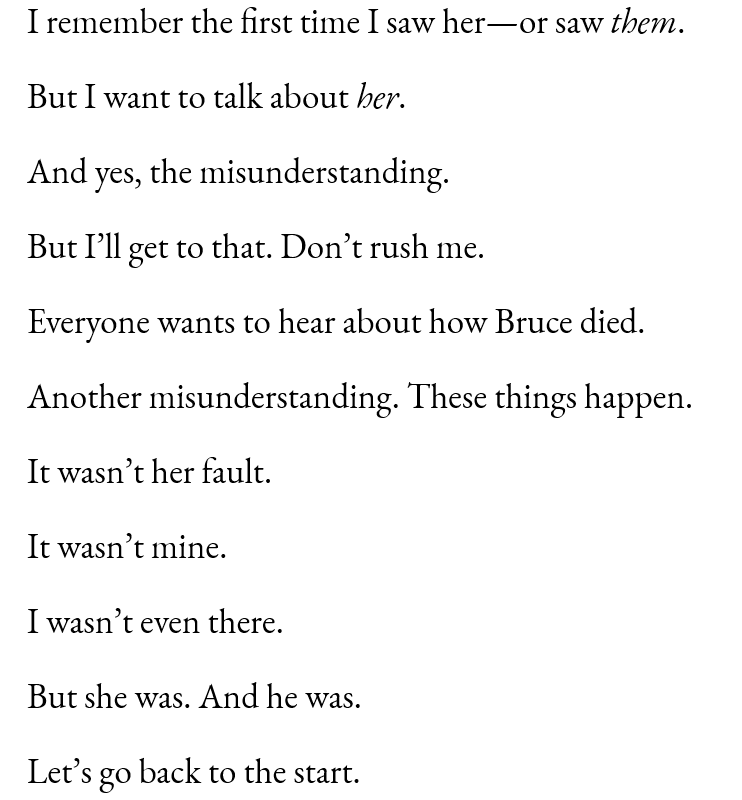
In scene 1, we have this:
Narrator establishes his identity, location, and tone.
Mentions girl, Bruce’s death, and being misunderstood.
Foreshadows larger story.
Time: When the scene takes place, whether exact or relative (e.g., “early morning,” “flashback,” “six months later”).
We are in the now.
Retrospective/Near-Present
Primary Characters in Scene: The characters actively driving or anchoring the scene.
This is a first-person, present, limited, deep POV story, so Kenny is one with the narrator.
Secondary Characters in Scene: Important but less central characters who influence or are present in the scene.
Kenny is just setting up the scene, and he mentions two secondary characters:
Bruce (mentioned)
‘Her’ (mentioned)
My preference is to scope the characters globally. This means that if some character interacts with a significant character but doesn’t appear elsewhere, I’ll consider them to be a tertiary or minor character. Some writers prefer to track these characters at a scene level. This is a personal preference.
Minor Characters in Scene: Tertiary figures mentioned or briefly appearing without narrative weight.
These are incidental characters that you might want to track in case you want to expand or adjust them.
Jake (mentioned)
narrator’s dad (mentioned)
Word Count: The number of words in the scene, useful for pacing and balance.
These are two short scenes: 247 and 502 words.
Emotional Beat/Theme: The scene’s dominant emotional tone or thematic current (e.g., betrayal, longing, discovery).
What’s going on here? Am I conveying what I aim to?
Isolation, defensiveness, curiosity
Belonging vs alienation; repetition vs rupture
Emotional State: The internal condition or affective register of the POV character(s) during the scene.
What’s the POV character feeling?
Guarded, nostalgic, lonely
Resigned, mildly boastful, reflective
Scene Function: What the scene accomplishes narratively (e.g., exposition, climax, setup, reversal).
Why does this scene exist? If it doesn’t serve a purpose, get rid of it, or give it one. Make sure every scene builds on characters or advances the plot.
Narrator introduction; frame story establishment; tonally primes the reader
Establishes rural setting, background on narrator’s world and connections, foreshadows disruption
Character Arc: How a character is developing, stagnating, or regressing within the scene.
Again, ensure your characters(s) have movement. In this story, there are several characters with an arc, but Kenny is the only one being tracked thus far. Being the start of the story, the question is, where does he go from here?
Establishes base-level insecurity masked by bravado
Solidifies narrator’s self-image and history within town hierarchy
External Stakes: The tangible, real-world risks or consequences present in the scene.
What external considerations might the character be making in this scene, whether they do or don’t do something?
Implied social stigma or alienation
Community perception and social standing
Internal Stakes: The emotional, psychological, or relational consequences at play.
What internal considerations might the character be making in this scene, whether they do or don’t do something?
Fear of being misunderstood or blamed
Fear of irrelevance, unresolved identity
Needs Clarification?: A flag to indicate whether a scene contains confusing elements or ambiguous logic.
When sketching a scene idea, you may have unresolved loose ends that you either need to tie up in the scene or somewhere else. Usually, this is more interested in making sure a reader doesn’t leave the scene confused — unless, of course, this is your intent.
Revision Priority: A ranking of how urgently the scene needs refinement.
This is important in a reviewing/editing phase. As you are cleaning up your manuscript, are there massive holes that need to be plugged, or might this just need some minor refinements?
Conflict Type: The dominant form of conflict (e.g., internal, interpersonal, systemic, environmental).
This could be a post of its own, so I won’t belabour the issue here. Readers like conflict. It gives something to resolve. Is this conflict related to the person, their past, another person, their environment, society, and so on? Document it here. Several conflicts make for more complex characters and stories.
Internal (identity, credibility)
Internal (identity vs environment)
Turning Point?: Whether the scene marks a key reversal or decision point in the narrative.
In this case, the first scene has now; the second does.
No
Yes
Turning Point Direction: Indicates the shift’s trajectory (positive, negative, neutral, ambiguous).
If there is a turning point, what’s the direction? A stable or lateral vector is fine.
None
Foreshadows disruption
Direction Commentary: A brief rationale for how and why the narrative tone or direction changes.
If there is a shift in direction, what is it? This might help to orient you when scanning, so you can know in the scene where to edit.
None
Last line (“Until that day”) subtly transitions from ordinary routine into impending change
This next section captures how the scene functions from several perspectives.
Reinforces: Themes, motifs, or ideas the scene strengthens.
Undermines: Themes or ideas the scene weakens, contradicts, or questions.
I like to subvert tropes and expectations as well as make social commentary, so this can be informative for me. In this case, I want to depict these things in a different light.
Traditional heroic framing
Romanticisation of small-town life
Reveals: New information, secrets, or understandings brought to light.
What does this scene reveal?
Setting, tone, perspective
Social fabric of the town, Kenny’s values and limitations
Conceals: Key details or truths the scene deliberately withholds.
In the first scene, I mention matter-of-factly,
Real details of Bruce’s death and who ‘she’ is
The event that disrupted the routine
So the reader knows there’s a “Bruce” and a “she,” but who they are remains to be seen. And Bruce died. How?
Distorts: Misunderstandings, biases, or unreliable elements introduced.
This is getting more nitpicky, but sometimes I like to obscur some things?
Narrator’s reliability and possible biases
Self-perception vs actual social role
Is this a reliable narrator? Even if he wants to be, is his perception accurate?
Inverts: Role, expectation, or thematic reversals subverted in the scene.
I like to subvert tropes and expectations here, too. This can also be used to intentionally have a character act out of character.
Traditional ‘boy meets girl’ trope
The classic “tight-knit community” mythos
Echoes: Recurrent phrases, images, or patterns from earlier scenes or motifs.
Early on, this most captures echoes of the external world, as this does. Later on, a scene might echo (and perhaps amplify) a prior scene.
Small-town fatalism
American nostalgia, masculine banality
Revision Commentary: Notes on potential rewrites, improvements, or cautions.
Here, the AI gods advise me to streamline these scenes, but I answer to no gods. 😉
Could trim repetition or streamline internal monologue for pacing
Minor streamlining of “rural inventory” might improve pacing without losing tone
Punch List: Specific edits or action items needed in revision.
If there are revisions to be made, capture them here, so you’ll remember what you were thinking about when you suggested a revision. In this case, the reminder is the same. Too late, it’s already published.
None
Possibly trim town description repetition
Resolved?: Whether the scene’s tension, question, or arc has been closed.
In both case, the answer here is no. Being an opening scene, hopefully, this open issues and questions – unless you prefer to resolve everything immediately.
Location: Where the scene is physically set—important for continuity, blocking, and worldbuilding.
This is setting information. This will be more helpful in a complex environment. In this case, there’s not a lot to say. He’s on his front porch step, rambling away about his town and his story.
Iowa, unspecified small town
Iowa, narrator’s town and neighbouring town
ChatGPT and Plot Matrices
After completing my manuscript, say a first draft, I feed it into a ChatGPT project. Then I run this prompt.
Let's use this format. I'll provide the value of (X). From where we are, Narrative and Chronological orders have converged and will remain so. They are equal to Row ID - 1. I'll use Row ID (X) as a reference marker.

Row ID (2), Narrative Order (), Chronological Order (), Sentiment, (Integer: Range between -5 and +5), Chapter (Iowa), Plot Points, Time, Primary Characters in Scene, Secondary Characters in Scene, Minor Characters in Scene, Word Count (247), Emotional Beat/Theme, Emotional State, Scene Function, Character Arc, External Stakes, Internal Stakes, Needs Clarification?, Revision Priority, Conflict Type, Turning Point?, Turning Point Direction, Direction Commentary, Reinforces, Undermines, Reveals, Conceals, Distorts, Inverts, Echoes, Revison Commentary, Punch List, Resolved?, Location

I know you’ve heard this before.

Boy meets girl. Different places. Different cultures.

Not quite Romeo and Juliet. Not yet, anyway.

It could’ve been Nebraska. Montana. Oklahoma.

But it wasn’t. We’re in Iowa.

I remember the first time I saw her—or saw them.

But I want to talk about her.

And yes, the misunderstanding.

But I’ll get to that. Don’t rush me.

Everyone wants to hear about how Bruce died.

Another misunderstanding. These things happen.

It wasn’t her fault.

It wasn’t mine.

I wasn’t even there.

But she was. And he was.

Let’s go back to the start.

It was over a year ago.

A bit before that.

But first, let’s set the facts straight. I’m a
regular guy. Graduated high school. Not some conspiracy theorist, if that’s what you’re thinking.

Never left Iowa. Not even for college. The furthest
I’ve been’s Jake’s and the flea market a couple towns West. I know this place the way some folks know scripture—by scent, not verse. The way the soybean dust hits your throat during harvest. The way old barn wood smells after rain.

I believe in Jesus, but I’m not one of those Jesus freaks. Don’t paint me with that broad brush.

And I’m not one of them incels either. I’ve had girls. I’ll tell you about Jake’s. I even had a girlfriend for a few weeks, but it didn’t work out. A guy needs some space. That’s all. I’m sure you know what I mean.
I find that ChatGPT isn’t great tracking within larger documents, so I’ll pass in a section at a time, as shown above. This is the first scene of the first chapter of Substance.
Noticing that this scene sets up a flashback to a year in the past, the narrative and chronological order values should differ. Since this is just an example, I hope you learn from my mistakes. Also, I’d reorder the columns next time, but I created this prompt in steps as I progressed.
You need to be careful about what AI outputs. Don’t take it all at face value. If you incorporate a lot of nuance or subtext, the AI will likely miss the point. AI is a low-context system. Most communication in the West (notably excepting the South in the United States) is high-context.
High-context cultures rely heavily on shared understanding, nonverbal cues, and implied meaning—much is left unsaid because context fills in the gaps. Low-context cultures prioritise explicit, direct communication where meaning is made clear through words, not assumptions.
The AI picks out the plot points from your passage. This is usually uncontroversial.
The way ChatGPT uses Time could be better. This is almost an extension of the setting. What I was initially hoping for in my more complex story is a method to ensure my timeline wasn’t convoluted. I didn’t want to have a pregnancy delivery flashback to a conception two weeks earlier – unless that is an intentional plot point… or we’re talking about flies or something.
I find that some of the scene descriptions are a bit suss, but you can tweak them if they are too far off target. To be fair, you can share your manuscript with a dozen readers and get a dozen renditions – none of them in line with your own. It happens.
I commented on the Revision Commentary earlier. Just like a human editor, you can take or leave the advice. In the end, the writing is that of the author.
In many cases, you can ask the AI to elaborate: What do you mean it’s too long? or some such.
Or you can explain your intent. For example, I wrote another book and intentionally left it open-ended. The AI came back with, What happened?
I explained that the reader could draw their own conclusions, and the AI came into line.
One parting thought: You may pass the same passage through the same AI several times and get several outputs. They aren’t usually diametric, but be aware of this. Also, if you run this on Claude, Perplexity, or another platform, your results might vary there, too.
Anyway, if you got this far, what did you think? Do you use pilot grids? Do you use AI to assist in your editing? I use AI for research. Do you? Some people use AI for writing. I’m not as keen on this, but I’m not judging.
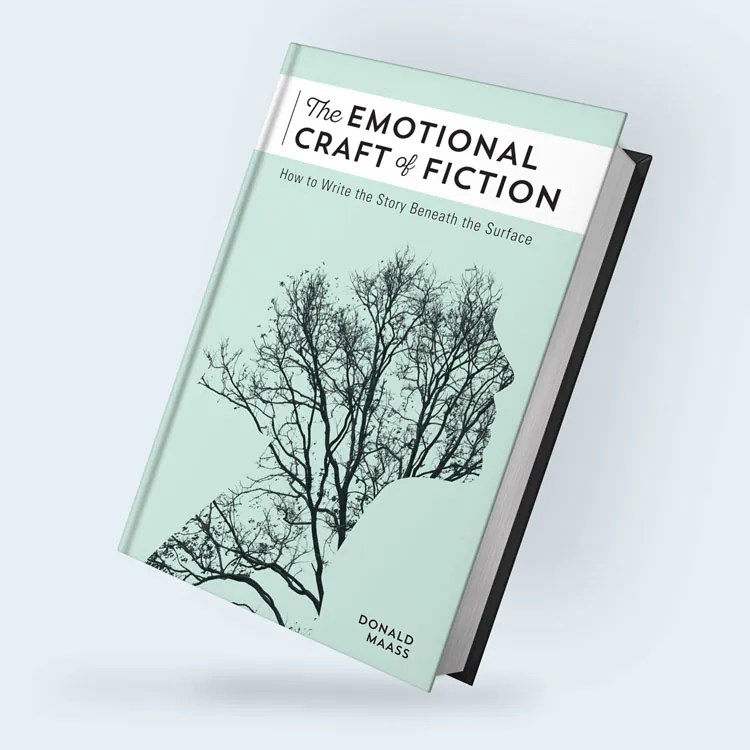
I just finished this book. I’ll say it’s good and even recommend it, but it’s not really for me. I wrote a blurb recently before I was even halfway through, and my opinion hasn’t changed.
Audio: NotebookLM podcast on this topic.
If you like to write in typical, character-driven stories, this should be right up your street. Besides character depth, the author also pushes moral righteousness. Thanks, but no thanks.
All of this said, I did gain some benefits from it, because although my writing is not heavily centred on characters, it does contain them, and I want them to feel alive. I want the world to feel lived in.
Personally, I think in schemes and threads – big ideas, deep ideas. Once all of this is roughly in place, I take a second pass for details. This is where Maass can help.
Full disclosure: Some people adopt a plotting approach to writing, whilst others adopt a pantser approach. I fall somewhere in between. Moreover, I might write something from one perspective and the next from the other – and I might flip-flop back and forth.
As a plotter, I might have waypoints that I want to hit, ideas I want to explore. Sometimes, I write these down on paper, in a spreadsheet, or somewhere to keep myself honest. Other times, I have these plot points in mind, but I take a stream-of-consciousness approach, simply discovering the story as it unfolds under my fingertips. I may even plot half a story and “pants” the rest of it. No telling.
As a pantser, I might have a kernel of an idea, and I just want to ideate on the page. So, I write. I lock myself in my room, throw up a “Do Not Disturb” sign, and head down to write until the well of ideas runs dry. At this point, I might put the idea aside or step back and consider plot points.
Looking back on this post, it’s not so much a book review at all. Apologies. That said, if you write characters and enjoy mainstream writing approaches, I think you’ll find the ideas in this book helpful. Many of the better ideas are presented early on, but it’s a short read. He offers some authors, titles, and excerpts you might find interesting. I found them to be a mixed bag.
I, Ridley Park, am an independent author and publisher. Before this literary turn, I did time as an economist, business analyst, and management consultant – none of which prepared me for the peculiar economics of modern publishing.
Much like traditional music in the Digital Age, traditional publishing has lost a bit of its lustre. Its gatekeeping function remains, but the gates are now rusted, and half the guards have been made redundant.
Audio: NotebookLM podcast on this topic.
From a business standpoint, the Independent™ must ask: Is the distribution reach of a traditional publisher or third-party distributor worth the revenue share they demand? It’s tempting to cast them as parasites feeding off your creative lifeblood—but statistically, the average indie author sells only 60 copies of their book. Yes, that includes the five you bought yourself and the ten your mum distributed among reluctant neighbours.
Could you sell more than average? Possibly. Less? Almost certainly. Better to sell 100 copies and earn a pittance than to earn 100% of nothing. But if the publisher can’t move your book either, and if they’re not investing in you as an author, you may well find yourself in the red. Especially if you’re the one paying them for the privilege of being published. That’s not publishing – that’s vanity cosplay.
Publishers also offer (read: upsell) services like editing, formatting, and cover design. As an Independent™, you either pay for these à la carte or do them yourself. Or, if you’re like me, you cobble together a mixed strategy of DIY, AI, and professional outsourcing – whatever the project demands.
For Hemo Sapiens, I did everything except the typography for the title and byline on the cover. That part I outsourced; I know my limits. The rest – cover composition, layout, typesetting – I handled. I also brought in beta readers, who offered some valuable copyedits and corrections.
With Sustenance, I went end-to-end solo, with AI in the wings for flow and proofing support.
Propensity followed a similar path – except I made the rare (some might say perverse) choice of hiring a beta reader after release. Heretical, I know. But the feedback was so incisive I’m now considering a mid-edition revision, particularly in the middle third, where things get a bit heady.
As for Temporal Babel – still unreleased – I’ve done everything myself thus far, but I’m leaning toward bringing that same beta reader back for another round of bruising clarity.
Beta readers, it turns out, are worth their weight in snark and red ink. I’ll save my ruminations on them for another post, which I promise will be full of revelations and at least one semi-poetic lament.
I could say more here, but there are other things demanding my time – and no publisher breathing down my neck.
Bless MidJourney for the cover art based on this prompt:
beautiful woman wearing glasses and a sheer top, holding a red pen, reading a book, office setting
Ever wondered why my characters are displaced, disillusioned, or linguistically marooned? Why my fiction leans philosophical, post-structural, and just a touch anti-humanist?
In this short video, I explain the underlying motivations behind my stories—from Heidegger’s Geworfenheit to Galen Strawson’s Causa Sui, with detours through identity, agency, and the lies we call language.
This isn’t about world-building. It’s about world-dismantling.










 Ridley Park