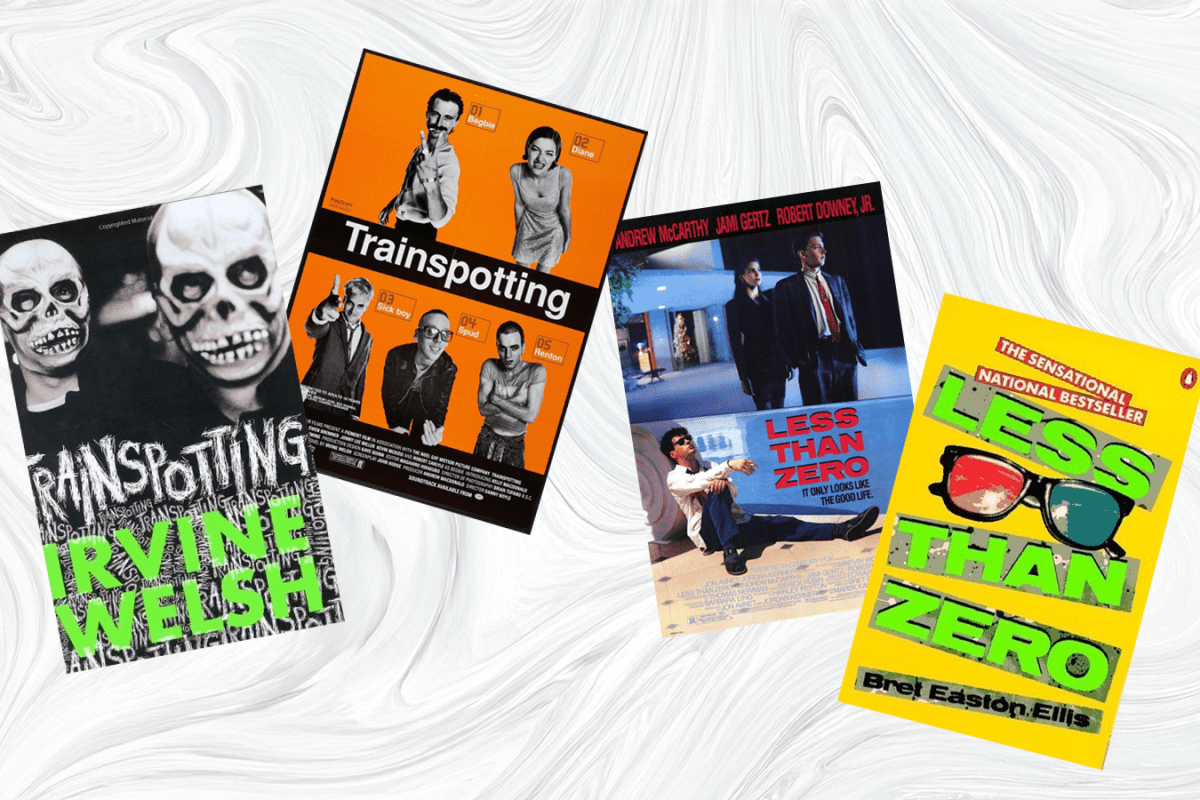
From Less Than Zero to Trainspotting: The Cinematic Pasteurisation of Addiction

Film has an extraordinary talent for turning jagged, difficult novels into cultural smoothies. Hand Hollywood a text about drugs, despair, and the grotesque collapse of youth, and it will hand you back something fit for a date night. Less Than Zero was gutted. Trainspotting was diluted. Both survived, after a fashion, but only one crawled back out with its bones still rattling.

Audio: NotebookLM podcast on this topic.

Ellis’s Less Than Zero was a flatline pulse of Californian ennui, a catalogue of hollow gestures in which the children of wealth consume themselves into oblivion. The backdrop was Reaganism in full bloom—an America drunk on consumerism, cocaine, and the fantasy of eternal prosperity. The kids in Ellis’s Los Angeles aren’t rebelling; they’re marinating in the very ideology that produced them. The film, by contrast, became a tepid morality play, complete with Robert Downey Jr.’s photogenic martyrdom. The void was swapped for a sermon: drugs are bad, lessons have been learned, and the Reaganite dream remains intact.

Welsh’s Trainspotting was messier, darker, harder to pasteurise. His junkies live in Thatcher’s Britain, where industry has collapsed, communities have rotted, and heroin fills the crater where meaningful work and social support once stood. Addiction is not just chemical but political: it is Thatcher’s neoliberalism rendered in track marks. Boyle’s film kept the faeces, the dead baby, the violence—but also imposed coherence, Renton as protagonist, a redemption arc, and that chirpy “Choose Life” coda. Welsh’s episodic chaos was welded into a three-act rave, all set to Underworld and Iggy Pop. Diluted, yes, but in a way that worked: a cocktail still intoxicating, even if the glass had been sanitised.

And yet, here’s the perennial fraud: drug films always get high wrong. No matter how grim the setting, the “junkie experience” is rendered as theatre, actors impersonating a template someone else once performed badly. The reality of heroin use is crushingly dull: twenty minutes of near-unconsciousness, slack faces, dead time. But you can’t sell tickets to drool and silence. So we get Baudrillard’s simulacrum: a copy of a copy of an inaccurate performance, dressed up as reality. McGregor’s manic sprint to “Born Slippy.” Downey’s trembling collapse. Junkies who look good on screen, because audiences demand their squalor to be cinematic.

And here’s where readers outpace viewers. Readers don’t need their despair blended smooth. They can sit with a text for days, grappling with jagged syntax, bleak repetitions, and moral vacuums. Viewers get two hours, max, and the thing must be purréd into something digestible. Of course, not all books are intellectual, and not all films are pap. But the balance is clear: readers wrestle, viewers swallow. One is jagged nourishment, the other pasteurised baby food.

So Less Than Zero becomes a sermon that spares Reagan’s dream, Trainspotting becomes a rave-poster that softens Thatcher’s wreckage, and audiences leave the cinema convinced they’ve glimpsed the underbelly. What they’ve really consumed is a sanitised simulation, safe for bourgeois digestion. The true addict, the tedious, unconscious ruin of the body, is nowhere to be found, because no audience wants that reality. They want the thrill of transgression without the boredom of truth.

And that, finally, is the trick: cinema gives you Reagan’s children and Thatcher’s lost boys, but only after they’ve been scrubbed clean and made photogenic. Literature showed us the rot; film sells us the simulacrum. Choose Life, indeed.

Video: Discussing Needle’s Edge, Part 1

Some novels are born in a lightning bolt. Needle’s Edge was forged in sediment: years of observations, contradictions, and lived experience settling into something that could no longer be ignored.

Video: Author Ridley Park Discusses Needle’s Edge

The video is intentionally, if not mercifully, short for all parties considered; it comes in under five minutes.

From the description:

Needle’s Edge is Ridley Park’s latest novel-in-progress, a raw, unvarnished work of literary realism with grit under its nails and philosophy in its bloodstream.

In this first episode of a new series on my writing process, I unpack the origins of Needle’s Edge: from life between the vantage point of an anthropologist and the poetry of Bukowski, to lived experience inside the worlds of sex work, addiction, and the quiet economies of trust and betrayal.

I reflect on the shift from speculative fiction to a tethered, reality-bound narrative, a story that rejects morality tales, subverts tropes, and meets its protagonist, Sarah, in the middle of her life before looping back to her beginnings. Along the way, he weaves in themes from Simone de Beauvoir, explores personae and code-switching, and interrogates the myths of middle-class respectability.

This is not a documentary – twenty years of lived history are compressed into five – but it’s true in its bones. Join me as he begins peeling back the layers of Needle’s Edge and the philosophy that drives it.

Persona, Identity, and the Many Faces of Sarah

(Notes from the cutting room floor)

I’m taking a break from editing to share something about the protagonist in my latest novel-in-progress, Needle’s Edge. She’s a woman – yes, but not just. She’s a prostitute. She’s an addict. And she’s three people.

Audio: NotebookLM podcast on this topic. (Direct)

There’s Sarah, her given name. The name reserved for friends, family, and those rare few who know her without conditions. It’s the name she hears in moments of tenderness, or shame, or memory.

Then there’s Stacey, the escort, the stripper, the performer. This is the name on her ads. The one whispered in hotel rooms and shouted in clubs. Stacey is curated. Sexual. Selective. She knows what sells and how to sell it.

And then there’s Pink, the street persona. The user. Pink is who shows up when Sarah needs to score. She trades in slang and silence. She wears a different skin. A different currency.

Three names. One woman. No seams showing – if she can help it.

In her world, compartmentalisation is survival. If a dealer connects the dots and knows she’s an escort, she’s vulnerable. If a client finds out she’s using, her value drops. Appearances are everything. Rates depend on it. Reputation is a balancing act on a razor’s edge. And so each name carries its own set of rules, risks, and rituals.

But here’s the deeper cut: Who’s the “real” Sarah?

Is Stacey fake? Is Pink less than? Is Sarah just the base layer beneath the makeup and muscle memory?

They’re all her. None of them. Some of each. Identity is slippery.

The left hemisphere of the brain craves coherence. It wants simplicity, categories, reduction. But the truth is, identity is a heuristic. A convenient fiction. And Sarah, more than most, knows this. Where most people perform one role and pretend it’s a self, she splits hers openly. She curates them. Manages them. Leverages them.

And yet, the cost is high.

Stacey and Pink are exhausting. High maintenance. High risk. But being Sarah isn’t a comfort either. It’s just what’s left when the others are stripped away. She doesn’t retreat into Sarah so much as collapse into her.

In that way, Sarah isn’t a self – she’s a default.

The irony? For all this agency, for all her awareness, she’s still trapped in identities designed for consumption. For transaction. For escape. Whether it’s sex, drugs, or memory, she’s always negotiating something.

Three names.
Three roles.
Still no way out.

Needle’s Edge Cover Reveal

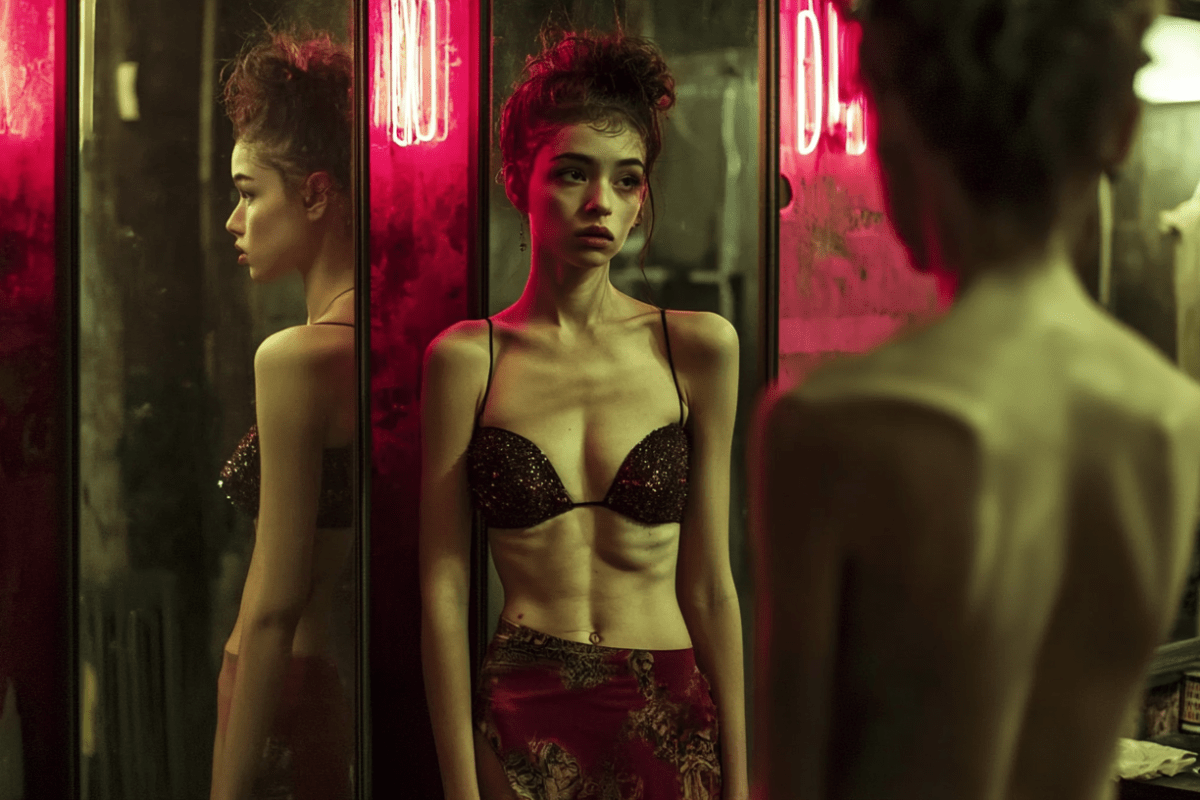
I’m sharing a comp of the cover art* for my upcoming novel – a story about a prostitute. More accurately, it’s a story about prostitutes, addiction, survival, and the consequences of living at the periphery – not just of society, but of personhood itself.

The earliest notes I have are dated 2019. I finished the first draft in June. I’m now editing – both structurally and line by line, which is probably a bad idea, but here we are. Because I’m reorganising scenes, I need to ensure the transitions make sense, emotionally and narratively.

Since completing the draft, I’ve been reading Simone de Beauvoir’s The Second Sex. First published in 1949, the edition I’m reading was translated in 2011. It’s given me language for something I was already trying to do.

This line is central to my approach. My protagonist isn’t born a prostitute. More importantly, she isn’t even born a woman. She’s made into one by church ladies, jealous sisters, careless boys, and indifferent systems. Through gestures, punishments, expectations, and neglect. Through the crucible of a society that offers her a script before she understands the stage.

Yes, her psychology matters. But the world matters more.

That’s what I’m trying to explore — not just the facts of a life on the edge, but the forces that shape it.

* I’ve actually designed two covers – one for hardcover and the other for paperback. It provides me with options.