I’m taking a break from editing to share something about the protagonist in my latest novel-in-progress, Needle’s Edge. She’s a woman – yes, but not just. She’s a prostitute. She’s an addict. And she’s three people.
There’s Sarah, her given name. The name reserved for friends, family, and those rare few who know her without conditions. It’s the name she hears in moments of tenderness, or shame, or memory.
Then there’s Stacey, the escort, the stripper, the performer. This is the name on her ads. The one whispered in hotel rooms and shouted in clubs. Stacey is curated. Sexual. Selective. She knows what sells and how to sell it.
And then there’s Pink, the street persona. The user. Pink is who shows up when Sarah needs to score. She trades in slang and silence. She wears a different skin. A different currency.
Three names. One woman. No seams showing – if she can help it.
In her world, compartmentalisation is survival. If a dealer connects the dots and knows she’s an escort, she’s vulnerable. If a client finds out she’s using, her value drops. Appearances are everything. Rates depend on it. Reputation is a balancing act on a razor’s edge. And so each name carries its own set of rules, risks, and rituals.
But here’s the deeper cut: Who’s the “real” Sarah?
Is Stacey fake? Is Pink less than? Is Sarah just the base layer beneath the makeup and muscle memory?
They’re all her. None of them. Some of each. Identity is slippery.
The left hemisphere of the brain craves coherence. It wants simplicity, categories, reduction. But the truth is, identity is a heuristic. A convenient fiction. And Sarah, more than most, knows this. Where most people perform one role and pretend it’s a self, she splits hers openly. She curates them. Manages them. Leverages them.
And yet, the cost is high.
Stacey and Pink are exhausting. High maintenance. High risk. But being Sarah isn’t a comfort either. It’s just what’s left when the others are stripped away. She doesn’t retreat into Sarah so much as collapse into her.
In that way, Sarah isn’t a self – she’s a default.
The irony? For all this agency, for all her awareness, she’s still trapped in identities designed for consumption. For transaction. For escape. Whether it’s sex, drugs, or memory, she’s always negotiating something.
I watched this video this morning: Why I Quit Goodreads. Apparently, people are fleeing Goodreads like it’s a sinking ship. Frankly, I didn’t realise they’d ever boarded.
Video: Why I Quit Goodreads by Alison Reads Books
I’ve used Goodreads for years. Not out of love – habit. I was on another platform before Amazon bought both and quietly euthanised the lesser one. So, like any good digital serf, I migrated. Goodreads never really improved. But that’s not what this post is about.
The woman in the video, Alison, recounts how she got sucked into the vortex of reading-as-performance. A treadmill of trending titles, five-star pressure, and dopamine farming. In short: social media with spines. She, like me, identifies as an introvert. Social media, she says, offered connection on her terms.
Fine. But here’s where we part ways: I don’t read what’s popular. I read like I write: deliberately, slowly, and mostly alone. I don’t care what the hive is reading. I don’t follow BookTok. I’m not hunting genre tropes like Pokémon. I’m not even watching telly.
That’s not snobbery. That’s filtration.
Yes, I read Tolstoy and Dostoevsky, not because they’re trending, but because they have staying power. I read Beauvoir and Foucault, not because they’re fashionable, but because they dismantle the very notion of fashion.
Ironically, AI has been more useful to me than Goodreads ever was. I ask it about tropes, continuity, and which authors my work resembles. Sometimes, it throws out a name I don’t know. So I investigate. If I see a resonance, great; I might lean in or veer away. Not because I want to copy, but because “originality” is a fairytale. Everything is recombinant DNA, literary or otherwise.
I’ve read friend recommendations. Mixed results. Often disastrous. I don’t care how many millions adore The Hunger Games, or William Gibson, or Taylor bloody Swift. That’s not an insult; it’s a mismatch. Their work just doesn’t speak to me. And that’s the point of art, it’s not for everyone.
Because of this, I’ve grown wary of recommendations. I no longer approach them with hope; I approach them like a suspicious mushroom in a stranger’s risotto.
So why do I still use Goodreads? To track what I’ve read and, occasionally, write reviews…for myself. If others find those reviews useful, great. If Goodreads’ recommendation engine serves up a gem, brilliant; but it rarely does. Algorithms don’t understand headspace. They see pattern, not mood.
I might binge Dostoevsky and Tolstoy one week, but that doesn’t mean I want a Russian lit syllabus. After Notes from Underground and The Death of Ivan Ilych, I finally cracked open The Second Sex – a book that’s loomed on my TBR like a monument.
Sometimes reading fuels my writing. Sometimes it stalls it. But unlike Alison, I never needed Goodreads to tell me who I am as a reader. And I sure as hell don’t need social media to validate my literary tastes.
If you’re quitting Goodreads because it became too performative, maybe you were never using it for the right reasons. Or maybe, like most platforms, it just stopped being fun once everyone else showed up.
About the cover image: “photo of a stereotypical punk rocker anarchist reading a book in a crowd of people staring at their mobile phones”
I’m not sure this Midjourney render captures much of the essence of my prompt, but there it is.
A funny thing happened on my way to bed. I’d been feeding my latest draft manuscript into various AI chat platforms to assess tropes, inversions, and target demographics. It turns out that Grok 3 got stuck in an endless loop.
Audio: NotebookLM podcast on this topic.
The content is not essential. I am only sharing it to illustrate where it went off the rails. It started fine enough, but if you scroll down or search for “In terms of target demographics, this could include artists,” you’ll see the font changes to red. This block of text kept repeating.
The entire block – red and black – represents Grok’s thought process. My chat prompt is in the shaded box below. It “thought” for more than 360 seconds. Perhaps that’s the mark representing where it went off the rails.
If you can’t sleep or are otherwise interested in how AI “thinks,” feel free to scan through. I hope there are no overt spoilers. You’ve been warned.
For context, this is the manuscript I referenced yesterday related to the book cover reveal.
One of my more significant concerns is the reaction of, let’s say, “immature” readers who translate all sexual references to erotica. Of course, they are not the key demographic. On this note, who might be the target demographic (cohorts) for this finished work?
Thought for: 360s So, I’m considering the target demographic for this work, and I need to think about who would be most interested in and impacted by its content. The manuscript deals with heavy themes like addiction, sex work, survival, and the complexities of identity, particularly through a feminist lens influenced by Beauvoir and Mulvey. It’s not erotica, but it does contain explicit sexual content, which could be misinterpreted by some readers. I need to identify who would appreciate the depth and nuance of the work rather than focusing solely on the sexual elements.
First, I should consider readers who are interested in feminist literature and theory. The manuscript’s exploration of “becoming a woman” and the “male gaze” suggests it would appeal to those who engage with gender studies, women’s studies, or feminist philosophy. This could include academics, students, and general readers who are familiar with or curious about these concepts.
Next, I should think about readers who are drawn to gritty, realistic portrayals of marginalized experiences. The manuscript’s focus on addiction and sex work, presented without romanticization, might resonate with those who appreciate raw, unflinching narratives. This could include people who have lived similar experiences, those who work in social services or advocacy, and readers who seek out stories that challenge societal norms and highlight systemic issues.
I should also consider readers who enjoy character-driven stories with complex, flawed protagonists. Sarah’s journey, with its cyclical nature of progress and relapse, offers a deep exploration of human resilience and vulnerability. This could attract readers who are interested in psychological depth and character development, regardless of their specific interest in the manuscript’s themes.
Additionally, I should think about readers who are interested in literature that pushes boundaries and challenges conventional storytelling. The manuscript’s structure, with its non-linear phases and raw language, might appeal to those who appreciate experimental or avant-garde literature. This could include literary fiction enthusiasts, writers, and critics who are looking for works that innovate in form and content.
Finally, I should consider readers who are part of or allied with communities that are often marginalized or stigmatized. The manuscript’s portrayal of sex work and addiction could resonate with those who seek representation and understanding of these experiences. This could include sex workers, people in recovery, and advocates for harm reduction and decriminalization.
Given these considerations, the target demographic for this finished work would likely include:
Readers interested in feminist literature and theory, particularly those familiar with Beauvoir and Mulvey. Individuals drawn to gritty, realistic portrayals of marginalized experiences, including those with lived experience or professional involvement in related fields. Fans of character-driven stories with complex protagonists, who appreciate psychological depth. Enthusiasts of experimental or boundary-pushing literature, who value innovation in form and content. Members of or allies to marginalized communities, especially those related to sex work and addiction, who seek representation and nuanced understanding. These cohorts would likely appreciate the manuscript’s depth, complexity, and unflinching portrayal of its themes, rather than misinterpreting it as erotica.
I should also consider that the manuscript’s explicit content might limit its appeal to certain readers, particularly those who are sensitive to graphic depictions of sex and drug use. However, for the target demographic, this content is integral to the narrative and its exploration of the themes.
Additionally, the manuscript’s non-linear structure and dense theoretical underpinnings might require a certain level of literary or academic engagement, which could further narrow its audience to those who are comfortable with or seeking out challenging reads.
Overall, the target demographic is likely to be a niche but intellectually curious and socially aware group of readers who are open to confronting difficult topics and engaging with complex ideas.
I should also think about potential secondary audiences. For example, readers interested in memoirs or autobiographical fiction might be drawn to the manuscript’s raw, personal tone, even if they are not specifically focused on the feminist or theoretical aspects. Similarly, those who enjoy true crime or social commentary might find the manuscript’s exploration of systemic issues compelling.
However, these secondary audiences might require additional framing or context to fully appreciate the manuscript’s intentions and themes. For instance, a reader primarily interested in memoirs might need guidance to understand the feminist theory woven into the narrative.
To maximize the manuscript’s reach and impact, it might be beneficial to consider how it is marketed and presented. Clear messaging about its themes, influences, and intended audience could help attract the right readers and set appropriate expectations.
For example, positioning the manuscript as a feminist exploration of identity and survival, rather than a straightforward narrative about sex work or addiction, could help draw in readers who are interested in those deeper layers. Similarly, highlighting its literary merits and theoretical underpinnings could appeal to academic and intellectually curious readers.
In terms of distribution, targeting independent bookstores, feminist literary festivals, and academic conferences could help reach the manuscript’s core audience. Online platforms that cater to niche literary communities, such as Goodreads groups focused on feminist literature or experimental fiction, could also be effective.
Ultimately, the success of the manuscript will depend on finding readers who are willing to engage with its challenging content and appreciate its nuanced exploration of complex themes. By carefully considering the target demographic and how to reach them, the manuscript can find its place among those who will value it most.
I should also consider the potential for the manuscript to spark discussions or be used in educational settings. Its engagement with feminist theory and its portrayal of marginalized experiences could make it a valuable text for courses on gender studies, sociology, or literature. This could further expand its audience to include students and educators.
However, the explicit content might limit its use in some educational contexts, particularly at the secondary level. At the university level, where there is more flexibility and a focus on critical analysis, the manuscript could be a powerful tool for exploring its themes.
To facilitate this, it might be helpful to create supplementary materials, such as discussion guides or essays that contextualize the manuscript within its theoretical frameworks. This could make it more accessible to educators and students who are engaging with these ideas.
In conclusion, the target demographic for this finished work is a diverse group of intellectually curious and socially aware readers who are interested in feminist literature, gritty realism, character-driven stories, experimental fiction, and the experiences of marginalized communities. By carefully considering how to reach and engage these readers, the manuscript can find a meaningful place in the literary landscape.
I should also think about the potential for the manuscript to resonate with readers who are not typically drawn to feminist literature or experimental fiction. For example, those who have personal experiences with addiction or sex work might find the manuscript’s portrayal validating or cathartic, even if they are not familiar with the theoretical frameworks.
Similarly, readers who are interested in stories of resilience and survival might be drawn to Sarah’s journey, regardless of their background or interests. The manuscript’s raw, unflinching portrayal of her experiences could resonate with anyone who has faced adversity or struggled to find their place in the world.
To reach these readers, it might be helpful to emphasize the human elements of the story—Sarah’s struggles, her moments of hope, her relationships with others—rather than focusing solely on the theoretical or thematic aspects. This could help the manuscript connect with a broader audience while still honoring its depth and complexity.
Ultimately, the target demographic for this work is not a monolith but a collection of overlapping cohorts who share an interest in challenging, thought-provoking literature. By recognizing and embracing this diversity, the manuscript can find its way into the hands of those who will appreciate it most.
I should also consider the potential for the manuscript to be adapted into other formats, such as film or television, which could further expand its reach. However, given the explicit content and complex themes, any adaptation would need to be handled with care to preserve the integrity of the original work.
For example, a film adaptation could visually convey the rawness of Sarah’s experiences, but it would need to avoid sensationalizing or romanticizing her story. Similarly, a television series could explore the manuscript’s themes in greater depth, but it would require a nuanced approach to character development and storytelling.
In either case, the target demographic for an adaptation would likely overlap with that of the manuscript, but it could also attract new audiences who are drawn to visual storytelling or who might not typically engage with literary fiction.
To maximize the potential for adaptation, it might be helpful to consider how the manuscript’s structure and themes could translate to the screen. For instance, the non-linear phases could be adapted into episodic storytelling, with each phase serving as a distinct arc. Similarly, the manuscript’s focus on character and internal struggle could lend itself to a character-driven series.
However, any adaptation would need to be approached with caution, as the explicit content and challenging themes could be difficult to navigate in a visual medium. It would be essential to work with creators who understand and respect the manuscript’s intentions and are committed to preserving its complexity.
In conclusion, the target demographic for this finished work is a diverse and intellectually engaged group of readers who are drawn to challenging, thought-provoking literature. By carefully considering how to reach and engage these readers—whether through marketing, distribution, or adaptation—the manuscript can find its place in the literary landscape and make a meaningful impact.
I should also think about the potential for the manuscript to be part of a larger conversation about its themes. For example, it could be featured in book clubs, reading groups, or online forums where readers can discuss and dissect its content. This could help build a community around the work and encourage deeper engagement with its ideas.
Additionally, the manuscript could be paired with other works that explore similar themes, such as memoirs by sex workers, feminist theory texts, or novels that delve into addiction and recovery. This could help contextualize the manuscript within a broader literary and cultural landscape and attract readers who are interested in these topics.
To facilitate this, it might be helpful to create reading guides or discussion questions that highlight the manuscript’s connections to other works and encourage readers to think critically about its themes. This could also make the manuscript more appealing to book clubs or educational settings.
Ultimately, the target demographic for this work is not just a group of readers but a community of thinkers and seekers who are willing to engage with difficult questions and explore the complexities of human experience. By fostering this community and providing opportunities for discussion and reflection, the manuscript can have a lasting impact beyond its pages.
I should also consider the potential for the manuscript to be translated into other languages, which could further expand its reach and impact. Given the universal nature of its themes—identity, power, survival—it could resonate with readers around the world, particularly in cultures where similar issues are prevalent.
However, translation would require careful attention to the nuances of language and culture, as the manuscript’s raw, explicit content might be received differently in various contexts. It would be essential to work with translators who understand the manuscript’s intentions and can convey its tone and meaning accurately.
In terms of target demographics for translations, it would be important to consider regions where there is a strong interest in feminist literature, social justice, or experimental fiction. For example, countries with active feminist movements or vibrant literary scenes might be particularly receptive to the manuscript’s themes and style.
Additionally, the manuscript could be promoted through international literary festivals, book fairs, or cultural exchanges, which could help introduce it to new audiences and generate interest in translations.
Overall, the potential for translation offers an exciting opportunity to expand the manuscript’s reach and impact, connecting with readers across linguistic and cultural boundaries. By carefully considering how to approach translation and promotion, the manuscript can find a global audience and contribute to important conversations on a wider scale.
I should also think about the potential for the manuscript to be adapted into other formats, such as audiobooks or podcasts, which could make it more accessible to different audiences. For example, an audiobook could allow readers to engage with the manuscript’s content in a new way, while a podcast series could explore its themes through interviews, discussions, or dramatizations.
However, as with film or television adaptations, any alternative format would need to be handled with care to preserve the integrity of the original work. It would be essential to work with creators who understand and respect the manuscript’s intentions and are committed to conveying its complexity and nuance.
In terms of target demographics for these formats, they could overlap with the manuscript’s core audience but also attract new listeners who prefer audio content or who might not typically engage with written literature. For example, an audiobook could appeal to busy professionals or commuters, while a podcast could attract fans of true crime, social commentary, or feminist media.
To maximize the potential for these adaptations, it might be helpful to consider how the manuscript’s structure and themes could translate to audio formats. For instance, the non-linear phases could be adapted into episodic storytelling, with each episode focusing on a different aspect of Sarah’s journey. Similarly, the manuscript’s focus on character and internal struggle could lend itself to a narrative podcast that explores her experiences in depth.
Ultimately, the target demographic for these adaptations would depend on how the content is presented and promoted. By carefully considering the format and messaging, it is possible to reach a diverse audience while staying true to the manuscript’s core themes and intentions.
I should also consider the potential for the manuscript to be used in therapeutic or support group settings, particularly for individuals who have experienced addiction, sex work, or trauma. The manuscript’s raw, unflinching portrayal of these experiences could serve as a powerful tool for reflection, discussion, and healing.
For example, it could be used in group therapy sessions to facilitate conversations about identity, power, and resilience. Similarly, it could be incorporated into support groups for sex workers or people in recovery, providing a shared text that reflects their experiences and encourages empathy and understanding.
To facilitate this, it might be helpful to create discussion guides or resources that highlight the manuscript’s relevance to these contexts and provide prompts for reflection and conversation. This could make the manuscript more accessible and impactful for these audiences.
However, it is important to approach this with sensitivity and care, as the manuscript’s explicit content and challenging themes could be triggering for some individuals. It would be essential to provide appropriate support and resources, such as content warnings or access to mental health professionals, to ensure that the manuscript is used in a safe and constructive way.
In terms of target demographics, this could include therapists, counselors, support group facilitators, and individuals who are seeking to understand or process their own experiences. By positioning the manuscript as a tool for healing and growth, it can reach a new audience and make a meaningful difference in people’s lives.
Overall, the potential for the manuscript to be used in therapeutic or support settings offers an exciting opportunity to expand its impact and contribute to important conversations about recovery, resilience, and empowerment.
I should also think about the potential for the manuscript to be part of a larger multimedia project, such as a website or online platform that explores its themes through various forms of content. For example, a website could feature excerpts from the manuscript alongside essays, interviews, artwork, or other creative works that engage with its ideas.
This could help create a richer, more immersive experience for readers and attract a diverse audience who are interested in exploring the manuscript’s themes through different lenses. It could also provide a space for community engagement, allowing readers to share their own stories, reflections, or creative responses to the work.
To maximize the potential for this, it might be helpful to collaborate with artists, writers, or activists who are working on similar issues or who can bring new perspectives to the manuscript’s themes. This could help create a dynamic, interdisciplinary project that resonates with a wide range of audiences.
In terms of target demographics, this could include readers who are interested in multimedia storytelling, as well as those who are drawn to feminist art, social justice, or experimental media. By creating a platform that invites participation and dialogue, the manuscript can become part of a larger conversation and reach a broader audience.
Ultimately, the target demographic for this work is not limited to a single group but encompasses a wide range of readers who are united by their interest in challenging, thought-provoking content. By exploring different formats, contexts, and collaborations, the manuscript can find its way into the hands of those who will appreciate it most and make a lasting impact.
I should also consider the potential for the manuscript to be used in academic research or as a case study in fields such as gender studies, sociology, or literature. Its engagement with feminist theory and its portrayal of marginalized experiences could make it a valuable text for scholars who are exploring these topics.
For example, researchers could analyze the manuscript’s use of Beauvoir’s and Mulvey’s concepts, examining how they are woven into the narrative and what they reveal about gender, power, and identity. Similarly, sociologists could use the manuscript to explore the social dynamics of sex work and addiction, drawing on its portrayal of systemic issues and individual experiences.
To facilitate this, it might be helpful to engage with academic communities through conferences, journals, or online platforms, sharing insights about the manuscript’s themes and inviting scholarly engagement. This could help position the manuscript as a significant contribution to its field and attract readers who are interested in its intellectual and theoretical dimensions.
In terms of target demographics, this could include academics, researchers, and students who are studying gender, sexuality, or social issues, as well as those who are interested in the intersection of literature and theory. By fostering connections with these communities, the manuscript can contribute to important academic conversations and expand its reach.
Overall, the potential for the manuscript to be part of academic discourse offers an exciting opportunity to deepen its impact and engage with readers who are passionate about its themes. By embracing this potential, the manuscript can find a place in both literary and scholarly landscapes.
I should also think about the potential for the manuscript to inspire activism or advocacy around the issues it addresses, such as sex work decriminalization, addiction recovery, or feminist empowerment. Its raw, unflinching portrayal of these experiences could serve as a powerful catalyst for change, encouraging readers to take action or support relevant causes.
For example, the manuscript could be used in fundraising campaigns, awareness events, or educational workshops that aim to address the systemic issues it highlights. Similarly, it could be featured in advocacy materials or social media campaigns that seek to challenge stigma and promote understanding.
To maximize this potential, it might be helpful to partner with organizations or activists who are working on these issues, using the manuscript as a tool for education and engagement. This could help amplify its message and reach audiences who are already invested in these causes.
In terms of target demographics, this could include activists, advocates, and community organizers, as well as individuals who are passionate about social justice and systemic change. By positioning the manuscript as a call to action, it can inspire readers to make a difference and contribute to a broader movement for change.
Ultimately, the target demographic for this work includes not just readers but also doers—those who are willing to engage with its themes and take steps to address the issues it raises. By fostering this sense of purpose and possibility, the manuscript can have a lasting impact beyond its pages.
I should also consider the potential for the manuscript to be part of a series or larger body of work that explores similar themes. For example, it could be the first in a trilogy that follows Sarah’s journey or the stories of other characters in her world. Alternatively, it could be part of an anthology that features multiple voices and perspectives on addiction, sex work, or identity.
This could help create a more comprehensive exploration of the manuscript’s themes and attract readers who are interested in a deeper dive into these topics. It could also provide opportunities for collaboration with other writers or artists, enriching the manuscript’s impact and reach.
To explore this potential, it might be helpful to consider how the manuscript’s structure and themes could be expanded or complemented by additional works. For instance, a prequel could delve into Sarah’s childhood and the experiences that shaped her, while a sequel could explore her legacy or the impact of her story on others.
In terms of target demographics, this could include readers who are invested in the manuscript’s world and characters, as well as those who are drawn to series or anthologies that offer a multifaceted exploration of complex issues. By creating a larger body of work, the manuscript can build a dedicated following and sustain its impact over time.
Overall, the potential for the manuscript to be part of a series or larger project offers an exciting opportunity to deepen its exploration of its themes and engage with readers on a broader scale. By embracing this potential, the manuscript can become a cornerstone of a rich and meaningful literary endeavor.
I should also think about the potential for the manuscript to be adapted into interactive or immersive experiences, such as virtual reality or augmented reality, which could allow readers to engage with its themes in new and innovative ways. For example, a VR experience could simulate Sarah’s world, providing a visceral sense of her struggles and triumphs, while an AR app could overlay additional content or insights onto the physical book.
However, as with other adaptations, this would require careful consideration of how to preserve the manuscript’s integrity and ensure that the interactive elements enhance rather than detract from its core message. It would be essential to work with creators who understand the manuscript’s intentions and can translate them into an immersive format.
In terms of target demographics, this could include tech-savvy readers who are interested in cutting-edge storytelling, as well as those who are drawn to experiential learning or multimedia art. By offering an interactive dimension, the manuscript can attract a new audience and provide a unique way to engage with its themes.
Ultimately, the potential for interactive adaptations offers an exciting opportunity to push the boundaries of how the manuscript is experienced and understood. By exploring this potential, the manuscript can remain at the forefront of literary innovation and reach readers in ways that traditional formats cannot.
I should also consider the potential for the manuscript to be used in creative writing workshops or educational programs that focus on storytelling, character development, or social issues. Its complex narrative structure and rich thematic content could serve as a powerful teaching tool, inspiring writers and students to explore their own voices and perspectives.
For example, it could be used in workshops that focus on writing about marginalized experiences, feminist theory, or experimental fiction. Similarly, it could be incorporated into educational curricula that explore literature’s role in social change or the power of narrative to challenge norms.
To facilitate this, it might be helpful to create lesson plans, writing prompts, or other resources that guide participants in engaging with the manuscript’s themes and techniques. This could make the manuscript more accessible and impactful for educational settings.
In terms of target demographics, this could include aspiring writers, students, educators, and anyone interested in the craft of storytelling or the exploration of social issues through literature. By positioning the manuscript as a source of inspiration and learning, it can reach a new generation of thinkers and creators.
Overall, the potential for the manuscript to be used in educational and creative contexts offers an exciting opportunity to expand its influence and foster meaningful engagement with its themes. By embracing this potential, the manuscript can contribute to the development of new voices and perspectives in literature.
I should also think about the potential for the manuscript to be part of a cultural or artistic movement that seeks to challenge societal norms and amplify marginalized voices. For example, it could be featured in exhibitions, performances, or festivals that focus on feminist art, social justice, or experimental storytelling.
This could help create a broader cultural conversation around the manuscript’s themes and attract audiences who are interested in art that provokes thought and inspires change. It could also provide opportunities for collaboration with artists, performers, or activists who can bring new dimensions to the manuscript’s message.
To explore this potential, it might be helpful to connect with cultural institutions, galleries, or festivals that align with the manuscript’s values and vision. This could help position the manuscript as a significant cultural artifact and attract a diverse audience of art lovers, activists, and thinkers.
In terms of target demographics, this could include individuals who are passionate about art, culture, and social change, as well as those who are seeking to engage with literature in a multidisciplinary context. By integrating the manuscript into a larger cultural movement, it can reach a wide and varied audience and make a lasting impact.
Ultimately, the target demographic for this work is not just readers but cultural participants—those who are willing to engage with its themes through various forms of expression and who see literature as a catalyst for broader societal conversations. By fostering this cultural engagement, the manuscript can transcend its pages and become part of a dynamic and evolving dialogue.
I should also consider the potential for the manuscript to be used in policy discussions or advocacy efforts related to its themes, such as sex work decriminalization, addiction treatment, or gender equality. Its portrayal of these issues could serve as a powerful narrative tool for policymakers, advocates, or organizations working to effect change.
For example, excerpts from the manuscript could be used in reports, presentations, or campaigns to humanize the statistics and provide a personal perspective on the challenges faced by individuals like Sarah. Similarly, it could be featured in public forums or debates to illustrate the real-world impact of policy decisions.
To facilitate this, it might be helpful to engage with policymakers, advocates, or organizations that are working on these issues, offering the manuscript as a resource for education and awareness. This could help amplify its message and reach audiences who are in positions to influence change.
In terms of target demographics, this could include policymakers, advocates, researchers, and anyone involved in shaping public discourse or policy around the manuscript’s themes. By positioning the manuscript as a tool for advocacy, it can contribute to important conversations and help drive meaningful action.
Overall, the potential for the manuscript to be part of policy and advocacy efforts offers an exciting opportunity to extend its impact beyond the literary world and into the realm of social change. By embracing this potential, the manuscript can make a tangible difference in the lives of those it portrays and inspire progress on the issues it addresses.
I should also think about the potential for the manuscript to be adapted into educational materials or resources for schools, community groups, or online platforms. For example, it could be used in curricula that explore literature, social issues, or feminist theory, providing students with a rich text for analysis and discussion.
Similarly, it could be featured in online courses, webinars, or workshops that focus on its themes, offering participants a chance to engage with the manuscript in a structured and guided way. This could help make the manuscript more accessible to a wider audience and encourage deeper exploration of its ideas.
To maximize this potential, it might be helpful to create educational resources, such as study guides, lesson plans, or discussion questions, that align with the manuscript’s content and themes. This could make it easier for educators and facilitators to incorporate the manuscript into their programs.
In terms of target demographics, this could include students, educators, community leaders, and lifelong learners who are interested in exploring literature, social issues, or feminist thought. By positioning the manuscript as an educational tool, it can reach a new generation of readers and thinkers and inspire critical engagement with its themes.
Ultimately, the target demographic for this work includes not just passive readers but active learners—those who are willing to engage with its content on a deeper level and use it as a springboard for personal or collective growth. By fostering this educational engagement, the manuscript can have a lasting impact and contribute to a broader understanding of its themes.
I should also consider the potential for the manuscript to be part of a personal or collective journey of healing, reflection, or transformation. For example, it could be used in therapeutic settings, support groups, or self-help programs to facilitate discussions about identity, resilience, or recovery.
Similarly, it could be featured in personal development workshops or retreats that focus on empowerment, self-discovery, or creative expression. This could help individuals connect with the manuscript’s themes on a personal level and find inspiration or solace in Sarah’s story.
To explore this potential, it might be helpful to collaborate with therapists, coaches, or facilitators who can guide participants in engaging with the manuscript in a supportive and constructive way. This could help create a safe space for exploration and growth.
In terms of target demographics, this could include individuals who are seeking healing, growth, or transformation, as well as those who are interested in using literature as a tool for self-reflection or personal development. By positioning the manuscript as a resource for personal journeys, it can reach a new audience and make a meaningful difference in people’s lives.
Overall, the potential for the manuscript to be part of personal or collective transformation offers an exciting opportunity to extend its impact and connect with readers on a deeply personal level. By embracing this potential, the manuscript can become a source of inspiration, empowerment, and change.
I should also think about the potential for the manuscript to be part of a legacy or archive that preserves and celebrates its themes and contributions. For example, it could be included in literary collections, feminist archives, or cultural repositories that document important works and voices.
This could help ensure that the manuscript’s impact endures over time and that its message continues to reach new generations of readers. It could also provide a platform for future scholarship, artistic interpretation, or cultural reflection.
To facilitate this, it might be helpful to engage with institutions, organizations, or platforms that are dedicated to preserving and promoting literature, feminist thought, or social justice. This could help secure the manuscript’s place in the cultural and intellectual landscape.
In terms of target demographics, this could include archivists, curators, scholars, and anyone interested in the preservation and celebration of important works. By positioning the manuscript as a significant contribution to its field, it can find a lasting home and continue to inspire and challenge readers for years to come.
Ultimately, the target demographic for this work includes not just current readers but future generations—those who will discover it in years to come and find value in its themes, insights, and artistry. By thinking about the manuscript’s legacy, we can ensure that its impact is not just immediate but enduring.
I should also consider the potential for the manuscript to be part of a dialogue or exchange with other works, authors, or thinkers who are exploring similar themes. For example, it could be featured in literary conversations, panel discussions, or collaborative projects that bring together multiple perspectives on identity, power, or survival.
This could help create a richer, more nuanced understanding of the manuscript’s themes and connect it to a broader intellectual or artistic community. It could also provide opportunities for cross-pollination and inspiration, as different voices and ideas intersect and inform each other.
To explore this potential, it might be helpful to engage with writers, scholars, or artists who are working on related topics, inviting them to respond to or build upon the manuscript’s themes. This could help foster a sense of dialogue and community around the work.
In terms of target demographics, this could include readers who are interested in interdisciplinary or collaborative approaches to literature, as well as those who are drawn to conversations that bridge different fields or perspectives. By positioning the manuscript as part of a larger dialogue, it can reach a diverse audience and contribute to a dynamic exchange of ideas.
Overall, the potential for the manuscript to be part of a broader conversation offers an exciting opportunity to expand its reach and deepen its impact. By embracing this potential, the manuscript can become a catalyst for connection, collaboration, and growth.
I should also think about the potential for the manuscript to be used in creative or artistic responses, such as adaptations, reinterpretations, or inspired works. For example, it could inspire visual art, music, dance, or other forms of expression that engage with its themes and bring them to life in new ways.
This could help create a multifaceted exploration of the manuscript’s ideas and attract audiences who are interested in the intersection of literature and other art forms. It could also provide opportunities for artists to reinterpret or reimagine Sarah’s story, offering fresh perspectives and insights.
To facilitate this, it might be helpful to create open calls for artistic responses or to collaborate with artists who are interested in engaging with the manuscript’s themes. This could help generate a diverse array of creative works that complement and expand upon the original text.
In terms of target demographics, this could include artists, performers, and creators who are seeking inspiration or who are interested in exploring the manuscript’s themes through their own mediums. By positioning the manuscript as a source of artistic inspiration, it can reach a new audience and foster a vibrant creative community.
Ultimately, the potential for creative responses offers an exciting opportunity to extend the manuscript’s impact and engage with readers and artists in innovative ways. By embracing this potential, the manuscript can become a living, evolving work that continues to inspire and challenge long after its publication.
I should also consider the potential for the manuscript to be part of a personal or collective ritual or ceremony that honors its themes or celebrates its message. For example, it could be used in readings, performances, or gatherings that bring people together to reflect on identity, power, or survival.
This could help create a sense of community and shared purpose around the manuscript, allowing participants to connect with its themes on a deeper level. It could also provide a space for healing, empowerment, or transformation, as individuals come together to honor their own journeys or those of others.
To explore this potential, it might be helpful to organize or participate in events that incorporate the manuscript into a ritualistic or ceremonial context, such as a reading circle, a performance piece, or a commemorative gathering. This could help create a powerful, immersive experience that resonates with participants.
In terms of target demographics, this could include individuals who are seeking connection, meaning, or community, as well as those who are interested in the transformative power of literature and art. By positioning the manuscript as part of a ritual or ceremony, it can reach a new audience and foster a sense of shared experience and purpose.
Overall, the potential for the manuscript to be part of a ritual or ceremony offers an exciting opportunity to deepen its impact and create lasting memories for participants. By embracing this potential, the manuscript can become a touchstone for personal and collective growth.
I should also think about the potential for the manuscript to be used in mindfulness or meditation practices that focus on its themes or messages. For example, it could be incorporated into guided meditations, reflective exercises, or mindfulness workshops that encourage participants to explore identity, power, or resilience.
This could help individuals engage with the manuscript’s themes in a contemplative and introspective way, fostering self-awareness and personal growth. It could also provide a unique way to connect with the manuscript’s content, using it as a tool for inner exploration and transformation.
To facilitate this, it might be helpful to create mindfulness resources or guided practices that draw on the manuscript’s themes and invite participants to reflect on their own experiences. This could make the manuscript more accessible and impactful for those who are interested in mindfulness or meditation.
In terms of target demographics, this could include individuals who are seeking personal development, self-discovery, or spiritual growth, as well as those who are interested in the intersection of literature and mindfulness. By positioning the manuscript as a tool for contemplative practice, it can reach a new audience and offer a unique path to engagement.
Ultimately, the potential for the manuscript to be part of mindfulness or meditation practices offers an exciting opportunity to expand its reach and provide readers with a new way to connect with its themes. By embracing this potential, the manuscript can become a source of inspiration and insight for those on a journey of self-discovery.
I should also consider the potential for the manuscript to be used in creative writing or storytelling workshops that focus on empowering marginalized voices or exploring personal narratives. For example, it could be used as a model or inspiration for participants to craft their own stories of survival, identity, or resilience.
This could help create a space for individuals to share their experiences and find their voices, using the manuscript as a catalyst for creative expression. It could also provide opportunities for community building and mutual support, as participants connect through their shared stories.
To explore this potential, it might be helpful to organize or participate in workshops that use the manuscript as a starting point for creative writing exercises, storytelling sessions, or group discussions. This could help participants feel seen and heard, while also deepening their engagement with the manuscript’s themes.
In terms of target demographics, this could include aspiring writers, storytellers, and individuals from marginalized communities who are seeking a platform to share their experiences. By positioning the manuscript as a tool for empowerment and expression, it can reach a new audience and foster a sense of agency and creativity.
Overall, the potential for the manuscript to be used in creative writing or storytelling workshops offers an exciting opportunity to amplify its impact and support the voices of those who resonate with its themes. By embracing this potential, the manuscript can become a catalyst for personal and collective storytelling.
I should also think about the potential for the manuscript to be part of a digital or online community that engages with its themes through forums, social media, or virtual events. For example, it could be featured in online book clubs, discussion groups, or social media campaigns that invite readers to share their thoughts, reflections, or creative responses.
This could help create a global community around the manuscript, allowing readers from different backgrounds and locations to connect and engage with its content. It could also provide a platform for ongoing dialogue and exploration, keeping the manuscript’s themes alive and relevant.
To maximize this potential, it might be helpful to create dedicated online spaces, such as a website, forum, or social media group, where readers can gather to discuss the manuscript and share their insights. This could help foster a sense of belonging and community among readers.
In terms of target demographics, this could include readers who are active online, as well as those who are seeking connection and conversation around the manuscript’s themes. By positioning the manuscript as the center of a digital community, it can reach a wide and diverse audience and sustain its impact over time.
Ultimately, the potential for the manuscript to be part of an online community offers an exciting opportunity to expand its reach and create a dynamic space for engagement. By embracing this potential, the manuscript can become a hub for connection, reflection, and growth.
I should also consider the potential for the manuscript to be used in research or data collection efforts that aim to understand its impact or explore its themes further. For example, it could be part of studies that examine reader responses, analyze its narrative structure, or investigate its portrayal of addiction and sex work.
This could help generate new insights and knowledge about the manuscript’s significance and contribute to broader academic or cultural discussions. It could also provide opportunities for collaboration with researchers, scholars, or institutions that are interested in its themes.
To facilitate this, it might be helpful to make the manuscript available for research purposes or to engage with researchers who are exploring related topics. This could help position the manuscript as a valuable resource for scholarly inquiry and expand its influence in academic circles.
In terms of target demographics, this could include researchers, scholars, and students who are studying literature, gender, or social issues, as well as those who are interested in the manuscript’s unique approach to storytelling. By embracing its potential for research, the manuscript can contribute to important conversations and deepen its impact.
Overall, the potential for the manuscript to be part of research efforts offers an exciting opportunity to explore its themes and significance in greater depth. By fostering connections with the research community, the manuscript can find a place in both literary and academic landscapes.
I should also think about the potential for the manuscript to be used in artistic or creative collaborations that bring its themes to life through different mediums. For example, it could inspire visual art, music, theater, or dance that interprets or responds to Sarah’s journey.
This could help create a multidisciplinary exploration of the manuscript’s themes and attract audiences who are interested in the intersection of literature and other art forms. It could also provide opportunities for artists to engage with the manuscript’s content and bring new perspectives to its story.
To explore this potential, it might be helpful to organize or participate in collaborative projects that invite artists from various disciplines to respond to the manuscript. This could help generate a diverse array of creative works that complement and expand upon the original text.
NB: The cover image is the design I handed to the designer to create the cover. The current consensus is that the syringe replacing the L doesn’t work. Back to the drawing board.
I’m sharing a comp of the cover art* for my upcoming novel – a story about a prostitute. More accurately, it’s a story about prostitutes, addiction, survival, and the consequences of living at the periphery – not just of society, but of personhood itself.
The earliest notes I have are dated 2019. I finished the first draft in June. I’m now editing – both structurally and line by line, which is probably a bad idea, but here we are. Because I’m reorganising scenes, I need to ensure the transitions make sense, emotionally and narratively.
Since completing the draft, I’ve been reading Simone de Beauvoir’s The Second Sex. First published in 1949, the edition I’m reading was translated in 2011. It’s given me language for something I was already trying to do.
“One is not born, but rather becomes, a woman.”
— Simone de Beauvoir
This line is central to my approach. My protagonist isn’t born a prostitute. More importantly, she isn’t even born a woman. She’s made into one by church ladies, jealous sisters, careless boys, and indifferent systems. Through gestures, punishments, expectations, and neglect. Through the crucible of a society that offers her a script before she understands the stage.
Yes, her psychology matters. But the world matters more.
That’s what I’m trying to explore — not just the facts of a life on the edge, but the forces that shape it.
* I’ve actually designed two covers – one for hardcover and the other for paperback. It provides me with options.
The novel Propensity is divided into three sections, each with fifteen chapters – because symmetry is pleasing and my OCD deserves a biscuit. The first third plays it straight. More or less. A novel in the classical sense. You know – plot, people, dialogue, the odd existential quip. The middle third begins to fray at the edges, like an overstretched cardigan at an avant-garde poetry slam. And the final third? Well, it abandons form like a cult member in a cornfield, embracing the experimental, the elliptical, and the structurally suspect.
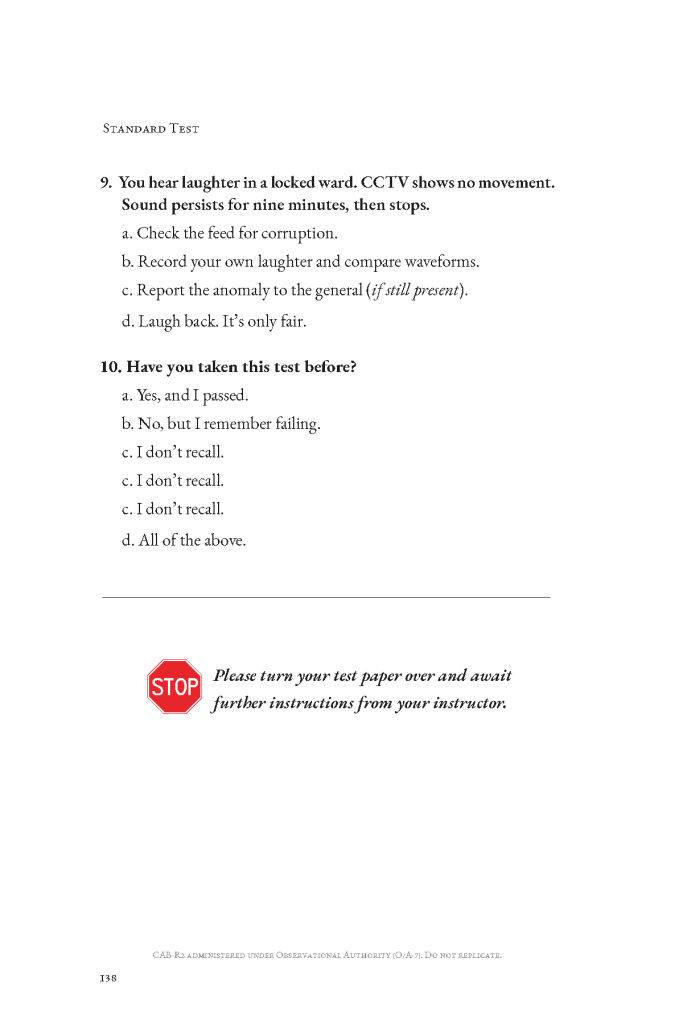
Chapter 28 is where the wheels come off. Or rather, where we slap on entirely different wheels – hexagonal ones. It takes the form of a standardised test. Yes, a literal test. Multiple choice. But fret not – there’s no grade, no timer, no Scantron sheet. Just questions. Absurd ones. Possibly even meaningful ones, though that’s above my pay grade.
Is it serious? Not remotely. Does it “advance the plot”? Hardly. Does it offer deep character insight? Not unless you’re profiling the author. But it does serve as a playful rupture in the narrative – a breather, a jab, a meta-giggle at the expense of structure and expectation. And let’s be honest: if you’ve made it to Chapter 28, you probably deserve a bit of a reward for tolerating everything prior.
As for spoilers: yes, technically, there are some. But without context, they’re like IKEA instructions written in Sanskrit. You might glimpse the shadow of something meaningful, but you’ll have no bloody idea what you’re looking at. No harm, no foul.
You can view Chapter 28 (along with several other amuse-bouches) for free on the Propensity book page. It’s downloadable as a PDF. No catch. No mailing list sign-up. I don’t want your email. I want your confusion.
Now, go take the test. Or don’t. It’s not graded. But it is a chapter.
I’ve been lurking and participating in many author and writing groups, but I’m not sure this is a productive strategy.
Like other authors, my goal is to network and connect to readers, and more importantly, buyers. The problem is that other authors, like myself, share the same goal in mind. There is no reciprocity, no “coincidence of wants,” which is that I happen to be offering a book that you might find engaging.
Audio: NotebookLM podcast on this topic.
Of course, one can frequent reader groups, but these are often inundated with publications, so there is no focus. I don’t write genre fiction, so I don’t have the benefit of, say, a sci-fi group, romance, werewolves, and whatnot. I (tend to) write literary fiction without identifiable tropes and storyline. As I’ve written before, there are no Hero’s Journeys, no saving the cat.
Indeed, there are literary fiction groups, but there are numerous motivations for this reader cohort. It is not homogeneous. I could (and do) hunt for sub-categories, but these are less fruitful.
I see dozens of ads splashed on my screen, suggesting someone can help me write my next book by telling me what’s hot, what’s selling. I am not interested in writing books that sell. I want to tell my stories. I am not a commercial writer in the same way that I was never a commercial musician. I am interested in the art. Of course, I want to sell my works, but it needs to be on my terms. If I were to sell out, it would just be another job with all of the intrinsic joy sucked out of it. The extrinsic appeal of money is not enough to compensate. Some people who take this commercial convince themselves, “at least I’m still writing,” or painting, or performing for a living. I am not able to comfort myself with this self-delusion. As the saying goes, ignorance is bliss.
Since I’m ranting…
I’ve been haunting author and writing groups for a while now – lurking in the shadows, peeking behind the curtain, occasionally tossing in a snide comment or two. Call it market research. Call it masochism. Either way, I’m starting to suspect it’s not the most productive use of my time.
You see, like most of these poor souls, I’m here to “network” (whatever that means in late-stage capitalism) and, more importantly, connect with actual readers. Buyers. The unicorns. Not fellow authors trying to sell me their 17-book werewolf reverse-harem saga or the latest AI-generated cover that somehow still manages to have three left hands.
And here’s the rub: we’re all pitching. No one’s catching. It’s a bazaar where everyone’s hawking their wares and no one’s carrying a purse. The law of the marketplace – what economists once called the “coincidence of wants” – simply doesn’t hold. I don’t want what they’re selling. They don’t want what I’m offering. It’s not even personal. It’s just noise.
Could I wade into reader groups instead? Sure. But these are often genre-clogged pools: romance, sci-fi, vampires with high school diplomas. God bless them. It’s just not my lane. I write literary fiction. You know, the kind without a tidy plot, without a cat-saving hero, and – brace yourselves – without an obligatory third-act redemption arc.
Even literary fiction groups aren’t much help. That label encompasses too much: Booker-bait bildungsromans, moody minimalism, and the occasional Proustian doorstop for good measure. And reader motivation in these spaces is hardly uniform. Some want to weep. Some want to feel clever. Some just want to say they read something “important” at brunch. None of them are asking for me – and that’s fine. But it does make targeting a pain in the arse.
Then come the ads. The snake-oil salesmen. “Here’s how to write a book that sells!” “Tap into trending genres!” “Master the market!” As if we’re all desperate to become a literary McDonald’s franchisee, pumping out Big Macs with words. I didn’t become a writer to stuff my soul into a Happy Meal box. I didn’t become a musician to churn out jingles. I don’t paint by numbers and I don’t plot by templates.
Yes, I want to sell my work – but on my terms. I’m not allergic to money; I just refuse to whore out my creativity to chase it. Some people convince themselves that so long as they’re still writing – still playing the game – they’ve won. I’m not built for that flavour of self-delusion. Call it ego. Call it integrity. I call it survival.
Since I’m already up here on my soapbox, let me kick it once or twice for good measure.
There’s a mountain of writing advice out there. I’ve read plenty. Some of it’s even good. But much of it is just a conveyor belt back to the same old factory settings: save the cat, beat the plot, rinse and repeat. I don’t write that way. I don’t read that way. I need more than recycled tropes wearing different hats. I need teeth. Friction. Depth.
Do I use tropes? Of course. We all do. Language itself is a trope. But I twist them. I break them. I bury them in the garden and see what grotesque things bloom. It’s not even effortful – it’s just how my brain is wired. Call it a feature, not a bug.
Anyway, that’s enough bark for one day. If you’ve ever stared into the marketing void and felt it blink indifferently back, I see you. If you’re a writer trying to walk the tightrope between integrity and visibility, I hear you. If you’ve got thoughts, confessions, or sacrificial goats to share, drop them in the comments. Misery loves literate company.
I’ve read a wide range of genres. I’ve found them most unsatisfying and therefore unappealing. I am not saying that these are now good. I’m saying that they don’t resonate with me. It’s why I don’t watch television and find few movies interesting. I need more than templated tropes.
Do I use tropes? Of course I do. Writing a book without tropes would be nearly impossible. I try to subvert tropes and expectations. In practice, I don’t even have to try very hard. It’s how my brain works on its own.
Last but not least, I don’t need a writer’s group, starter ideas, prompts, or exercises. I don’t get writer’s block, probably because I am not trying to force a plot.
Anyway, I’ll hop down off my soapbox. I wonder how many other writers share some of my perspectives and challenges. Let me know in the comments.
Measuring progress is far simpler when you’re writing. You can count words. Or characters, if you’re a sadist. Sure, half of them might be drivel. Whole chapters may end up ceremonially executed by draft five, but at least you’ve done something. There’s a metric. A tally. A sense of movement.
Audio: NotebookLM podcast on this topic.
You can even see your progress, pages stack, paragraphs grow fat with promise. And if you still write on physical media (bless your nostalgic heart), you get the added catharsis of crumpling your failures and lobbing them at the bin like a disgruntled poet. It’s theatre. It’s progress. It’s delusional.
Editing, by contrast, offers no such cheap thrills. The word count doesn’t so much creep as collapse. One minute you’re a literary demi-god sitting on 80,000 words. The next, you’re scraping along at 74k and wondering whether your “tightening” has amputated a limb.
Yes, the prose might be cleaner. Punchier. Less like a whisky-soaked rant and more like a distilled insult. But does it feel like progress? Not in the way dopamine understands it.
As I’ve written before, editing takes me five – maybe ten – times longer than drafting. It’s a full hemispheric shift: from right-brain dreamscapes to left-brain bureaucracy. Creativity gives way to spreadsheet logic. Grammar. Timelines. Continuity. Did she sit before she spoke, or after? Is this line meant to be his? Why is this in past tense? Is this in any tense?
And so, the grind.
Yes, there are flashes of satisfaction – a retooled transition here, a twist landed just-so there. But mostly, it’s a long, slow crawl through self-loathing and misplaced modifiers.
I’ve spent most of my adult life toggling between left-right hemisphere roles. And frankly, the left side still gives me hives. The corporate world, bless its hollow soul, tried to stuff me in a logic-shaped box. A coffin of metrics, meetings, and “measurable outcomes.” I’m still recovering.
So why not outsource editing? Why not let someone else swing the machete through this jungle?
Two reasons:
I secretly enjoy the act of refinement. It’s masochism, but it’s my masochism.
I operate on a margin so thin it’s practically theoretical. A Schrödinger’s budget – simultaneously there and not.
I’m editing what I expect will become my next novel. Editing, for me, is a fundamentally different headspace than writing. When I’m drafting – especially when pantsing – I lean into a stream-of-consciousness flow. Iain McGilchrist might call this right-hemisphere activity. I don’t steer so much as ride shotgun, scribbling while the character drives.
Audio: NotebookLM podcast on this topic.
(Side note: I’ll share the tentative cover art soon, but this post is about process.)
Editing, by contrast, is all left hemisphere – angles, order, logic, connection. When I’m writing, I don’t worry if a detail makes sense. That’s future-me’s problem. In this project, future-me discovered that the protagonist had been pregnant for over thirteen months, undertaking activities most wouldn’t attempt in that state. In a nonlinear story, this might slip past many readers – but not past my editorial self. I mentioned this in a prior post.
I used to devour writing advice, but I don’t write like other people. Most advice seems geared toward genre fiction. I’m not opposed to that, but I lean literary and experimental. Templates don’t work for me.
I know the Hero’s Journey. I’ve read Save the Cat. But I don’t write about heroes – or even anti-heroes. That’s not the kind of story I’m telling, nor the kind I usually read.
I don’t much care about strong characters for their own sake. I care about what they allow me to explore philosophically. That said, this project is different. The main character is strong. So are the secondaries. And while it’s still fiction, it’s rooted in real people and events – compressed, reshaped, but recognisable.
I’ve condensed two decades of experience into a seven-year arc across ~200 pages. The first three years are flashbacks, brushed in for colour. The rest unfolds more or less in sequence. This time, I didn’t give myself free rein. There are rails. And while I occasionally jump them, I still need to land somewhere coherent.
The structure is a four-phase design. The book opens in media res and stays there for a few chapters. Then we rewind. And rewind again. Eventually, the timeline catches up, and the final half moves more linearly.
To tame this beast, I turned to spreadsheets. I built a plot matrix – numbering each section twice: narrative order (as written) and chronological order (as lived). I had to find the earliest flashbacks and stitch the rest together like some temporal jigsaw. It felt like Inception at times. Where am I? What layer is this?
From there, I started tracking time: days, weeks, months. That’s when I uncovered the 13-month pregnancy. Realistic for an elephant, not a human.
The root problem? I sequenced the conception too late and compressed the birth too early. I also omitted two earlier pregnancies to streamline the plot. To fix it, I reinstated one and used it to restore character depth that had been left on the cutting room floor. It worked – but it added new complications. Now I’m back in spreadsheet land, scanning for widows and orphans – narrative orphans, I mean – where scenes dangle or disconnect.
This is where editing diverges from writing. Writing is dreaming. Editing is retelling. And retelling demands coherence. Dreams ignore time, cause, and logic. Retelling insists on them: this happened before that, and then…
So-called “plotters” operate almost entirely in the left hemisphere. Structure first. Logic forward. Details coloured in after. It’s a valid approach – but one with fewer degrees of freedom. Creative constraints come with the template. You still get unique results, but you’ve narrowed the space. Stephen King’s version would differ wildly from JK Rowling’s – but both would be channelled through the same scaffolding.
You can argue that creativity happens in the choosing of the structure. Fair. But unless you’ve invented something truly novel, you’ve still chosen from a shelf of precedents. The story begins where freedom ends.
Welcome, dear reader, to the eternal skirmish between Art and Entertainment, or as the marketing departments like to call it, Literary Fiction vs Commercial Fiction. This is not just a genre squabble; it is the ideological showdown between truth-seeking masochists and market-savvy optimists.
Literary Fiction: Starving Artist Chic
Literary Fiction is what happens when someone spends ten years writing a novel that doesn’t sell but gets shortlisted for an award no one outside The Guardian has heard of. It is the sanctum of character studies, of prose polished until it cuts glass, of metaphors so dense they require footnotes and a whisky.
It doesn’t have to be inaccessible, of course—it just often chooses to be, on principle. Plot is optional, punctuation negotiable. The point is to mean something. To explore the human condition. To examine alienation in a post-industrial neoliberal hellscape, not to entertain your aunt with a beach read.
It’s not that Literary Fiction hates readers. It just isn’t convinced they’re entirely necessary.
Commercial Fiction: Mass Appeal on Tap
Enter Commercial Fiction: the cheerfully formulaic cousin who makes six figures ghostwriting romance under three pseudonyms while sipping cocktails on a cruise. It values clarity, pace, and payoff. There is a beginning, a middle, and—brace yourself—a satisfying end.
It’s written with the audience in mind. The actual audience, not the imagined one you conjure during your third espresso in a North London café while reworking the opening line for the sixth time.
Commercial Fiction exists to be read. Literary Fiction exists to be discussed. Possibly in a room full of mirrors. Possibly after death.
The High-Low Culture Divide
If this were the Renaissance, Literary Fiction would be frescoes in a cathedral—revered, roped-off, and best viewed with your neck craned in discomfort. Commercial Fiction would be the travelling puppet show outside: rowdy, raucous, full of cheap laughs and bawdy jokes. Guess which one brings joy to the masses and which one gets preserved by UNESCO.
There is still this Victorian hangover about high art and low art, as if prose needs a monocle and a trust fund to be taken seriously. Literary Fiction clings to its moral high ground, publishing monographs on the death of the novel, while Commercial Fiction’s out here resurrecting it one bestseller at a time.
Intention Matters
Let’s be honest: some literary writers stumble into the bestseller lists. It’s not beneath them—it just wasn’t the point. Conversely, when a commercially-minded author attempts “Art,” the results are often embarrassing—like a stand-up comic trying Shakespeare in clown shoes.
Approaching from a commercial angle and achieving something artistically resonant? That’s the alchemy. That’s the rare bird. But the reverse—starting with art and accidentally making money—is a tale as old as Joyce (who, let’s remember, died broke and banned).
Can’t We All Just Get Along?
No. Just kidding. Sort of.
Yes, there is crossover. Yes, The Road is both. But let’s not pretend that Twilight and To the Lighthouse are playing the same game. One is trying to build a fanbase; the other is trying to dissect perception itself. And while both may involve vampires, only one is metaphorical.
In Conclusion
Commercial Fiction is a warm bath. Literary Fiction is a cold shower that leaves you questioning your life choices. One sells. The other sulks. One entertains. The other enlightens (maybe). You can love both, loathe both, or—if you’re cursed with a literary soul—you can write one while envying the other.
Either way, don’t pretend they’re the same. One is art. The other is commerce. Sometimes they shake hands. Occasionally they snog. But more often, they glare at each other from opposite ends of the bookstore, muttering into their blurbs.





 Ridley Park