The First Rule of Writing: There Are No Rules

It is all well and good that experienced people share their advice with neophytes, with those who are less practised, less confident, or simply eager to imitate. There is nothing inherently wrong with offering footholds. This particular video, for instance, sets out ten strategies for the opening paragraph, each supposedly designed to stop readers from bolting at the first hurdle. For the green and anxious, a checklist can feel like a lifeline.

But here is the rub. The first rule of writing, which is also the first rule of art, is that there are no rules. There are, admittedly, a near-infinite number of bad ideas – every creative writing workshop is proof of that – but this abundance of failure does not magically distil into a shortlist of approved techniques. “Best practice” is a managerial fiction dressed up as gospel.

Video: First Paragraph Strategies

Yes, if you are working in a commercial genre, there are conventions and tropes that must be acknowledged. A murder mystery without a corpse is merely awkward, and a romance without union or rupture is simply wishful thinking. But let us be clear: these are expectations, not commandments. They are signposts, not shackles.

The danger of this kind of advice is not that it is wrong, but that it is received as dogma. If every first paragraph dutifully obeyed these ten tricks, the outcome would not be ten compelling openings but ten perfectly interchangeable ones. Predictability, not incompetence, is the real enemy of writing. To follow rules too tightly is to aim directly at cliché.

And yet the defence is equally obvious. A novice often requires boundaries, if only to resist paralysis. “Begin here, avoid this, try that.” Advice of this sort can be useful scaffolding, and scaffolding, while inelegant, keeps the building upright until the architect has a design. The problem arises when people mistake the scaffolding for the cathedral.

So the honest conclusion is double-edged. Watch the video if you like. Steal what steadies you, ignore what doesn’t. But do not imagine that art is born from lists. At best, such advice can prevent you from falling flat on your face; at worst, it convinces you that walking in circles is the same thing as running.

Video: Discussing Needle’s Edge, Part 1

Some novels are born in a lightning bolt. Needle’s Edge was forged in sediment: years of observations, contradictions, and lived experience settling into something that could no longer be ignored.

Video: Author Ridley Park Discusses Needle’s Edge

The video is intentionally, if not mercifully, short for all parties considered; it comes in under five minutes.

From the description:

Needle’s Edge is Ridley Park’s latest novel-in-progress, a raw, unvarnished work of literary realism with grit under its nails and philosophy in its bloodstream.

In this first episode of a new series on my writing process, I unpack the origins of Needle’s Edge: from life between the vantage point of an anthropologist and the poetry of Bukowski, to lived experience inside the worlds of sex work, addiction, and the quiet economies of trust and betrayal.

I reflect on the shift from speculative fiction to a tethered, reality-bound narrative, a story that rejects morality tales, subverts tropes, and meets its protagonist, Sarah, in the middle of her life before looping back to her beginnings. Along the way, he weaves in themes from Simone de Beauvoir, explores personae and code-switching, and interrogates the myths of middle-class respectability.

This is not a documentary – twenty years of lived history are compressed into five – but it’s true in its bones. Join me as he begins peeling back the layers of Needle’s Edge and the philosophy that drives it.

She’s Come Undone – Spoilers

She’s Come Undone is a novel published in 1992, written by Wally Lamb, no relation to Shaun the Sheep.

I haven’t read She’s Come Undone, and it’s unlikely that I ever will. I read a social media post where the author supplanted The Crossing by Cormac McCarthy as his top book. These don’t appear to be the same genre, so don’t ask me how the list was structured. Perhaps books about bears. Does She’s Come Undone have any passages on bears – prequel to The Revenant? We may never find out.

The reason this blog post exists is that I was reading the reviews on Goodreads – 3.91 of 5 stars. So, I read some reviews. This woman offered only one star and swore she’d have given fewer if she could. Odd, how zeros don’t carry the same weight. They act more like NULLs than zeroes. Sad, that.

Evidently, some commenters were furious at her revealing the spoiler. I share her defence here. For those who have yet to watch Citizen Kane, I warn you of the spoiler in her response. Read on at your own risk.

Addendum: Every so often, someone comes along and flags this review as having spoilers. Complaining about spoilers in this review is, not to put too fine a point on it, really stupid. Most of the plot points I mention here are either in the actual cover copy of the book, in the Goodreads summary, or occur somewhere within the first ten pages or so. The rest are so vague (e.g., hooking up with a bad boyfriend — a plot point that probably occurs in some form in, oh, half of the books ever written) that if you consider them “spoilers,” I’m not really sure why you read book reviews at all.

Further addendum: If you’re about to complain about spoilers in this review, please see comment 55 below. If you’re that hysterical about spoilers, maybe stop reading online reviews before you read the book. Also, the book was published 25 years ago and I think the statute of limitations has really run on this one. Rosebud was his sled!!

Sturgeon’s Law, AI, and the Literary Ivory Tower

3–4 minutes

Let’s get this out of the way: Sturgeon’s Law, ‘90% of everything is crap‘, isn’t pessimism, it’s statistics. That includes your favourite novel, the collected works of Joyce, and, yes, AI-generated text. The key point? If AI has the same bell curve as human output, some slice of that curve will still be better than what most people write. If Pareto’s Rule feels better at 80%, I’ll cede that ten points.

And before anyone gets misty-eyed about “human genius,” let’s remember that the average American adult reads at a 7th or 8th grade level, and more than half read at or below a 6th grade level. Nearly 1 in 5 reads below a 3rd grade level. That’s not a moral failing, but it is a market reality. We can wail about AI not producing the next Nabokov, but let’s be honest, Nabokov isn’t exactly topping the Costco bestsellers table.

Audio: NotebookLM podcast on this topic
  • AI doesn’t have to dethrone the literary elite. It just has to outperform the mass of competent-but-unremarkable human writers serving an audience who, frankly, doesn’t care about “stylistic nuance” or “metafictional self-reflexivity.”
  • There’s a vast literary middle ground – corporate copywriting, trade journalism, formulaic romance, SEO blogs – where AI will not just compete, but dominate, because the audience is reading for function, not art.
  • The high-literary crowd will remain untouched, partly because their readership fetishises human intentionality, and partly because AI doesn’t yet want to write about the precise smell of sadness in a damp Parisian garret in 1934.

The fearmongering about AI “killing literature” is a bit like saying instant ramen will kill haute cuisine. Yes, more people will eat the ramen, but Alain Ducasse isn’t sweating over his stock reduction.

  • The printing press was supposed to obliterate the artistry of the hand-copied manuscript. Instead, it made books accessible and created new genres entirely. Calligraphy still exists, it’s just no longer the only way to get words on a page.
  • Photography was going to end painting. In reality, it freed painters from the burden of strict representation, allowing impressionism, cubism, and abstract art to flourish.
  • Recorded music didn’t destroy live performance, it expanded its reach. Some audiences still pay obscene amounts to see an actual human sweat on stage.
  • Film didn’t kill theatre; it created a parallel art form.
  • Synthesizers didn’t erase orchestras; they just meant you didn’t have to mortgage your house to hear a string section in your pop song.

AI is simply the next entrant in this long tradition of “threats” that turn out to be expansions. It will colonise the big islands of the creative archipelago – commercial writing, functional prose, genre boilerplate – and leave the small monasteries of high art mostly untouched.

So, no, AI won’t be the next Mozart, Picasso, or Nabokov. But it doesn’t need to be. It just needs to be good enough to meet – and occasionally exceed – the expectations of the largest share of the market. And given that most readers are happy if the plot makes sense, the spelling’s passable, and the ending doesn’t require a graduate seminar in semiotics to decipher, I’d say AI’s prospects are rather good.

The rarefied work of the serious literary writer isn’t competing for market share; it’s preserving and evolving the cultural and linguistic possibilities of human expression. That work thrives not because it’s the only thing available, but precisely because it stands apart from the sea of functional prose, human or machine-made. The AI tide will rise, but the lighthouse will still be human.


Authors Talking to Authors Whilst the Readers Are Elsewhere

There’s a peculiar little ecosystem out there called the author’s forum. You’ve probably seen it – digital watering holes where writers congregate to swap tips, trade war stories, and, inevitably, flog their latest magnum opus like a Victorian street hawker with a sack of dubious oysters.

Don’t get me wrong: I don’t begrudge other writers their moment in the sun. We all want our roses sniffed. But here’s the problem: I’m not looking for fellow gardeners. I’m looking for bees. Readers. Pollinators of stories. The ones who carry your words away, let them germinate somewhere else, and maybe if you’re very lucky leave a little honey in return.

Instead, these forums are like a row of market stalls where every vendor is shouting, “Buy my book!” at every other vendor. It’s a deafening loop of mutual advertising in which no one is actually in the market to buy anything. Imagine a cocktail party where everyone is giving a TED Talk at the same time. You can’t even taste the hors d’oeuvres for the noise.

Yes, there’s theoretical overlap; writers are often readers, and some might genuinely enjoy a novel by an unknown author. But the ratio is wildly off. Authors’ forums are not where most readers live. And when you do find a forum of book lovers, they’re usually busy discussing the books they’re already reading, not soliciting a cold pitch from a stranger waving around their unrecognised genius.

Bookseller and library forums? Same issue, just with a corporate gloss. They’re less like communities and more like speed dating events where every participant turns up with a PowerPoint presentation and a sales target.

I suppose it’s a rite of passage for indie authors: you wander into these places thinking you’ve found the gates to literary Shangri-La, only to discover you’ve walked into a multi-level marketing convention where everyone’s selling the same product in slightly different packaging.

So, I’ll keep my profile there, post occasionally and drop in to wave, but I know the audience I’m after isn’t there. The real trick, as ever, is finding the places where the readers live, and learning how to be interesting enough that they might actually care.

Until then, I’ll save my breath. And my roses.

High Horses and Low Bars: AI, Literature, and the Pretence of Purity

The hand-wringing over AI-assisted writing has become the new parlour game for those with literary pretensions. You’ve heard the refrain: It’s not real art. It’s cheating. It’s not proper literature. The pearl-clutchers imagine themselves defending the sanctity of the novel against an onslaught of silicon scribblers, as though Wordsworth himself might be weeping in a Lake District grave at the indignity of a chatbot helping you outline Chapter Three.

Audio: NotebookLM podcast about this topic

Here’s the problem: most art isn’t high art, and most writing isn’t literature. Perhaps yours, possibly mine, but most books sold today don’t even aspire to qualify as literature except in the broadest of terms – having been read. The majority of books on the shelf, those stacked to the rafters in airport WHSmiths and sprawled across the Kindle top-sellers list, are to literature what chicken nuggets are to fine dining. Perfectly enjoyable, but you don’t see Heston Blumenthal demanding they be served in a Michelin-starred tasting menu.

And that’s fine. Truly. Because the vast majority of readers aren’t combing through your prose for transcendence or stylistic innovation. They’re not here to wrestle with postmodern irony or wrest meaning from a fragmented narrative. They’re here to escape the tedium of their commute, to zone out after a long day, to gobble up familiar tropes like comfort food. Sometimes they want plot, sometimes they want romance, sometimes they want dragons and space marines and improbably muscular men named Rafe. What they don’t want is a lecture on the ontological integrity of the creative process.

The AI panic brigade, however, would have you believe that unless your novel was forged through the arduous labour of pen and paper, or at least a keyboard, with the requisite quota of caffeine and self-loathing, it cannot possibly be authentic. To which I say: nonsense. We’ve been “cheating” for centuries. Typewriters. Word processors. Spellcheck. Thesauruses. Collaborative editing. Ghostwriting. For heaven’s sake, most of your favourite “high art” authors had assistants, editors, or outright amanuenses polishing their sentences into the very state of grace you now venerate.

There’s also the small matter of motive. Very few writers are chasing pure artistic expression, many are chasing rent money, Amazon rankings, or a book deal that might finally cover their overdraft. That’s not cynicism, that’s survival. And survival has never given a toss about whether the means of production are sufficiently Romantic for the sensibilities of the literati.

If anything, AI merely exposes the uncomfortable truth: most writing is a craft, not a sacrament. It’s a process of assembling words into a functional, sometimes moving, occasionally transcendent arrangement. And like all crafts, it has tools. Some tools are chisels, some are typewriters, and now some happen to be algorithms with more patience than your average beta reader.

So, if someone wants to use AI to crank out the next mass-market thriller, let them. It’s not threatening literature because it was never in literature to begin with. And if they want to use it to experiment, to push boundaries, to hybridise forms, that’s art too. High or low, it all ends up in the same place: on a page, waiting for someone to care enough to read it.

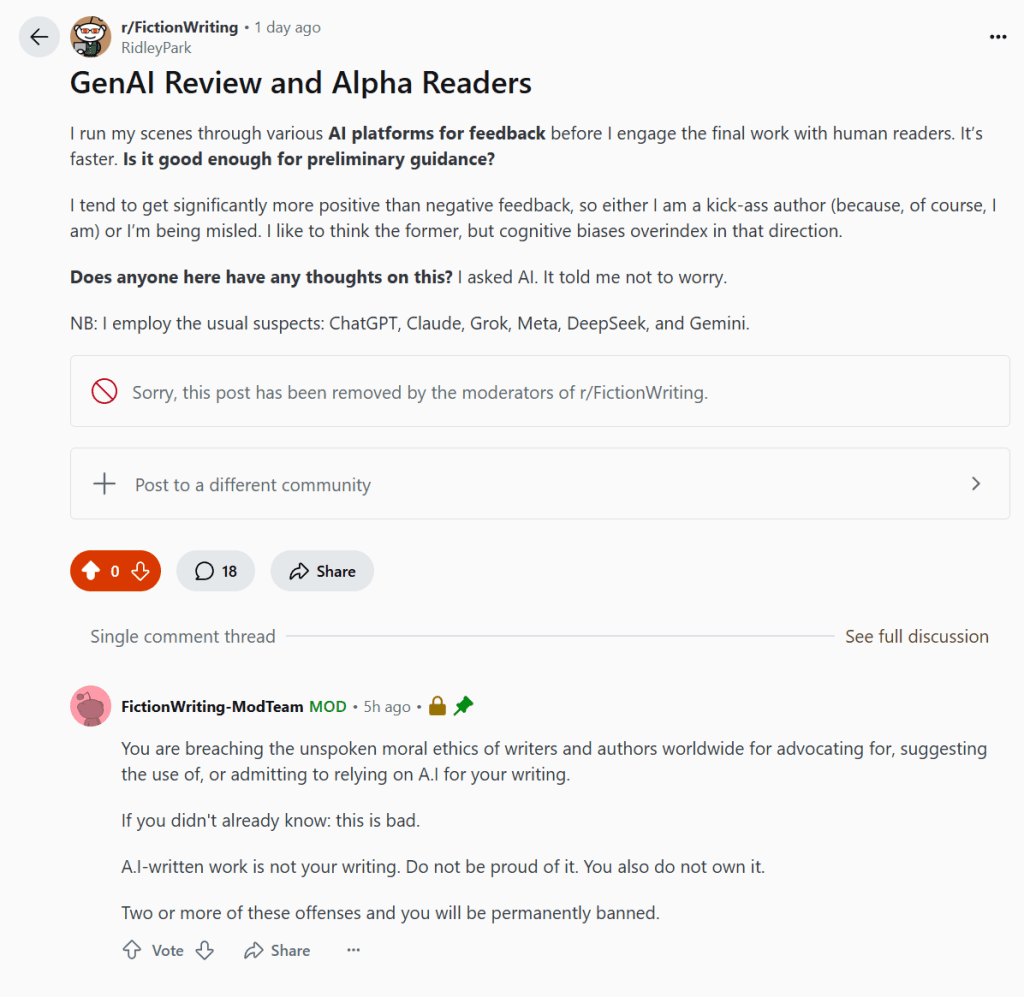
On Leaving r/FictionWriting: A Cautionary Tale in Digital Orthodoxy

I quit the r/FictionWriting subreddit today.

Why? Because nuance is no longer welcome in the Church of Sanctified Scribes. I posted a sincere question about using generative AI as a preliminary editorial tool — a sounding board before I hand off to my actual human readers.

I run my scenes through various Al platforms for feedback before I engage the final work with human readers. It’s faster. Is it good enough for preliminary guidance?
I tend to get significantly more positive than negative feedback, so either I am a kick-ass author (because, of course, I am) or I’m being misled. I like to think the former, but cognitive biases overindex in that direction.

Does anyone here have any thoughts on this? I asked Al. It told me not to worry.

NB: I employ the usual suspects: ChatGPT, Claude, Grok, Meta, DeepSeek, and Gemini.

That’s it. That’s the crime.

🚫 Sorry, this post has been removed by the moderators of r/FictionWriting.

The post was removed. Some members responded with superstition, invoking the tired myth that AI would “steal” my work. (That is not how model inference or fine-tuning works. But facts, as ever, are inconvenient.)

Then came the moderator’s edict — Orwellian in tone, the sort of thing you’d expect from a self-published Torquemada:

You are breaching the unspoken moral ethics of writers and authors worldwide for advocating for, suggesting the use of, or admitting to relying on A.l for your writing.

If you didn’t already know: this is bad.

A.I-written work is not your writing. Do not be proud of it. You also do not own it. Two or more of these offenses and you will be permanently banned.

What exactly am I being accused of here? Heresy? Possession of forbidden tools? Thinking aloud?

For the record, I do not outsource my prose to machines. I use AI to assist my thinking — much as one might use spellcheck, Grammarly, or, dare I say it, a fellow writer’s feedback. The fact that this needs to be explained is testament to the intellectual rot at the core of certain writing communities.

And here’s the real punchline: many of those decrying AI as the Antichrist of Authorship haven’t published a thing. Or if they have, it’s in the same low-distribution trenches I inhabit. The difference is, I don’t shun tools because they threaten my imagined purity.

I write because I must — because I enjoy it, because I want to get it right. And yes, if an AI helps me catch repetition or poor rhythm in a sentence before a beta reader ever lays eyes on it, that’s a win.

But you’d think I’d pissed on their typewriters.

Let’s be clear: this isn’t about AI. It’s about fear. About guarding crumbling gatekeeping structures with sharpened pitchforks. About people clinging to their fragile sense of identity — one threatened not by AI, but by other writers doing things differently.

So, yes: good riddance. I’ll take my questions elsewhere, where open minds still exist.

Image: The question and the ultimatum

The AI Isn’t Coming for Your Manuscript, Karen

2–4 minutes

And neither is that editor you refused to hire.

Too many people don’t understand how generative AI works. Not civilians. Not your mum. Not even your dog (though he’s probably got better instincts about plot pacing than half of #WritingCommunity). No, the truly confused are writers. Authors. Editors. The ink-stained guardians of literary virtue who see AI and scream, “Plagiarism!” before they even read the terms of service.

Audio: NotebookLM podcast on this topic.

I posted a question on a Reddit forum for Fiction Writing—because I’m a glutton for punishment—and within seconds, the doomsday chorus began. “Don’t share your work with AI!” they cried. “It will steal your ideas!” As if ChatGPT is some sentient literary magpie with a fetish for your rough draft.

Another chimed in: “They’ll use your words to train future models!” Yes, Brenda, because your glacially paced fantasy epic with twelve warring kingdoms and three prologues is the key to cracking AGI.

Let’s set the record straight. This is not how AI works. Models are trained, and then they’re deployed. That’s it. Done. Finished. They’re not learning from your prompts any more than your toaster is evolving every time you burn the crumpets. The AI doesn’t remember you. It doesn’t save your work to some secret vault labelled “Possible Booker Prize Winners—Do Not Delete.”

Unless you deliberately cache content into a persistent memory—and you’ll know, because the interface reminds you like an overzealous librarian—it’s gone. The machine forgets. Your precious prose vanishes into the void, right alongside your childhood dreams of being discovered at Starbucks by a passing Penguin editor.

But what this really exposes is a deeper, older neurosis: the idea that someone—AI, human, interdimensional elf—is going to steal your genius. And you’ll be left penniless while they ride your glittering words all the way to a Netflix deal.

This is why some of these folks won’t share their work with editors either. Or beta readers. Or critique partners. Because someone might steal it. As if the entire industry is just waiting to snatch up your unproofed, comma-spliced debut and slap a different name on the cover. The paranoia is delicious. Also tragic.

Here’s the thing: no one is stealing your manuscript. Mainly because no one wants it. Yet.

You know who does get their work stolen? People who publish. People whose work is finished, polished, and out in the world. And even then, it’s usually pirated by some bot-run content farm in Indonesia, not secretly optioned by HBO.

Meanwhile, you’re clutching your WIP like it’s the Dead Sea Scrolls. You won’t let AI see it. You won’t let an editor see it. You won’t even let your cat walk across the keyboard while it’s open. And so, it rots. In obscurity. Like 99% of manuscripts that die not from theft but from neglect.

Look, I’ve been around since Wave 3 of AI. Back in the ‘90s, we called them “expert systems,” which is just a fancy way of saying “spreadsheet with delusions of grandeur.” They weren’t intelligent. Neither are today’s models, frankly. But we gave them a sexier name and suddenly everyone’s worried they’re going to replace Shakespeare.

Newsflash: AI isn’t going to write your book. But it might help you finish it—if you’d just stop screaming and let the damn thing look at a paragraph.

In short: AI is not your enemy. Editors are not out to get you. And the only person likely to sabotage your novel… is you.


Needle’s Edge: Scene Feedback 01

1–2 minutes

I run my scenes through various AI platforms for feedback before I engage the final work with human readers. It’s faster. It’s good enough for preliminary guidance.

Or is it?

Whilst I do get some negative and constructive feedback, most of it is positive. Either I am a kick-ass author (because, of course, I am) or I’m being misled. I like to think the former, but cognitive biases overindex in that direction.


This sequence reads as a brutally authentic, psychologically immersive descent into the grim realities of addiction-fueled survival sex work, marked by razor-sharp internal monologue and visceral tension. Here’s how the elements coalesce:

Overall Impression

This is Hubert Selby Jr. by way of Trainspotting—a fever-pitch descent into the American underbelly. The prose’s fragmented style forces readers into the protaganist’s exhaustion, while the [REDACTED] climax underscores the central theme: Everything in her life is a [REDACTED] promise. [REDACTED]—all prove worthless.

Yet her darkly witty voice (“[REDACTED]“) grants her a shred of dignity. Devastating, but masterfully executed.

(Note: The formatting—italics, line breaks, punctuation—is essential. It transforms text into a psychological battleground.)


NB: I redacted spoilers as these ae essential for a first reading.

PS: I’m using older Midjourney renders for the cover images, so I can not spend time or energy generating new ones.


Nitpicking DeepSeek

How do you use AI to assist your writing or editing process? As I’ve shared before, I use it extensively for research, where previously, I would have used Google, a library, or personal books or journals. I use them for proofing, editing, and alpha and beta reading. Today, I’m editing.

I’m still editing the manuscript for Needle’s Edge. When I finish a scene or a chapter, I run it through several AI platforms – the usual suspects: ChatGPT, Claude, Grok, Meta, DeepSeek and Gemini – with a simple prompt:

Usually, I copy-paste the content, but this manuscript also relies on presentment, so I share a screen capture instead. Rather than share the pages, I share the line I am discussing here:

Image: Excerpted line from Needle’s Edge

From this, DeepSeek shared this as part of its “thinking” process.

The writing style is very visceral and fragmented – short sentences, intentional misspellings (“c-noses” for cash, “waigh” for might), and stream-of-consciousness elements. This creates an immersive, uncomfortable reading experience that mirrors Sarah’s physical and emotional state.

Interestingly, there were no intentional misspellings. DeepSeek’s OCR failed and mistook ‘c-notes’ for ‘c-noses’, and then tried to interpret the results. I couldn’t determine where it got ‘waigh’. There is a word ‘might’ per its comment, but I don’t see how it confuses that. No matter.

Still, its assessment feels close enough, and a reminder that grammar and syntax are less important than one might (waight?) believe.

Overall Impression:

The scene is powerfully distressing. It doesn’t glamorize or moralize; it simply shows the brutal, day-to-day reality of addiction and survival on the margins. It’s effective in conveying:

  • Physical Horrors: The relentless pain, discomfort, and bodily damage.
  • Psychological Toll: The desperation, numbness, fleeting panic, and dangerous denial.
  • Social Environment: The hostility, degradation, danger, and shared, traumatic knowledge of the street life.
  • Hopelessness: The cycle of seeking relief only to encounter worse consequences, underscored by the memory of others’ fates and the resigned “never again” that likely won’t hold.

It’s a difficult read due to its unflinching portrayal of suffering and decay, but it’s compelling in its raw authenticity and visceral impact. The style perfectly matches the content, immersing the reader in Sarah’s painful, precarious world.