This is as much a reminder for me as a PSA. Time is the most limited resource you’ve got.
Consider your goals, and plan accordingly. Not everyone has concrete goals. As writers, we likely do. Finish that sentence, that page, that chapter, that draft, those edits, that book…
There’s social media – that’s this place – video games, partying, family and mates, eating and sleeping. Whatevs.
And don’t forget to take care of your mental health.
You may have many goals – or just one or two. Consider opportunity costs.
This blog post is distracting me from my editing. Still, I want to share. maybe it will help you.
Perspective is key.
Define your goals. Prioritise them. Make it happen.
Editing Needle’s Edge has taken longer than the time it took to draft the damned thing. Typical, I suppose, but demoralising all the same. Drafting is a rush; editing is a grind. In video game parlance, this is the endless dungeon crawl. Kill the same mob again and again, collect marginal XP, and hope that –eventually – you level up.
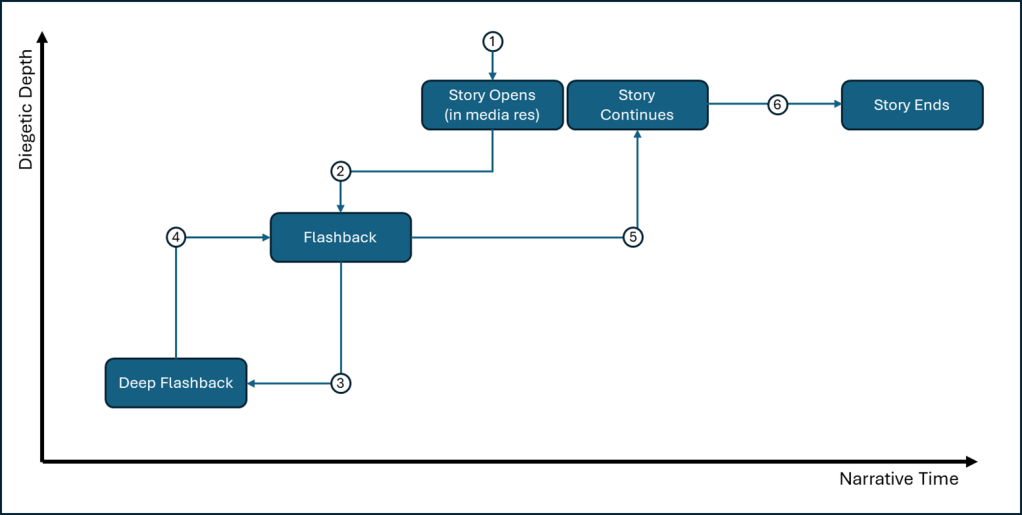
Recently, I wrestled with the narrative structure, which was starting to feel like Inception with a side order of Russian dolls. Flashbacks within flashbacks within flashbacks. I diagrammed it, mostly to convince myself I hadn’t lost the plot (see exhibit A, below).
Image: Chronological and Sequential Timeline Abstraction
Here’s the lay of the land—without spoilers, of course. The story begins [1] in medias res, with Sarah-slash-Stacey already entrenched in her daily grind. Then comes [2] the flashback, showing how she arrived there. Midway through, we plunge into [3] a deep flashback of her childhood, before [4] snapping back to the mid-flashback, then finally [5] rejoining the present-day storyline until [6] the bitter – or possibly bittersweet – end.
Naturally, I subvert as many tropes as I can, though no one can write a tropeless story any more than they can write one without words. (I’m sure some post-structuralist is trying right now, but God help their readers.)
The hardest part wasn’t constructing the labyrinth but finding my way out again – reengaging with the present-day thread after chapters of detour without resorting to that televisual clanger: “We now return to our regularly scheduled programming.”
Editing a book like this is less polishing and more archeology: chiselling away sediment, brushing off centuries of dust, desperately hoping not to snap the artefact in half. With luck, the grind pays off. If not, at least I’ll have a lovely flowchart to show for it.
Fresh from my recent post on movies that are better than books, I now consider books and movies with symbiotic or synergistic energy – better together.
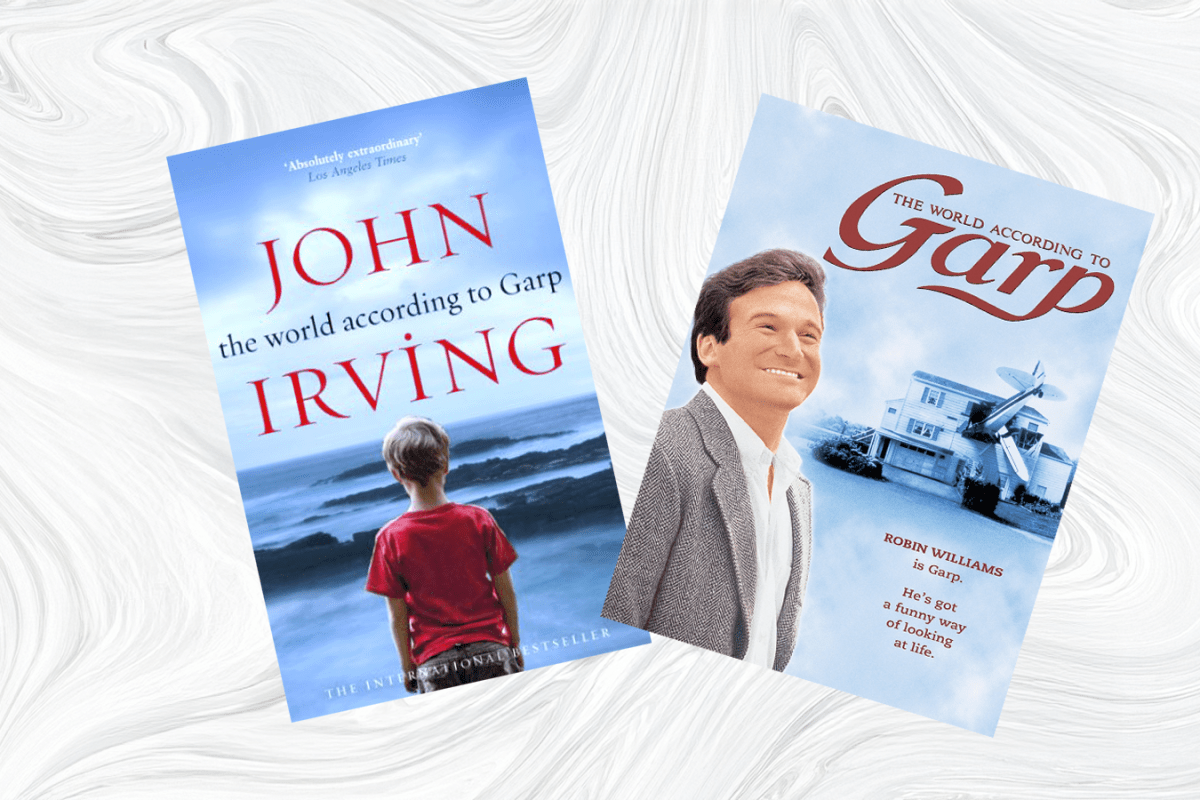
I first stumbled onto this realisation with The World According to Garp. Hearing that the film was about to be released, I bought the book; it was decent. I saw the movie when it came out; it was decent.
The book (John Irving, 1978) is sprawling, grotesque, and digressive, with moments of brilliance scattered through longueurs.
The film (1982), with Robin Williams and Glenn Close, trims away nuance for two hours of cinematic shorthand.
Alone, each feels middling. Together, they fill the gaps. The novel provides texture and detail; the film provides embodiment and immediacy. It’s like puzzle pieces snapping together.
We tend to frame it as a duel: book versus movie, page versus screen. One must be superior, the other a pale imitation. But occasionally, the two work in tandem, not rivals, but co-conspirators. Taken alone, each may be “just okay.” Together, they form a whole greater than their parts. Notice that the IMDB scores are lower for movies that are better than books, due to the synergistic effects.
Disclaimer: I didn’t like these uniformly, but my thesis still holds. Moreover, film is not typically my preferred medium.
Here are a few other book–film pairings that work this way:
McEwan’s metafictional games on the page feel cerebral. Wright’s film, with its Dunkirk tracking shot and that infamous green dress, floods the senses. Together they fuse thought and feeling.
Proulx’s prose is spare, devastating in its restraint. Ang Lee’s film opens the silences into landscape and longing. Neither feels whole without the other.
Mitchell’s Russian-doll narratives dazzle but drag; the Wachowskis’ intercutting dazzles but confuses. Together they hint at the ambition neither medium alone quite nails.
I publicly confess that I didn’t really like either version of Cloud Atlas. A mate suggested I read the book ahead of the film. It was convoluted and mid. Ditto for the film, but for different reasons. I felt that the concept was nice; it simply didn’t translate. YMMV.
Golding’s allegory sometimes feels over-determined. Brook’s film, shot with actual boys descending into ferality, restores the anthropology behind the allegory.
IMDB Rating: 6.9/10
Why Symbiosis Matters
When book and film complete one another, it challenges the false binary of better or worse. Sometimes, the text supplies what the film cannot: detail, psychology, interior voice. Sometimes the film supplies what the text cannot: embodiment, atmosphere, a world you can see.
Instead of competition, the relationship becomes conversation.
So perhaps the real question isn’t “Which is better?” but “Which needs the other to feel complete?”
What pairings have you found where book and film together elevate each other beyond what either could manage alone?
I recently watched two movies. The book The Children of Men was published by P.D. James in 1992, and the movie was adapted by Alfonso Cuarón in 2006; Filth was written by Irvine Welsh in 1998 and adapted for film by Jon S. Baird in 2013.
Upon watching Children of Men, I came away feeling that the movie was better than the book – at least it resonated more to my liking. A person with other sensibilities may prefer the other. Taste is never universal. I understand that some people can actually eat seafood.
Audio: NotebookLM podcast on this topic.
The book Filth was more typical in that it was better than the movie, although the movie was interesting in its own right; it still paled in comparison. I also found Trainspotting – another Irvine Welsh story – to be a good movie, but it still doesn’t quite live up to the book.
So where am I going with this?
I decided to consider what movies surpassed their source material. I chatted it up with several colleagues and came up with a short list of titles I suspect many have already encountered at least one or the other. I’ll mention where I disagree with the consensus position.
Here’s my rogue’s gallery of films that managed the rare trick of outshining their ink-and-paper parents. Note that this doesn’t represent the order of importance. It is sorted by IMDB film rating as of today.
Stephen King’s novella Rita Hayworth and Shawshank Redemption is solid, but Darabont turns it into a near-religious fable of hope, anchored by Tim Robbins and Morgan Freeman.
Mario Puzo’s novel is pulpy, uneven, and bogged down with subplots; e.g., a chapter on vaginal surgery, no joke. Francis Ford Coppola elevates it into a Shakespearean tragedy.
Chuck Palahniuk’s Fight Club is culty fun, but Fincher sharpens it into a pop-culture grenade – stylistically explosive and endlessly quoted.
IMDB Rating: 8.8/10
One Flew Over the Cuckoo’s Nest (Book: 1962; Film: 1975)
Ken Kesey’s novel One Flew Over the Cuckoo’s Nest is beloved but limited by its narrator’s hallucinations. Milos Forman widens the lens, gives Nicholson free rein, and makes Louise Fletcher’s Nurse Ratched iconic.
Robert Bloch’s Psycho is a tidy pulp thriller. Hitchcock elevates it to a cultural earthquake: the shower scene, mother’s voice, the birth of the modern slasher film.
Stephen King hated Kubrick’s icy interpretation, but cinephiles generally rank the film higher for its visual dread and Nicholson’s unhinged performance.
Inspired by Joseph Conrad’s Heart of Darkness. Conrad’s novella is foundational but slight. Coppola transposes it to Vietnam and creates an operatic nightmare of war.
Apocalypse Now is the consensus masterpiece, and I’ll grant Coppola his fever-dream credentials. But here’s where I part ways with the choir: strip away the meta-theme and you’re left with a bloated war movie that mistakes endurance for profundity.
Upton Sinclair’s socialist novel Oil! is didactic and sprawling. Paul Thomas Anderson cherry-picks a few ideas and creates a volcanic character study of greed and obsession.
Philip K. Dick’s Do Androids Dream of Electric Sheep?is clever but meandering; Ridley Scott builds a visual and philosophical cathedral around identity, memory, and humanity.
Stephen King’s second entry, novella The Body, is a touching coming-of-age tale, but Reiner’s adaptation injects nostalgia, pathos, and one of the best ensemble casts of the ’80s.
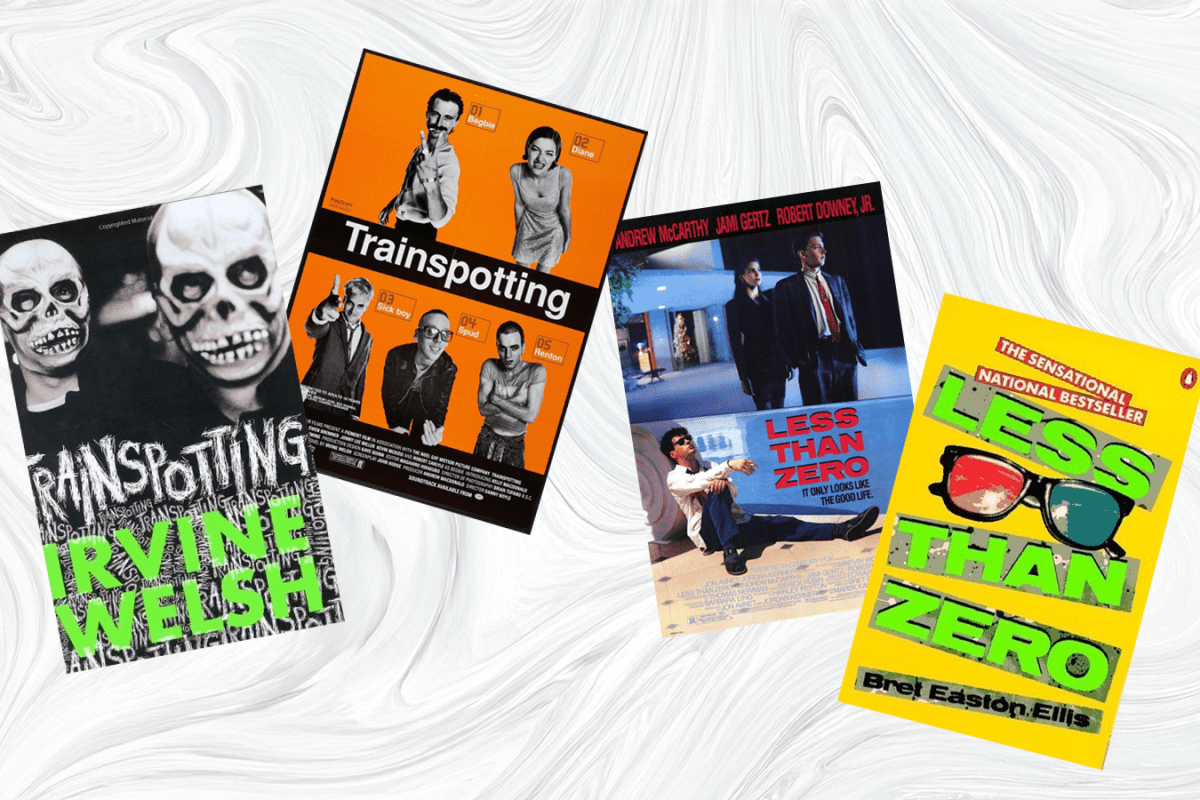
Film has an extraordinary talent for turning jagged, difficult novels into cultural smoothies. Hand Hollywood a text about drugs, despair, and the grotesque collapse of youth, and it will hand you back something fit for a date night. Less Than Zero was gutted. Trainspotting was diluted. Both survived, after a fashion, but only one crawled back out with its bones still rattling.
Audio: NotebookLM podcast on this topic.
Ellis’s Less Than Zero was a flatline pulse of Californian ennui, a catalogue of hollow gestures in which the children of wealth consume themselves into oblivion. The backdrop was Reaganism in full bloom—an America drunk on consumerism, cocaine, and the fantasy of eternal prosperity. The kids in Ellis’s Los Angeles aren’t rebelling; they’re marinating in the very ideology that produced them. The film, by contrast, became a tepid morality play, complete with Robert Downey Jr.’s photogenic martyrdom. The void was swapped for a sermon: drugs are bad, lessons have been learned, and the Reaganite dream remains intact.
Welsh’s Trainspotting was messier, darker, harder to pasteurise. His junkies live in Thatcher’s Britain, where industry has collapsed, communities have rotted, and heroin fills the crater where meaningful work and social support once stood. Addiction is not just chemical but political: it is Thatcher’s neoliberalism rendered in track marks. Boyle’s film kept the faeces, the dead baby, the violence—but also imposed coherence, Renton as protagonist, a redemption arc, and that chirpy “Choose Life” coda. Welsh’s episodic chaos was welded into a three-act rave, all set to Underworld and Iggy Pop. Diluted, yes, but in a way that worked: a cocktail still intoxicating, even if the glass had been sanitised.
And yet, here’s the perennial fraud: drug films always get high wrong. No matter how grim the setting, the “junkie experience” is rendered as theatre, actors impersonating a template someone else once performed badly. The reality of heroin use is crushingly dull: twenty minutes of near-unconsciousness, slack faces, dead time. But you can’t sell tickets to drool and silence. So we get Baudrillard’s simulacrum: a copy of a copy of an inaccurate performance, dressed up as reality. McGregor’s manic sprint to “Born Slippy.” Downey’s trembling collapse. Junkies who look good on screen, because audiences demand their squalor to be cinematic.
And here’s where readers outpace viewers. Readers don’t need their despair blended smooth. They can sit with a text for days, grappling with jagged syntax, bleak repetitions, and moral vacuums. Viewers get two hours, max, and the thing must be purréd into something digestible. Of course, not all books are intellectual, and not all films are pap. But the balance is clear: readers wrestle, viewers swallow. One is jagged nourishment, the other pasteurised baby food.
So Less Than Zero becomes a sermon that spares Reagan’s dream, Trainspotting becomes a rave-poster that softens Thatcher’s wreckage, and audiences leave the cinema convinced they’ve glimpsed the underbelly. What they’ve really consumed is a sanitised simulation, safe for bourgeois digestion. The true addict, the tedious, unconscious ruin of the body, is nowhere to be found, because no audience wants that reality. They want the thrill of transgression without the boredom of truth.
And that, finally, is the trick: cinema gives you Reagan’s children and Thatcher’s lost boys, but only after they’ve been scrubbed clean and made photogenic. Literature showed us the rot; film sells us the simulacrum. Choose Life, indeed.
Congratulations, you’ve finished a manuscript. You’ve pushed the boulder uphill, typed “The End,” and maybe even convinced yourself you’re done. Spoiler: you’re not. This is where beta readers come in — those kind souls who’ll slog through your draft and tell you whether it sings, stumbles, or just sits there like porridge. The trouble is, most writers don’t actually know what to ask them, and so they end up with feedback about as useful as a horoscope.
The first and most uncomfortable question is about intent. What are my goals in writing this, and did you see them? Most writers never ask, because it forces them to say what they meant in the first place. Are you interrogating free will? Trying to write a page-turner? Smuggling philosophy under the hood of a dystopian thriller? If your beta doesn’t see it, either you buried it too deep or you didn’t put it in at all. Of course, not every writer works with some grand meta in mind, but if you do, this is the question that makes or breaks the project.
If your story feels like homework, you’ve already lost.
Enjoyment comes next, even if it bruises the ego. Did they actually like reading it? If your story feels like homework, you’ve already lost. It’s better to know this from a sympathetic reader now than from Goodreads later. A related angle is pacing: where did the story drag? Readers know exactly where they reached for their phone, even if they’re too polite to say so without prompting. Ask them to point to the spots where the air went out of the room.
Did the conclusion feel like it belonged to the story’s own logic?
Characters are another litmus test. Which ones did they care about, and which ones left them cold? Writers are often too close to notice when a protagonist reads like cardboard, or when a side character steals the oxygen. Beta readers are your lab rats here, revealing who’s magnetic and who’s forgettable. The same goes for endings. Don’t ask if it was happy – ask if it was satisfying. Did the conclusion feel like it belonged to the story’s own logic? If the reader feels cheated, the manuscript isn’t finished.
World-building deserves its own interrogation, especially in speculative fiction. Readers will happily forgive dragons, AI dictators, or interstellar chalk drawings, but not inconsistency. If the rules of your world shift without reason, they’ll notice. In fact, coherence is more important than cleverness. The reader doesn’t need to understand every mechanism, but they do need to trust that you do.
Was there an image, a phrase, a scene that stayed with them once the book was closed?
Finally, ask what lingered afterwards. Was there an image, a phrase, a scene that stayed with them once the book was closed? That’s your gold. Double down on it. If nothing sticks, you’ve got polishing to do.
One last but often overlooked question is about the reader themselves: am I asking the right person? An excellent sci-fi enthusiast might not be your best pick for YA urban fiction. A romance aficionado won’t necessarily grasp the rhythms of a philosophy-laden dystopia. Fit matters. You wouldn’t ask a vegan to taste-test your steakhouse menu, so don’t ask the wrong reader to bless your book.
Am I asking the right person?
And here’s the tightrope for the beta reader: they are not there to tell you the book they would have written. Their job is to respond to the book you actually put on the page. It’s your manuscript, not a co-authorship audition. If their feedback starts with “what I would have done,” that’s not critique – that’s a rewrite.
The meta point is simple. Beta readers are not editors. They aren’t there to fix your commas or restructure your second act. Their value is in telling you what it feels like to read your book – hot, cold, flat, or electric. And if you’ve got a grand philosophical undercurrent humming beneath the surface, they’re the only ones who can tell you whether it came across.
Beta readers are not editors.
So don’t hand your beta readers a scalpel and ask them to perform surgery. Hand them your story and ask: did you taste what I meant to cook?
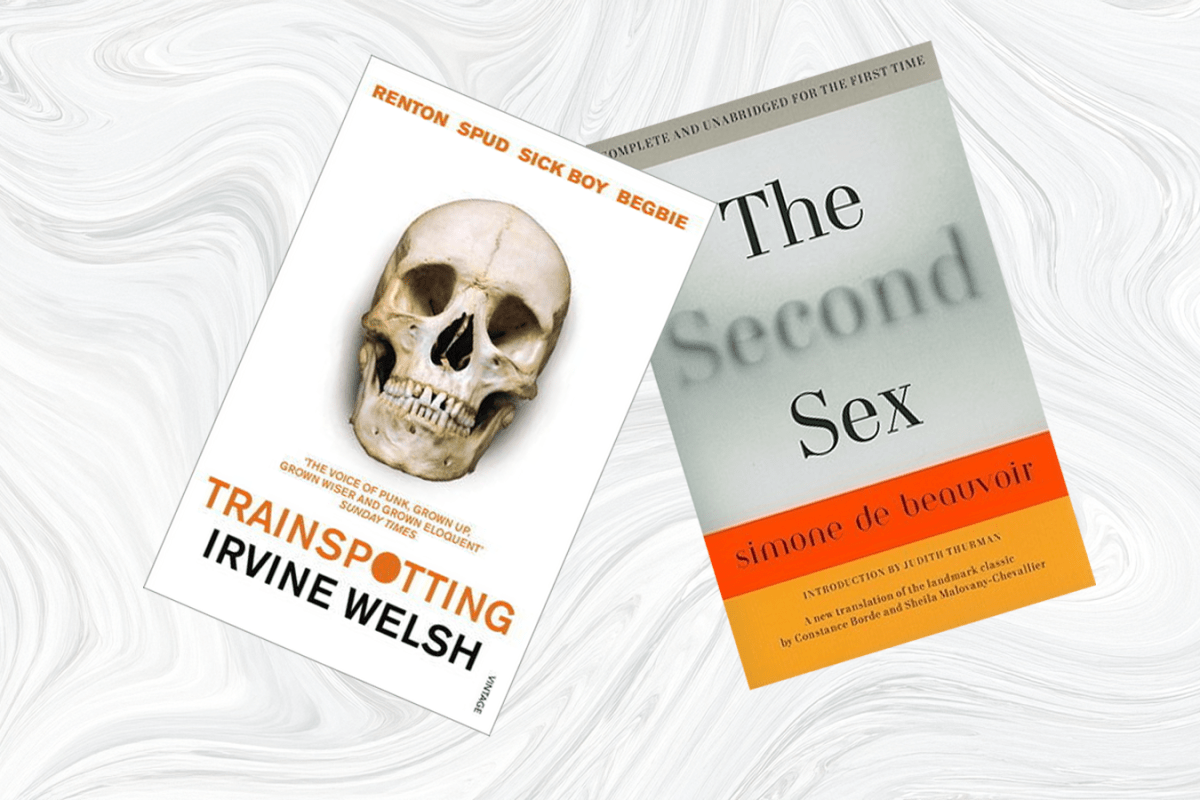
I’ve just finished Simone de Beauvoir’s The Second Sex – all 800 pages of it – and have now started Irvine Welsh’s Trainspotting. Both are classics in their own way. I’ll review Second Sex properly on my Philosophics Blog, but here I want to think about Trainspotting in relation to my current manuscript, Needle’s Edge.
Interestingly, Trainspotting was a ChatGPT recommendation. I fed in my draft of Needle’s Edge and this was one of the books it said my work resembled. Two chapters in, I see the connexion. First, the subject matter – drugs and addiction. Second, the rawness of the experience.
There are differences, of course. Trainspotting is rooted in Leith, Scotland; Needle’s Edge belongs to the East Coast of the United States – Delaware and Philadelphia. Welsh draws heavily on dialect and vernacular, with a narrative voice that’s linguistically dense and aurally charged. In Needle’s Edge, the style is pared down. Sentence fragments, middle dots instead of full stops, and an intentional “lower” register mirror the protagonist’s fractured perception and limited resources.
That gap in register creates a different authorial challenge. With every edit pass, I find myself policing intrusions of my vocabulary into her voice. Welsh, by contrast, can deploy a broader lexicon and trust the dialectal texture to keep it authentic. Listening to Trainspotting, I’m struck by how words and turns of phrase leap out – sometimes apt for Needle’s Edge, but often just a shade too polished for Stacey’s world.
Both texts orbit around environments that resist glamour. Welsh’s squat flats and pubs are grimy and feral; Needle’s Edge’s motel rooms and sidewalks are littered with fast-food wrappers, orange caps, and fading unicorn posters. Addiction erodes bodies in both stories, but the textures differ – Scotland’s industrial gray versus the East Coast’s cheap motels and suburban detritus.
As for the film version of Trainspotting, I saw it long ago and remember almost nothing. The novel isn’t refreshing my memory either; it feels like a separate creature altogether. Which is fitting: both Trainspotting and Needle’s Edge are less about plot than about capturing a lived texture, a rhythm of voices and environments that mainstream narratives usually discard.
Story ideas come from everywhere. Sometimes from books, sometimes from overheard conversations, sometimes from the dubious cesspool of internet memes. The meme I saw claimed that male flatworms duel with their penises to determine which one gets saddled with pregnancy. Naturally, I thought: That’s a story seed if ever I’ve seen one. Biomimicry is also a viable source.
Audio: NotebookLM podcast on this topic.
Of course, the meme was wrong. Flatworms aren’t male, or female. They’re simultaneous hermaphrodites – every worm is kitted out with sperm factories and egg sacs, with duelling penises to boot. When two meet, they fence. Whoever lands the stab injects sperm through the other’s skin (hypodermic insemination, to use the clinical term). The “winner” struts away as father, the “loser” absorbs the sperm, becomes mother, and carries the eggs. Sometimes both stab each other, and both walk away victorious fathers and reluctant mothers. Equality at last.
This is not genre fantasy, it’s zoology. No X or Y chromosomes, no fixed roles, just biology as a knife fight.
Writers, take note: this is why you don’t trust memes as science, but you do trust them as inspiration. The error – “male flatworms” – was pedestrian. The truth – all flatworms are both sexes all the time – is far more subversive. It blows up the binary and replaces it with a contest. Parenthood isn’t destiny, it’s a duel.
If I were to anthropomorphise this, I’d have the makings of a gladiator society: wounds as wombs, motherhood as punishment, fatherhood as prize. Not homoerotic vampire tropes, not vagina dentata horror – something stranger, sharper, harder to tame. A kind of Spartacus with gonads.
The point isn’t whether I’ll write it (probably not; worms don’t sell). The point is that even bad science can spark good fiction, provided you bother to check the details before running to press. Let the meme start the fire, let the facts shape the flame.
See Also (for the bookish wormhole explorer):
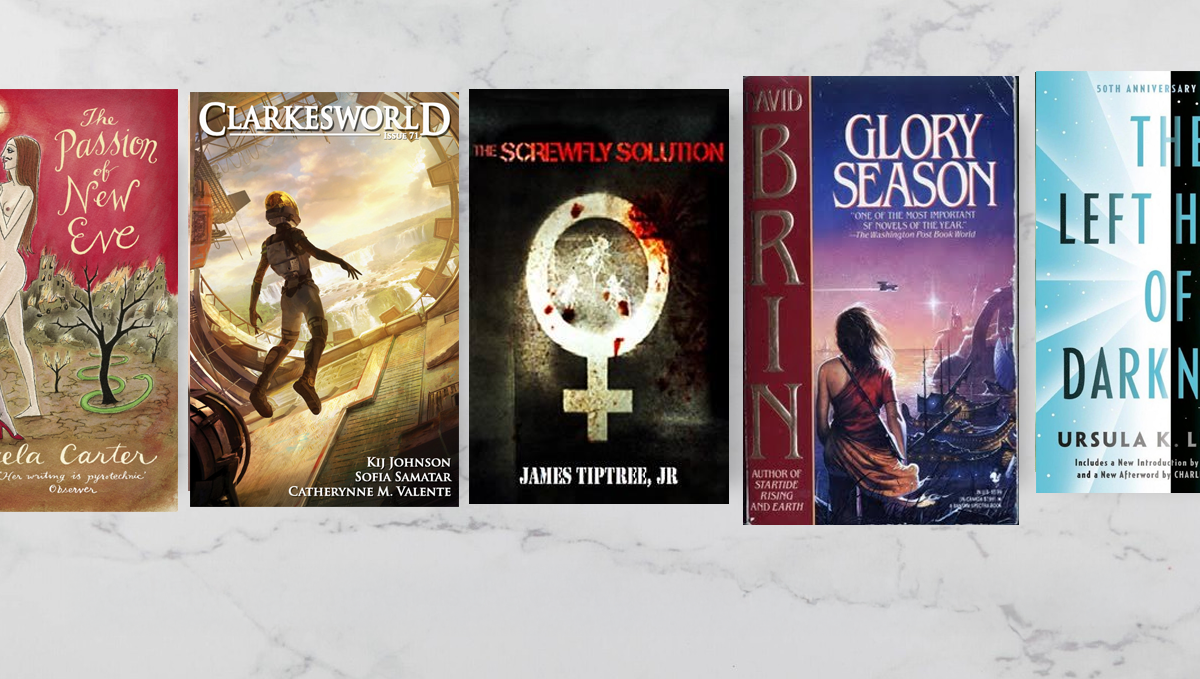
David Brin, Glory Season: speculative reproductive politics, society structured by cloning and sexual cycles.
Ursula K. Le Guin, The Left Hand of Darkness: androgynous Gethenians shifting between fatherhood and motherhood.
Kij Johnson, Mantis Wives (short story): erotic horror inspired by mantis cannibalism, equal parts Kama Sutra and war crime.
Angela Carter, The Passion of New Eve: grotesque gender-bending satire, bodies rewritten as battlegrounds.
Zach Cregger wrote Weapons. He also directed it, produced it, and composed the soundtrack. This blog is about writing, so let’s stay with that. In a recent interview with Perri Nemiroff at Fandango, he described how the story emerged almost by accident:
Video: Perri Nemiroff Interviews Cast and Director of Weapons
Perri asks Zach how he got the idea for the story:
I didn’t have an idea for the movie when I started writing
— Zach Cregger
I was like, “Okay, little girl telling a story— takes place at a school. Kids go to school. Follow a teacher. Class is empty. Why? I don’t know. Let’s find out.”
And then two sentences later – because the kids all ran out the night before.
Okay, that’s a hook I like. So, I knew… I have a good question. So then, I probably wrote 50 pages before I even knew what the answer was going to be, honestly.
So, you know, I got the teacher, I got the angry dad, and they’re kind of doing their cat and mouse sort of a thing, and then… I got this cop, and… it wasn’t until about the midpoint where I had… what it was.
And that was a really good moment for me because I was like, “This might not ever be a thing. I might not have anything here.”
You know, if I don’t have a good answer, there’s no reason to watch this movie.
That’s pantsing in its purest form — starting with a question and running fifty pages before you even know if there’s an answer. Discovery writing at its most precarious: equal parts exhilaration and existential dread.
Personally, I lean hybrid. Sometimes I pants a draft until it coughs up a structure; other times I start with scaffolding and let the innards misbehave. But the dead ends always loom. I’ve euthanised countless ideas that failed to evolve, rather than stitching them together with some lazy deus ex contrivance. (Television thrives on that sort of duct-taped plotting, which is precisely why I don’t bother with it.)
Anyway, I have not seen this movie. I am not a fan of horror, but every now and then I sample what’s out there. I might check this out to see how well it delivers.
Critics never tire of reminding us that AI has no emotions, as though this were some startling revelation. Next, perhaps, they’ll inform us that penguins can’t fly and that bankers are allergic to honesty. Yes, generative AI has no emotions. But must we wheel in the fainting couches? Writers don’t need it to sob into its silicon sleeve.
Full disclosure: I am a writer who writes fiction and non-fiction alike. I am also a language philosopher; I study language. And a technologist. I’ve been working with artificial intelligence since the early ’90s with Wave 3 – expert systems. I am still involved with our current incarnation, Wave 4 – generative AI. I know that artificial intelligence has no intelligence. I also know that intelligence is ill-defined and contains metaphysical claims, so there’s that…
Meantime, let’s stroll, briskly, through three ghosts of philosophy: Saussure, Wittgenstein, and Derrida.
Audio: NotebookLM podcast on this topic.
Saussure and the Tree That Isn’t There
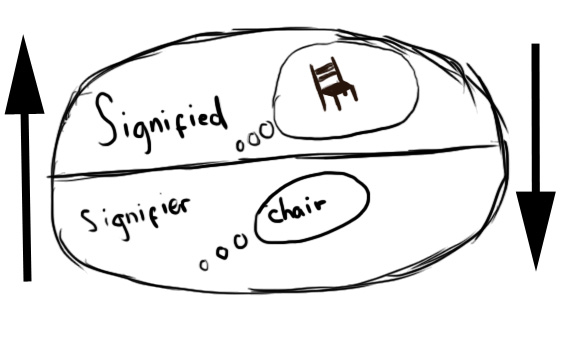
Ferdinand de Saussure gave us the tidy structuralist package: the signified (the thing itself, say, a tree) and the signifier (the sound, the squiggle, the utterance “tree,” “arbre,” “árbol”). Lovely when we’re talking about branches and bark. Less useful when we stray into abstractions—justice, freedom, love—the slippery things that dissolve under scrutiny.
Image: Saussure’s Signified and Signifiers
Still, Saussure’s model gets us so far. AI has consumed entire forests of texts and images. It “knows” trees in the sense that it can output something you and I would recognise as one. Does it see trees when it dreams? Do Androids Dream of Electric Sheep? Of course not. But neither do you when you define one.
René Magritte‘s famous painting reminds us that the reference is not the object.
Image: Magritte’s Ceci n’est pas une pipe (This is not a pipe)
Wittgenstein and the Dictionary Without a Key
Ludwig Wittgenstein, that glorious thorn, tore the Saussurean comfort blanket to shreds. Words, he said, are not tethered to the world with neat strings. They define themselves by what they are not. A tree is a tree because it is not a cow, a kettle, or an Aston Martin.
Image: Tree, isolated
Take a dictionary entry:
tree /trē/ noun a woody perennial plant, typically having a single stem or trunk growing to a considerable height and bearing lateral branches at some distance from the ground.
What’s woody? What’s perennial? If you already speak English, you nod along. If you’re an alien with no prior knowledge, you’ve learned nothing. Dictionaries are tautological loops; words point only to more words. If you want to play along in another language, here’s a Russian equivalent.
дерево /derevo/ существительное древесное многолетнее растение, обычно имеющее один стебель или ствол, растущий до значительной высоты и несущее боковые ветви на некотором расстоянии от земли.
AI, like Wittgenstein’s alien, sits inside the loop. It never “sees” a tree but recognises the patterns of description. And this is enough. Give it your prompt, and it dutifully produces something we humans identify as a tree. Not your tree, not my tree, but plausibly treelike. Which is, incidentally, all any of us ever manage with language.
Derrida, Difference, and Emotional Overtones
Enter Jacques Derrida with his deconstructive wrecking ball. Language, he reminds us, privileges pairs—male/female, black/white—where one term lords it over the other. These pairs carry emotional weight: power, hierarchy, exclusion. The charge isn’t in the bark of the word, but in the cultural forest around it.
AI doesn’t “feel” the weight of male over female, but it registers that Tolstoy, Austen, Baldwin, Beauvoir, or Butler did. And it can reproduce the linguistic trace of that imbalance. Which is precisely what writers do: not transmit private emotion, but arrange words that conjure emotion in readers.
On Reading Without Tears
I recently stumbled on the claim that AI cannot “read.” Merriam-Webster defines reading as “to receive or take in the sense of (letters, symbols, etc.), especially by sight or touch.” AI most certainly does this—just not with eyeballs. To deny it the label is to engage in etymological protectionism, a petty nationalism of words.
The Point Writers Keep Missing
Here is the uncomfortable truth: when you write, your own emotions are irrelevant. You may weep over the keyboard like a tragic Byronic hero, but the reader may shrug. Or worse, laugh. Writing is not a syringe injecting your feelings into another’s bloodstream. It is a conjuring act with language.
AI can conjure. It has read Tolstoy, Ishiguro, Morrison, Murakami. It knows how words relate, exclude, and resonate. If it reproduces emotional cadence, that is all that matters. The question is not whether it feels but whether you, the reader, do.
So yes, AI has no emotions. Neither does your dictionary. And yet both will continue to outlast your heartbreak.








 Ridley Park