Propensity Kindle Promotion – Limited-Time Offer

1–2 minutes

Propensity has always been available for free with KindleUnlimited. For the first time ever, Propensity will be free for all available markets between 12 and 16 December 2025. Limited-time offer. Not sure how this operates across time zones. Download it sooner than later so you don’t miss the opportunity.

Propensity is also available in hardcover and paperback, as well as an audiobook. Scroll down to listen to chapter 1.

Also available at Barnes & Noble, if that’s your preference – hardcover and paperback.

I’m offering Propensity in the hope of getting some reviews and comments, whether here or on the site of purchase. Goodreads reviews are nice, too. You can be the first.

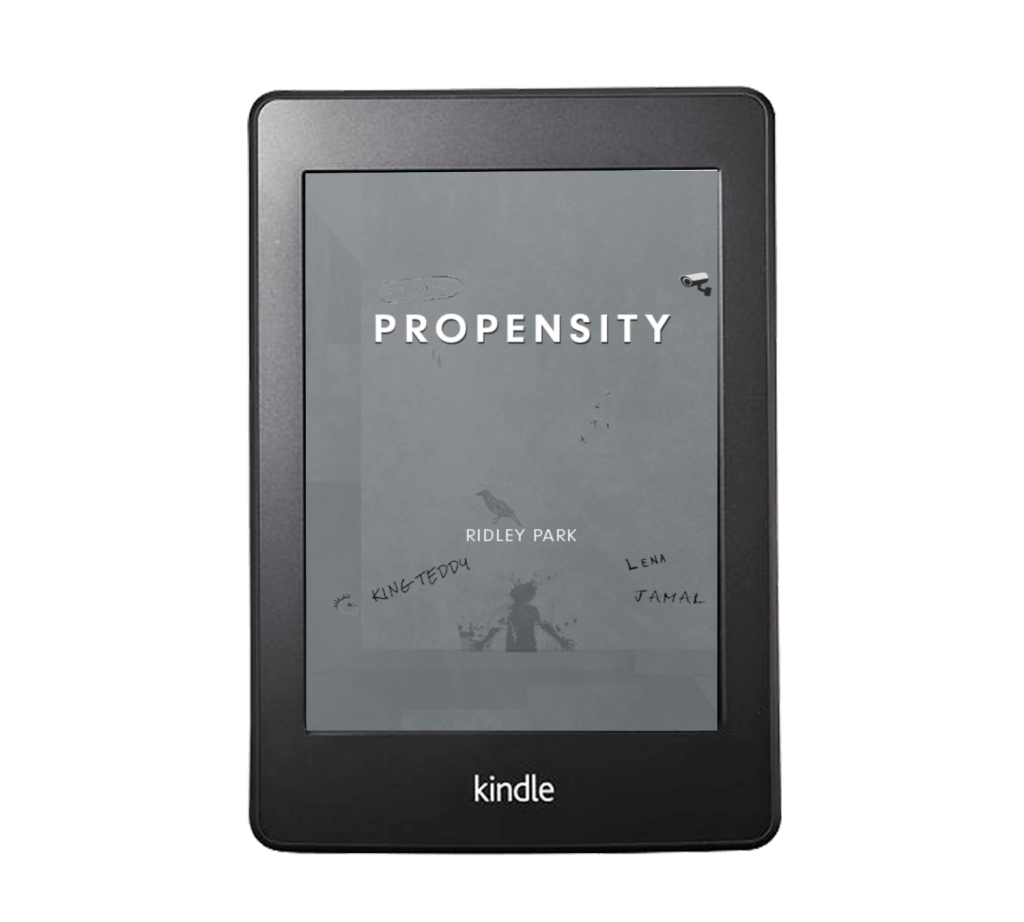
Image: Mockup of Propensity in a Kindle reader frame

Propensity is a story in three sections: Implementation, Drift, and Entropic. Google Gemini summarised each section; NotebookLM summarised those. Listen below.

Audio: NotebookLM podcast summary of Section I: Implementation
Audio: NotebookLM podcast summary of Section II: Drift
Audio: NotebookLM podcast summary of Section III: Entropic

A thematic trailer for Section I is also available. I hope to make more.

Video: 37-second Propensity Trailer – Act I

Audiobook: Propensity Excerpt: Section I – Implementation, Chapter 1: Calibration

Have any more questions? Visit the dedicated product page.

I feel I’ve stuffed this page, so it’s time to go.

Propensity – Video Trailer 1

Video: 37-second Propensity trailer.

I’ve finally given Propensity a trailer.
This short piece captures the first of the novel’s three movements – the ‘scientific’ phase, when everything still believes it’s under control. Except for this cover image, I used no AI. Except for the book covers, all assets – video clips and soundtrack – came from Motion Array

There may be another to follow, drawn from the second section, where control begins to crack. For now, consider this a visual prelude: thirty-two seconds of atmosphere, code, and quiet collapse.

Propensity is available in print and eBook in the usual places – online or at your local bookseller.

Also available as an audiobook. Listen to this sample on Spotify.

Thoughts on Solaris

I finished reading Lem’s Solaris and then was notified of a discussion about the book and the film adaptations.

I intended to draft a book review, but I may defer.

For now, I’ll note that the similarities between this and my own work are superficial. Both have philosophical perspectives, but Lem’s is much more psychological. This is nice, but it’s not where I tend to take things, and not so overtly.

What’s With the Violet Aliens?

🛸 A Closer Look at the Cover of Sustenance

👽 People ask me: What’s with the aliens on the front cover of Sustenance?
Fair enough. Let’s talk about it.

Sustenance is set in Iowa – real, dusty, soybean-and-corn Iowa. I’ve spent months there. I’ve lived in the Midwest (including Chicago) for over a decade. The farms, the tractors, the gravel roads… they aren’t just set dressing. They’re part of the book’s DNA.

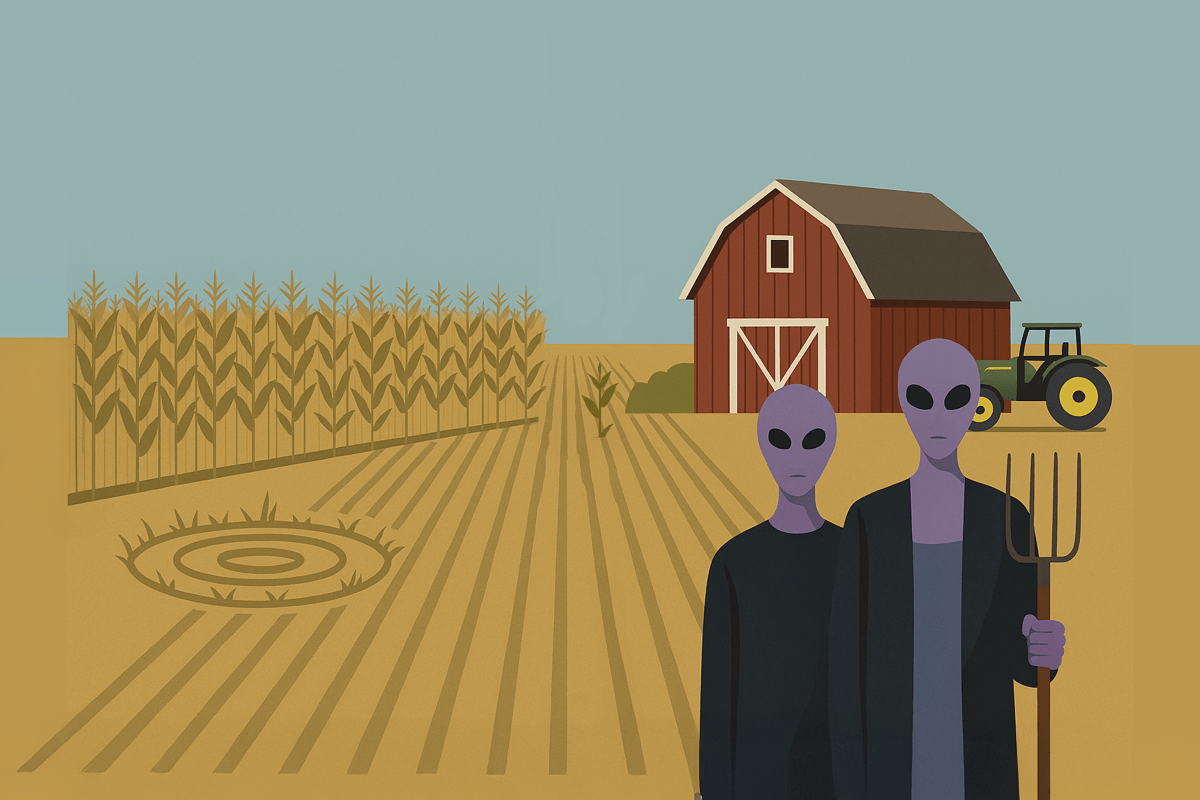
So, yes: we’ve got the requisite red barn, green tractor with yellow wheels (hi, John Deere 🚜), and a crop circle or two. The audiobook cover even features an alien peeking out of the barn – though logistics are holding that version back for now.

But those aliens…

If the composition feels familiar, it should.

The cover is a quiet parody of Grant Wood’s “American Gothic – a pitchfork-wielding farmer and his companion, stoic before their rural home. It’s one of the most recognisable paintings in American art, and I couldn’t resist twisting it just slightly. Grant was an Iowa boy.

I designed this cover using a flat vector art style, almost like cut paper or stylised children’s book illustrations. The sky is cyan, the land is beige, and everything is built in clean layers: barn, tractor, field, crop circle, and of course… two violet, large-eyed aliens striking a pose.

But no, this isn’t a literal scene from the book. You might encounter violet aliens in Sustenance, but you won’t find them standing around with pitchforks like interstellar Grant Wood impersonators. The image is meant to evoke the tone, not transcribe the events.

Why this style?

Because the story itself is quiet. Subtle. Set in the kind of place often overlooked or written off. The aliens aren’t invading with lasers. They’re… complicated. And the humans, well, aren’t always the best ambassadors of Earth.

The cover reflects that blend of satire, stillness, and unease.

Oh, and one last note:
🛑 No aliens were harmed in the writing of this book.

Autofiction Break

Three of the last four books I’ve read have been autofiction of one flavour or another.

I had never read Virginia Woolf’s A Room of One’s Own, but I picked it up after finishing The Hour of the Star by Clarice Lispector. The there was Trainspotting by Irvine Welsh.

I found Hour of the Star to be an interesting experiement, but I would have preferred a short story over a novelette. A Room of One’s Own is interesting and well-written, though the content resonates with me historically rather than personally. I’ve already written a bit on Trainspotting, which hit me quite close to home. I liked it the best but needed a change of scenery before engaging in its prequel, Skagboys. I need more motivation before I embark on a 500 page journey. I like Welsh’s writing, but it’s not an easy read, I I need more stamina or a break first.

I haven’t decided what to pick up next.

Done with Facebook

Graveyard cemetry

I’ve shut down my personal Facebook account. Inevitably, that dragged the Ridley Park page into the digital abyss with it. Collateral damage in the war against nonsense.

Why? Because I’ve grown tired of sparring with what amounts to a bot infestation masquerading as “content moderation.” My blog link – a single post flagged thirteen times as spam in a matter of seconds. Appealed to purported humans, twice denied. If those were humans, they were scarcely distinguishable from meat-based chatbots reciting policy incantations.

So, for now, Ridley’s gone dark on Facebook. That may change; I might spin up a Ridley-only account, but it will be out of necessity, not affection. Still, I’ve no taste for systems that feel more Kafka than community.

For the record, I shared the same post on LinkedIn. Here’s a screengrab:

Image: Screen capture of the offending post, qualifying as spam.

Until then, you’ll find me here and other social media suspects, unencumbered by algorithmic gatekeepers.

Comprehensive Links on Link Tree

https://linktr.ee/ridleypark

Did I miss any?

Needle’s Edge: Pregnancy Continuity

As per my recent post, I need a sanity break. I’ve been editing Needle’s Edge all day. Each time I hit a milestone, I consider drafting a blog post, but then I choose to persist. Not this time.

I’ve been untangling the spaghetti of a misplaced – or rather, overextended – pregnancy. It had stretched on for too long, so I weeded out contradictory events. Some of these had dependencies, so I relocated or eliminated them to preserve flow.

In the process, I re-oriented her conception date and reset any foreshadowing that tied into it. To keep myself honest, I started tracking her progress in the manuscript with markers: <p=X>. With each time-specific event, I increment X.

So far, I’ve reviewed 24 sequential scenes, not counting the half-dozen relocated ones I had to rework just enough to maintain continuity. This leaves the protagonist at 29 weeks. That also meant pruning irrelevant references, for instance, cutting any mention of pregnancy before it even began.

Being a typical human pregnancy, my target is 38 to 40 weeks. That leaves me with another 10-odd weeks to rummage through. Once I’ve untangled the draft, I still need to return for line edits, colour, and shape.

Editing is often pitched as polishing, but sometimes it’s surgery. Today, I’ve been elbows-deep in the operating theatre.

Why Sustenance Reads Like It Does

2–3 minutes

People ask why my books don’t look like “normal” books. Why the titles twitch, why the prose refuses to march in straight lines, why I lean into formatting that makes copyeditors twitch. The answer is both simple and evasive: the story demanded it. Subversion is my key motivator – language, culture, genre, whatever stands too smugly, I want to knock it sideways.

Audio: NotebookLM podcast on this topic.

Take the paratext, those pages most readers skip. I didn’t want a safe little disclaimer to pat anyone on the head. I wanted the opening to feel unstable, already compromised, as though coherence itself were optional. The dedication isn’t reassurance; it’s a warning label.

The prose had to wobble, too. One moment rural realism, the next lyric intensity, the next something uncanny seeping in. Stability is the lie. If I’d written Sustenance in straight realist mode, it would have betrayed the book’s core.

As a language philosopher, I treat manuscripts as sandboxes for showing how language falters. Words crack, meanings slip, syntax betrays us. Fiction is my way of rubbing readers’ noses in that insufficiency.

I don’t hate genre fiction, but I refuse to be bound by it. In Sustenance, I swerve deliberately:

It’s genre fluidity as method. I know this puts off readers who want neat tropes and templates. But those readers are welcome to their factory-sealed shelves.

Did I intend to frustrate? Yes, a little. Not out of malice, but because too many books behave like obedient products. I don’t want to hand readers a smoothie. I want them to taste the grit, to feel that the novel might collapse under them. In fact, it does. The refusal to “pay off” is deliberate. Closure is a consumer demand, not a literary necessity.

So why did I write Sustenance this way? Because it’s not just about what happens. It’s about how information fails, how language decays, how coherence itself becomes suspect. If the book looked and read “normally,” it would have been lying to you.


Motivation: This reflection isn’t meant as a commentary on Sustenance’s plot. My intent here is to discuss the meta — the formal and philosophical scaffolding — rather than the story itself, so as to avoid spoilers. I’ll engage with the work more directly, in more traditional fashion, elsewhere.

Trainspotting Takes Over

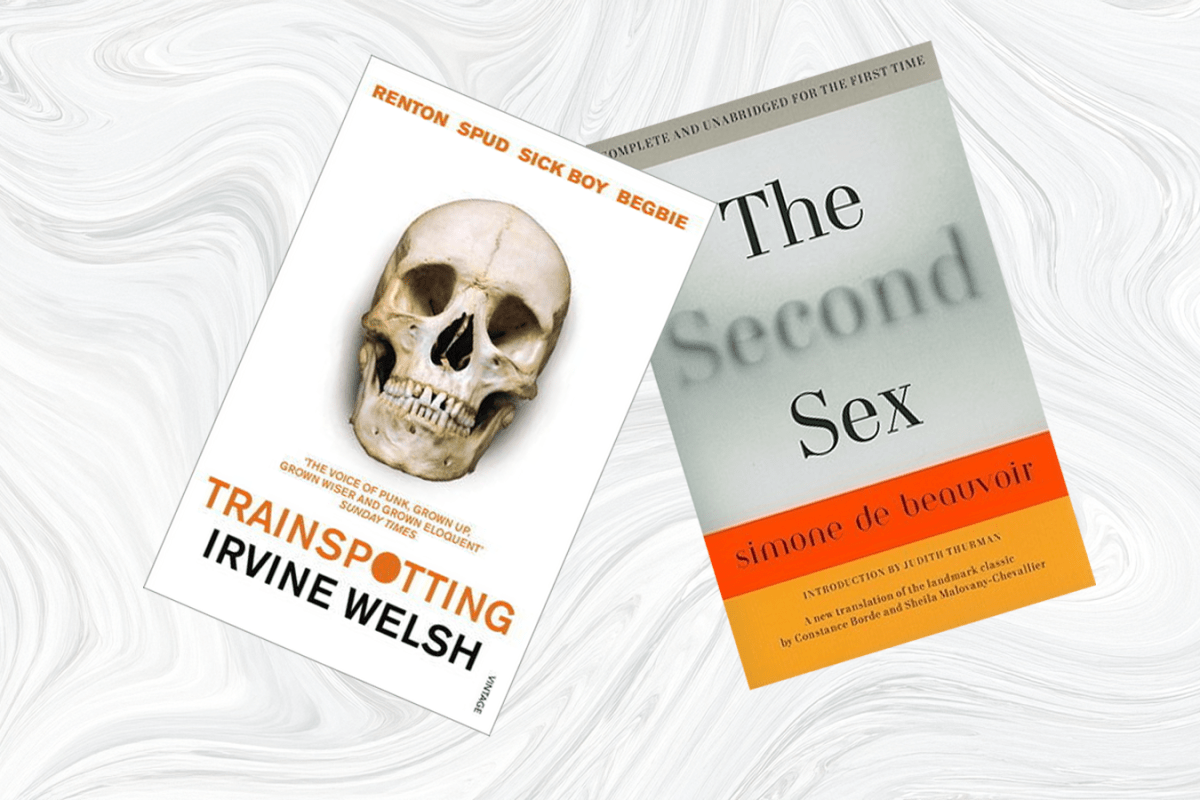
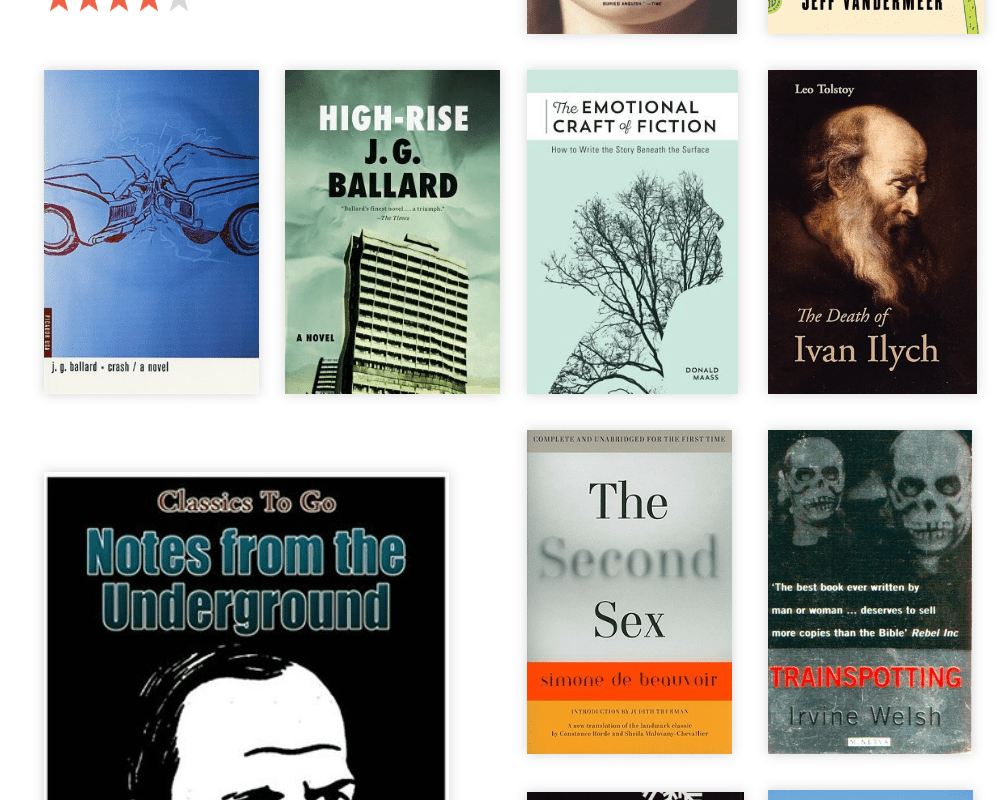
I’ve just finished Simone de Beauvoir’s The Second Sex – all 800 pages of it – and have now started Irvine Welsh’s Trainspotting. Both are classics in their own way. I’ll review Second Sex properly on my Philosophics Blog, but here I want to think about Trainspotting in relation to my current manuscript, Needle’s Edge.

Interestingly, Trainspotting was a ChatGPT recommendation. I fed in my draft of Needle’s Edge and this was one of the books it said my work resembled. Two chapters in, I see the connexion. First, the subject matter – drugs and addiction. Second, the rawness of the experience.

There are differences, of course. Trainspotting is rooted in Leith, Scotland; Needle’s Edge belongs to the East Coast of the United States – Delaware and Philadelphia. Welsh draws heavily on dialect and vernacular, with a narrative voice that’s linguistically dense and aurally charged. In Needle’s Edge, the style is pared down. Sentence fragments, middle dots instead of full stops, and an intentional “lower” register mirror the protagonist’s fractured perception and limited resources.

That gap in register creates a different authorial challenge. With every edit pass, I find myself policing intrusions of my vocabulary into her voice. Welsh, by contrast, can deploy a broader lexicon and trust the dialectal texture to keep it authentic. Listening to Trainspotting, I’m struck by how words and turns of phrase leap out – sometimes apt for Needle’s Edge, but often just a shade too polished for Stacey’s world.

Both texts orbit around environments that resist glamour. Welsh’s squat flats and pubs are grimy and feral; Needle’s Edge’s motel rooms and sidewalks are littered with fast-food wrappers, orange caps, and fading unicorn posters. Addiction erodes bodies in both stories, but the textures differ – Scotland’s industrial gray versus the East Coast’s cheap motels and suburban detritus.

As for the film version of Trainspotting, I saw it long ago and remember almost nothing. The novel isn’t refreshing my memory either; it feels like a separate creature altogether. Which is fitting: both Trainspotting and Needle’s Edge are less about plot than about capturing a lived texture, a rhythm of voices and environments that mainstream narratives usually discard.

On Leaving r/FictionWriting: A Cautionary Tale in Digital Orthodoxy

I quit the r/FictionWriting subreddit today.

Why? Because nuance is no longer welcome in the Church of Sanctified Scribes. I posted a sincere question about using generative AI as a preliminary editorial tool — a sounding board before I hand off to my actual human readers.

I run my scenes through various Al platforms for feedback before I engage the final work with human readers. It’s faster. Is it good enough for preliminary guidance?
I tend to get significantly more positive than negative feedback, so either I am a kick-ass author (because, of course, I am) or I’m being misled. I like to think the former, but cognitive biases overindex in that direction.

Does anyone here have any thoughts on this? I asked Al. It told me not to worry.

NB: I employ the usual suspects: ChatGPT, Claude, Grok, Meta, DeepSeek, and Gemini.

That’s it. That’s the crime.

🚫 Sorry, this post has been removed by the moderators of r/FictionWriting.

The post was removed. Some members responded with superstition, invoking the tired myth that AI would “steal” my work. (That is not how model inference or fine-tuning works. But facts, as ever, are inconvenient.)

Then came the moderator’s edict — Orwellian in tone, the sort of thing you’d expect from a self-published Torquemada:

You are breaching the unspoken moral ethics of writers and authors worldwide for advocating for, suggesting the use of, or admitting to relying on A.l for your writing.

If you didn’t already know: this is bad.

A.I-written work is not your writing. Do not be proud of it. You also do not own it. Two or more of these offenses and you will be permanently banned.

What exactly am I being accused of here? Heresy? Possession of forbidden tools? Thinking aloud?

For the record, I do not outsource my prose to machines. I use AI to assist my thinking — much as one might use spellcheck, Grammarly, or, dare I say it, a fellow writer’s feedback. The fact that this needs to be explained is testament to the intellectual rot at the core of certain writing communities.

And here’s the real punchline: many of those decrying AI as the Antichrist of Authorship haven’t published a thing. Or if they have, it’s in the same low-distribution trenches I inhabit. The difference is, I don’t shun tools because they threaten my imagined purity.

I write because I must — because I enjoy it, because I want to get it right. And yes, if an AI helps me catch repetition or poor rhythm in a sentence before a beta reader ever lays eyes on it, that’s a win.

But you’d think I’d pissed on their typewriters.

Let’s be clear: this isn’t about AI. It’s about fear. About guarding crumbling gatekeeping structures with sharpened pitchforks. About people clinging to their fragile sense of identity — one threatened not by AI, but by other writers doing things differently.

So, yes: good riddance. I’ll take my questions elsewhere, where open minds still exist.

Image: The question and the ultimatum