There Is No Anti-Memetics Division: An Impression by Ridley Park

I’ve recorded an impression – a sort of review – for There Is No Anti-Memetics Division by QNTM.

Video: There Is No Anti-Memetics Division: An Impression by Ridley Park

I’ll allow the content to speak for itself. tl;dr? I like it.

Audio-Video: Also on Spotify.

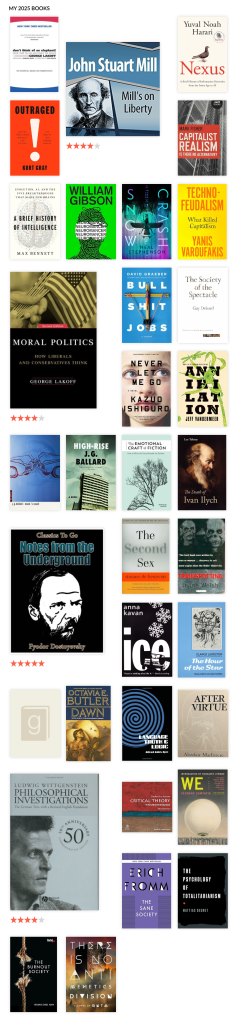
I Return From My Fictional Sabbatical (With Antimemes in Tow)

2–3 minutes

Ridley Park has not been dead, merely sleeping like a hungover deity ignoring its worshippers. As has become my regrettable habit, most of my creative energy has been siphoned into non-fiction projects, leaving the poor world deprived of my fictional offerings and my blog gathering dust like an abandoned cathedral.

But fate – or more accurately, an algorithm – shoved a book into my face with all the subtlety of a street preacher: There Is No Antimemetics Division. Hard science fiction, horror, and something about antimemes. Naturally, I pressed Play Sample instead of behaving like a responsible adult and reading the summary. Antimemetic sounded deliciously unwholesome. Straight down the hatch.

Image: Advert with an author pic for this book.

I’m only into Chapter Two, so don’t expect a full exegesis yet. This is merely a field report from the early trenches.

I bought the Audible version, because audiobooks are the only thing keeping me sane through workouts, where otherwise, one contemplates mortality and the price of groceries. As the sample ran, I learned two things:

  1. Parts of the narrative are redacted.
  2. They did not redact to protect state secrets or Jeffrey Epstein’s ghost.

No – it’s a stylistic device. A textual blackout. Beeps, static, corrupted passages like intercepted voicemail from a doomed expedition. Being partial to experimental prose, I took it as a dare. My brain applauded.

The effect reminded me of Irvine Welsh’s Filth – not in theme, but in the editorial scars, the moth-eaten structure. Welsh, more widely known for Trainspotting, does chaos like astrophysicists do numbers. Obfuscation as aesthetic. Disorder as design. The connection may be superficial, but it’s one worth pocketing.

The title earns its relevance quickly: certain ideas spread like plague; others erase themselves on contact. Antimemes – cognitive black holes. Information that cannot be held without dissolving. A story that fights the mind that reads it.

Hard sci-fi rarely offers such structural mischief. I’m morbidly delighted to see where the horror emerges, when the narrative begins to eat its own memory like a recursive ouroboros.

More to come, once I descend deeper into the antimemetic labyrinth.

And yes – lest anyone call the coroner – I am still writing.


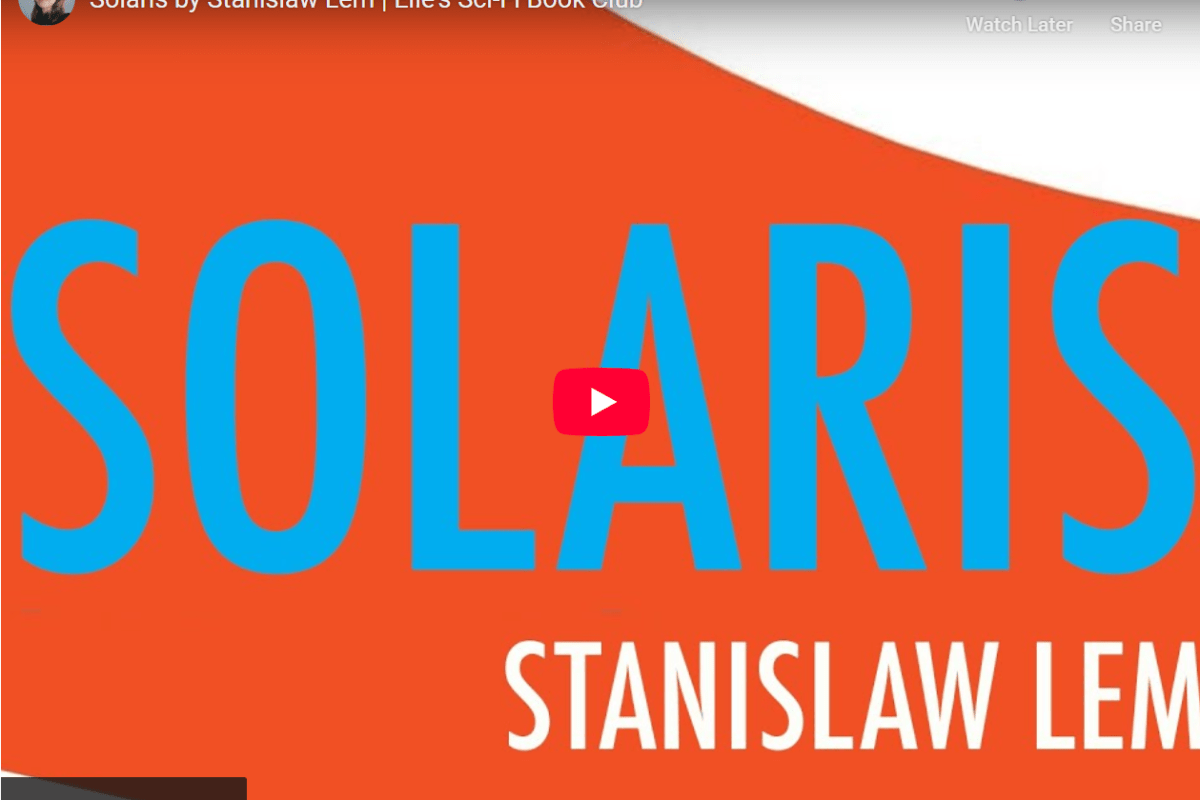
I happened upon this short film of the story whilst seeking a cover image.

Thoughts on Solaris

I finished reading Lem’s Solaris and then was notified of a discussion about the book and the film adaptations.

I intended to draft a book review, but I may defer.

For now, I’ll note that the similarities between this and my own work are superficial. Both have philosophical perspectives, but Lem’s is much more psychological. This is nice, but it’s not where I tend to take things, and not so overtly.

On Accidental Kinship and the Limits of Originality

I don’t read sci-fi. It rarely resonates with me. I’ve read many classics, but I don’t get the hype. As a speculative fiction author, I sometimes operate in an adjacent space – close enough to borrow a few ideas, but never quite belonging. I’m not interested in fetishising technology or celebrating so-called human ingenuity. But if an idea serves the story? I’ll use it.

One concept I wanted to explore: the definition of life itself, and what sentience means when we can barely define it for ourselves.

Not long ago, I began working on a story: some people leave Earth to inhabit another planet in a different solar system. Nothing revolutionary there. They land on what appears to be an uninhabited world – uninhabited, that is, by our current definition of life. Instead, the planet itself is alive. Not in the Gaia hypothesis sense of interconnected ecosystems, but truly interactive. Responsive. Alien in ways that challenge every assumption about consciousness.

Of course, there are more details – dual suns in a figure-eight orbit, shifting gravity, time that expands and contracts, organisms that defy classification. But those are mechanics. The heart of the story is simpler: what happens when survival requires abandoning the frameworks that made you human?

As is my protocol, I fed my manuscript into AI and asked: is this idea unique? If not, what’s it similar to? Who am I adjacent to?

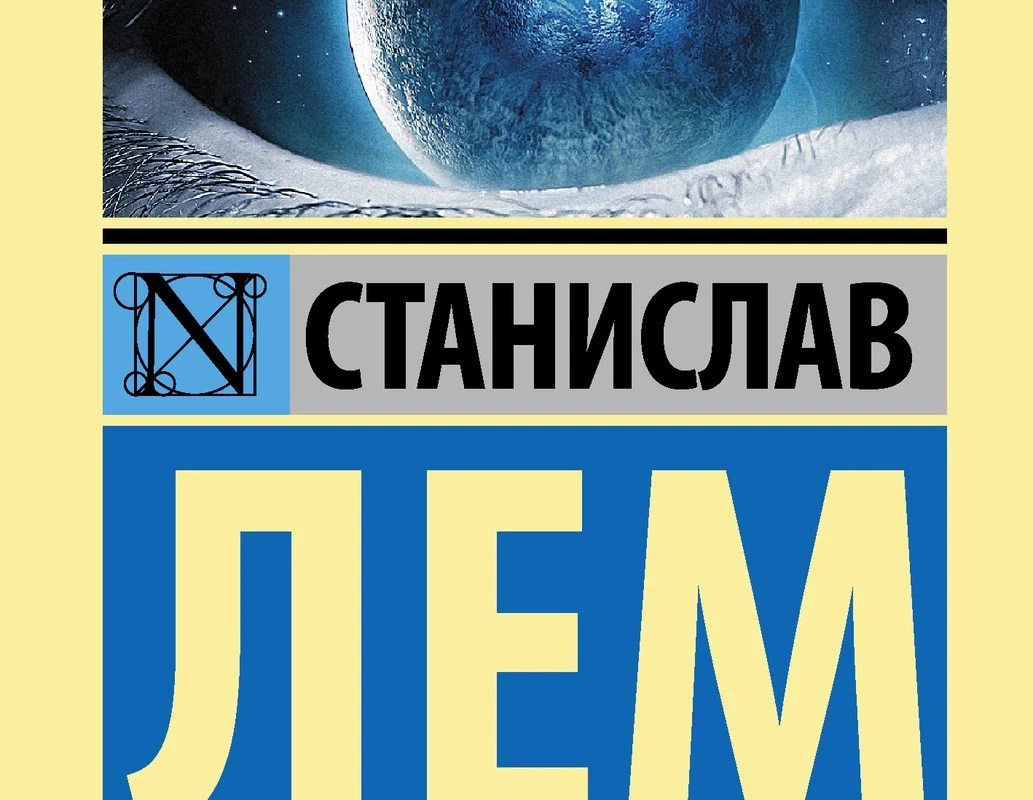
I got names. Titles. Books and films. Most had superficial similarities but different intents. Then one stood out: Solaris, Stanisław Lem’s 1961 novel. I hadn’t read it, so I got a copy.

There were so many commonalities it felt like discovery and defeat in equal measure.

Lem wrote Solaris before humans had meaningfully left Earth’s atmosphere. Published in 1961, it predated material space exploration by years. On October 4, 1957, the Soviets launched Sputnik 1 – the first artificial satellite. Four years later, Yuri Gagarin became the first human to orbit Earth, his flight lasting just 108 minutes. The first American in space, Alan Shepard, flew in 1961. John Glenn orbited in 1962.

Lem imagined a sentient ocean on an alien world orbiting twin suns before we’d even confirmed planets existed beyond our solar system. His protagonist grapples with a consciousness so alien that communication may be impossible – not because of language barriers, but because shared reference points don’t exist.

In some ways, Solaris also shares DNA with Jeff VanderMeer’s Annihilation – that same sense of an environment that isn’t hostile so much as indifferent, operating by rules humans can barely perceive, let alone comprehend. But where VanderMeer leans into existential dread, Lem’s tone is colder, more philosophical. Less visceral horror, more intellectual vertigo.

My story, working title: Goldilocks, sits somewhere between them. It has Lem’s alien sentience and dual-sun orbital mechanics. It has VanderMeer’s gradual unravelling of human perception and sanity. But it also has something neither quite touches: the brutal intimacy of being the last of your species, seeking warmth in a universe that offers none.

So is my idea original? Not entirely. Does that matter? I’m not sure anymore.

Lem wrote his novel sixty years ago, before we’d touched the moon, before we knew what exoplanets looked like, before we’d meaningfully begun asking whether consciousness requires a brain. He imagined sentience beyond human comprehension – and did it so thoroughly that anyone following feels like they’re retracing his steps.

But perhaps that’s the point. Originality isn’t about being first. It’s about what you do with inherited ideas – how you refract them through your own obsessions, anxieties, and questions.

Lem asked: can we ever truly know an alien intelligence?

VanderMeer asked: what happens when the environment rewrites you?

I’m asking: what does it mean to be human when humanity itself is ending?

Maybe that’s enough distance. Maybe it’s not. Either way, the story exists now – half-written, haunted by its predecessors, searching for its own voice in the silence between stars.

Sci-Fi, Fantasy, and the Politics of Imagination

1–2 minutes

As I’ve been working through Octavia Butler’s Dawn, I’ve realised why science fiction as a genre rarely resonates with me. It isn’t the aliens or the starships; it’s the scaffolding. Sci-Fi carries the weight of the Modernist project – questions posed and quickly answered, problems rationally explained, the reader guided toward the “lesson.” It feels like indoctrination: tidy, didactic, instructional.

Companion piece on Philosophics Blog
Audio: NotebookLM podcast summarising this topic.

Fantasy, strangely enough, I tolerate even less. Where science fiction pushes forward, fantasy looks backward. Sci-Fi imagines the future of the Modern experiment: technology, politics, survival scenarios, all with a rationalist bent. Fantasy imagines the past of the same experiment: kings, bloodlines, prophecies, destiny. One proclaims progress, the other tradition, but both insist on role conformity.

This struck me as almost political: science fiction reads like fodder for Liberals and Progressives, those who believe we can build better systems if only we’re clever enough. Fantasy, meanwhile, often aligns with a Conservative ethos – a return to order, hierarchy, and providence, just with dragons and spells thrown in. Both are catechisms of Modernity, just oriented in opposite directions.

It may just be me. I don’t identify with the Modern project, and so the genres that proselytise it – looking forward or looking back – leave me cold. I prefer literature that unsettles, that leaves silence where there might have been certainty, that lets ambiguity breathe. But for many, Sci-Fi and Fantasy provide something else entirely: reassurance.

Thank You for Sustenance Reviews

Sustenance (available here) was free for everyone on Kindle on 8 and 9 September. My goal was to provide access to the book for exposure with the hope of getting ratings and reviews. It’s still early, but I’d like to report that over 100 people downloaded the Kindle version. Now, I’ll share some details.

  • The Kindle version was downloaded 106 times in the past two days.
  • Some read it from their KindleUnlimited accounts
  • Some bought physical copies
  • Some people rated the book; some even left reviews on Amazon or Goodreads

The ratings and reviews are mixed, but all are welcome. Few people rate books; even fewer review them, so I appreciate the effort.

I got 3 ratings and 2 reviews on Amazon: ⭐⭐⭐⭐⭐, ⭐⭐⭐⭐, and ⭐. A one-star review. Thanks for that, too.

The ⭐rating didn’t leave a review, so I don’t know why they didn’t like it. I don’t know what types of books they read or this is exatcly what they prefer – they just didn’t like this. Still, at least they took the time to do it.

As a former statistician who has worked with survey data, I find this to be similar – most people don’t respond to surveys. Most people don’t engage in call-in shows. Most often, the people who respond either love or hate the topic so much that they feel compelled to broadcast their opinions. The people who say “meh” won’t even bother.

KindleUnlimited notwithstanding, I have no idea how people engage with a book. I have purchased and downloaded more books than I can read in a lifetime – probably multiple lifetimes. Sometimes, I just want to have access to a classic in case the mood strikes me; sometimes a book comes into view, and I convince myself that when I have the time, I might read it. I have no way of knowing.

Image: Sustenance Trope Board

I’m guilty of some single-star ratings without leaving a review, so I am in no position to point fingers. Sometimes a book seems bad that you want to warn the world, but you don’t want to expend more time on the endeavour that you already have.

I took this screengrab of 1-star ratings from Goodreads – some have reviewers, others don’t.

Image: 1-Star Reviews

Only one of these books is non-fiction, though I might argue that point, hence the single star.

One Ayn Rand was a class assignment. The other was someone telling me that I hadn’t judged her best work. In this case, her best work is one star, so I can skip anything else. Ditto for the Bible – complete dreck.

Authority, I only recently read. it was part of a trilogy. The other two books got 4 and 3 stars, so I’ll consider this one a dud. I’m not in good company, as it rated worse than the other two on average, yet still managed a 3.55. Some people liked it.

The last one was a class assignment for my son that I read with him. His rating matched mine. How it became an assignment is just testimony that there is no accounting for taste.

Also, as a public service, I’d be willing to bet that if you liked these books, you won’t like mine.

Octavia Butler’s Dawn

On the topic of rating— I am midway through Dawn. It’s mid. I was asked why I hadn’t read it as part of the dystopian Venn, so I picked it up. To be fair, I thought several of the stories on the Venn were mid themselves, classics or otherwise. Perhaps I’ll write a separate post on that someday.

Honestly, I’d give Dawn 2 stars. However, I also know that Sci-Fi is not a genre that resonates with me, so I’ll be generous and give it a star because it may just be my personal bias of not relating to Sci-Fi that’s the problem, and the book might be better received by fans of that genre. Offhand, the only fiction genres I dislike worse than Sci-Fi are Fantasy and Romance.

Aside from being Sci-Fi, it reads like YA fiction. There’s nothing inherently wrong with YA, but I am clearly not its target demographic. Other than that, it’s serviceable, but I prefer to read content that’s more complex and layered, not spoonfed to me.

Conclusion

Anyway, I’ve derailed this thread, but I wanted to clarify how I approach rating books and want to thank those of you who have taken the time on Sustenance. If you haven’t yet, I’d appreciate any rating from 1 to 5. Reviews earn extra karma points.

What’s With the Violet Aliens?

🛸 A Closer Look at the Cover of Sustenance

👽 People ask me: What’s with the aliens on the front cover of Sustenance?
Fair enough. Let’s talk about it.

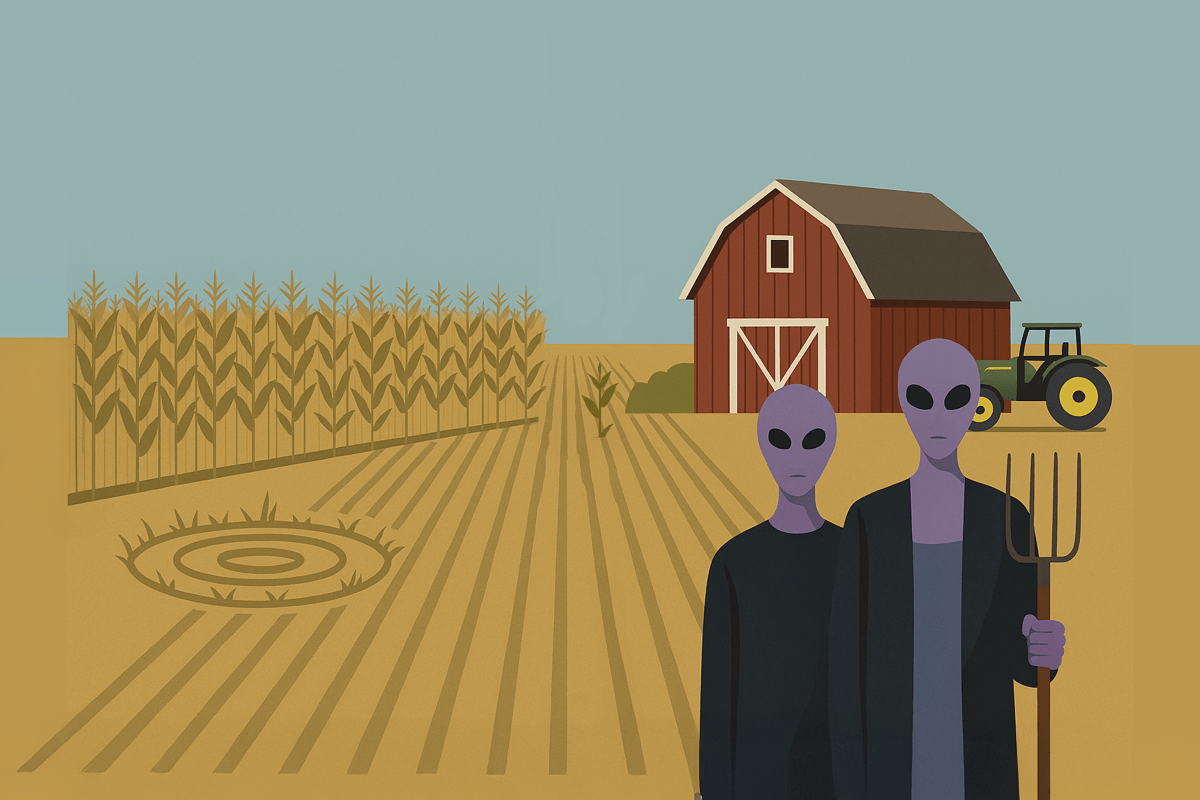
Sustenance is set in Iowa – real, dusty, soybean-and-corn Iowa. I’ve spent months there. I’ve lived in the Midwest (including Chicago) for over a decade. The farms, the tractors, the gravel roads… they aren’t just set dressing. They’re part of the book’s DNA.

So, yes: we’ve got the requisite red barn, green tractor with yellow wheels (hi, John Deere 🚜), and a crop circle or two. The audiobook cover even features an alien peeking out of the barn – though logistics are holding that version back for now.

But those aliens…

If the composition feels familiar, it should.

The cover is a quiet parody of Grant Wood’s “American Gothic – a pitchfork-wielding farmer and his companion, stoic before their rural home. It’s one of the most recognisable paintings in American art, and I couldn’t resist twisting it just slightly. Grant was an Iowa boy.

I designed this cover using a flat vector art style, almost like cut paper or stylised children’s book illustrations. The sky is cyan, the land is beige, and everything is built in clean layers: barn, tractor, field, crop circle, and of course… two violet, large-eyed aliens striking a pose.

But no, this isn’t a literal scene from the book. You might encounter violet aliens in Sustenance, but you won’t find them standing around with pitchforks like interstellar Grant Wood impersonators. The image is meant to evoke the tone, not transcribe the events.

Why this style?

Because the story itself is quiet. Subtle. Set in the kind of place often overlooked or written off. The aliens aren’t invading with lasers. They’re… complicated. And the humans, well, aren’t always the best ambassadors of Earth.

The cover reflects that blend of satire, stillness, and unease.

Oh, and one last note:
🛑 No aliens were harmed in the writing of this book.

Octavia Butler Dawn Crosspost

I began reading Octavia Butler’s Dawn, and it raised some interesting* philosophical questions.

In the early chapters of Dawn, an alien declares that humanity has “committed mass suicide.” Sartre insists, “Inaction is still a choice.” Howard Zinn reminds us, “You can’t be neutral on a moving train.” Each collapses complexity into the fiction of agency, a story that props up Modernist notions of responsibility and blame. But what if agency itself is an unnecessary fiction? I’ve explored this tension in a new essay on my Philosophics blog:

Someone on social media, commenting on my Dystopian Venn post, asked me why I hadn’t read Octavia E Butler. Challenge accepted.

* Questions interesting to me.

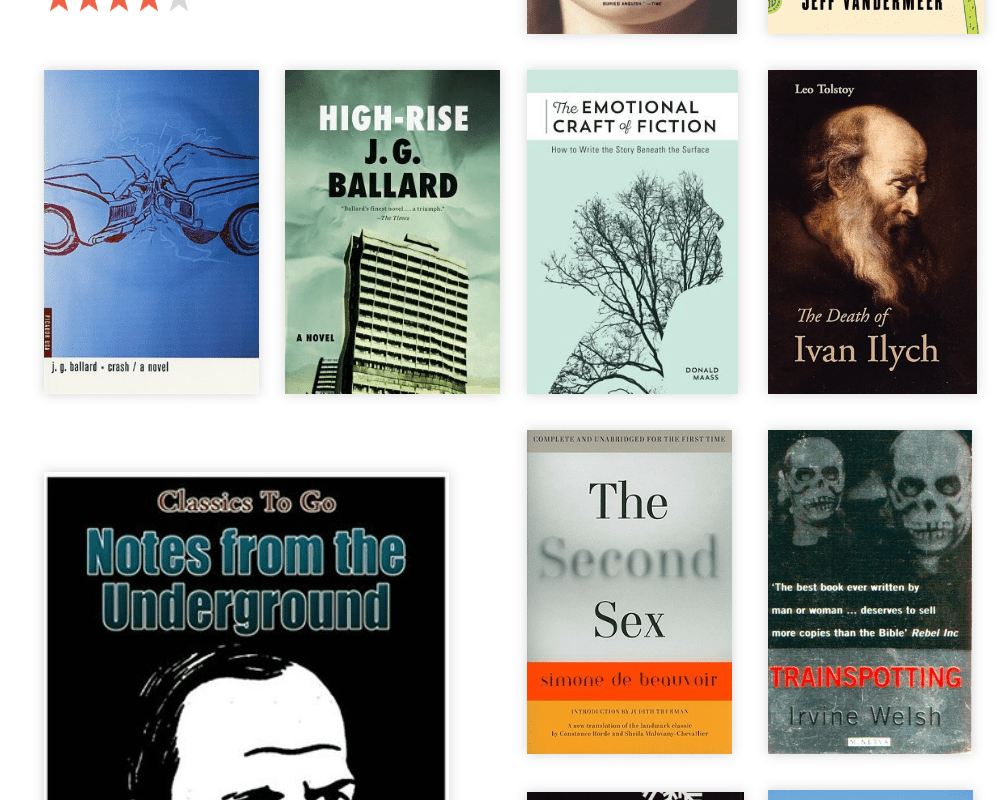
The Dystopia Venn: Four Circles of Absolute Nonsense

2–3 minutes

This particular meme has been making the rounds like a drunk uncle at a wedding – loud, colourful, and convinced it’s profound. A Venn diagram, no less! Four big circles stuffed with dystopias, slapped together as if geometry itself conferred wisdom. Most of them are books, a few are films, and one – Gattaca – is glaring at me because I haven’t seen it. That omission alone feels like a character flaw. I might grit my teeth and watch it just to close the loop, though it doesn’t exactly scream, “Pour a glass of wine and enjoy.”

Image: Venn Diagram

Here’s the thing: as art, it’s rather lovely. As a piece of intellectual cartography? It’s rubbish. It pretends to classify but in fact it merely collages. Orwell is pressed up against Burgess, Atwood rubs shoulders with Logan’s bloody Run, and in the middle sits Animal Farm, as if pigs with clipboards are somehow the Rosetta Stone of dystopia.

And yet – if you squint just so, tilt your head like a dog hearing a harmonica, you can just about see some tenuous ligatures:

  • Surveillance and conditioning: 1984, Clockwork Orange, and The Matrix all insist that the human mind is clay to be moulded by boot, syringe, or simulation.
  • Reproduction and regulation: Brave New World, The Handmaid’s Tale, and yes, Gattaca (apparently) fret endlessly over who gets to breed, who gets culled, and whose DNA deserves a future.
  • Bodies as resource: Soylent Green, Brazil, Gattaca again – people ground down into spreadsheets, rations, or literal mince.
  • The veneer of civilisation: Lord of the Flies and Animal Farm showing us that civilisation is just papier-mâché over the swamp.

But let’s be honest: the diagram isn’t actually saying this. It’s just four intersecting blobs, with titles hurled in like darts at a pub quiz. The apparent “structure” is nothing more than meme-magic – order conjured out of chaos to make you nod gravely as you scroll by.

So yes: as art, it works. As a Venn diagram, it’s a travesty. And maybe that’s the deeper joke. We live in an age where every complexity gets crushed into an infographic, every horror squeezed into a digestible meme. Which, if you think about it, is itself a bit dystopian.

Cybergirl Meets Steampunk Girl

On my Philosophics Blog, I share my experience using Midjourney’s image-to-video feature. In that article, I discuss some benefits and limitations of Midjourney. This is an adjacent discussion.

Image, still from video: Cybermech Warrior Meets Steampunk Girl

The clip above was an image I generated about a year ago – a steampunk girl on the left battling a cybermech whatever. This is ostensibly the prompt I used.

cinematic photograph, a pale young European steampunk woman meets a steampunk ninja villain woman dressed in black with mechanical arms

I forgot about the ninja part, hence the black outfit.

tl;dr: When I prompted Midjourney to animate the two, rather than a vicious fight to the death, I got a tender dance and race to the bed. I made that last part up. Watch for yourself.

Now, I am left wondering if I should pursue a trope of a woman falling in love with another cyber-woman. Has this been done?

It would undoubtedly be genre fiction – whether sci-fi, steampunk, or erotica remains to be seen. Perhaps more of a manga.

This isn’t my space, so I’m being facetious, but I can still imagine the implications.