Simulacra: A Screenplay Inside a Novel

Chapter 26 of Propensity shifts form once again.

Much like Chapter 10 (Memorandum), it functions less as narrative propulsion and more as an aperture, fleshing out character psychology and relational tension. But unlike the bureaucratic memo of Chapter 10, this one adopts the cinematic grammar of a screenplay.

Three teens. One post-collapse flat. No script but survival.

Teddy, Lena, and Jamal, three of the few who’ve retained volition after the global cognitive outage, attempt to negotiate the boundaries of self, sex, and something like ethics. The world has gone silent. Behavioural modulations have zeroed out the rest of humanity. What’s left is not exactly freedom, but the residue of agency.

Teddy wants to dominate; he flirts with tyranny and the post-moral indulgence of the moment.

Jamal wants to refuse the cycle; he recognises the scaffoldings that led to collapse and hopes not to rebuild them.
Lena wants… something else entirely. Survival, perhaps. Or at least integrity.

Their conversation, unfolding through stage direction and dialogu, wrestles with autonomy, desire, and disgust. What counts as a violation in a world where the victims cannot resist? What norms persist when no one is left to enforce them?

This chapter doesn’t tell the reader what to think. It lets the contradictions breathe. And for a few pages, the novel becomes a film that cannot be watched, only read.

New Video: Why I Write the Way I Do

Close-up of a human eye with digital glitch effects and overlaid text reading 'What if reality is wrong?'—a visual metaphor for distorted perception and unreliable truth.

Ever wondered why my characters are displaced, disillusioned, or linguistically marooned? Why my fiction leans philosophical, post-structural, and just a touch anti-humanist?

In this short video, I explain the underlying motivations behind my stories—from Heidegger’s Geworfenheit to Galen Strawson’s Causa Sui, with detours through identity, agency, and the lies we call language.

This isn’t about world-building. It’s about world-dismantling.

▶️ Watch now: Why I Write the Way I Do

Choosing Beta Readers

After my post yesterday on beta readers, I thought a short YouTube video might make a fine companion.


Here are the timestamps for the content:

  • 00:00 Intro – Why Beta Readers Matter
  • 00:24 What a Beta Reader *Is* (And Isn’t)
  • 01:04 Genre Mismatch: The Common Mistake
  • 01:25 How to Vet Your Beta Reader
  • 01:50 What Good Feedback Sounds Like
  • 02:05 What Bad Feedback Sounds Like
  • 02:18 Building the Relationship
  • 02:38 Final Thoughts (and a Warning)

I hope to create more content focused on writing, particularly my own writing.

Let me know in the comments if you like this and if you have any topics you’d like me to cover. Until then, it’s back to writing… ☼

Propensity Excerpts

I’ve recently released a new book, Propensity. In preparation for the audiobook version, I’ve assembled some material for PDF that doesn’t convey well in an audible format – this image, for example, from Chapter 43.

This image depicts a frantic ink sketch of a woman’s face, wide-eyed and stricken, as if caught in the instant her world unravels. Her features are carved from chaos—lines scribbled in anguish, as though the act of drawing itself were a desperate grasp for meaning.

The PDF is available for free on the dedicated Propensity page.

I’ll be posting content on Propensity as well as some of my other recent and upcoming releases presently.

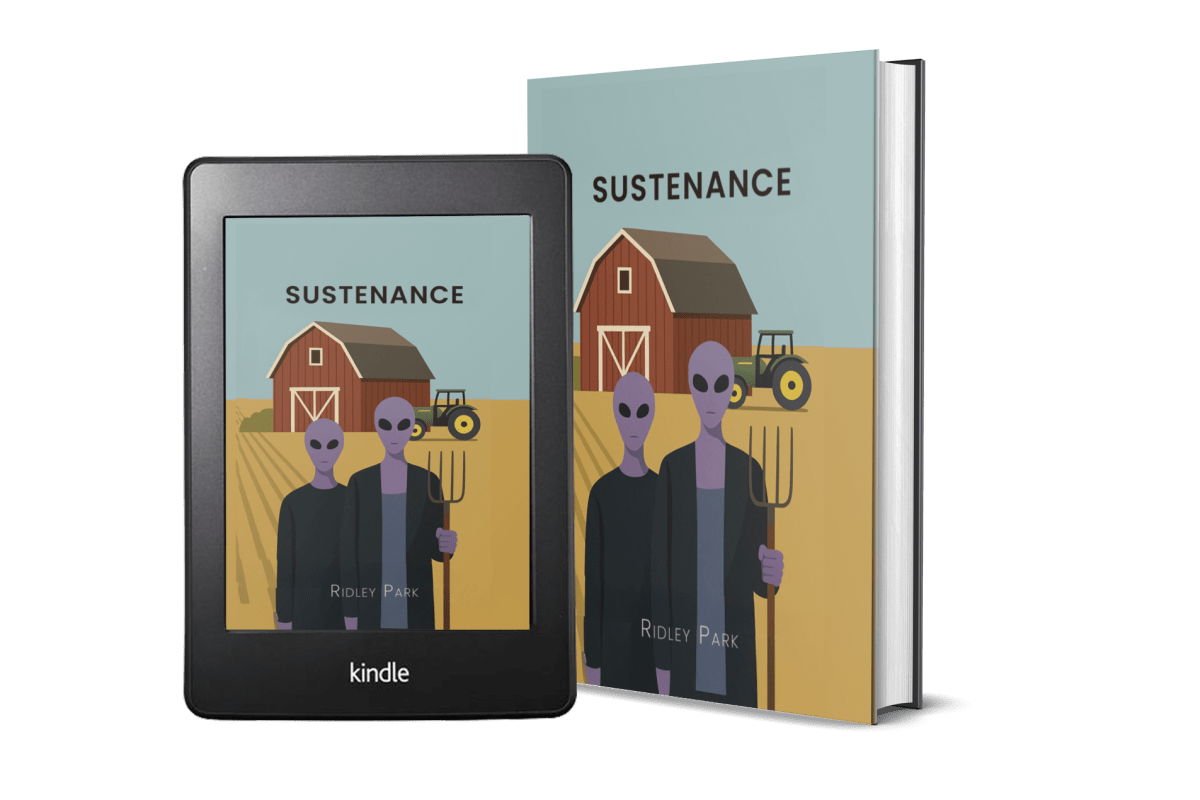
🛸 SUSTENANCE Has Landed

A note from Ridley Park on language, consent, and the limits of knowing.

Well, this one’s live.

Sustenance has officially launched.

Audio: NotebookLM podcast on the book Sustenance.

If Propensity was about engineered peace through probabilistic compliance, Sustenance asks what happens when understanding itself breaks down—and nothing you think is mutual, is.

No war. No invasion. No end-of-days. Just a quiet landing. And a failure to translate.

The Premise

A group of non-human beings arrive—not in conquest, not in friendship, but in continuity. They are not like us. They do not see like us. They don’t even mean like us.

There is no universal translator.
No welcome committee.

Just humans—interpreting through projection, desire, and confusion.

And aliens—operating by a logic that doesn’t require interpretation.

The Themes


Sustenance explores what happens when:

  • Language fails and nothing fills the gap
  • Consent becomes guesswork
  • Culture is mistaken for nature
  • Property has no meaning, and law no parallel
  • Sex isn’t private, sacred, violent—or even especially enjoyable
  • Memory becomes narrative, and narrative becomes defence
  • Contact isn’t miraculous—it’s awkward, biological, and quietly irreversible

This is a story about misunderstanding. Not just what others mean—but who we are when we assume we understand anything at all.

The Tone

Think Arrival but rural. Annihilation without the shimmer.

A bit of VanderMeer. A hint of Flannery O’Connor. The cornfields are real. The discomfort is earned.

No apocalypse.

Just a failure to process.

And maybe, something new inside the gap that opens when the old stories no longer apply.

Why Write This?

Because contact doesn’t have to be violent to be destabilising.

Because not all miscommunication is linguistic—some is anatomical.

Because the most alien thing we can encounter is ourselves, misinterpreted.

Because I wanted to write a story where the question isn’t “what do they want?” but “what have we already assumed?”

Now Available

Sustenance is available now in hardcover, paperback, and Kindle.

If you read it—thank you. If you don’t, that’s fine.

The misunderstanding will continue regardless.

📘 More about the book →

Ridley Park
Possibly a person. Possibly a place. Possibly both.

📡 PROPENSITY Has Launched

A note from Ridley Park on behaviour, control, and the illusion of peace.


Well, it’s out.
Propensity has officially launched.

This one’s been brewing for a while. If Sustenance asked what happens when we can’t understand each other, Propensity asks what happens when we stop needing to.

No invasion. No superintelligence. No overt dystopia. Just a device—quietly implemented—that modulates human behaviour through neurochemical cues. Less anger. Less risk. Less faith, libido, disobedience. More calm. More compliance. More… nothing.

And nobody notices.
Because the best control doesn’t look like control.


The Premise

Imagine a world where we solve violence—not through laws, treaties, or education—but by dampening the neurological signals that make people aggressive in the first place. You don’t choose peace. Peace is chosen for you, chemically. You just comply.

That’s the Propensity Device: a system designed not to control what you do, but to shift what you’re likely to do. Your odds of revolt drop. Your odds of submission rise. It’s not sedative. It’s statistical.

Free will doesn’t vanish. It just stops being statistically significant.


The Themes

The novel explores what happens when:

  • Free will is reframed as background noise
  • Consent is irrelevant because no one thinks to object
  • Violence becomes programmable—but only directionally
  • Peace is achieved without ideology, meaning, or narrative
  • Narrative itself becomes residue

There’s horror in here, but it’s not loud. It’s administrative. Institutional. Clean.

The horror of things working exactly as designed.


The Tone

Think Black Mirror but less sensational. Think Ballard after a lobotomy.

A dash of Ligotti. A flicker of DeLillo. A long stare from Atwood.
Propensity is soft dystopia—flattened, not broken.

And yes, there’s a fall. But it’s not a collapse. It’s an asymptote.
A tapering. A loss of signal fidelity. A kind of surrender.


Why Write This?

Because we’re already doing it.

Because behavioural nudge theory isn’t fiction.

Because control doesn’t need to be malicious—just implemented.

Because some of the worst horrors are quiet, polite, and empirically validated.

Because I wanted to ask: what if peace worked too well?


Now Available

You can get Propensity on Amazon and other booksellers.

If you do read it—thank you. If you don’t, that’s alright.
The system will keep humming either way.

📘 More about the book →

Ridley Park
Possibly a person. Possibly a place. Possibly both.

Geworfenheit: Not Born, Just Here: What Drives My Fiction

A common question I get about my writing—my fiction, anyway—is: what motivates you?

It sounds like a harmless question. Like asking a plumber what motivates them to fix pipes. But fiction is not plumbing. And motivation, for a writer, is often post-rationalised. Still, I have answers. Or at least fragments of them.

Audio: NotebookLM podcast on this topic.

A primary driver is to convey philosophical concepts that I feel apply to life in general, but don’t tend to get the airtime they deserve. A good example is Heidegger’s Geworfenheit.

In English, that’s usually translated as “thrownness.” It refers to the feeling—no, the condition—of having been thrown into existence without consent, without context, without recourse. It’s the anti-heroic beginning. You wake up on a raft. No map, no memory. Just current.

Now, Heidegger gets a bad rap. And some of it is earned. He joined the Nazi party. There’s no excusing that. But if we’re going to disqualify thinkers based on political affiliation, we’ll need to scrap about half of the Enlightenment and most of the 20th century. The point is: Geworfenheit is useful. It names something modern life often glosses over: the fact that you didn’t choose to be here, and now you have to swim.

This theme shows up across my work. In Temporal Babel, Jef is stranded in a temporally dislocated world. In Sustenance, the visitors are alien in both senses of the word. And in Hemo Sapiens, the title species are cloned into personhood with no legal or cultural footing.

None of us choose how, where, or when we are born. But I like to amplify that truth until it becomes impossible to ignore. Take the Hemo Sapiens case: they aren’t born; they’re instantiated. But what is birth if not a legally sanctioned instantiation? Once you remove the ritual scaffolding of parentage, nationhood, and paperwork, what remains is the raw fact of being.

Another key motivator for me is philosophical provocation—questions I don’t intend to answer, only pose. Like this one: imagine you’re shipwrecked and wash up on a tiny island. A single inhabitant lives there and claims ownership. He tells you to leave or die. You have no weapon. He has a spear. The sea is vast and lethal.

Do you have the right to stay?

Do you take the spear?

Does ownership matter when survival is at stake?

Sustenance explores that tension. Property, sovereignty, mercy, survival—these are themes we pretend to understand until the scaffolding is removed. My aim isn’t to preach about what’s fair. My aim is to show what happens when fairness loses its footing.

Related to this is the theme of otherness. Us versus them. But I’m less interested in dramatising hostility and more interested in the quiet bewilderment that comes when categories fail. What do you call someone who isn’t man or woman, isn’t alive or dead in the way we recognise, doesn’t speak our language or obey our metaphysics? What happens when you meet something you can’t assimilate?

Another layer is cultural construction—the way our societies retrofit meaning onto reality. We build scaffolds. Gender, law, ownership, grief. Then we forget we built them. My fiction likes to peel back the drywall. Not to show the truth, but to reveal the studs. The story behind the story.

And finally, I write because I suspect something important is always missing. That language is never quite enough. So I keep trying. Not to solve the insufficiency, but to dwell inside it.

That’s what motivates me.

Or maybe I’m just trying to answer questions I never knew how to ask.

That too.

Characters Are Overrated: A Treatise Against the Tyranny of Arcs

You’ll hear it a thousand times in creative writing circles, often whispered with the reverence of sacred doctrine: character is king. Give your protagonist an arc, they say. Make them grow. Show them change. Rinse. Resolve. Repeat.

Audio: NotebookLM podcast on this topic.

Forgive me, but I’m not here for that workshop claptrap.


My writing isn’t character-driven in the conventional sense. I don’t sculpt protagonists to take heroic journeys or undergo epiphanic transformations. I’m not interested in plumbing the depths of their souls or bandaging their inner wounds with moral insight. My primary concern is the world—the philosophical or sociological structure—through which characters drift, orbit, or plummet. Sometimes they leave a mark. Often, they don’t.

Because real life isn’t narrative. It doesn’t arc. It drifts. And most of us don’t develop. We adapt. We cope. We muddle through.


Resolution, in most stories, is a parlour trick—narrative taxidermy dressed as transcendence. In reality, most encounters don’t resolve. They expire. People come and go. You cross paths with strangers who change your life—or don’t—and then vanish back into the abyss of statistical anonymity.

One of my recent manuscripts begins with a woman named Sena discovering a body by the roadside. She reports it, the authorities arrive, and the narrative follows them—until it doesn’t. It dissipates. No tidy resolution, no tight bow. Just the unfurling tedium of systemic procedure and human irrelevance. It’s not a mystery story. It’s a story with mystery in it. Big difference.

We like to pretend we’re central to our own story, each of us a protagonist in a universe scripted for personal development. But sometimes, we’re not even side characters. Sometimes, we’re scenery. Camus’ Meursault had it right: the sun matters more than your feelings, and death shows up whether you’ve had your arc or not.


Yes, some readers crave grandiosity—heroes, villains, the Great Man Theory dressed in narrative drag. Napoleon didn’t just wage war; he “struggled with destiny.” Stalin wasn’t just a paranoid bureaucrat; he was “a force of history.” These are characters written by history with the same myth-making brush that writes fiction. Convenient, cathartic, utterly inaccurate.

But I don’t write demigods. I write witnesses, floaters, participants without insight. They’re often not even granted the courtesy of closure. They move through a world that refuses to acknowledge their significance. And why should it? The cosmos doesn’t care if your backstory is tragic or if your girlfriend left you on page forty-two.

Sometimes the character who seems central is merely catalytic. Other times, they’re inert—filler between philosophies. If someone changes, maybe it’s society, not them. Maybe the reader. Or maybe no one.

So no, I don’t build arcs. I don’t force characters to evolve like Pokémon just because Act III demands it. I drop them into a world and watch what happens—often, nothing. Because that, more than any tidy redemption tale, is how life actually works.


That’s the work. Not myth-making. Not therapy. Observation. Dissection. Not a ladder to transcendence but a mirror, tilted just so.

Welcome to Ridley Park. Watch your footing. There are no arcs—only echoes.

Behind the Binding: Sustenance in Print, Pixels, and Purgatory

Not quite a launch. Not quite a rant. Just one author trying to get a novella into the world without sacrificing too many hours or brain cells.

Paperback Problems

I’ve been writing quite a bit lately—several novellas/novelettes, to be precise.

They all began life as short stories, but brevity doesn’t come naturally. Apparently, I can’t shut up even on the page. I toyed with the idea of releasing a thematic collection, and I still might. But for now, Sustenance is getting its own debut—likely this month.

The book clocks in at around 14,000 words, printed across 144 pages. I’ve read that readers prefer novels to novellas, but I’ve also read that readers don’t really read anymore. Time’s short. Attention spans are shorter. Maybe shorter fiction has a fighting chance. We’ll see.

I formatted it in 6×9 inches, which may have been overly generous. It’s leaner than your average indie fantasy tome but still thicker than my last Žižek collection. So there’s that.

The manuscript began in Word, like every poor decision. I laid it out in InDesign and exported the PDF through Acrobat. No budget, so I designed the cover too—started in Illustrator for the vector charm, but ended up in Photoshop, where I’m more at home. I designed the full wrap—front, back, spine—as a single canvas.

This was a mistake. More on that later.

Still, I’m pleased with the final look. Might reuse the style across future novellas for a bit of visual branding. There’s barely enough of a spine to print on, but we suffer for aesthetics.

Proofs arrive Thursday. Fingers crossed.

Hardback Headaches

Then came the hardback edition. Same 6×9 size, same interior. Should’ve been simple.

It wasn’t.

I forgot (again) that hardbacks require extra bleed and margin space. Couldn’t just resize the existing cover without risking pixelation. If I’d stuck with vectors, this would’ve been a breeze. Instead, I got to rebuild the entire layout from scratch—layers, guides, grids, the lot.

Hours of joyous rework. Lesson learned. Until next time.

eBook Escapism (and Other Fantasies)

Converting the layout to eBook format was a slow-motion trainwreck. I’d inserted custom font glyphs above chapter titles in InDesign. They rendered fine—until they didn’t. Halfway through, chaos reigned.

I cracked open Sigil and manually edited the XHTML. So far, so fiddly.

Then I uploaded the .epub to Amazon. Except Amazon wanted a .kpf file. Of course it did.

Enter Kindle Previewer. Except it doesn’t support embedded font glyphs. So I converted them to SVGs.

Still no dice. Kindle’s rendering engine is older than most of its readers. SVGs failed too. So I converted every glyph to PNG, rewrote the CSS, rebuilt the XHTML again, and gave it another go.

Looks fine. Not perfect. I gave up.

They’re just decorative anyway. No plot-critical glyphs here.

The Kindle version should go live shortly. I enrolled it in KDP Select, which means 90 days of exclusivity in exchange for a modicum of convenience. After that, I’ll look at wider distribution.

For the eBook cover, I simply cropped the original layout in Photoshop. That part was, mercifully, straightforward.


What’s Next?

This post is more documentation than declaration. A sort of production diary. I’ll follow up with an actual announcement when the book launches, plus a few reflections on themes, characters, and that moment when you realise your protagonist may have accidentally sexed up a chicken.

Long story.

Anyway, this is just the start. Stay tuned.

Or don’t. Up to you.