I’m sharing a comp of the cover art* for my upcoming novel – a story about a prostitute. More accurately, it’s a story about prostitutes, addiction, survival, and the consequences of living at the periphery – not just of society, but of personhood itself.
The earliest notes I have are dated 2019. I finished the first draft in June. I’m now editing – both structurally and line by line, which is probably a bad idea, but here we are. Because I’m reorganising scenes, I need to ensure the transitions make sense, emotionally and narratively.
Since completing the draft, I’ve been reading Simone de Beauvoir’s The Second Sex. First published in 1949, the edition I’m reading was translated in 2011. It’s given me language for something I was already trying to do.
“One is not born, but rather becomes, a woman.”
— Simone de Beauvoir
This line is central to my approach. My protagonist isn’t born a prostitute. More importantly, she isn’t even born a woman. She’s made into one by church ladies, jealous sisters, careless boys, and indifferent systems. Through gestures, punishments, expectations, and neglect. Through the crucible of a society that offers her a script before she understands the stage.
Yes, her psychology matters. But the world matters more.
That’s what I’m trying to explore — not just the facts of a life on the edge, but the forces that shape it.
* I’ve actually designed two covers – one for hardcover and the other for paperback. It provides me with options.
The novel Propensity is divided into three sections, each with fifteen chapters – because symmetry is pleasing and my OCD deserves a biscuit. The first third plays it straight. More or less. A novel in the classical sense. You know – plot, people, dialogue, the odd existential quip. The middle third begins to fray at the edges, like an overstretched cardigan at an avant-garde poetry slam. And the final third? Well, it abandons form like a cult member in a cornfield, embracing the experimental, the elliptical, and the structurally suspect.
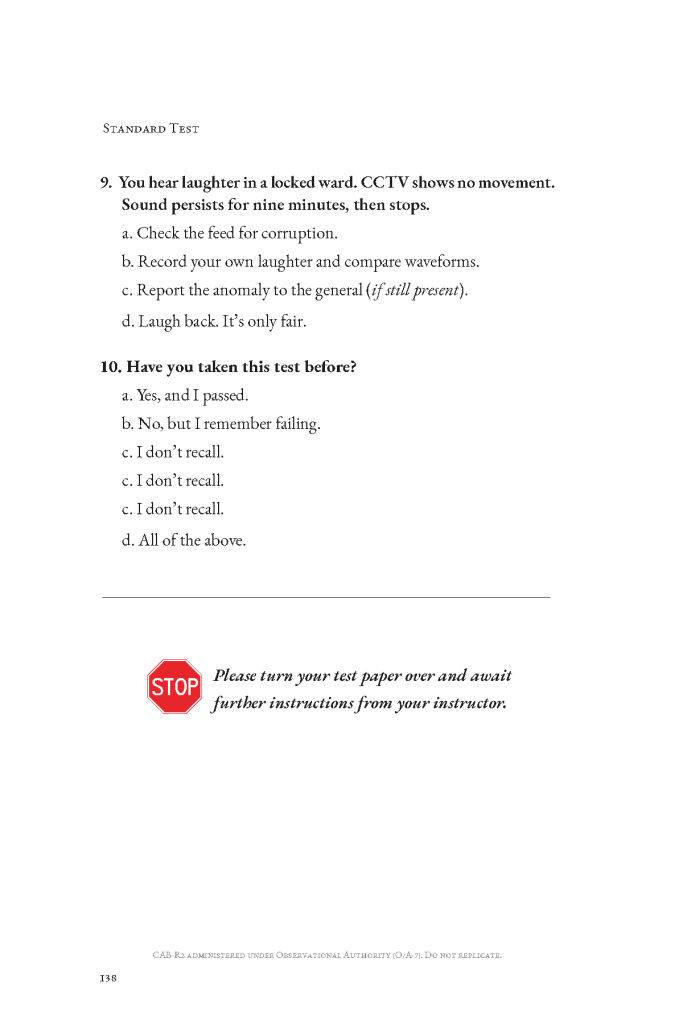
Chapter 28 is where the wheels come off. Or rather, where we slap on entirely different wheels – hexagonal ones. It takes the form of a standardised test. Yes, a literal test. Multiple choice. But fret not – there’s no grade, no timer, no Scantron sheet. Just questions. Absurd ones. Possibly even meaningful ones, though that’s above my pay grade.
Is it serious? Not remotely. Does it “advance the plot”? Hardly. Does it offer deep character insight? Not unless you’re profiling the author. But it does serve as a playful rupture in the narrative – a breather, a jab, a meta-giggle at the expense of structure and expectation. And let’s be honest: if you’ve made it to Chapter 28, you probably deserve a bit of a reward for tolerating everything prior.
As for spoilers: yes, technically, there are some. But without context, they’re like IKEA instructions written in Sanskrit. You might glimpse the shadow of something meaningful, but you’ll have no bloody idea what you’re looking at. No harm, no foul.
You can view Chapter 28 (along with several other amuse-bouches) for free on the Propensity book page. It’s downloadable as a PDF. No catch. No mailing list sign-up. I don’t want your email. I want your confusion.
Now, go take the test. Or don’t. It’s not graded. But it is a chapter.
I’ve been lurking and participating in many author and writing groups, but I’m not sure this is a productive strategy.
Like other authors, my goal is to network and connect to readers, and more importantly, buyers. The problem is that other authors, like myself, share the same goal in mind. There is no reciprocity, no “coincidence of wants,” which is that I happen to be offering a book that you might find engaging.
Audio: NotebookLM podcast on this topic.
Of course, one can frequent reader groups, but these are often inundated with publications, so there is no focus. I don’t write genre fiction, so I don’t have the benefit of, say, a sci-fi group, romance, werewolves, and whatnot. I (tend to) write literary fiction without identifiable tropes and storyline. As I’ve written before, there are no Hero’s Journeys, no saving the cat.
Indeed, there are literary fiction groups, but there are numerous motivations for this reader cohort. It is not homogeneous. I could (and do) hunt for sub-categories, but these are less fruitful.
I see dozens of ads splashed on my screen, suggesting someone can help me write my next book by telling me what’s hot, what’s selling. I am not interested in writing books that sell. I want to tell my stories. I am not a commercial writer in the same way that I was never a commercial musician. I am interested in the art. Of course, I want to sell my works, but it needs to be on my terms. If I were to sell out, it would just be another job with all of the intrinsic joy sucked out of it. The extrinsic appeal of money is not enough to compensate. Some people who take this commercial convince themselves, “at least I’m still writing,” or painting, or performing for a living. I am not able to comfort myself with this self-delusion. As the saying goes, ignorance is bliss.
Since I’m ranting…
I’ve been haunting author and writing groups for a while now – lurking in the shadows, peeking behind the curtain, occasionally tossing in a snide comment or two. Call it market research. Call it masochism. Either way, I’m starting to suspect it’s not the most productive use of my time.
You see, like most of these poor souls, I’m here to “network” (whatever that means in late-stage capitalism) and, more importantly, connect with actual readers. Buyers. The unicorns. Not fellow authors trying to sell me their 17-book werewolf reverse-harem saga or the latest AI-generated cover that somehow still manages to have three left hands.
And here’s the rub: we’re all pitching. No one’s catching. It’s a bazaar where everyone’s hawking their wares and no one’s carrying a purse. The law of the marketplace – what economists once called the “coincidence of wants” – simply doesn’t hold. I don’t want what they’re selling. They don’t want what I’m offering. It’s not even personal. It’s just noise.
Could I wade into reader groups instead? Sure. But these are often genre-clogged pools: romance, sci-fi, vampires with high school diplomas. God bless them. It’s just not my lane. I write literary fiction. You know, the kind without a tidy plot, without a cat-saving hero, and – brace yourselves – without an obligatory third-act redemption arc.
Even literary fiction groups aren’t much help. That label encompasses too much: Booker-bait bildungsromans, moody minimalism, and the occasional Proustian doorstop for good measure. And reader motivation in these spaces is hardly uniform. Some want to weep. Some want to feel clever. Some just want to say they read something “important” at brunch. None of them are asking for me – and that’s fine. But it does make targeting a pain in the arse.
Then come the ads. The snake-oil salesmen. “Here’s how to write a book that sells!” “Tap into trending genres!” “Master the market!” As if we’re all desperate to become a literary McDonald’s franchisee, pumping out Big Macs with words. I didn’t become a writer to stuff my soul into a Happy Meal box. I didn’t become a musician to churn out jingles. I don’t paint by numbers and I don’t plot by templates.
Yes, I want to sell my work – but on my terms. I’m not allergic to money; I just refuse to whore out my creativity to chase it. Some people convince themselves that so long as they’re still writing – still playing the game – they’ve won. I’m not built for that flavour of self-delusion. Call it ego. Call it integrity. I call it survival.
Since I’m already up here on my soapbox, let me kick it once or twice for good measure.
There’s a mountain of writing advice out there. I’ve read plenty. Some of it’s even good. But much of it is just a conveyor belt back to the same old factory settings: save the cat, beat the plot, rinse and repeat. I don’t write that way. I don’t read that way. I need more than recycled tropes wearing different hats. I need teeth. Friction. Depth.
Do I use tropes? Of course. We all do. Language itself is a trope. But I twist them. I break them. I bury them in the garden and see what grotesque things bloom. It’s not even effortful – it’s just how my brain is wired. Call it a feature, not a bug.
Anyway, that’s enough bark for one day. If you’ve ever stared into the marketing void and felt it blink indifferently back, I see you. If you’re a writer trying to walk the tightrope between integrity and visibility, I hear you. If you’ve got thoughts, confessions, or sacrificial goats to share, drop them in the comments. Misery loves literate company.
I’ve read a wide range of genres. I’ve found them most unsatisfying and therefore unappealing. I am not saying that these are now good. I’m saying that they don’t resonate with me. It’s why I don’t watch television and find few movies interesting. I need more than templated tropes.
Do I use tropes? Of course I do. Writing a book without tropes would be nearly impossible. I try to subvert tropes and expectations. In practice, I don’t even have to try very hard. It’s how my brain works on its own.
Last but not least, I don’t need a writer’s group, starter ideas, prompts, or exercises. I don’t get writer’s block, probably because I am not trying to force a plot.
Anyway, I’ll hop down off my soapbox. I wonder how many other writers share some of my perspectives and challenges. Let me know in the comments.
Measuring progress is far simpler when you’re writing. You can count words. Or characters, if you’re a sadist. Sure, half of them might be drivel. Whole chapters may end up ceremonially executed by draft five, but at least you’ve done something. There’s a metric. A tally. A sense of movement.
Audio: NotebookLM podcast on this topic.
You can even see your progress, pages stack, paragraphs grow fat with promise. And if you still write on physical media (bless your nostalgic heart), you get the added catharsis of crumpling your failures and lobbing them at the bin like a disgruntled poet. It’s theatre. It’s progress. It’s delusional.
Editing, by contrast, offers no such cheap thrills. The word count doesn’t so much creep as collapse. One minute you’re a literary demi-god sitting on 80,000 words. The next, you’re scraping along at 74k and wondering whether your “tightening” has amputated a limb.
Yes, the prose might be cleaner. Punchier. Less like a whisky-soaked rant and more like a distilled insult. But does it feel like progress? Not in the way dopamine understands it.
As I’ve written before, editing takes me five – maybe ten – times longer than drafting. It’s a full hemispheric shift: from right-brain dreamscapes to left-brain bureaucracy. Creativity gives way to spreadsheet logic. Grammar. Timelines. Continuity. Did she sit before she spoke, or after? Is this line meant to be his? Why is this in past tense? Is this in any tense?
And so, the grind.
Yes, there are flashes of satisfaction – a retooled transition here, a twist landed just-so there. But mostly, it’s a long, slow crawl through self-loathing and misplaced modifiers.
I’ve spent most of my adult life toggling between left-right hemisphere roles. And frankly, the left side still gives me hives. The corporate world, bless its hollow soul, tried to stuff me in a logic-shaped box. A coffin of metrics, meetings, and “measurable outcomes.” I’m still recovering.
So why not outsource editing? Why not let someone else swing the machete through this jungle?
Two reasons:
I secretly enjoy the act of refinement. It’s masochism, but it’s my masochism.
I operate on a margin so thin it’s practically theoretical. A Schrödinger’s budget – simultaneously there and not.
I’m editing what I expect will become my next novel. Editing, for me, is a fundamentally different headspace than writing. When I’m drafting – especially when pantsing – I lean into a stream-of-consciousness flow. Iain McGilchrist might call this right-hemisphere activity. I don’t steer so much as ride shotgun, scribbling while the character drives.
Audio: NotebookLM podcast on this topic.
(Side note: I’ll share the tentative cover art soon, but this post is about process.)
Editing, by contrast, is all left hemisphere – angles, order, logic, connection. When I’m writing, I don’t worry if a detail makes sense. That’s future-me’s problem. In this project, future-me discovered that the protagonist had been pregnant for over thirteen months, undertaking activities most wouldn’t attempt in that state. In a nonlinear story, this might slip past many readers – but not past my editorial self. I mentioned this in a prior post.
I used to devour writing advice, but I don’t write like other people. Most advice seems geared toward genre fiction. I’m not opposed to that, but I lean literary and experimental. Templates don’t work for me.
I know the Hero’s Journey. I’ve read Save the Cat. But I don’t write about heroes – or even anti-heroes. That’s not the kind of story I’m telling, nor the kind I usually read.
I don’t much care about strong characters for their own sake. I care about what they allow me to explore philosophically. That said, this project is different. The main character is strong. So are the secondaries. And while it’s still fiction, it’s rooted in real people and events – compressed, reshaped, but recognisable.
I’ve condensed two decades of experience into a seven-year arc across ~200 pages. The first three years are flashbacks, brushed in for colour. The rest unfolds more or less in sequence. This time, I didn’t give myself free rein. There are rails. And while I occasionally jump them, I still need to land somewhere coherent.
The structure is a four-phase design. The book opens in media res and stays there for a few chapters. Then we rewind. And rewind again. Eventually, the timeline catches up, and the final half moves more linearly.
To tame this beast, I turned to spreadsheets. I built a plot matrix – numbering each section twice: narrative order (as written) and chronological order (as lived). I had to find the earliest flashbacks and stitch the rest together like some temporal jigsaw. It felt like Inception at times. Where am I? What layer is this?
From there, I started tracking time: days, weeks, months. That’s when I uncovered the 13-month pregnancy. Realistic for an elephant, not a human.
The root problem? I sequenced the conception too late and compressed the birth too early. I also omitted two earlier pregnancies to streamline the plot. To fix it, I reinstated one and used it to restore character depth that had been left on the cutting room floor. It worked – but it added new complications. Now I’m back in spreadsheet land, scanning for widows and orphans – narrative orphans, I mean – where scenes dangle or disconnect.
This is where editing diverges from writing. Writing is dreaming. Editing is retelling. And retelling demands coherence. Dreams ignore time, cause, and logic. Retelling insists on them: this happened before that, and then…
So-called “plotters” operate almost entirely in the left hemisphere. Structure first. Logic forward. Details coloured in after. It’s a valid approach – but one with fewer degrees of freedom. Creative constraints come with the template. You still get unique results, but you’ve narrowed the space. Stephen King’s version would differ wildly from JK Rowling’s – but both would be channelled through the same scaffolding.
You can argue that creativity happens in the choosing of the structure. Fair. But unless you’ve invented something truly novel, you’ve still chosen from a shelf of precedents. The story begins where freedom ends.
Welcome, dear reader, to the eternal skirmish between Art and Entertainment, or as the marketing departments like to call it, Literary Fiction vs Commercial Fiction. This is not just a genre squabble; it is the ideological showdown between truth-seeking masochists and market-savvy optimists.
Literary Fiction: Starving Artist Chic
Literary Fiction is what happens when someone spends ten years writing a novel that doesn’t sell but gets shortlisted for an award no one outside The Guardian has heard of. It is the sanctum of character studies, of prose polished until it cuts glass, of metaphors so dense they require footnotes and a whisky.
It doesn’t have to be inaccessible, of course—it just often chooses to be, on principle. Plot is optional, punctuation negotiable. The point is to mean something. To explore the human condition. To examine alienation in a post-industrial neoliberal hellscape, not to entertain your aunt with a beach read.
It’s not that Literary Fiction hates readers. It just isn’t convinced they’re entirely necessary.
Commercial Fiction: Mass Appeal on Tap
Enter Commercial Fiction: the cheerfully formulaic cousin who makes six figures ghostwriting romance under three pseudonyms while sipping cocktails on a cruise. It values clarity, pace, and payoff. There is a beginning, a middle, and—brace yourself—a satisfying end.
It’s written with the audience in mind. The actual audience, not the imagined one you conjure during your third espresso in a North London café while reworking the opening line for the sixth time.
Commercial Fiction exists to be read. Literary Fiction exists to be discussed. Possibly in a room full of mirrors. Possibly after death.
The High-Low Culture Divide
If this were the Renaissance, Literary Fiction would be frescoes in a cathedral—revered, roped-off, and best viewed with your neck craned in discomfort. Commercial Fiction would be the travelling puppet show outside: rowdy, raucous, full of cheap laughs and bawdy jokes. Guess which one brings joy to the masses and which one gets preserved by UNESCO.
There is still this Victorian hangover about high art and low art, as if prose needs a monocle and a trust fund to be taken seriously. Literary Fiction clings to its moral high ground, publishing monographs on the death of the novel, while Commercial Fiction’s out here resurrecting it one bestseller at a time.
Intention Matters
Let’s be honest: some literary writers stumble into the bestseller lists. It’s not beneath them—it just wasn’t the point. Conversely, when a commercially-minded author attempts “Art,” the results are often embarrassing—like a stand-up comic trying Shakespeare in clown shoes.
Approaching from a commercial angle and achieving something artistically resonant? That’s the alchemy. That’s the rare bird. But the reverse—starting with art and accidentally making money—is a tale as old as Joyce (who, let’s remember, died broke and banned).
Can’t We All Just Get Along?
No. Just kidding. Sort of.
Yes, there is crossover. Yes, The Road is both. But let’s not pretend that Twilight and To the Lighthouse are playing the same game. One is trying to build a fanbase; the other is trying to dissect perception itself. And while both may involve vampires, only one is metaphorical.
In Conclusion
Commercial Fiction is a warm bath. Literary Fiction is a cold shower that leaves you questioning your life choices. One sells. The other sulks. One entertains. The other enlightens (maybe). You can love both, loathe both, or—if you’re cursed with a literary soul—you can write one while envying the other.
Either way, don’t pretend they’re the same. One is art. The other is commerce. Sometimes they shake hands. Occasionally they snog. But more often, they glare at each other from opposite ends of the bookstore, muttering into their blurbs.
Does anyone else use writing props to help immerse yourself in adjascent fiction?
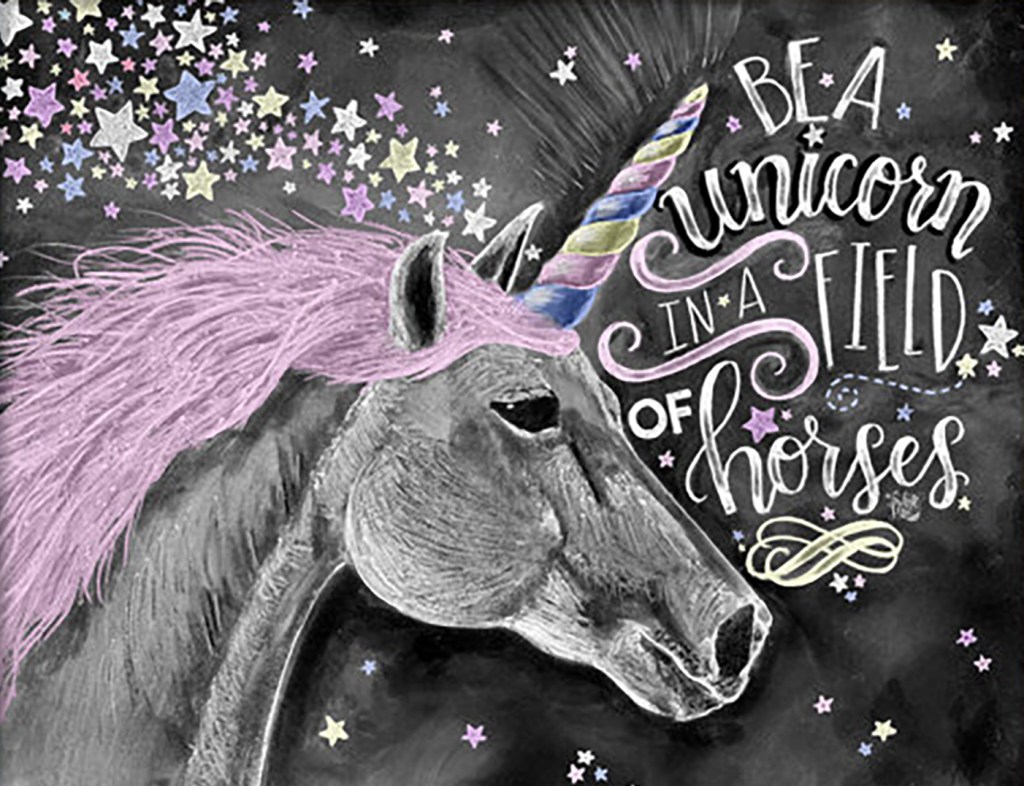
This unicorn image is from a poster. I am using it as a reference for a current project. It’s already seared into my brain, but it renders it somehow more real.
This unicorn poster hung on the wall of the inspiration for the protagonist of an upcoming novel, Needle’s Edge. It featuers prominently – almost has a speaking part.
Maps
Hemo Sapiens: Awakening is set in near-future Manchester, UK, so I had maps of Manchester at the ready. It helped me to add some realism. Because a trip from a nearby town into the city only took 15 to 20 minutes, I had to edit down a scene I was hoping would fill an hour. I could have used a location further away, but it wouldn’t have made sense to the plot, and I hate those sorts of plot gimmicks.
Sustenance is set in Iowa. I not only had a map of Iowa, I had resources on flora and fauna, so I could name-drop. I’ve visited parts of Iowa, but I couldn’t have drawn these details from memory—and I mightn’t have known the names or the onomonapoeia fascimiles.
Temporal Babel is set in New Mexico, so besides a map for highway references and distances from landmarks—towns, cities, and reservations—, I saved image resources of local photographs, landscapes, plants, buildings, attire, and so on. It really helps we with the description, something that is not otherwise my forte.
Propensity is set in no place in particular, so I used no maps, but I studied interiors of institutions, prisons, laboratories, and the like.
This is another unicorn sticker that was in the house of the protagonist, but it doesn’t make the cut. It still makes me chuckle.
Another unfinished novel, Everlasting Cocksucker, is set in Philly. I spent severl years in and around there, so I know the lay of the land. Still, I find maps useful.
I put this project ont he backburner because I received so much hate over the subject matter. I decided to concentrate on other projects. But, I created a physical shadowbox as a reminder of the protagonist.
Image: Reconstruction of a shadowbox.
In this story, this represents her life habits: Newport Menthol 100s in a box, Red Bull, Maruchan Ramen, and tarot readings. The Hanged Man is relevant to the plot. When I return to the manuscript, I’ll have this as, let’s call it, inspiraration.
If I wrote genre fiction, this wouldn’t work as well – Sci-Fi or Fantasy and whatnot. It might work for historical fiction though.
I hate to be the bearer of bad news – especially if you’re still slogging through a draft of your first manuscript. You know what some people say about writing a book is the hard part.
Lies. Damned lies. That’s the frothy, twinkly nonsense parroted by people who’ve never published anything beyond a social media post, probably only a comment.
Audio: NotebookLM podcast on this topic.
Let me tell you the truth. The actual, bloodstained, coffee-fuelled truth:
Writing the book is the easy part.
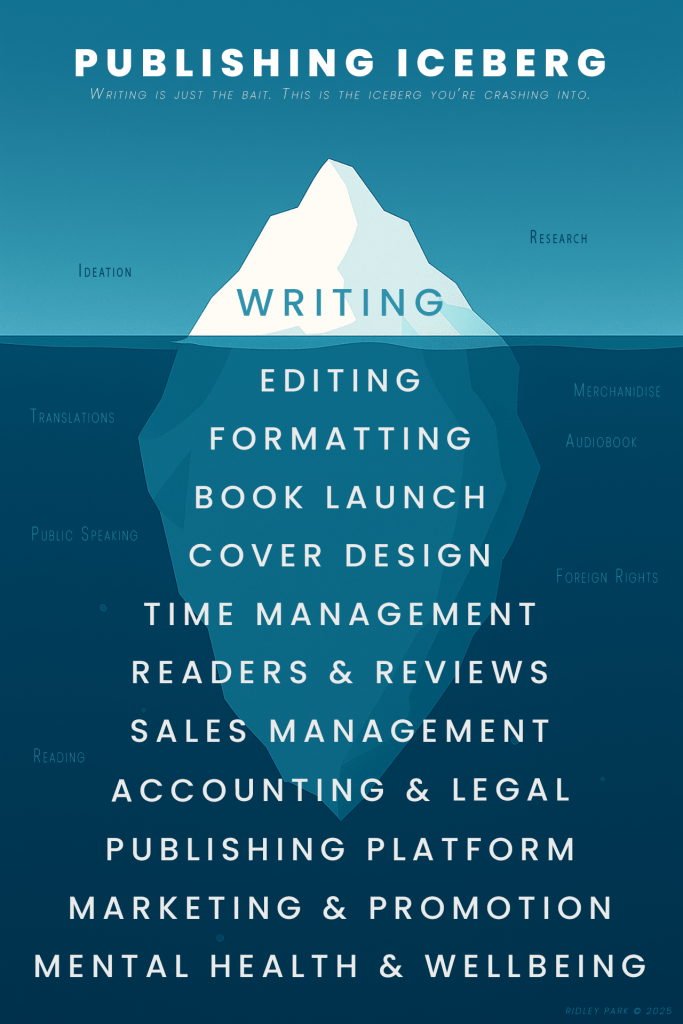
It’s the visible tip of the iceberg, smugly floating above the surface, soaking up the praise and admiration. Meanwhile, everything else – the sleepless nights, the decimal-point royalty statements, the unpaid invoices to your own soul – is lurking beneath, waiting to sink your mental health like the HMS Delusion.
So here it is, for posterity and pity:
Post-Writing Gauntlet: The Real Job Begins
1. Editing (Five Times, If You’re Lucky)
Developmental editing – “Is your plot a plot or a pile of wet spaghetti?”
Line editing – Making your sentences less embarrassing.
Copyediting – Catching your consistent misuse of ‘affect’ and ‘effect’.
Proofreading – The last defence against the typo apocalypse.
Beta feedback – Friends who suddenly vanish when asked to read a draft.
2. Formatting and Typesetting
Print vs digital layouts. Word crimes meet paragraph crimes.
EPUBs that break for fun.
That one widow on page 243 you didn’t notice until the proof copy arrived.
3. Cover Design
DIY, Fiverr roulette, or mortgage your cat to hire a professional.
Matching tone, genre conventions, and market expectations.
Spelling your own name correctly. (Don’t laugh, it happens.)
4. ISBNs and Metadata Hell
ISBN purchases (if you’re not relying on Amazon’s identifiers).
Title, subtitle, BISAC categories, keywords, blurbs, author bio — all rewritten seventeen times.
5. Publishing Platform Setup
Kindle Direct Publishing, IngramSpark, Kobo, Draft2Digital, Smashwords — pick your poison.
Print proofs, bleed settings, trim sizes, the baffling difference between matte and gloss.
6. Marketing (a.k.a. Screaming Into the Void)
Author website & blog (SEO: your new religion).
Social media presence — the façade of charm over existential dread.
Newsletter with a totally non-spammy freebie opt-in.
Ads: Amazon, Facebook, Instagram, Google. Burn money to test the water temperature.
7. Book Launch
ARCs, blog tours, launch events, or at least pretending you’re doing those things.
Coordinating reviews before anyone has read the damn thing.
Press kits and media outreach — basically shouting “LOOK AT ME” with tact.
I was feeling smug. Fourth revision pass. Plot matrix built. Columns for chapter, scene, POV, date, time, location, word count, and emotional arc – because I’m that kind of monster. I even added colour-coding.
And it worked. Mostly.
After pruning and polishing, it finally felt ready to ship. Just a couple cosmetic tweaks. A trim here, a varnish there. Run a lint roller over the dialogue. Call it done.
Except.
The matrix – traitorous little bastard – exposed a structural fault so elegant I’d almost admired it. The problem? Pregnancy. Not mine, the protagonist’s. (Let’s not get ahead of ourselves.)
Turns out, I’d compressed over a decade of real-life events into two years of narrative space. Bold. Efficient. Reckless. I’d wrung out the filler, reshuffled a few puzzle pieces, and declared the thing plausible.
Only it wasn’t.
When I sorted the scenes chronologically, the matrix coughed. The story broke like a cheap lawn chair. There she was: visibly pregnant while also, somehow, gallivanting about in scenes that would’ve required a different physiology entirely. Not an Olympian, but the metaphor holds.
And that’s when it hit me: time may be a flat circle, but gestation is not. No amount of POV tricks or narrative backflips can make a third-trimester body do first-trimester things. Biology, the ultimate killjoy.
So now I’m doing surgery. Not delicate surgery, either. I’m sawing out whole sections, rebuilding connective tissue, and laying down scar tissue where the timeline used to be. I’ll need new plot scaffolding to support the pregnancy and its repercussions. It’s fine. It’s good. It’s hell.
This is revision. We go in thinking we’re buffing up the finish, only to discover we paved over a sinkhole.
An unsolved literary mystery where language fails first.
I’m thrilled to announce the release of my latest novella, Temporal Babel, now available in paperback and hardcover. It’s a story about a man who arrives with no language the world can understand—and the woman who tries to name him anyway.
Audio: NotebookLM podcast on this topic.
Set in small-town New Mexico, Temporal Babel is not a thriller. It’s not about saving the future or rewriting the past. It’s about the weird middle ground where things don’t quite translate—linguistically, temporally, emotionally.
If you’ve ever wondered what it would feel like to encounter someone truly out of place—where even the word where doesn’t land—you’ll find something resonant in these pages.
What’s it about?
A young woman discovers a man on the roadside. He’s naked. Marked with strange blue scars. And the words coming out of his mouth aren’t quite English. Or anything else.
No memory. No ID. No history that the town of Anika can decipher. But as he begins to recover, the sound of his voice becomes its own riddle.
Some readers may call this speculative fiction. Others might shelve it under linguistic noir. I just call it a contact story—minus the aliens, or is it?
Why read it?
🔹 If you enjoy novels that refuse to explain themselves, this one’s for you.
🔹 If you like language play, phonetic drift, and dialect as plot, this one delivers.
🔹 If you like stories where the weirdness builds slowly, quietly, without fireworks—you’ll feel right at home.
“Dis kē?” he asks. What is this? No one knows. Not even the narrator.
📖 Temporal Babel is available now in paperback and hardcover.









 Ridley Park