Five chapters down, and Anna Kavan’s Ice is already proving itself to be less a novel than a feverish novelette-length hallucination. It hits differently than the sprawling sagas I’ve been chewing through – leaner, sharper, like a shard of frozen glass pressed against the skin.
This isn’t realism. If you try to read it as realist narrative you’ll only tie yourself in knots, muttering that the protagonist keeps chasing a girl he half-admits isn’t even there. He catches glimpses, shadows, phantoms – and follows them anyway. Contrived? Yes, if you expect logic. Coherent? Absolutely, if you treat it as dream grammar, where compulsion replaces causality and the world obeys obsession more than physics.
The point-of-view is the real hall of mirrors. Not so much “unreliable narrator” as unreliable perspective: the voice flickers, sometimes inside his skull, sometimes inside hers, sometimes perched like an outside observer. As in a dream, identities blur. The supposed rescuer blurts out sadistic fantasies, sounding alarmingly like the blue-eyed Warden he claims to oppose. It’s less “out of character” than a reminder that character itself is already compromised.
So, no, you can’t hold this text to the rules of straight narrative. You have to read it the way you stumble through a nightmare: half-convinced, half-sceptical, fully captive.
Where it all leads? I’ve got perhaps seventy pages left to find out. For now, I’m letting the ice close over me, listening for the crunch of those imaginary bones.
EDIT: I’ve finished Ice and left a review on Goodreads. tl;dr: I gave it a 3 of 5 stars. ⭐⭐⭐ It was good. Mercifully it was short. As it reads like a dream sequence, there are no stakes. From the start, I wasn’t heavily invested in what happened to the protagonist nor the subject of his attrction. There were some good scenes, but not enough for me to give it more than a 3.
I don’t want to develop a reputation as an AI apologist – I really don’t. But I do want to strip away the veneer humans so lovingly lacquer over themselves: the idea that art is some mystical emanation of a “soul,” accessible only to those blessed by the Muse and willing to suffer nobly in a garret.
Video: YouTube Short by Jonny Thompson of his interview with Rachel Barr
Rachel Barr argues that AI art can never be the same as human art, no matter how “perfect,” because AI has no feelings or drive. Cue the violins. These arguments always seem to hinge on metaphysical window-dressing. When Rachel says “we”, she’s not talking about humanity at large; she’s talking about herself and a very particular subset of humans who identify as artists. And when she invokes “masters”, the circle shrinks still further, to the cloistered guild who’ve anointed themselves the keepers of aesthetic legitimacy.
But here’s the bit they’d rather you didn’t notice: feelings and drive aren’t prerequisites for art. They’re just one of the many myths humans tell about art, usually the most flattering one. Strip away the Romantic varnish and art is often craft, habit, accident, repetition. A compulsive tic in oil paint. A mistake on the guitar that somehow worked. A poet bashing words together until something sticks.
And I say this not as a detached observer but as a writer, artist, and musician in my own right. I sympathise with the instinct to defend one’s turf, but I don’t need to steep myself in hubris to retain self-worth. My work stands or falls on its own. It doesn’t require a metaphysical monopoly.
So when someone insists AI art can never be “the same,” what they mean is it doesn’t flatter our myths. Because if an algorithm can spit out a perfect sonnet or an exquisite image without the tortured soul attached, then what have we been worshipping all this time? The art itself, or the halo around the artist?
Perhaps the real fear isn’t that AI art lacks feelings. It’s that human art doesn’t require them either. And that’s a blow to the species ego – an ego already so fragile it cracks if you so much as ask whether the Mona Lisa is just paint on a board.
At last, the circle is complete. I’ve slogged through the full dystopia roster, the canonical set so beloved of memes and Venn diagrams. Orwell, Atwood, Burgess, Huxley – and now, Gattaca. Completion is satisfying, but the price of admission? Almost two hours of cinema so wooden you could build an ark.
The problem is not the premise. Genetic determinism as a caste system is a fine conceit – prescient even. But the execution? Trite, contrived, and about as subtle as an Ayn Rand sermon. This is a film with zero degrees of freedom: a script where every outcome is preordained, every obstacle contrived, every subplot bent double to guarantee Vincent’s ascent. It rails against determinism while embodying it.
And the characters? Archetypes in pressed suits. Vincent, the plucky underdog. Jerome, the fallen aristocrat with a liquor cabinet. Irene, the sceptical love interest who abruptly switches sides because the script tells her to. They don’t act, they oblige. It could just as easily have been written in the 1940s, swapped in for a Jimmy Stewart melodrama about class prejudice, courtroom vindication, and the triumph of the “human spirit.” The only modern touch is the genome gimmick.
Yes, admirers gush about its minimalism, its prescience, its “timeless” style. But strip back the sleek lines and moody jazz soundtrack, and you’re left with fortune-cookie profundities (“There is no gene for the human spirit”) welded onto a Rube Goldberg plot. It’s not timeless; it’s tired.
So yes, I’ve ticked it off the list. But at what cost? I endured the dialogue, the implausible sequencing, the endless plot coupons masquerading as destiny. Gattaca may live on in classrooms and think-pieces, but as cinema it collapses under its own deterministic weight.
This particular meme has been making the rounds like a drunk uncle at a wedding – loud, colourful, and convinced it’s profound. A Venn diagram, no less! Four big circles stuffed with dystopias, slapped together as if geometry itself conferred wisdom. Most of them are books, a few are films, and one – Gattaca – is glaring at me because I haven’t seen it. That omission alone feels like a character flaw. I might grit my teeth and watch it just to close the loop, though it doesn’t exactly scream, “Pour a glass of wine and enjoy.”
DISCLAIMER: This is not a political post.
Image: Venn Diagram
Here’s the thing: as art, it’s rather lovely. As a piece of intellectual cartography? It’s rubbish. It pretends to classify but in fact it merely collages. Orwell is pressed up against Burgess, Atwood rubs shoulders with Logan’s bloody Run, and in the middle sits Animal Farm, as if pigs with clipboards are somehow the Rosetta Stone of dystopia.
And yet – if you squint just so, tilt your head like a dog hearing a harmonica, you can just about see some tenuous ligatures:
Surveillance and conditioning: 1984, Clockwork Orange, and The Matrix all insist that the human mind is clay to be moulded by boot, syringe, or simulation.
Reproduction and regulation: Brave New World, The Handmaid’s Tale, and yes, Gattaca (apparently) fret endlessly over who gets to breed, who gets culled, and whose DNA deserves a future.
Bodies as resource: Soylent Green, Brazil, Gattaca again – people ground down into spreadsheets, rations, or literal mince.
The veneer of civilisation: Lord of the Flies and Animal Farm showing us that civilisation is just papier-mâché over the swamp.
But let’s be honest: the diagram isn’t actually saying this. It’s just four intersecting blobs, with titles hurled in like darts at a pub quiz. The apparent “structure” is nothing more than meme-magic – order conjured out of chaos to make you nod gravely as you scroll by.
So yes: as art, it works. As a Venn diagram, it’s a travesty. And maybe that’s the deeper joke. We live in an age where every complexity gets crushed into an infographic, every horror squeezed into a digestible meme. Which, if you think about it, is itself a bit dystopian.
Fresh from my recent post on movies that are better than books, I now consider books and movies with symbiotic or synergistic energy – better together.
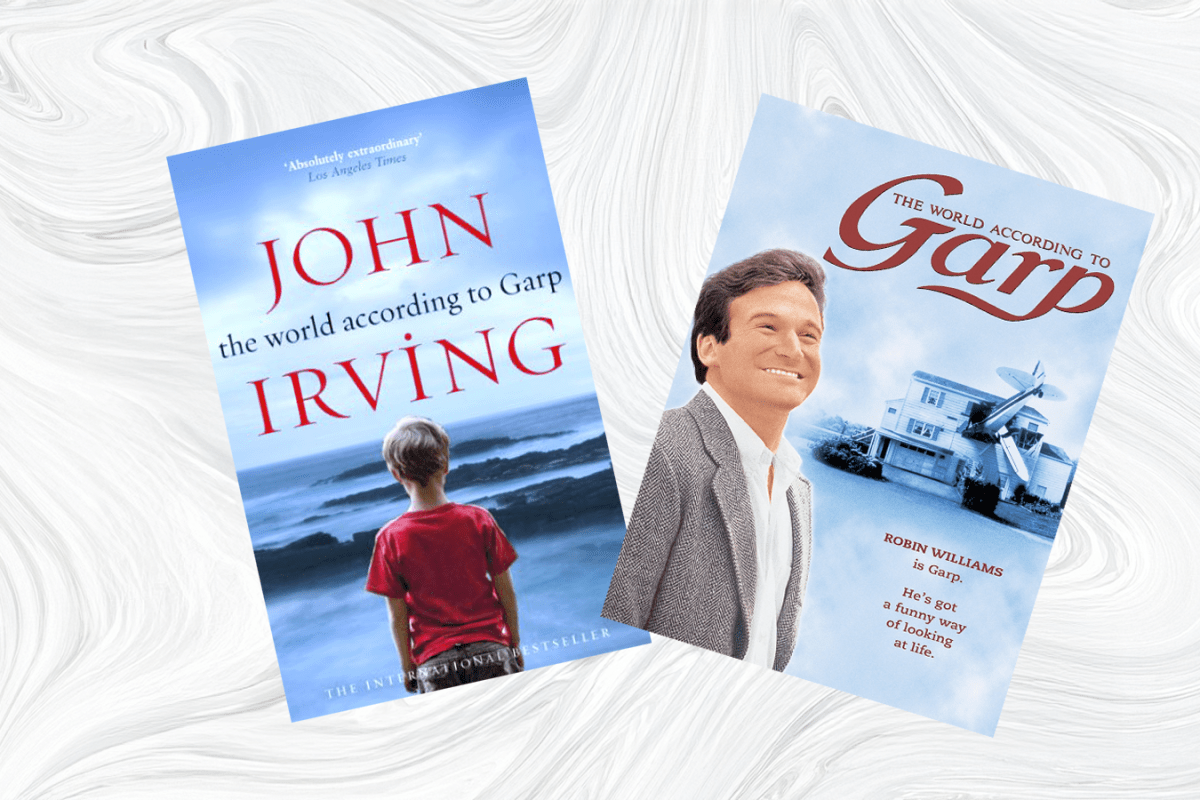
I first stumbled onto this realisation with The World According to Garp. Hearing that the film was about to be released, I bought the book; it was decent. I saw the movie when it came out; it was decent.
The book (John Irving, 1978) is sprawling, grotesque, and digressive, with moments of brilliance scattered through longueurs.
The film (1982), with Robin Williams and Glenn Close, trims away nuance for two hours of cinematic shorthand.
Alone, each feels middling. Together, they fill the gaps. The novel provides texture and detail; the film provides embodiment and immediacy. It’s like puzzle pieces snapping together.
We tend to frame it as a duel: book versus movie, page versus screen. One must be superior, the other a pale imitation. But occasionally, the two work in tandem, not rivals, but co-conspirators. Taken alone, each may be “just okay.” Together, they form a whole greater than their parts. Notice that the IMDB scores are lower for movies that are better than books, due to the synergistic effects.
Disclaimer: I didn’t like these uniformly, but my thesis still holds. Moreover, film is not typically my preferred medium.
Here are a few other book–film pairings that work this way:
McEwan’s metafictional games on the page feel cerebral. Wright’s film, with its Dunkirk tracking shot and that infamous green dress, floods the senses. Together they fuse thought and feeling.
Proulx’s prose is spare, devastating in its restraint. Ang Lee’s film opens the silences into landscape and longing. Neither feels whole without the other.
Mitchell’s Russian-doll narratives dazzle but drag; the Wachowskis’ intercutting dazzles but confuses. Together they hint at the ambition neither medium alone quite nails.
I publicly confess that I didn’t really like either version of Cloud Atlas. A mate suggested I read the book ahead of the film. It was convoluted and mid. Ditto for the film, but for different reasons. I felt that the concept was nice; it simply didn’t translate. YMMV.
Golding’s allegory sometimes feels over-determined. Brook’s film, shot with actual boys descending into ferality, restores the anthropology behind the allegory.
IMDB Rating: 6.9/10
Why Symbiosis Matters
When book and film complete one another, it challenges the false binary of better or worse. Sometimes, the text supplies what the film cannot: detail, psychology, interior voice. Sometimes the film supplies what the text cannot: embodiment, atmosphere, a world you can see.
Instead of competition, the relationship becomes conversation.
So perhaps the real question isn’t “Which is better?” but “Which needs the other to feel complete?”
What pairings have you found where book and film together elevate each other beyond what either could manage alone?
I recently watched two movies. The book The Children of Men was published by P.D. James in 1992, and the movie was adapted by Alfonso Cuarón in 2006; Filth was written by Irvine Welsh in 1998 and adapted for film by Jon S. Baird in 2013.
Upon watching Children of Men, I came away feeling that the movie was better than the book – at least it resonated more to my liking. A person with other sensibilities may prefer the other. Taste is never universal. I understand that some people can actually eat seafood.
Audio: NotebookLM podcast on this topic.
The book Filth was more typical in that it was better than the movie, although the movie was interesting in its own right; it still paled in comparison. I also found Trainspotting – another Irvine Welsh story – to be a good movie, but it still doesn’t quite live up to the book.
So where am I going with this?
I decided to consider what movies surpassed their source material. I chatted it up with several colleagues and came up with a short list of titles I suspect many have already encountered at least one or the other. I’ll mention where I disagree with the consensus position.
Here’s my rogue’s gallery of films that managed the rare trick of outshining their ink-and-paper parents. Note that this doesn’t represent the order of importance. It is sorted by IMDB film rating as of today.
Stephen King’s novella Rita Hayworth and Shawshank Redemption is solid, but Darabont turns it into a near-religious fable of hope, anchored by Tim Robbins and Morgan Freeman.
Mario Puzo’s novel is pulpy, uneven, and bogged down with subplots; e.g., a chapter on vaginal surgery, no joke. Francis Ford Coppola elevates it into a Shakespearean tragedy.
Chuck Palahniuk’s Fight Club is culty fun, but Fincher sharpens it into a pop-culture grenade – stylistically explosive and endlessly quoted.
IMDB Rating: 8.8/10
One Flew Over the Cuckoo’s Nest (Book: 1962; Film: 1975)
Ken Kesey’s novel One Flew Over the Cuckoo’s Nest is beloved but limited by its narrator’s hallucinations. Milos Forman widens the lens, gives Nicholson free rein, and makes Louise Fletcher’s Nurse Ratched iconic.
Robert Bloch’s Psycho is a tidy pulp thriller. Hitchcock elevates it to a cultural earthquake: the shower scene, mother’s voice, the birth of the modern slasher film.
Stephen King hated Kubrick’s icy interpretation, but cinephiles generally rank the film higher for its visual dread and Nicholson’s unhinged performance.
Inspired by Joseph Conrad’s Heart of Darkness. Conrad’s novella is foundational but slight. Coppola transposes it to Vietnam and creates an operatic nightmare of war.
Apocalypse Now is the consensus masterpiece, and I’ll grant Coppola his fever-dream credentials. But here’s where I part ways with the choir: strip away the meta-theme and you’re left with a bloated war movie that mistakes endurance for profundity.
Upton Sinclair’s socialist novel Oil! is didactic and sprawling. Paul Thomas Anderson cherry-picks a few ideas and creates a volcanic character study of greed and obsession.
Philip K. Dick’s Do Androids Dream of Electric Sheep?is clever but meandering; Ridley Scott builds a visual and philosophical cathedral around identity, memory, and humanity.
Stephen King’s second entry, novella The Body, is a touching coming-of-age tale, but Reiner’s adaptation injects nostalgia, pathos, and one of the best ensemble casts of the ’80s.
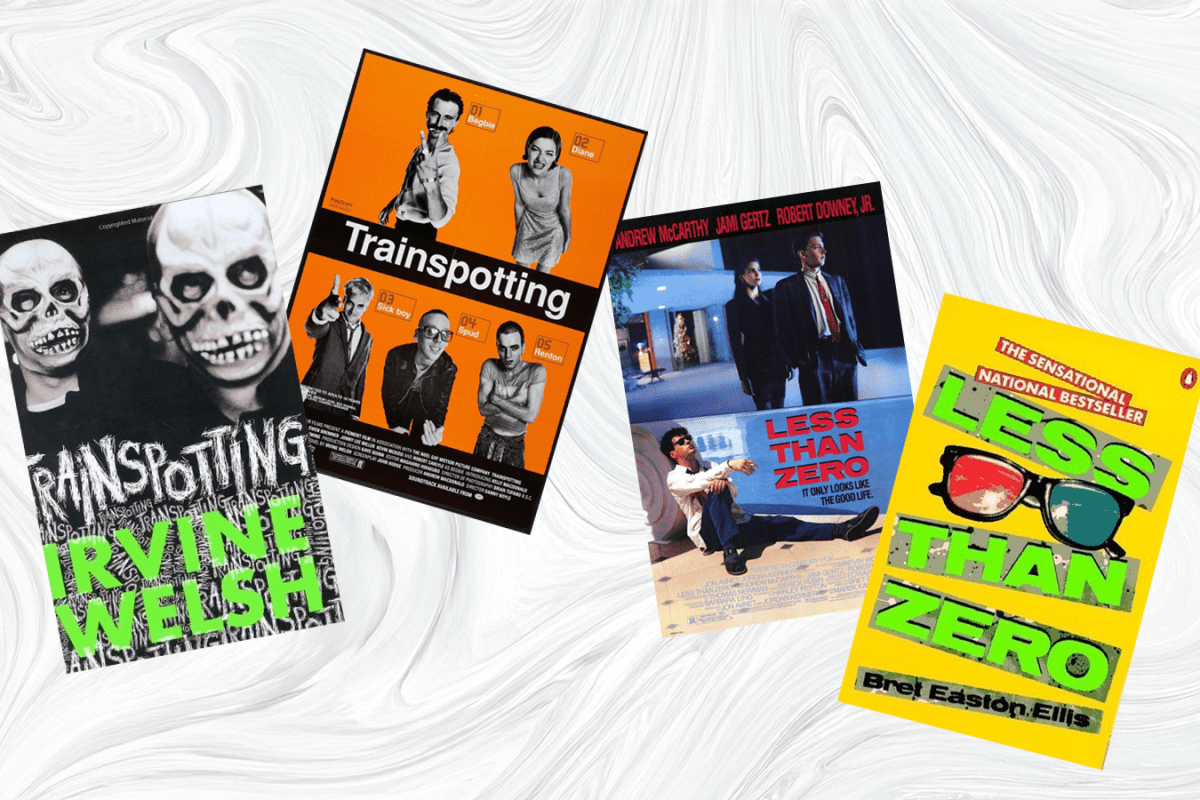
Film has an extraordinary talent for turning jagged, difficult novels into cultural smoothies. Hand Hollywood a text about drugs, despair, and the grotesque collapse of youth, and it will hand you back something fit for a date night. Less Than Zero was gutted. Trainspotting was diluted. Both survived, after a fashion, but only one crawled back out with its bones still rattling.
Audio: NotebookLM podcast on this topic.
Ellis’s Less Than Zero was a flatline pulse of Californian ennui, a catalogue of hollow gestures in which the children of wealth consume themselves into oblivion. The backdrop was Reaganism in full bloom—an America drunk on consumerism, cocaine, and the fantasy of eternal prosperity. The kids in Ellis’s Los Angeles aren’t rebelling; they’re marinating in the very ideology that produced them. The film, by contrast, became a tepid morality play, complete with Robert Downey Jr.’s photogenic martyrdom. The void was swapped for a sermon: drugs are bad, lessons have been learned, and the Reaganite dream remains intact.
Welsh’s Trainspotting was messier, darker, harder to pasteurise. His junkies live in Thatcher’s Britain, where industry has collapsed, communities have rotted, and heroin fills the crater where meaningful work and social support once stood. Addiction is not just chemical but political: it is Thatcher’s neoliberalism rendered in track marks. Boyle’s film kept the faeces, the dead baby, the violence—but also imposed coherence, Renton as protagonist, a redemption arc, and that chirpy “Choose Life” coda. Welsh’s episodic chaos was welded into a three-act rave, all set to Underworld and Iggy Pop. Diluted, yes, but in a way that worked: a cocktail still intoxicating, even if the glass had been sanitised.
And yet, here’s the perennial fraud: drug films always get high wrong. No matter how grim the setting, the “junkie experience” is rendered as theatre, actors impersonating a template someone else once performed badly. The reality of heroin use is crushingly dull: twenty minutes of near-unconsciousness, slack faces, dead time. But you can’t sell tickets to drool and silence. So we get Baudrillard’s simulacrum: a copy of a copy of an inaccurate performance, dressed up as reality. McGregor’s manic sprint to “Born Slippy.” Downey’s trembling collapse. Junkies who look good on screen, because audiences demand their squalor to be cinematic.
And here’s where readers outpace viewers. Readers don’t need their despair blended smooth. They can sit with a text for days, grappling with jagged syntax, bleak repetitions, and moral vacuums. Viewers get two hours, max, and the thing must be purréd into something digestible. Of course, not all books are intellectual, and not all films are pap. But the balance is clear: readers wrestle, viewers swallow. One is jagged nourishment, the other pasteurised baby food.
So Less Than Zero becomes a sermon that spares Reagan’s dream, Trainspotting becomes a rave-poster that softens Thatcher’s wreckage, and audiences leave the cinema convinced they’ve glimpsed the underbelly. What they’ve really consumed is a sanitised simulation, safe for bourgeois digestion. The true addict, the tedious, unconscious ruin of the body, is nowhere to be found, because no audience wants that reality. They want the thrill of transgression without the boredom of truth.
And that, finally, is the trick: cinema gives you Reagan’s children and Thatcher’s lost boys, but only after they’ve been scrubbed clean and made photogenic. Literature showed us the rot; film sells us the simulacrum. Choose Life, indeed.
Critics never tire of reminding us that AI has no emotions, as though this were some startling revelation. Next, perhaps, they’ll inform us that penguins can’t fly and that bankers are allergic to honesty. Yes, generative AI has no emotions. But must we wheel in the fainting couches? Writers don’t need it to sob into its silicon sleeve.
Full disclosure: I am a writer who writes fiction and non-fiction alike. I am also a language philosopher; I study language. And a technologist. I’ve been working with artificial intelligence since the early ’90s with Wave 3 – expert systems. I am still involved with our current incarnation, Wave 4 – generative AI. I know that artificial intelligence has no intelligence. I also know that intelligence is ill-defined and contains metaphysical claims, so there’s that…
Meantime, let’s stroll, briskly, through three ghosts of philosophy: Saussure, Wittgenstein, and Derrida.
Audio: NotebookLM podcast on this topic.
Saussure and the Tree That Isn’t There
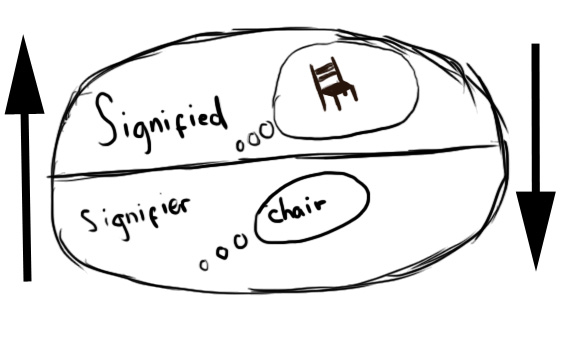
Ferdinand de Saussure gave us the tidy structuralist package: the signified (the thing itself, say, a tree) and the signifier (the sound, the squiggle, the utterance “tree,” “arbre,” “árbol”). Lovely when we’re talking about branches and bark. Less useful when we stray into abstractions—justice, freedom, love—the slippery things that dissolve under scrutiny.
Image: Saussure’s Signified and Signifiers
Still, Saussure’s model gets us so far. AI has consumed entire forests of texts and images. It “knows” trees in the sense that it can output something you and I would recognise as one. Does it see trees when it dreams? Do Androids Dream of Electric Sheep? Of course not. But neither do you when you define one.
René Magritte‘s famous painting reminds us that the reference is not the object.
Image: Magritte’s Ceci n’est pas une pipe (This is not a pipe)
Wittgenstein and the Dictionary Without a Key
Ludwig Wittgenstein, that glorious thorn, tore the Saussurean comfort blanket to shreds. Words, he said, are not tethered to the world with neat strings. They define themselves by what they are not. A tree is a tree because it is not a cow, a kettle, or an Aston Martin.
Image: Tree, isolated
Take a dictionary entry:
tree /trē/ noun a woody perennial plant, typically having a single stem or trunk growing to a considerable height and bearing lateral branches at some distance from the ground.
What’s woody? What’s perennial? If you already speak English, you nod along. If you’re an alien with no prior knowledge, you’ve learned nothing. Dictionaries are tautological loops; words point only to more words. If you want to play along in another language, here’s a Russian equivalent.
дерево /derevo/ существительное древесное многолетнее растение, обычно имеющее один стебель или ствол, растущий до значительной высоты и несущее боковые ветви на некотором расстоянии от земли.
AI, like Wittgenstein’s alien, sits inside the loop. It never “sees” a tree but recognises the patterns of description. And this is enough. Give it your prompt, and it dutifully produces something we humans identify as a tree. Not your tree, not my tree, but plausibly treelike. Which is, incidentally, all any of us ever manage with language.
Derrida, Difference, and Emotional Overtones
Enter Jacques Derrida with his deconstructive wrecking ball. Language, he reminds us, privileges pairs—male/female, black/white—where one term lords it over the other. These pairs carry emotional weight: power, hierarchy, exclusion. The charge isn’t in the bark of the word, but in the cultural forest around it.
AI doesn’t “feel” the weight of male over female, but it registers that Tolstoy, Austen, Baldwin, Beauvoir, or Butler did. And it can reproduce the linguistic trace of that imbalance. Which is precisely what writers do: not transmit private emotion, but arrange words that conjure emotion in readers.
On Reading Without Tears
I recently stumbled on the claim that AI cannot “read.” Merriam-Webster defines reading as “to receive or take in the sense of (letters, symbols, etc.), especially by sight or touch.” AI most certainly does this—just not with eyeballs. To deny it the label is to engage in etymological protectionism, a petty nationalism of words.
The Point Writers Keep Missing
Here is the uncomfortable truth: when you write, your own emotions are irrelevant. You may weep over the keyboard like a tragic Byronic hero, but the reader may shrug. Or worse, laugh. Writing is not a syringe injecting your feelings into another’s bloodstream. It is a conjuring act with language.
AI can conjure. It has read Tolstoy, Ishiguro, Morrison, Murakami. It knows how words relate, exclude, and resonate. If it reproduces emotional cadence, that is all that matters. The question is not whether it feels but whether you, the reader, do.
So yes, AI has no emotions. Neither does your dictionary. And yet both will continue to outlast your heartbreak.
Let’s get this out of the way: Sturgeon’s Law, ‘90% of everything is crap‘, isn’t pessimism, it’s statistics. That includes your favourite novel, the collected works of Joyce, and, yes, AI-generated text. The key point? If AI has the same bell curve as human output, some slice of that curve will still be better than what most people write. If Pareto’s Rule feels better at 80%, I’ll cede that ten points.
90% of everything is crap
— Sturgeon’s Law
And before anyone gets misty-eyed about “human genius,” let’s remember that the average American adult reads at a 7th or 8th grade level, and more than half read at or below a 6th grade level. Nearly 1 in 5 reads below a 3rd grade level. That’s not a moral failing, but it is a market reality. We can wail about AI not producing the next Nabokov, but let’s be honest, Nabokov isn’t exactly topping the Costco bestsellers table.
Audio: NotebookLM podcast on this topic
Here’s the bit nobody wants to say out loud
AI doesn’t have to dethrone the literary elite. It just has to outperform the mass of competent-but-unremarkable human writers serving an audience who, frankly, doesn’t care about “stylistic nuance” or “metafictional self-reflexivity.”
There’s a vast literary middle ground – corporate copywriting, trade journalism, formulaic romance, SEO blogs – where AI will not just compete, but dominate, because the audience is reading for function, not art.
The high-literary crowd will remain untouched, partly because their readership fetishises human intentionality, and partly because AI doesn’t yet want to write about the precise smell of sadness in a damp Parisian garret in 1934.
The fearmongering about AI “killing literature” is a bit like saying instant ramen will kill haute cuisine. Yes, more people will eat the ramen, but Alain Ducasse isn’t sweating over his stock reduction.
More than half of American adults read at or below a sixth-grade level.
The printing press was supposed to obliterate the artistry of the hand-copied manuscript. Instead, it made books accessible and created new genres entirely. Calligraphy still exists, it’s just no longer the only way to get words on a page.
Photography was going to end painting. In reality, it freed painters from the burden of strict representation, allowing impressionism, cubism, and abstract art to flourish.
Recorded music didn’t destroy live performance, it expanded its reach. Some audiences still pay obscene amounts to see an actual human sweat on stage.
Film didn’t kill theatre; it created a parallel art form.
Synthesizers didn’t erase orchestras; they just meant you didn’t have to mortgage your house to hear a string section in your pop song.
AI is simply the next entrant in this long tradition of “threats” that turn out to be expansions. It will colonise the big islands of the creative archipelago – commercial writing, functional prose, genre boilerplate – and leave the small monasteries of high art mostly untouched.
So, no, AI won’t be the next Mozart, Picasso, or Nabokov. But it doesn’t need to be. It just needs to be good enough to meet – and occasionally exceed – the expectations of the largest share of the market. And given that most readers are happy if the plot makes sense, the spelling’s passable, and the ending doesn’t require a graduate seminar in semiotics to decipher, I’d say AI’s prospects are rather good.
Here’s why that 10% still matters
The rarefied work of the serious literary writer isn’t competing for market share; it’s preserving and evolving the cultural and linguistic possibilities of human expression. That work thrives not because it’s the only thing available, but precisely because it stands apart from the sea of functional prose, human or machine-made. The AI tide will rise, but the lighthouse will still be human.
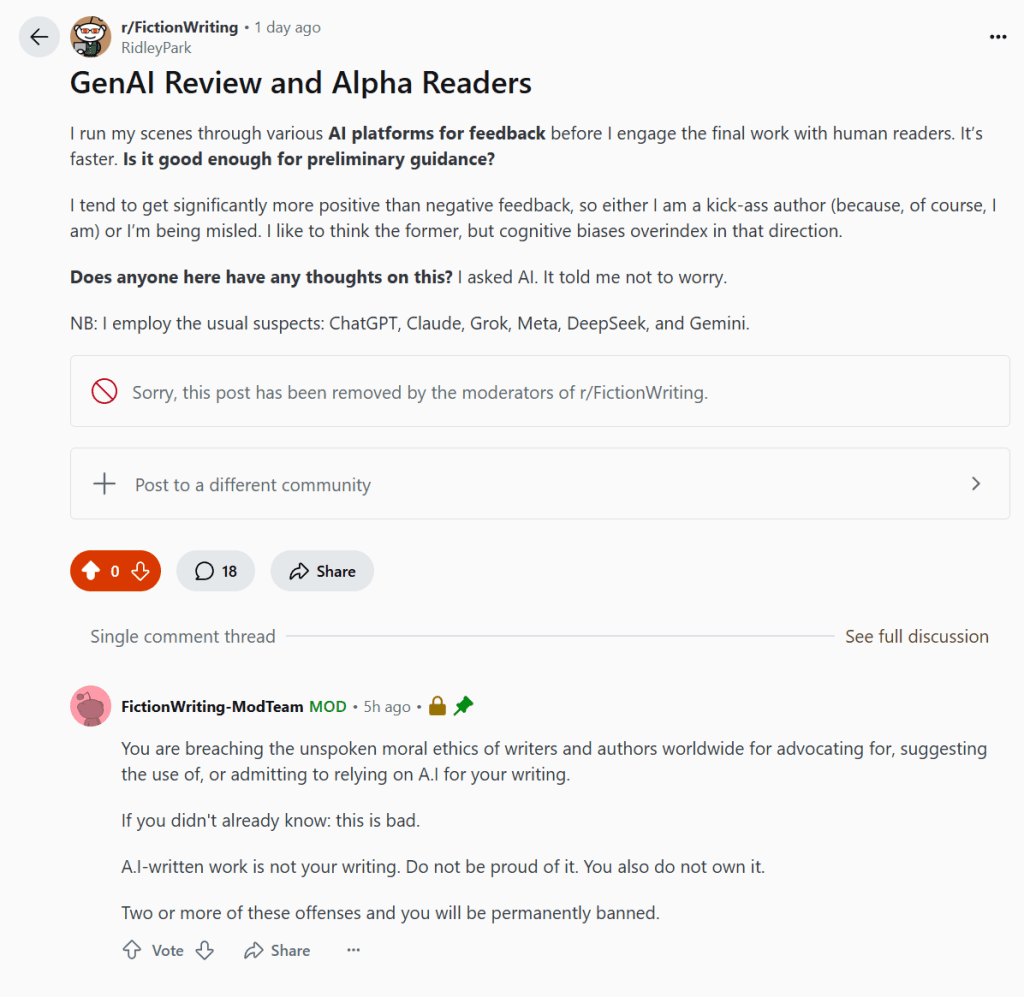
Why? Because nuance is no longer welcome in the Church of Sanctified Scribes. I posted a sincere question about using generative AI as a preliminary editorial tool — a sounding board before I hand off to my actual human readers.
I run my scenes through various Al platforms for feedback before I engage the final work with human readers. It’s faster. Is it good enough for preliminary guidance? I tend to get significantly more positive than negative feedback, so either I am a kick-ass author (because, of course, I am) or I’m being misled. I like to think the former, but cognitive biases overindex in that direction.
Does anyone here have any thoughts on this? I asked Al. It told me not to worry.
NB: I employ the usual suspects: ChatGPT, Claude, Grok, Meta, DeepSeek, and Gemini.
That’s it. That’s the crime.
🚫 Sorry, this post has been removed by the moderators of r/FictionWriting.
The post was removed. Some members responded with superstition, invoking the tired myth that AI would “steal” my work. (That is not how model inference or fine-tuning works. But facts, as ever, are inconvenient.)
Then came the moderator’s edict — Orwellian in tone, the sort of thing you’d expect from a self-published Torquemada:
You are breaching the unspoken moral ethics of writers and authors worldwide for advocating for, suggesting the use of, or admitting to relying on A.l for your writing.
If you didn’t already know: this is bad.
A.I-written work is not your writing. Do not be proud of it. You also do not own it. Two or more of these offenses and you will be permanently banned.
What exactly am I being accused of here? Heresy? Possession of forbidden tools? Thinking aloud?
For the record, I do not outsource my prose to machines. I use AI to assist my thinking — much as one might use spellcheck, Grammarly, or, dare I say it, a fellow writer’s feedback. The fact that this needs to be explained is testament to the intellectual rot at the core of certain writing communities.
And here’s the real punchline: many of those decrying AI as the Antichrist of Authorship haven’t published a thing. Or if they have, it’s in the same low-distribution trenches I inhabit. The difference is, I don’t shun tools because they threaten my imagined purity.
I write because I must — because I enjoy it, because I want to get it right. And yes, if an AI helps me catch repetition or poor rhythm in a sentence before a beta reader ever lays eyes on it, that’s a win.
But you’d think I’d pissed on their typewriters.
Let’s be clear: this isn’t about AI. It’s about fear. About guarding crumbling gatekeeping structures with sharpened pitchforks. About people clinging to their fragile sense of identity — one threatened not by AI, but by other writers doing things differently.
So, yes: good riddance. I’ll take my questions elsewhere, where open minds still exist.







 Ridley Park