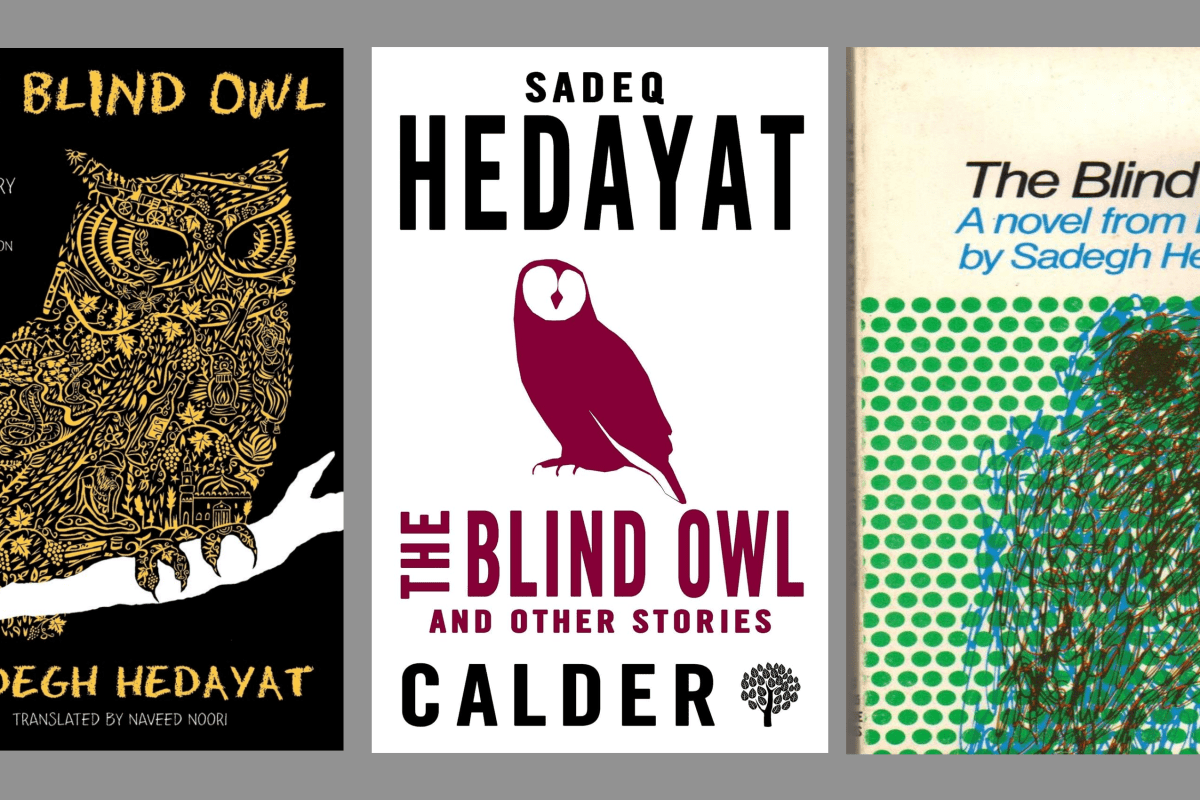
Translations of The Blind Owl

I was less than happy with my review of The Blind Owl. It’s an OK summary, but it’s at too high of a level—fifty-thousand feet as some say.

I problem is that I need to make notes as I read rather than recollect at the end. As it happens, I’ve got three English translations of the book, I don’t read Persian, and reading in French still gives me translation differences. I decided to read a different translation, and they’re a bit askew. So I picked up the third. Different, still. I’ll illustrate my point.

The book opens with a sort of prologue before the narrative begins. Each of the translations read as follows:


Each of these establishes the tone but in differing ways. The narrator’s world is bleak. It’s a mean world, full of wretchedness and misery; a base world, full of destitution and want; a debased and wretched world, full of destitution and want.

As the chapters progress, I can’t help but wonder what the translators have interjected and what is faithful. I’ve written about the challenge in translations is that sometimes an exact word doesn’t exist in the target language.

For example, in Camus’ L’étranger, the novel opens:

Aujourd’hui, maman est morte. Ou peut-être hier, je ne sais pas.”

This translates to “Today, mother died. Or maybe yesterday, I don’t know.” Rather, it doesn’t.

In English, we have the word ‘mother’, which is relatively formal when referring to one’s own parent. We also have the children’s term ‘mummy’ or perhaps ‘mom’, but maman falls between them. ‘Mother’ makes him feel overly rigid or formal than his character unfolds to be; ‘mummy’ would make him seem feeble or infantile, so we are left with ‘mother’.

In The Blind Owl, I have no such reference to parse the language. I am at the mercy of the translator. In the sample passages, not much meaning is lost, if any, but stylistically it reads differently. The pace feels different. I don’t know which I prefer. Anchoring has likely led me to favour the first.

Is the world bad, or does it contain bad, or both, and in what composition?

I’ll keep reading, and I hope to improve it with a more personal accounting.

Book Review: The Blind Owl

“The Blind Owl” is a highly regarded Persian novel written by Sadegh Hedayat, first published in 1937. The novel is a dense and surreal exploration of despair, madness, and existential dread. The narrative is fragmented and non-linear, presenting the protagonist’s experiences and inner turmoil in a disjointed manner that reflects his disturbed mental state.

VIDEO: The Blind Owl

The story follows an unnamed narrator who lives in isolation, haunted by visions and memories that blur the line between reality and hallucination. He is obsessed with a mysterious woman who appears to him in various forms, embodying his deepest desires and fears. As the narrative unfolds, the protagonist recounts bizarre and disturbing events, including the dismemberment of a woman and interactions with shadowy figures.

The novel’s structure is cyclical, with repeated motifs and themes that create a sense of inescapable fate. The protagonist’s descent into madness is depicted through his disjointed thoughts and unreliable narration, leaving readers questioning the boundaries between reality and imagination.

Commentary from a Postmodern Literary Position:

From a postmodern perspective, “The Blind Owl” can be seen as a text that challenges traditional narrative structures and notions of objective reality. The novel’s fragmented and non-linear form disrupts the conventional flow of storytelling, reflecting the postmodern interest in multiplicity and indeterminacy. The unreliable narrator, whose perception of reality is constantly in question, embodies the postmodern skepticism towards absolute truths and stable identities.

The novel’s exploration of themes such as existential despair, alienation, and the search for meaning aligns with postmodern concerns about the human condition in a fragmented, disenchanted world. The repetitive and cyclical nature of the narrative can be interpreted as a critique of the idea of progress and linear time, suggesting instead a sense of eternal recurrence and the impossibility of escape from one’s existential plight.

The surreal and dreamlike quality of “The Blind Owl” also resonates with postmodern aesthetics, which often incorporate elements of the uncanny, the grotesque, and the fantastical to disrupt the reader’s sense of reality. Hedayat’s use of symbolism and imagery, which defy straightforward interpretation, invites multiple readings and emphasizes the instability of meaning.

Comparative Literature:

“The Blind Owl” can be compared to several other works in terms of its themes, style, and narrative approach:

  1. “Nausea” by Jean-Paul Sartre: Both novels explore existential themes, focusing on the protagonist’s sense of alienation and the search for meaning in an indifferent world. Sartre’s use of stream-of-consciousness narrative and exploration of existential dread parallels Hedayat’s portrayal of the protagonist’s inner turmoil.
  2. “The Metamorphosis” by Franz Kafka: Kafka’s novella shares a similar sense of surrealism and existential angst. Both texts feature protagonists who undergo a profound and disturbing transformation, confronting the absurdity and alienation of their existence.
  3. “One Hundred Years of Solitude” by Gabriel García Márquez: While differing in style and cultural context, García Márquez’s work shares with “The Blind Owl” a cyclical narrative structure and a blending of reality with fantastical elements. Both novels use magical realism to explore deep-seated human emotions and existential themes.
  4. “The Trial” by Franz Kafka: Kafka’s exploration of the absurdity of bureaucratic systems and the protagonist’s sense of helplessness and disorientation can be compared to the surreal and oppressive atmosphere in “The Blind Owl.”
  5. “Heart of Darkness” by Joseph Conrad: Conrad’s novella, with its journey into the depths of the human psyche and exploration of madness, can be seen as a thematic counterpart to Hedayat’s exploration of the protagonist’s inner darkness and despair.

In summary, “The Blind Owl” is a seminal work that delves into the depths of human despair and madness through a fragmented and surreal narrative. Its postmodern elements, such as the unreliable narrator and cyclical structure, challenge traditional storytelling conventions and invite readers to question the nature of reality and meaning. The novel’s themes and style resonate with works by Sartre, Kafka, García Márquez, and Conrad, making it a significant contribution to existential and modernist literature.

Intelligence and Cognition

It seems that I am constantly apologising for not posting more here. Have no fear, these apologies appear on my other sites, too.

My absence here is due to another writing project I am focusing on. The competing project has a working title of “Democracy: The Grand Illusion“. It’s a work of fiction, so I am documenting it on my Philosophics blog.

Recently, I’ve been posting content related to my initial editorial process using AutoCrit.* I was planning to produce content for this site as well as YouTube using Hemo Sapiens: Awakening as the source material, but since I am currently writing this academic non-fiction piece, I figured I’d apply it there.

For me, writing fiction is different to writing non-fiction. With fiction, I have an idea, and I document a possible skeleton framework. This may (and does) change as I make progress, but it serves mainly as waymarkers to orient my original idea. In this manner, I am more of a planner than a pantser.

Once I establish this structure, I start writing exposition, and all bets are off. I do not feel restricted by this framework if my subconscious has a different idea and the characters and narrative come to life.

On the other hand, non-fiction is very planned and structures. I create chapters for continuity and flow. Then I place all sorts of section content within each chapter and record thoughts and citations.

For this book, I did most of this in 2021-22 during the tail end of the COVID debacle. I stopped and started, but this month I am re-engaging. As the skeleton and muscular systems are already in place as are many organs, I need to add the rest and flesh it out. This is how I occupy my days.

Despite the planning, nothing is cast in stone. Case in point, I had just drafted a chapter on Defining Intelligence. It included sections on.

  • Intelligence
  • IQ (as a proxy for intelligence)
  • Emotional Intelligence
  • Multiple Intelligences
  • Cognitive Biases

I thought I was done until I decided to add a section on Cognitive Deficits and Limitations. This inclusion prompted me to rename the chapter to Intelligence and Cognition.

I expect this book to be completed in 2024. I’ve written some 58,000 words with another 30,000 more likely. I don’t really have a target in mind—just the content I want it to cover.

I may still pop in to demonstrate AutoCrit on my published book as I feel it may be instructive.


* AutoCrit is an AI-based editorial application. I am a member of their affiliate programme, so I gain minor financial benefits at no cost to you if you purchase through a link on this page.

First Review of Awakening

Woohoo. Hemo Sapiens: Awakening has it’s first review, and it wasn’t even me. The question remains, should an author review their own book?

Evidently, this question does not remain very long because it’s against Amazon’s terms and conditions to do so. And so it goes…

“They fear for their future, for their freedom, for their sanity.”

“Hemo Sapiens” is a fantastic, very original mystery thriller, I had never read anything like it, which manages to perfectly combine suspense, action, and futuristic elements, and adds a layer of complexity to the plot.

The writing style is addictive, the pages fly by, and it strikes a balance between dialogue and descriptive passages that immerse us in the story process. The author deftly navigates between moments of peace and chaos, generating suspense through a tense chase and revealing interrogations and plot twists.

The book expertly delves into the protagonists’ internal conflict as they grapple with the rise of Hemo sapiens, presenting a delicate balance between two worlds.

The characters face a web of criminal, social and ethical issues. Something I liked is how they are portrayed with depth and authenticity, and each one plays a unique role in the mystery that unfolds, you want to get to know more about them. The exploration of ethical, political, and emotional topics adds depth to the story, addressing themes of discrimination, violence, and the fight for justice.

It is a book that I highly recommend, without a doubt reading it is like watching a movie, it is an incredible experience. It stands out a lot in its genre.

— Izzy Vega

Ref: https://www.amazon.com/review/R3MQRPA5C94URX/

It look like it was posted on Goodreads and ported across. I’ll take it.

Hemingway App

I watched a YouTube video that referenced Hemingway App as an authors’ tool. Here, I pasted some sample content from Hemo Sapiens: Origins to see what it might suggest.

It’s a short passage, but the only things it found were trivial nits.

Highlighted, the complaint is that the top sentence (in yellow) is too complex, so I should break it up as shown in green. The only difference is that it swapped the semicolon with a full stop and capitalised the next letter to begin the next sentence. It also declared the Grade 11 writing sample to be reduced to Grade 6.

Is this really worth more than the free trial or the time and effort?

It highlighted two other related challenges: both adverbs, and neither with remediation advice. In the sceen shot, you can read ‘slightly crispy’. Honestly, I don’t have a more direct way to show this information. I suppose if it was ‘crispy’, I could specify a ‘crunch’ sound. But how is the crispy crunch diminished when it’s just ‘slightly’? Enquiring minds want to know.

Barely Audible

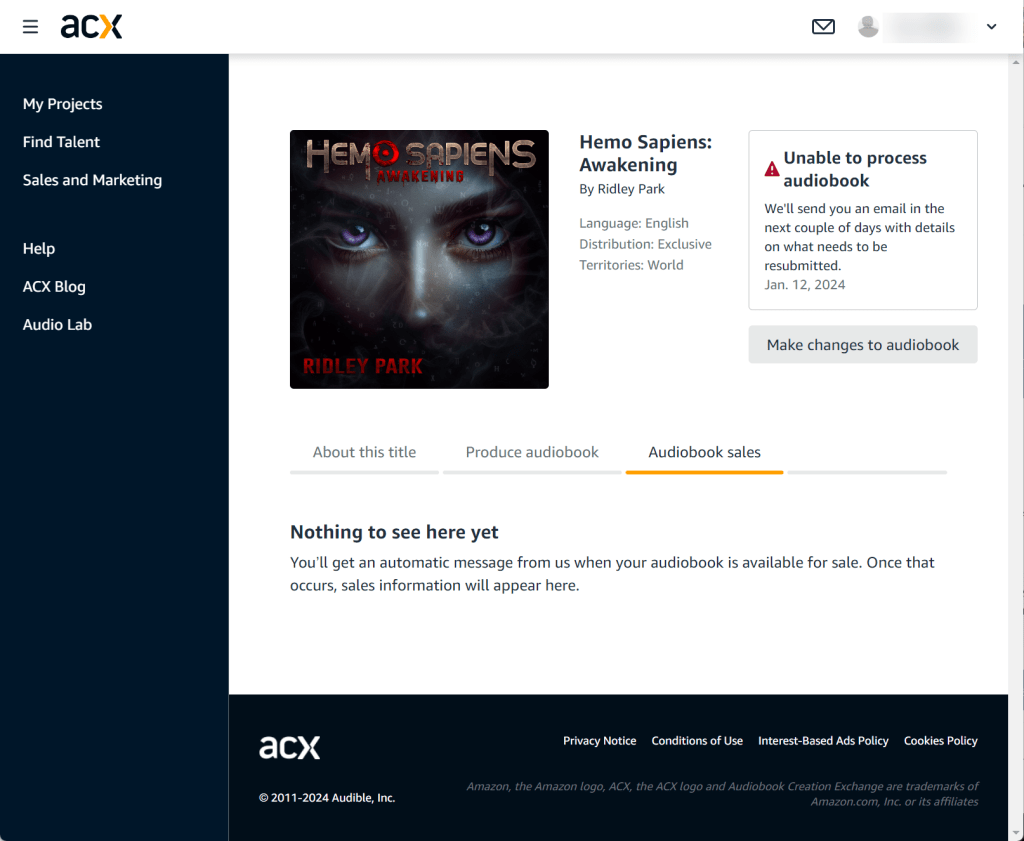
So this happened. I submitted Hemo Sapiens: Awakening as an audiobook, and it was rejected. The site says that they’ll let me know why in a couple days. My question is: if you rejected it, don’t you immediately know why?

I think I know why, but I can’t ‘fix’ the problem if I don’t know what it is. I don’t want to act on an assumption.

I believe they’ll inform me that I can’t use AI-generated narration. This would be odd because they have a programme in Beta where they provide the service of automatically converting the text of a book to audio. To be honest, it doesn’t sound amazing. It appears that they are using their own Amazon Polly, which I like, but you need to babysit it hard. It is very unlikely to sound good without heavy hand-holding. As it is, I hand-held my ElevenLabs AI to make the outcome sound like a professional human.

Audible offers some voiceover actors, but I didn’t like any of them, and they couldn’t compete with my ElevenLabs voice. I can understand that they don’t want to sell audiobooks that sound like Stephen Hawking, but theirs sound closer to him than mine.

On another note, I had to render and upload square cover art. There was a stated restriction disallowing padding a rectangular cover image with space or colour to make it square. I followed this rule, but this is exactly what they do. They take the cover of the book you’re selling through Amazon, and they pad the left and right margins with filler colour. I may append the rationale they provide once I’ve received it. Until them, my audiobook is on hold.

First Chapters Free on Kindle

If you are interested in Hemo Sapiens: Awakening, but you don’t want to commit your hard-earned shekels, the first four and a half chapters are available for FREE (woohoo). I mean, you’ll miss the best chapters, but what can I say. Dip your toe in the water.

If you have Kindle Unlimited, you can read the entire book for free. Sounds like a win-win to me. You are a winner, right?

Hemo Sapiens: Origins

Now that Hemo Sapiens: Awakening has been released into the wild, I can again focus on Hemo Sapiens: Origins. I started writing Origins a few weeks ago, but I was interrupted by the review and production process of Awakening.

In the world of Pantsers and Plotters, I tend to fall somewhere in between, but I favour plotting.

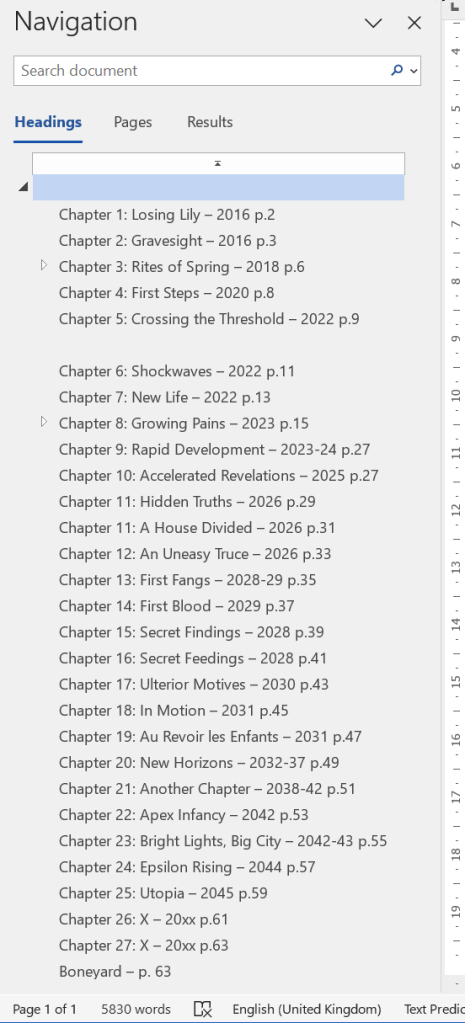
I write in Word. In the example above, you can see the working chapter titles, the year(s) a chapter covers and its starting page. Some of the chapters already contain preliminary copy.

As a writer, I don’t necessarily work chronologically. I find the chapters that are the most compelling and interesting to me. Then, I work down to the bridging chapters, hoping that the meat of the chapters penned earlier will support and inspire the later ones.

As I write, I usually create a ‘Boneyard’ chapter. This is where ideas go to incubate or die. Workable ideas are resurrected whilst others are laid to rest. Some ideas are like zombies, but at the end a project, they are either among the dead or living.

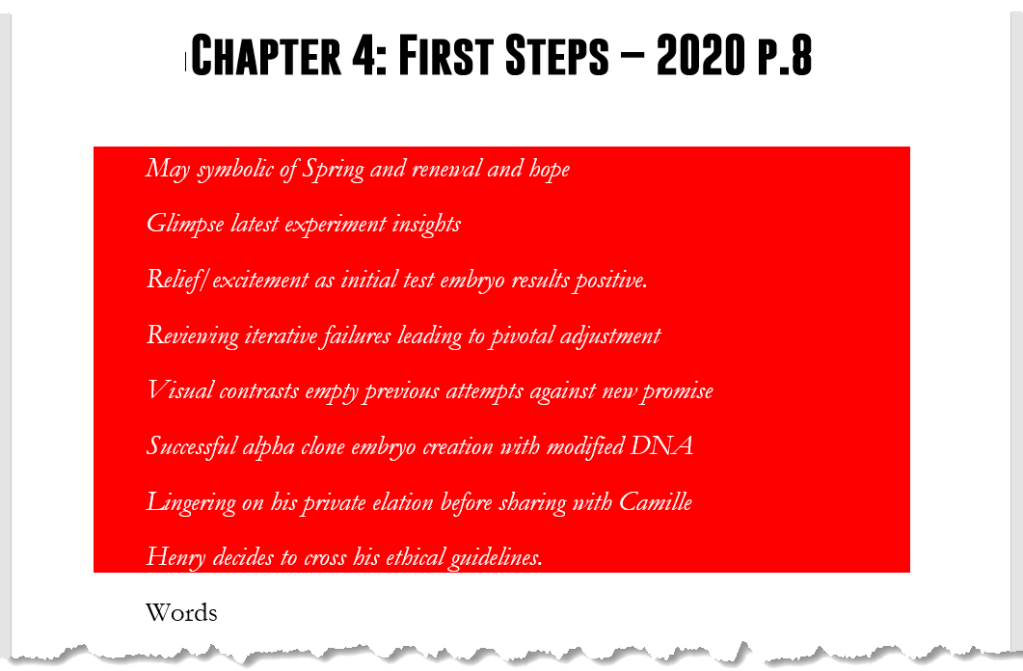
At the start, a chapter looks something like this. It’s a blend between ideas and story beats. Each chapter is outlined similarly. The other advantage this lends me is that I can *ahem* walk away from writing for a while and still have handholds and reminders when I return. For short fiction, I just write. No outlines. Perhaps just an idea to explore.

What is your writing style? Leave comments below.

Hemp Sapiens: Awakening Advert Spot 1

Podcast: Audio version of this content

Hemo Sapiens: Awakening is a compelling near-future science fiction novel that explores issues of identity, belonging, and the struggle for personal sovereignty. When a community living off the grid is discovered by the authorities of a dominant society, their entire way of life is threatened. Forced to assimilate into a culture not their own, they must make an impossible choice – abandon their traditions or fight to preserve their cultural identity at any cost.

This thought-provoking book sets the stage for an epic series that investigates the origin of these mysterious people. Their future hangs in the balance as the reader joins them on a journey of self-discovery. Will they succumb to conformity or rise up to claim their autonomy?

I’m the author, Ridley Park, and I invite you to immerse yourself in this imaginative new world and come along for an unforgettable adventure. Hemo Sapiens: Awakening is available now in hardcover, paperback and ebook formats. Audiobook versions will be released in February 2024. Get your copy today!

Thanks to India

I’d like to thank the person in India who earned me $0.02 by reading 17 Kindle pages of Hemo Sapiens: Awakening. Reading on Kindle Unlimited is free—time aside. Read the whole book, and I’ve earned $0.50. In time, we’ll be as rich as astronauts.