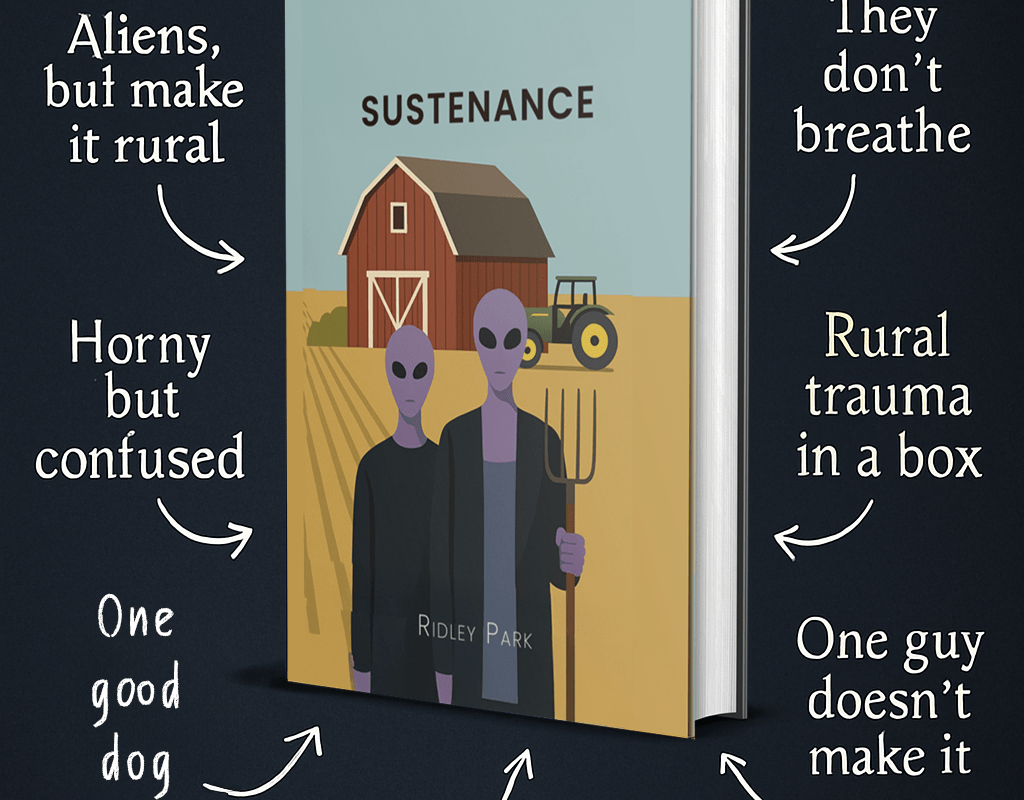
Trope maps seem to be popular. They catch my attention. What are your thoughts?

Author
Trope maps seem to be popular. They catch my attention. What are your thoughts?

🛸 A Closer Look at the Cover of Sustenance
👽 People ask me: What’s with the aliens on the front cover of Sustenance?
Fair enough. Let’s talk about it.
Sustenance is set in Iowa – real, dusty, soybean-and-corn Iowa. I’ve spent months there. I’ve lived in the Midwest (including Chicago) for over a decade. The farms, the tractors, the gravel roads… they aren’t just set dressing. They’re part of the book’s DNA.
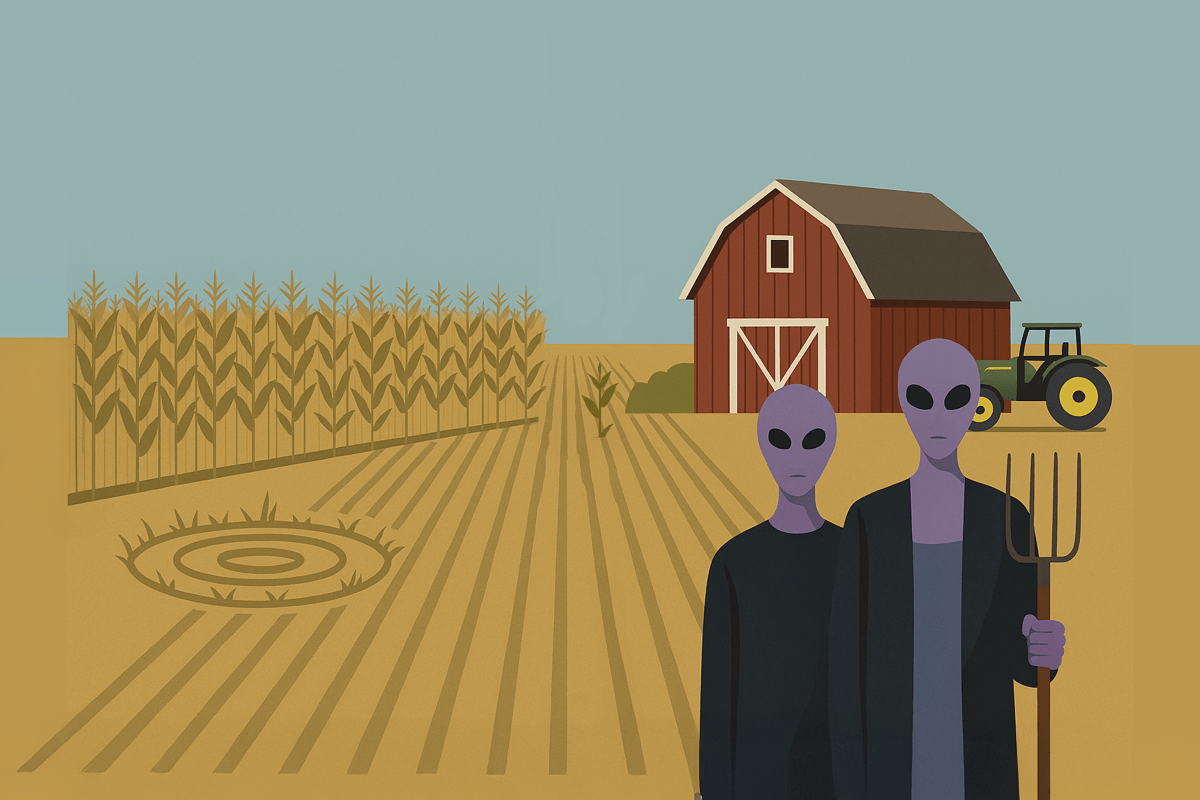
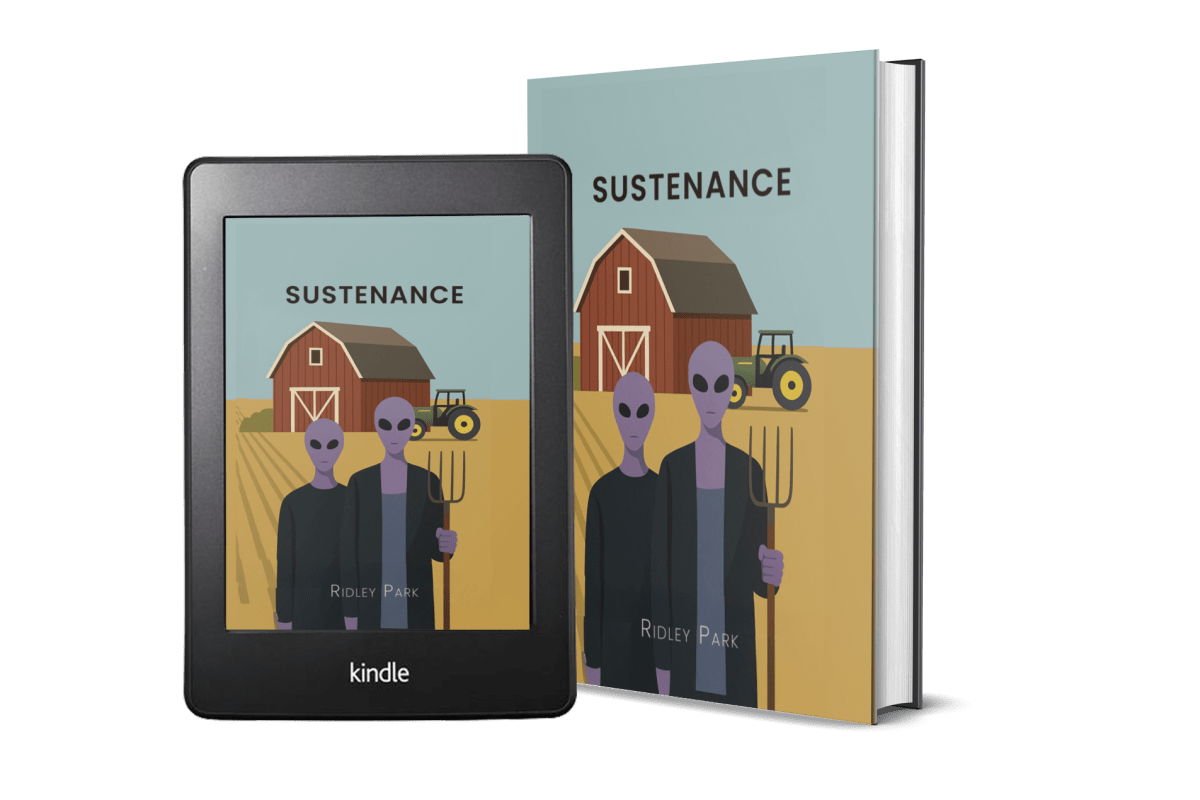
So, yes: we’ve got the requisite red barn, green tractor with yellow wheels (hi, John Deere 🚜), and a crop circle or two. The audiobook cover even features an alien peeking out of the barn – though logistics are holding that version back for now.
Please note that the Kindle version is available for free for the rest of today (8 Sep 25). Download your copy while you still can without paying through the nose. Leave a review for👍 better or for👎 worse.
If the composition feels familiar, it should.
The cover is a quiet parody of Grant Wood’s “American Gothic” – a pitchfork-wielding farmer and his companion, stoic before their rural home. It’s one of the most recognisable paintings in American art, and I couldn’t resist twisting it just slightly. Grant was an Iowa boy.
I designed this cover using a flat vector art style, almost like cut paper or stylised children’s book illustrations. The sky is cyan, the land is beige, and everything is built in clean layers: barn, tractor, field, crop circle, and of course… two violet, large-eyed aliens striking a pose.
But no, this isn’t a literal scene from the book. You might encounter violet aliens in Sustenance, but you won’t find them standing around with pitchforks like interstellar Grant Wood impersonators. The image is meant to evoke the tone, not transcribe the events.
Because the story itself is quiet. Subtle. Set in the kind of place often overlooked or written off. The aliens aren’t invading with lasers. They’re… complicated. And the humans, well, aren’t always the best ambassadors of Earth.
The cover reflects that blend of satire, stillness, and unease.
Oh, and one last note:
🛑 No aliens were harmed in the writing of this book.
I began reading Octavia Butler’s Dawn, and it raised some interesting* philosophical questions.
In the early chapters of Dawn, an alien declares that humanity has “committed mass suicide.” Sartre insists, “Inaction is still a choice.” Howard Zinn reminds us, “You can’t be neutral on a moving train.” Each collapses complexity into the fiction of agency, a story that props up Modernist notions of responsibility and blame. But what if agency itself is an unnecessary fiction? I’ve explored this tension in a new essay on my Philosophics blog:
Someone on social media, commenting on my Dystopian Venn post, asked me why I hadn’t read Octavia E Butler. Challenge accepted.
* Questions interesting to me.
On 7–8 September 2025, the Kindle version of my novella Sustenance will be available free to everyone on Amazon. (It’s always free if you’re a KindleUnlimited member, but these two days open it up to all readers.)
It’s a novella that begins with the dust and grit of rural Iowa – soybean fields, rusted trucks, a small town where everyone knows your name (and your secrets). At first glance, it reads like plainspoken realism, narrated by a local mechanic who insists he’s just a “regular guy.” But then the ground literally shifts. A crash. Figures glimpsed by firelight in the woods. Naked, violet-skinned beings who don’t laugh, don’t sleep, don’t even breathe.
What follows is not your usual alien-invasion story. It’s quieter, stranger, and more unsettling. The encounters with the visitors aren’t about lasers or spaceships – they’re about language, culture, and the limits of human understanding. What happens when concepts like property, law, or even woman and man don’t translate? What does it mean when intimacy itself becomes a site of misunderstanding?
This isn’t a story that offers tidy answers. It lingers, provokes, and resists easy moral closure. Think of it less as a sci-fi romp and more as a philosophical fable wrapped in small-town dust and cicada-song.
This version of the book is available in these Kindle storefronts:
United States, United Kingdom, Germany, France, Spain, Italy, Netherlands, Japan, Brazil, Canada, Mexico, Australia, and India
For more details, visit the Sustenance page.
📚 Grab your free Kindle copy on 7–8 September 2025.
Three of the last four books I’ve read have been autofiction of one flavour or another.
I had never read Virginia Woolf’s A Room of One’s Own, but I picked it up after finishing The Hour of the Star by Clarice Lispector. The there was Trainspotting by Irvine Welsh.
I found Hour of the Star to be an interesting experiement, but I would have preferred a short story over a novelette. A Room of One’s Own is interesting and well-written, though the content resonates with me historically rather than personally. I’ve already written a bit on Trainspotting, which hit me quite close to home. I liked it the best but needed a change of scenery before engaging in its prequel, Skagboys. I need more motivation before I embark on a 500 page journey. I like Welsh’s writing, but it’s not an easy read, I I need more stamina or a break first.
I haven’t decided what to pick up next.
Five chapters down, and Anna Kavan’s Ice is already proving itself to be less a novel than a feverish novelette-length hallucination. It hits differently than the sprawling sagas I’ve been chewing through – leaner, sharper, like a shard of frozen glass pressed against the skin.
This isn’t realism. If you try to read it as realist narrative you’ll only tie yourself in knots, muttering that the protagonist keeps chasing a girl he half-admits isn’t even there. He catches glimpses, shadows, phantoms – and follows them anyway. Contrived? Yes, if you expect logic. Coherent? Absolutely, if you treat it as dream grammar, where compulsion replaces causality and the world obeys obsession more than physics.
The point-of-view is the real hall of mirrors. Not so much “unreliable narrator” as unreliable perspective: the voice flickers, sometimes inside his skull, sometimes inside hers, sometimes perched like an outside observer. As in a dream, identities blur. The supposed rescuer blurts out sadistic fantasies, sounding alarmingly like the blue-eyed Warden he claims to oppose. It’s less “out of character” than a reminder that character itself is already compromised.
So, no, you can’t hold this text to the rules of straight narrative. You have to read it the way you stumble through a nightmare: half-convinced, half-sceptical, fully captive.
Where it all leads? I’ve got perhaps seventy pages left to find out. For now, I’m letting the ice close over me, listening for the crunch of those imaginary bones.
EDIT: I’ve finished Ice and left a review on Goodreads. tl;dr: I gave it a 3 of 5 stars. ⭐⭐⭐ It was good. Mercifully it was short. As it reads like a dream sequence, there are no stakes. From the start, I wasn’t heavily invested in what happened to the protagonist nor the subject of his attrction. There were some good scenes, but not enough for me to give it more than a 3.
This particular meme has been making the rounds like a drunk uncle at a wedding – loud, colourful, and convinced it’s profound. A Venn diagram, no less! Four big circles stuffed with dystopias, slapped together as if geometry itself conferred wisdom. Most of them are books, a few are films, and one – Gattaca – is glaring at me because I haven’t seen it. That omission alone feels like a character flaw. I might grit my teeth and watch it just to close the loop, though it doesn’t exactly scream, “Pour a glass of wine and enjoy.”
DISCLAIMER: This is not a political post.

Here’s the thing: as art, it’s rather lovely. As a piece of intellectual cartography? It’s rubbish. It pretends to classify but in fact it merely collages. Orwell is pressed up against Burgess, Atwood rubs shoulders with Logan’s bloody Run, and in the middle sits Animal Farm, as if pigs with clipboards are somehow the Rosetta Stone of dystopia.
And yet – if you squint just so, tilt your head like a dog hearing a harmonica, you can just about see some tenuous ligatures:
But let’s be honest: the diagram isn’t actually saying this. It’s just four intersecting blobs, with titles hurled in like darts at a pub quiz. The apparent “structure” is nothing more than meme-magic – order conjured out of chaos to make you nod gravely as you scroll by.
So yes: as art, it works. As a Venn diagram, it’s a travesty. And maybe that’s the deeper joke. We live in an age where every complexity gets crushed into an infographic, every horror squeezed into a digestible meme. Which, if you think about it, is itself a bit dystopian.
As per my recent post, I need a sanity break. I’ve been editing Needle’s Edge all day. Each time I hit a milestone, I consider drafting a blog post, but then I choose to persist. Not this time.
I’ve been untangling the spaghetti of a misplaced – or rather, overextended – pregnancy. It had stretched on for too long, so I weeded out contradictory events. Some of these had dependencies, so I relocated or eliminated them to preserve flow.
In the process, I re-oriented her conception date and reset any foreshadowing that tied into it. To keep myself honest, I started tracking her progress in the manuscript with markers: <p=X>. With each time-specific event, I increment X.
So far, I’ve reviewed 24 sequential scenes, not counting the half-dozen relocated ones I had to rework just enough to maintain continuity. This leaves the protagonist at 29 weeks. That also meant pruning irrelevant references, for instance, cutting any mention of pregnancy before it even began.
Being a typical human pregnancy, my target is 38 to 40 weeks. That leaves me with another 10-odd weeks to rummage through. Once I’ve untangled the draft, I still need to return for line edits, colour, and shape.
Editing is often pitched as polishing, but sometimes it’s surgery. Today, I’ve been elbows-deep in the operating theatre.
This is as much a reminder for me as a PSA. Time is the most limited resource you’ve got.
Consider your goals, and plan accordingly. Not everyone has concrete goals. As writers, we likely do. Finish that sentence, that page, that chapter, that draft, those edits, that book…
There’s social media – that’s this place – video games, partying, family and mates, eating and sleeping. Whatevs.
And don’t forget to take care of your mental health.
You may have many goals – or just one or two. Consider opportunity costs.
This blog post is distracting me from my editing. Still, I want to share. maybe it will help you.
Perspective is key.
Define your goals. Prioritise them. Make it happen.
Go away now!
Editing Needle’s Edge has taken longer than the time it took to draft the damned thing. Typical, I suppose, but demoralising all the same. Drafting is a rush; editing is a grind. In video game parlance, this is the endless dungeon crawl. Kill the same mob again and again, collect marginal XP, and hope that –eventually – you level up.
Recently, I wrestled with the narrative structure, which was starting to feel like Inception with a side order of Russian dolls. Flashbacks within flashbacks within flashbacks. I diagrammed it, mostly to convince myself I hadn’t lost the plot (see exhibit A, below).

Here’s the lay of the land—without spoilers, of course. The story begins [1] in medias res, with Sarah-slash-Stacey already entrenched in her daily grind. Then comes [2] the flashback, showing how she arrived there. Midway through, we plunge into [3] a deep flashback of her childhood, before [4] snapping back to the mid-flashback, then finally [5] rejoining the present-day storyline until [6] the bitter – or possibly bittersweet – end.
Naturally, I subvert as many tropes as I can, though no one can write a tropeless story any more than they can write one without words. (I’m sure some post-structuralist is trying right now, but God help their readers.)
The hardest part wasn’t constructing the labyrinth but finding my way out again – reengaging with the present-day thread after chapters of detour without resorting to that televisual clanger: “We now return to our regularly scheduled programming.”
Editing a book like this is less polishing and more archeology: chiselling away sediment, brushing off centuries of dust, desperately hoping not to snap the artefact in half. With luck, the grind pays off. If not, at least I’ll have a lovely flowchart to show for it.