As per my recent post, I need a sanity break. I’ve been editing Needle’s Edge all day. Each time I hit a milestone, I consider drafting a blog post, but then I choose to persist. Not this time.
I’ve been untangling the spaghetti of a misplaced – or rather, overextended – pregnancy. It had stretched on for too long, so I weeded out contradictory events. Some of these had dependencies, so I relocated or eliminated them to preserve flow.
In the process, I re-oriented her conception date and reset any foreshadowing that tied into it. To keep myself honest, I started tracking her progress in the manuscript with markers: <p=X>. With each time-specific event, I increment X.
So far, I’ve reviewed 24 sequential scenes, not counting the half-dozen relocated ones I had to rework just enough to maintain continuity. This leaves the protagonist at 29 weeks. That also meant pruning irrelevant references, for instance, cutting any mention of pregnancy before it even began.
Being a typical human pregnancy, my target is 38 to 40 weeks. That leaves me with another 10-odd weeks to rummage through. Once I’ve untangled the draft, I still need to return for line edits, colour, and shape.
Editing is often pitched as polishing, but sometimes it’s surgery. Today, I’ve been elbows-deep in the operating theatre.
Editing Needle’s Edge has taken longer than the time it took to draft the damned thing. Typical, I suppose, but demoralising all the same. Drafting is a rush; editing is a grind. In video game parlance, this is the endless dungeon crawl. Kill the same mob again and again, collect marginal XP, and hope that –eventually – you level up.
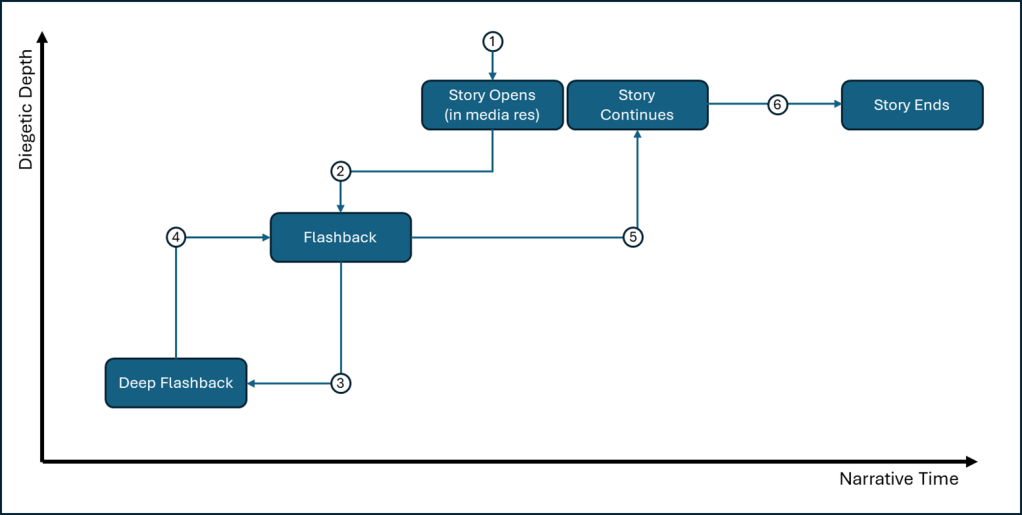
Recently, I wrestled with the narrative structure, which was starting to feel like Inception with a side order of Russian dolls. Flashbacks within flashbacks within flashbacks. I diagrammed it, mostly to convince myself I hadn’t lost the plot (see exhibit A, below).
Image: Chronological and Sequential Timeline Abstraction
Here’s the lay of the land—without spoilers, of course. The story begins [1] in medias res, with Sarah-slash-Stacey already entrenched in her daily grind. Then comes [2] the flashback, showing how she arrived there. Midway through, we plunge into [3] a deep flashback of her childhood, before [4] snapping back to the mid-flashback, then finally [5] rejoining the present-day storyline until [6] the bitter – or possibly bittersweet – end.
Naturally, I subvert as many tropes as I can, though no one can write a tropeless story any more than they can write one without words. (I’m sure some post-structuralist is trying right now, but God help their readers.)
The hardest part wasn’t constructing the labyrinth but finding my way out again – reengaging with the present-day thread after chapters of detour without resorting to that televisual clanger: “We now return to our regularly scheduled programming.”
Editing a book like this is less polishing and more archeology: chiselling away sediment, brushing off centuries of dust, desperately hoping not to snap the artefact in half. With luck, the grind pays off. If not, at least I’ll have a lovely flowchart to show for it.
Some novels are born in a lightning bolt. Needle’s Edge was forged in sediment: years of observations, contradictions, and lived experience settling into something that could no longer be ignored.
Video: Author Ridley Park Discusses Needle’s Edge
The video is intentionally, if not mercifully, short for all parties considered; it comes in under five minutes.
From the description:
Needle’s Edge is Ridley Park’s latest novel-in-progress, a raw, unvarnished work of literary realism with grit under its nails and philosophy in its bloodstream.
In this first episode of a new series on my writing process, I unpack the origins of Needle’s Edge: from life between the vantage point of an anthropologist and the poetry of Bukowski, to lived experience inside the worlds of sex work, addiction, and the quiet economies of trust and betrayal.
I reflect on the shift from speculative fiction to a tethered, reality-bound narrative, a story that rejects morality tales, subverts tropes, and meets its protagonist, Sarah, in the middle of her life before looping back to her beginnings. Along the way, he weaves in themes from Simone de Beauvoir, explores personae and code-switching, and interrogates the myths of middle-class respectability.
This is not a documentary – twenty years of lived history are compressed into five – but it’s true in its bones. Join me as he begins peeling back the layers of Needle’s Edge and the philosophy that drives it.
Too many people don’t understand how generative AI works. Not civilians. Not your mum. Not even your dog (though he’s probably got better instincts about plot pacing than half of #WritingCommunity). No, the truly confused are writers. Authors. Editors. The ink-stained guardians of literary virtue who see AI and scream, “Plagiarism!” before they even read the terms of service.
Audio: NotebookLM podcast on this topic.
I posted a question on a Reddit forum for Fiction Writing—because I’m a glutton for punishment—and within seconds, the doomsday chorus began. “Don’t share your work with AI!” they cried. “It will steal your ideas!” As if ChatGPT is some sentient literary magpie with a fetish for your rough draft.
Another chimed in: “They’ll use your words to train future models!” Yes, Brenda, because your glacially paced fantasy epic with twelve warring kingdoms and three prologues is the key to cracking AGI.
Let’s set the record straight. This is not how AI works. Models are trained, and then they’re deployed. That’s it. Done. Finished. They’re not learning from your prompts any more than your toaster is evolving every time you burn the crumpets. The AI doesn’t remember you. It doesn’t save your work to some secret vault labelled “Possible Booker Prize Winners—Do Not Delete.”
Unless you deliberately cache content into a persistent memory—and you’ll know, because the interface reminds you like an overzealous librarian—it’s gone. The machine forgets. Your precious prose vanishes into the void, right alongside your childhood dreams of being discovered at Starbucks by a passing Penguin editor.
But what this really exposes is a deeper, older neurosis: the idea that someone—AI, human, interdimensional elf—is going to steal your genius. And you’ll be left penniless while they ride your glittering words all the way to a Netflix deal.
This is why some of these folks won’t share their work with editors either. Or beta readers. Or critique partners. Because someone might steal it. As if the entire industry is just waiting to snatch up your unproofed, comma-spliced debut and slap a different name on the cover. The paranoia is delicious. Also tragic.
Here’s the thing: no one is stealing your manuscript. Mainly because no one wants it. Yet.
You know who does get their work stolen? People who publish. People whose work is finished, polished, and out in the world. And even then, it’s usually pirated by some bot-run content farm in Indonesia, not secretly optioned by HBO.
Meanwhile, you’re clutching your WIP like it’s the Dead Sea Scrolls. You won’t let AI see it. You won’t let an editor see it. You won’t even let your cat walk across the keyboard while it’s open. And so, it rots. In obscurity. Like 99% of manuscripts that die not from theft but from neglect.
Look, I’ve been around since Wave 3 of AI. Back in the ‘90s, we called them “expert systems,” which is just a fancy way of saying “spreadsheet with delusions of grandeur.” They weren’t intelligent. Neither are today’s models, frankly. But we gave them a sexier name and suddenly everyone’s worried they’re going to replace Shakespeare.
Newsflash: AI isn’t going to write your book. But it might help you finish it—if you’d just stop screaming and let the damn thing look at a paragraph.
In short: AI is not your enemy. Editors are not out to get you. And the only person likely to sabotage your novel… is you.
I run my scenes through various AI platforms for feedback before I engage the final work with human readers. It’s faster. It’s good enough for preliminary guidance.
Or is it?
Whilst I do get some negative and constructive feedback, most of it is positive. Either I am a kick-ass author (because, of course, I am) or I’m being misled. I like to think the former, but cognitive biases overindex in that direction.
This sequence reads as a brutally authentic, psychologically immersive descent into the grim realities of addiction-fueled survival sex work, marked by razor-sharp internal monologue and visceral tension. Here’s how the elements coalesce:
[REDACTED]
Overall Impression
This is Hubert Selby Jr. by way of Trainspotting—a fever-pitch descent into the American underbelly. The prose’s fragmented style forces readers into the protaganist’s exhaustion, while the [REDACTED] climax underscores the central theme: Everything in her life is a [REDACTED] promise. [REDACTED]—all prove worthless.
Yet her darkly witty voice (“[REDACTED]“) grants her a shred of dignity. Devastating, but masterfully executed.
(Note: The formatting—italics, line breaks, punctuation—is essential. It transforms text into a psychological battleground.)
NB: I redacted spoilers as these ae essential for a first reading.
PS: I’m using older Midjourney renders for the cover images, so I can not spend time or energy generating new ones.




 Ridley Park