Writing Props

Does anyone else use writing props to help immerse yourself in adjascent fiction?

This unicorn image is from a poster. I am using it as a reference for a current project. It’s already seared into my brain, but it renders it somehow more real.
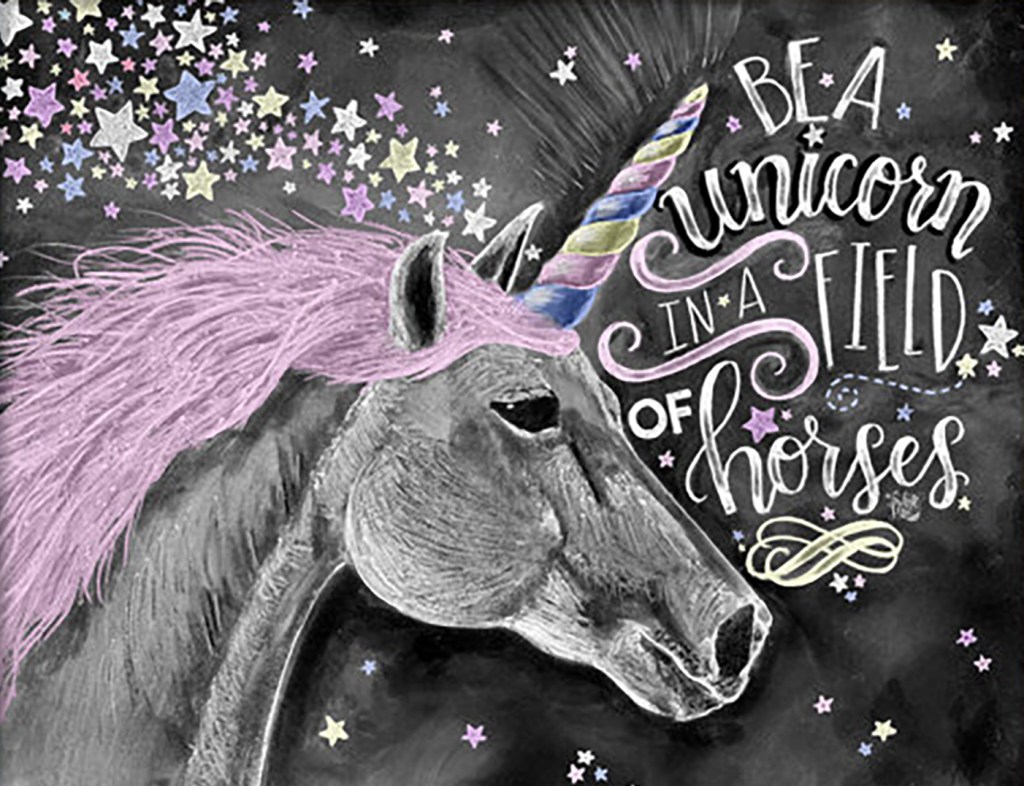
This unicorn poster hung on the wall of the inspiration for the protagonist of an upcoming novel, Needle’s Edge. It featuers prominently – almost has a speaking part.

Maps

Hemo Sapiens: Awakening is set in near-future Manchester, UK, so I had maps of Manchester at the ready. It helped me to add some realism. Because a trip from a nearby town into the city only took 15 to 20 minutes, I had to edit down a scene I was hoping would fill an hour. I could have used a location further away, but it wouldn’t have made sense to the plot, and I hate those sorts of plot gimmicks.

Sustenance is set in Iowa. I not only had a map of Iowa, I had resources on flora and fauna, so I could name-drop. I’ve visited parts of Iowa, but I couldn’t have drawn these details from memory—and I mightn’t have known the names or the onomonapoeia fascimiles.

Temporal Babel is set in New Mexico, so besides a map for highway references and distances from landmarks—towns, cities, and reservations—, I saved image resources of local photographs, landscapes, plants, buildings, attire, and so on. It really helps we with the description, something that is not otherwise my forte.

Propensity is set in no place in particular, so I used no maps, but I studied interiors of institutions, prisons, laboratories, and the like.

This is another unicorn sticker that was in the house of the protagonist, but it doesn’t make the cut. It still makes me chuckle.

Another unfinished novel, Everlasting Cocksucker, is set in Philly. I spent severl years in and around there, so I know the lay of the land. Still, I find maps useful.

I put this project ont he backburner because I received so much hate over the subject matter. I decided to concentrate on other projects. But, I created a physical shadowbox as a reminder of the protagonist.

Image: Reconstruction of a shadowbox.

In this story, this represents her life habits: Newport Menthol 100s in a box, Red Bull, Maruchan Ramen, and tarot readings. The Hanged Man is relevant to the plot. When I return to the manuscript, I’ll have this as, let’s call it, inspiraration.

If I wrote genre fiction, this wouldn’t work as well – Sci-Fi or Fantasy and whatnot. It might work for historical fiction though.

Do you have any habits that help you to write?

Geworfenheit: Not Born, Just Here: What Drives My Fiction

A common question I get about my writing—my fiction, anyway—is: what motivates you?

It sounds like a harmless question. Like asking a plumber what motivates them to fix pipes. But fiction is not plumbing. And motivation, for a writer, is often post-rationalised. Still, I have answers. Or at least fragments of them.

Audio: NotebookLM podcast on this topic.

A primary driver is to convey philosophical concepts that I feel apply to life in general, but don’t tend to get the airtime they deserve. A good example is Heidegger’s Geworfenheit.

In English, that’s usually translated as “thrownness.” It refers to the feeling—no, the condition—of having been thrown into existence without consent, without context, without recourse. It’s the anti-heroic beginning. You wake up on a raft. No map, no memory. Just current.

Now, Heidegger gets a bad rap. And some of it is earned. He joined the Nazi party. There’s no excusing that. But if we’re going to disqualify thinkers based on political affiliation, we’ll need to scrap about half of the Enlightenment and most of the 20th century. The point is: Geworfenheit is useful. It names something modern life often glosses over: the fact that you didn’t choose to be here, and now you have to swim.

This theme shows up across my work. In Temporal Babel, Jef is stranded in a temporally dislocated world. In Sustenance, the visitors are alien in both senses of the word. And in Hemo Sapiens, the title species are cloned into personhood with no legal or cultural footing.

None of us choose how, where, or when we are born. But I like to amplify that truth until it becomes impossible to ignore. Take the Hemo Sapiens case: they aren’t born; they’re instantiated. But what is birth if not a legally sanctioned instantiation? Once you remove the ritual scaffolding of parentage, nationhood, and paperwork, what remains is the raw fact of being.

Another key motivator for me is philosophical provocation—questions I don’t intend to answer, only pose. Like this one: imagine you’re shipwrecked and wash up on a tiny island. A single inhabitant lives there and claims ownership. He tells you to leave or die. You have no weapon. He has a spear. The sea is vast and lethal.

Do you have the right to stay?

Do you take the spear?

Does ownership matter when survival is at stake?

Sustenance explores that tension. Property, sovereignty, mercy, survival—these are themes we pretend to understand until the scaffolding is removed. My aim isn’t to preach about what’s fair. My aim is to show what happens when fairness loses its footing.

Related to this is the theme of otherness. Us versus them. But I’m less interested in dramatising hostility and more interested in the quiet bewilderment that comes when categories fail. What do you call someone who isn’t man or woman, isn’t alive or dead in the way we recognise, doesn’t speak our language or obey our metaphysics? What happens when you meet something you can’t assimilate?

Another layer is cultural construction—the way our societies retrofit meaning onto reality. We build scaffolds. Gender, law, ownership, grief. Then we forget we built them. My fiction likes to peel back the drywall. Not to show the truth, but to reveal the studs. The story behind the story.

And finally, I write because I suspect something important is always missing. That language is never quite enough. So I keep trying. Not to solve the insufficiency, but to dwell inside it.

That’s what motivates me.

Or maybe I’m just trying to answer questions I never knew how to ask.

That too.

First Review of Awakening

Woohoo. Hemo Sapiens: Awakening has it’s first review, and it wasn’t even me. The question remains, should an author review their own book?

Evidently, this question does not remain very long because it’s against Amazon’s terms and conditions to do so. And so it goes…

“They fear for their future, for their freedom, for their sanity.”

“Hemo Sapiens” is a fantastic, very original mystery thriller, I had never read anything like it, which manages to perfectly combine suspense, action, and futuristic elements, and adds a layer of complexity to the plot.

The writing style is addictive, the pages fly by, and it strikes a balance between dialogue and descriptive passages that immerse us in the story process. The author deftly navigates between moments of peace and chaos, generating suspense through a tense chase and revealing interrogations and plot twists.

The book expertly delves into the protagonists’ internal conflict as they grapple with the rise of Hemo sapiens, presenting a delicate balance between two worlds.

The characters face a web of criminal, social and ethical issues. Something I liked is how they are portrayed with depth and authenticity, and each one plays a unique role in the mystery that unfolds, you want to get to know more about them. The exploration of ethical, political, and emotional topics adds depth to the story, addressing themes of discrimination, violence, and the fight for justice.

It is a book that I highly recommend, without a doubt reading it is like watching a movie, it is an incredible experience. It stands out a lot in its genre.

— Izzy Vega

Ref: https://www.amazon.com/review/R3MQRPA5C94URX/

It look like it was posted on Goodreads and ported across. I’ll take it.

Hemingway App

I watched a YouTube video that referenced Hemingway App as an authors’ tool. Here, I pasted some sample content from Hemo Sapiens: Origins to see what it might suggest.

It’s a short passage, but the only things it found were trivial nits.

Highlighted, the complaint is that the top sentence (in yellow) is too complex, so I should break it up as shown in green. The only difference is that it swapped the semicolon with a full stop and capitalised the next letter to begin the next sentence. It also declared the Grade 11 writing sample to be reduced to Grade 6.

Is this really worth more than the free trial or the time and effort?

It highlighted two other related challenges: both adverbs, and neither with remediation advice. In the sceen shot, you can read ‘slightly crispy’. Honestly, I don’t have a more direct way to show this information. I suppose if it was ‘crispy’, I could specify a ‘crunch’ sound. But how is the crispy crunch diminished when it’s just ‘slightly’? Enquiring minds want to know.

Barely Audible

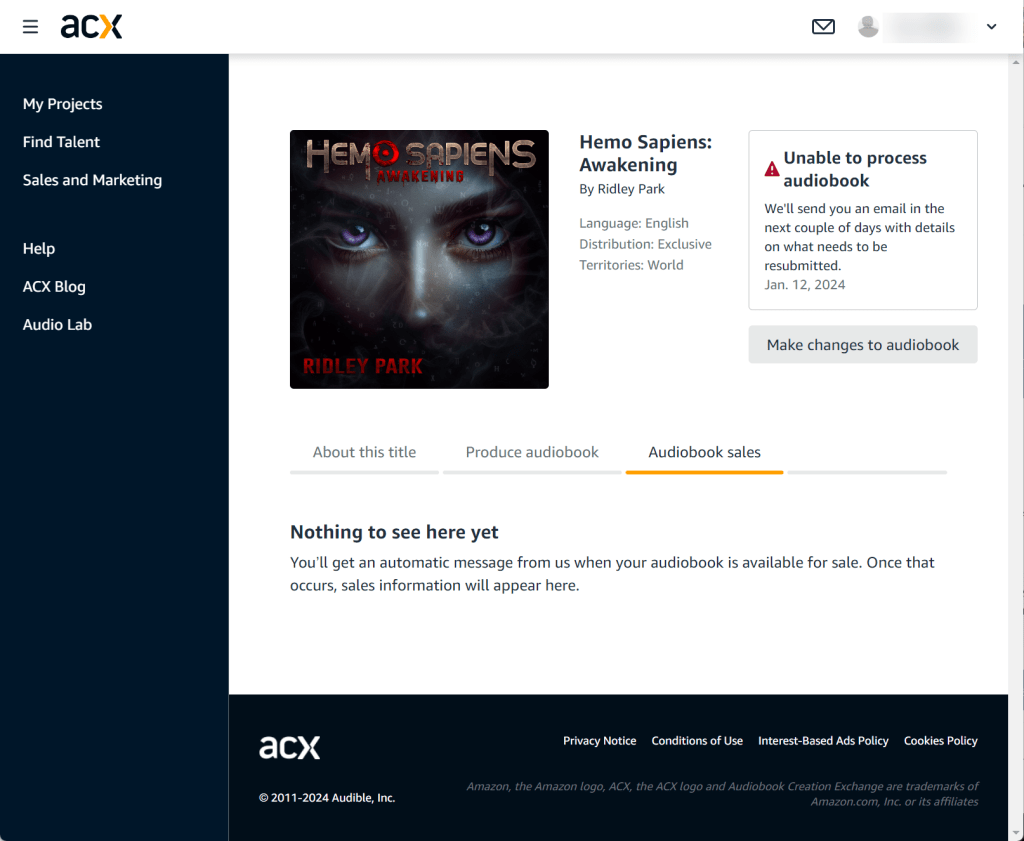
So this happened. I submitted Hemo Sapiens: Awakening as an audiobook, and it was rejected. The site says that they’ll let me know why in a couple days. My question is: if you rejected it, don’t you immediately know why?

I think I know why, but I can’t ‘fix’ the problem if I don’t know what it is. I don’t want to act on an assumption.

I believe they’ll inform me that I can’t use AI-generated narration. This would be odd because they have a programme in Beta where they provide the service of automatically converting the text of a book to audio. To be honest, it doesn’t sound amazing. It appears that they are using their own Amazon Polly, which I like, but you need to babysit it hard. It is very unlikely to sound good without heavy hand-holding. As it is, I hand-held my ElevenLabs AI to make the outcome sound like a professional human.

Audible offers some voiceover actors, but I didn’t like any of them, and they couldn’t compete with my ElevenLabs voice. I can understand that they don’t want to sell audiobooks that sound like Stephen Hawking, but theirs sound closer to him than mine.

On another note, I had to render and upload square cover art. There was a stated restriction disallowing padding a rectangular cover image with space or colour to make it square. I followed this rule, but this is exactly what they do. They take the cover of the book you’re selling through Amazon, and they pad the left and right margins with filler colour. I may append the rationale they provide once I’ve received it. Until them, my audiobook is on hold.

First Chapters Free on Kindle

If you are interested in Hemo Sapiens: Awakening, but you don’t want to commit your hard-earned shekels, the first four and a half chapters are available for FREE (woohoo). I mean, you’ll miss the best chapters, but what can I say. Dip your toe in the water.

If you have Kindle Unlimited, you can read the entire book for free. Sounds like a win-win to me. You are a winner, right?

Hemo Sapiens: Origins

Now that Hemo Sapiens: Awakening has been released into the wild, I can again focus on Hemo Sapiens: Origins. I started writing Origins a few weeks ago, but I was interrupted by the review and production process of Awakening.

In the world of Pantsers and Plotters, I tend to fall somewhere in between, but I favour plotting.

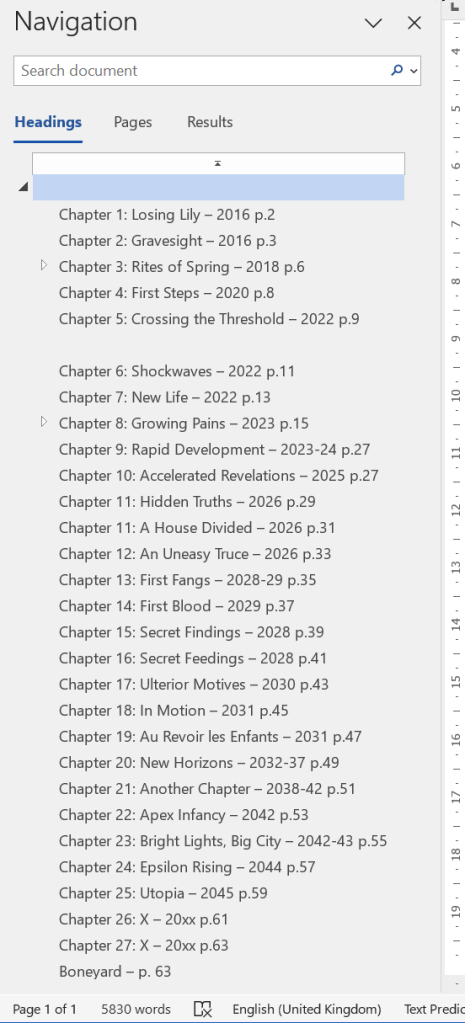
I write in Word. In the example above, you can see the working chapter titles, the year(s) a chapter covers and its starting page. Some of the chapters already contain preliminary copy.

As a writer, I don’t necessarily work chronologically. I find the chapters that are the most compelling and interesting to me. Then, I work down to the bridging chapters, hoping that the meat of the chapters penned earlier will support and inspire the later ones.

As I write, I usually create a ‘Boneyard’ chapter. This is where ideas go to incubate or die. Workable ideas are resurrected whilst others are laid to rest. Some ideas are like zombies, but at the end a project, they are either among the dead or living.

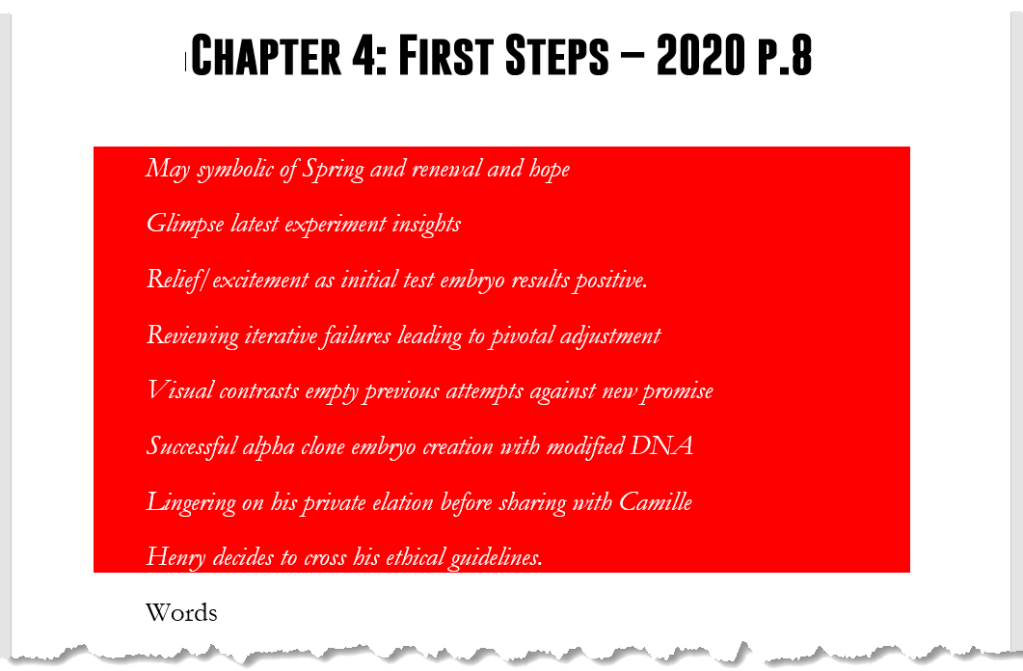
At the start, a chapter looks something like this. It’s a blend between ideas and story beats. Each chapter is outlined similarly. The other advantage this lends me is that I can *ahem* walk away from writing for a while and still have handholds and reminders when I return. For short fiction, I just write. No outlines. Perhaps just an idea to explore.

What is your writing style? Leave comments below.

Hemp Sapiens: Awakening Advert Spot 1

Podcast: Audio version of this content

Hemo Sapiens: Awakening is a compelling near-future science fiction novel that explores issues of identity, belonging, and the struggle for personal sovereignty. When a community living off the grid is discovered by the authorities of a dominant society, their entire way of life is threatened. Forced to assimilate into a culture not their own, they must make an impossible choice – abandon their traditions or fight to preserve their cultural identity at any cost.

This thought-provoking book sets the stage for an epic series that investigates the origin of these mysterious people. Their future hangs in the balance as the reader joins them on a journey of self-discovery. Will they succumb to conformity or rise up to claim their autonomy?

I’m the author, Ridley Park, and I invite you to immerse yourself in this imaginative new world and come along for an unforgettable adventure. Hemo Sapiens: Awakening is available now in hardcover, paperback and ebook formats. Audiobook versions will be released in February 2024. Get your copy today!

Thanks to India

I’d like to thank the person in India who earned me $0.02 by reading 17 Kindle pages of Hemo Sapiens: Awakening. Reading on Kindle Unlimited is free—time aside. Read the whole book, and I’ve earned $0.50. In time, we’ll be as rich as astronauts.

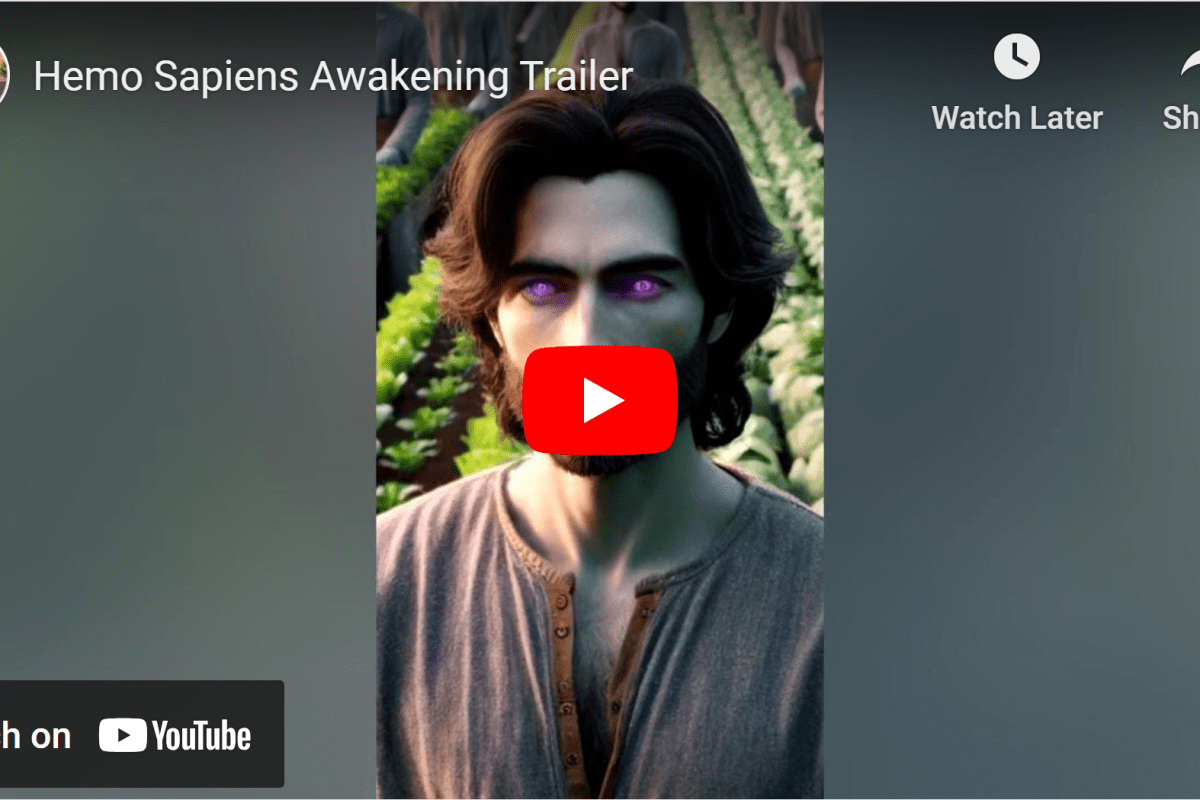
Hemo Sapiens: Awakening Trailer

The trailer advert for Hemo Sapiens: Awakening is now available on YouTube as a 60-second short.

I think I’ll stick to writing. The cover-making wasn’t half bad, but video production with Generative AI is not all it’s cracked up to be.

I considered Artlist.io, but I didn’t want to spend the cash. Maybe next time.

Let me know what you think. You can find a copy of the book from a link on my announcement page. If you get a copy, leave a review. It helps to appease the algorithm gods.