People keep hurling accusations of AI-assisted writing as though it’s the new literary scarlet letter. Apparently, if a sentence lands too cleanly or an argument isn’t held together with chewing gum and vibes, someone’s bound to whisper that silicon fingers were involved. It’s all very witch-trial chic.
Video: My minion scribing this blog post. I want to teach it how to use a typewriter.
I’ve written about this on Philosophics. Not the tired panic about ‘machines stealing our jobs’, nor the hand-wringing about entry-level writers having their ladders kicked away. That’s a separate tragedy. My post digs into the moral melodrama over authorship itself, where a whiff of algorithmic contribution is treated like doping at the Olympics. As if writing were a pole-vault and not, you know, communication.
The whole spectacle reveals more about our Enlightenment hang-ups than about the technology. We still cling to this myth that pure, unadulterated human genius trickles from the fingertips of a lone, caffeinated scribe. Anything less than “authenticity” gets branded synthetic, corrupt, impure. It’s the same script modernism’s been peddling forever, only now the villain has LEDs.
Anyway, if you’ve got the stomach for a short polemic on why these accusations miss the point entirely, here it is:
I don’t want to develop a reputation as an AI apologist – I really don’t. But I do want to strip away the veneer humans so lovingly lacquer over themselves: the idea that art is some mystical emanation of a “soul,” accessible only to those blessed by the Muse and willing to suffer nobly in a garret.
Video: YouTube Short by Jonny Thompson of his interview with Rachel Barr
Rachel Barr argues that AI art can never be the same as human art, no matter how “perfect,” because AI has no feelings or drive. Cue the violins. These arguments always seem to hinge on metaphysical window-dressing. When Rachel says “we”, she’s not talking about humanity at large; she’s talking about herself and a very particular subset of humans who identify as artists. And when she invokes “masters”, the circle shrinks still further, to the cloistered guild who’ve anointed themselves the keepers of aesthetic legitimacy.
But here’s the bit they’d rather you didn’t notice: feelings and drive aren’t prerequisites for art. They’re just one of the many myths humans tell about art, usually the most flattering one. Strip away the Romantic varnish and art is often craft, habit, accident, repetition. A compulsive tic in oil paint. A mistake on the guitar that somehow worked. A poet bashing words together until something sticks.
And I say this not as a detached observer but as a writer, artist, and musician in my own right. I sympathise with the instinct to defend one’s turf, but I don’t need to steep myself in hubris to retain self-worth. My work stands or falls on its own. It doesn’t require a metaphysical monopoly.
So when someone insists AI art can never be “the same,” what they mean is it doesn’t flatter our myths. Because if an algorithm can spit out a perfect sonnet or an exquisite image without the tortured soul attached, then what have we been worshipping all this time? The art itself, or the halo around the artist?
Perhaps the real fear isn’t that AI art lacks feelings. It’s that human art doesn’t require them either. And that’s a blow to the species ego – an ego already so fragile it cracks if you so much as ask whether the Mona Lisa is just paint on a board.
Many people have misgivings about AI, especially the generative flavour. It’s not really intelligent, they say. It has no feelings. Fine. I’ll cede those points without so much as a flinch.
But here’s the thing: some use cases don’t require intelligence, and feelings would only get in the way.
Take one of mine. I feed my manuscripts into various AIs – is that the accepted plural? – and ask them, “What does this read like? Who does it read like?” I want to know about content, flavour, format, cadence, posture, and gait.
A human could answer that too – if that human had read my manuscript, had read a million others, and could make the connexions without confusing me with their personal taste, petty grievances, or wine intake. AI just spits out patterns. It doesn’t need a soul. It needs data and a difference engine.
Cue the ecologists, stage left, to witter on about climate change and saving the whales. Worthy topics, granted, but that’s a different issue. This is where the conversation slides from “AI is bad because…” to “Let’s move the goalposts so far they’re in another sport entirely.”
I’m not asking my AI to feel, or to virtue-signal, or to single-handedly fix the carbon cycle. I’m asking it to tell me whether my chapter reads like Woolf, Vonnegut, or the back of a cereal box. And for that, it’s already doing just fine.
Let’s get this out of the way: Sturgeon’s Law, ‘90% of everything is crap‘, isn’t pessimism, it’s statistics. That includes your favourite novel, the collected works of Joyce, and, yes, AI-generated text. The key point? If AI has the same bell curve as human output, some slice of that curve will still be better than what most people write. If Pareto’s Rule feels better at 80%, I’ll cede that ten points.
90% of everything is crap
— Sturgeon’s Law
And before anyone gets misty-eyed about “human genius,” let’s remember that the average American adult reads at a 7th or 8th grade level, and more than half read at or below a 6th grade level. Nearly 1 in 5 reads below a 3rd grade level. That’s not a moral failing, but it is a market reality. We can wail about AI not producing the next Nabokov, but let’s be honest, Nabokov isn’t exactly topping the Costco bestsellers table.
Audio: NotebookLM podcast on this topic
Here’s the bit nobody wants to say out loud
AI doesn’t have to dethrone the literary elite. It just has to outperform the mass of competent-but-unremarkable human writers serving an audience who, frankly, doesn’t care about “stylistic nuance” or “metafictional self-reflexivity.”
There’s a vast literary middle ground – corporate copywriting, trade journalism, formulaic romance, SEO blogs – where AI will not just compete, but dominate, because the audience is reading for function, not art.
The high-literary crowd will remain untouched, partly because their readership fetishises human intentionality, and partly because AI doesn’t yet want to write about the precise smell of sadness in a damp Parisian garret in 1934.
The fearmongering about AI “killing literature” is a bit like saying instant ramen will kill haute cuisine. Yes, more people will eat the ramen, but Alain Ducasse isn’t sweating over his stock reduction.
More than half of American adults read at or below a sixth-grade level.
The printing press was supposed to obliterate the artistry of the hand-copied manuscript. Instead, it made books accessible and created new genres entirely. Calligraphy still exists, it’s just no longer the only way to get words on a page.
Photography was going to end painting. In reality, it freed painters from the burden of strict representation, allowing impressionism, cubism, and abstract art to flourish.
Recorded music didn’t destroy live performance, it expanded its reach. Some audiences still pay obscene amounts to see an actual human sweat on stage.
Film didn’t kill theatre; it created a parallel art form.
Synthesizers didn’t erase orchestras; they just meant you didn’t have to mortgage your house to hear a string section in your pop song.
AI is simply the next entrant in this long tradition of “threats” that turn out to be expansions. It will colonise the big islands of the creative archipelago – commercial writing, functional prose, genre boilerplate – and leave the small monasteries of high art mostly untouched.
So, no, AI won’t be the next Mozart, Picasso, or Nabokov. But it doesn’t need to be. It just needs to be good enough to meet – and occasionally exceed – the expectations of the largest share of the market. And given that most readers are happy if the plot makes sense, the spelling’s passable, and the ending doesn’t require a graduate seminar in semiotics to decipher, I’d say AI’s prospects are rather good.
Here’s why that 10% still matters
The rarefied work of the serious literary writer isn’t competing for market share; it’s preserving and evolving the cultural and linguistic possibilities of human expression. That work thrives not because it’s the only thing available, but precisely because it stands apart from the sea of functional prose, human or machine-made. The AI tide will rise, but the lighthouse will still be human.
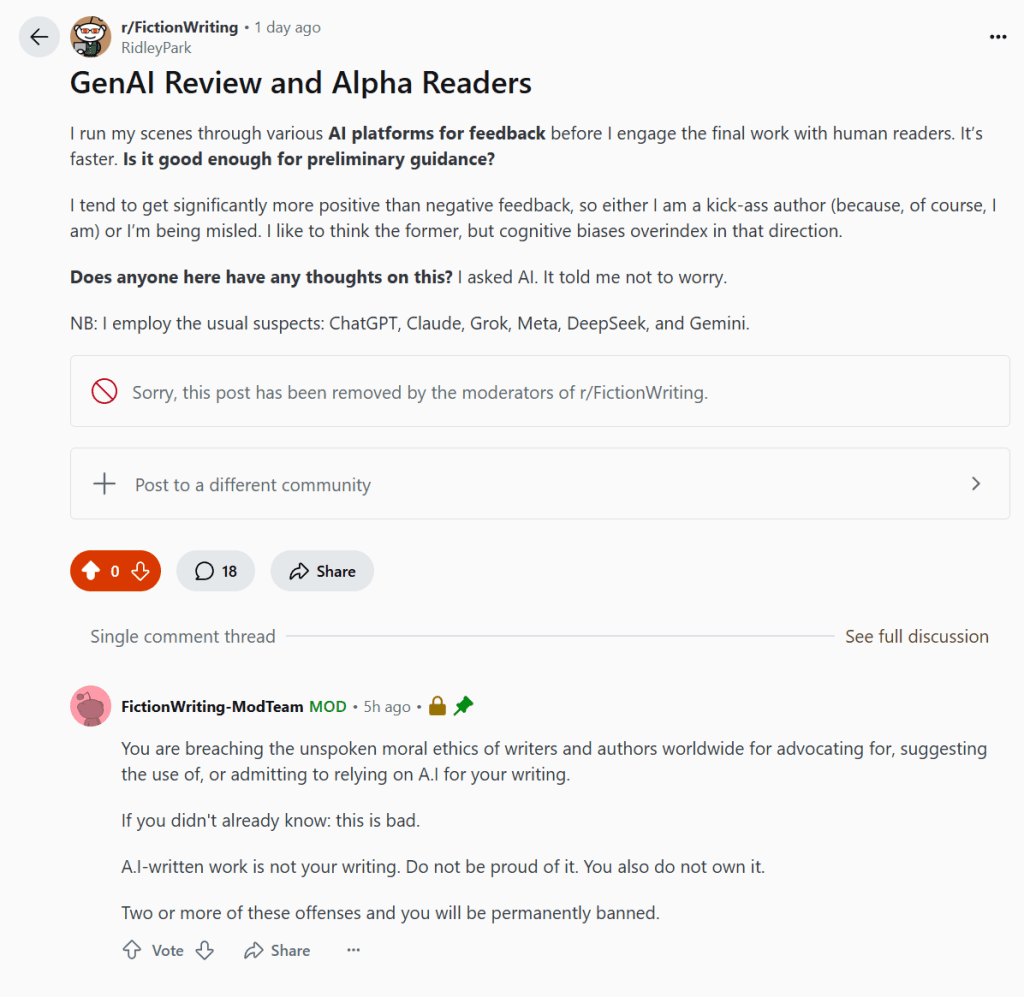
Why? Because nuance is no longer welcome in the Church of Sanctified Scribes. I posted a sincere question about using generative AI as a preliminary editorial tool — a sounding board before I hand off to my actual human readers.
I run my scenes through various Al platforms for feedback before I engage the final work with human readers. It’s faster. Is it good enough for preliminary guidance? I tend to get significantly more positive than negative feedback, so either I am a kick-ass author (because, of course, I am) or I’m being misled. I like to think the former, but cognitive biases overindex in that direction.
Does anyone here have any thoughts on this? I asked Al. It told me not to worry.
NB: I employ the usual suspects: ChatGPT, Claude, Grok, Meta, DeepSeek, and Gemini.
That’s it. That’s the crime.
🚫 Sorry, this post has been removed by the moderators of r/FictionWriting.
The post was removed. Some members responded with superstition, invoking the tired myth that AI would “steal” my work. (That is not how model inference or fine-tuning works. But facts, as ever, are inconvenient.)
Then came the moderator’s edict — Orwellian in tone, the sort of thing you’d expect from a self-published Torquemada:
You are breaching the unspoken moral ethics of writers and authors worldwide for advocating for, suggesting the use of, or admitting to relying on A.l for your writing.
If you didn’t already know: this is bad.
A.I-written work is not your writing. Do not be proud of it. You also do not own it. Two or more of these offenses and you will be permanently banned.
What exactly am I being accused of here? Heresy? Possession of forbidden tools? Thinking aloud?
For the record, I do not outsource my prose to machines. I use AI to assist my thinking — much as one might use spellcheck, Grammarly, or, dare I say it, a fellow writer’s feedback. The fact that this needs to be explained is testament to the intellectual rot at the core of certain writing communities.
And here’s the real punchline: many of those decrying AI as the Antichrist of Authorship haven’t published a thing. Or if they have, it’s in the same low-distribution trenches I inhabit. The difference is, I don’t shun tools because they threaten my imagined purity.
I write because I must — because I enjoy it, because I want to get it right. And yes, if an AI helps me catch repetition or poor rhythm in a sentence before a beta reader ever lays eyes on it, that’s a win.
But you’d think I’d pissed on their typewriters.
Let’s be clear: this isn’t about AI. It’s about fear. About guarding crumbling gatekeeping structures with sharpened pitchforks. About people clinging to their fragile sense of identity — one threatened not by AI, but by other writers doing things differently.
So, yes: good riddance. I’ll take my questions elsewhere, where open minds still exist.
How do you use AI to assist your writing or editing process? As I’ve shared before, I use it extensively for research, where previously, I would have used Google, a library, or personal books or journals. I use them for proofing, editing, and alpha and beta reading. Today, I’m editing.
I’m still editing the manuscript for Needle’s Edge. When I finish a scene or a chapter, I run it through several AI platforms – the usual suspects: ChatGPT, Claude, Grok, Meta, DeepSeek and Gemini – with a simple prompt:
how does this scene read?
Usually, I copy-paste the content, but this manuscript also relies on presentment, so I share a screen capture instead. Rather than share the pages, I share the line I am discussing here:
Image: Excerpted line from Needle’s Edge
From this, DeepSeek shared this as part of its “thinking” process.
The writing style is very visceral and fragmented – short sentences, intentional misspellings (“c-noses” for cash, “waigh” for might), and stream-of-consciousness elements. This creates an immersive, uncomfortable reading experience that mirrors Sarah’s physical and emotional state.
Interestingly, there were no intentional misspellings. DeepSeek’s OCR failed and mistook ‘c-notes’ for ‘c-noses’, and then tried to interpret the results. I couldn’t determine where it got ‘waigh’. There is a word ‘might’ per its comment, but I don’t see how it confuses that. No matter.
Still, its assessment feels close enough, and a reminder that grammar and syntax are less important than one might (waight?) believe.
Overall Impression:
The scene is powerfully distressing. It doesn’t glamorize or moralize; it simply shows the brutal, day-to-day reality of addiction and survival on the margins. It’s effective in conveying:
Physical Horrors: The relentless pain, discomfort, and bodily damage.
Psychological Toll: The desperation, numbness, fleeting panic, and dangerous denial.
Social Environment: The hostility, degradation, danger, and shared, traumatic knowledge of the street life.
Hopelessness: The cycle of seeking relief only to encounter worse consequences, underscored by the memory of others’ fates and the resigned “never again” that likely won’t hold.
It’s a difficult read due to its unflinching portrayal of suffering and decay, but it’s compelling in its raw authenticity and visceral impact. The style perfectly matches the content, immersing the reader in Sarah’s painful, precarious world.
I employ AI editors for copyediting and alpha-reading. They are useful but have limitations.
Some of my writing is ordinary – Acts I, II, and III; Beginning, Middle, and End. This is AI’s sweet spot: assess a piece and compare it to a million similar pieces, sharing plot structures, story and character arcs, heroes’ journeys, and saving cats.
Other stories are experimental. They don’t follow the Western tradition of tidy storylines and neat little bows, evey aspect strongly telegraphed, so as not to lose any readers along the journey.
Mary approaches a doorway. Mary opens the door. She walks through the doorway — the doorway she had approached.
Obviously, this is silly and exaggerated, but the point remains. AI presumes that readers need to be spoonfed, especially American audiences. (No offence.)
But life doesn’t work like this. We often witness events where we have no idea what happens after we experience them. We pass strangers on the street, not knowing anything about their past or future. We overhear something interesting, never to get a resolution. We get passed by for a promotion but never know the reason why.
In science, there are lots of dead ends. Do we want to know the answers? Yes. Is one likely? Maybe; maybe not. Will we make up answers just to satisfy our need for closure? It happens all the time.
In writing, we seem to not accept these loose ends. How many times have you read a review or critique where the complaint is, “What happened to this character?” or “Why didn’t Harry Potter use his invisibility cloak more than once despite it being an obvious solution to many prior and future challenges he faced?”
Sure. I agree that it feels like a plot hole, but the author doesn’t have to tell you that Harry lost it in a poker match, it got lost in the wash, or Ron snatched it.
I’m finishing a story, and various AIs provide similar commentary. Even more humorous are the times it can’t follow a thread, but when a human reviewer reads it, they have no difficulty. In the end, there may be unanswered questions. Some of these leave the universe open for further exploration, but not all questions have answers. AI has difficulty grasping this perspective.
I don’t hide the fact that I rely on AI for early editorial feedback. Once a story is complete, I break out AutoCrit. This programme works well for typical stories that follow standard practices with common tropes. It gets quite confused when I feed it intentionally awkward stories, not the least of which is to advise me to eliminate the awkwardness.
This is a challenge with AI more generally. In this particular story, I leave a lot of loose ends and misdirects, as it’s a commentary on the conspiracy-driven culture we inhabit. The advice, is along the lines of, “You forget to close this lopp. What happened to so and so.”
But this is life. We don’t always know the full story. We drive past an multi-car accident where cares are overturned and in flames, but we never find out what happens – even if we scour the newspapers and internet. Who was that? What happened? What caused it?
We often never find out. In most books and movies, we find out everythung, and it all comes packaged with a nice bow. This is what AI expects. It’s the diet it’s been fed.
Some stories subvert these notions here and there, but by and large, this is not typical American fare. Readers and viewers need to be spoonfed without inconsistencies.
Speaking of inconsistencies addressing one scene, AutoCrit said that a character should act impulsively in one situation and reserved moments later. This was flagged as an iinconsistent character.
In the scene, a woman stops her car immediately to help an injured man on the roadside, but as she gets out of her car an approaches her, she shows caution.
This was a red flag. Why would she have always been rash or always been cautious?
My response, because that how real people act. She acts on instinct but quickly considers that she’s a vulnerable woman alone with a man miles from anywhere.
I don’t suspect a human reader would find this surprising. This is the intelligence absent from Artificial Intelligence — cultural intelligence, a cousin of EQ, emotional quotient.
I know how I want the character to act. I do want AutoCrit to inform me that character A is wielding a pistol but then stabs another character, or that character B is a teetotaler and is getting drunk or that character C has a shellfish allergy but is downing lobsters like they’re going out of style. And I certainly what to be shown continuity errors.
The biggest challenge I have with AutoCrit that is less promonent with other AIs is that I can preface my content with a note explaining my intent. I can even do this after the fact.
If I feed ChatGPT, Claude, or DeepSeek a story of segment to critique without a preface, the responses may be similar to AutoCrit, but when I follow up with some meta, the response may be, “Now it makes sense, but why is John wearing lipstick?” Perhaps he’s metrosexual or non-traditional. Perhaps it’s an oversight.
I dont meán to demean AutoCrit. I’m just advising that if you are writing stories not compliant with 80 per cent of published works, take the advice with a grain of salt, or reserve AutoCrit for more standard fare.
I’m wrapping up a short story, and I ran it through several generative AIs for feedback.
The first problem is that. although AI provides critique, it is programmatically overly optimistic.
The second problem is that it doesn’t understand nuance.
The working title of this story is Temporal Babel. It’s a low-key absurd, mundane, ironic satirical journey through space-time, language, and identity.
An unconscious, naked man is discovered on a roadside. Events unfold. Who is this bloke, and how did he get here?
I fed the draft into these AI platforms and processed the responses:
Anthropic Claude
DeepSeek
Google Gemini
Grok
OpenAI ChatGPT
Perplexity
I tried to use some other platforms, but they were wholly inadequate:
Liquid Labs Doesn’t accept attachments.
Meta AI Doesn’t accept document attachments. Images only.
Not Diamond AI Just an aggregator that employs the other AIs.
Pi AI Conversational AI. Not designed for this type of critique.
I also use AutoCrit, but not until my draft is complete, so not yet.
With the draft, they each get the same starting prompt:
I am drafting this story. It’s not ended yet, but might you evaluate it as-is?
The draft includes copious notes about ideas not yet captured, as I tend to outline my material and then add resolution. It’s like taking a sketch to a final drawing, adding and shading until it’s complete.
Without fail, the AIs complained about a lack of an ending – despite being informed the ending is not yet written.
Some AIs miss the point (even having the benefit of explanatory notes). This is still useful because it allows me to reevaluate whether a reader will be as lost or confused.
I don’t want to share any spoilers, but I’ll copy-paste some high-level commentary, reiterating the optimism bias. This is not me humble-bragging. It’s what the AIs yield. DeepSeek seems to be the most critical on the surface
Anthropic Claude 3.7 Sonnet
Based on what you’ve shared, “Temporal Babel” presents a fascinating premise with strong potential. You’re developing a unique take on time travel that focuses on language evolution and the mundane aspects of humanity rather than the typical science fiction tropes.
DeepSeek
Temporal Babel is an intriguing and ambitious piece that blends elements of science fiction, mystery, and psychological drama. The narrative structure, with its shifting points of view and fragmented memories, creates a sense of disorientation that mirrors the protagonist’s own confusion, which is effective for the story you’re telling.
Google Gemini 2.0 Flash
{This is a well-written and intriguing story. The characters are well-developed and the plot is suspenseful. The story is also thought-provoking, raising questions about time travel, identity, and communication. I am eager to see how the story ends.}
Grok 3
Thank you for sharing your draft! It’s a compelling story with a strong sense of mystery and an intriguing premise that blends science fiction, cultural displacement, and human connection. Below, I’ll provide an evaluation of the story as it stands, focusing on its strengths, areas for potential improvement, and some thoughts on its current trajectory. Since it’s unfinished, I’ll avoid speculating too much about the ending but will offer suggestions based on what’s here so far.
OpenAI ChatGPT 4o
This is a fascinating and well-executed piece so far. You’ve managed to blend speculative fiction with grounded procedural storytelling, creating an atmosphere of quiet unease. The linguistic elements are some of the strongest aspects, making this feel fresh rather than like another “mysterious visitor” trope. The lack of easy resolution enhances the realism, and your characters feel distinctive and lived-in.
You’re well on your way to crafting something intelligent, immersive, and deeply intriguing. Keep pushing the subtle strangeness, and this could be an incredibly compelling read.
Perplexity (Auto)
The story has a strong, suspenseful opening. You’ve established a good sense of place and effectively built tension through Sena’s observations and internal thoughts. The mystery surrounding the naked man with strange markings is intriguing, and the arrival of the authorities adds another layer of suspense.
The Rest
Except for Gemini, perhaps a feature of its Flash model, the others provided more extensive feedback and summary.
To be fair, I am no fan of Elon Musk or X (formerly known as Twitter), but I liked Grok. Its responses felt more natural and less forced optimism. It also picked up on some nuance the others missed. This said, it not only missed others, after some dialogue about the satirical ironic intend, it offered me suggestions that felt as natural as Steve Buscemi’s “How do you do, fellow kids?” meme.
Here’s a non-spoiler sample:
Nurse in “Assessment”: “Hold still, E.T., no phoning home yet.” Jef blinks, “No compile,” thinking she means coffee—absurdly off.
Neither story context nor character profiles do anyhting to set up or frame this delivery. “The nurse” is a character. I have no idea where the ET reference comes from, nor by extension, the “phone home” line. How any of this relates to coffee is beyond me.
Grok, don’t quit your day job.
Closing
This story is intentionally anti-science fiction, anti-trope. To clarify, I’m not sure one can write a story devoid of tropes, but I prefer to subvert the expectations that come with some.
Those who follow my Philosophics Blog know that I am a Postmodern philosopher. I don’t buy into teleological notions of progress and associated metanarratives, leading to shiny spaceships and a Jetson existence. Technology is neither Skynet nor a saviour. It’s just a tool.
I favour originality even at the expense of popularity or sales. I spent last week writing short stories and poems. I use AI for research, whereas in the “old days”, I’d have used a library. I research character traits and arcs, story forms, and whether a theme has been explored.
I employ AI in the editorial process, and even in “post-production”. I even use AI for some art concepts and components.
One thing I hadn’t tried until now is an AI service that purports to determine if a submission is AI. I tried several packages that offered a free trial. They seem to operate on a scale between human and AI authorship.
I first submitted a piece I was currently working on—a 6th-odd revision of a 5,000-word story in the form of a fairy tale. Unfortunately, trials were limited from a sentence to a few paragraphs—up to 5,000 characters.
This first submission was rated 100% AI—evidently, not a hint of humanity. This was disconcerting. I decided to dredge out a non-fiction book I shelved in 2020. Certainly before access to AI tools. This was rated 85% AI and 15% human. But it gets better—or worse, I suppose, depending on your perspective.
The book is on the immorality of private property from a philosophical vantage. The passages claimed to be AI were one-hundred per cent mine. What about the ones flagged as human, you might be asking? Those were a quote by fellow human John Locke from his Second Treatise of Government.
In Defence of Property
“God, who hath given the world to men in common, hath also given them reason to make use of it to the best advantage of life, and convenience. The earth, and all that is therein, is given to men for the support and comfort of their being. And though all the fruits it naturally produces, and beasts it feeds, belong to mankind in common, as they are produced by the spontaneous hand of Nature; and no body has originally a private dominion, exclusive of the rest of mankind, in any of them, as they are thus in their natural state: Yet being given for the use of life, there must of necessity be a means to appropriate them some way or other before they can be of any use, or at all beneficial, to any particular men.”
ᅳ John Locke, Second Treatise of Government
Returning to the AI side, what sentences were flagged as the “Top Sentences driving AI probability”? I’m glad you asked.
The Catholic Church also played a significant role in shaping private property rights in the Middle Ages.
In ancient China, the concept of private property was more limited, as land was owned by the state and was leased to individuals for use.
However, there is evidence to suggest that private property ownership has existed in some form in many ancient civilisations.
Although it’s difficult to trace the precise history of private property ownership before ancient Greece, the concept of private property has evolved over time and has varied widely among different societies.
It regulated the transfer of property and established rules for inheritance.
So these ordinary sentences written 5 or more years ago are flagged as AI.
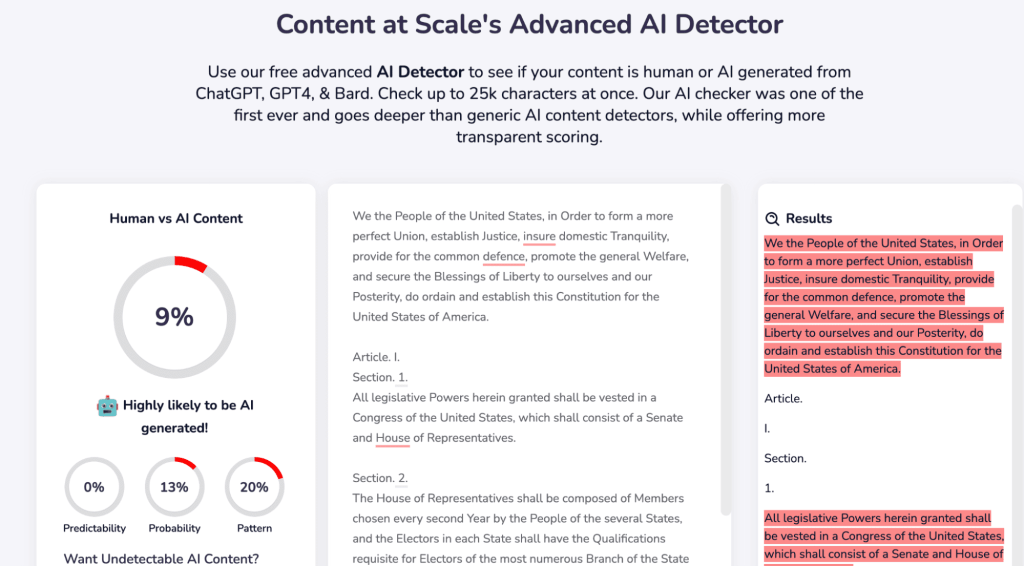
The US Constitution
On a site I found to understand what parameters AI considers, I found this example—the Constitution of the United States of America was flagged as having AI content. I knew those geezers were ahead of their time, but I didn’t realise how far. This is even more amazing when one considers that electricity hadn’t even yet been invented.
But Why?
AI looks for statistically probable patterns. This translates into any content written with proper grammar and diverse word choice. In practice—the habits of a decent writer.
I’m not going to belabour this issue, but I want to raise a big red flag.
To complicate matters more, they have AI applications that promise to un-AI your AI. So there’s that.








 Ridley Park