People keep hurling accusations of AI-assisted writing as though it’s the new literary scarlet letter. Apparently, if a sentence lands too cleanly or an argument isn’t held together with chewing gum and vibes, someone’s bound to whisper that silicon fingers were involved. It’s all very witch-trial chic.
Video: My minion scribing this blog post. I want to teach it how to use a typewriter.
I’ve written about this on Philosophics. Not the tired panic about ‘machines stealing our jobs’, nor the hand-wringing about entry-level writers having their ladders kicked away. That’s a separate tragedy. My post digs into the moral melodrama over authorship itself, where a whiff of algorithmic contribution is treated like doping at the Olympics. As if writing were a pole-vault and not, you know, communication.
The whole spectacle reveals more about our Enlightenment hang-ups than about the technology. We still cling to this myth that pure, unadulterated human genius trickles from the fingertips of a lone, caffeinated scribe. Anything less than “authenticity” gets branded synthetic, corrupt, impure. It’s the same script modernism’s been peddling forever, only now the villain has LEDs.
Anyway, if you’ve got the stomach for a short polemic on why these accusations miss the point entirely, here it is:
I don’t want to develop a reputation as an AI apologist – I really don’t. But I do want to strip away the veneer humans so lovingly lacquer over themselves: the idea that art is some mystical emanation of a “soul,” accessible only to those blessed by the Muse and willing to suffer nobly in a garret.
Video: YouTube Short by Jonny Thompson of his interview with Rachel Barr
Rachel Barr argues that AI art can never be the same as human art, no matter how “perfect,” because AI has no feelings or drive. Cue the violins. These arguments always seem to hinge on metaphysical window-dressing. When Rachel says “we”, she’s not talking about humanity at large; she’s talking about herself and a very particular subset of humans who identify as artists. And when she invokes “masters”, the circle shrinks still further, to the cloistered guild who’ve anointed themselves the keepers of aesthetic legitimacy.
But here’s the bit they’d rather you didn’t notice: feelings and drive aren’t prerequisites for art. They’re just one of the many myths humans tell about art, usually the most flattering one. Strip away the Romantic varnish and art is often craft, habit, accident, repetition. A compulsive tic in oil paint. A mistake on the guitar that somehow worked. A poet bashing words together until something sticks.
And I say this not as a detached observer but as a writer, artist, and musician in my own right. I sympathise with the instinct to defend one’s turf, but I don’t need to steep myself in hubris to retain self-worth. My work stands or falls on its own. It doesn’t require a metaphysical monopoly.
So when someone insists AI art can never be “the same,” what they mean is it doesn’t flatter our myths. Because if an algorithm can spit out a perfect sonnet or an exquisite image without the tortured soul attached, then what have we been worshipping all this time? The art itself, or the halo around the artist?
Perhaps the real fear isn’t that AI art lacks feelings. It’s that human art doesn’t require them either. And that’s a blow to the species ego – an ego already so fragile it cracks if you so much as ask whether the Mona Lisa is just paint on a board.
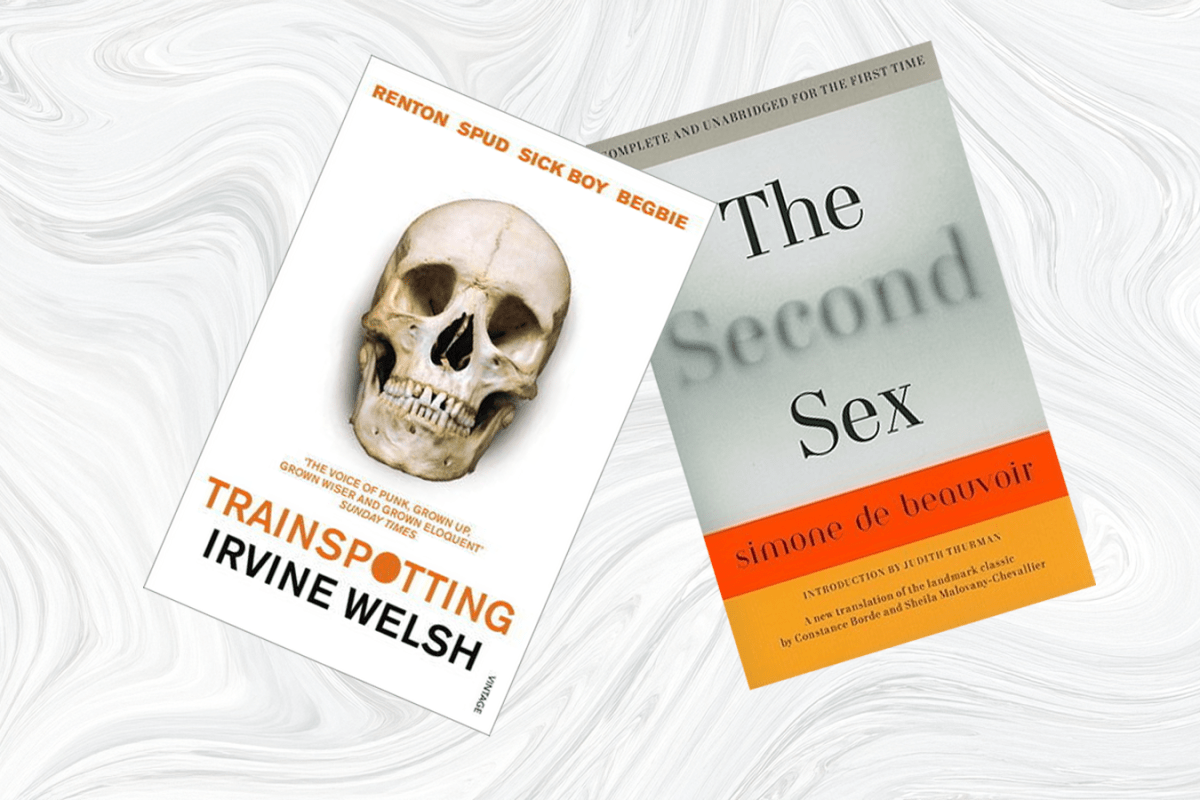
I’ve just finished Simone de Beauvoir’s The Second Sex – all 800 pages of it – and have now started Irvine Welsh’s Trainspotting. Both are classics in their own way. I’ll review Second Sex properly on my Philosophics Blog, but here I want to think about Trainspotting in relation to my current manuscript, Needle’s Edge.
Interestingly, Trainspotting was a ChatGPT recommendation. I fed in my draft of Needle’s Edge and this was one of the books it said my work resembled. Two chapters in, I see the connexion. First, the subject matter – drugs and addiction. Second, the rawness of the experience.
There are differences, of course. Trainspotting is rooted in Leith, Scotland; Needle’s Edge belongs to the East Coast of the United States – Delaware and Philadelphia. Welsh draws heavily on dialect and vernacular, with a narrative voice that’s linguistically dense and aurally charged. In Needle’s Edge, the style is pared down. Sentence fragments, middle dots instead of full stops, and an intentional “lower” register mirror the protagonist’s fractured perception and limited resources.
That gap in register creates a different authorial challenge. With every edit pass, I find myself policing intrusions of my vocabulary into her voice. Welsh, by contrast, can deploy a broader lexicon and trust the dialectal texture to keep it authentic. Listening to Trainspotting, I’m struck by how words and turns of phrase leap out – sometimes apt for Needle’s Edge, but often just a shade too polished for Stacey’s world.
Both texts orbit around environments that resist glamour. Welsh’s squat flats and pubs are grimy and feral; Needle’s Edge’s motel rooms and sidewalks are littered with fast-food wrappers, orange caps, and fading unicorn posters. Addiction erodes bodies in both stories, but the textures differ – Scotland’s industrial gray versus the East Coast’s cheap motels and suburban detritus.
As for the film version of Trainspotting, I saw it long ago and remember almost nothing. The novel isn’t refreshing my memory either; it feels like a separate creature altogether. Which is fitting: both Trainspotting and Needle’s Edge are less about plot than about capturing a lived texture, a rhythm of voices and environments that mainstream narratives usually discard.
Many people have misgivings about AI, especially the generative flavour. It’s not really intelligent, they say. It has no feelings. Fine. I’ll cede those points without so much as a flinch.
But here’s the thing: some use cases don’t require intelligence, and feelings would only get in the way.
Take one of mine. I feed my manuscripts into various AIs – is that the accepted plural? – and ask them, “What does this read like? Who does it read like?” I want to know about content, flavour, format, cadence, posture, and gait.
A human could answer that too – if that human had read my manuscript, had read a million others, and could make the connexions without confusing me with their personal taste, petty grievances, or wine intake. AI just spits out patterns. It doesn’t need a soul. It needs data and a difference engine.
Cue the ecologists, stage left, to witter on about climate change and saving the whales. Worthy topics, granted, but that’s a different issue. This is where the conversation slides from “AI is bad because…” to “Let’s move the goalposts so far they’re in another sport entirely.”
I’m not asking my AI to feel, or to virtue-signal, or to single-handedly fix the carbon cycle. I’m asking it to tell me whether my chapter reads like Woolf, Vonnegut, or the back of a cereal box. And for that, it’s already doing just fine.
Let’s get this out of the way: Sturgeon’s Law, ‘90% of everything is crap‘, isn’t pessimism, it’s statistics. That includes your favourite novel, the collected works of Joyce, and, yes, AI-generated text. The key point? If AI has the same bell curve as human output, some slice of that curve will still be better than what most people write. If Pareto’s Rule feels better at 80%, I’ll cede that ten points.
90% of everything is crap
— Sturgeon’s Law
And before anyone gets misty-eyed about “human genius,” let’s remember that the average American adult reads at a 7th or 8th grade level, and more than half read at or below a 6th grade level. Nearly 1 in 5 reads below a 3rd grade level. That’s not a moral failing, but it is a market reality. We can wail about AI not producing the next Nabokov, but let’s be honest, Nabokov isn’t exactly topping the Costco bestsellers table.
Audio: NotebookLM podcast on this topic
Here’s the bit nobody wants to say out loud
AI doesn’t have to dethrone the literary elite. It just has to outperform the mass of competent-but-unremarkable human writers serving an audience who, frankly, doesn’t care about “stylistic nuance” or “metafictional self-reflexivity.”
There’s a vast literary middle ground – corporate copywriting, trade journalism, formulaic romance, SEO blogs – where AI will not just compete, but dominate, because the audience is reading for function, not art.
The high-literary crowd will remain untouched, partly because their readership fetishises human intentionality, and partly because AI doesn’t yet want to write about the precise smell of sadness in a damp Parisian garret in 1934.
The fearmongering about AI “killing literature” is a bit like saying instant ramen will kill haute cuisine. Yes, more people will eat the ramen, but Alain Ducasse isn’t sweating over his stock reduction.
More than half of American adults read at or below a sixth-grade level.
The printing press was supposed to obliterate the artistry of the hand-copied manuscript. Instead, it made books accessible and created new genres entirely. Calligraphy still exists, it’s just no longer the only way to get words on a page.
Photography was going to end painting. In reality, it freed painters from the burden of strict representation, allowing impressionism, cubism, and abstract art to flourish.
Recorded music didn’t destroy live performance, it expanded its reach. Some audiences still pay obscene amounts to see an actual human sweat on stage.
Film didn’t kill theatre; it created a parallel art form.
Synthesizers didn’t erase orchestras; they just meant you didn’t have to mortgage your house to hear a string section in your pop song.
AI is simply the next entrant in this long tradition of “threats” that turn out to be expansions. It will colonise the big islands of the creative archipelago – commercial writing, functional prose, genre boilerplate – and leave the small monasteries of high art mostly untouched.
So, no, AI won’t be the next Mozart, Picasso, or Nabokov. But it doesn’t need to be. It just needs to be good enough to meet – and occasionally exceed – the expectations of the largest share of the market. And given that most readers are happy if the plot makes sense, the spelling’s passable, and the ending doesn’t require a graduate seminar in semiotics to decipher, I’d say AI’s prospects are rather good.
Here’s why that 10% still matters
The rarefied work of the serious literary writer isn’t competing for market share; it’s preserving and evolving the cultural and linguistic possibilities of human expression. That work thrives not because it’s the only thing available, but precisely because it stands apart from the sea of functional prose, human or machine-made. The AI tide will rise, but the lighthouse will still be human.
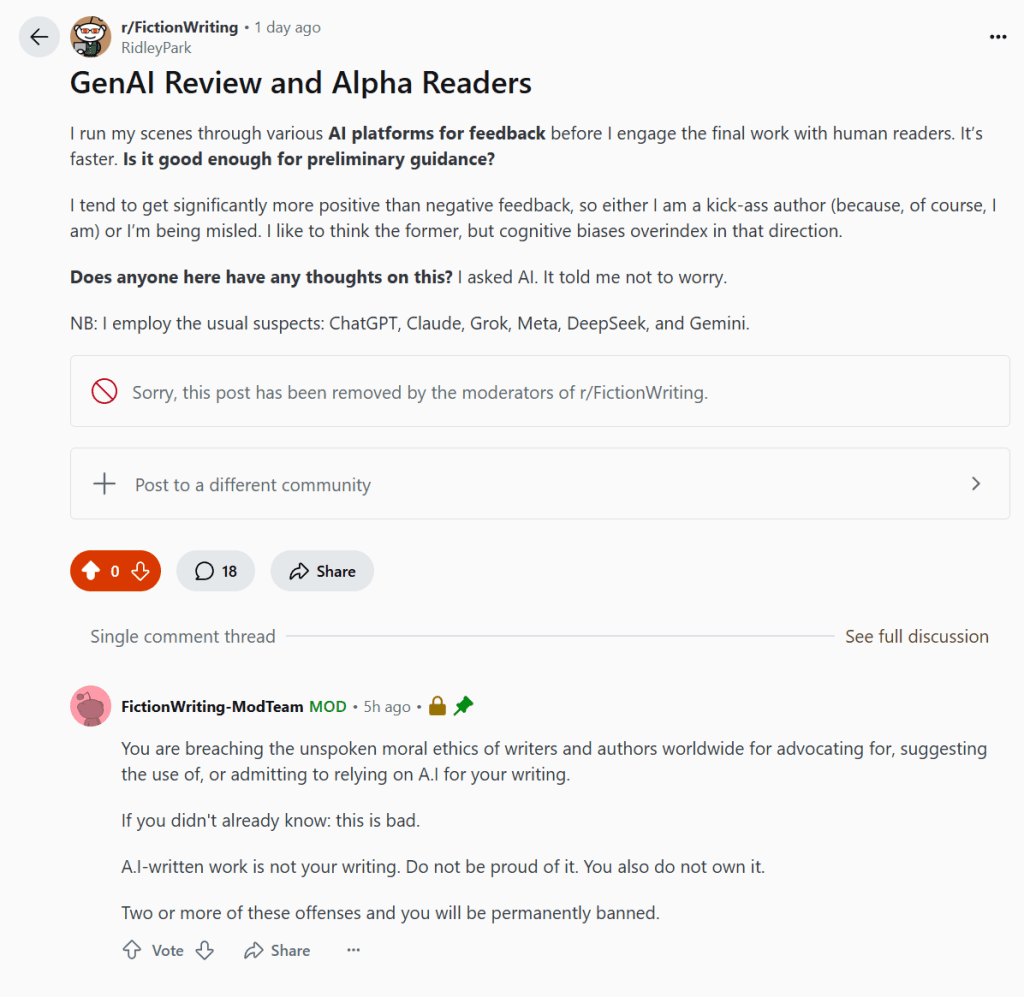
Why? Because nuance is no longer welcome in the Church of Sanctified Scribes. I posted a sincere question about using generative AI as a preliminary editorial tool — a sounding board before I hand off to my actual human readers.
I run my scenes through various Al platforms for feedback before I engage the final work with human readers. It’s faster. Is it good enough for preliminary guidance? I tend to get significantly more positive than negative feedback, so either I am a kick-ass author (because, of course, I am) or I’m being misled. I like to think the former, but cognitive biases overindex in that direction.
Does anyone here have any thoughts on this? I asked Al. It told me not to worry.
NB: I employ the usual suspects: ChatGPT, Claude, Grok, Meta, DeepSeek, and Gemini.
That’s it. That’s the crime.
🚫 Sorry, this post has been removed by the moderators of r/FictionWriting.
The post was removed. Some members responded with superstition, invoking the tired myth that AI would “steal” my work. (That is not how model inference or fine-tuning works. But facts, as ever, are inconvenient.)
Then came the moderator’s edict — Orwellian in tone, the sort of thing you’d expect from a self-published Torquemada:
You are breaching the unspoken moral ethics of writers and authors worldwide for advocating for, suggesting the use of, or admitting to relying on A.l for your writing.
If you didn’t already know: this is bad.
A.I-written work is not your writing. Do not be proud of it. You also do not own it. Two or more of these offenses and you will be permanently banned.
What exactly am I being accused of here? Heresy? Possession of forbidden tools? Thinking aloud?
For the record, I do not outsource my prose to machines. I use AI to assist my thinking — much as one might use spellcheck, Grammarly, or, dare I say it, a fellow writer’s feedback. The fact that this needs to be explained is testament to the intellectual rot at the core of certain writing communities.
And here’s the real punchline: many of those decrying AI as the Antichrist of Authorship haven’t published a thing. Or if they have, it’s in the same low-distribution trenches I inhabit. The difference is, I don’t shun tools because they threaten my imagined purity.
I write because I must — because I enjoy it, because I want to get it right. And yes, if an AI helps me catch repetition or poor rhythm in a sentence before a beta reader ever lays eyes on it, that’s a win.
But you’d think I’d pissed on their typewriters.
Let’s be clear: this isn’t about AI. It’s about fear. About guarding crumbling gatekeeping structures with sharpened pitchforks. About people clinging to their fragile sense of identity — one threatened not by AI, but by other writers doing things differently.
So, yes: good riddance. I’ll take my questions elsewhere, where open minds still exist.
How do you use AI to assist your writing or editing process? As I’ve shared before, I use it extensively for research, where previously, I would have used Google, a library, or personal books or journals. I use them for proofing, editing, and alpha and beta reading. Today, I’m editing.
I’m still editing the manuscript for Needle’s Edge. When I finish a scene or a chapter, I run it through several AI platforms – the usual suspects: ChatGPT, Claude, Grok, Meta, DeepSeek and Gemini – with a simple prompt:
how does this scene read?
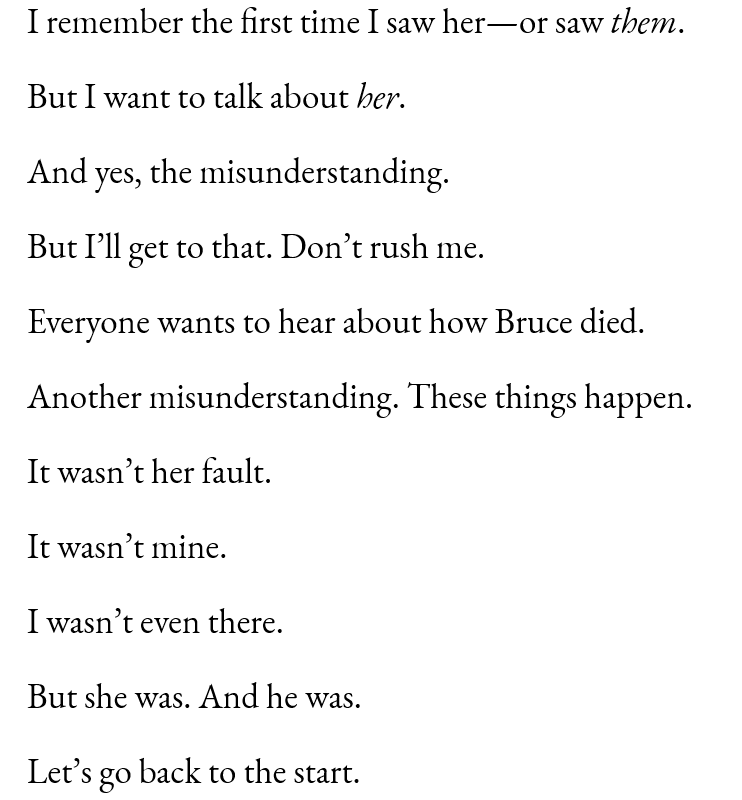
Usually, I copy-paste the content, but this manuscript also relies on presentment, so I share a screen capture instead. Rather than share the pages, I share the line I am discussing here:
Image: Excerpted line from Needle’s Edge
From this, DeepSeek shared this as part of its “thinking” process.
The writing style is very visceral and fragmented – short sentences, intentional misspellings (“c-noses” for cash, “waigh” for might), and stream-of-consciousness elements. This creates an immersive, uncomfortable reading experience that mirrors Sarah’s physical and emotional state.
Interestingly, there were no intentional misspellings. DeepSeek’s OCR failed and mistook ‘c-notes’ for ‘c-noses’, and then tried to interpret the results. I couldn’t determine where it got ‘waigh’. There is a word ‘might’ per its comment, but I don’t see how it confuses that. No matter.
Still, its assessment feels close enough, and a reminder that grammar and syntax are less important than one might (waight?) believe.
Overall Impression:
The scene is powerfully distressing. It doesn’t glamorize or moralize; it simply shows the brutal, day-to-day reality of addiction and survival on the margins. It’s effective in conveying:
Physical Horrors: The relentless pain, discomfort, and bodily damage.
Psychological Toll: The desperation, numbness, fleeting panic, and dangerous denial.
Social Environment: The hostility, degradation, danger, and shared, traumatic knowledge of the street life.
Hopelessness: The cycle of seeking relief only to encounter worse consequences, underscored by the memory of others’ fates and the resigned “never again” that likely won’t hold.
It’s a difficult read due to its unflinching portrayal of suffering and decay, but it’s compelling in its raw authenticity and visceral impact. The style perfectly matches the content, immersing the reader in Sarah’s painful, precarious world.
I’ve got a bone to pick with Claire Fraise, dammit. I’ve lost 2 days I’ll never get back — including the time it’s taking me to create this post.
Claire shared a YouTube video on using plot grids for your writing process. Being me and heeding her advice, I decided to create a plot grid – I call it a plot matrix; same thing – for a project I am editing.
Video: What is a plot grid?
I should probably create a video response, but I didn’t have even more time to lose.
Full Disclosure: By lose time, I don’t want to imply by any means that this is wasted time.
Since the plot matrix I created is for an unpublished manuscript, I decided to create one for the first chapter of my published book, Sustenance. It contains two sections or scenes.
Audio: NotebookLM podcast on this topic.
I’ll share the process I used and reference the Excel document I created. Download it if you’d like to follow along.
After the explanations, I’ll discuss how I use ChatGPT to help me with this, as well as some challenges you may wish to be aware of.
Below is a screenshot of a portion of the plot matrix.
Image: Portion of plot matrix
I’ll start by sharing the column headers and a brief explanation of what each means. Some should be obvious, but I’ll describe them as well.
Narrative Order: The order a scene appears in the manuscript.
Chronological Order: The sequence in which events occur in story-time, enabling tracking of flashbacks or non-linear jumps.
Sentiment: A numerical indicator of the scene’s emotional tone, from deeply negative (–5) to strongly positive (+5).
Chapter: The chapter or section title in which the scene appears.
Plot Points: A summary of key events, revelations, or decisions that occur in the scene.
Time: When the scene takes place, whether exact or relative (e.g., “early morning,” “flashback,” “six months later”).
Primary Characters in Scene: The characters actively driving or anchoring the scene.
Secondary Characters in Scene: Important but less central characters who influence or are present in the scene.
Minor Characters in Scene: Tertiary figures mentioned or briefly appearing without narrative weight.
Word Count: The number of words in the scene, useful for pacing and balance.
Emotional Beat/Theme: The scene’s dominant emotional tone or thematic current (e.g., betrayal, longing, discovery).
Emotional State: The internal condition or affective register of the POV character(s) during the scene.
Scene Function: What the scene accomplishes narratively (e.g., exposition, climax, setup, reversal).
Character Arc: How a character is developing, stagnating, or regressing within the scene.
External Stakes: The tangible, real-world risks or consequences present in the scene.
Internal Stakes: The emotional, psychological, or relational consequences at play.
Needs Clarification?: A flag to indicate whether a scene contains confusing elements or ambiguous logic.
Revision Priority: A ranking of how urgently the scene needs refinement.
Conflict Type: The dominant form of conflict (e.g., internal, interpersonal, systemic, environmental).
Turning Point?: Whether the scene marks a key reversal or decision point in the narrative.
Turning Point Direction: Indicates the shift’s trajectory (positive, negative, neutral, ambiguous).
Direction Commentary: A brief rationale for how and why the narrative tone or direction changes.
Reinforces: Themes, motifs, or ideas the scene strengthens.
Undermines: Themes or ideas the scene weakens, contradicts, or questions.
Reveals: New information, secrets, or understandings brought to light.
Conceals: Key details or truths the scene deliberately withholds.
Distorts: Misunderstandings, biases, or unreliable elements introduced.
Inverts: Role, expectation, or thematic reversals subverted in the scene.
Echoes: Recurrent phrases, images, or patterns from earlier scenes or motifs.
Revision Commentary: Notes on potential rewrites, improvements, or cautions.
Punch List: Specific edits or action items needed in revision.
Resolved?: Whether the scene’s tension, question, or arc has been closed.
Location: Where the scene is physically set—important for continuity, blocking, and worldbuilding.
Iowa: Opening Scene
Narrative Order: The order a scene appears in the manuscript.
I am tracking scenes/sections rather than chapters because that’s the way I’ve organised the manuscript. I want to capture the smalled logical element of the story.
Being a spreadsheet, I need to keep track of the sections, so I give each scene a number. In this case, we are looking at section 1 of the narrative order, the first section a reader encounters.
Chronological Order: The sequence in which events occur in story-time, enabling tracking of flashbacks or non-linear jumps.
This manuscript has no flashbacks at this point, so the sequencing tracks 1-to-1. In the manuscript I am editing, it starts in media res, and there are two large jumps back and forth in time.
Being in a spreadsheet table, I can sort the story by narrative or chronology, which helps me track logical progressions that I might miss otherwise.
Sentiment: A numerical indicator of the scene’s emotional tone, from deeply negative (–5) to strongly positive (+5).
I like to track sentiment, so I can provide emotional dynamics to the reader. I don’t want to come across as bleak or euphoric for extended periods.
By this scale, 0 is neutral, -5 is gawdawful, and +5 is over the moon.
In these first two scenes, the protagonist, Kenny, is tracking just under baseline to neutral. Nothing much is happening emotionally, as we are just establishing the place.
Chapter: The chapter or section title in which the scene appears.
The name of this chapter is Iowa.
Plot Points: A summary of key events, revelations, or decisions that occur in the scene.
In scene 1, we have this:
Narrator establishes his identity, location, and tone.
Mentions girl, Bruce’s death, and being misunderstood.
Foreshadows larger story.
Time: When the scene takes place, whether exact or relative (e.g., “early morning,” “flashback,” “six months later”).
We are in the now.
Retrospective/Near-Present
Primary Characters in Scene: The characters actively driving or anchoring the scene.
This is a first-person, present, limited, deep POV story, so Kenny is one with the narrator.
Secondary Characters in Scene: Important but less central characters who influence or are present in the scene.
Kenny is just setting up the scene, and he mentions two secondary characters:
Bruce (mentioned)
‘Her’ (mentioned)
My preference is to scope the characters globally. This means that if some character interacts with a significant character but doesn’t appear elsewhere, I’ll consider them to be a tertiary or minor character. Some writers prefer to track these characters at a scene level. This is a personal preference.
Minor Characters in Scene: Tertiary figures mentioned or briefly appearing without narrative weight.
These are incidental characters that you might want to track in case you want to expand or adjust them.
Jake (mentioned)
narrator’s dad (mentioned)
Word Count: The number of words in the scene, useful for pacing and balance.
These are two short scenes: 247 and 502 words.
Emotional Beat/Theme: The scene’s dominant emotional tone or thematic current (e.g., betrayal, longing, discovery).
What’s going on here? Am I conveying what I aim to?
Isolation, defensiveness, curiosity
Belonging vs alienation; repetition vs rupture
Emotional State: The internal condition or affective register of the POV character(s) during the scene.
What’s the POV character feeling?
Guarded, nostalgic, lonely
Resigned, mildly boastful, reflective
Scene Function: What the scene accomplishes narratively (e.g., exposition, climax, setup, reversal).
Why does this scene exist? If it doesn’t serve a purpose, get rid of it, or give it one. Make sure every scene builds on characters or advances the plot.
Narrator introduction; frame story establishment; tonally primes the reader
Establishes rural setting, background on narrator’s world and connections, foreshadows disruption
Character Arc: How a character is developing, stagnating, or regressing within the scene.
Again, ensure your characters(s) have movement. In this story, there are several characters with an arc, but Kenny is the only one being tracked thus far. Being the start of the story, the question is, where does he go from here?
Establishes base-level insecurity masked by bravado
Solidifies narrator’s self-image and history within town hierarchy
External Stakes: The tangible, real-world risks or consequences present in the scene.
What external considerations might the character be making in this scene, whether they do or don’t do something?
Implied social stigma or alienation
Community perception and social standing
Internal Stakes: The emotional, psychological, or relational consequences at play.
What internal considerations might the character be making in this scene, whether they do or don’t do something?
Fear of being misunderstood or blamed
Fear of irrelevance, unresolved identity
Needs Clarification?: A flag to indicate whether a scene contains confusing elements or ambiguous logic.
When sketching a scene idea, you may have unresolved loose ends that you either need to tie up in the scene or somewhere else. Usually, this is more interested in making sure a reader doesn’t leave the scene confused — unless, of course, this is your intent.
Revision Priority: A ranking of how urgently the scene needs refinement.
This is important in a reviewing/editing phase. As you are cleaning up your manuscript, are there massive holes that need to be plugged, or might this just need some minor refinements?
Conflict Type: The dominant form of conflict (e.g., internal, interpersonal, systemic, environmental).
This could be a post of its own, so I won’t belabour the issue here. Readers like conflict. It gives something to resolve. Is this conflict related to the person, their past, another person, their environment, society, and so on? Document it here. Several conflicts make for more complex characters and stories.
Internal (identity, credibility)
Internal (identity vs environment)
Turning Point?: Whether the scene marks a key reversal or decision point in the narrative.
In this case, the first scene has now; the second does.
No
Yes
Turning Point Direction: Indicates the shift’s trajectory (positive, negative, neutral, ambiguous).
If there is a turning point, what’s the direction? A stable or lateral vector is fine.
None
Foreshadows disruption
Direction Commentary: A brief rationale for how and why the narrative tone or direction changes.
If there is a shift in direction, what is it? This might help to orient you when scanning, so you can know in the scene where to edit.
None
Last line (“Until that day”) subtly transitions from ordinary routine into impending change
This next section captures how the scene functions from several perspectives.
Reinforces: Themes, motifs, or ideas the scene strengthens.
Undermines: Themes or ideas the scene weakens, contradicts, or questions.
I like to subvert tropes and expectations as well as make social commentary, so this can be informative for me. In this case, I want to depict these things in a different light.
Traditional heroic framing
Romanticisation of small-town life
Reveals: New information, secrets, or understandings brought to light.
What does this scene reveal?
Setting, tone, perspective
Social fabric of the town, Kenny’s values and limitations
Conceals: Key details or truths the scene deliberately withholds.
In the first scene, I mention matter-of-factly,
Real details of Bruce’s death and who ‘she’ is
The event that disrupted the routine
So the reader knows there’s a “Bruce” and a “she,” but who they are remains to be seen. And Bruce died. How?
Distorts: Misunderstandings, biases, or unreliable elements introduced.
This is getting more nitpicky, but sometimes I like to obscur some things?
Narrator’s reliability and possible biases
Self-perception vs actual social role
Is this a reliable narrator? Even if he wants to be, is his perception accurate?
Inverts: Role, expectation, or thematic reversals subverted in the scene.
I like to subvert tropes and expectations here, too. This can also be used to intentionally have a character act out of character.
Traditional ‘boy meets girl’ trope
The classic “tight-knit community” mythos
Echoes: Recurrent phrases, images, or patterns from earlier scenes or motifs.
Early on, this most captures echoes of the external world, as this does. Later on, a scene might echo (and perhaps amplify) a prior scene.
Small-town fatalism
American nostalgia, masculine banality
Revision Commentary: Notes on potential rewrites, improvements, or cautions.
Here, the AI gods advise me to streamline these scenes, but I answer to no gods. 😉
Could trim repetition or streamline internal monologue for pacing
Minor streamlining of “rural inventory” might improve pacing without losing tone
Punch List: Specific edits or action items needed in revision.
If there are revisions to be made, capture them here, so you’ll remember what you were thinking about when you suggested a revision. In this case, the reminder is the same. Too late, it’s already published.
None
Possibly trim town description repetition
Resolved?: Whether the scene’s tension, question, or arc has been closed.
In both case, the answer here is no. Being an opening scene, hopefully, this open issues and questions – unless you prefer to resolve everything immediately.
Location: Where the scene is physically set—important for continuity, blocking, and worldbuilding.
This is setting information. This will be more helpful in a complex environment. In this case, there’s not a lot to say. He’s on his front porch step, rambling away about his town and his story.
Iowa, unspecified small town
Iowa, narrator’s town and neighbouring town
ChatGPT and Plot Matrices
After completing my manuscript, say a first draft, I feed it into a ChatGPT project. Then I run this prompt.
Let's use this format. I'll provide the value of (X). From where we are, Narrative and Chronological orders have converged and will remain so. They are equal to Row ID - 1. I'll use Row ID (X) as a reference marker.

Row ID (2), Narrative Order (), Chronological Order (), Sentiment, (Integer: Range between -5 and +5), Chapter (Iowa), Plot Points, Time, Primary Characters in Scene, Secondary Characters in Scene, Minor Characters in Scene, Word Count (247), Emotional Beat/Theme, Emotional State, Scene Function, Character Arc, External Stakes, Internal Stakes, Needs Clarification?, Revision Priority, Conflict Type, Turning Point?, Turning Point Direction, Direction Commentary, Reinforces, Undermines, Reveals, Conceals, Distorts, Inverts, Echoes, Revison Commentary, Punch List, Resolved?, Location

I know you’ve heard this before.

Boy meets girl. Different places. Different cultures.

Not quite Romeo and Juliet. Not yet, anyway.

It could’ve been Nebraska. Montana. Oklahoma.

But it wasn’t. We’re in Iowa.

I remember the first time I saw her—or saw them.

But I want to talk about her.

And yes, the misunderstanding.

But I’ll get to that. Don’t rush me.

Everyone wants to hear about how Bruce died.

Another misunderstanding. These things happen.

It wasn’t her fault.

It wasn’t mine.

I wasn’t even there.

But she was. And he was.

Let’s go back to the start.

It was over a year ago.

A bit before that.

But first, let’s set the facts straight. I’m a
regular guy. Graduated high school. Not some conspiracy theorist, if that’s what you’re thinking.

Never left Iowa. Not even for college. The furthest
I’ve been’s Jake’s and the flea market a couple towns West. I know this place the way some folks know scripture—by scent, not verse. The way the soybean dust hits your throat during harvest. The way old barn wood smells after rain.

I believe in Jesus, but I’m not one of those Jesus freaks. Don’t paint me with that broad brush.

And I’m not one of them incels either. I’ve had girls. I’ll tell you about Jake’s. I even had a girlfriend for a few weeks, but it didn’t work out. A guy needs some space. That’s all. I’m sure you know what I mean.
I find that ChatGPT isn’t great tracking within larger documents, so I’ll pass in a section at a time, as shown above. This is the first scene of the first chapter of Substance.
Noticing that this scene sets up a flashback to a year in the past, the narrative and chronological order values should differ. Since this is just an example, I hope you learn from my mistakes. Also, I’d reorder the columns next time, but I created this prompt in steps as I progressed.
You need to be careful about what AI outputs. Don’t take it all at face value. If you incorporate a lot of nuance or subtext, the AI will likely miss the point. AI is a low-context system. Most communication in the West (notably excepting the South in the United States) is high-context.
High-context cultures rely heavily on shared understanding, nonverbal cues, and implied meaning—much is left unsaid because context fills in the gaps. Low-context cultures prioritise explicit, direct communication where meaning is made clear through words, not assumptions.
The AI picks out the plot points from your passage. This is usually uncontroversial.
The way ChatGPT uses Time could be better. This is almost an extension of the setting. What I was initially hoping for in my more complex story is a method to ensure my timeline wasn’t convoluted. I didn’t want to have a pregnancy delivery flashback to a conception two weeks earlier – unless that is an intentional plot point… or we’re talking about flies or something.
I find that some of the scene descriptions are a bit suss, but you can tweak them if they are too far off target. To be fair, you can share your manuscript with a dozen readers and get a dozen renditions – none of them in line with your own. It happens.
I commented on the Revision Commentary earlier. Just like a human editor, you can take or leave the advice. In the end, the writing is that of the author.
In many cases, you can ask the AI to elaborate: What do you mean it’s too long? or some such.
Or you can explain your intent. For example, I wrote another book and intentionally left it open-ended. The AI came back with, What happened?
I explained that the reader could draw their own conclusions, and the AI came into line.
One parting thought: You may pass the same passage through the same AI several times and get several outputs. They aren’t usually diametric, but be aware of this. Also, if you run this on Claude, Perplexity, or another platform, your results might vary there, too.
Anyway, if you got this far, what did you think? Do you use pilot grids? Do you use AI to assist in your editing? I use AI for research. Do you? Some people use AI for writing. I’m not as keen on this, but I’m not judging.
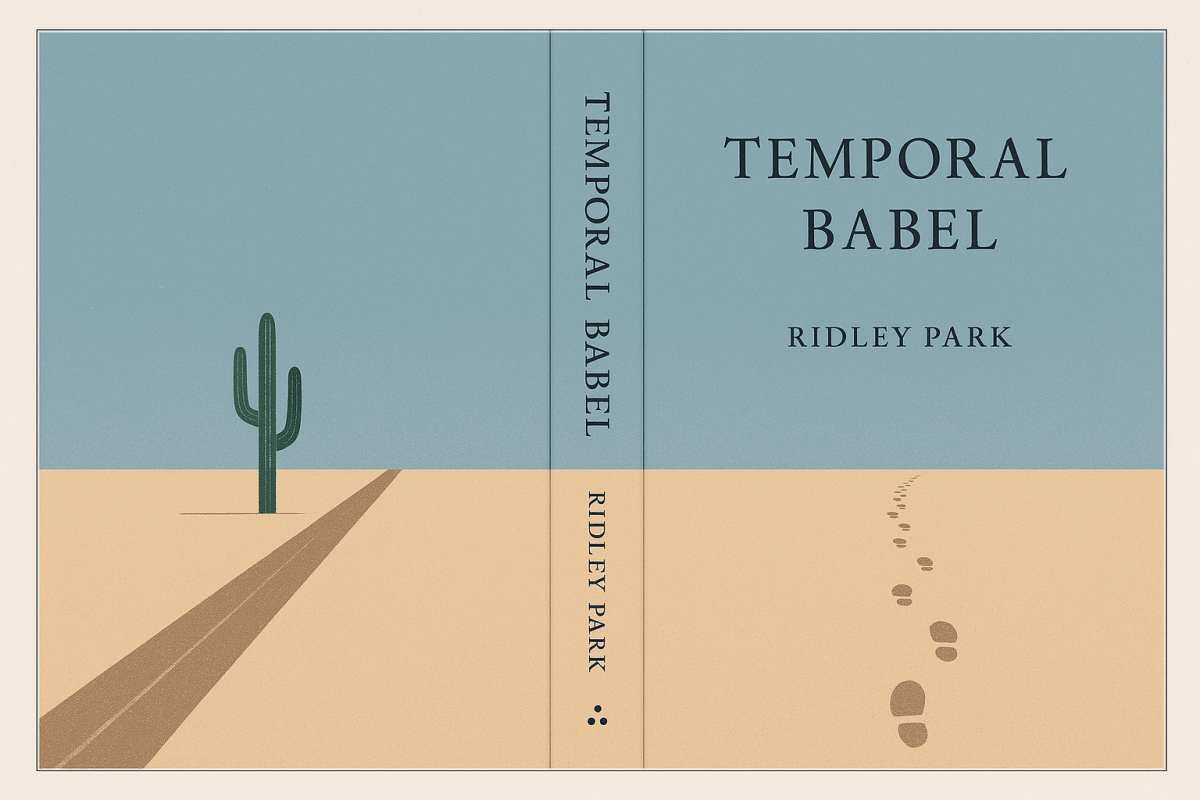
I just completed a second draft of a novelette I’ve been working on. I had ChatGPT (Dall-E) render a quick sample cover.
A young woman stumbles across an unconscious man on a remote highway outside Anika, New Mexico. He’s naked, tattooed, breathing — and utterly incomprehensible. Medical professionals, police, and a determined psychiatrist try to parse his language, but his words follow rules that don’t exist and reference a world no one knows. As they struggle to decode him, they’re forced to reckon with the limits of their own assumptions, both linguistic and moral.
Temporal Babel explores the failure of language, the fragility of identity, and the quiet panic that sets in when comprehension fails.
The story takes place in New Mexico, and I wanted a minimalist visual style to match the prose. I believe that a beige desert set against a blue sky is perfect. The deserted highway with a single cactus speaks volumes. The footprints in the desert are also evocative. I love the simplicity of the palette.
Though it revered the front and back cover art, it generally followed my instructions. Artificial intelligence (AI) has made significant progress in a year. All of the words are spelt correctly. I could Photoshop this into shape with little effort.
I only plan to release this as an ePUB because I am compiling a triptych. Currently, the body copy stands at 105 pages, so with title pages and the rest, it should reach 112 pages, which is perfect for seven 16-page signatures.
I employ AI editors for copyediting and alpha-reading. They are useful but have limitations.
Some of my writing is ordinary – Acts I, II, and III; Beginning, Middle, and End. This is AI’s sweet spot: assess a piece and compare it to a million similar pieces, sharing plot structures, story and character arcs, heroes’ journeys, and saving cats.
Other stories are experimental. They don’t follow the Western tradition of tidy storylines and neat little bows, evey aspect strongly telegraphed, so as not to lose any readers along the journey.
Mary approaches a doorway. Mary opens the door. She walks through the doorway — the doorway she had approached.
Obviously, this is silly and exaggerated, but the point remains. AI presumes that readers need to be spoonfed, especially American audiences. (No offence.)
But life doesn’t work like this. We often witness events where we have no idea what happens after we experience them. We pass strangers on the street, not knowing anything about their past or future. We overhear something interesting, never to get a resolution. We get passed by for a promotion but never know the reason why.
In science, there are lots of dead ends. Do we want to know the answers? Yes. Is one likely? Maybe; maybe not. Will we make up answers just to satisfy our need for closure? It happens all the time.
In writing, we seem to not accept these loose ends. How many times have you read a review or critique where the complaint is, “What happened to this character?” or “Why didn’t Harry Potter use his invisibility cloak more than once despite it being an obvious solution to many prior and future challenges he faced?”
Sure. I agree that it feels like a plot hole, but the author doesn’t have to tell you that Harry lost it in a poker match, it got lost in the wash, or Ron snatched it.
I’m finishing a story, and various AIs provide similar commentary. Even more humorous are the times it can’t follow a thread, but when a human reviewer reads it, they have no difficulty. In the end, there may be unanswered questions. Some of these leave the universe open for further exploration, but not all questions have answers. AI has difficulty grasping this perspective.










 Ridley Park