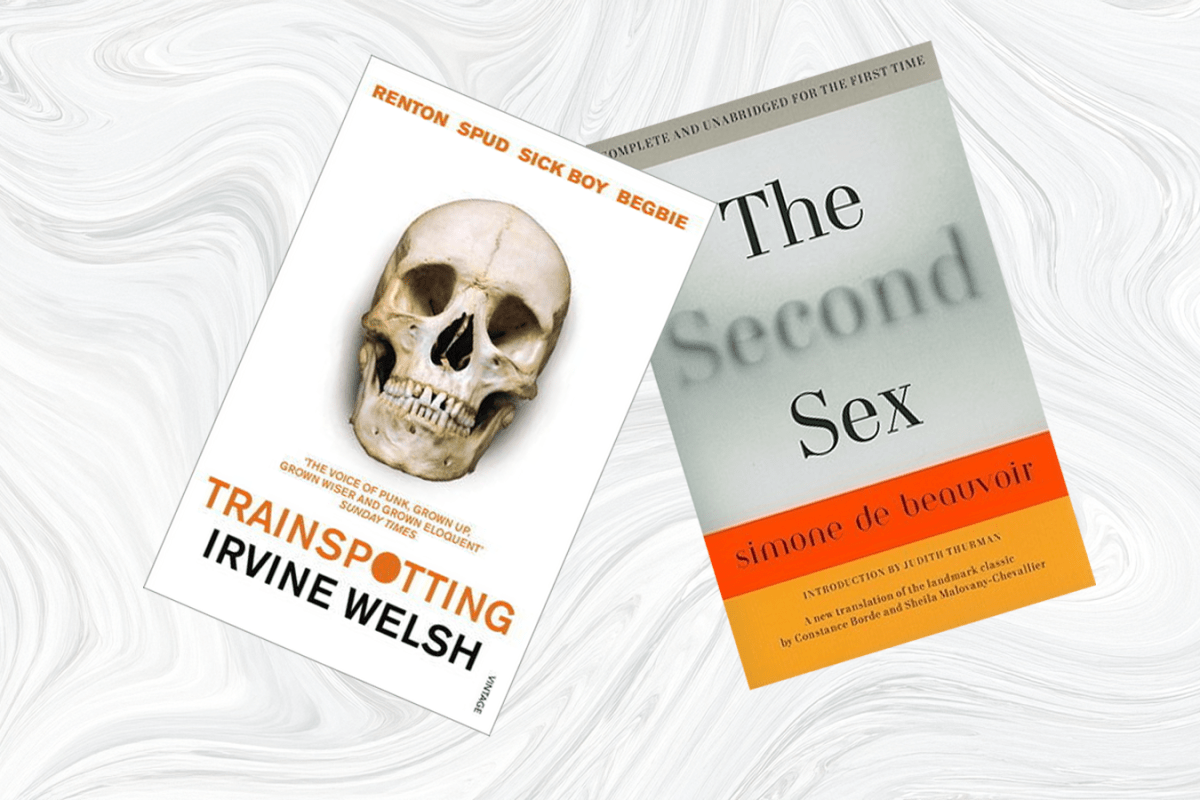
Trainspotting Takes Over

I’ve just finished Simone de Beauvoir’s The Second Sex – all 800 pages of it – and have now started Irvine Welsh’s Trainspotting. Both are classics in their own way. I’ll review Second Sex properly on my Philosophics Blog, but here I want to think about Trainspotting in relation to my current manuscript, Needle’s Edge.

Interestingly, Trainspotting was a ChatGPT recommendation. I fed in my draft of Needle’s Edge and this was one of the books it said my work resembled. Two chapters in, I see the connexion. First, the subject matter – drugs and addiction. Second, the rawness of the experience.

There are differences, of course. Trainspotting is rooted in Leith, Scotland; Needle’s Edge belongs to the East Coast of the United States – Delaware and Philadelphia. Welsh draws heavily on dialect and vernacular, with a narrative voice that’s linguistically dense and aurally charged. In Needle’s Edge, the style is pared down. Sentence fragments, middle dots instead of full stops, and an intentional “lower” register mirror the protagonist’s fractured perception and limited resources.

That gap in register creates a different authorial challenge. With every edit pass, I find myself policing intrusions of my vocabulary into her voice. Welsh, by contrast, can deploy a broader lexicon and trust the dialectal texture to keep it authentic. Listening to Trainspotting, I’m struck by how words and turns of phrase leap out – sometimes apt for Needle’s Edge, but often just a shade too polished for Stacey’s world.

Both texts orbit around environments that resist glamour. Welsh’s squat flats and pubs are grimy and feral; Needle’s Edge’s motel rooms and sidewalks are littered with fast-food wrappers, orange caps, and fading unicorn posters. Addiction erodes bodies in both stories, but the textures differ – Scotland’s industrial gray versus the East Coast’s cheap motels and suburban detritus.

As for the film version of Trainspotting, I saw it long ago and remember almost nothing. The novel isn’t refreshing my memory either; it feels like a separate creature altogether. Which is fitting: both Trainspotting and Needle’s Edge are less about plot than about capturing a lived texture, a rhythm of voices and environments that mainstream narratives usually discard.

Needle’s Edge Cover Reveal

I’m sharing a comp of the cover art* for my upcoming novel – a story about a prostitute. More accurately, it’s a story about prostitutes, addiction, survival, and the consequences of living at the periphery – not just of society, but of personhood itself.

The earliest notes I have are dated 2019. I finished the first draft in June. I’m now editing – both structurally and line by line, which is probably a bad idea, but here we are. Because I’m reorganising scenes, I need to ensure the transitions make sense, emotionally and narratively.

Since completing the draft, I’ve been reading Simone de Beauvoir’s The Second Sex. First published in 1949, the edition I’m reading was translated in 2011. It’s given me language for something I was already trying to do.

This line is central to my approach. My protagonist isn’t born a prostitute. More importantly, she isn’t even born a woman. She’s made into one by church ladies, jealous sisters, careless boys, and indifferent systems. Through gestures, punishments, expectations, and neglect. Through the crucible of a society that offers her a script before she understands the stage.

Yes, her psychology matters. But the world matters more.

That’s what I’m trying to explore — not just the facts of a life on the edge, but the forces that shape it.

* I’ve actually designed two covers – one for hardcover and the other for paperback. It provides me with options.

Le deuxième sexe – What Rises After the Fall

I’m reading The Second Sex. It’s a story of women, about women, for women, and by a woman—but it’s also a story of otherness.

This post isn’t about that book.

It’s a reflection on a premise within it: that woman is a cultural construction.

Written in 1949, before the language of gender identity emerged, Beauvoir’s work distinguishes “female” as biological sex and “woman” as imposed gender.
But this post isn’t about that either.

Audio: NotebookLM podcast on this topic.

A Novel Possibility

This is about a seed of an idea—one that took root while reading—and the novel it might become.

A near-future world.
Shaped not by vengeance, utopia, or techno-salvation.
But by a quiet unravelling of power itself.

It is not a story of triumph.
Nor of ruin.
It is the aftermath of both.

After Collapse, Reconstitution

When extractive systems—ecological, economic, ideological—collapse, society does not revert, rebuild, or resist.
It reconstitutes.

Not as hierarchy repainted in pastel.
Not as hive-mind in harmony drag.

But as a resonant ecology:
A decentralised, cooperative, post-Enlightenment culture in which traditional male-coded traits—dominance, control, instrumental reason—have become maladaptive relics.

What Rises

The values that rise—attunement, memory, restraint, emotional literacy—are neither glorified nor enforced.
They are simply what works now.

This is not a matriarchy.
Not a revenge fantasy.
Not feminism cast in steel and slogans.

It’s a structural inversion:
A world in which those trained for dominance find themselves culturally disarmed—
While the formerly subordinate, at last, inhabit a society scaled to their sensibilities.

No Brain, No Throne

There is no single ideology.
No central brain.
No throne.

Power does not pool.
It diffuses—like mycelium beneath a forest.

Language shifts.
Leadership evaporates.
Progress, once a sacred cow, is now met with suspicion.

Not out of fear of change,
But for love of equilibrium.

Still, Tensions Remain

A generation raised in scarcity seeks to anchor stillness.
A younger one, born amid calm, yearns for momentum.

Outside the collective, remnants of the old world stir—
Confused. Indignant. Armed.

And within, a few still long to lead.

These tensions are not resolved by war.
Nor suppressed by force.

This is not a tale of rebellion or revolution.
But of repatterning.
And its cost.


   Tone: Literary. Spare. Sensory realism.
   Influences: Atwood, Le Guin, Ishiguro, Butler.
   Conflict: Emotional. Ideological. Structural.
   Message: A level playing field was always a myth. The tilt now favours something new.

What Comes After

The question isn’t how to stop the old world from returning.
The question is whether it ever really left—
and if so,
what takes its place.