Rave Reviews

1–2 minutes

“I’d rather get reviews than sales.”

Yes, I actually said that. Possibly whilst caffeinated.

I was chatting with a mate about book sales, and it slipped out: I’d rather get reviews than sales. Not that I’d turn down either. But priorities matter.

Priority One: Write

The first goal is to write. I wrote for years before publishing a single page. The ideas pile up in my head like unwashed dishes, and writing is how I clear the sink. I write for myself. Call it narcissism if you must – but it’s a productive narcissism.

Priority Two: Be Read

Then comes the hope of being read. A sale is not a reader. Someone might buy your book and never open it. They might read it and hate it. They might toss it into the void. I just want to know.

Last month, I gave away over a hundred copies of Sustenance. Four reviews. One was one-star – she loathed it. Good. At least I know. The other ninety-nine? A mystery. For all I know, they’re gathering digital dust on forgotten hard drives. To be fair, I’ve got thousands of neglected downloads myself, so no judgment. Still, if you did read it, I’d love to hear what you thought. Leave a review.

Priority Three: Money (the tedious bit)

I’m not a consumerist, nor a fan of money-based systems. Unfortunately, that’s the system we’ve got, so yes – I still appreciate sales. But sales without engagement are hollow victories.

Reviews (the absurd bit)

Some people email me their thoughts instead of posting reviews. Lovely, but invisible. I can’t quote a private email without looking like a fraud. I could always fake one —

“King Charles absolutely loved Hemo Sapiens.”

But alas, he never said that. (He should.)

Anyway… that’s all I’ve got. Back to writing.

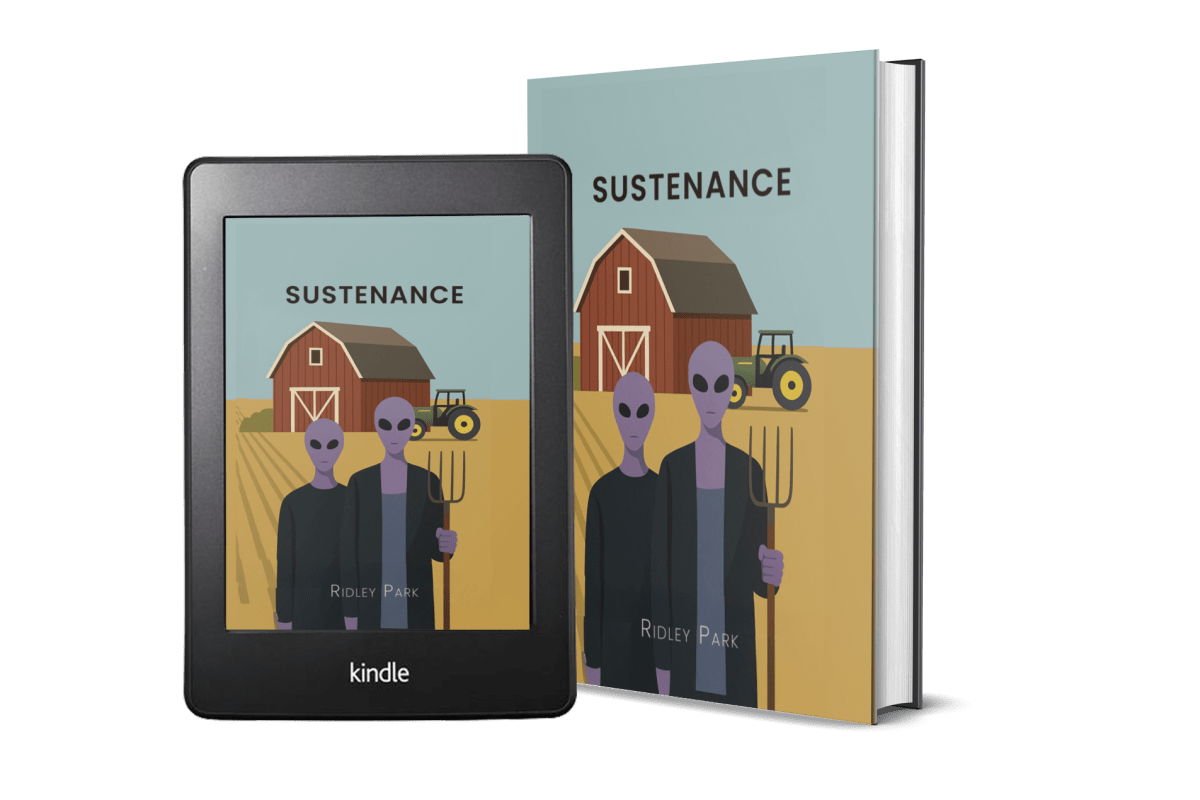
Free for Two Days Only: Sustenance (Kindle Edition)

1–2 minutes

On 7–8 September 2025, the Kindle version of my novella Sustenance will be available free to everyone on Amazon. (It’s always free if you’re a KindleUnlimited member, but these two days open it up to all readers.)

So what is Sustenance?

It’s a novella that begins with the dust and grit of rural Iowa – soybean fields, rusted trucks, a small town where everyone knows your name (and your secrets). At first glance, it reads like plainspoken realism, narrated by a local mechanic who insists he’s just a “regular guy.” But then the ground literally shifts. A crash. Figures glimpsed by firelight in the woods. Naked, violet-skinned beings who don’t laugh, don’t sleep, don’t even breathe.

What follows is not your usual alien-invasion story. It’s quieter, stranger, and more unsettling. The encounters with the visitors aren’t about lasers or spaceships – they’re about language, culture, and the limits of human understanding. What happens when concepts like property, law, or even woman and man don’t translate? What does it mean when intimacy itself becomes a site of misunderstanding?

Sustenance is for readers who:

  • Gravitate toward literary fiction with a speculative edge rather than straight genre beats.
  • Appreciate the mix of the banal and the uncanny – the smell of corn dust giving way to the shock of alien otherness.
  • Are interested in themes of language, power, misunderstanding, and human self-deception.
  • Enjoy writers like Jeff VanderMeer, Margaret Atwood, Octavia Butler, or Denis Johnson – voices that blur realism, philosophy, and estrangement.

This isn’t a story that offers tidy answers. It lingers, provokes, and resists easy moral closure. Think of it less as a sci-fi romp and more as a philosophical fable wrapped in small-town dust and cicada-song.

This version of the book is available in these Kindle storefronts:
United States, United Kingdom, Germany, France, Spain, Italy, Netherlands, Japan, Brazil, Canada, Mexico, Australia, and India

For more details, visit the Sustenance page.

📚 Grab your free Kindle copy on 7–8 September 2025.

Why Sustenance Reads Like It Does

2–3 minutes

People ask why my books don’t look like “normal” books. Why the titles twitch, why the prose refuses to march in straight lines, why I lean into formatting that makes copyeditors twitch. The answer is both simple and evasive: the story demanded it. Subversion is my key motivator – language, culture, genre, whatever stands too smugly, I want to knock it sideways.

Audio: NotebookLM podcast on this topic.

Take the paratext, those pages most readers skip. I didn’t want a safe little disclaimer to pat anyone on the head. I wanted the opening to feel unstable, already compromised, as though coherence itself were optional. The dedication isn’t reassurance; it’s a warning label.

The prose had to wobble, too. One moment rural realism, the next lyric intensity, the next something uncanny seeping in. Stability is the lie. If I’d written Sustenance in straight realist mode, it would have betrayed the book’s core.

As a language philosopher, I treat manuscripts as sandboxes for showing how language falters. Words crack, meanings slip, syntax betrays us. Fiction is my way of rubbing readers’ noses in that insufficiency.

I don’t hate genre fiction, but I refuse to be bound by it. In Sustenance, I swerve deliberately:

It’s genre fluidity as method. I know this puts off readers who want neat tropes and templates. But those readers are welcome to their factory-sealed shelves.

Did I intend to frustrate? Yes, a little. Not out of malice, but because too many books behave like obedient products. I don’t want to hand readers a smoothie. I want them to taste the grit, to feel that the novel might collapse under them. In fact, it does. The refusal to “pay off” is deliberate. Closure is a consumer demand, not a literary necessity.

So why did I write Sustenance this way? Because it’s not just about what happens. It’s about how information fails, how language decays, how coherence itself becomes suspect. If the book looked and read “normally,” it would have been lying to you.


Motivation: This reflection isn’t meant as a commentary on Sustenance’s plot. My intent here is to discuss the meta — the formal and philosophical scaffolding — rather than the story itself, so as to avoid spoilers. I’ll engage with the work more directly, in more traditional fashion, elsewhere.

🛸 SUSTENANCE Has Landed

A note from Ridley Park on language, consent, and the limits of knowing.

Well, this one’s live.

Sustenance has officially launched.

Audio: NotebookLM podcast on the book Sustenance.

If Propensity was about engineered peace through probabilistic compliance, Sustenance asks what happens when understanding itself breaks down—and nothing you think is mutual, is.

No war. No invasion. No end-of-days. Just a quiet landing. And a failure to translate.

The Premise

A group of non-human beings arrive—not in conquest, not in friendship, but in continuity. They are not like us. They do not see like us. They don’t even mean like us.

There is no universal translator.
No welcome committee.

Just humans—interpreting through projection, desire, and confusion.

And aliens—operating by a logic that doesn’t require interpretation.

The Themes


Sustenance explores what happens when:

  • Language fails and nothing fills the gap
  • Consent becomes guesswork
  • Culture is mistaken for nature
  • Property has no meaning, and law no parallel
  • Sex isn’t private, sacred, violent—or even especially enjoyable
  • Memory becomes narrative, and narrative becomes defence
  • Contact isn’t miraculous—it’s awkward, biological, and quietly irreversible

This is a story about misunderstanding. Not just what others mean—but who we are when we assume we understand anything at all.

The Tone

Think Arrival but rural. Annihilation without the shimmer.

A bit of VanderMeer. A hint of Flannery O’Connor. The cornfields are real. The discomfort is earned.

No apocalypse.

Just a failure to process.

And maybe, something new inside the gap that opens when the old stories no longer apply.

Why Write This?

Because contact doesn’t have to be violent to be destabilising.

Because not all miscommunication is linguistic—some is anatomical.

Because the most alien thing we can encounter is ourselves, misinterpreted.

Because I wanted to write a story where the question isn’t “what do they want?” but “what have we already assumed?”

Now Available

Sustenance is available now in hardcover, paperback, and Kindle.

If you read it—thank you. If you don’t, that’s fine.

The misunderstanding will continue regardless.

📘 More about the book →

Ridley Park
Possibly a person. Possibly a place. Possibly both.

Geworfenheit: Not Born, Just Here: What Drives My Fiction

A common question I get about my writing—my fiction, anyway—is: what motivates you?

It sounds like a harmless question. Like asking a plumber what motivates them to fix pipes. But fiction is not plumbing. And motivation, for a writer, is often post-rationalised. Still, I have answers. Or at least fragments of them.

Audio: NotebookLM podcast on this topic.

A primary driver is to convey philosophical concepts that I feel apply to life in general, but don’t tend to get the airtime they deserve. A good example is Heidegger’s Geworfenheit.

In English, that’s usually translated as “thrownness.” It refers to the feeling—no, the condition—of having been thrown into existence without consent, without context, without recourse. It’s the anti-heroic beginning. You wake up on a raft. No map, no memory. Just current.

Now, Heidegger gets a bad rap. And some of it is earned. He joined the Nazi party. There’s no excusing that. But if we’re going to disqualify thinkers based on political affiliation, we’ll need to scrap about half of the Enlightenment and most of the 20th century. The point is: Geworfenheit is useful. It names something modern life often glosses over: the fact that you didn’t choose to be here, and now you have to swim.

This theme shows up across my work. In Temporal Babel, Jef is stranded in a temporally dislocated world. In Sustenance, the visitors are alien in both senses of the word. And in Hemo Sapiens, the title species are cloned into personhood with no legal or cultural footing.

None of us choose how, where, or when we are born. But I like to amplify that truth until it becomes impossible to ignore. Take the Hemo Sapiens case: they aren’t born; they’re instantiated. But what is birth if not a legally sanctioned instantiation? Once you remove the ritual scaffolding of parentage, nationhood, and paperwork, what remains is the raw fact of being.

Another key motivator for me is philosophical provocation—questions I don’t intend to answer, only pose. Like this one: imagine you’re shipwrecked and wash up on a tiny island. A single inhabitant lives there and claims ownership. He tells you to leave or die. You have no weapon. He has a spear. The sea is vast and lethal.

Do you have the right to stay?

Do you take the spear?

Does ownership matter when survival is at stake?

Sustenance explores that tension. Property, sovereignty, mercy, survival—these are themes we pretend to understand until the scaffolding is removed. My aim isn’t to preach about what’s fair. My aim is to show what happens when fairness loses its footing.

Related to this is the theme of otherness. Us versus them. But I’m less interested in dramatising hostility and more interested in the quiet bewilderment that comes when categories fail. What do you call someone who isn’t man or woman, isn’t alive or dead in the way we recognise, doesn’t speak our language or obey our metaphysics? What happens when you meet something you can’t assimilate?

Another layer is cultural construction—the way our societies retrofit meaning onto reality. We build scaffolds. Gender, law, ownership, grief. Then we forget we built them. My fiction likes to peel back the drywall. Not to show the truth, but to reveal the studs. The story behind the story.

And finally, I write because I suspect something important is always missing. That language is never quite enough. So I keep trying. Not to solve the insufficiency, but to dwell inside it.

That’s what motivates me.

Or maybe I’m just trying to answer questions I never knew how to ask.

That too.