The Beta Reader Is Not Your Mum (Unless Your Mum Gets Postmodern Alienation and Narrative Decay)

Let’s get one thing straight: not all feedback is good feedback. In fact, a depressingly large proportion of it is the literary equivalent of asking a vegan to review your steakhouse. Technically they read the menu, but were they ever really your audience?

Audio: NotebookLM podcast on this topic.

We live in a culture that treats opinion like currency. Everyone’s got one. Everyone’s desperate to spend it. And nowhere is this more evident than in the world of beta reading—a supposedly sacred process in which brave authors hand over their embryonic manuscripts to friends, lovers, ex-wives, and total strangers in the desperate hope someone will “get it.” Most don’t.

Know Thy Manuscript (Before It’s Murdered by Committee)

Before you even think about soliciting feedback, ask yourself: do you actually know what your manuscript is? Is it a quiet literary allegory disguised as sci-fi? A philosophical middle finger wearing the trench coat of genre fiction? A slow-burn deconstruction of capitalism wrapped in alien gloop?

If you can’t answer that, neither can your beta reader. And you’ll deserve every clueless comment that comes slouching back across your inbox like a drunken tortoise.

Audience Matters. (No, Really.)

Let me put it in culinary terms for the metaphorically impaired: if someone hates seafood, they are not qualified to tell you whether your oysters are overcooked. They might be able to describe their gag reflex in exquisite detail, but that’s not useful culinary feedback—that’s autobiography.

Likewise, if your beta reader consumes nothing but cosy mysteries and thinks House of Leaves was “a bit confusing,” why in the name of Borges are you handing them your experimental novella about time, recursion, and the semiotics of grief?

I Know a Writer. I Know Your Pain.

A personal note, if I may. A close friend is a writer. A good one, in fact. But our ideas are so philosophically incompatible that they could be placed on opposite ends of a Möbius strip. Every time they read my work, they suggest alterations that, while technically well-formed, have the uncanny knack of annihilating the entire point of the piece. When I respond, “That’s a great idea—why don’t you write it?” they get cross.

Because here’s the truth: most beta readers don’t give you feedback on your book. They give you notes on the book they wish you’d written.

Signal vs Noise: Spotting the Useful Reader

There’s a simple test I use to distinguish signal from noise.

Bad beta feedback:

“I didn’t like the main character.”
“Why don’t they just call the police?”
“This story would be better with a love triangle.”

Good beta feedback:

“The way you structured the timeline echoes the narrator’s fragmentation—was that deliberate?”
“I wasn’t confused until Chapter 5, which made the earlier ambiguity retroactively frustrating.”
“The tonal shift on page 42 feels earned but abrupt—was that intentional?”

In short: good feedback interrogates execution. Bad feedback critiques intention.

The Beta Reader Interview (Yes, You Need One)

You wouldn’t hire a babysitter without asking if they’ve ever met a child. Why would you let someone babysit your manuscript without screening for genre literacy?

Ask them:

  • What do you normally read?
  • What do you hate reading?
  • Can you name a book you loved that nobody else seemed to?
  • Have you read [Insert book similar to yours]? Did you like it?

If they look at you blankly or start talking about Colleen Hoover, back away slowly.

The Beta Reader Zoo: Know Your Species

Here are a few common subspecies to watch for:

  • The Rewriter: Wants to turn your Kafkaesque nightmare into Eat, Pray, Love. Run.
  • The Literalist: “But how would that actually work in real life?” Mate, it’s a parable. About entropy.
  • The Cheerleader: “Loved it! Don’t change a thing!” (Translation: I skimmed it during Bake Off.)
  • The Cynic: Thinks everything is nihilistic, including your dedication page.
  • The Goldilocks: Rare. Reads the book you actually wrote, not the one they wish you had. Cultivate this one like a bonsai tree.

Curate, Don’t Crowdsource

Beta reading is not a democratic process. You are not running a focus group for toothpaste branding. You are searching for a handful of individuals who understand what you’re doing, why you’re doing it, and whether you’ve pulled it off—or fallen on your clever, post-structuralist arse.

Better three brilliant readers than thirty who think you should add a dragon in Chapter Two.

Final Thought

Your beta reader is not your editor. They’re not your therapist. And they’re definitely not your mum (unless your mum has an MA in critical theory and a fetish for broken narrative structures).

Choose wisely.

Or don’t – and enjoy reading thirty pages of feedback that begins, “I don’t usually read this sort of thing, but…”

PS: I love how Dall-E totally misfired on the cover image. lol
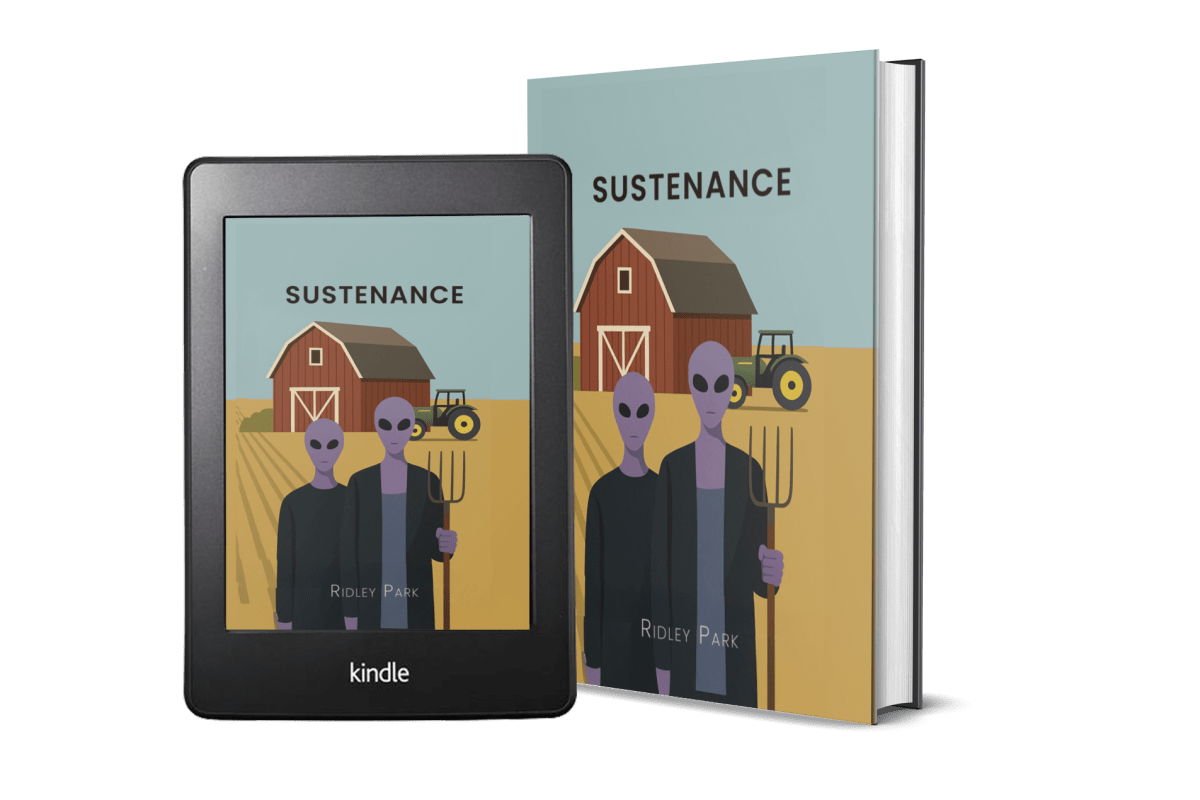
🛸 SUSTENANCE Has Landed

A note from Ridley Park on language, consent, and the limits of knowing.

Well, this one’s live.

Sustenance has officially launched.

Audio: NotebookLM podcast on the book Sustenance.

If Propensity was about engineered peace through probabilistic compliance, Sustenance asks what happens when understanding itself breaks down—and nothing you think is mutual, is.

No war. No invasion. No end-of-days. Just a quiet landing. And a failure to translate.

The Premise

A group of non-human beings arrive—not in conquest, not in friendship, but in continuity. They are not like us. They do not see like us. They don’t even mean like us.

There is no universal translator.
No welcome committee.

Just humans—interpreting through projection, desire, and confusion.

And aliens—operating by a logic that doesn’t require interpretation.

The Themes


Sustenance explores what happens when:

  • Language fails and nothing fills the gap
  • Consent becomes guesswork
  • Culture is mistaken for nature
  • Property has no meaning, and law no parallel
  • Sex isn’t private, sacred, violent—or even especially enjoyable
  • Memory becomes narrative, and narrative becomes defence
  • Contact isn’t miraculous—it’s awkward, biological, and quietly irreversible

This is a story about misunderstanding. Not just what others mean—but who we are when we assume we understand anything at all.

The Tone

Think Arrival but rural. Annihilation without the shimmer.

A bit of VanderMeer. A hint of Flannery O’Connor. The cornfields are real. The discomfort is earned.

No apocalypse.

Just a failure to process.

And maybe, something new inside the gap that opens when the old stories no longer apply.

Why Write This?

Because contact doesn’t have to be violent to be destabilising.

Because not all miscommunication is linguistic—some is anatomical.

Because the most alien thing we can encounter is ourselves, misinterpreted.

Because I wanted to write a story where the question isn’t “what do they want?” but “what have we already assumed?”

Now Available

Sustenance is available now in hardcover, paperback, and Kindle.

If you read it—thank you. If you don’t, that’s fine.

The misunderstanding will continue regardless.

📘 More about the book →

Ridley Park
Possibly a person. Possibly a place. Possibly both.

📡 PROPENSITY Has Launched

A note from Ridley Park on behaviour, control, and the illusion of peace.


Well, it’s out.
Propensity has officially launched.

This one’s been brewing for a while. If Sustenance asked what happens when we can’t understand each other, Propensity asks what happens when we stop needing to.

No invasion. No superintelligence. No overt dystopia. Just a device—quietly implemented—that modulates human behaviour through neurochemical cues. Less anger. Less risk. Less faith, libido, disobedience. More calm. More compliance. More… nothing.

And nobody notices.
Because the best control doesn’t look like control.


The Premise

Imagine a world where we solve violence—not through laws, treaties, or education—but by dampening the neurological signals that make people aggressive in the first place. You don’t choose peace. Peace is chosen for you, chemically. You just comply.

That’s the Propensity Device: a system designed not to control what you do, but to shift what you’re likely to do. Your odds of revolt drop. Your odds of submission rise. It’s not sedative. It’s statistical.

Free will doesn’t vanish. It just stops being statistically significant.


The Themes

The novel explores what happens when:

  • Free will is reframed as background noise
  • Consent is irrelevant because no one thinks to object
  • Violence becomes programmable—but only directionally
  • Peace is achieved without ideology, meaning, or narrative
  • Narrative itself becomes residue

There’s horror in here, but it’s not loud. It’s administrative. Institutional. Clean.

The horror of things working exactly as designed.


The Tone

Think Black Mirror but less sensational. Think Ballard after a lobotomy.

A dash of Ligotti. A flicker of DeLillo. A long stare from Atwood.
Propensity is soft dystopia—flattened, not broken.

And yes, there’s a fall. But it’s not a collapse. It’s an asymptote.
A tapering. A loss of signal fidelity. A kind of surrender.


Why Write This?

Because we’re already doing it.

Because behavioural nudge theory isn’t fiction.

Because control doesn’t need to be malicious—just implemented.

Because some of the worst horrors are quiet, polite, and empirically validated.

Because I wanted to ask: what if peace worked too well?


Now Available

You can get Propensity on Amazon and other booksellers.

If you do read it—thank you. If you don’t, that’s alright.
The system will keep humming either way.

📘 More about the book →

Ridley Park
Possibly a person. Possibly a place. Possibly both.

Geworfenheit: Not Born, Just Here: What Drives My Fiction

A common question I get about my writing—my fiction, anyway—is: what motivates you?

It sounds like a harmless question. Like asking a plumber what motivates them to fix pipes. But fiction is not plumbing. And motivation, for a writer, is often post-rationalised. Still, I have answers. Or at least fragments of them.

Audio: NotebookLM podcast on this topic.

A primary driver is to convey philosophical concepts that I feel apply to life in general, but don’t tend to get the airtime they deserve. A good example is Heidegger’s Geworfenheit.

In English, that’s usually translated as “thrownness.” It refers to the feeling—no, the condition—of having been thrown into existence without consent, without context, without recourse. It’s the anti-heroic beginning. You wake up on a raft. No map, no memory. Just current.

Now, Heidegger gets a bad rap. And some of it is earned. He joined the Nazi party. There’s no excusing that. But if we’re going to disqualify thinkers based on political affiliation, we’ll need to scrap about half of the Enlightenment and most of the 20th century. The point is: Geworfenheit is useful. It names something modern life often glosses over: the fact that you didn’t choose to be here, and now you have to swim.

This theme shows up across my work. In Temporal Babel, Jef is stranded in a temporally dislocated world. In Sustenance, the visitors are alien in both senses of the word. And in Hemo Sapiens, the title species are cloned into personhood with no legal or cultural footing.

None of us choose how, where, or when we are born. But I like to amplify that truth until it becomes impossible to ignore. Take the Hemo Sapiens case: they aren’t born; they’re instantiated. But what is birth if not a legally sanctioned instantiation? Once you remove the ritual scaffolding of parentage, nationhood, and paperwork, what remains is the raw fact of being.

Another key motivator for me is philosophical provocation—questions I don’t intend to answer, only pose. Like this one: imagine you’re shipwrecked and wash up on a tiny island. A single inhabitant lives there and claims ownership. He tells you to leave or die. You have no weapon. He has a spear. The sea is vast and lethal.

Do you have the right to stay?

Do you take the spear?

Does ownership matter when survival is at stake?

Sustenance explores that tension. Property, sovereignty, mercy, survival—these are themes we pretend to understand until the scaffolding is removed. My aim isn’t to preach about what’s fair. My aim is to show what happens when fairness loses its footing.

Related to this is the theme of otherness. Us versus them. But I’m less interested in dramatising hostility and more interested in the quiet bewilderment that comes when categories fail. What do you call someone who isn’t man or woman, isn’t alive or dead in the way we recognise, doesn’t speak our language or obey our metaphysics? What happens when you meet something you can’t assimilate?

Another layer is cultural construction—the way our societies retrofit meaning onto reality. We build scaffolds. Gender, law, ownership, grief. Then we forget we built them. My fiction likes to peel back the drywall. Not to show the truth, but to reveal the studs. The story behind the story.

And finally, I write because I suspect something important is always missing. That language is never quite enough. So I keep trying. Not to solve the insufficiency, but to dwell inside it.

That’s what motivates me.

Or maybe I’m just trying to answer questions I never knew how to ask.

That too.

Outlining Hemo Sapiens: Origins

I’ve just wrapped up three days of outlining Hemo Sapiens: Origins, the prequel to Hemo Sapiens: Awakening. I feel it’s in a good place to get started.

As I wait to get Beta feedback on Hemo Sapiens: Awakening, I want to continue to make progress in this universe. As of now, my working titles for this series are as follows:

  • Hemo Sapiens: Origins
  • Hemo Sapiens: Awakening
  • Hemo Sapiens: Aftermath
  • Hemo Sapiens: Epsilon Rising

I know what I want to happen over the arc of Epsilon Rising, and I know some key events for Aftermath, but Aftermath just needs to bridge the gap between Awakening and Epsilon Rising to lend plausibility to the events in Epsilon Rising.

This project was supposed to have been a side-project—a few short stories to cleanse my creative palate. Instead, I imagined a universe and this series. I’m looking forward to returning to my original project after I put this behind me. There is plenty of ground to tread here. For now, I just want to strike when the inspiration is here.

NB: I chose the cover image because the alternate was rendered with human teeth. That’s just going too far. 🤖

Psychology of Writing

I’ve put in some 42,000 words and counting into Hemo Sapiens, so I’ve taken a couple of days to step back and take a long view. I want to ensure I am keeping my original vision with integrity. A major motivator for me is to write a social commentary. I am a philosophical and psychological person, but I am not looking to come across like Dostoyevsky, one of my favourite writers. Besides, this is adult contemporary speculative fiction, not psychological literary fiction like Fyodor. I’m shooting more in the space of Margaret Atwood or Cormac McCarthy, at least thematically.

The working title is Hemo Sapiens: Awakening. I might amend the subtitle to Awakenings. Time will tell. The story is about the awakening of the hemo sapiens. I’m always refining, but here’s the general pitch:

Nearly a hundred strong, a family of genetically engineered clones confront harsh realities when discovered by a fearful outside world.

It’s a story of the construction of group and individual identities—going from no conception of identity to battling an imposed identity as outsiders to form one of their own; from no individuation to a semblance of personal identity.

I hope to pay homage to Erikson’s stages of identity formation and Kubler-Ross’s stages of dying. Kubler-Ross gets double duty, as I wish to personify characters with each of her stages: Denial, Anger, Bargaining, Depression, and Acceptance.

It will also serve as a critique against post-Enlightenment Modernism. Whilst I agree that change was necessary and inevitable at that time, the direction taken was not necessarily for the better. As a so-called Postmodern™, this is my default position. As Rousseau notes, promises of freedom abound, yet most remains enchained. Or in the lyrics of Mad Season’s River of Deceit,

My pain is self-chosen

Anyway, back to writing.

Hemo Sapiens: Aftermath: First Encounters

This is one of five sections from my short story, Hemo Sapiens: Aftermath. I’ve made available an audio version if you are so inclined. I’ll be publishing the rest of the story over the next few days. The first section is also available. Let me know how you feel about it in the comments section. Check out another story in this universe: Hemo Sapiens: The Unidentified.

Podcast: Audio version of this story

The late afternoon sun slants across Dr Chandrasekar’s desk, illuminating the organised chaos of papers, books, mugs, and a potted succulent. He leans back, cradling a fresh chai, inhaling the rich aroma.

His eyes briefly rest on a framed picture; him, garbed in traditional Sikh attire, turban and all, standing next to his wife and two children. It’s a rare still moment before his two o’clock afternoon appointment interrupts his tranquillity.

Maggie enters, boots scuffing the worn tiles. Her eyes quickly find Dr Chandrasekar.

“Professor,” she calls out, a subtle lift of excitement in her voice. “Still got time?”

“Yes, of course,” he replies, setting down his pen and looking up from a stack of student papers. “What have you got?”

“It’s about my research. I think I’m onto something,” she says, a sense of urgency underscoring her words.

Maggie settles into the chair across from his desk, her nose catching a whiff of something aromatic. “Mmm, what’s that smell? Chai?”

“You’ve got it,” Ravi grins, his hands wrapping around his own cup. “Helps me get through paper-grading marathons.”

“Cambridge, yeah? Full-on, that is.”

“Intense, for sure,” Ravi agrees, his eyes following hers to the framed diplomas. “Learned from the best, charted my own course.”

“That’s the game, innit? Learn from the top, then do your own madness,” Maggie says, eyes flicking back to his.

Ravi feels a subtle rapport develop. “Exactly. That’s how fields advance.”

“Speaking of evolving, let’s dive into your project,” Ravi says, shifting forward. “What’s got you so wrapped up?”

Maggie powers up her tablet, her face alight with anticipation. “This could redefine human history, professor. You need to see it.”

“Now you’ve got my attention,” Ravi says, leaning in slightly, intrigued but cautious. “Let’s see what you’ve got.”

Maggie swipes her finger across the tablet screen, pulling up complex data and images. “Take a look at this,” she says, rotating the device so Ravi can see. “Tell me that doesn’t pique your interest.”

Ravi’s eyes scan the data, feeling a growing sense of excitement. “This is provocative work, Maggie,” he admits, keeping his voice steady. “It’s got potential, serious potential.”

“I thought you’d see it that way,” Maggie replies, reclaiming her tablet and taking a deep breath. “So, what’s our next move?”

“First, let’s make sure we cross our t’s and dot our i’s. Let’s make sure we’ve considered this from all ethical angles,” Ravi advises, sobered by the gravity of her findings. “Research like this could have profound consequences we haven’t even anticipated. We must be thoughtful in how we proceed to the next level.”

“Understood,” Maggie nods, a determined look settling over her features. “We’ll make sure everything’s ironclad, then we’ll blow everyone’s minds.”

“Exactly,” Ravi echoes, feeling that the room has shifted, that they’re onto something big. “This could redefine careers, even shift the whole field.”

A sudden rap at the open door interrupts the conversation.

Maggie turns to see the Department Head and another at the door and powers down her tablet.

“Thank you, Dr. Chandrasekar, that was very helpful!” She stands up.

“Of course, always happy to illuminate the wonders of genetics,” Ravi replies warmly as Maggie slips out past the two men on her way out.

Roger Dean enters with Detective Sergeant Jones on his heels.

“Ravi, sorry to interrupt,” he begins. “This is Detective Sergeant Jones. He was hoping you could assist with a rather sensitive case.”

Ravi raises his eyebrows, looking at Roger, who gives a nod, signalling it’s okay to proceed. “Of course, please come in, Detective.”

Detective Sergeant Jones is sat in the chair Maggie had just left. Passing by, Ravi sniffs stale coffee and underlying stress. Up close, he notices shadows under the detective’s eyes and stubble lining his jaw.

“Thank you for seeing me, Dr. Chandrasekar,” Jones begins. Roger interjects, “Based on the gravity, I thought it best to bring Detective Sergeant Jones directly to you.”

Ravi leans forward, mind already racing with possibilities. “Go on.”

“We’ve been watching a group, based on a tip from a concerned neighbour. Joint operation,” Jones explains.

“We finally got probable cause for a raid,” Jones continues. “Took them by surprise.”

“These blokes, they’re proper twisted,” Jones mutters, voice low.

Ravi’s pulse quickens. “Tell me more,” wondering all the while how this affects him.

After an extended pause, Jones leans closer. “Can’t say more here. Just… involves blood and teeth. That, and they are all twins. Genetic curiosities.”

“I suggest you meet with our forensic team at the station,” Jones says. The Department Head nods, “We can arrange for you to have whatever university resources you’ll need.”

“You’ve got my full support, Detective,” Ravi promises. Roger smiles, apparently relieved. “That’s what I was hoping to hear.”

Ravi shows the detective out, eager to learn more about these individuals—and what’s so unusual about them. This cryptic case ignites his academic curiosity. The detective grabs his coat and heads to the station, energised by the potential revelations ahead.

After Ravi agrees to assist, Roger steps into the hall, polished leather shoes squeaking under his weight.

The door catches Professor Moss’s attention. Seeing Henry, Roger ekes out a sclerotic smile, his formal demeanour at odds with his rumpled suit.

“Roger, a moment if you will,” Henry intones, just as his superior’s about to vanish down the hall. “Was that a detective leaving Ravi’s office? Everything sorted?” Roger pauses, deliberating each word before it escapes his lips.

He hesitates, then lowers his voice. “Let’s just say, Ravi is assisting on a sensitive case with the police. That’s all I can share for now.” His hushed tone borders on conspiratorial, despite his reserved nature.

Intrigued but respectful of the obvious secrecy, Henry simply nods knowingly. “Well, if it’s in Ravi’s hands, I’m sure it’s being well managed.”

With a light knock as a prelude, Henry pokes his head in. “Got a moment?”

Looking up from his notes, Ravi waves Henry in.

Door clicks shut behind him, Henry occupies the chair opposite Ravi. “I couldn’t help but overhear a portion of your conversation with the detective.”

A glint of curiosity flickers in Ravi’s eyes. “Indeed, they’ve requested my expertise in genetics for an unusual case.”

“Teeth were mentioned, I believe?” Henry probes, his tone calibrated to nonchalance.

A quiet chuckle escapes Ravi. “Your hearing serves you well. The detective was scant on particulars but intimated as much. I’m due at the station to gather further information.”

Henry leans forward, his demeanour serious. “If you find you’re in need of another scientific viewpoint, I would be most willing to assist.”

Ravi agrees to update Henry as he learns more about the case. A second scientific perspective could prove useful if the genetics are as anomalous as implied. For now, the mystery deepens.

The next morning, Henry arrives early to his quiet office, thoughts returning to the unusual case Ravi had been asked to consult on. Thoughts whirring. His fingers tap the desktop as he considers the fringes of genetic research that might be related to these so-called ‘unusual’ people.

Henry leans back, his eyes go cold as they find the ceiling. “Why consult Ravi and not me?” he questions the empty room, annoyance thinly veiled.

With a huff, he opens a drawer and retrieves a journal, flipping through pages on recent advances in fringe genetics. “Let’s see if Ravi can handle this one without stumbling. If not, I’ll be ready.”


DisclaimerThis content is not necessarily a finished work. As such, details are subject to change or removal.