The Echo Chamber of Aspiring Authors

I’ve been thinking…

I’ve been lurking and participating in many author and writing groups, but I’m not sure this is a productive strategy.

Like other authors, my goal is to network and connect to readers, and more importantly, buyers. The problem is that other authors, like myself, share the same goal in mind. There is no reciprocity, no “coincidence of wants,” which is that I happen to be offering a book that you might find engaging.

Audio: NotebookLM podcast on this topic.

Of course, one can frequent reader groups, but these are often inundated with publications, so there is no focus. I don’t write genre fiction, so I don’t have the benefit of, say, a sci-fi group, romance, werewolves, and whatnot. I (tend to) write literary fiction without identifiable tropes and storyline. As I’ve written before, there are no Hero’s Journeys, no saving the cat.

Indeed, there are literary fiction groups, but there are numerous motivations for this reader cohort. It is not homogeneous. I could (and do) hunt for sub-categories, but these are less fruitful.

I see dozens of ads splashed on my screen, suggesting someone can help me write my next book by telling me what’s hot, what’s selling. I am not interested in writing books that sell. I want to tell my stories. I am not a commercial writer in the same way that I was never a commercial musician. I am interested in the art. Of course, I want to sell my works, but it needs to be on my terms. If I were to sell out, it would just be another job with all of the intrinsic joy sucked out of it. The extrinsic appeal of money is not enough to compensate. Some people who take this commercial convince themselves, “at least I’m still writing,” or painting, or performing for a living. I am not able to comfort myself with this self-delusion. As the saying goes, ignorance is bliss.

Since I’m ranting…

I’ve been haunting author and writing groups for a while now – lurking in the shadows, peeking behind the curtain, occasionally tossing in a snide comment or two. Call it market research. Call it masochism. Either way, I’m starting to suspect it’s not the most productive use of my time.

You see, like most of these poor souls, I’m here to “network” (whatever that means in late-stage capitalism) and, more importantly, connect with actual readers. Buyers. The unicorns. Not fellow authors trying to sell me their 17-book werewolf reverse-harem saga or the latest AI-generated cover that somehow still manages to have three left hands.

And here’s the rub: we’re all pitching. No one’s catching. It’s a bazaar where everyone’s hawking their wares and no one’s carrying a purse. The law of the marketplace – what economists once called the “coincidence of wants” – simply doesn’t hold. I don’t want what they’re selling. They don’t want what I’m offering. It’s not even personal. It’s just noise.

Could I wade into reader groups instead? Sure. But these are often genre-clogged pools: romance, sci-fi, vampires with high school diplomas. God bless them. It’s just not my lane. I write literary fiction. You know, the kind without a tidy plot, without a cat-saving hero, and – brace yourselves – without an obligatory third-act redemption arc.

Even literary fiction groups aren’t much help. That label encompasses too much: Booker-bait bildungsromans, moody minimalism, and the occasional Proustian doorstop for good measure. And reader motivation in these spaces is hardly uniform. Some want to weep. Some want to feel clever. Some just want to say they read something “important” at brunch. None of them are asking for me – and that’s fine. But it does make targeting a pain in the arse.

Then come the ads. The snake-oil salesmen. “Here’s how to write a book that sells!” “Tap into trending genres!” “Master the market!” As if we’re all desperate to become a literary McDonald’s franchisee, pumping out Big Macs with words. I didn’t become a writer to stuff my soul into a Happy Meal box. I didn’t become a musician to churn out jingles. I don’t paint by numbers and I don’t plot by templates.

Yes, I want to sell my work – but on my terms. I’m not allergic to money; I just refuse to whore out my creativity to chase it. Some people convince themselves that so long as they’re still writing – still playing the game – they’ve won. I’m not built for that flavour of self-delusion. Call it ego. Call it integrity. I call it survival.

Since I’m already up here on my soapbox, let me kick it once or twice for good measure.

There’s a mountain of writing advice out there. I’ve read plenty. Some of it’s even good. But much of it is just a conveyor belt back to the same old factory settings: save the cat, beat the plot, rinse and repeat. I don’t write that way. I don’t read that way. I need more than recycled tropes wearing different hats. I need teeth. Friction. Depth.

Do I use tropes? Of course. We all do. Language itself is a trope. But I twist them. I break them. I bury them in the garden and see what grotesque things bloom. It’s not even effortful – it’s just how my brain is wired. Call it a feature, not a bug.

Anyway, that’s enough bark for one day. If you’ve ever stared into the marketing void and felt it blink indifferently back, I see you. If you’re a writer trying to walk the tightrope between integrity and visibility, I hear you. If you’ve got thoughts, confessions, or sacrificial goats to share, drop them in the comments. Misery loves literate company.

I’ve read a wide range of genres. I’ve found them most unsatisfying and therefore unappealing. I am not saying that these are now good. I’m saying that they don’t resonate with me. It’s why I don’t watch television and find few movies interesting. I need more than templated tropes.

Do I use tropes? Of course I do. Writing a book without tropes would be nearly impossible. I try to subvert tropes and expectations. In practice, I don’t even have to try very hard. It’s how my brain works on its own.

Last but not least, I don’t need a writer’s group, starter ideas, prompts, or exercises. I don’t get writer’s block, probably because I am not trying to force a plot.

Anyway, I’ll hop down off my soapbox. I wonder how many other writers share some of my perspectives and challenges. Let me know in the comments.

Editing is a Vicious Sport

Measuring progress is far simpler when you’re writing. You can count words. Or characters, if you’re a sadist. Sure, half of them might be drivel. Whole chapters may end up ceremonially executed by draft five, but at least you’ve done something. There’s a metric. A tally. A sense of movement.

Audio: NotebookLM podcast on this topic.

You can even see your progress, pages stack, paragraphs grow fat with promise. And if you still write on physical media (bless your nostalgic heart), you get the added catharsis of crumpling your failures and lobbing them at the bin like a disgruntled poet. It’s theatre. It’s progress. It’s delusional.

Editing, by contrast, offers no such cheap thrills. The word count doesn’t so much creep as collapse. One minute you’re a literary demi-god sitting on 80,000 words. The next, you’re scraping along at 74k and wondering whether your “tightening” has amputated a limb.

Yes, the prose might be cleaner. Punchier. Less like a whisky-soaked rant and more like a distilled insult. But does it feel like progress? Not in the way dopamine understands it.

As I’ve written before, editing takes me five – maybe ten – times longer than drafting. It’s a full hemispheric shift: from right-brain dreamscapes to left-brain bureaucracy. Creativity gives way to spreadsheet logic. Grammar. Timelines. Continuity. Did she sit before she spoke, or after? Is this line meant to be his? Why is this in past tense? Is this in any tense?

And so, the grind.

Yes, there are flashes of satisfaction – a retooled transition here, a twist landed just-so there. But mostly, it’s a long, slow crawl through self-loathing and misplaced modifiers.

I’ve spent most of my adult life toggling between left-right hemisphere roles. And frankly, the left side still gives me hives. The corporate world, bless its hollow soul, tried to stuff me in a logic-shaped box. A coffin of metrics, meetings, and “measurable outcomes.” I’m still recovering.

So why not outsource editing? Why not let someone else swing the machete through this jungle?

Two reasons:

  1. I secretly enjoy the act of refinement. It’s masochism, but it’s my masochism.
  2. I operate on a margin so thin it’s practically theoretical. A Schrödinger’s budget – simultaneously there and not.

Still, the margin’s probably winning.

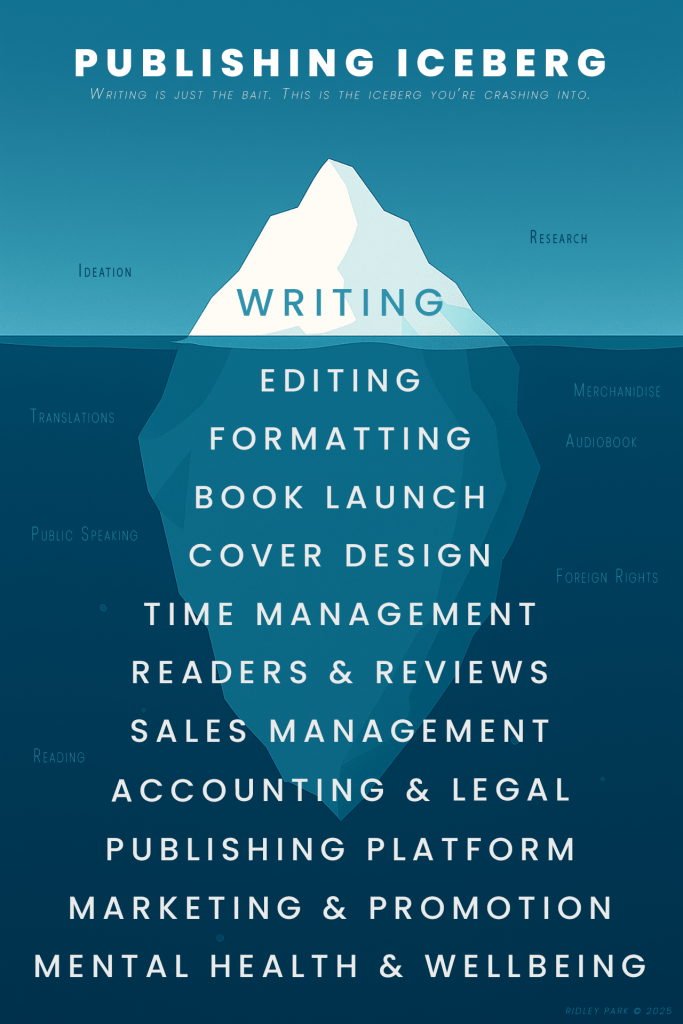
Writing is Just the Tip of the Iceberg

I hate to be the bearer of bad news – especially if you’re still slogging through a draft of your first manuscript. You know what some people say about writing a book is the hard part.

Lies. Damned lies. That’s the frothy, twinkly nonsense parroted by people who’ve never published anything beyond a social media post, probably only a comment.

Audio: NotebookLM podcast on this topic.

Let me tell you the truth. The actual, bloodstained, coffee-fuelled truth:

Writing the book is the easy part.

It’s the visible tip of the iceberg, smugly floating above the surface, soaking up the praise and admiration. Meanwhile, everything else – the sleepless nights, the decimal-point royalty statements, the unpaid invoices to your own soul – is lurking beneath, waiting to sink your mental health like the HMS Delusion.

So here it is, for posterity and pity:

Post-Writing Gauntlet: The Real Job Begins

1. Editing (Five Times, If You’re Lucky)

  • Developmental editing – “Is your plot a plot or a pile of wet spaghetti?”
  • Line editing – Making your sentences less embarrassing.
  • Copyediting – Catching your consistent misuse of ‘affect’ and ‘effect’.
  • Proofreading – The last defence against the typo apocalypse.
  • Beta feedback – Friends who suddenly vanish when asked to read a draft.

2. Formatting and Typesetting

  • Print vs digital layouts. Word crimes meet paragraph crimes.
  • EPUBs that break for fun.
  • That one widow on page 243 you didn’t notice until the proof copy arrived.

3. Cover Design

  • DIY, Fiverr roulette, or mortgage your cat to hire a professional.
  • Matching tone, genre conventions, and market expectations.
  • Spelling your own name correctly. (Don’t laugh, it happens.)

4. ISBNs and Metadata Hell

  • ISBN purchases (if you’re not relying on Amazon’s identifiers).
  • Title, subtitle, BISAC categories, keywords, blurbs, author bio — all rewritten seventeen times.

5. Publishing Platform Setup

  • Kindle Direct Publishing, IngramSpark, Kobo, Draft2Digital, Smashwords — pick your poison.
  • Print proofs, bleed settings, trim sizes, the baffling difference between matte and gloss.

6. Marketing (a.k.a. Screaming Into the Void)

  • Author website & blog (SEO: your new religion).
  • Social media presence — the façade of charm over existential dread.
  • Newsletter with a totally non-spammy freebie opt-in.
  • Ads: Amazon, Facebook, Instagram, Google. Burn money to test the water temperature.

7. Book Launch

  • ARCs, blog tours, launch events, or at least pretending you’re doing those things.
  • Coordinating reviews before anyone has read the damn thing.
  • Press kits and media outreach — basically shouting “LOOK AT ME” with tact.

8. Ongoing Sales Maintenance

  • Price promos, countdown deals, boxed sets, bundling — keep flogging the corpse.
  • Monitoring sales dashboards like a Victorian ghost watches the wallpaper peel.
  • Adjusting metadata because one reviewer didn’t understand it was satire.

9. Audiobook Production (If You Hate Money)

  • Narrator auditions, contracts, studio time.
  • Alternatively, read it yourself and discover your own voice is intolerable.
  • Or muddle through with an AI speech companion. Hullo, ElevenLabs.
  • Distribution through ACX or Findaway, both of which will pay you in dry leaves.

10. Accounting and Legal Fuss

  • Tracking royalties across platforms.
  • Filing taxes as an “author-publisher-entrepreneur-marketer-entity”.
  • Copyright registration, contracts, intellectual property trolls under the bridge.

11. Dealing With Readers

  • Responding to fan mail (both lovely and deranged).
  • Ignoring 1-star reviews that say “not what I expected, didn’t read it”.
  • Navigating book clubs who want a discount because they’re “doing you a favour”.

12. Mental Health and Motivation

  • Impostor syndrome, burnout, elation, despair — the writer’s buffet.
  • Rewriting your author bio weekly because you don’t know who you are anymore.

Optional Add-Ons (for masochists)

  • Translations and foreign rights – Because English isn’t the only language in which you can fail to sell books.
  • Merchandise – T-shirts nobody buys, mugs that mock your financial situation.
  • Public speaking / readings – Summon the courage to read your sex scenes aloud in a room of pensioners.
Image: Publishing iceberg poster in all its glory.

The Loneliest Table in the Room

What if you scheduled a book signing… and no one showed?

I’ve had that thought more than once. The kind of creeping doubt that slinks in just after you order the bookmarks and rehearse your elevator pitch in the mirror.

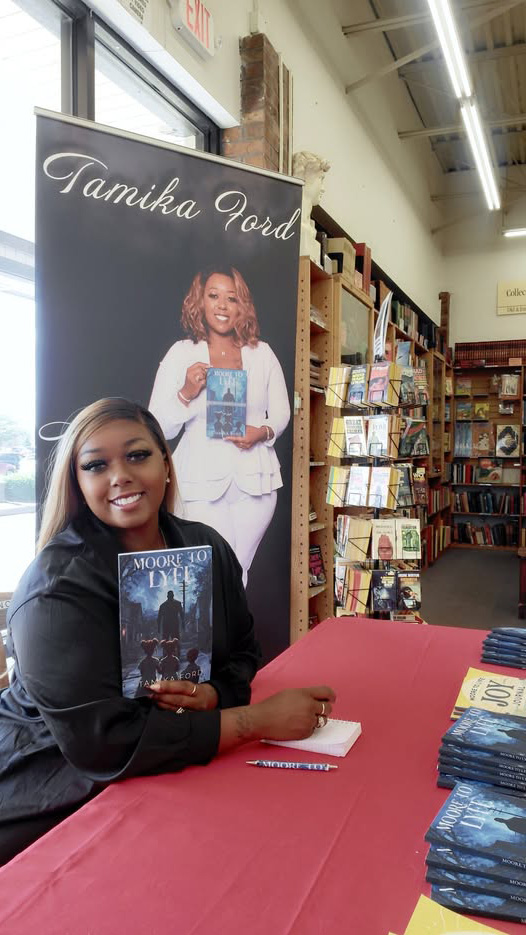
It happened to Tamika Ford.

Image: Tamika Ford – Moore to Lyfe

https://www.facebook.com/share/p/18niMMYv3C

I don’t know this woman, but this post appeared in my feed:

First book signing ⚠️📢🚨

I showed up. I sat at the table. Books neatly stacked, pen ready, heart open — and no one came.

At first, it stung. But then I realized… I’m still proud. Proud that I created something from my story. Proud that I had the courage to show up, even when the seats were empty.

Every table won’t be full. Every event won’t be packed. But every moment is a seed. And I’m still planting. 🌱📚

I don’t know Tamika personally. This post just floated into my feed. But her candour caught me off guard—because I’ve imagined the same thing.

Audio: NotebookLM Podcast on this topic.

A book signing. It sounds like the natural next step. A rite of passage. Something authors do. I’m an introvert, but I’ve taught lecture halls full of glazed-over undergrads and stood before execs who paid me not to bore them. Public speaking doesn’t rattle me.

But the idea of speaking to an empty room? That’s different.

As a professor, the audience is compulsory. As a consultant, the client paid to listen. But a signing? That’s a gamble. No RSVP, no guaranteed bodies. Just hope in paperback.

I’ve published three books, with two more on the way. There are still a few manuscripts in editorial purgatory and some non-fiction titles pacing impatiently backstage. No wonder people hire publicists. It’s a circus, and some days, you don’t even get the monkey.

Tamika said, “At first, it stung.” And how could it not?

She’d already written the book. That’s the real accomplishment. She could have been proud before the signing, without the signing. But she showed up. That’s the part that wrecks me a bit.

She probably rehearsed the scene in her head. Smiling, shaking hands. Someone saying, “I loved this part.” A moment of affirmation.

Instead: silence. Stale air and the slow tick of a wall clock.

And yet there she is in the photo—beaming. She shared the moment not to seek pity but to offer calibration for anyone planting seeds of their own.

May her next event be packed. May strangers pick up her book and find something that speaks to them. Failing that, may they at least buy the damn thing.

Either way, she’s already won.

Dispatches from the Publishing Trenches: A Field Report

I, Ridley Park, am an independent author and publisher. Before this literary turn, I did time as an economist, business analyst, and management consultant – none of which prepared me for the peculiar economics of modern publishing.

Much like traditional music in the Digital Age, traditional publishing has lost a bit of its lustre. Its gatekeeping function remains, but the gates are now rusted, and half the guards have been made redundant.

Audio: NotebookLM podcast on this topic.

From a business standpoint, the Independent™ must ask: Is the distribution reach of a traditional publisher or third-party distributor worth the revenue share they demand? It’s tempting to cast them as parasites feeding off your creative lifeblood—but statistically, the average indie author sells only 60 copies of their book. Yes, that includes the five you bought yourself and the ten your mum distributed among reluctant neighbours.

Could you sell more than average? Possibly. Less? Almost certainly. Better to sell 100 copies and earn a pittance than to earn 100% of nothing. But if the publisher can’t move your book either, and if they’re not investing in you as an author, you may well find yourself in the red. Especially if you’re the one paying them for the privilege of being published. That’s not publishing – that’s vanity cosplay.

Publishers also offer (read: upsell) services like editing, formatting, and cover design. As an Independent™, you either pay for these à la carte or do them yourself. Or, if you’re like me, you cobble together a mixed strategy of DIY, AI, and professional outsourcing – whatever the project demands.

For Hemo Sapiens, I did everything except the typography for the title and byline on the cover. That part I outsourced; I know my limits. The rest – cover composition, layout, typesetting – I handled. I also brought in beta readers, who offered some valuable copyedits and corrections.

With Sustenance, I went end-to-end solo, with AI in the wings for flow and proofing support.

Propensity followed a similar path – except I made the rare (some might say perverse) choice of hiring a beta reader after release. Heretical, I know. But the feedback was so incisive I’m now considering a mid-edition revision, particularly in the middle third, where things get a bit heady.

As for Temporal Babel – still unreleased – I’ve done everything myself thus far, but I’m leaning toward bringing that same beta reader back for another round of bruising clarity.

Beta readers, it turns out, are worth their weight in snark and red ink. I’ll save my ruminations on them for another post, which I promise will be full of revelations and at least one semi-poetic lament.

I could say more here, but there are other things demanding my time – and no publisher breathing down my neck.


Bless MidJourney for the cover art based on this prompt:

beautiful woman wearing glasses and a sheer top, holding a red pen, reading a book, office setting

Why I Create Audiobooks for All My Books

This isn’t a promotional post. I’ve recently discovered the hidden value of audiobooks—and it has nothing to do with selling them.

Back in 2024, when I released Hemo Sapiens: Awakening, I must have read the manuscript a thousand times. I even recorded an audiobook, using an AI voice from ElevenLabs. At the time, Audible wouldn’t accept AI narration. The rules have since changed. It’s now available—though still not on Audible (and therefore not on Amazon).

I’d hired a few proofreaders and beta readers. They helped. The book improved. And yet, even after all that, I still found typos. Those bastards are insidious.

The real revelation came when I started listening.

Since I’d already created the audiobook, I began proofreading by ear. That’s when it hit me: hearing the story is nothing like reading it. Sentences that looked fine on the page fell flat aloud. So I rewrote passages—not for grammar, but for cadence, clarity, flow.

Then came the second benefit: catching mistakes. Typos. Tense slips. I favour first-person, present-tense, limited point of view—it’s immersive, intimate, synchronised with the protagonist’s thoughts. But sometimes, I slip. Listening helped catch those lapses, especially the subtle ones a skim-reading brain politely ignores.

For Sustenance, the audiobook was an afterthought. I submitted the print files, requested a proof copy, and while I waited, I rendered the audio. When the proof arrived, I listened instead of reading. I found errors. Again. Thanks to that timing, I could fix them before production. Of course, fixing the manuscript meant updating the audiobook. A pain—but worth it.

I hadn’t planned to make an audiobook for Propensity—some of the prose is too stylistic, too internal—but I did anyway, because of what I’d learned from Sustenance. And again, I found too many errors. Maybe I need better proofreaders. Or maybe this is just the fallback system now.

I’ve had Temporal Babel, a novelette, on hold for months. I won’t release it until I do the same: make an audiobook, listen, reconcile with the page.

Lesson learned.

I’ve got several more manuscripts waiting in the wings—some have been loitering there for over a year. Their release has been deprioritised for various reasons, but when they go out, they’ll have audio versions too. Not for the sake of listeners. For me.

Honestly, I should do this for my blog posts as well. But editing on the web is easier. The stakes are lower. Mistakes don’t print themselves in ink.

Behind the Binding: Sustenance in Print, Pixels, and Purgatory

Not quite a launch. Not quite a rant. Just one author trying to get a novella into the world without sacrificing too many hours or brain cells.

Paperback Problems

I’ve been writing quite a bit lately—several novellas/novelettes, to be precise.

They all began life as short stories, but brevity doesn’t come naturally. Apparently, I can’t shut up even on the page. I toyed with the idea of releasing a thematic collection, and I still might. But for now, Sustenance is getting its own debut—likely this month.

The book clocks in at around 14,000 words, printed across 144 pages. I’ve read that readers prefer novels to novellas, but I’ve also read that readers don’t really read anymore. Time’s short. Attention spans are shorter. Maybe shorter fiction has a fighting chance. We’ll see.

I formatted it in 6×9 inches, which may have been overly generous. It’s leaner than your average indie fantasy tome but still thicker than my last Žižek collection. So there’s that.

The manuscript began in Word, like every poor decision. I laid it out in InDesign and exported the PDF through Acrobat. No budget, so I designed the cover too—started in Illustrator for the vector charm, but ended up in Photoshop, where I’m more at home. I designed the full wrap—front, back, spine—as a single canvas.

This was a mistake. More on that later.

Still, I’m pleased with the final look. Might reuse the style across future novellas for a bit of visual branding. There’s barely enough of a spine to print on, but we suffer for aesthetics.

Proofs arrive Thursday. Fingers crossed.

Hardback Headaches

Then came the hardback edition. Same 6×9 size, same interior. Should’ve been simple.

It wasn’t.

I forgot (again) that hardbacks require extra bleed and margin space. Couldn’t just resize the existing cover without risking pixelation. If I’d stuck with vectors, this would’ve been a breeze. Instead, I got to rebuild the entire layout from scratch—layers, guides, grids, the lot.

Hours of joyous rework. Lesson learned. Until next time.

eBook Escapism (and Other Fantasies)

Converting the layout to eBook format was a slow-motion trainwreck. I’d inserted custom font glyphs above chapter titles in InDesign. They rendered fine—until they didn’t. Halfway through, chaos reigned.

I cracked open Sigil and manually edited the XHTML. So far, so fiddly.

Then I uploaded the .epub to Amazon. Except Amazon wanted a .kpf file. Of course it did.

Enter Kindle Previewer. Except it doesn’t support embedded font glyphs. So I converted them to SVGs.

Still no dice. Kindle’s rendering engine is older than most of its readers. SVGs failed too. So I converted every glyph to PNG, rewrote the CSS, rebuilt the XHTML again, and gave it another go.

Looks fine. Not perfect. I gave up.

They’re just decorative anyway. No plot-critical glyphs here.

The Kindle version should go live shortly. I enrolled it in KDP Select, which means 90 days of exclusivity in exchange for a modicum of convenience. After that, I’ll look at wider distribution.

For the eBook cover, I simply cropped the original layout in Photoshop. That part was, mercifully, straightforward.


What’s Next?

This post is more documentation than declaration. A sort of production diary. I’ll follow up with an actual announcement when the book launches, plus a few reflections on themes, characters, and that moment when you realise your protagonist may have accidentally sexed up a chicken.

Long story.

Anyway, this is just the start. Stay tuned.

Or don’t. Up to you.