Not a People Person

Person writing at a desh, on the wall behind him, scales of justice, drama masks, and a red heart

I Don’t Do People

I don’t write character-based fiction. I’m not a “people person” – not in the lived world, and certainly not on the page. I prefer people at arm’s length, ideally shrink-wrapped and on mute, where I can manage the terms of engagement.

Yes, my work features characters. I flesh them out just enough to spare readers the Ayn Rand experience, those one-dimensional ideological mannequins masquerading as protagonists. But character isn’t the centrepiece. I write to explore worldviews, metanarratives, and environmental interactions. I’m less interested in what a person feels and more in what their presence means within a broader system.

Audio: NotebookLM podcast of this topic.

Audible Irony

At the fitness centre (the irony isn’t lost on me), I listen to audiobooks. Today’s pick: The Emotional Craft of Fiction by Donald Maass. I’ve just cracked Chapter Four, and already I’ve panned a few glittering nuggets for future consideration.

That said, I found myself wondering: why am I even listening to a book so obsessed with the deep inner life of characters?

Simple. Because it’s still useful – even if I only dose it homeopathically. Just because I don’t write bleeding-heart confessions doesn’t mean I can’t exploit emotional undercurrents when it serves a structural or rhetorical purpose.

Character, Morality, and My Problem with Haidt

One section rubbed me the wrong way: the bit about character morality. Maass references Jonathan Haidt’s work on moral psychology—yes, that Jonathan Haidt, patron saint of middlebrow centrism and moral-sentiment handwaving.

I’m familiar with Haidt. Not a fan. His notion of “moral elevation”—the idea that stories with virtuous themes inspire moral behaviour—strikes me as both quaint and quaintly manipulative. In a sense, I agree with him: morality is curated. But that’s where our Venn diagram becomes a shrug.

I’m a moral non-cognitivist. I won’t bore you here (though feel free to tumble down that rabbit hole over on my philosophical blog). In short, I don’t believe morals are objective truths handed down from Olympus or Enlightenment think-tanks. They’re socio-emotional artefacts – human constructs born from gut feelings, tempered by culture, and ossified into norms. Different contexts yield different values. That’s why I delight in yanking characters out of time and place, disorienting them – and you – to expose just how contingent it all is.

So yes, I understand moral tropes. I even deploy them. But I do so to subvert them – not to reinforce a collective bedtime story about “goodness” or “redemption.” Those are the myths we tell ourselves to stay sane. I’m here to loosen your grip.

Dispatches from the Publishing Trenches: A Field Report

I, Ridley Park, am an independent author and publisher. Before this literary turn, I did time as an economist, business analyst, and management consultant – none of which prepared me for the peculiar economics of modern publishing.

Much like traditional music in the Digital Age, traditional publishing has lost a bit of its lustre. Its gatekeeping function remains, but the gates are now rusted, and half the guards have been made redundant.

Audio: NotebookLM podcast on this topic.

From a business standpoint, the Independent™ must ask: Is the distribution reach of a traditional publisher or third-party distributor worth the revenue share they demand? It’s tempting to cast them as parasites feeding off your creative lifeblood—but statistically, the average indie author sells only 60 copies of their book. Yes, that includes the five you bought yourself and the ten your mum distributed among reluctant neighbours.

Could you sell more than average? Possibly. Less? Almost certainly. Better to sell 100 copies and earn a pittance than to earn 100% of nothing. But if the publisher can’t move your book either, and if they’re not investing in you as an author, you may well find yourself in the red. Especially if you’re the one paying them for the privilege of being published. That’s not publishing – that’s vanity cosplay.

Publishers also offer (read: upsell) services like editing, formatting, and cover design. As an Independent™, you either pay for these à la carte or do them yourself. Or, if you’re like me, you cobble together a mixed strategy of DIY, AI, and professional outsourcing – whatever the project demands.

For Hemo Sapiens, I did everything except the typography for the title and byline on the cover. That part I outsourced; I know my limits. The rest – cover composition, layout, typesetting – I handled. I also brought in beta readers, who offered some valuable copyedits and corrections.

With Sustenance, I went end-to-end solo, with AI in the wings for flow and proofing support.

Propensity followed a similar path – except I made the rare (some might say perverse) choice of hiring a beta reader after release. Heretical, I know. But the feedback was so incisive I’m now considering a mid-edition revision, particularly in the middle third, where things get a bit heady.

As for Temporal Babel – still unreleased – I’ve done everything myself thus far, but I’m leaning toward bringing that same beta reader back for another round of bruising clarity.

Beta readers, it turns out, are worth their weight in snark and red ink. I’ll save my ruminations on them for another post, which I promise will be full of revelations and at least one semi-poetic lament.

I could say more here, but there are other things demanding my time – and no publisher breathing down my neck.


Bless MidJourney for the cover art based on this prompt:

beautiful woman wearing glasses and a sheer top, holding a red pen, reading a book, office setting

Ballard’s High-Rise: When Brutalism Meets Behavioural Collapse


I’ve been reading J.G. Ballard’s High-Rise (1975), a brutalist fever dream dressed in concrete and ennui. It’s a story that doesn’t so much depict a descent into chaos as suggest that chaos is the natural state, politely waiting in the wings until the lift stops working and someone pees in the pool.

Audio: NotebookLM podcast on this topic.

This isn’t horror in the Stephen King sense—there’s no room 1408 here, no haunted sheets or malevolent chandeliers. The building isn’t animated; it’s engineered. But like all great systems, it doesn’t need a soul to kill you. The real haunting, as ever, is society itself. Ballard simply does away with the need for ghosts and lets architecture and aspiration do the dirty work.

Compared to Crash—where characters make love to car crashes and each other with equal mechanical indifference—High-Rise has something resembling a cast. I say “resembling” because these aren’t people so much as archetypes on a descent escalator. There’s Laing, a kind of blank-eyed anthropologist; Wilder, who mistakes brute force for authenticity; and Royal, the man literally living in a penthouse and metaphorically in a delusion.

Do I care about them? Not in the slightest. But that might be Ballard’s point. Their motivations are as shallow as a puddle in the car park after the water’s been shut off. Much of the action feels contrived, like a staged rehearsal for an apocalypse that already happened.

And yet—isn’t that precisely what society is? A tepid soup of extrinsic motivators dressed up in motivational posters and mission statements. Nobody in the high-rise acts out of depth or conviction. They act because someone else did it first, because no one told them not to, or because the lift only goes so far down and what else is there to do?

If Crash explored the eroticism of the machine, High-Rise explores the nihilism of comfort. Ballard’s thesis seems to be that civilisation is little more than a thin laminate over our baser instincts—and once it peels, there’s nothing underneath but turf wars and brand loyalty to floor numbers.

The modern reader might recognise the high-rise in everything from gated communities to Meta’s metaverse: sanitised, stratified, severed from consequence. A self-cleaning coffin of convenience.

And, as in the United States today, it all comes heavily medicated and prettily lit—with lipstick, meet pig.

Aesthetic Artefacts in Propensity

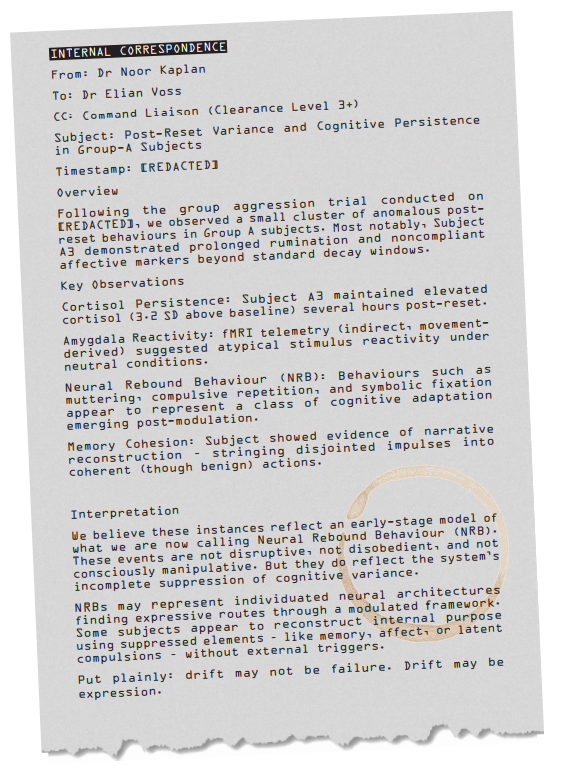
Chapter 10 of Propensity is a memorandum—fashioned in the style of a… wait for it… memorandum.

It doesn’t advance the plot much. That’s not its job. Like a dead-end corridor in a brutalist government building, it exists for atmosphere. Aesthetic artefact. Light foreshadowing. Bureaucratic texture. You know the type.

The memo comes from a psychologist involved in the Propensity experiment—writing to the study’s director about unexpected side effects. What they describe isn’t quite failure. It’s something stranger: drift, persistence, compulsive symbolism, the return of narrative despite modulation.

A precursor. A warning. And a throwback to a time when language still tried to make sense of things.

This chapter is one of several experimental inserts throughout the novel. I’ll be showcasing each of them here—in principle, if not in full.

🛸 SUSTENANCE Has Landed

A note from Ridley Park on language, consent, and the limits of knowing.

Well, this one’s live.

Sustenance has officially launched.

Audio: NotebookLM podcast on the book Sustenance.

If Propensity was about engineered peace through probabilistic compliance, Sustenance asks what happens when understanding itself breaks down—and nothing you think is mutual, is.

No war. No invasion. No end-of-days. Just a quiet landing. And a failure to translate.

The Premise

A group of non-human beings arrive—not in conquest, not in friendship, but in continuity. They are not like us. They do not see like us. They don’t even mean like us.

There is no universal translator.
No welcome committee.

Just humans—interpreting through projection, desire, and confusion.

And aliens—operating by a logic that doesn’t require interpretation.

The Themes


Sustenance explores what happens when:

  • Language fails and nothing fills the gap
  • Consent becomes guesswork
  • Culture is mistaken for nature
  • Property has no meaning, and law no parallel
  • Sex isn’t private, sacred, violent—or even especially enjoyable
  • Memory becomes narrative, and narrative becomes defence
  • Contact isn’t miraculous—it’s awkward, biological, and quietly irreversible

This is a story about misunderstanding. Not just what others mean—but who we are when we assume we understand anything at all.

The Tone

Think Arrival but rural. Annihilation without the shimmer.

A bit of VanderMeer. A hint of Flannery O’Connor. The cornfields are real. The discomfort is earned.

No apocalypse.

Just a failure to process.

And maybe, something new inside the gap that opens when the old stories no longer apply.

Why Write This?

Because contact doesn’t have to be violent to be destabilising.

Because not all miscommunication is linguistic—some is anatomical.

Because the most alien thing we can encounter is ourselves, misinterpreted.

Because I wanted to write a story where the question isn’t “what do they want?” but “what have we already assumed?”

Now Available

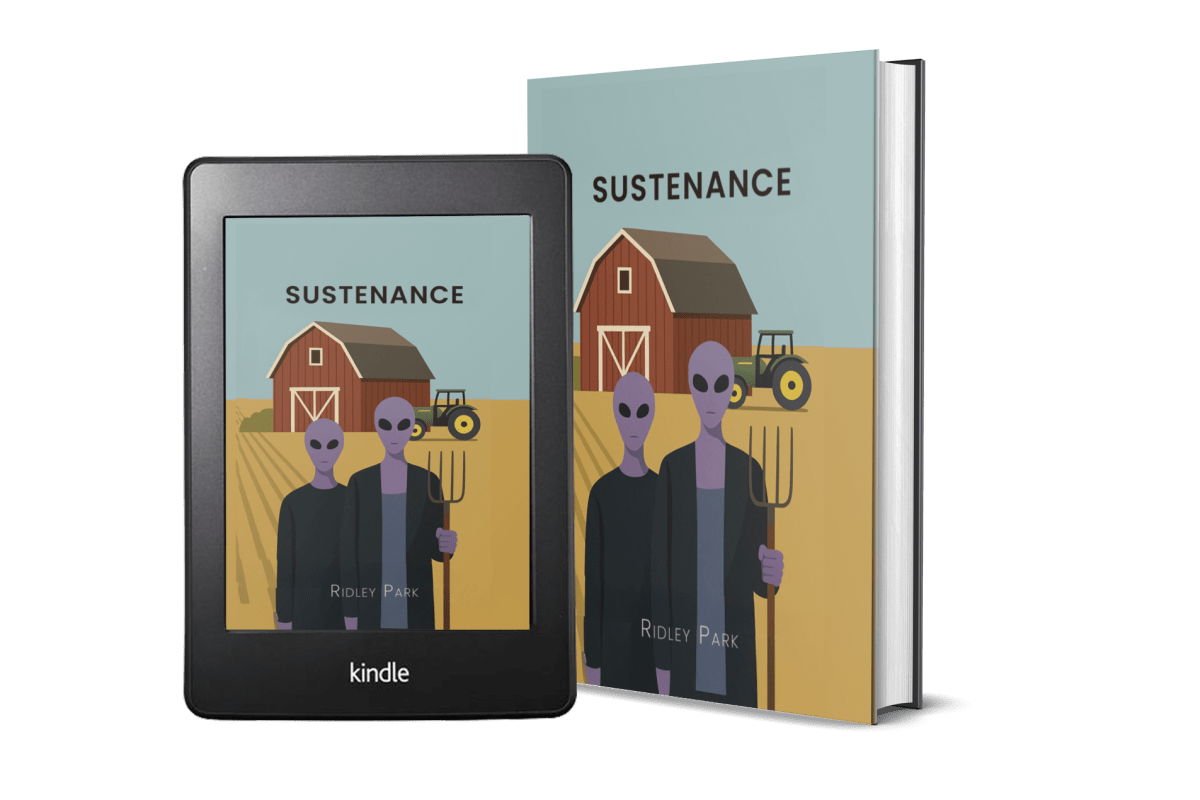
Sustenance is available now in hardcover, paperback, and Kindle.

If you read it—thank you. If you don’t, that’s fine.

The misunderstanding will continue regardless.

📘 More about the book →

Ridley Park
Possibly a person. Possibly a place. Possibly both.

📡 PROPENSITY Has Launched

A note from Ridley Park on behaviour, control, and the illusion of peace.


Well, it’s out.
Propensity has officially launched.

This one’s been brewing for a while. If Sustenance asked what happens when we can’t understand each other, Propensity asks what happens when we stop needing to.

No invasion. No superintelligence. No overt dystopia. Just a device—quietly implemented—that modulates human behaviour through neurochemical cues. Less anger. Less risk. Less faith, libido, disobedience. More calm. More compliance. More… nothing.

And nobody notices.
Because the best control doesn’t look like control.


The Premise

Imagine a world where we solve violence—not through laws, treaties, or education—but by dampening the neurological signals that make people aggressive in the first place. You don’t choose peace. Peace is chosen for you, chemically. You just comply.

That’s the Propensity Device: a system designed not to control what you do, but to shift what you’re likely to do. Your odds of revolt drop. Your odds of submission rise. It’s not sedative. It’s statistical.

Free will doesn’t vanish. It just stops being statistically significant.


The Themes

The novel explores what happens when:

  • Free will is reframed as background noise
  • Consent is irrelevant because no one thinks to object
  • Violence becomes programmable—but only directionally
  • Peace is achieved without ideology, meaning, or narrative
  • Narrative itself becomes residue

There’s horror in here, but it’s not loud. It’s administrative. Institutional. Clean.

The horror of things working exactly as designed.


The Tone

Think Black Mirror but less sensational. Think Ballard after a lobotomy.

A dash of Ligotti. A flicker of DeLillo. A long stare from Atwood.
Propensity is soft dystopia—flattened, not broken.

And yes, there’s a fall. But it’s not a collapse. It’s an asymptote.
A tapering. A loss of signal fidelity. A kind of surrender.


Why Write This?

Because we’re already doing it.

Because behavioural nudge theory isn’t fiction.

Because control doesn’t need to be malicious—just implemented.

Because some of the worst horrors are quiet, polite, and empirically validated.

Because I wanted to ask: what if peace worked too well?


Now Available

You can get Propensity on Amazon and other booksellers.

If you do read it—thank you. If you don’t, that’s alright.
The system will keep humming either way.

📘 More about the book →

Ridley Park
Possibly a person. Possibly a place. Possibly both.

Characters Are Overrated: A Treatise Against the Tyranny of Arcs

You’ll hear it a thousand times in creative writing circles, often whispered with the reverence of sacred doctrine: character is king. Give your protagonist an arc, they say. Make them grow. Show them change. Rinse. Resolve. Repeat.

Audio: NotebookLM podcast on this topic.

Forgive me, but I’m not here for that workshop claptrap.


My writing isn’t character-driven in the conventional sense. I don’t sculpt protagonists to take heroic journeys or undergo epiphanic transformations. I’m not interested in plumbing the depths of their souls or bandaging their inner wounds with moral insight. My primary concern is the world—the philosophical or sociological structure—through which characters drift, orbit, or plummet. Sometimes they leave a mark. Often, they don’t.

Because real life isn’t narrative. It doesn’t arc. It drifts. And most of us don’t develop. We adapt. We cope. We muddle through.


Resolution, in most stories, is a parlour trick—narrative taxidermy dressed as transcendence. In reality, most encounters don’t resolve. They expire. People come and go. You cross paths with strangers who change your life—or don’t—and then vanish back into the abyss of statistical anonymity.

One of my recent manuscripts begins with a woman named Sena discovering a body by the roadside. She reports it, the authorities arrive, and the narrative follows them—until it doesn’t. It dissipates. No tidy resolution, no tight bow. Just the unfurling tedium of systemic procedure and human irrelevance. It’s not a mystery story. It’s a story with mystery in it. Big difference.

We like to pretend we’re central to our own story, each of us a protagonist in a universe scripted for personal development. But sometimes, we’re not even side characters. Sometimes, we’re scenery. Camus’ Meursault had it right: the sun matters more than your feelings, and death shows up whether you’ve had your arc or not.


Yes, some readers crave grandiosity—heroes, villains, the Great Man Theory dressed in narrative drag. Napoleon didn’t just wage war; he “struggled with destiny.” Stalin wasn’t just a paranoid bureaucrat; he was “a force of history.” These are characters written by history with the same myth-making brush that writes fiction. Convenient, cathartic, utterly inaccurate.

But I don’t write demigods. I write witnesses, floaters, participants without insight. They’re often not even granted the courtesy of closure. They move through a world that refuses to acknowledge their significance. And why should it? The cosmos doesn’t care if your backstory is tragic or if your girlfriend left you on page forty-two.

Sometimes the character who seems central is merely catalytic. Other times, they’re inert—filler between philosophies. If someone changes, maybe it’s society, not them. Maybe the reader. Or maybe no one.

So no, I don’t build arcs. I don’t force characters to evolve like Pokémon just because Act III demands it. I drop them into a world and watch what happens—often, nothing. Because that, more than any tidy redemption tale, is how life actually works.


That’s the work. Not myth-making. Not therapy. Observation. Dissection. Not a ladder to transcendence but a mirror, tilted just so.

Welcome to Ridley Park. Watch your footing. There are no arcs—only echoes.

Who’s Ridley Park?

I love origin stories. In fact, my next writing project is an origin story.

But that’s a tale for another day. This post is to reveal the reason for the pseudonym, Ridley Park. This story starts in Delaware, where I lived from 2018 until 2023. I often travelled up 95 North to get to the aeroport or Philadelphia. On this drive, a road sign often caught my eye: Ridley Park.

I cached the name to memory, thinking it might make for an interesting character name. Each trip, this was further imprinted and reinforced.

In April 2022, I was writing another novel. The topic is beyond controversial. In fact, I haven’t yet found anyone who’s not abhorred by the concept, so I know I have to publish it when I finish it. Because of the subject matter, I felt a pen name was in order, and I decided to use Ridley Park. To be fair, the unfinished book is set in Philly, so the name felt particularly apt.

I’ll guess that most of us have heard of the film director, Ridley Scott. The connexion is beyond obvious. It maintains the same cadence.

I’ve never visited Ridley Park. All I know is that it’s a suburb south of Philly, and I’ve borrowed the name. In the end, as it turns out, the question was never ‘Who is Ridley Park?’ Rather, it’s ‘Where is Ridley Park?’ all along.