Reaching the Finish Line with Zamyatin, Le Guin, and Foucault Still in My Head

The book ends, as these things always do, with a sigh and a stack of annotated pages. I’ve just closed the cover on Zamyatin’s We, and, like a cigarette slipped into the afterword, there sat Ursula K. Le Guin’s essay “The Stalin in the Soul“. She wrote it decades later in 1979, but it might as well have been stitched into the same binding. I may write about it in more detail elsewhere.

Zamyatin built the totalitarian city of glass; Le Guin peered into the reflective surfaces. Her “Stalin” isn’t a political leader but the minor tyrant most of us cultivate internally — the censor who edits desire into silence, who rewards obedience with the narcotic of safety. She understood what Foucault would later codify as biopower: that power’s finest trick is to outsource itself. You don’t need Rousseau’s chains when you can teach people to manage their own submission.

Reading it now feels almost indecently prescient. The State of We had surveillance towers; ours has dashboards. Zamyatin imagined a future where citizens surrendered privacy for perfection. We call it good UX. Le Guin warned that the artist’s real jailer was the fear of making art that doesn’t please the market. Foucault, if he were still here, would simply nod and mark it as another case study in voluntary servitude.

We‘s protagonist, D-503, had shades of Dostoyevsky’s in Notes from Underground – only a bit more reliable of a narrator.

As I close this run of readings — We and its prophetic essay appendage — I can’t shake the feeling that finishing the book is part of the ritual it describes: the quiet filing of experience, the discipline of comprehension. Yet finishing also matters. There’s a line between vigilance and paralysis, between watching the gears of power and daring to write anyway.

So yes, the project reaches its line — not a triumphant banner, more a hand-painted sign reading enough for now. Zamyatin showed me the machine. Le Guin showed me the human who keeps it running. Foucault, the analyst of our beautiful cages, taught me not to pretend there’s an outside.

All that remains is to write, while the internal commissar mutters and the cursor blinks like a surveillance light. That, apparently, is freedom.
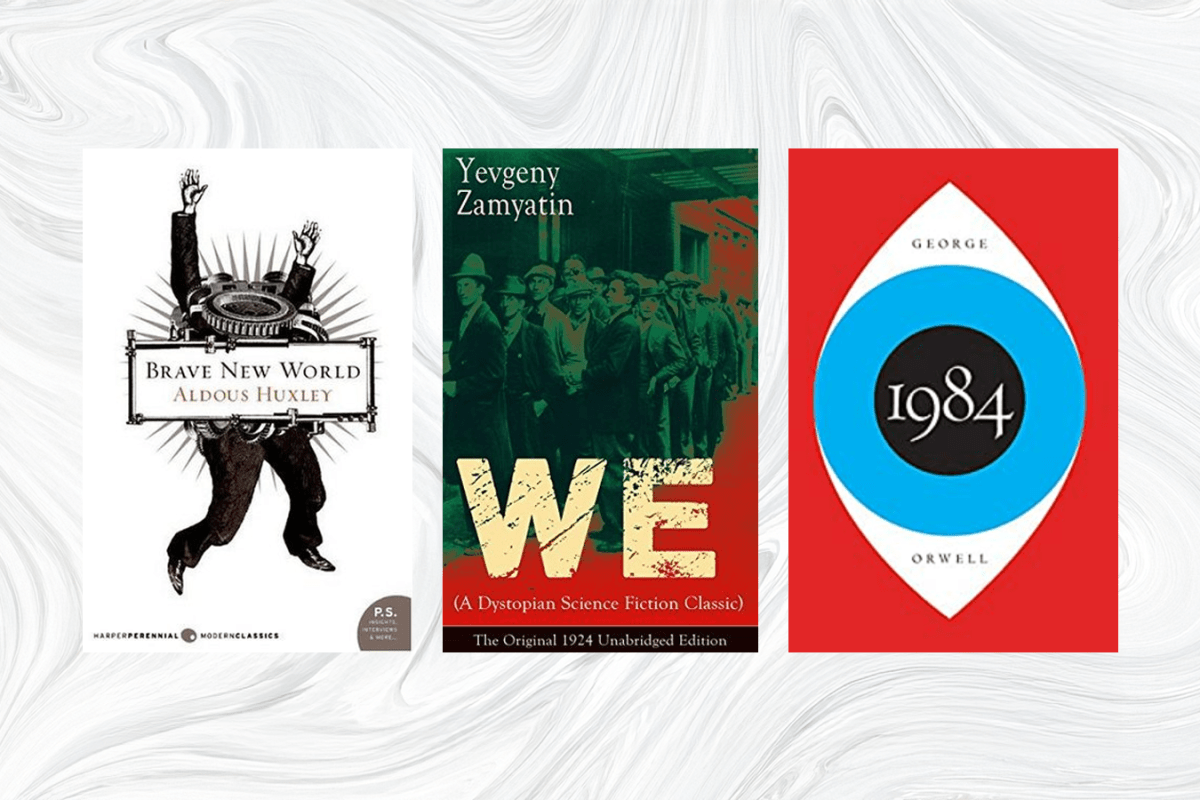
The Wrong Dystopias: Why ‘We’ May Be the Book for Now

2–3 minutes

Every time the news cycle coughs up another surveillance scandal, someone posts an Orwell meme. When pharmaceutical companies peddle happy pills, a Huxley meme pops up. 1984 and Brave New World have become the twin saints of dystopian shorthand, invoked as lazily as “Kafkaesque” or “Orwellian” whenever someone feels spooked by authority.

And yet, these two canonical nightmares don’t quite capture the mess we’re in. Our world is less Orwell’s boot stamping on a face, less Huxley’s soma lullaby, and more Zamyatin’s forgotten gem: We.

Audio: NotebookLM podcast on this topic.

NB: As my regular readers may know, I am an author and a philosopher. I decided to post this here – being about books – but from a philosophical perspective.

1984: The Boot and the Telescreen

Orwell’s vision of perpetual war, Newspeak, and state terror is always good for a scare. Yes, we have endless surveillance, but here’s the trick: nobody had to force us. We carry the telescreens in our pockets and call them iPhones. We gleefully sell our data for dopamine pellets disguised as “likes.” The Ministry of Truth hasn’t so much rewritten history as buried it under an avalanche of memes, cat videos, and outrage cycles. Orwell’s nightmare had to be imposed. Ours is volunteered.

Brave New World: The Soma Holiday

Huxley saw a culture distracted into oblivion – sex, drugs, and feelies. It resonates because the entertainment-industrial complex has outpaced even his imagination. We live in a time when attention spans collapse under TikTok’s weight, when “self-care” is code for medicated oblivion, and when consumption doubles as identity. But Huxley underestimated how much suffering we’d tolerate alongside our pleasures. His world was too tidy. Ours is messy: opioids meet social media, Prozac meets precarity.

We: The Transparent Cage

Here’s where Zamyatin earns his eerie prescience. Written in 1921, We imagines a society of glass walls, total transparency, and algorithmic order. People don’t need to be beaten into compliance; they celebrate their own reduction to predictable ciphers. Privacy is seen as deviance. Sound familiar? From fitness trackers to mood apps to your browsing history, we’re already busy quantifying ourselves into oblivion. Where Orwell needed torture and Huxley needed narcotics, Zamyatin needed only maths and consent.

Why We Now?

Because it shows the nightmare where people joyfully give themselves away. That’s not speculative fiction anymore; it’s our social contract with Big Tech, with influencer culture, with the dopamine economy. We don’t need Ministries or Somas when we’ve willingly built the glass house and handed over the keys.

So next time someone posts that Orwell vs Huxley meme, hand them Zamyatin. He may not have the brand recognition, but he has the sharper scalpel. And if you haven’t cracked We yet, do it soon – before it stops feeling like a novel and starts reading like user documentation.

Sci-Fi, Fantasy, and the Politics of Imagination

1–2 minutes

As I’ve been working through Octavia Butler’s Dawn, I’ve realised why science fiction as a genre rarely resonates with me. It isn’t the aliens or the starships; it’s the scaffolding. Sci-Fi carries the weight of the Modernist project – questions posed and quickly answered, problems rationally explained, the reader guided toward the “lesson.” It feels like indoctrination: tidy, didactic, instructional.

Companion piece on Philosophics Blog
Audio: NotebookLM podcast summarising this topic.

Fantasy, strangely enough, I tolerate even less. Where science fiction pushes forward, fantasy looks backward. Sci-Fi imagines the future of the Modern experiment: technology, politics, survival scenarios, all with a rationalist bent. Fantasy imagines the past of the same experiment: kings, bloodlines, prophecies, destiny. One proclaims progress, the other tradition, but both insist on role conformity.

This struck me as almost political: science fiction reads like fodder for Liberals and Progressives, those who believe we can build better systems if only we’re clever enough. Fantasy, meanwhile, often aligns with a Conservative ethos – a return to order, hierarchy, and providence, just with dragons and spells thrown in. Both are catechisms of Modernity, just oriented in opposite directions.

It may just be me. I don’t identify with the Modern project, and so the genres that proselytise it – looking forward or looking back – leave me cold. I prefer literature that unsettles, that leaves silence where there might have been certainty, that lets ambiguity breathe. But for many, Sci-Fi and Fantasy provide something else entirely: reassurance.

The Dystopia Venn: Four Circles of Absolute Nonsense

2–3 minutes

This particular meme has been making the rounds like a drunk uncle at a wedding – loud, colourful, and convinced it’s profound. A Venn diagram, no less! Four big circles stuffed with dystopias, slapped together as if geometry itself conferred wisdom. Most of them are books, a few are films, and one – Gattaca – is glaring at me because I haven’t seen it. That omission alone feels like a character flaw. I might grit my teeth and watch it just to close the loop, though it doesn’t exactly scream, “Pour a glass of wine and enjoy.”

Image: Venn Diagram

Here’s the thing: as art, it’s rather lovely. As a piece of intellectual cartography? It’s rubbish. It pretends to classify but in fact it merely collages. Orwell is pressed up against Burgess, Atwood rubs shoulders with Logan’s bloody Run, and in the middle sits Animal Farm, as if pigs with clipboards are somehow the Rosetta Stone of dystopia.

And yet – if you squint just so, tilt your head like a dog hearing a harmonica, you can just about see some tenuous ligatures:

  • Surveillance and conditioning: 1984, Clockwork Orange, and The Matrix all insist that the human mind is clay to be moulded by boot, syringe, or simulation.
  • Reproduction and regulation: Brave New World, The Handmaid’s Tale, and yes, Gattaca (apparently) fret endlessly over who gets to breed, who gets culled, and whose DNA deserves a future.
  • Bodies as resource: Soylent Green, Brazil, Gattaca again – people ground down into spreadsheets, rations, or literal mince.
  • The veneer of civilisation: Lord of the Flies and Animal Farm showing us that civilisation is just papier-mâché over the swamp.

But let’s be honest: the diagram isn’t actually saying this. It’s just four intersecting blobs, with titles hurled in like darts at a pub quiz. The apparent “structure” is nothing more than meme-magic – order conjured out of chaos to make you nod gravely as you scroll by.

So yes: as art, it works. As a Venn diagram, it’s a travesty. And maybe that’s the deeper joke. We live in an age where every complexity gets crushed into an infographic, every horror squeezed into a digestible meme. Which, if you think about it, is itself a bit dystopian.

📡 PROPENSITY Has Launched

A note from Ridley Park on behaviour, control, and the illusion of peace.


Well, it’s out.
Propensity has officially launched.

This one’s been brewing for a while. If Sustenance asked what happens when we can’t understand each other, Propensity asks what happens when we stop needing to.

No invasion. No superintelligence. No overt dystopia. Just a device—quietly implemented—that modulates human behaviour through neurochemical cues. Less anger. Less risk. Less faith, libido, disobedience. More calm. More compliance. More… nothing.

And nobody notices.
Because the best control doesn’t look like control.


The Premise

Imagine a world where we solve violence—not through laws, treaties, or education—but by dampening the neurological signals that make people aggressive in the first place. You don’t choose peace. Peace is chosen for you, chemically. You just comply.

That’s the Propensity Device: a system designed not to control what you do, but to shift what you’re likely to do. Your odds of revolt drop. Your odds of submission rise. It’s not sedative. It’s statistical.

Free will doesn’t vanish. It just stops being statistically significant.


The Themes

The novel explores what happens when:

  • Free will is reframed as background noise
  • Consent is irrelevant because no one thinks to object
  • Violence becomes programmable—but only directionally
  • Peace is achieved without ideology, meaning, or narrative
  • Narrative itself becomes residue

There’s horror in here, but it’s not loud. It’s administrative. Institutional. Clean.

The horror of things working exactly as designed.


The Tone

Think Black Mirror but less sensational. Think Ballard after a lobotomy.

A dash of Ligotti. A flicker of DeLillo. A long stare from Atwood.
Propensity is soft dystopia—flattened, not broken.

And yes, there’s a fall. But it’s not a collapse. It’s an asymptote.
A tapering. A loss of signal fidelity. A kind of surrender.


Why Write This?

Because we’re already doing it.

Because behavioural nudge theory isn’t fiction.

Because control doesn’t need to be malicious—just implemented.

Because some of the worst horrors are quiet, polite, and empirically validated.

Because I wanted to ask: what if peace worked too well?


Now Available

You can get Propensity on Amazon and other booksellers.

If you do read it—thank you. If you don’t, that’s alright.
The system will keep humming either way.

📘 More about the book →

Ridley Park
Possibly a person. Possibly a place. Possibly both.