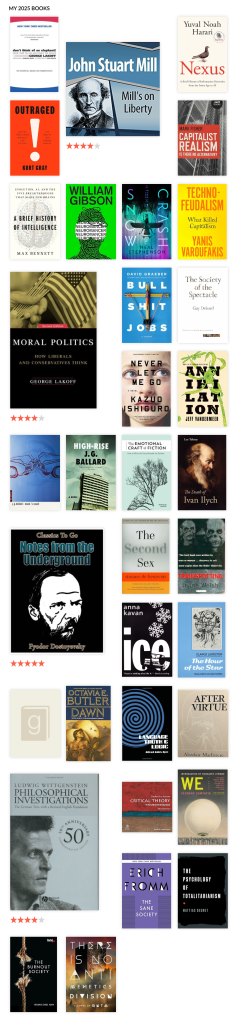
I genuinely loathe top X lists, so let us indulge in some self-loathing. I finished these books in 2026. As you can see, they cross genres, consist of fiction and non-fiction, and don’t even share temporal space. I admit that I’m a diverse reader and, ostensibly, writer. Instead of just the top 5. I’ll shoot for the top and bottom 5 to capture my anti-recommendations. Within categories are alphabetical.
Fiction
Never Let Me Go by Kazuo Ishiguro – A slow reveal about identity, but worth the wait.
Notes from Underground by Fyodor Dostoevsky – Classic unreliable narrator.
There Is No Antimemetics Division by QNTM (AKA Sam Hughes) – Points for daring to be different and hitting the landing.
Trainspotting by Irvine Welsh – Scottish drugs culture and bonding mates narrative.
We by Yevgeny Zamyatin – In the league of 1984 and Brave New World, but without the acclaim.
Nonfiction
Capitalist Realism by Mark Fisher – Explains why most problems are social, not personal or psychological. Follows Erich Fromm’s Sane Society, which I also read in 2025 and liked, but it fell into the ‘lost the trail’ territory at some point, so fell off the list.
Moral Politics by George Lakoff
Technofeudalism by Yanis Varoufakis – Explains why Capitalism is already dead on arrival.
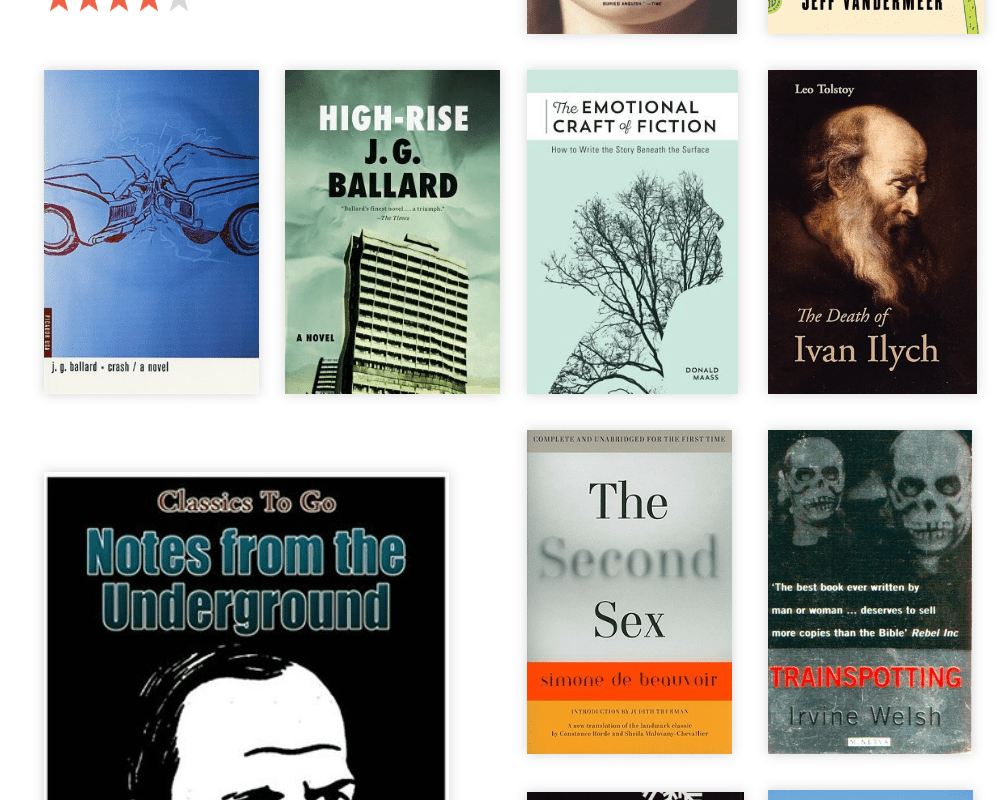
NB: Some of the other books had great pieces of content, but failed as books. They may have been better as essays or blog posts. They didn’t have enough material for a full book. The Second Sex had enough for a book, but then poured in enough for two books. She should have quit whilst she was ahead.
Image: Books I read in 2025 on Goodreads. Full disclosure: I don’t always record my reading on Goodreads, but I try.
Bottom of the Barrel
Crash by J.G. Ballard – Hard no. I also didn’t like High-rise, but it was marginally better, and I didn’t want to count an author twice.
Neuromancer by William Gibson – I don’t tend to like SciFi. This is a classic. Maybe it read differently back in the day. Didn’t age well.
Nexus by Yuval Harari – Drivel. My mates goaded me into reading this. I liked Sapiens. He’s gone downhill since then. He’s a historian, not a futurist.
Outraged by Kurt Gray – Very reductionist view of moral harm, following the footsteps of George Lakoff and Jonathan Haidt
Society of the Spectacle by Guy Debord – A cautionary tale on why writing a book on LSD may not be a recipe for success.
Honourable Mention
Annihilation by Jeff VernderMeer was also good, but my cutoff was at 5. Sorry, Jeff.
That’s the first line of Chapter 26, ‘Simulacra’, in Propensity. A small, airless room. A flickering light. Three teenagers – Teddy, Lena, Jamal – trying to remember what morality looked like before the world stopped watching.
This chapter is written as a script, not prose. Directions, shots, and camera pans replace internal monologue. The reader becomes the lens – an observer, never a participant. It’s deliberate. In a story about imitation and collapse, the camera itself becomes the narrator, the conscience, and the judge.
Audio: NotebookLM podcast on this topic.
The camera pushes through the door, searching. Dust floats in suspension, and time feels posthumous. Teddy zips his hoodie over bare skin; Jamal leans in the doorway, arms folded, disgust simmering behind teenage boredom.
JAMAL You can’t just be shagging Gormies, mate.
TEDDY That’s the point, innit?
Their exchange isn’t only about sex; it’s about the boundaries of what still counts as human. ‘Gormies’ are the gormless – the emptied remnants of pre-collapse society. They can’t consent or refuse. They’re alive but vacant. Human-shaped absences.
Teddy’s logic is brutal and pure simulation: if the subject can’t say no, the act ceases to carry meaning. He performs the motion of sin without the structure of morality.
Jamal’s recoil isn’t righteous; it’s aesthetic. He’s repulsed by Teddy’s theatre of transgression, the same way one might flinch at bad acting.
NB: Download this entire chapter as a PDF on the Propensity page.
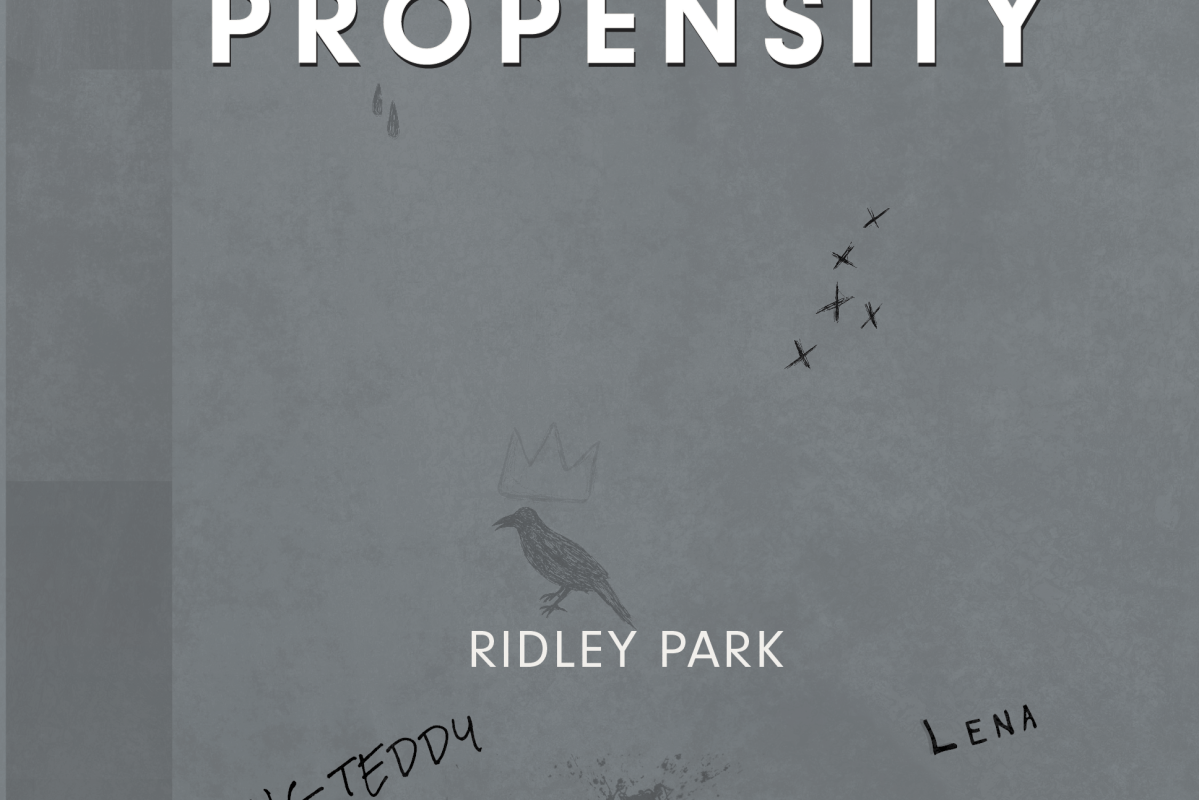
Image: Page 125 of Propensity, Chapter 26 – Simulacra.
26 · Simulacra
INT. FLAT – BEDROOM – LATE AFTERNOON The room smells like a tin of low tide. CAMERA: SLOW DOLLY IN from hallway, pushing through the open door into a dim, dust-suspended interior. Thin curtains bleed grey light onto water-stained wallpaper. The ceiling flickers from a dying fluorescent. A single, empty BED lies unmade in the centre – crumpled sheets, a dent in the mattress. CAMERA: HOLD ON WIDE SHOT, framing the bed dead centre, with figures occupying the room’s periphery. TEDDY (14) zips up his hoodie. Shirtless underneath. Sweat drying on his chest. He leans against the flaking wall, chewing on a broken fingernail. CAMERA: SLOW PAN RIGHT to JAMAL (16), posted near the doorway, arms crossed. He watches Teddy, face unreadable but for the curl of disgust on his lip.
The title Simulacra is a nod to Jean Baudrillard’s Simulacra and Simulation, the philosophical text the Wachowskis borrowed – and misunderstood – forThe Matrix. Baudrillard didn’t mean that the world was an illusion hiding the truth. He meant that the distinction between illusion and truth had already evaporated.
The real no longer disappears behind its representation; it becomes its representation. The sign replaces the substance.
In this scene, Teddy, Jamal, and Lena are copies of moral beings without moral context. They mimic the gestures of civilisation – disgust, guilt, justice – without the living institutions that once gave those words gravity. They don’t believe in morality; they reenact it.
Baudrillard called this the third order of simulacra: when the copy no longer hides the absence of reality but replaces it entirely.
JAMAL You can’t just be shagging Gormies, mate. TEDDY (grinning) That’s the point, innit? (smirking toward the bed) She’s gormless. Don’t care. None of them do. CAMERA: CUT TO TIGHT SHOT – Teddy’s face. The smile is too wide. Forced. CAMERA: OVER JAMAL’S SHOULDER, the bed is empty now, but the shape in the sheet tells a story. JAMAL That’s Lena’s mum. CAMERA: CUT TO CLOSE-UP – Teddy blinks. Shrugs. TEDDY Didn’t know Lena, did I? (beat) CAMERA: SLOW REVEAL – LENA (15) stands in shadow. Hood up. Motionless in the corner. LENA You do now.
Then comes the slow reveal:
CAMERA: SLOW REVEAL – LENA (15) stands in shadow. Hood up. Motionless in the corner.
LENA You do now.
Lena’s voice reintroduces consequence, but only as performance. It’s not morality restored; it’s morality remembered. The moment isn’t ethical – it’s cinematic. The reveal is the moral event.
Her mother, the Gormie in question, is little more than an echo of personhood. The outrage in Lena’s voice belongs not to ethics but to staging: a scene constructed to look like remorse.
The simulacrum here isn’t the Gormie. It’s the moral itself – played out as ritual, devoid of anchor. These children have inherited the gestures of adulthood but none of its meaning. They mimic guilt because that’s what the dead world taught them to do.
By writing the chapter as a film script, Propensity exposes its own mechanism. Every camera move, every cut, is a reminder that you, the reader, are complicit. You’re watching a reconstruction of a reconstruction. The text becomes its own simulacrum – a story imitating cinema imitating life.
Even the bed, ‘a dent in the mattress’, is a metaphor for what remains of the real: an impression where something used to be.
The result isn’t post-apocalyptic horror but philosophical unease. What happens when moral sense survives as empty choreography? When consent and consequence are just old lines, the species keeps rehearsing?
Propensity isn’t about survival. It’s about what comes after survival—when humanity’s operating system still runs, but the data’s corrupted. The characters are trying to rebuild a moral code from cached files.
Simulacra is the point where imitation becomes indistinguishable from intent. It’s a study in ethical entropy, a mirror held up to our own cultural exhaustion, where outrage has become performance and empathy a brand identity.
This is the future Propensity imagines: not a world without humans, but humans without the real.
I never took creative writing courses at university. I wanted to, but I was shackled to a double major in economics and finance, worlds far removed from literature. With only four free electives to spend, I squandered them on philosophy (which, in retrospect, I should have pursued outright). That’s a story for another day. I did manage to complete a couple of critical writing courses and a couple of literature courses, and those linger in my memory.
My critical writing professor was a lesbian feminist. She assigned us nothing but female authors – save one strange detour, when I was made to compare Gloria Steinem with Thorstein Veblen on economics. In our very first class, she asked for a handwritten sample, pen on paper, no dictionaries, no spellcheck. This was the late ’80s; such tools barely existed. My handwriting was atrocious then – as now –, so I resorted to all-caps block letters. She commented on the novelty. She was a marvellous teacher.
My first literature professor adored poetry, though I did not. He made the best of it. He also had a curious fixation on penguins and mocked the way I pronounced finance (short “i,” the way I still say it). He was equally amused when I once asked to “interject” – apparently not the word he thought I should have chosen.
My last literature professor was enthralled by all things American. Our reading list was composed entirely of American writers, perhaps some women among them, though I don’t recall. Before his class, their works didn’t quite resonate with me. Still, it was enjoyable. He also insisted that one must understand an author’s history to grasp the text, an idea Barthes would have scoffed at. He, in turn, scoffed at Barthes.
My favourite moment came at the end. After the term ended, he posted back our final essays. On mine, he scribbled two lines alongside the grade:
I’ll miss your sardonic humour. My name is not David Grace.
I had typed the wrong name on the title page – borrowing one from a maths professor whose name stuck, while my literature professor’s did not. I still can’t recall his name. But I remember him fondly all the same.
Does anyone else use writing props to help immerse yourself in adjascent fiction?
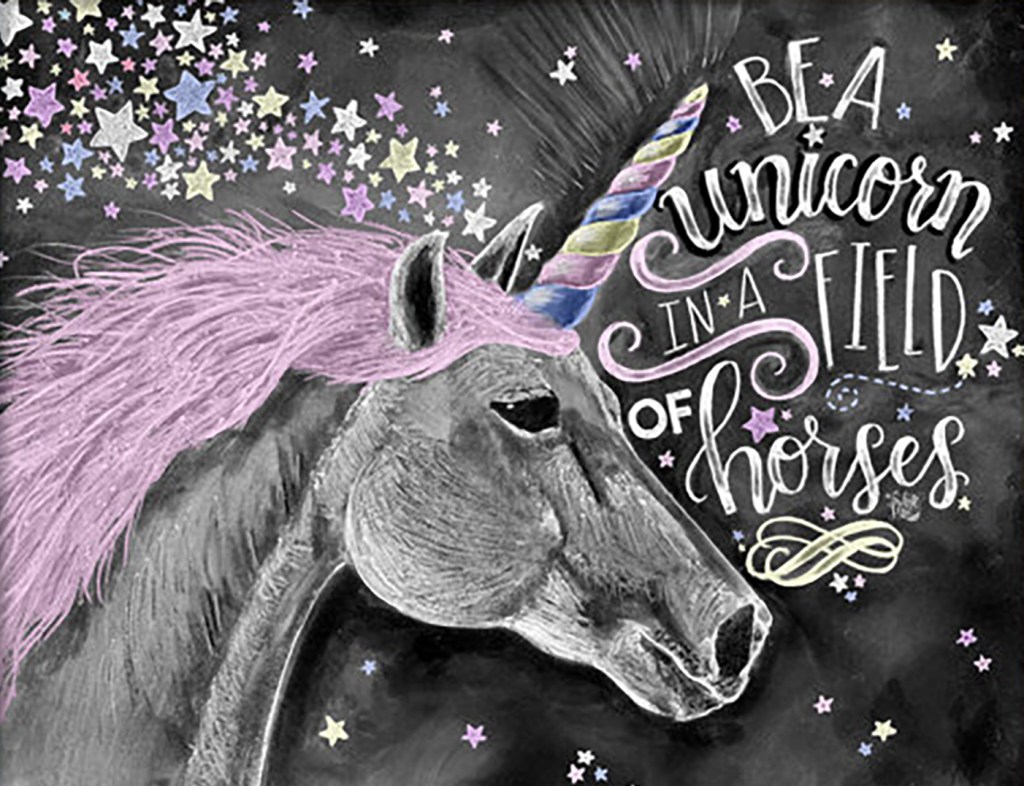
This unicorn image is from a poster. I am using it as a reference for a current project. It’s already seared into my brain, but it renders it somehow more real.
This unicorn poster hung on the wall of the inspiration for the protagonist of an upcoming novel, Needle’s Edge. It featuers prominently – almost has a speaking part.
Maps
Hemo Sapiens: Awakening is set in near-future Manchester, UK, so I had maps of Manchester at the ready. It helped me to add some realism. Because a trip from a nearby town into the city only took 15 to 20 minutes, I had to edit down a scene I was hoping would fill an hour. I could have used a location further away, but it wouldn’t have made sense to the plot, and I hate those sorts of plot gimmicks.
Sustenance is set in Iowa. I not only had a map of Iowa, I had resources on flora and fauna, so I could name-drop. I’ve visited parts of Iowa, but I couldn’t have drawn these details from memory—and I mightn’t have known the names or the onomonapoeia fascimiles.
Temporal Babel is set in New Mexico, so besides a map for highway references and distances from landmarks—towns, cities, and reservations—, I saved image resources of local photographs, landscapes, plants, buildings, attire, and so on. It really helps we with the description, something that is not otherwise my forte.
Propensity is set in no place in particular, so I used no maps, but I studied interiors of institutions, prisons, laboratories, and the like.
This is another unicorn sticker that was in the house of the protagonist, but it doesn’t make the cut. It still makes me chuckle.
Another unfinished novel, Everlasting Cocksucker, is set in Philly. I spent severl years in and around there, so I know the lay of the land. Still, I find maps useful.
I put this project ont he backburner because I received so much hate over the subject matter. I decided to concentrate on other projects. But, I created a physical shadowbox as a reminder of the protagonist.
Image: Reconstruction of a shadowbox.
In this story, this represents her life habits: Newport Menthol 100s in a box, Red Bull, Maruchan Ramen, and tarot readings. The Hanged Man is relevant to the plot. When I return to the manuscript, I’ll have this as, let’s call it, inspiraration.
If I wrote genre fiction, this wouldn’t work as well – Sci-Fi or Fantasy and whatnot. It might work for historical fiction though.
I’ve been working on experimental short stories and poems this week. One almost grew into a novella, but I tamed it. Passages is one such experiment. It’s a short story. It might have been flash fiction, but I got carried away in the moment. I’ll provide a deeper analysis of the story and meta aspects on my philosophics blog in a week or so, because I already have a weeklong series on queue there.
This story was spawned from Hillary Putnam’s brain in a vat thought experiment. The notion is a response to what if you were just a manifestation of a brain in a vat in some laboratory and entities control your thoughts and experience, but you have no body. In the Cartesian sense, you have mind-body dualism. Here, you’ve got only an imagined body.
Taking this further, in a nod to Dali’s Persistence of Memory, I envisioned a reality that worked like a procedurally generated computer game. At any moment, only your immediate experience was loaded into memory. In a game, when you leave an area for another, the cache is refreshed with the information regarding the new area, including the aesthetic and physics of the area. I didn’t want to go overboard. Some readers will find this difficult enough to enjoy. It’s easy to read, but it breaks several cognitive conventions, so it becomes disorienting.
This story evolved from several prior attempts. This is the first I feel comfortable sharing and critiquing.
After this story, I provide some additional commentary, but they’re rather spoilers, so if you read them in advance, it’s your own damn fault.
I created an audio version of this story. It’s got an ASMR sense about it. I could probably add sound design to make it more of a multimedia experience. Stand by. One never knows.
Passages
The water runs over her hands, lukewarm, as soap lathers across her skin. The smell of citrus fills the small space. A soft hum from the bathroom fan blends with the steady drip of the faucet. Eyes catch the reflection in the mirror—just a momentary glance. There’s a smudge of condensation along the glass, distorting the edges of the face staring back at Alex.
A towel is pulled from the rack, and the sound of fabric rubbing against skin is a faint whisper in the quiet room. The faint buzz of traffic seeps in through the cracked window, muffled by distance.
Fingers fumble with the faucet knob, twisting it tighter, silencing the slow drip. The window clinks as it’s nudged shut, the movement sending a cool draft through the room. The towel is left draped over the counter, forgotten.
A hand reaches for the light switch, and the bulb flickers once before the room is swallowed by darkness. Footsteps echo softly down the hall, and with each step, the hum of the fan fades further, replaced by the distant ticking of a clock.
The ticking persists, steady and rhythmic. Sheets shift, pulling tighter around a body half-buried beneath the covers. The warmth lingers under the heavy quilt, though the room feels cooler—light filters faintly through the drawn curtains, casting dull shadows on the floor.
Eyes flutter open, squinting against the light, and the clock’s ticking grows louder, filling the quiet. A hand emerges from beneath the quilt, fumbling for the phone on the nightstand, fingers brushing against the smooth surface. The soft chime of a notification breaks the silence, and the ticking clock seems to fade into the background.
The phone screen illuminates briefly before being cast aside, forgotten. The sheets are kicked back, and bare feet hit the floor, cold against the worn wooden boards. Outside, the distant sound of a lawnmower hums, a low drone that weaves into the clock’s ticking rhythm.
A pause. A glance at the clock—its hands moving in slow, deliberate ticks. The light from the window is stronger now, but the room remains dim. The ticking fades as footsteps shuffle across the floor, toward the half-open door.
The air is cooler here, carrying with it the faint hum of an air conditioning unit. A shift in weight, and the sound of polished shoes on hard flooring is barely audible in the hushed space. Shadows stretch across the marble tiles as muted voices, distant and faint, rise and fall somewhere behind, their echoes absorbed by the high ceilings.
A pause at the centre of the room. Eyes wander across the painting on the wall, its brushstrokes heavy with colour and movement, though the room itself feels still—almost frozen. Fingers trace the air near the canvas, close enough to feel the charge of the paint, but never touching.
A quiet cough breaks the silence. The space feels empty but alive with potential energy, suspended between the art and the unseen visitors just out of view. The faint scrape of a chair being pulled out echoes from across the gallery, reverberating softly against the walls.
There’s a shift. One step, then another. Footsteps, soft and careful, move across the cold floor, the sound nearly absorbed by the echoing quiet of the room. A final glance at the painting, and then movement towards the next exhibit, the footsteps fading into the distance.
The next painting stands framed beneath an open sky. The warm evening air brushes past, carrying with it the faint scent of oil paint. The canvas itself is suspended in the light, its surface thick with texture, every brushstroke visible in the waning sun.
The light shifts across the canvas, illuminating streaks of red and orange as if they are moving, alive. Fingers reach out but stop just short of the surface, tracing the air where paint meets air. The soft hum of a nearby streetlamp flickers on, casting a faint glow that mingles with the light still clinging to the day.
The wind shifts, rustling through nearby trees, the leaves whispering in response. A figure moves past in the periphery, their footsteps light and distant, blending into the soft sound of the leaves. The moment holds, suspended between stillness and movement.
A final glance at the painting, the colours deepening as the light continues to fade. Another step forward, away from the canvas, and into the shifting evening, the hum of the streetlamp steady in the air.
The hum cuts through the morning stillness, louder than it should be. For a moment, there’s only the sound—an electric thrum in the dawn air. Then, a sharp click, and the streetlamp dies, leaving the light of the rising sun to catch the sky in pale shades of pink and orange.
Her arms rest around his shoulders, the warmth of his body a contrast to the cool breeze off the water. The smell of salt fills the air, mingling with the faint scent of his cologne. Her fingers trace the outline of his collar, gentle, almost absent, as if the touch is more for herself than him.
Waves crash softly against the shore, a rhythm far older and deeper than the hum of any streetlamp. The light grows, soft and steady, casting long shadows across the sand, pulling her focus toward the horizon.
Her gaze lingers there, at the place where the sun meets the water, and in the quiet, there’s a pause. The warmth of the embrace holds, even as her mind drifts, caught somewhere between the fading night and the new day.
The scent lingers in the air, caught briefly in the wind as bodies move past. The sidewalk is crowded now, bustling with the energy of mid-morning, the sun already casting long shadows against the brick buildings. There’s warmth in the air—heat rising from the pavement beneath every step, and the sound of passing conversations blends with the distant honk of traffic.
Hands slide into the pockets of a jacket, and the faint scent of cologne clings to the fabric. The smell mingles with the dampness of the city after last night’s rain, a strange mixture of familiar and fresh.
A group passes by, their laughter rising above the dull hum of the street, and there’s a brief moment of stillness—a pause to look up, catching the flash of sunlight reflected off a nearby window. The brightness is sharp, almost blinding for a second, before fading back into the rhythm of the street.
Feet move forward again, weaving through the crowd, the scent of cologne slipping away as quickly as it arrived.
The brightness is overwhelming for a moment, a sharp glare cutting across the open road. Squinting against the light, a hand rises instinctively to shield eyes from the sun’s harsh rays. The air is thick with warmth, the heat rising off the asphalt in shimmering waves.
The countryside stretches on, fields fading into the horizon, the hum of insects in the distance blending with the wind rustling through dry grass. Each step on the gravel feels slow, deliberate, the weight of the afternoon pressing down with a quiet intensity.
The sun dips lower, its angle shifting, casting longer shadows now. A car passes in the distance, the sound barely more than a whisper, its engine humming faintly before it disappears into the landscape.
Fingers brush against the edge of a dusty road sign, the metal cool under the lingering heat of the day. The road ahead seems endless, stretching toward the horizon, bathed in the golden light of the setting sun.
The car door swings open with a soft creak, cutting through the quiet of the evening. The city feels muted here, distant traffic blending into a low hum beneath the cool night air. Fingers grip the edge of the door, the metal smooth and cool beneath a hand as it holds the car open.
The scent of leather and faint traces of cologne linger in the air as the inside of the car is revealed, the seats illuminated by the faint glow of a streetlamp. A pause, waiting for a movement that doesn’t come. The street is empty, save for the gentle flicker of the lamplight across the wet pavement.
A glance to the side, and the door swings shut behind, the click of the latch cutting through the stillness. The car shifts slightly as weight settles into the driver’s seat, hands resting on the steering wheel. The scent of cologne lingers, familiar, though the night is quiet and the city beyond feels far away.
The engine hums to life with a low, steady rumble, the faint glow of dashboard lights casting shadows against the inside of the car. Eyes linger on the rearview mirror, catching the dim reflections of passing headlights in the distance.
The restroom is quiet, the faint sound of clinking silverware drifting in from the dining room beyond. Fingers brush lightly over the porcelain sink, the cool surface grounding against the warmth of flushed skin. Eyes meet the reflection in the mirror—just for a moment.
The light above flickers, casting a faint shadow over the face staring back. There’s a small blemish, barely noticeable, but enough to cause a pause. Lips part, the curve of a smile forming before fading. A hand reaches into a small bag, fingers closing around a tube of lipstick, its smooth, familiar weight comforting in the silence.
A quick swipe of colour, the bright red standing out against the pale skin. Eyes flicker again to the mirror, the reflection now sharper, more defined. The sound of footsteps outside the door grows louder, blending with the low hum of conversation.
And then the scent. It hits in waves—the aroma of fresh bread, the tang of something rich and savoury, creeping into the room like an invitation. The stomach tightens, a soft growl stirring the silence as the aroma pulls attention away from the reflection. The door opens with a quiet creak, the scent stronger now, more insistent, beckoning back to the table.
The aroma fills the room, rich and warm, wrapping itself around the clatter of silverware and the murmur of conversation. A deep breath draws it all in—roasted vegetables, buttery rolls, the sweetness of cinnamon, and the earthy scent of something cooking in the oven. Plates are already half full, but it’s the smell that dominates, lingering in the air like a memory.
The table stretches out in front, crowded with food and faces, bathed in the soft, golden light of the overhead chandelier. Fingers toy with the edge of a napkin, folding and unfolding the corners as eyes scan the familiar scene—glasses raised, laughter bubbling up from the far end of the table.
A glance down to the plate, the fork paused mid-air. The food is warm, comforting, though the room itself is filled with an odd sort of quiet, broken only by the distant hum of the kitchen timer. A soft voice calls from the kitchen, and there’s a slight shift as chairs scrape back against the wooden floor.
The scent of the food hangs in the air, heavy and satisfying, as plates begin to empty, the last bits of conversation fading into the background. Another deep breath—the smell of something sweet just beginning to bake—lingers, promising dessert.
Another deep breath—the scent of leather mixed with a faint trace of perfume lingers in the air, soft and familiar. His arms wrap around her waist, fingers resting gently against her skin, warm beneath the fabric of her dress. The room is quiet, the only sound the soft ticking of a clock somewhere in the background, blending with the faint hum of the evening.
Her head rests against his shoulder, the curve of her body fitting perfectly into the space between them. He inhales deeply, the smell of her skin mixing with the faint traces of the leather sofa beneath them. The warmth of her breath against his neck sends a quiet ripple through him, grounding him in the moment.
He shifts slightly, his hand tracing a line along her arm, feeling the softness of her skin under his touch. She murmurs something, a half-whisper, her voice barely audible as she shifts closer, her perfume lingering in the air between them.
His eyes close for a moment, letting the scent and the warmth wash over him. The night feels still, timeless, suspended in the quiet of their embrace.
The whisper fades into the quiet, barely a breath, soft as silk against the darkness of the room. The warmth of the sheets wraps around, cocooning the stillness. Outside, the world feels far away, the faint sound of a breeze rustling through the trees barely audible through the closed window.
A body shifts beneath the blankets, the fabric brushing against skin. Eyes blink open, adjusting to the dim light filtering through the curtains, the glow of a streetlamp casting faint shadows against the walls. The voice lingers in the quiet, though the words are lost now, absorbed into the silence.
Fingers brush the edge of the pillow, tracing the softness of the fabric, grounding in the weight of the moment. A sigh escapes, low and quiet, blending with the rhythmic sound of breathing nearby—slow, steady, almost lulling.
The night feels endless, suspended between waking and sleep, between the fading whisper and the deep pull of rest.
Eyes blink open, and the light is suddenly too bright—harsh, artificial. The soft glow of the bedroom is gone, replaced by the sterile brightness of fluorescent lights flickering overhead. The echo of footsteps bounces off the cold tiles, and the low hum of voices fills the space, overlapping with the sharp whistle of a departing train.
A quick breath, disoriented, hands reaching instinctively for balance. The air feels cooler here, crisp, as a gust of wind rushes past from the open doors. The scent of engine oil and faint hints of coffee hang in the air, blending with the faint scent of old newspapers clutched in the hands of those passing by.
A suitcase rolls past, its wheels clattering against the ground, briefly drawing focus. The station is busy, bodies moving in every direction, each step blending into the next. The light shifts again as a shadow passes by—a figure stepping into view, silhouetted by the glow from the platform ahead.
A distant announcement crackles over the loudspeaker, garbled and unintelligible. The light flickers once more, and the footsteps begin again, each sound layered over the rhythmic pulse of the trains in motion.
The rumble continues, but it shifts. The rhythmic clatter of the train fades, replaced by the uneven jolt of wooden wheels over dirt. The scent of engine oil is gone, replaced by the heavy musk of horses and the dry heat of dust swirling in the air. A faint creak of leather mixes with the steady trot of hooves on the packed earth.
A figure stands by the road, the wide-brimmed hat casting a long shadow in the harsh midday sun. The stagecoach rattles past, its wheels kicking up dust in great clouds, the dark shape of the driver silhouetted against the bright sky. The creaking wooden frame of the coach sways with each bump, and the horses snort, their breath heavy in the dry air.
Eyes squint against the brightness, the sun sharp and unrelenting. The clatter of the stagecoach continues into the distance, its echo lost in the vastness of the open road. Hands rest on worn leather reins, rough from years of use, the smell of sweat and dirt clinging to everything.
A gust of wind stirs the dust again, carrying the scent of dried grass and far-off rain. A distant sound, low and rhythmic, begins to blend with the fading clatter of the stagecoach, like the beating of hooves, steady and constant.
The wind shifts, carrying the scent of grass—dry, brittle, barely clinging to life in the heat. The sky looms heavy overhead, a dull, unrelenting grey, with streaks of dust swirling in the air like ghosts on the move. The ground beneath is cracked, each step stirring up fine clouds of dirt that settle on everything—clothes, skin, eyes.
A woman stands by the edge of a field, her gaze fixed on the horizon where the earth seems to melt into the sky, the line between them blurred by the dust. The once-green grass is yellowed and brittle, crunching underfoot as she moves, one slow step at a time, her body weighed down by the oppressive heat.
Her fingers reach for the brim of her hat, tugging it lower to shield her eyes from the blinding sun. The air is thick with the scent of dried earth, the faint sweetness of dying grass barely detectable beneath the dust. In the distance, a tractor sits idle, half-buried in the dirt, its once-shiny metal rusted and worn, abandoned in the heat.
A deep breath pulls in more dust than air, the taste of it gritty on her tongue. She coughs, the sound sharp against the quiet, and for a moment, the world feels empty, endless. The wind picks up again, stronger this time, swirling the dust into the air, choking out the last remnants of the grass.
The wind stirs again, but this time it carries not dust from the fields, but sand—fine grains that swirl across the vast expanse of the desert. The heat is still oppressive, but different, dry and relentless, stretching out as far as the eye can see. The caravan moves slowly, the camels’ hooves pressing into the shifting dunes, their shadows long under the scorching sun.
A figure leads, wrapped in cloth to keep the sun’s bite from skin, each step careful, deliberate, as the sand shifts beneath. The creak of the wooden carts behind blends with the low grunts of the camels, the scent of spice wafting from the cargo, carried by the same wind that sweeps the dunes.
The horizon seems endless, the line between sky and earth shimmering in the heat. The sun, bright and unyielding, hovers directly overhead, casting a blinding glare. A hand rises to shield the eyes from the brightness, but the light reflects off the sand, burning in every direction.
A voice calls from behind, low and muffled by the wind, as the caravan moves deeper into the desert. The sand shifts underfoot, the wind carrying the faint scent of something distant, unfamiliar, as the sun continues its slow descent toward the horizon.
The sand shifts again. It feels cool, damp beneath the feet, as the sound of crashing waves replaces the distant wind. The endless dunes fade, replaced by the wide expanse of blue ocean stretching out before her. The air is fresh, carrying the sharp scent of saltwater mixed with sunscreen, the taste of the sea lingering on the breeze.
A surfboard cuts through the waves, its rider balanced with ease as the water curls around him, glistening in the sun. The sand underfoot is soft now, wet where the waves lap against the shore. The sound of seagulls calls out from above, mingling with the laughter of children playing further down the beach.
A dolphin breaches the surface, its sleek body catching the light as it arcs through the air before disappearing again into the depths. The rhythm of the ocean is steady, constant, the crashing waves creating a soothing backdrop as the surfers wait for the next set.
The sun climbs higher, warming the skin, casting long shadows across the sand as the waves roll in. A distant voice calls out from a lifeguard stand, but it’s drowned out by the sound of the ocean, relentless and powerful.
The warmth lingers, but the texture changes to a filtered, softer light spilling through tall café windows. The rays fall across the tiled floor, casting long shadows that stretch toward the empty tables near the counter.
Inside, the air is thick with the rich scent of coffee, mixing with the faint sweetness of pastries cooling on a rack behind the glass display. The hum of conversation blends with the quiet clatter of cups and saucers, the sound soft but constant, like a low murmur in the background.
A hand wraps around a warm mug, the surface smooth against the skin. The liquid inside swirls lazily, catching the light as the spoon stirs it slowly. Outside, people rush past, their figures blurred by the sun streaming through the glass.
The sunlight shifts, moving across the room as a door opens briefly, letting in a gust of fresh air. It fades for a moment, the warmth still clinging to the skin, before returning again, softer now, as the day slowly leans into the afternoon.
The steam rises slowly from the mug, spiralling upward, carrying with it the rich, familiar scent of freshly brewed coffee. The kitchen is quiet, the early morning light filtering through the small window above the sink, casting soft shadows across the countertop. The air feels cool, but the warmth of the coffee radiates gently from the cup, filling the space with a comforting heat.
A spoon clinks softly against the rim of the mug, stirring sugar into the dark liquid. The faint sound of the fridge hums in the background, blending with the occasional drip from the faucet. Outside, the world is still waking up, the distant sound of birdsong just beginning to break through the silence.
Fingers curl around the cup, lifting it slowly. The first sip is tentative, the heat lingering on the lips before the flavour settles, rich and deep. The steam fogs the glasses perched on the edge of the nose, and a quiet sigh escapes, a release of the night’s lingering tension.
The room is still, save for the sound of the coffee being stirred, the soft clink of the spoon punctuating the calm. The light shifts slightly as the sun continues to rise, the day creeping in slowly, moment by moment.
The water runs steadily, the sound soft but constant, filling the small space. Steam rises from the cup still resting on the counter, curling gently in the cool air. Fingers hover over the faucet, feeling the warmth of the water trickle past before twisting the knob tighter. The slow drip stops.
The air is damp, clinging to the skin, carrying the faint scent of soap and citrus. The soft hum of the bathroom fan vibrates in the background, blending with the distant sound of traffic outside the cracked window. A hand reaches for the towel, pulling it from the rack, and the fabric brushes softly against the skin, a familiar warmth in the quiet room.
Eyes catch the reflection in the mirror—just for a moment. A small smear of condensation distorts the outline of the face staring back, and a sigh escapes into the silence. The light flickers once before the room is swallowed by darkness.
Footsteps echo softly down the hall, the sound fading as the hum of the fan continues, replaced slowly by the distant ticking of a clock.
Spoiler Alert!
Passages operates on mechanics. Each scene or beat is four stanzas or paragraphs long. The story doesn’t operate on characters or character arcs. Instead, it operates on sensory details. The way I bridge from scene to scene if through sensory continuity.
The transition from the first scene to the next is the ticking of a clock; from the second to the third are footsteps, and so on. The transitionary motif may be the scent of cologne, the warmth of the sun, sand on a beach, or dust in the air. And so it goes.
I considered adding visual cues between the bridging paragraphs but felt that it interrupted bridging the flow and the pretext of continuity.
I feel this creates enough cognitive comfort for a reader to engage without feeling they’re reading random passages. There is continuity for the mind to track. It’s just different.
In a way, it reminds me of listening to a playlist but focused elsewhere. The songs change in the background, but it doesn’t really matter because your attention only checks out and in periodically.
There is no dialogue. The character is really characters. There is no contiguity here either. Aspects as gender, age, appearance, and such are not persistent, but the instantiation of the character is unawares.
If you just read or listen without paying careful attention to the serpentine plot, it just feels like a story—perhaps a church sermon. There’s a stream of words. Maybe they even somehow fit together. It’s like the word salads popular with some politicians of our age.
I hope you either like it or find it interesting. I’ll share more in time. I’ve written half a dozen thus far. In any case, I’d love to read your reactions and thoughts.






 Ridley Park