I’ve finally given Propensity a trailer. This short piece captures the first of the novel’s three movements – the ‘scientific’ phase, when everything still believes it’s under control. Except for this cover image, I used no AI. Except for the book covers, all assets – video clips and soundtrack – came from Motion Array
There may be another to follow, drawn from the second section, where control begins to crack. For now, consider this a visual prelude: thirty-two seconds of atmosphere, code, and quiet collapse.
Propensity is available in print and eBook in the usual places – online or at your local bookseller.
As an author, reviews matter. Not because they inflate the ego (though I won’t pretend a kind one doesn’t help), but because they’re one of the few moments when the work stops being mine and becomes read.
I submitted Propensity for professional review through Reedsy – why not? It’s always interesting to see how a stranger processes what you’ve made. Some of my books have Kindle editions, which makes collecting feedback easier: I can offer them free for a day or two and watch the downloads climb. Whether those books are ever opened is another question. I’ve been that reader too – downloaded an eBook, nodded at the cover, and forgotten it. I’ve bought audiobooks I’ve never started.
So when someone actually read Propensity, a book not yet available as an eBook, and took the time to write a thoughtful review, that meant something. And unlike the memorable one-star “Garbage” review that Sustenance once earned, this one had a little more nuance.
An unnerving story that begins with a bizarre experiment and unfolds into an impressive hyperbole for human hubris.
Synopsis
What if peace could be engineered?
In Propensity, a team of scientists and a military general pioneer a device capable of altering human behaviour itself—tuning aggression, obedience, libido, faith, and risk tolerance like dials on a console. At first, the results seem miraculous: violence quelled, conflict dissolved, impulses muted. But as the technology scales from labs to battlefields to cities, the illusion of control begins to fracture.
Through sharp, unsettling vignettes, the novel traces both the grand sweep of societal collapse and the intimate struggles of those left to navigate it. At its heart, Propensity is a literary exploration of power, morality, and the fragile myth of free will.
Both speculative and philosophical, it poses an unnerving question: if our choices can be rewritten at the neurochemical level, were they ever truly ours?
– Review Begins –
“Reader discretion is advised. Free will has been deprecated.”
This ominous word of caution is what Ridley Park’s speculative novel ‘Propensity’ opens with, and it sets a tone that strikes an impressive balance between clinically descriptive and quietly devastating. Beginning as a bizarre experiment in behavioural modulation by way of neurochemical intereference, it unfolds into an eerie metaphor for the tricky road between control and conscience.
Park’s chapters are short and succinct, some barely a page long, in a staccato rhythm. This creative choice, while initially a little unnerving, works well to reflect the story’s inherent disintegration: scientists losing grip on their own creation, subjects dissolving into numb submission or what they term “the zeroed state”, and a world slowly learning the price of their “engineered peace”. The writing comes off as crisp in an almost detached manner that leaves one wanting for a bit more emotional depth in the first part of the book but not only does that eventually grow on you, it ends up serving its purpose of thematic execution in both its text and subtext. Phrases like “silence playing dress-up as danger” and “peace was never meant to be built, only remembered” linger like faint echoes long after you turn the page.
This dogged curiosity and thought the writing dredges up anchor the novel’s core strength. Its impact is rooted not in prosaic preaching but letting the reader unpack the implications by themselves as they go on. Working in the field of medical physiology myself, the scientific nitty-gritty delved into, including the hormonal cues and neuronal plasticity, particularly intrigued me and while I acknowledge the convenience of fictitious extrapolation of theory, it manages to add a certain sense of realism to the story. It’s equally fascinating and disturbing, especially in the current epidemic of artifical intelligence we live in, to see faith and empathy become mere variables in a lab.
A fitting hyperbole of human’s hunger for order, ‘Propensity‘ does occasionally falter. Its fragmented and experimental structure, with prose interspersed with poems and memos, while successful in tying up its chaos, sometimes undercuts emotional engagement. The chapters are like snapshots that end before they can fully breathe. But when Park makes it work, especially through the poetic montage that follows the post-modulation disaster, it’s hypnotic.
By the end, I found myself returning to that elusive idea of peace conspicuous throughout the book. The text seems to suggest that peace isn’t something we construct but rather, something we remember. It’s almost a fragile illusion fleeting across one’s reality, often better suited to being a word than a sentiment, history than hope. It’s as if the moment you declare peaceful times, they’re already past.
‘Propensity’, thus, doesn’t offer answers; it offers questions and their ramifications. And in more ways than thought possible through the misconception surrounding the scope of speculative genre, that’s perhaps a truly accurate representation of the times we live in.
– Review Ends –
Why I appreciate this review
It would be easy to say I appreciate it because it’s positive. But that’s not the point.
One of my beta readers—someone I trust implicitly—had the opposite reaction. He loved the first half and thought the latter sections fell apart. This reviewer? The reverse. She found the disintegration satisfying. She saw design in the decay.
That tells me Propensity did what I intended: it divided readers by temperament. It rewards those who stay long enough to realise the structure mirrors the subject—the erosion of coherence itself. I never meant to write a tidy narrative. I meant to write an experiment in entropy.
If your literary diet leans on plot-driven fiction, my work might not taste familiar. I don’t spoon-feed answers. I leave questions open, sometimes maddeningly so. That’s deliberate.
An Anecdote
Years ago, my company ran a focus group for a software interface. Two groups saw the same prototype: one in their twenties, one in their fifties.
“It’s like a video game!”
Both said the same thing—“It’s like a video game.” The twenty-somethings meant it as praise. The fifty-somethings meant it as criticism.
Same words. Opposite meanings.
That’s literature too. Same text, different minds, different appetites. Some readers crave clarity and closure; others prefer complexity and dissonance. The trick is knowing which audience you’re writing for—and not apologising for it.
I write literary speculative fiction. It’s a small, peculiar corner of the bookshelf. But when someone wanders in and gets it, it’s enough.
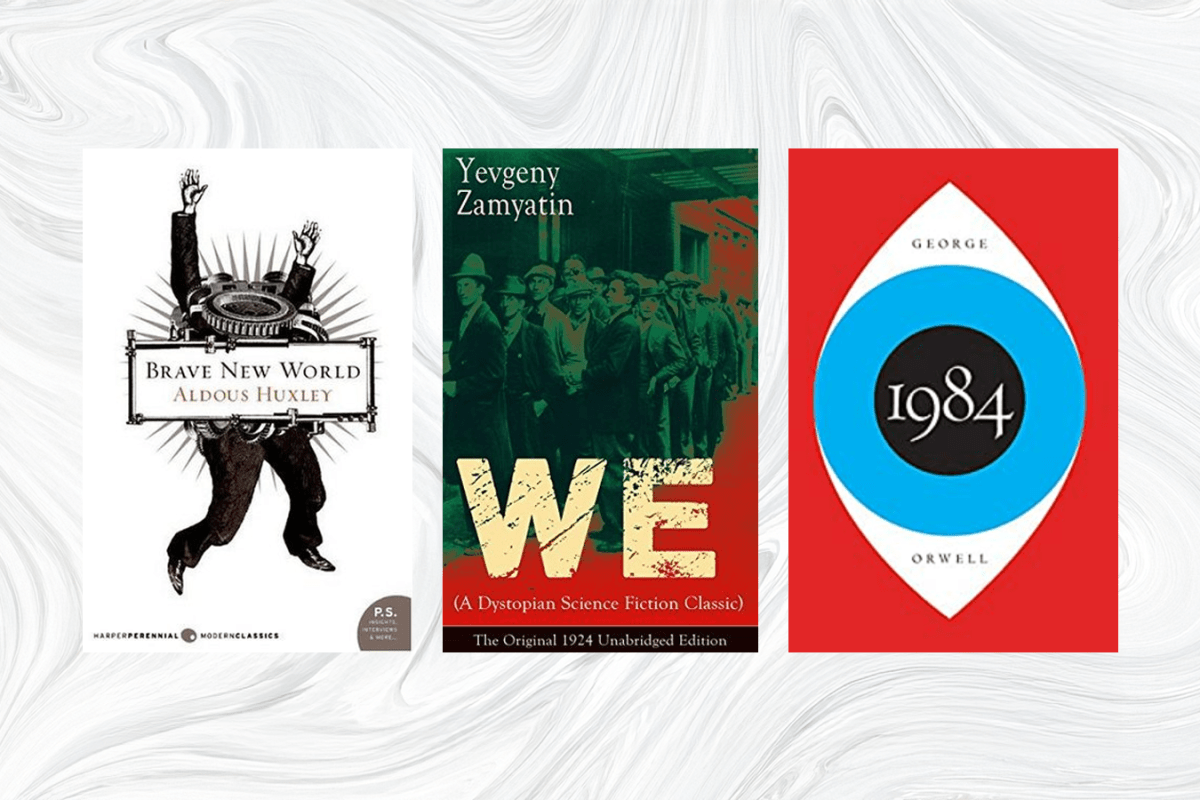
Every time the news cycle coughs up another surveillance scandal, someone posts an Orwell meme. When pharmaceutical companies peddle happy pills, a Huxley meme pops up. 1984 and Brave New World have become the twin saints of dystopian shorthand, invoked as lazily as “Kafkaesque” or “Orwellian” whenever someone feels spooked by authority.
And yet, these two canonical nightmares don’t quite capture the mess we’re in. Our world is less Orwell’s boot stamping on a face, less Huxley’s soma lullaby, and more Zamyatin’s forgotten gem: We.
Audio: NotebookLM podcast on this topic.
NB: As my regular readers may know, I am an author and a philosopher. I decided to post this here – being about books – but from a philosophical perspective.
1984: The Boot and the Telescreen
Orwell’s vision of perpetual war, Newspeak, and state terror is always good for a scare. Yes, we have endless surveillance, but here’s the trick: nobody had to force us. We carry the telescreens in our pockets and call them iPhones. We gleefully sell our data for dopamine pellets disguised as “likes.” The Ministry of Truth hasn’t so much rewritten history as buried it under an avalanche of memes, cat videos, and outrage cycles. Orwell’s nightmare had to be imposed. Ours is volunteered.
Brave New World: The Soma Holiday
Huxley saw a culture distracted into oblivion – sex, drugs, and feelies. It resonates because the entertainment-industrial complex has outpaced even his imagination. We live in a time when attention spans collapse under TikTok’s weight, when “self-care” is code for medicated oblivion, and when consumption doubles as identity. But Huxley underestimated how much suffering we’d tolerate alongside our pleasures. His world was too tidy. Ours is messy: opioids meet social media, Prozac meets precarity.
We: The Transparent Cage
Here’s where Zamyatin earns his eerie prescience. Written in 1921, We imagines a society of glass walls, total transparency, and algorithmic order. People don’t need to be beaten into compliance; they celebrate their own reduction to predictable ciphers. Privacy is seen as deviance. Sound familiar? From fitness trackers to mood apps to your browsing history, we’re already busy quantifying ourselves into oblivion. Where Orwell needed torture and Huxley needed narcotics, Zamyatin needed only maths and consent.
Why We Now?
Because it shows the nightmare where people joyfully give themselves away. That’s not speculative fiction anymore; it’s our social contract with Big Tech, with influencer culture, with the dopamine economy. We don’t need Ministries or Somas when we’ve willingly built the glass house and handed over the keys.
So next time someone posts that Orwell vs Huxley meme, hand them Zamyatin. He may not have the brand recognition, but he has the sharper scalpel. And if you haven’t cracked We yet, do it soon – before it stops feeling like a novel and starts reading like user documentation.
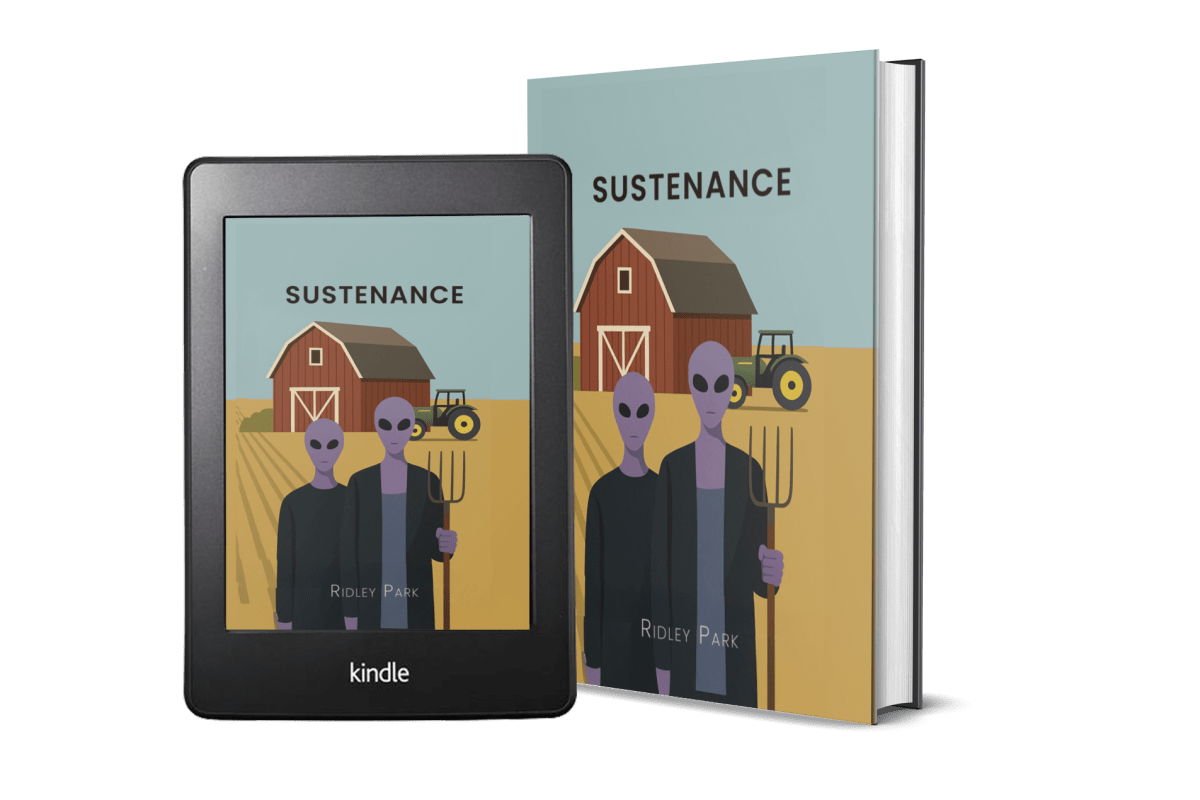
On 7–8 September 2025, the Kindle version of my novella Sustenance will be available free to everyone on Amazon. (It’s always free if you’re a KindleUnlimited member, but these two days open it up to all readers.)
So what is Sustenance?
It’s a novella that begins with the dust and grit of rural Iowa – soybean fields, rusted trucks, a small town where everyone knows your name (and your secrets). At first glance, it reads like plainspoken realism, narrated by a local mechanic who insists he’s just a “regular guy.” But then the ground literally shifts. A crash. Figures glimpsed by firelight in the woods. Naked, violet-skinned beings who don’t laugh, don’t sleep, don’t even breathe.
What follows is not your usual alien-invasion story. It’s quieter, stranger, and more unsettling. The encounters with the visitors aren’t about lasers or spaceships – they’re about language, culture, and the limits of human understanding. What happens when concepts like property, law, or even woman and man don’t translate? What does it mean when intimacy itself becomes a site of misunderstanding?
Sustenance is for readers who:
Gravitate toward literary fiction with a speculative edge rather than straight genre beats.
Appreciate the mix of the banal and the uncanny – the smell of corn dust giving way to the shock of alien otherness.
Are interested in themes of language, power, misunderstanding, and human self-deception.
Enjoy writers like Jeff VanderMeer, Margaret Atwood, Octavia Butler, or Denis Johnson – voices that blur realism, philosophy, and estrangement.
This isn’t a story that offers tidy answers. It lingers, provokes, and resists easy moral closure. Think of it less as a sci-fi romp and more as a philosophical fable wrapped in small-town dust and cicada-song.
This version of the book is available in these Kindle storefronts: United States, United Kingdom, Germany, France, Spain, Italy, Netherlands, Japan, Brazil, Canada, Mexico, Australia, and India
An unsolved literary mystery where language fails first.
I’m thrilled to announce the release of my latest novella, Temporal Babel, now available in paperback and hardcover. It’s a story about a man who arrives with no language the world can understand—and the woman who tries to name him anyway.
Audio: NotebookLM podcast on this topic.
Set in small-town New Mexico, Temporal Babel is not a thriller. It’s not about saving the future or rewriting the past. It’s about the weird middle ground where things don’t quite translate—linguistically, temporally, emotionally.
If you’ve ever wondered what it would feel like to encounter someone truly out of place—where even the word where doesn’t land—you’ll find something resonant in these pages.
What’s it about?
A young woman discovers a man on the roadside. He’s naked. Marked with strange blue scars. And the words coming out of his mouth aren’t quite English. Or anything else.
No memory. No ID. No history that the town of Anika can decipher. But as he begins to recover, the sound of his voice becomes its own riddle.
Some readers may call this speculative fiction. Others might shelve it under linguistic noir. I just call it a contact story—minus the aliens, or is it?
Why read it?
🔹 If you enjoy novels that refuse to explain themselves, this one’s for you.
🔹 If you like language play, phonetic drift, and dialect as plot, this one delivers.
🔹 If you like stories where the weirdness builds slowly, quietly, without fireworks—you’ll feel right at home.
“Dis kē?” he asks. What is this? No one knows. Not even the narrator.
📖 Temporal Babel is available now in paperback and hardcover.
I’m reading The Second Sex. It’s a story of women, about women, for women, and by a woman—but it’s also a story of otherness.
This post isn’t about that book.
It’s a reflection on a premise within it: that woman is a cultural construction.
Written in 1949, before the language of gender identity emerged, Beauvoir’s work distinguishes “female” as biological sex and “woman” as imposed gender. But this post isn’t about that either.
Audio: NotebookLM podcast on this topic.
A Novel Possibility
This is about a seed of an idea—one that took root while reading—and the novel it might become.
A near-future world. Shaped not by vengeance, utopia, or techno-salvation. But by a quiet unravelling of power itself.
It is not a story of triumph. Nor of ruin. It is the aftermath of both.
After Collapse, Reconstitution
When extractive systems—ecological, economic, ideological—collapse, society does not revert, rebuild, or resist. It reconstitutes.
Not as hierarchy repainted in pastel. Not as hive-mind in harmony drag.
But as a resonant ecology: A decentralised, cooperative, post-Enlightenment culture in which traditional male-coded traits—dominance, control, instrumental reason—have become maladaptive relics.
What Rises
The values that rise—attunement, memory, restraint, emotional literacy—are neither glorified nor enforced. They are simply what works now.
This is not a matriarchy. Not a revenge fantasy. Not feminism cast in steel and slogans.
It’s a structural inversion: A world in which those trained for dominance find themselves culturally disarmed— While the formerly subordinate, at last, inhabit a society scaled to their sensibilities.
No Brain, No Throne
There is no single ideology. No central brain. No throne.
Power does not pool. It diffuses—like mycelium beneath a forest.
Language shifts. Leadership evaporates. Progress, once a sacred cow, is now met with suspicion.
Not out of fear of change, But for love of equilibrium.
Still, Tensions Remain
A generation raised in scarcity seeks to anchor stillness. A younger one, born amid calm, yearns for momentum.
Outside the collective, remnants of the old world stir— Confused. Indignant. Armed.
And within, a few still long to lead.
These tensions are not resolved by war. Nor suppressed by force.
This is not a tale of rebellion or revolution. But of repatterning. And its cost.
   Tone: Literary. Spare. Sensory realism.
   Influences: Atwood, Le Guin, Ishiguro, Butler.
   Conflict: Emotional. Ideological. Structural.
   Message: A level playing field was always a myth. The tilt now favours something new.
What Comes After
The question isn’t how to stop the old world from returning. The question is whether it ever really left— and if so, what takes its place.
★★★★★ – “I Am a Sick Man. I Am a Spiteful Man. I Am, Apparently, Hilarious.”
Dostoevsky’s Notes from Underground is a masterclass in misanthropic soliloquy — part philosophical treatise, part psychological farce, and altogether one of the most darkly entertaining monologues I’ve ever had the guilty pleasure of eavesdropping upon. It’s a screaming match between Enlightenment rationality and the petty, pulsing irrationality of actual human life — and guess who wins? (Hint: not the utopians.)
Audio: NotebookLM podcast on this topic.
The first part, a searing, feverish diatribe, reads like the diary of a man who’s been locked in a room with too much Hegel and not enough human contact. It’s Dostoevsky’s pre-emptive strike against every social engineer who’s ever said, “Well, surely man will behave if we just fix the plumbing.” The Underground Man begs to differ — loudly, neurotically, and with an almost Shakespearean flourish of self-abuse.
But it’s the second part — Apropos of the Wet Snow — where things truly fall gloriously apart. Here the theoretical gives way to the tragically tangible. Our narrator, more unhinged by the page, lurches into society like a moth into a bonfire — vengeful, humiliated, self-aware to the point of paralysis. His disastrous encounter with Liza is almost unbearable in its sincerity and cruelty, a pas de deux of hope and destruction that left me squirming and spellbound.
What surprised me most was the humour. Not the cheap slapstick of caricature, but the agonising, close-to-the-bone absurdity that arises when a man is too clever to be functional and too self-aware to change. The Underground Man doesn’t just dig his hole — he drafts blueprints, writes footnotes, and criticises the soil quality.
As a companion read, Tolstoy’s The Death of Ivan Ilych provides a poignant counterpoint. Where Tolstoy charts the steady, ghastly march of bourgeois conformity towards a deathbed revelation, Dostoevsky gives us a man already buried in his psyche, clawing at the dirt and calling it philosophy. Ivan Ilych dies trying to make sense of his life; the Underground Man lives trying to make death of sense itself.
Together, they are a fine Russian reminder that being alive is no guarantee of being well — or even remotely rational.
I don’t write character-based fiction. I’m not a “people person” – not in the lived world, and certainly not on the page. I prefer people at arm’s length, ideally shrink-wrapped and on mute, where I can manage the terms of engagement.
Yes, my work features characters. I flesh them out just enough to spare readers the Ayn Rand experience, those one-dimensional ideological mannequins masquerading as protagonists. But character isn’t the centrepiece. I write to explore worldviews, metanarratives, and environmental interactions. I’m less interested in what a person feels and more in what their presence means within a broader system.
Audio: NotebookLM podcast of this topic.
Audible Irony
At the fitness centre (the irony isn’t lost on me), I listen to audiobooks. Today’s pick: The Emotional Craft of Fiction by Donald Maass. I’ve just cracked Chapter Four, and already I’ve panned a few glittering nuggets for future consideration.
That said, I found myself wondering: why am I even listening to a book so obsessed with the deep inner life of characters?
Simple. Because it’s still useful – even if I only dose it homeopathically. Just because I don’t write bleeding-heart confessions doesn’t mean I can’t exploit emotional undercurrents when it serves a structural or rhetorical purpose.
Character, Morality, and My Problem with Haidt
One section rubbed me the wrong way: the bit about character morality. Maass references Jonathan Haidt’s work on moral psychology—yes, that Jonathan Haidt, patron saint of middlebrow centrism and moral-sentiment handwaving.
I’m familiar with Haidt. Not a fan. His notion of “moral elevation”—the idea that stories with virtuous themes inspire moral behaviour—strikes me as both quaint and quaintly manipulative. In a sense, I agree with him: morality is curated. But that’s where our Venn diagram becomes a shrug.
I’m a moral non-cognitivist. I won’t bore you here (though feel free to tumble down that rabbit hole over on my philosophical blog). In short, I don’t believe morals are objective truths handed down from Olympus or Enlightenment think-tanks. They’re socio-emotional artefacts – human constructs born from gut feelings, tempered by culture, and ossified into norms. Different contexts yield different values. That’s why I delight in yanking characters out of time and place, disorienting them – and you – to expose just how contingent it all is.
So yes, I understand moral tropes. I even deploy them. But I do so to subvert them – not to reinforce a collective bedtime story about “goodness” or “redemption.” Those are the myths we tell ourselves to stay sane. I’m here to loosen your grip.
I’ve been reading J.G. Ballard’s High-Rise (1975), a brutalist fever dream dressed in concrete and ennui. It’s a story that doesn’t so much depict a descent into chaos as suggest that chaos is the natural state, politely waiting in the wings until the lift stops working and someone pees in the pool.
Audio: NotebookLM podcast on this topic.
This isn’t horror in the Stephen King sense—there’s no room 1408 here, no haunted sheets or malevolent chandeliers. The building isn’t animated; it’s engineered. But like all great systems, it doesn’t need a soul to kill you. The real haunting, as ever, is society itself. Ballard simply does away with the need for ghosts and lets architecture and aspiration do the dirty work.
Compared to Crash—where characters make love to car crashes and each other with equal mechanical indifference—High-Rise has something resembling a cast. I say “resembling” because these aren’t people so much as archetypes on a descent escalator. There’s Laing, a kind of blank-eyed anthropologist; Wilder, who mistakes brute force for authenticity; and Royal, the man literally living in a penthouse and metaphorically in a delusion.
Do I care about them? Not in the slightest. But that might be Ballard’s point. Their motivations are as shallow as a puddle in the car park after the water’s been shut off. Much of the action feels contrived, like a staged rehearsal for an apocalypse that already happened.
And yet—isn’t that precisely what society is? A tepid soup of extrinsic motivators dressed up in motivational posters and mission statements. Nobody in the high-rise acts out of depth or conviction. They act because someone else did it first, because no one told them not to, or because the lift only goes so far down and what else is there to do?
If Crash explored the eroticism of the machine, High-Rise explores the nihilism of comfort. Ballard’s thesis seems to be that civilisation is little more than a thin laminate over our baser instincts—and once it peels, there’s nothing underneath but turf wars and brand loyalty to floor numbers.
The modern reader might recognise the high-rise in everything from gated communities to Meta’s metaverse: sanitised, stratified, severed from consequence. A self-cleaning coffin of convenience.
And, as in the United States today, it all comes heavily medicated and prettily lit—with lipstick, meet pig.
If Propensity was about engineered peace through probabilistic compliance, Sustenance asks what happens when understanding itself breaks down—and nothing you think is mutual, is.
No war. No invasion. No end-of-days. Just a quiet landing. And a failure to translate.
The Premise
A group of non-human beings arrive—not in conquest, not in friendship, but in continuity. They are not like us. They do not see like us. They don’t even mean like us.
There is no universal translator. No welcome committee.
Just humans—interpreting through projection, desire, and confusion.
And aliens—operating by a logic that doesn’t require interpretation.
The Themes
Sustenance explores what happens when:
Language fails and nothing fills the gap
Consent becomes guesswork
Culture is mistaken for nature
Property has no meaning, and law no parallel
Sex isn’t private, sacred, violent—or even especially enjoyable
Memory becomes narrative, and narrative becomes defence
Contact isn’t miraculous—it’s awkward, biological, and quietly irreversible
This is a story about misunderstanding. Not just what others mean—but who we are when we assume we understand anything at all.
The Tone
Think Arrival but rural. Annihilation without the shimmer.
A bit of VanderMeer. A hint of Flannery O’Connor. The cornfields are real. The discomfort is earned.
No apocalypse.
Just a failure to process.
And maybe, something new inside the gap that opens when the old stories no longer apply.
Why Write This?
Because contact doesn’t have to be violent to be destabilising.
Because not all miscommunication is linguistic—some is anatomical.
Because the most alien thing we can encounter is ourselves, misinterpreted.
Because I wanted to write a story where the question isn’t “what do they want?” but “what have we already assumed?”





 Ridley Park