As per my recent post, I need a sanity break. I’ve been editing Needle’s Edge all day. Each time I hit a milestone, I consider drafting a blog post, but then I choose to persist. Not this time.
I’ve been untangling the spaghetti of a misplaced – or rather, overextended – pregnancy. It had stretched on for too long, so I weeded out contradictory events. Some of these had dependencies, so I relocated or eliminated them to preserve flow.
In the process, I re-oriented her conception date and reset any foreshadowing that tied into it. To keep myself honest, I started tracking her progress in the manuscript with markers: <p=X>. With each time-specific event, I increment X.
So far, I’ve reviewed 24 sequential scenes, not counting the half-dozen relocated ones I had to rework just enough to maintain continuity. This leaves the protagonist at 29 weeks. That also meant pruning irrelevant references, for instance, cutting any mention of pregnancy before it even began.
Being a typical human pregnancy, my target is 38 to 40 weeks. That leaves me with another 10-odd weeks to rummage through. Once I’ve untangled the draft, I still need to return for line edits, colour, and shape.
Editing is often pitched as polishing, but sometimes it’s surgery. Today, I’ve been elbows-deep in the operating theatre.
Editing Needle’s Edge has taken longer than the time it took to draft the damned thing. Typical, I suppose, but demoralising all the same. Drafting is a rush; editing is a grind. In video game parlance, this is the endless dungeon crawl. Kill the same mob again and again, collect marginal XP, and hope that –eventually – you level up.
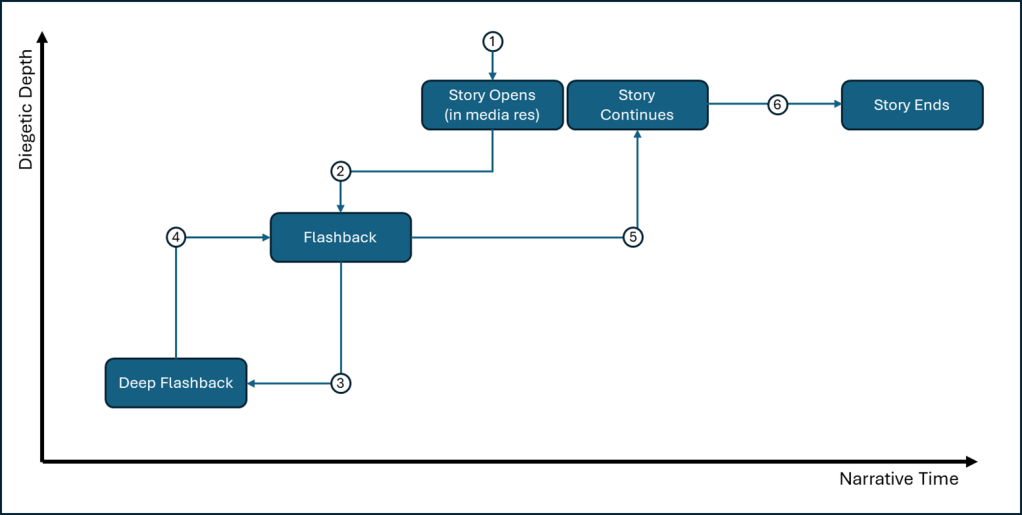
Recently, I wrestled with the narrative structure, which was starting to feel like Inception with a side order of Russian dolls. Flashbacks within flashbacks within flashbacks. I diagrammed it, mostly to convince myself I hadn’t lost the plot (see exhibit A, below).
Image: Chronological and Sequential Timeline Abstraction
Here’s the lay of the land—without spoilers, of course. The story begins [1] in medias res, with Sarah-slash-Stacey already entrenched in her daily grind. Then comes [2] the flashback, showing how she arrived there. Midway through, we plunge into [3] a deep flashback of her childhood, before [4] snapping back to the mid-flashback, then finally [5] rejoining the present-day storyline until [6] the bitter – or possibly bittersweet – end.
Naturally, I subvert as many tropes as I can, though no one can write a tropeless story any more than they can write one without words. (I’m sure some post-structuralist is trying right now, but God help their readers.)
The hardest part wasn’t constructing the labyrinth but finding my way out again – reengaging with the present-day thread after chapters of detour without resorting to that televisual clanger: “We now return to our regularly scheduled programming.”
Editing a book like this is less polishing and more archeology: chiselling away sediment, brushing off centuries of dust, desperately hoping not to snap the artefact in half. With luck, the grind pays off. If not, at least I’ll have a lovely flowchart to show for it.
I’m editing what I expect will become my next novel. Editing, for me, is a fundamentally different headspace than writing. When I’m drafting – especially when pantsing – I lean into a stream-of-consciousness flow. Iain McGilchrist might call this right-hemisphere activity. I don’t steer so much as ride shotgun, scribbling while the character drives.
Audio: NotebookLM podcast on this topic.
(Side note: I’ll share the tentative cover art soon, but this post is about process.)
Editing, by contrast, is all left hemisphere – angles, order, logic, connection. When I’m writing, I don’t worry if a detail makes sense. That’s future-me’s problem. In this project, future-me discovered that the protagonist had been pregnant for over thirteen months, undertaking activities most wouldn’t attempt in that state. In a nonlinear story, this might slip past many readers – but not past my editorial self. I mentioned this in a prior post.
I used to devour writing advice, but I don’t write like other people. Most advice seems geared toward genre fiction. I’m not opposed to that, but I lean literary and experimental. Templates don’t work for me.
I know the Hero’s Journey. I’ve read Save the Cat. But I don’t write about heroes – or even anti-heroes. That’s not the kind of story I’m telling, nor the kind I usually read.
I don’t much care about strong characters for their own sake. I care about what they allow me to explore philosophically. That said, this project is different. The main character is strong. So are the secondaries. And while it’s still fiction, it’s rooted in real people and events – compressed, reshaped, but recognisable.
I’ve condensed two decades of experience into a seven-year arc across ~200 pages. The first three years are flashbacks, brushed in for colour. The rest unfolds more or less in sequence. This time, I didn’t give myself free rein. There are rails. And while I occasionally jump them, I still need to land somewhere coherent.
The structure is a four-phase design. The book opens in media res and stays there for a few chapters. Then we rewind. And rewind again. Eventually, the timeline catches up, and the final half moves more linearly.
To tame this beast, I turned to spreadsheets. I built a plot matrix – numbering each section twice: narrative order (as written) and chronological order (as lived). I had to find the earliest flashbacks and stitch the rest together like some temporal jigsaw. It felt like Inception at times. Where am I? What layer is this?
From there, I started tracking time: days, weeks, months. That’s when I uncovered the 13-month pregnancy. Realistic for an elephant, not a human.
The root problem? I sequenced the conception too late and compressed the birth too early. I also omitted two earlier pregnancies to streamline the plot. To fix it, I reinstated one and used it to restore character depth that had been left on the cutting room floor. It worked – but it added new complications. Now I’m back in spreadsheet land, scanning for widows and orphans – narrative orphans, I mean – where scenes dangle or disconnect.
This is where editing diverges from writing. Writing is dreaming. Editing is retelling. And retelling demands coherence. Dreams ignore time, cause, and logic. Retelling insists on them: this happened before that, and then…
So-called “plotters” operate almost entirely in the left hemisphere. Structure first. Logic forward. Details coloured in after. It’s a valid approach – but one with fewer degrees of freedom. Creative constraints come with the template. You still get unique results, but you’ve narrowed the space. Stephen King’s version would differ wildly from JK Rowling’s – but both would be channelled through the same scaffolding.
You can argue that creativity happens in the choosing of the structure. Fair. But unless you’ve invented something truly novel, you’ve still chosen from a shelf of precedents. The story begins where freedom ends.



 Ridley Park