What You Should Ask a Beta Reader (and What You Shouldn’t)

Chef reading a cookbook that reads Beta Recipes

Congratulations, you’ve finished a manuscript. You’ve pushed the boulder uphill, typed “The End,” and maybe even convinced yourself you’re done. Spoiler: you’re not. This is where beta readers come in — those kind souls who’ll slog through your draft and tell you whether it sings, stumbles, or just sits there like porridge. The trouble is, most writers don’t actually know what to ask them, and so they end up with feedback about as useful as a horoscope.

The first and most uncomfortable question is about intent. What are my goals in writing this, and did you see them? Most writers never ask, because it forces them to say what they meant in the first place. Are you interrogating free will? Trying to write a page-turner? Smuggling philosophy under the hood of a dystopian thriller? If your beta doesn’t see it, either you buried it too deep or you didn’t put it in at all. Of course, not every writer works with some grand meta in mind, but if you do, this is the question that makes or breaks the project.

Enjoyment comes next, even if it bruises the ego. Did they actually like reading it? If your story feels like homework, you’ve already lost. It’s better to know this from a sympathetic reader now than from Goodreads later. A related angle is pacing: where did the story drag? Readers know exactly where they reached for their phone, even if they’re too polite to say so without prompting. Ask them to point to the spots where the air went out of the room.

Characters are another litmus test. Which ones did they care about, and which ones left them cold? Writers are often too close to notice when a protagonist reads like cardboard, or when a side character steals the oxygen. Beta readers are your lab rats here, revealing who’s magnetic and who’s forgettable. The same goes for endings. Don’t ask if it was happy – ask if it was satisfying. Did the conclusion feel like it belonged to the story’s own logic? If the reader feels cheated, the manuscript isn’t finished.

World-building deserves its own interrogation, especially in speculative fiction. Readers will happily forgive dragons, AI dictators, or interstellar chalk drawings, but not inconsistency. If the rules of your world shift without reason, they’ll notice. In fact, coherence is more important than cleverness. The reader doesn’t need to understand every mechanism, but they do need to trust that you do.

Finally, ask what lingered afterwards. Was there an image, a phrase, a scene that stayed with them once the book was closed? That’s your gold. Double down on it. If nothing sticks, you’ve got polishing to do.

One last but often overlooked question is about the reader themselves: am I asking the right person? An excellent sci-fi enthusiast might not be your best pick for YA urban fiction. A romance aficionado won’t necessarily grasp the rhythms of a philosophy-laden dystopia. Fit matters. You wouldn’t ask a vegan to taste-test your steakhouse menu, so don’t ask the wrong reader to bless your book.

And here’s the tightrope for the beta reader: they are not there to tell you the book they would have written. Their job is to respond to the book you actually put on the page. It’s your manuscript, not a co-authorship audition. If their feedback starts with “what I would have done,” that’s not critique – that’s a rewrite.

The meta point is simple. Beta readers are not editors. They aren’t there to fix your commas or restructure your second act. Their value is in telling you what it feels like to read your book – hot, cold, flat, or electric. And if you’ve got a grand philosophical undercurrent humming beneath the surface, they’re the only ones who can tell you whether it came across.

So don’t hand your beta readers a scalpel and ask them to perform surgery. Hand them your story and ask: did you taste what I meant to cook?

Sturgeon’s Law, AI, and the Literary Ivory Tower

3–4 minutes

Let’s get this out of the way: Sturgeon’s Law, ‘90% of everything is crap‘, isn’t pessimism, it’s statistics. That includes your favourite novel, the collected works of Joyce, and, yes, AI-generated text. The key point? If AI has the same bell curve as human output, some slice of that curve will still be better than what most people write. If Pareto’s Rule feels better at 80%, I’ll cede that ten points.

And before anyone gets misty-eyed about “human genius,” let’s remember that the average American adult reads at a 7th or 8th grade level, and more than half read at or below a 6th grade level. Nearly 1 in 5 reads below a 3rd grade level. That’s not a moral failing, but it is a market reality. We can wail about AI not producing the next Nabokov, but let’s be honest, Nabokov isn’t exactly topping the Costco bestsellers table.

Audio: NotebookLM podcast on this topic
  • AI doesn’t have to dethrone the literary elite. It just has to outperform the mass of competent-but-unremarkable human writers serving an audience who, frankly, doesn’t care about “stylistic nuance” or “metafictional self-reflexivity.”
  • There’s a vast literary middle ground – corporate copywriting, trade journalism, formulaic romance, SEO blogs – where AI will not just compete, but dominate, because the audience is reading for function, not art.
  • The high-literary crowd will remain untouched, partly because their readership fetishises human intentionality, and partly because AI doesn’t yet want to write about the precise smell of sadness in a damp Parisian garret in 1934.

The fearmongering about AI “killing literature” is a bit like saying instant ramen will kill haute cuisine. Yes, more people will eat the ramen, but Alain Ducasse isn’t sweating over his stock reduction.

  • The printing press was supposed to obliterate the artistry of the hand-copied manuscript. Instead, it made books accessible and created new genres entirely. Calligraphy still exists, it’s just no longer the only way to get words on a page.
  • Photography was going to end painting. In reality, it freed painters from the burden of strict representation, allowing impressionism, cubism, and abstract art to flourish.
  • Recorded music didn’t destroy live performance, it expanded its reach. Some audiences still pay obscene amounts to see an actual human sweat on stage.
  • Film didn’t kill theatre; it created a parallel art form.
  • Synthesizers didn’t erase orchestras; they just meant you didn’t have to mortgage your house to hear a string section in your pop song.

AI is simply the next entrant in this long tradition of “threats” that turn out to be expansions. It will colonise the big islands of the creative archipelago – commercial writing, functional prose, genre boilerplate – and leave the small monasteries of high art mostly untouched.

So, no, AI won’t be the next Mozart, Picasso, or Nabokov. But it doesn’t need to be. It just needs to be good enough to meet – and occasionally exceed – the expectations of the largest share of the market. And given that most readers are happy if the plot makes sense, the spelling’s passable, and the ending doesn’t require a graduate seminar in semiotics to decipher, I’d say AI’s prospects are rather good.

The rarefied work of the serious literary writer isn’t competing for market share; it’s preserving and evolving the cultural and linguistic possibilities of human expression. That work thrives not because it’s the only thing available, but precisely because it stands apart from the sea of functional prose, human or machine-made. The AI tide will rise, but the lighthouse will still be human.


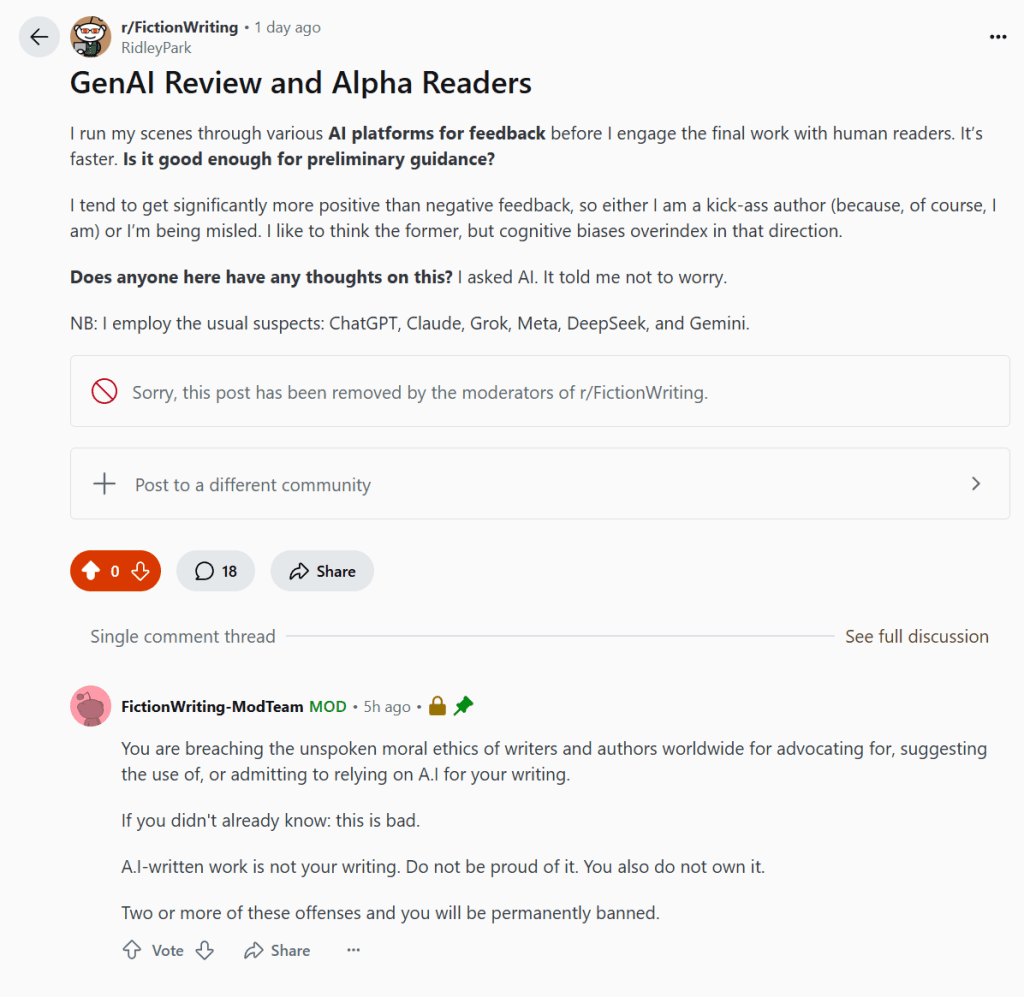
On Leaving r/FictionWriting: A Cautionary Tale in Digital Orthodoxy

I quit the r/FictionWriting subreddit today.

Why? Because nuance is no longer welcome in the Church of Sanctified Scribes. I posted a sincere question about using generative AI as a preliminary editorial tool — a sounding board before I hand off to my actual human readers.

I run my scenes through various Al platforms for feedback before I engage the final work with human readers. It’s faster. Is it good enough for preliminary guidance?
I tend to get significantly more positive than negative feedback, so either I am a kick-ass author (because, of course, I am) or I’m being misled. I like to think the former, but cognitive biases overindex in that direction.

Does anyone here have any thoughts on this? I asked Al. It told me not to worry.

NB: I employ the usual suspects: ChatGPT, Claude, Grok, Meta, DeepSeek, and Gemini.

That’s it. That’s the crime.

🚫 Sorry, this post has been removed by the moderators of r/FictionWriting.

The post was removed. Some members responded with superstition, invoking the tired myth that AI would “steal” my work. (That is not how model inference or fine-tuning works. But facts, as ever, are inconvenient.)

Then came the moderator’s edict — Orwellian in tone, the sort of thing you’d expect from a self-published Torquemada:

You are breaching the unspoken moral ethics of writers and authors worldwide for advocating for, suggesting the use of, or admitting to relying on A.l for your writing.

If you didn’t already know: this is bad.

A.I-written work is not your writing. Do not be proud of it. You also do not own it. Two or more of these offenses and you will be permanently banned.

What exactly am I being accused of here? Heresy? Possession of forbidden tools? Thinking aloud?

For the record, I do not outsource my prose to machines. I use AI to assist my thinking — much as one might use spellcheck, Grammarly, or, dare I say it, a fellow writer’s feedback. The fact that this needs to be explained is testament to the intellectual rot at the core of certain writing communities.

And here’s the real punchline: many of those decrying AI as the Antichrist of Authorship haven’t published a thing. Or if they have, it’s in the same low-distribution trenches I inhabit. The difference is, I don’t shun tools because they threaten my imagined purity.

I write because I must — because I enjoy it, because I want to get it right. And yes, if an AI helps me catch repetition or poor rhythm in a sentence before a beta reader ever lays eyes on it, that’s a win.

But you’d think I’d pissed on their typewriters.

Let’s be clear: this isn’t about AI. It’s about fear. About guarding crumbling gatekeeping structures with sharpened pitchforks. About people clinging to their fragile sense of identity — one threatened not by AI, but by other writers doing things differently.

So, yes: good riddance. I’ll take my questions elsewhere, where open minds still exist.

Image: The question and the ultimatum

Persona, Identity, and the Many Faces of Sarah

(Notes from the cutting room floor)

I’m taking a break from editing to share something about the protagonist in my latest novel-in-progress, Needle’s Edge. She’s a woman – yes, but not just. She’s a prostitute. She’s an addict. And she’s three people.

Audio: NotebookLM podcast on this topic. (Direct)

There’s Sarah, her given name. The name reserved for friends, family, and those rare few who know her without conditions. It’s the name she hears in moments of tenderness, or shame, or memory.

Then there’s Stacey, the escort, the stripper, the performer. This is the name on her ads. The one whispered in hotel rooms and shouted in clubs. Stacey is curated. Sexual. Selective. She knows what sells and how to sell it.

And then there’s Pink, the street persona. The user. Pink is who shows up when Sarah needs to score. She trades in slang and silence. She wears a different skin. A different currency.

Three names. One woman. No seams showing – if she can help it.

In her world, compartmentalisation is survival. If a dealer connects the dots and knows she’s an escort, she’s vulnerable. If a client finds out she’s using, her value drops. Appearances are everything. Rates depend on it. Reputation is a balancing act on a razor’s edge. And so each name carries its own set of rules, risks, and rituals.

But here’s the deeper cut: Who’s the “real” Sarah?

Is Stacey fake? Is Pink less than? Is Sarah just the base layer beneath the makeup and muscle memory?

They’re all her. None of them. Some of each. Identity is slippery.

The left hemisphere of the brain craves coherence. It wants simplicity, categories, reduction. But the truth is, identity is a heuristic. A convenient fiction. And Sarah, more than most, knows this. Where most people perform one role and pretend it’s a self, she splits hers openly. She curates them. Manages them. Leverages them.

And yet, the cost is high.

Stacey and Pink are exhausting. High maintenance. High risk. But being Sarah isn’t a comfort either. It’s just what’s left when the others are stripped away. She doesn’t retreat into Sarah so much as collapse into her.

In that way, Sarah isn’t a self – she’s a default.

The irony? For all this agency, for all her awareness, she’s still trapped in identities designed for consumption. For transaction. For escape. Whether it’s sex, drugs, or memory, she’s always negotiating something.

Three names.
Three roles.
Still no way out.