Top (and Bottom) Books Read in 2025

I genuinely loathe top X lists, so let us indulge in some self-loathing. I finished these books in 2026. As you can see, they cross genres, consist of fiction and non-fiction, and don’t even share temporal space. I admit that I’m a diverse reader and, ostensibly, writer. Instead of just the top 5. I’ll shoot for the top and bottom 5 to capture my anti-recommendations. Within categories are alphabetical.

Fiction

Never Let Me Go by Kazuo Ishiguro – A slow reveal about identity, but worth the wait.

Notes from Underground by Fyodor Dostoevsky – Classic unreliable narrator.

There Is No Antimemetics Division by QNTM (AKA Sam Hughes) – Points for daring to be different and hitting the landing.

Trainspotting by Irvine Welsh – Scottish drugs culture and bonding mates narrative.

We by Yevgeny Zamyatin – In the league of 1984 and Brave New World, but without the acclaim.

Nonfiction

Capitalist Realism by Mark Fisher – Explains why most problems are social, not personal or psychological. Follows Erich Fromm’s Sane Society, which I also read in 2025 and liked, but it fell into the ‘lost the trail’ territory at some point, so fell off the list.

Moral Politics by George Lakoff

Technofeudalism by Yanis Varoufakis – Explains why Capitalism is already dead on arrival.

NB: Some of the other books had great pieces of content, but failed as books. They may have been better as essays or blog posts. They didn’t have enough material for a full book. The Second Sex had enough for a book, but then poured in enough for two books. She should have quit whilst she was ahead.
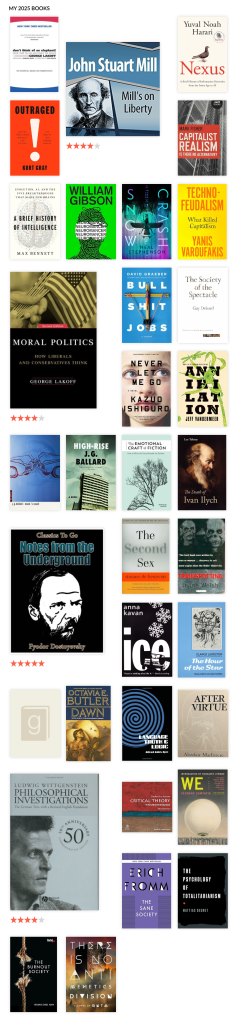
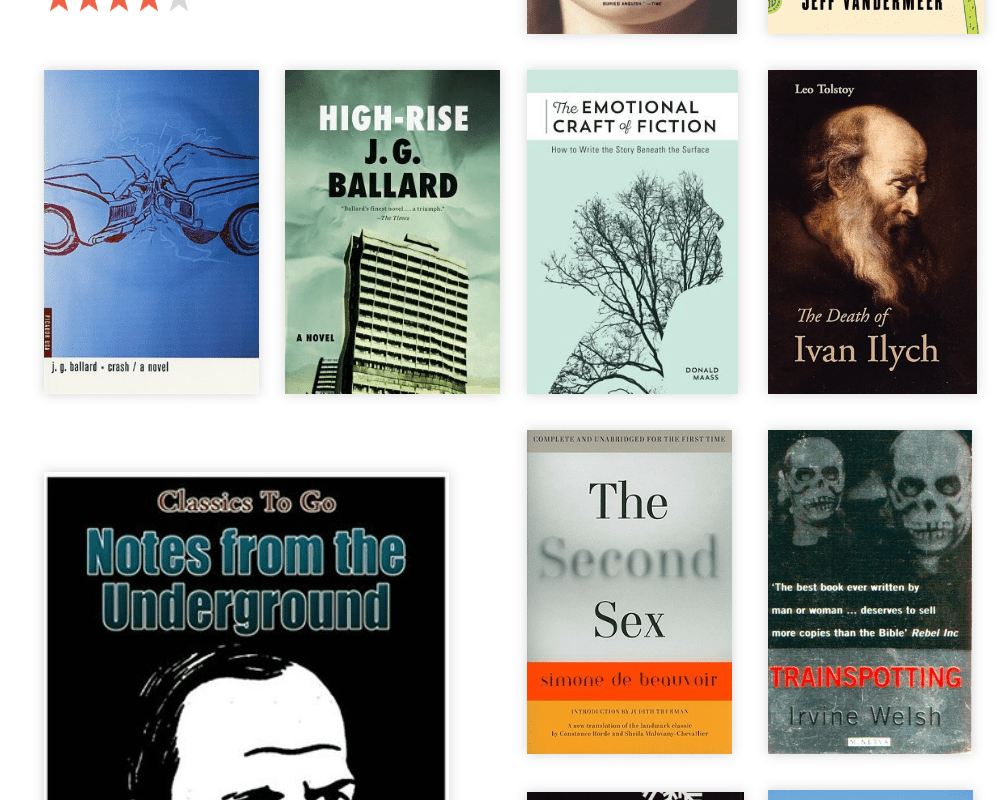
Image: Books I read in 2025 on Goodreads.
Full disclosure: I don’t always record my reading on Goodreads, but I try.

Bottom of the Barrel

Crash by J.G. Ballard – Hard no. I also didn’t like High-rise, but it was marginally better, and I didn’t want to count an author twice.

Neuromancer by William Gibson – I don’t tend to like SciFi. This is a classic. Maybe it read differently back in the day. Didn’t age well.

Nexus by Yuval Harari – Drivel. My mates goaded me into reading this. I liked Sapiens. He’s gone downhill since then. He’s a historian, not a futurist.

Outraged by Kurt Gray – Very reductionist view of moral harm, following the footsteps of George Lakoff and Jonathan Haidt

Society of the Spectacle by Guy Debord – A cautionary tale on why writing a book on LSD may not be a recipe for success.

Honourable Mention

Annihilation by Jeff VernderMeer was also good, but my cutoff was at 5. Sorry, Jeff.

Neuromancer

William Gibson coined the term ‘cyberspace’ in his book Neuromancer. Just the opening sentence informs the reader to expect something different.

In this book, Gibson is poetic and florid. I decided to task ChatGPT to rephrase a paragraph I wrote in Hemo Sapiens: Awakening to follow the style of Gibson.

I shared this paragraph:

The Deputy Chief Inspector starts her day at her polished wooden desk, perusing emails whilst sipping hot morning tea. The sharp aroma fills her nostrils. The fluorescent office lighting hides nothing. Except for some personal photos, her office looks like an austerity challenge. The absence of personal effects betrays her personality.

ChatGPT rendered this:

In the sterile dance of fluorescent light, the Deputy Chief Inspector’s day unfolds. This unforgiving light, a stark mimic of daylight, strips the room of shadows, laying bare the austerity of her workspace. It’s a realm where the polished wooden desk becomes a stage for the mundane ritual of morning emails, and where the walls, devoid of adornment except for a few personal photos, echo the unspoken ethos of restraint.

Amidst this, her morning tea stands as a solitary rebellion. Its steam, a curling serpent of warmth in the chill of artificial light, carries with it an aroma sharp enough to slice through the monochrome of her surroundings. Each sip is a fleeting escape, a momentary immersion in sensory richness that contrasts starkly with the barren office landscape. The tea’s heat whispers of a world beyond these walls, a reminder of life’s subtle flavors amidst the unyielding glare of fluorescent reality. In this space, where the lighting reveals all but understands nothing, the tea becomes not just a beverage, but a quiet testament to the hidden depths beneath her pragmatic exterior.

You’ll notice straight away that my writing is more concise. When I write in 51 words, he writes (by AI proxy) in 181. Mine is 28% of his.

Don’t get me wrong, I love the poetry of the longer form. I just don’t think like that unless I force myself, and then it comes off as stilted or pretentious. My preference is a more direct, terse writing style over the verbose. Perhaps, I’m of a different era. In the end, I compromise.

When I ask AI to critique my prose, a common response to to provide more sensory inputs. In this case, these are represented by her desk, polished and wooden, no less. And she’s sipping hot morning tea—not just a drink, but tea; not just tea, but hot tea, morning tea; and she’s sipping. And this tea has aroma. It’s sharp. So, I’ve got a visual (tea), a tactile (hot), and an olfactory (aroma). I’ve got no auditory or gustatory cues, but I might have.

My preference is to describe as little as possible to allow readers to form their own impressions. This is even more important for characters. On balance, I don’t personally care about the sex, gender, or race of my characters, but I share clues anyway. For race, I might be somewhat obvious as in Hemo Sapiens: Awakening by naming a character Ravi Chandrasekar. It’s fairly obvious that this is an male with heritage from the Indian subcontinent, though it says nothing of his preferred gender.

I might mention height or physique, a moustache or spectacles, a lisp or a stammer, but in the end if a reader wants to image that person as black or white or brown or whatever, I’m not affecting that much. Naming a character Maria instead of Marie sends subtle hints, but it’s not overpowering.

It the case of the Hemo Sapiens, they have blue eyes. Probability would lead one to believe they are Caucasian whites, but this doesn’t preclude something else. That’s not for me to decide. In my head, they are European whites, but I am not going to beat the reader over the head with this trivia.

I’m rambling now. Now read the faux-Gibson passage. It is much more immersive and experiential. If that’s your aim, then go for it. No harm, no foul.

You may prefer one over the other. I say they are simply different, and it depends on the intent of both the reader and the writer.

BONUS

Wanting to generate a featured image for this post, I used Dall-E. I’ve never had Dall-E talk back to me. It usually just renders what I’ve asked. This time, note its response. 🤣

Do you have a writing style preference? Does your writing style veer from your reading style? Let me know in the comments.