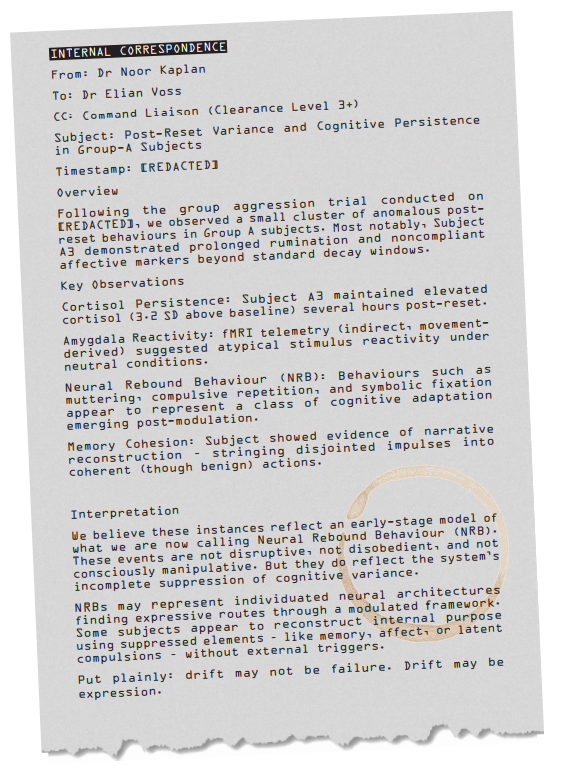
Chapter 10 of Propensity is a memorandum—fashioned in the style of a… wait for it… memorandum.
It doesn’t advance the plot much. That’s not its job. Like a dead-end corridor in a brutalist government building, it exists for atmosphere. Aesthetic artefact. Light foreshadowing. Bureaucratic texture. You know the type.
The memo comes from a psychologist involved in the Propensity experiment—writing to the study’s director about unexpected side effects. What they describe isn’t quite failure. It’s something stranger: drift, persistence, compulsive symbolism, the return of narrative despite modulation.
A precursor. A warning. And a throwback to a time when language still tried to make sense of things.
This chapter is one of several experimental inserts throughout the novel. I’ll be showcasing each of them here—in principle, if not in full.
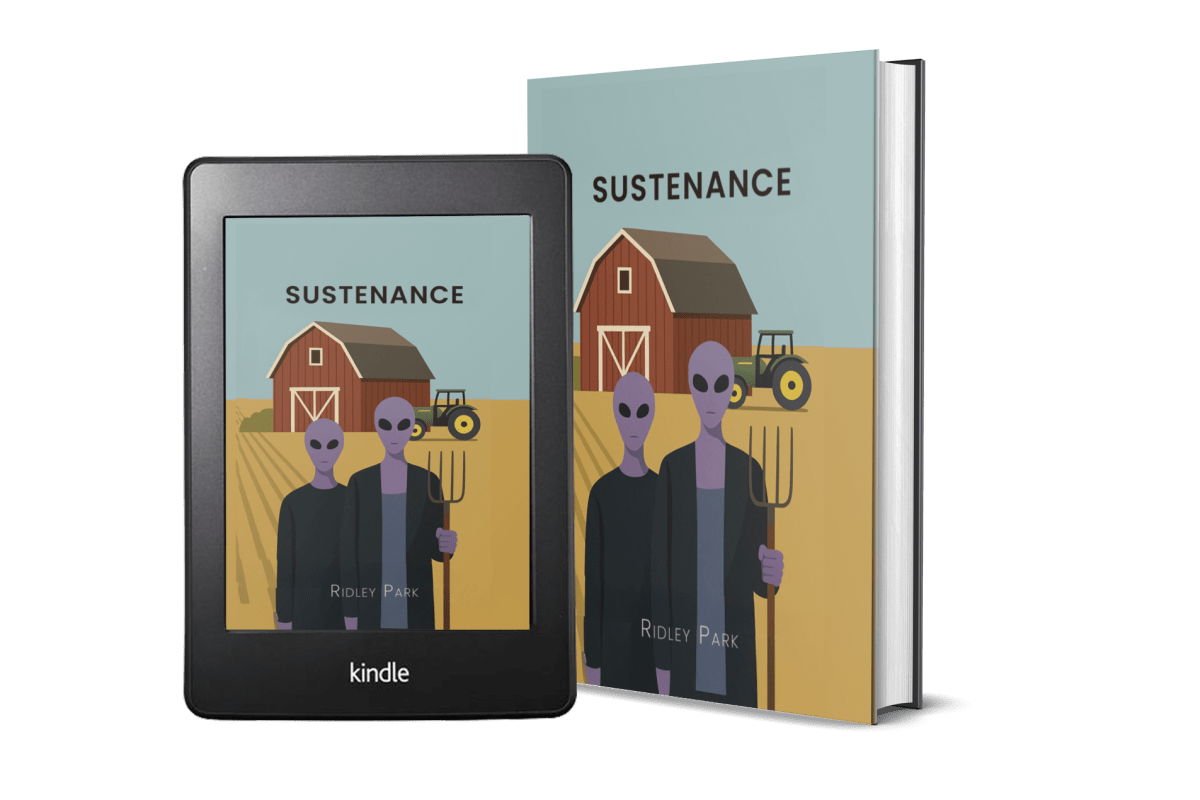
If Propensity was about engineered peace through probabilistic compliance, Sustenance asks what happens when understanding itself breaks down—and nothing you think is mutual, is.
No war. No invasion. No end-of-days. Just a quiet landing. And a failure to translate.
The Premise
A group of non-human beings arrive—not in conquest, not in friendship, but in continuity. They are not like us. They do not see like us. They don’t even mean like us.
There is no universal translator. No welcome committee.
Just humans—interpreting through projection, desire, and confusion.
And aliens—operating by a logic that doesn’t require interpretation.
The Themes
Sustenance explores what happens when:
Language fails and nothing fills the gap
Consent becomes guesswork
Culture is mistaken for nature
Property has no meaning, and law no parallel
Sex isn’t private, sacred, violent—or even especially enjoyable
Memory becomes narrative, and narrative becomes defence
Contact isn’t miraculous—it’s awkward, biological, and quietly irreversible
This is a story about misunderstanding. Not just what others mean—but who we are when we assume we understand anything at all.
The Tone
Think Arrival but rural. Annihilation without the shimmer.
A bit of VanderMeer. A hint of Flannery O’Connor. The cornfields are real. The discomfort is earned.
No apocalypse.
Just a failure to process.
And maybe, something new inside the gap that opens when the old stories no longer apply.
Why Write This?
Because contact doesn’t have to be violent to be destabilising.
Because not all miscommunication is linguistic—some is anatomical.
Because the most alien thing we can encounter is ourselves, misinterpreted.
Because I wanted to write a story where the question isn’t “what do they want?” but “what have we already assumed?”

 Ridley Park