I Return From My Fictional Sabbatical (With Antimemes in Tow)

2–3 minutes

Ridley Park has not been dead, merely sleeping like a hungover deity ignoring its worshippers. As has become my regrettable habit, most of my creative energy has been siphoned into non-fiction projects, leaving the poor world deprived of my fictional offerings and my blog gathering dust like an abandoned cathedral.

But fate – or more accurately, an algorithm – shoved a book into my face with all the subtlety of a street preacher: There Is No Antimemetics Division. Hard science fiction, horror, and something about antimemes. Naturally, I pressed Play Sample instead of behaving like a responsible adult and reading the summary. Antimemetic sounded deliciously unwholesome. Straight down the hatch.

Image: Advert with an author pic for this book.

I’m only into Chapter Two, so don’t expect a full exegesis yet. This is merely a field report from the early trenches.

I bought the Audible version, because audiobooks are the only thing keeping me sane through workouts, where otherwise, one contemplates mortality and the price of groceries. As the sample ran, I learned two things:

  1. Parts of the narrative are redacted.
  2. They did not redact to protect state secrets or Jeffrey Epstein’s ghost.

No – it’s a stylistic device. A textual blackout. Beeps, static, corrupted passages like intercepted voicemail from a doomed expedition. Being partial to experimental prose, I took it as a dare. My brain applauded.

The effect reminded me of Irvine Welsh’s Filth – not in theme, but in the editorial scars, the moth-eaten structure. Welsh, more widely known for Trainspotting, does chaos like astrophysicists do numbers. Obfuscation as aesthetic. Disorder as design. The connection may be superficial, but it’s one worth pocketing.

The title earns its relevance quickly: certain ideas spread like plague; others erase themselves on contact. Antimemes – cognitive black holes. Information that cannot be held without dissolving. A story that fights the mind that reads it.

Hard sci-fi rarely offers such structural mischief. I’m morbidly delighted to see where the horror emerges, when the narrative begins to eat its own memory like a recursive ouroboros.

More to come, once I descend deeper into the antimemetic labyrinth.

And yes – lest anyone call the coroner – I am still writing.


I happened upon this short film of the story whilst seeking a cover image.

Why Sustenance Reads Like It Does

2–3 minutes

People ask why my books don’t look like “normal” books. Why the titles twitch, why the prose refuses to march in straight lines, why I lean into formatting that makes copyeditors twitch. The answer is both simple and evasive: the story demanded it. Subversion is my key motivator – language, culture, genre, whatever stands too smugly, I want to knock it sideways.

Audio: NotebookLM podcast on this topic.

Take the paratext, those pages most readers skip. I didn’t want a safe little disclaimer to pat anyone on the head. I wanted the opening to feel unstable, already compromised, as though coherence itself were optional. The dedication isn’t reassurance; it’s a warning label.

The prose had to wobble, too. One moment rural realism, the next lyric intensity, the next something uncanny seeping in. Stability is the lie. If I’d written Sustenance in straight realist mode, it would have betrayed the book’s core.

As a language philosopher, I treat manuscripts as sandboxes for showing how language falters. Words crack, meanings slip, syntax betrays us. Fiction is my way of rubbing readers’ noses in that insufficiency.

I don’t hate genre fiction, but I refuse to be bound by it. In Sustenance, I swerve deliberately:

It’s genre fluidity as method. I know this puts off readers who want neat tropes and templates. But those readers are welcome to their factory-sealed shelves.

Did I intend to frustrate? Yes, a little. Not out of malice, but because too many books behave like obedient products. I don’t want to hand readers a smoothie. I want them to taste the grit, to feel that the novel might collapse under them. In fact, it does. The refusal to “pay off” is deliberate. Closure is a consumer demand, not a literary necessity.

So why did I write Sustenance this way? Because it’s not just about what happens. It’s about how information fails, how language decays, how coherence itself becomes suspect. If the book looked and read “normally,” it would have been lying to you.


Motivation: This reflection isn’t meant as a commentary on Sustenance’s plot. My intent here is to discuss the meta — the formal and philosophical scaffolding — rather than the story itself, so as to avoid spoilers. I’ll engage with the work more directly, in more traditional fashion, elsewhere.

When a Meme Lies but the Story Survives

Story ideas come from everywhere. Sometimes from books, sometimes from overheard conversations, sometimes from the dubious cesspool of internet memes. The meme I saw claimed that male flatworms duel with their penises to determine which one gets saddled with pregnancy. Naturally, I thought: That’s a story seed if ever I’ve seen one. Biomimicry is also a viable source.

Audio: NotebookLM podcast on this topic.

Of course, the meme was wrong. Flatworms aren’t male, or female. They’re simultaneous hermaphrodites – every worm is kitted out with sperm factories and egg sacs, with duelling penises to boot. When two meet, they fence. Whoever lands the stab injects sperm through the other’s skin (hypodermic insemination, to use the clinical term). The “winner” struts away as father, the “loser” absorbs the sperm, becomes mother, and carries the eggs. Sometimes both stab each other, and both walk away victorious fathers and reluctant mothers. Equality at last.

Article: Story Genesis

When a Meme Lies but the Story Survives

This is not genre fantasy, it’s zoology. No X or Y chromosomes, no fixed roles, just biology as a knife fight.

Writers, take note: this is why you don’t trust memes as science, but you do trust them as inspiration. The error – “male flatworms” – was pedestrian. The truth – all flatworms are both sexes all the time – is far more subversive. It blows up the binary and replaces it with a contest. Parenthood isn’t destiny, it’s a duel.

If I were to anthropomorphise this, I’d have the makings of a gladiator society: wounds as wombs, motherhood as punishment, fatherhood as prize. Not homoerotic vampire tropes, not vagina dentata horror – something stranger, sharper, harder to tame. A kind of Spartacus with gonads.

The point isn’t whether I’ll write it (probably not; worms don’t sell). The point is that even bad science can spark good fiction, provided you bother to check the details before running to press. Let the meme start the fire, let the facts shape the flame.


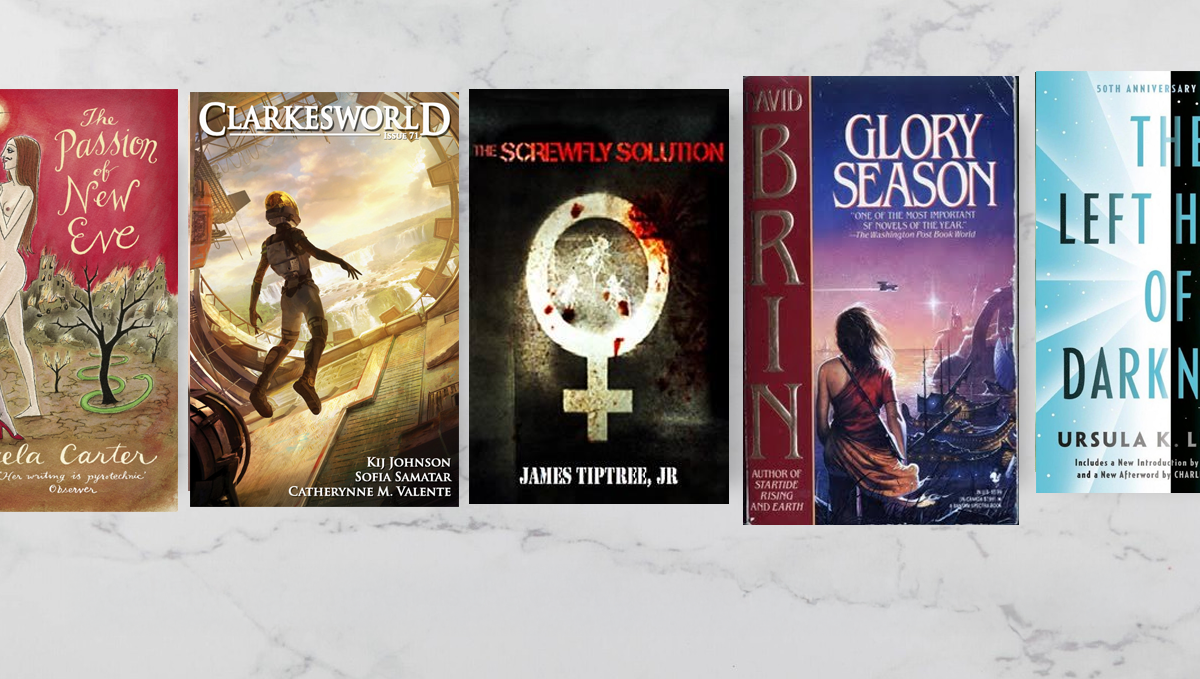
See Also (for the bookish wormhole explorer):

David Brin, Glory Season: speculative reproductive politics, society structured by cloning and sexual cycles.

Ursula K. Le Guin, The Left Hand of Darkness: androgynous Gethenians shifting between fatherhood and motherhood.

Kij Johnson, Mantis Wives (short story): erotic horror inspired by mantis cannibalism, equal parts Kama Sutra and war crime.

Angela Carter, The Passion of New Eve: grotesque gender-bending satire, bodies rewritten as battlegrounds.

James Tiptree Jr., The Screwfly Solution (short story): apocalyptic biology, where desire mutates into violence.

Writing Weapons

Zach Cregger wrote Weapons. He also directed it, produced it, and composed the soundtrack. This blog is about writing, so let’s stay with that. In a recent interview with Perri Nemiroff at Fandango, he described how the story emerged almost by accident:

Video: Perri Nemiroff Interviews Cast and Director of Weapons

Perri asks Zach how he got the idea for the story:

I was like, “Okay, little girl telling a story— takes place at a school. Kids go to school. Follow a teacher. Class is empty. Why? I don’t know. Let’s find out.”

And then two sentences later – because the kids all ran out the night before.

Okay, that’s a hook I like. So, I knew… I have a good question. So then, I probably wrote 50 pages before I even knew what the answer was going to be, honestly.

So, you know, I got the teacher, I got the angry dad, and they’re kind of doing their cat and mouse sort of a thing, and then… I got this cop, and… it wasn’t until about the midpoint where I had… what it was.

And that was a really good moment for me because I was like, “This might not ever be a thing. I might not have anything here.”

You know, if I don’t have a good answer, there’s no reason to watch this movie.

That’s pantsing in its purest form — starting with a question and running fifty pages before you even know if there’s an answer. Discovery writing at its most precarious: equal parts exhilaration and existential dread.

Personally, I lean hybrid. Sometimes I pants a draft until it coughs up a structure; other times I start with scaffolding and let the innards misbehave. But the dead ends always loom. I’ve euthanised countless ideas that failed to evolve, rather than stitching them together with some lazy deus ex contrivance. (Television thrives on that sort of duct-taped plotting, which is precisely why I don’t bother with it.)

Anyway, I have not seen this movie. I am not a fan of horror, but every now and then I sample what’s out there. I might check this out to see how well it delivers.

📡 PROPENSITY Has Launched

A note from Ridley Park on behaviour, control, and the illusion of peace.


Well, it’s out.
Propensity has officially launched.

This one’s been brewing for a while. If Sustenance asked what happens when we can’t understand each other, Propensity asks what happens when we stop needing to.

No invasion. No superintelligence. No overt dystopia. Just a device—quietly implemented—that modulates human behaviour through neurochemical cues. Less anger. Less risk. Less faith, libido, disobedience. More calm. More compliance. More… nothing.

And nobody notices.
Because the best control doesn’t look like control.


The Premise

Imagine a world where we solve violence—not through laws, treaties, or education—but by dampening the neurological signals that make people aggressive in the first place. You don’t choose peace. Peace is chosen for you, chemically. You just comply.

That’s the Propensity Device: a system designed not to control what you do, but to shift what you’re likely to do. Your odds of revolt drop. Your odds of submission rise. It’s not sedative. It’s statistical.

Free will doesn’t vanish. It just stops being statistically significant.


The Themes

The novel explores what happens when:

  • Free will is reframed as background noise
  • Consent is irrelevant because no one thinks to object
  • Violence becomes programmable—but only directionally
  • Peace is achieved without ideology, meaning, or narrative
  • Narrative itself becomes residue

There’s horror in here, but it’s not loud. It’s administrative. Institutional. Clean.

The horror of things working exactly as designed.


The Tone

Think Black Mirror but less sensational. Think Ballard after a lobotomy.

A dash of Ligotti. A flicker of DeLillo. A long stare from Atwood.
Propensity is soft dystopia—flattened, not broken.

And yes, there’s a fall. But it’s not a collapse. It’s an asymptote.
A tapering. A loss of signal fidelity. A kind of surrender.


Why Write This?

Because we’re already doing it.

Because behavioural nudge theory isn’t fiction.

Because control doesn’t need to be malicious—just implemented.

Because some of the worst horrors are quiet, polite, and empirically validated.

Because I wanted to ask: what if peace worked too well?


Now Available

You can get Propensity on Amazon and other booksellers.

If you do read it—thank you. If you don’t, that’s alright.
The system will keep humming either way.

📘 More about the book →

Ridley Park
Possibly a person. Possibly a place. Possibly both.