I was feeling smug. Fourth revision pass. Plot matrix built. Columns for chapter, scene, POV, date, time, location, word count, and emotional arc – because I’m that kind of monster. I even added colour-coding.
And it worked. Mostly.
After pruning and polishing, it finally felt ready to ship. Just a couple cosmetic tweaks. A trim here, a varnish there. Run a lint roller over the dialogue. Call it done.
Except.
The matrix – traitorous little bastard – exposed a structural fault so elegant I’d almost admired it. The problem? Pregnancy. Not mine, the protagonist’s. (Let’s not get ahead of ourselves.)
Turns out, I’d compressed over a decade of real-life events into two years of narrative space. Bold. Efficient. Reckless. I’d wrung out the filler, reshuffled a few puzzle pieces, and declared the thing plausible.
Only it wasn’t.
When I sorted the scenes chronologically, the matrix coughed. The story broke like a cheap lawn chair. There she was: visibly pregnant while also, somehow, gallivanting about in scenes that would’ve required a different physiology entirely. Not an Olympian, but the metaphor holds.
And that’s when it hit me: time may be a flat circle, but gestation is not. No amount of POV tricks or narrative backflips can make a third-trimester body do first-trimester things. Biology, the ultimate killjoy.
So now I’m doing surgery. Not delicate surgery, either. I’m sawing out whole sections, rebuilding connective tissue, and laying down scar tissue where the timeline used to be. I’ll need new plot scaffolding to support the pregnancy and its repercussions. It’s fine. It’s good. It’s hell.
This is revision. We go in thinking we’re buffing up the finish, only to discover we paved over a sinkhole.
An unsolved literary mystery where language fails first.
I’m thrilled to announce the release of my latest novella, Temporal Babel, now available in paperback and hardcover. It’s a story about a man who arrives with no language the world can understand—and the woman who tries to name him anyway.
Audio: NotebookLM podcast on this topic.
Set in small-town New Mexico, Temporal Babel is not a thriller. It’s not about saving the future or rewriting the past. It’s about the weird middle ground where things don’t quite translate—linguistically, temporally, emotionally.
If you’ve ever wondered what it would feel like to encounter someone truly out of place—where even the word where doesn’t land—you’ll find something resonant in these pages.
What’s it about?
A young woman discovers a man on the roadside. He’s naked. Marked with strange blue scars. And the words coming out of his mouth aren’t quite English. Or anything else.
No memory. No ID. No history that the town of Anika can decipher. But as he begins to recover, the sound of his voice becomes its own riddle.
Some readers may call this speculative fiction. Others might shelve it under linguistic noir. I just call it a contact story—minus the aliens, or is it?
Why read it?
🔹 If you enjoy novels that refuse to explain themselves, this one’s for you.
🔹 If you like language play, phonetic drift, and dialect as plot, this one delivers.
🔹 If you like stories where the weirdness builds slowly, quietly, without fireworks—you’ll feel right at home.
“Dis kē?” he asks. What is this? No one knows. Not even the narrator.
📖 Temporal Babel is available now in paperback and hardcover.
I’m reading The Second Sex. It’s a story of women, about women, for women, and by a woman—but it’s also a story of otherness.
This post isn’t about that book.
It’s a reflection on a premise within it: that woman is a cultural construction.
Written in 1949, before the language of gender identity emerged, Beauvoir’s work distinguishes “female” as biological sex and “woman” as imposed gender. But this post isn’t about that either.
Audio: NotebookLM podcast on this topic.
A Novel Possibility
This is about a seed of an idea—one that took root while reading—and the novel it might become.
A near-future world. Shaped not by vengeance, utopia, or techno-salvation. But by a quiet unravelling of power itself.
It is not a story of triumph. Nor of ruin. It is the aftermath of both.
After Collapse, Reconstitution
When extractive systems—ecological, economic, ideological—collapse, society does not revert, rebuild, or resist. It reconstitutes.
Not as hierarchy repainted in pastel. Not as hive-mind in harmony drag.
But as a resonant ecology: A decentralised, cooperative, post-Enlightenment culture in which traditional male-coded traits—dominance, control, instrumental reason—have become maladaptive relics.
What Rises
The values that rise—attunement, memory, restraint, emotional literacy—are neither glorified nor enforced. They are simply what works now.
This is not a matriarchy. Not a revenge fantasy. Not feminism cast in steel and slogans.
It’s a structural inversion: A world in which those trained for dominance find themselves culturally disarmed— While the formerly subordinate, at last, inhabit a society scaled to their sensibilities.
No Brain, No Throne
There is no single ideology. No central brain. No throne.
Power does not pool. It diffuses—like mycelium beneath a forest.
Language shifts. Leadership evaporates. Progress, once a sacred cow, is now met with suspicion.
Not out of fear of change, But for love of equilibrium.
Still, Tensions Remain
A generation raised in scarcity seeks to anchor stillness. A younger one, born amid calm, yearns for momentum.
Outside the collective, remnants of the old world stir— Confused. Indignant. Armed.
And within, a few still long to lead.
These tensions are not resolved by war. Nor suppressed by force.
This is not a tale of rebellion or revolution. But of repatterning. And its cost.
   Tone: Literary. Spare. Sensory realism.
   Influences: Atwood, Le Guin, Ishiguro, Butler.
   Conflict: Emotional. Ideological. Structural.
   Message: A level playing field was always a myth. The tilt now favours something new.
What Comes After
The question isn’t how to stop the old world from returning. The question is whether it ever really left— and if so, what takes its place.
What if you scheduled a book signing… and no one showed?
I’ve had that thought more than once. The kind of creeping doubt that slinks in just after you order the bookmarks and rehearse your elevator pitch in the mirror.
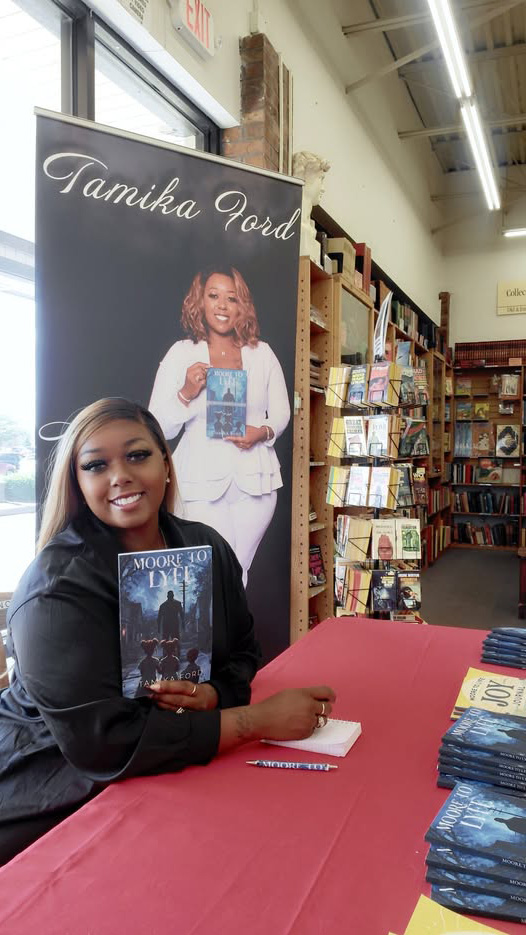
I don’t know this woman, but this post appeared in my feed:
First book signing
I showed up. I sat at the table. Books neatly stacked, pen ready, heart open — and no one came.
At first, it stung. But then I realized… I’m still proud. Proud that I created something from my story. Proud that I had the courage to show up, even when the seats were empty.
Every table won’t be full. Every event won’t be packed. But every moment is a seed. And I’m still planting.
I don’t know Tamika personally. This post just floated into my feed. But her candour caught me off guard—because I’ve imagined the same thing.
Audio: NotebookLM Podcast on this topic.
A book signing. It sounds like the natural next step. A rite of passage. Something authors do. I’m an introvert, but I’ve taught lecture halls full of glazed-over undergrads and stood before execs who paid me not to bore them. Public speaking doesn’t rattle me.
But the idea of speaking to an empty room? That’s different.
As a professor, the audience is compulsory. As a consultant, the client paid to listen. But a signing? That’s a gamble. No RSVP, no guaranteed bodies. Just hope in paperback.
I’ve published three books, with two more on the way. There are still a few manuscripts in editorial purgatory and some non-fiction titles pacing impatiently backstage. No wonder people hire publicists. It’s a circus, and some days, you don’t even get the monkey.
Tamika said, “At first, it stung.” And how could it not?
She’d already written the book. That’s the real accomplishment. She could have been proud before the signing, without the signing. But she showed up. That’s the part that wrecks me a bit.
She probably rehearsed the scene in her head. Smiling, shaking hands. Someone saying, “I loved this part.” A moment of affirmation.
Instead: silence. Stale air and the slow tick of a wall clock.
And yet there she is in the photo—beaming. She shared the moment not to seek pity but to offer calibration for anyone planting seeds of their own.
May her next event be packed. May strangers pick up her book and find something that speaks to them. Failing that, may they at least buy the damn thing.
I’ve got a bone to pick with Claire Fraise, dammit. I’ve lost 2 days I’ll never get back — including the time it’s taking me to create this post.
Claire shared a YouTube video on using plot grids for your writing process. Being me and heeding her advice, I decided to create a plot grid – I call it a plot matrix; same thing – for a project I am editing.
Video: What is a plot grid?
I should probably create a video response, but I didn’t have even more time to lose.
Full Disclosure: By lose time, I don’t want to imply by any means that this is wasted time.
Since the plot matrix I created is for an unpublished manuscript, I decided to create one for the first chapter of my published book, Sustenance. It contains two sections or scenes.
Audio: NotebookLM podcast on this topic.
I’ll share the process I used and reference the Excel document I created. Download it if you’d like to follow along.
After the explanations, I’ll discuss how I use ChatGPT to help me with this, as well as some challenges you may wish to be aware of.
Below is a screenshot of a portion of the plot matrix.
Image: Portion of plot matrix
I’ll start by sharing the column headers and a brief explanation of what each means. Some should be obvious, but I’ll describe them as well.
Narrative Order: The order a scene appears in the manuscript.
Chronological Order: The sequence in which events occur in story-time, enabling tracking of flashbacks or non-linear jumps.
Sentiment: A numerical indicator of the scene’s emotional tone, from deeply negative (–5) to strongly positive (+5).
Chapter: The chapter or section title in which the scene appears.
Plot Points: A summary of key events, revelations, or decisions that occur in the scene.
Time: When the scene takes place, whether exact or relative (e.g., “early morning,” “flashback,” “six months later”).
Primary Characters in Scene: The characters actively driving or anchoring the scene.
Secondary Characters in Scene: Important but less central characters who influence or are present in the scene.
Minor Characters in Scene: Tertiary figures mentioned or briefly appearing without narrative weight.
Word Count: The number of words in the scene, useful for pacing and balance.
Emotional Beat/Theme: The scene’s dominant emotional tone or thematic current (e.g., betrayal, longing, discovery).
Emotional State: The internal condition or affective register of the POV character(s) during the scene.
Scene Function: What the scene accomplishes narratively (e.g., exposition, climax, setup, reversal).
Character Arc: How a character is developing, stagnating, or regressing within the scene.
External Stakes: The tangible, real-world risks or consequences present in the scene.
Internal Stakes: The emotional, psychological, or relational consequences at play.
Needs Clarification?: A flag to indicate whether a scene contains confusing elements or ambiguous logic.
Revision Priority: A ranking of how urgently the scene needs refinement.
Conflict Type: The dominant form of conflict (e.g., internal, interpersonal, systemic, environmental).
Turning Point?: Whether the scene marks a key reversal or decision point in the narrative.
Turning Point Direction: Indicates the shift’s trajectory (positive, negative, neutral, ambiguous).
Direction Commentary: A brief rationale for how and why the narrative tone or direction changes.
Reinforces: Themes, motifs, or ideas the scene strengthens.
Undermines: Themes or ideas the scene weakens, contradicts, or questions.
Reveals: New information, secrets, or understandings brought to light.
Conceals: Key details or truths the scene deliberately withholds.
Distorts: Misunderstandings, biases, or unreliable elements introduced.
Inverts: Role, expectation, or thematic reversals subverted in the scene.
Echoes: Recurrent phrases, images, or patterns from earlier scenes or motifs.
Revision Commentary: Notes on potential rewrites, improvements, or cautions.
Punch List: Specific edits or action items needed in revision.
Resolved?: Whether the scene’s tension, question, or arc has been closed.
Location: Where the scene is physically set—important for continuity, blocking, and worldbuilding.
Iowa: Opening Scene
Narrative Order: The order a scene appears in the manuscript.
I am tracking scenes/sections rather than chapters because that’s the way I’ve organised the manuscript. I want to capture the smalled logical element of the story.
Being a spreadsheet, I need to keep track of the sections, so I give each scene a number. In this case, we are looking at section 1 of the narrative order, the first section a reader encounters.
Chronological Order: The sequence in which events occur in story-time, enabling tracking of flashbacks or non-linear jumps.
This manuscript has no flashbacks at this point, so the sequencing tracks 1-to-1. In the manuscript I am editing, it starts in media res, and there are two large jumps back and forth in time.
Being in a spreadsheet table, I can sort the story by narrative or chronology, which helps me track logical progressions that I might miss otherwise.
Sentiment: A numerical indicator of the scene’s emotional tone, from deeply negative (–5) to strongly positive (+5).
I like to track sentiment, so I can provide emotional dynamics to the reader. I don’t want to come across as bleak or euphoric for extended periods.
By this scale, 0 is neutral, -5 is gawdawful, and +5 is over the moon.
In these first two scenes, the protagonist, Kenny, is tracking just under baseline to neutral. Nothing much is happening emotionally, as we are just establishing the place.
Chapter: The chapter or section title in which the scene appears.
The name of this chapter is Iowa.
Plot Points: A summary of key events, revelations, or decisions that occur in the scene.
In scene 1, we have this:
Narrator establishes his identity, location, and tone.
Mentions girl, Bruce’s death, and being misunderstood.
Foreshadows larger story.
Time: When the scene takes place, whether exact or relative (e.g., “early morning,” “flashback,” “six months later”).
We are in the now.
Retrospective/Near-Present
Primary Characters in Scene: The characters actively driving or anchoring the scene.
This is a first-person, present, limited, deep POV story, so Kenny is one with the narrator.
Secondary Characters in Scene: Important but less central characters who influence or are present in the scene.
Kenny is just setting up the scene, and he mentions two secondary characters:
Bruce (mentioned)
‘Her’ (mentioned)
My preference is to scope the characters globally. This means that if some character interacts with a significant character but doesn’t appear elsewhere, I’ll consider them to be a tertiary or minor character. Some writers prefer to track these characters at a scene level. This is a personal preference.
Minor Characters in Scene: Tertiary figures mentioned or briefly appearing without narrative weight.
These are incidental characters that you might want to track in case you want to expand or adjust them.
Jake (mentioned)
narrator’s dad (mentioned)
Word Count: The number of words in the scene, useful for pacing and balance.
These are two short scenes: 247 and 502 words.
Emotional Beat/Theme: The scene’s dominant emotional tone or thematic current (e.g., betrayal, longing, discovery).
What’s going on here? Am I conveying what I aim to?
Isolation, defensiveness, curiosity
Belonging vs alienation; repetition vs rupture
Emotional State: The internal condition or affective register of the POV character(s) during the scene.
What’s the POV character feeling?
Guarded, nostalgic, lonely
Resigned, mildly boastful, reflective
Scene Function: What the scene accomplishes narratively (e.g., exposition, climax, setup, reversal).
Why does this scene exist? If it doesn’t serve a purpose, get rid of it, or give it one. Make sure every scene builds on characters or advances the plot.
Narrator introduction; frame story establishment; tonally primes the reader
Establishes rural setting, background on narrator’s world and connections, foreshadows disruption
Character Arc: How a character is developing, stagnating, or regressing within the scene.
Again, ensure your characters(s) have movement. In this story, there are several characters with an arc, but Kenny is the only one being tracked thus far. Being the start of the story, the question is, where does he go from here?
Establishes base-level insecurity masked by bravado
Solidifies narrator’s self-image and history within town hierarchy
External Stakes: The tangible, real-world risks or consequences present in the scene.
What external considerations might the character be making in this scene, whether they do or don’t do something?
Implied social stigma or alienation
Community perception and social standing
Internal Stakes: The emotional, psychological, or relational consequences at play.
What internal considerations might the character be making in this scene, whether they do or don’t do something?
Fear of being misunderstood or blamed
Fear of irrelevance, unresolved identity
Needs Clarification?: A flag to indicate whether a scene contains confusing elements or ambiguous logic.
When sketching a scene idea, you may have unresolved loose ends that you either need to tie up in the scene or somewhere else. Usually, this is more interested in making sure a reader doesn’t leave the scene confused — unless, of course, this is your intent.
Revision Priority: A ranking of how urgently the scene needs refinement.
This is important in a reviewing/editing phase. As you are cleaning up your manuscript, are there massive holes that need to be plugged, or might this just need some minor refinements?
Conflict Type: The dominant form of conflict (e.g., internal, interpersonal, systemic, environmental).
This could be a post of its own, so I won’t belabour the issue here. Readers like conflict. It gives something to resolve. Is this conflict related to the person, their past, another person, their environment, society, and so on? Document it here. Several conflicts make for more complex characters and stories.
Internal (identity, credibility)
Internal (identity vs environment)
Turning Point?: Whether the scene marks a key reversal or decision point in the narrative.
In this case, the first scene has now; the second does.
No
Yes
Turning Point Direction: Indicates the shift’s trajectory (positive, negative, neutral, ambiguous).
If there is a turning point, what’s the direction? A stable or lateral vector is fine.
None
Foreshadows disruption
Direction Commentary: A brief rationale for how and why the narrative tone or direction changes.
If there is a shift in direction, what is it? This might help to orient you when scanning, so you can know in the scene where to edit.
None
Last line (“Until that day”) subtly transitions from ordinary routine into impending change
This next section captures how the scene functions from several perspectives.
Reinforces: Themes, motifs, or ideas the scene strengthens.
Undermines: Themes or ideas the scene weakens, contradicts, or questions.
I like to subvert tropes and expectations as well as make social commentary, so this can be informative for me. In this case, I want to depict these things in a different light.
Traditional heroic framing
Romanticisation of small-town life
Reveals: New information, secrets, or understandings brought to light.
What does this scene reveal?
Setting, tone, perspective
Social fabric of the town, Kenny’s values and limitations
Conceals: Key details or truths the scene deliberately withholds.
In the first scene, I mention matter-of-factly,
Real details of Bruce’s death and who ‘she’ is
The event that disrupted the routine
So the reader knows there’s a “Bruce” and a “she,” but who they are remains to be seen. And Bruce died. How?
Distorts: Misunderstandings, biases, or unreliable elements introduced.
This is getting more nitpicky, but sometimes I like to obscur some things?
Narrator’s reliability and possible biases
Self-perception vs actual social role
Is this a reliable narrator? Even if he wants to be, is his perception accurate?
Inverts: Role, expectation, or thematic reversals subverted in the scene.
I like to subvert tropes and expectations here, too. This can also be used to intentionally have a character act out of character.
Traditional ‘boy meets girl’ trope
The classic “tight-knit community” mythos
Echoes: Recurrent phrases, images, or patterns from earlier scenes or motifs.
Early on, this most captures echoes of the external world, as this does. Later on, a scene might echo (and perhaps amplify) a prior scene.
Small-town fatalism
American nostalgia, masculine banality
Revision Commentary: Notes on potential rewrites, improvements, or cautions.
Here, the AI gods advise me to streamline these scenes, but I answer to no gods. 😉
Could trim repetition or streamline internal monologue for pacing
Minor streamlining of “rural inventory” might improve pacing without losing tone
Punch List: Specific edits or action items needed in revision.
If there are revisions to be made, capture them here, so you’ll remember what you were thinking about when you suggested a revision. In this case, the reminder is the same. Too late, it’s already published.
None
Possibly trim town description repetition
Resolved?: Whether the scene’s tension, question, or arc has been closed.
In both case, the answer here is no. Being an opening scene, hopefully, this open issues and questions – unless you prefer to resolve everything immediately.
Location: Where the scene is physically set—important for continuity, blocking, and worldbuilding.
This is setting information. This will be more helpful in a complex environment. In this case, there’s not a lot to say. He’s on his front porch step, rambling away about his town and his story.
Iowa, unspecified small town
Iowa, narrator’s town and neighbouring town
ChatGPT and Plot Matrices
After completing my manuscript, say a first draft, I feed it into a ChatGPT project. Then I run this prompt.
Let's use this format. I'll provide the value of (X). From where we are, Narrative and Chronological orders have converged and will remain so. They are equal to Row ID - 1. I'll use Row ID (X) as a reference marker.

Row ID (2), Narrative Order (), Chronological Order (), Sentiment, (Integer: Range between -5 and +5), Chapter (Iowa), Plot Points, Time, Primary Characters in Scene, Secondary Characters in Scene, Minor Characters in Scene, Word Count (247), Emotional Beat/Theme, Emotional State, Scene Function, Character Arc, External Stakes, Internal Stakes, Needs Clarification?, Revision Priority, Conflict Type, Turning Point?, Turning Point Direction, Direction Commentary, Reinforces, Undermines, Reveals, Conceals, Distorts, Inverts, Echoes, Revison Commentary, Punch List, Resolved?, Location

I know you’ve heard this before.

Boy meets girl. Different places. Different cultures.

Not quite Romeo and Juliet. Not yet, anyway.

It could’ve been Nebraska. Montana. Oklahoma.

But it wasn’t. We’re in Iowa.

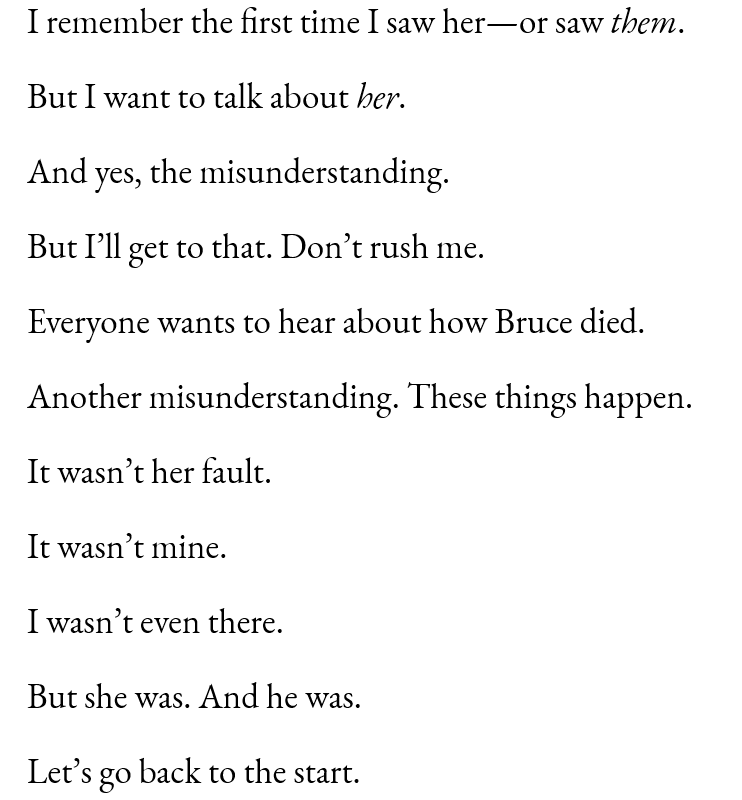
I remember the first time I saw her—or saw them.

But I want to talk about her.

And yes, the misunderstanding.

But I’ll get to that. Don’t rush me.

Everyone wants to hear about how Bruce died.

Another misunderstanding. These things happen.

It wasn’t her fault.

It wasn’t mine.

I wasn’t even there.

But she was. And he was.

Let’s go back to the start.

It was over a year ago.

A bit before that.

But first, let’s set the facts straight. I’m a
regular guy. Graduated high school. Not some conspiracy theorist, if that’s what you’re thinking.

Never left Iowa. Not even for college. The furthest
I’ve been’s Jake’s and the flea market a couple towns West. I know this place the way some folks know scripture—by scent, not verse. The way the soybean dust hits your throat during harvest. The way old barn wood smells after rain.

I believe in Jesus, but I’m not one of those Jesus freaks. Don’t paint me with that broad brush.

And I’m not one of them incels either. I’ve had girls. I’ll tell you about Jake’s. I even had a girlfriend for a few weeks, but it didn’t work out. A guy needs some space. That’s all. I’m sure you know what I mean.
I find that ChatGPT isn’t great tracking within larger documents, so I’ll pass in a section at a time, as shown above. This is the first scene of the first chapter of Substance.
Noticing that this scene sets up a flashback to a year in the past, the narrative and chronological order values should differ. Since this is just an example, I hope you learn from my mistakes. Also, I’d reorder the columns next time, but I created this prompt in steps as I progressed.
You need to be careful about what AI outputs. Don’t take it all at face value. If you incorporate a lot of nuance or subtext, the AI will likely miss the point. AI is a low-context system. Most communication in the West (notably excepting the South in the United States) is high-context.
High-context cultures rely heavily on shared understanding, nonverbal cues, and implied meaning—much is left unsaid because context fills in the gaps. Low-context cultures prioritise explicit, direct communication where meaning is made clear through words, not assumptions.
The AI picks out the plot points from your passage. This is usually uncontroversial.
The way ChatGPT uses Time could be better. This is almost an extension of the setting. What I was initially hoping for in my more complex story is a method to ensure my timeline wasn’t convoluted. I didn’t want to have a pregnancy delivery flashback to a conception two weeks earlier – unless that is an intentional plot point… or we’re talking about flies or something.
I find that some of the scene descriptions are a bit suss, but you can tweak them if they are too far off target. To be fair, you can share your manuscript with a dozen readers and get a dozen renditions – none of them in line with your own. It happens.
I commented on the Revision Commentary earlier. Just like a human editor, you can take or leave the advice. In the end, the writing is that of the author.
In many cases, you can ask the AI to elaborate: What do you mean it’s too long? or some such.
Or you can explain your intent. For example, I wrote another book and intentionally left it open-ended. The AI came back with, What happened?
I explained that the reader could draw their own conclusions, and the AI came into line.
One parting thought: You may pass the same passage through the same AI several times and get several outputs. They aren’t usually diametric, but be aware of this. Also, if you run this on Claude, Perplexity, or another platform, your results might vary there, too.
Anyway, if you got this far, what did you think? Do you use pilot grids? Do you use AI to assist in your editing? I use AI for research. Do you? Some people use AI for writing. I’m not as keen on this, but I’m not judging.
I just finished this book. I’ll say it’s good and even recommend it, but it’s not really for me. I wrote a blurb recently before I was even halfway through, and my opinion hasn’t changed.
Audio: NotebookLM podcast on this topic.
If you like to write in typical, character-driven stories, this should be right up your street. Besides character depth, the author also pushes moral righteousness. Thanks, but no thanks.
All of this said, I did gain some benefits from it, because although my writing is not heavily centred on characters, it does contain them, and I want them to feel alive. I want the world to feel lived in.
Personally, I think in schemes and threads – big ideas, deep ideas. Once all of this is roughly in place, I take a second pass for details. This is where Maass can help.
Full disclosure: Some people adopt a plotting approach to writing, whilst others adopt a pantser approach. I fall somewhere in between. Moreover, I might write something from one perspective and the next from the other – and I might flip-flop back and forth.
As a plotter, I might have waypoints that I want to hit, ideas I want to explore. Sometimes, I write these down on paper, in a spreadsheet, or somewhere to keep myself honest. Other times, I have these plot points in mind, but I take a stream-of-consciousness approach, simply discovering the story as it unfolds under my fingertips. I may even plot half a story and “pants” the rest of it. No telling.
As a pantser, I might have a kernel of an idea, and I just want to ideate on the page. So, I write. I lock myself in my room, throw up a “Do Not Disturb” sign, and head down to write until the well of ideas runs dry. At this point, I might put the idea aside or step back and consider plot points.
Looking back on this post, it’s not so much a book review at all. Apologies. That said, if you write characters and enjoy mainstream writing approaches, I think you’ll find the ideas in this book helpful. Many of the better ideas are presented early on, but it’s a short read. He offers some authors, titles, and excerpts you might find interesting. I found them to be a mixed bag.
I don’t write character-based fiction. I’m not a “people person” – not in the lived world, and certainly not on the page. I prefer people at arm’s length, ideally shrink-wrapped and on mute, where I can manage the terms of engagement.
Yes, my work features characters. I flesh them out just enough to spare readers the Ayn Rand experience, those one-dimensional ideological mannequins masquerading as protagonists. But character isn’t the centrepiece. I write to explore worldviews, metanarratives, and environmental interactions. I’m less interested in what a person feels and more in what their presence means within a broader system.
Audio: NotebookLM podcast of this topic.
Audible Irony
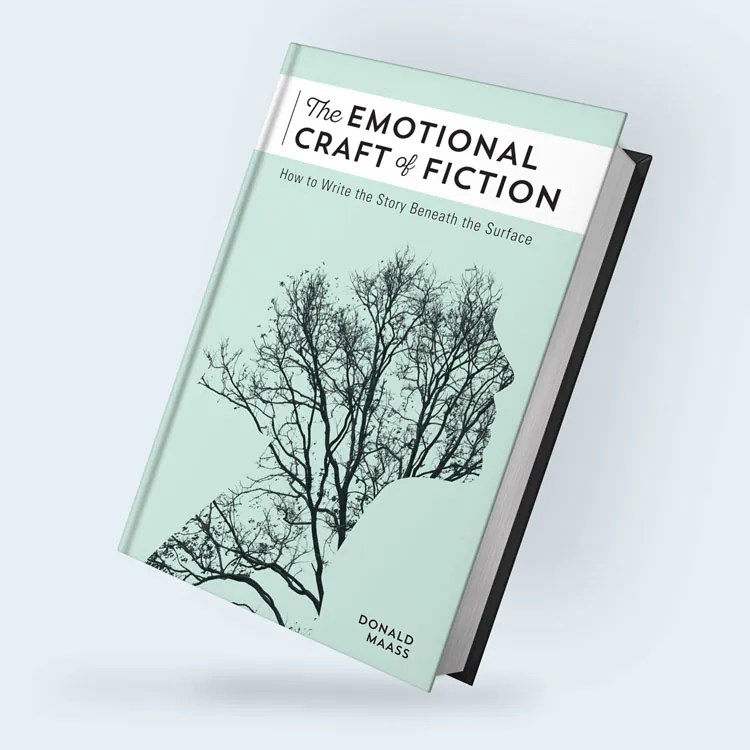
At the fitness centre (the irony isn’t lost on me), I listen to audiobooks. Today’s pick: The Emotional Craft of Fiction by Donald Maass. I’ve just cracked Chapter Four, and already I’ve panned a few glittering nuggets for future consideration.
That said, I found myself wondering: why am I even listening to a book so obsessed with the deep inner life of characters?
Simple. Because it’s still useful – even if I only dose it homeopathically. Just because I don’t write bleeding-heart confessions doesn’t mean I can’t exploit emotional undercurrents when it serves a structural or rhetorical purpose.
Character, Morality, and My Problem with Haidt
One section rubbed me the wrong way: the bit about character morality. Maass references Jonathan Haidt’s work on moral psychology—yes, that Jonathan Haidt, patron saint of middlebrow centrism and moral-sentiment handwaving.
I’m familiar with Haidt. Not a fan. His notion of “moral elevation”—the idea that stories with virtuous themes inspire moral behaviour—strikes me as both quaint and quaintly manipulative. In a sense, I agree with him: morality is curated. But that’s where our Venn diagram becomes a shrug.
I’m a moral non-cognitivist. I won’t bore you here (though feel free to tumble down that rabbit hole over on my philosophical blog). In short, I don’t believe morals are objective truths handed down from Olympus or Enlightenment think-tanks. They’re socio-emotional artefacts – human constructs born from gut feelings, tempered by culture, and ossified into norms. Different contexts yield different values. That’s why I delight in yanking characters out of time and place, disorienting them – and you – to expose just how contingent it all is.
So yes, I understand moral tropes. I even deploy them. But I do so to subvert them – not to reinforce a collective bedtime story about “goodness” or “redemption.” Those are the myths we tell ourselves to stay sane. I’m here to loosen your grip.
You’ll hear it a thousand times in creative writing circles, often whispered with the reverence of sacred doctrine: character is king. Give your protagonist an arc, they say. Make them grow. Show them change. Rinse. Resolve. Repeat.
Audio: NotebookLM podcast on this topic.
Forgive me, but I’m not here for that workshop claptrap.
“I don’t build arcs. I drop people into a world and let them drown, float, or disappear.”
My writing isn’t character-driven in the conventional sense. I don’t sculpt protagonists to take heroic journeys or undergo epiphanic transformations. I’m not interested in plumbing the depths of their souls or bandaging their inner wounds with moral insight. My primary concern is the world—the philosophical or sociological structure—through which characters drift, orbit, or plummet. Sometimes they leave a mark. Often, they don’t.
Because real life isn’t narrative. It doesn’t arc. It drifts. And most of us don’t develop. We adapt. We cope. We muddle through.
“From a narrative perspective, we start somewhere in the middle and end somewhere else in the middle.”
Resolution, in most stories, is a parlour trick—narrative taxidermy dressed as transcendence. In reality, most encounters don’t resolve. They expire. People come and go. You cross paths with strangers who change your life—or don’t—and then vanish back into the abyss of statistical anonymity.
One of my recent manuscripts begins with a woman named Sena discovering a body by the roadside. She reports it, the authorities arrive, and the narrative follows them—until it doesn’t. It dissipates. No tidy resolution, no tight bow. Just the unfurling tedium of systemic procedure and human irrelevance. It’s not a mystery story. It’s a story with mystery in it. Big difference.
We like to pretend we’re central to our own story, each of us a protagonist in a universe scripted for personal development. But sometimes, we’re not even side characters. Sometimes, we’re scenery. Camus’ Meursault had it right: the sun matters more than your feelings, and death shows up whether you’ve had your arc or not.
“Psychologically, we like to assume we have agency. That’s why we tell stories with resolution—because it flatters us to imagine things make sense.”
Yes, some readers crave grandiosity—heroes, villains, the Great Man Theory dressed in narrative drag. Napoleon didn’t just wage war; he “struggled with destiny.” Stalin wasn’t just a paranoid bureaucrat; he was “a force of history.” These are characters written by history with the same myth-making brush that writes fiction. Convenient, cathartic, utterly inaccurate.
But I don’t write demigods. I write witnesses, floaters, participants without insight. They’re often not even granted the courtesy of closure. They move through a world that refuses to acknowledge their significance. And why should it? The cosmos doesn’t care if your backstory is tragic or if your girlfriend left you on page forty-two.
Sometimes the character who seems central is merely catalytic. Other times, they’re inert—filler between philosophies. If someone changes, maybe it’s society, not them. Maybe the reader. Or maybe no one.
So no, I don’t build arcs. I don’t force characters to evolve like Pokémon just because Act III demands it. I drop them into a world and watch what happens—often, nothing. Because that, more than any tidy redemption tale, is how life actually works.
“In my stories, characters are pawns—how I envisage others: merely players, perhaps trying to make sense of the world they’ve been thrown into.”
That’s the work. Not myth-making. Not therapy. Observation. Dissection. Not a ladder to transcendence but a mirror, tilted just so.
Welcome to Ridley Park. Watch your footing. There are no arcs—only echoes.
I employ AI editors for copyediting and alpha-reading. They are useful but have limitations.
Some of my writing is ordinary – Acts I, II, and III; Beginning, Middle, and End. This is AI’s sweet spot: assess a piece and compare it to a million similar pieces, sharing plot structures, story and character arcs, heroes’ journeys, and saving cats.
Other stories are experimental. They don’t follow the Western tradition of tidy storylines and neat little bows, evey aspect strongly telegraphed, so as not to lose any readers along the journey.
Mary approaches a doorway. Mary opens the door. She walks through the doorway — the doorway she had approached.
Obviously, this is silly and exaggerated, but the point remains. AI presumes that readers need to be spoonfed, especially American audiences. (No offence.)
But life doesn’t work like this. We often witness events where we have no idea what happens after we experience them. We pass strangers on the street, not knowing anything about their past or future. We overhear something interesting, never to get a resolution. We get passed by for a promotion but never know the reason why.
In science, there are lots of dead ends. Do we want to know the answers? Yes. Is one likely? Maybe; maybe not. Will we make up answers just to satisfy our need for closure? It happens all the time.
In writing, we seem to not accept these loose ends. How many times have you read a review or critique where the complaint is, “What happened to this character?” or “Why didn’t Harry Potter use his invisibility cloak more than once despite it being an obvious solution to many prior and future challenges he faced?”
Sure. I agree that it feels like a plot hole, but the author doesn’t have to tell you that Harry lost it in a poker match, it got lost in the wash, or Ron snatched it.
I’m finishing a story, and various AIs provide similar commentary. Even more humorous are the times it can’t follow a thread, but when a human reviewer reads it, they have no difficulty. In the end, there may be unanswered questions. Some of these leave the universe open for further exploration, but not all questions have answers. AI has difficulty grasping this perspective.
The skies darkened over the Coop of Justice. Inside, Rhoticity Chicken—a rooster of unparalleled enunciation—perched on his golden roost, adjusting his crimson cape. His mission was simple: to defend the final R in English against the insidious forces of vowel decay.
Audio: NotebookLM discusses this topic.
Across the barnyard, his greatest nemesis, Non-Rhotic Chicken, cackled from atop his weathered soapbox. “Togethah, my feathah’d comrades,” he declared, wings outstretched, “we shall ERASE the intrusive ‘R’ from this land. Wintah, summah, law and ordah—it shall all flow smoothly once more!”
A murmur rippled through the coop. Some hens clucked nervously. Others nodded, spellbound by his seamless vowel transitions.
But then, a mighty R echoed through the barn like thunder.
“NEVER!”
Rhoticity Chicken flapped into the air, his chest puffed out with impeccable articulation. “You shall NOT take the final ‘R’! I have defended it from the creeping shadows of elision for YEARS, and I shall not fail now!”
From the shadows emerged The Trilled Chick Henchmen, a gang of feathered mercenaries trained in rolled Rs. They trilled menacingly, their Spanish and Italian inflections rattling the walls of the barn.
“Señor Rhoticity, your time is up,” rasped El Gallito, the leader of the henchmen. “Your crude American Rs will be smoothed away like an old dialect in the sands of time. Trill, my hermanos!”
They rolled their Rs in unison, a sinister wave of phonetic force blasting toward Rhoticity Chicken. He staggered, his own hard R wavering against the onslaught of linguistic variation.
But he clenched his beak and stood firm.
“No,” he declared, eyes blazing. “You can roll your Rs, you can drop them, but you will NEVER take away my right… to pronounce… HARD R’s!”
With a mighty CROW, he unleashed his ultimate attack:
THE RHOTIC RESONANCE
A shockwave of perfectly articulated, non-trilled Rs blasted through the barn. It swept across the land, restoring all lost R’s to their rightful places.
Non-Rhotic Chicken gasped as his vowels stiffened. “No—NOOOO! My beautiful syllabic flow—GONE!” He clutched his throat as a long-forgotten ‘R’ slipped back into his speech.
“I… I… can’t… say cah anymore… I… I just said… car.”
The barn fell silent.
Defeated, Non-Rhotic Chicken collapsed into a pile of feathers, mumbling in fully articulated rhoticity.
The Trilled Chick Henchmen scattered, their rolling Rs faltering into incoherent babbling.
Rhoticity Chicken stood victorious. He fluffed his cape, took a dignified breath, and proclaimed:
“Justice. Honor. Pronunciation.”
And with that, he flew into the night, ready to defend hard R’s wherever they were threatened.








 Ridley Park