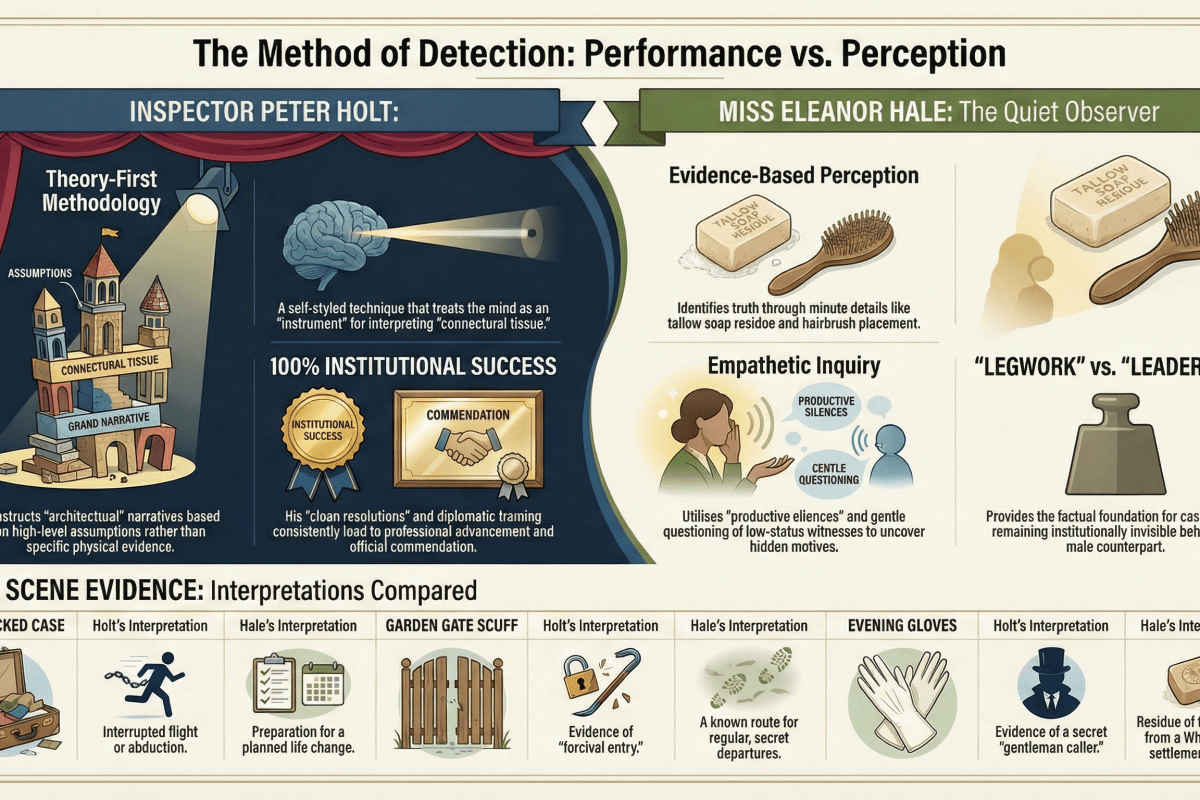
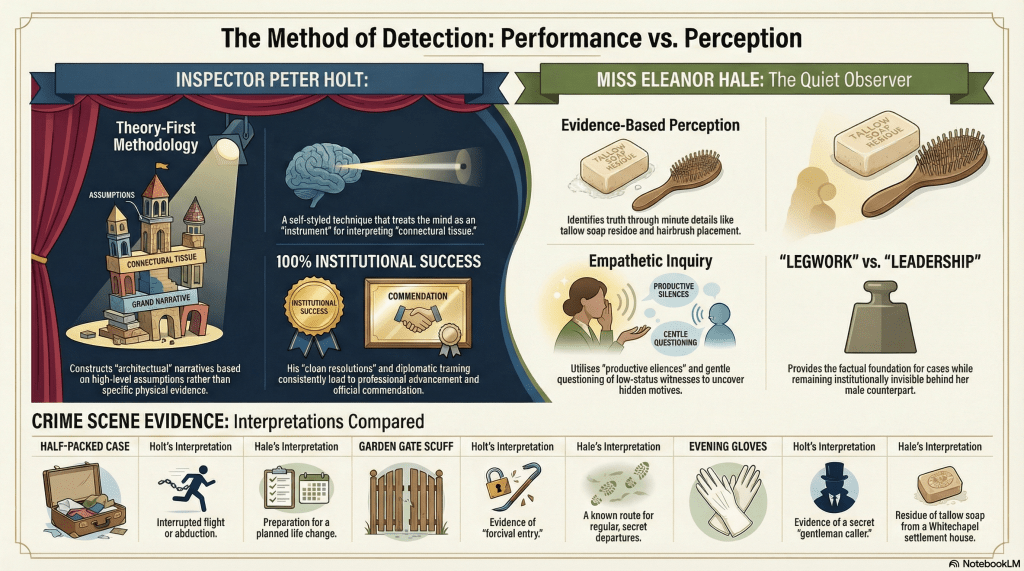
The room had been left precisely as it was, which Inspector Peter Holt regarded as a sign of considerative intelligence on the part of the household staff. He stood in the centre of Miss Arabella Cheswick’s dressing room and turned slowly, as though the air itself might yield to methodical observation. The vanity was undisturbed. The wardrobe stood open. A travelling case, half-packed, sat on the chaise longue with the resigned posture of an abandoned argument.
‘You will observe’, Peter said, addressing no one and everyone with equal conviction, ‘that the circumstantials are most revealative’.
Miss Eleanor Hale, standing two paces behind and slightly to the left – a position she had, over eighteen months of partnership, refined to a geometry of maximum utility and minimum visibility – observed that the hairbrush on the vanity had been placed bristle-down. She said nothing about this.
‘The travelling case’, Peter continued, gesturing with the slow authority of portraiture, ‘indicates a departural intention. She meant to leave. The question of investigatorial significancy is therefore not where she has gone, but why the going was interrupted’.
He paused. The pause was architectural.
‘This is the cruxment of the matter.’
Hale noted the pair of evening gloves folded beside the case. Cream kid leather. One still bore the faint impression of pressure along the fourth finger – someone had held her hand, or she had held something tightly, recently and for some time. The gloves did not belong with a travelling case. They belonged with a dinner engagement. Two intentions, then, overlapping. She filed this quietly beside the hairbrush.
The room was on the second floor of the Cheswick house in Belgrave Square, the sort of address that made investigations both simpler and more difficult: simpler because the servants remembered everything, more difficult because they had been trained to say nothing. The Mayor’s daughter had not been seen since Tuesday evening. It was now Thursday morning. The interval was not yet alarming in the manner of penny-dreadful disappearances, but it was alarming in the manner of politics, which is to say that people who mattered had begun to notice.
Superintendent Briggs arrived at half ten, earlier than he generally arrived anywhere, and this itself constituted a message. He filled the doorway of the dressing room in a way that suggested doorways had been designed with less consequential men in mind.
‘Holt’, he said. ‘Miss Hale.’
The order of address was habitual and, Hale reflected, diagnostic.
‘Superintendent’, Peter replied, with a nod calibrated to convey both deference and the quiet confidence of a man who has already formed his theory. ‘I have been conducting a preliminarial assessment.’
‘Yes, well.’ Briggs surveyed the room without entering, as though crossing the threshold might commit him to something. ‘The Cheswick business. You know the father is dining with the Home Secretary on Friday.’
‘I am aware of the politicality’, Peter said.
‘Good.’ Briggs adjusted his gloves. ‘Because after the Pennington affair, there are people paying attention. That was well handled. Very clean resolution. The Commissioner remarked on it specifically.’
Peter received this with the solemn modesty of a man who believes modesty is something performed after excellence. Hale, who had traced the Pennington boy to his aunt’s house in Stepney through three conversations and a hunch about laundry schedules, allowed her expression to remain professionally neutral.
‘Whoever brings this one home cleanly’, Briggs said, and stopped. He possessed a gift for the productive incomplete sentence. The implication settled into the room like furniture: advancement was available. A Chief Inspector’s position had opened. The resolution of a high-visibility case involving the Mayor’s household would constitute, in the arithmetic of institutional life, a compelling qualification.
Briggs looked at Peter. He looked at Hale. The look was not equal in duration or weight, but it encompassed them both, and for a moment the future was genuinely unwritten.
Then Briggs left, and Peter, restored to the full spaciousness of his authority, turned to Hale with an expression of generous pedagogy.
‘Miss Hale’, he said, ‘I should like to share with you a principality of method that I have found most conducing to success in matters of this complexity.’
Hale inclined her head.
‘The error of the common investigator’, Peter began, clasping his hands behind his back in the manner of a man delivering remarks he has delivered before and found satisfying on each occasion, ‘is to pursue the evidentials in a state of dispersionary attention. One examines this, one examines that. The mind becomes a catalogue rather than an instrument. What is required – if I may speak from experience – is the cultivament of what I call the Singular Focus’.
He let the phrase land. It landed.
‘The Singular Focus permits the trained mind to perceive the connectural tissue between apparently unrelated circumstantials. Where the ordinary inspector sees a room, I perceive a narrational structure. Where others catalogue, I interpret. This is the distinctional advantage that separates the methodical from the merely industrious.’
He turned to the travelling case and regarded it with the intensity of a man communing with evidence.
‘Consider. The case is half-packed. The packing was interrupted. Why? Because the interruptional event was unexpected. And what manner of event arrives unexpectedly to a young woman of station?’
He raised one finger.
‘A visitor.’
This was not wrong. It was the sort of observation available to anyone who had spent thirty seconds in the room, delivered with the gravity of revelation. Peter’s difficulty was never stupidity. His insights were simply sufficient – legible, confident, and just close enough to the truth to resemble discovery.
Hale glanced again at the evening gloves. The hairbrush. The wardrobe, open not in the manner of someone selecting clothes for travel, but of someone who had changed in haste. Two intentions. The sequence mattered. The gloves were the key, but the key did not wish to be found by anyone announcing its keyness, and so Hale did not mention them.
‘A visitor’, Peter repeated. ‘I shall direct enquiries accordingly. The servants will be questioned with rigorous system.’
He strode toward the door, then paused and turned back.
‘Miss Hale, you would do well to observe these methods closely. A career of distinguishment is built upon such foundations. I offer this not as a superior, but as a colleague who has walked the path of professional ascendancy and found it responsive to disciplined effort.’
He smiled. It was a kind smile. Peter was never unkind. He was merely the beneficiary of a world arranged, long before his birth, to mistake his particular shape for competence.
‘Thank you, Inspector’, Hale said.
Peter nodded, satisfied, and left to question the servants.
Hale remained in the dressing room. She lifted the evening gloves and turned them once in her hands. The impression on the fourth finger was recent. The cream leather was faintly darkened at the wrist – not dirt, but the residue of a particular soap used in certain establishments east of the City. She replaced the gloves exactly as she had found them.
Then she went downstairs, found the scullery maid, and asked, very gently, about Tuesday.
The scullery maid was called Agnes and she was not, in the conventional sense, a witness. She had not seen Miss Cheswick leave. She had not heard a disturbance. She had not noticed anything unusual on Tuesday evening, which she confirmed twice before Hale asked her about the soap.
‘The soap, miss?’ ‘The household uses Pears’, Hale said. ‘The amber sort. I noticed it in the upstairs basin. But there was a different residue on Miss Cheswick’s gloves. Tallow-based. The kind used at the Whitechapel wash-houses.’
Agnes looked at Hale with the expression of someone recalculating the danger of a conversation.
‘I wouldn’t know about that, miss.’
‘Of course not’, Hale said. She let a silence develop. Silences, in Hale’s experience, were more productive than questions, provided one had the patience to let them work. Peter did not have this patience, which was not a moral failing but a structural one: the institution rewarded speech, and Peter had learned this lesson thoroughly.
Agnes smoothed her apron.
‘She’s not in any trouble, is she?’ Agnes said, which was not an answer but was better than one.
Upstairs, in the morning room, Inspector Peter Holt was interviewing the housekeeper, Mrs. Plimpton, with the full ceremonial weight of the Singular Focus.
‘Mrs. Plimpton’, he said, ‘I must ask you to cast your mind back to Tuesday evening with the utmost precisionality. I am looking for the anomalous detail. The thing that did not belong.’
Mrs. Plimpton, who had managed the Cheswick household for eleven years and did not require instruction on the identification of things that did not belong, folded her hands and waited.
‘Was there’, Peter continued, leaning forward with the confidential air of a man about to share a theory he has already committed to, ‘a gentleman caller? A visitor of the male persuasion, perhaps unexpected, perhaps arriving after the dinner hour?’
‘No, sir.’
‘You are quite certain.’
‘Quite certain, sir. No gentleman called on Tuesday.’
Peter absorbed this with the equanimity of a man whose theory has just been confirmed by its apparent refutation. ‘Of course’, he said. ‘The absence of a visible caller is itself revealative. It suggests clandestinity. A visitor who was not received through the front door. A visitor who arrived by irregular means – a rear entrance, a garden gate, a prearranged signal.’
He was constructing something. It had the architectural quality of his pauses – each element placed with care, the whole structure rising toward a conclusion that felt, from inside, like inevitability.
‘What we are looking at, Mrs. Plimpton, is not a disappearance but an abduction conducted with sophisticational planning. A young woman of station does not simply vanish. She is removed. The question is by whom and toward what purposement.’
Mrs. Plimpton said nothing. She had, Hale would later reflect, the particular stillness of someone who knows the truth and has decided it is not her business to distribute it to inspectors.
Peter stood. ‘I shall examine the rear entrance and the garden gate. Please have someone show me the service passages. The evidentials will confirm the trajectorial pattern’.
Mrs. Plimpton rang for the footman.
Hale found Agnes again in the scullery, peeling potatoes with the focused efficiency of someone who wished to be seen as too busy for further conversation. Hale sat down across from her and said nothing for a time.
‘She goes on Tuesdays’, Agnes said eventually. ‘Not every Tuesday. But often enough.’
‘Goes where?’
‘The settlement house. In Whitechapel. Toynbee Hall, or near it. She teaches reading to the women there. Has done for almost a year.’
Hale absorbed this. ‘The family don’t know.’
‘The family know she dines with the Ashburtons on Tuesdays. That’s what she tells them. She changes here – into something plainer – and goes out the garden way. I help with the buttons sometimes.’ Agnes paused. ‘She’s kind about it. She doesn’t make you feel like you’re keeping a secret. She makes you feel like you’re helping.’
Hale considered the half-packed travelling case. The evening gloves. The sequence she had been assembling since the dressing room.
‘Tuesday she was meant to go to the settlement house’, Hale said. ‘But there was a real dinner engagement. Something she couldn’t avoid.’
‘The Fenton-Clarkes’, Agnes said. ‘Last minute. The Mayor insisted. She was upset about it. She’d promised Mrs. Burridge – that’s who runs the reading classes – she’d promised she’d be there because they were starting a new group and the women get nervous with strangers.’
‘So she went to the dinner. And afterwards?’
‘Afterwards she came home and changed again and went to Whitechapel anyway. Late. I heard the garden gate past eleven.’
‘And didn’t come back.’
‘And didn’t come back.’
Hale sat with this. The travelling case now made sense – not as flight but as preparation. Arabella had been planning to spend more time at the settlement house. Perhaps to stay. Perhaps she had reached the point, familiar to anyone who has maintained a double life, where the secret self becomes more real than the public one and the distance between them is no longer sustainable.
‘You’re not going to bring her back, are you?’ Agnes said. It was not quite a question.
‘That isn’t my decision’, Hale said, which was true in several directions at once.
Peter, meanwhile, had completed his examination of the service passages with thoroughness and satisfaction. He had identified a scuff mark on the garden gate that he described, in his notebook, as ‘consistent with forcival entry’. He had noted that the rear courtyard was accessible from the mews, which connected to a street that connected to other streets, forming what he called ‘a network of escapatorial possibility.’ He had spoken to the footman, the cook, and the under-gardener, and from their collective testimony – which amounted to the fact that none of them had seen anything – he had constructed a narrative of impressive specificity.
He presented this narrative to Hale upon her return from the scullery.
‘The picture clarifies’, he said. ‘A gentleman of determinative purpose entered via the garden gate on Tuesday evening, having previously established a clandestine correspondency with Miss Cheswick. The half-packed case represents her preparational complicity – she knew he was coming and had begun to assemble the necessaries for departure. The interruption was the Fenton-Clarke dinner, which delayed but did not prevent the eventual elopement. She left with him after returning from dinner, under cover of the late hour.’
He clasped his hands.
‘We are looking for a man, Miss Hale. A man of some resourcement but limited social standing – hence the secrecy. The garden gate rather than the front door. I would suggest we begin with the household’s recent correspondence and any known acquaintances of uncertain reputation.’
The theory was, Hale noted, structurally sound. It had internal logic, it accounted for the available evidence, and it arrived at a conclusion that was both dramatic and institutionally satisfying: a young woman had been led astray by a man. This was a story the world knew how to tell. The machinery of response existed for it – constables could be dispatched, descriptions circulated, the father informed with appropriate gravity. It was, in every respect, a solvable case.
It was also wrong, but its wrongness was of a kind the institution could not detect, because the institution and the theory shared the same assumption: that a young woman of station did not act, but was acted upon.
Hale said, ‘Shall I pursue the correspondence angle, Inspector?’
‘Excellent initiative’, Peter said. ‘Yes. You take the letters. I shall coordinate with Briggs on the broader investigatorial strategy. We will converge upon the truth from multiple vectors of enquiry.’
He said this with such confidence that Hale almost envied him. Confidence of that quality – total, unexamined, self-sustaining – must be, she thought, a kind of freedom.
She did not pursue the correspondence angle. She went to Whitechapel.
The settlement house was a converted warehouse on a street that smelled of tallow and river. A woman named Mrs. Burridge met Hale at the door with the guarded hospitality of someone accustomed to official visitors who brought nothing good.
‘She’s here’, Mrs. Burridge said, before Hale had finished introducing herself. ‘She’s been here since Tuesday night. She’s not hiding – she simply hasn’t gone back.’
‘Is she well?’
‘She’s teaching. She’s been teaching since Wednesday morning. The women like her. She’s patient with them and doesn’t condescend, which is rarer than you’d think in a mayor’s daughter.’
Mrs. Burridge led Hale through a corridor that smelled of chalk and boiled tea to a room where seven women sat at trestle tables with slates and primers, and at the front of the room stood Arabella Cheswick in a plain grey dress, explaining the difference between ‘there’ and ‘their’ with patient exactness.
She looked up when Hale entered. She did not look frightened.
‘You’re from the police’, she said.
‘I am.’
‘I suppose Father has made a fuss.’
‘The Mayor has expressed concern.’
Arabella set down her chalk. The women at the tables watched with the particular alertness of people who understood, from experience, what it meant when someone in a plain dress was found by someone in authority.
‘I’m not going back’, Arabella said. She said it without drama, the way one states a fact about the weather. ‘Not permanently. I’ll speak to Father. But I’m not going back to being only his daughter.’
Hale looked at her for a long moment. The travelling case. The evening gloves with their residue of tallow soap. The wardrobe opened in haste. The hairbrush placed bristle-down by someone who was no longer thinking about vanity. The whole quiet narrative of a woman stepping, carefully and deliberately, from one life into another.
‘I understand’, Hale said.
She meant it in more ways than she intended.
The resolution, when it came, was handled with the discretion appropriate to a household of consequence. Hale spoke with Peter in the corridor outside Briggs’s office and set out the necessary facts with care.
‘The settlement house in Whitechapel’, she said. ‘She has been leaving by the garden gate on Tuesdays for some months. She went again after the Fenton-Clarke dinner and has remained there since.’
Peter received this in silence. His expression moved, briefly, through surprise and adjustment, and then settled into composure.
‘Of course’, he said. ‘The gate. The pattern of departure. The essential mechanism was already apparent. The particular destination is incidental to the investigatorial structure.’
He adjusted his cuffs.
‘The remainder is contextual.’
Hale inclined her head.
Peter presented the matter to Briggs that afternoon. Hale stood two paces behind and slightly to the left.
He spoke at measured length, describing the dressing room, the garden gate, the elimination of alternatives, and the eventual determination that Miss Cheswick had removed herself voluntarily to a charitable establishment in Whitechapel, motivated by philanthropic feeling and a desire for useful occupation beyond the domestic sphere.
The word voluntarily altered the case in a way no further evidence could have done. What might have been a failure became a conclusion. What had been missing became located. The distinction was sufficient.
‘Very clean’, Briggs said. ‘The father will require care.’
‘I have considered the diplomatic aspect’, Peter replied. ‘A private conversation, properly weighted. Emphasis upon virtue rather than irregularity. The Mayor will understand the framing.’
Briggs regarded him for a moment.
‘You’ll speak to him.’
‘I should be honoured.’
Briggs turned to Hale.
‘Good work on the legwork.’
‘Thank you, Superintendent’, she said.
The announcement followed the next week.
Chief Inspector Peter Holt, in recognition of distinguished service and the successful resolution of several matters of visibility, including the Cheswick case, was to assume the vacant position with immediate effect. The Commissioner’s letter referred to investigative instinct and leadership. It referred to nothing else.
There was a modest gathering in the office. Someone had arranged biscuits. Briggs shook Peter’s hand. Two constables offered congratulations. Hale did the same. Peter thanked her with unaffected warmth.
‘Miss Hale’, he said, ‘I trust you will continue the principalities we have discussed. The Singular Focus. The methodical life. You possess the necessary instincts. Development will follow.’
He touched her shoulder briefly, in encouragement.
‘I have every confidence’
‘Thank you, Chief Inspector’, Hale said.
The title settled easily upon him. He stood a little straighter. He adjusted his cuffs.
Hale returned to her desk and prepared the Cheswick notes.
She wrote in the established voice: the preliminarial assessment, the investigatorial sequence, the method brought steadily to bear. Where the language required assistance, she supplied it. Where clarity exceeded precedent, she moderated it. The account, when finished, described work that was orderly, perceptive, and properly concluded. It did not misstate events. It merely arranged them.
She placed the notes in their folder and returned the folder to the cabinet. The drawer closed with a small, sufficient sound.
Outside, London continued in its accustomed order.




 Ridley Park