Why I Create Audiobooks for All My Books

This isn’t a promotional post. I’ve recently discovered the hidden value of audiobooks—and it has nothing to do with selling them.

Back in 2024, when I released Hemo Sapiens: Awakening, I must have read the manuscript a thousand times. I even recorded an audiobook, using an AI voice from ElevenLabs. At the time, Audible wouldn’t accept AI narration. The rules have since changed. It’s now available—though still not on Audible (and therefore not on Amazon).

I’d hired a few proofreaders and beta readers. They helped. The book improved. And yet, even after all that, I still found typos. Those bastards are insidious.

The real revelation came when I started listening.

Since I’d already created the audiobook, I began proofreading by ear. That’s when it hit me: hearing the story is nothing like reading it. Sentences that looked fine on the page fell flat aloud. So I rewrote passages—not for grammar, but for cadence, clarity, flow.

Then came the second benefit: catching mistakes. Typos. Tense slips. I favour first-person, present-tense, limited point of view—it’s immersive, intimate, synchronised with the protagonist’s thoughts. But sometimes, I slip. Listening helped catch those lapses, especially the subtle ones a skim-reading brain politely ignores.

For Sustenance, the audiobook was an afterthought. I submitted the print files, requested a proof copy, and while I waited, I rendered the audio. When the proof arrived, I listened instead of reading. I found errors. Again. Thanks to that timing, I could fix them before production. Of course, fixing the manuscript meant updating the audiobook. A pain—but worth it.

I hadn’t planned to make an audiobook for Propensity—some of the prose is too stylistic, too internal—but I did anyway, because of what I’d learned from Sustenance. And again, I found too many errors. Maybe I need better proofreaders. Or maybe this is just the fallback system now.

I’ve had Temporal Babel, a novelette, on hold for months. I won’t release it until I do the same: make an audiobook, listen, reconcile with the page.

Lesson learned.

I’ve got several more manuscripts waiting in the wings—some have been loitering there for over a year. Their release has been deprioritised for various reasons, but when they go out, they’ll have audio versions too. Not for the sake of listeners. For me.

Honestly, I should do this for my blog posts as well. But editing on the web is easier. The stakes are lower. Mistakes don’t print themselves in ink.
Barely Audible

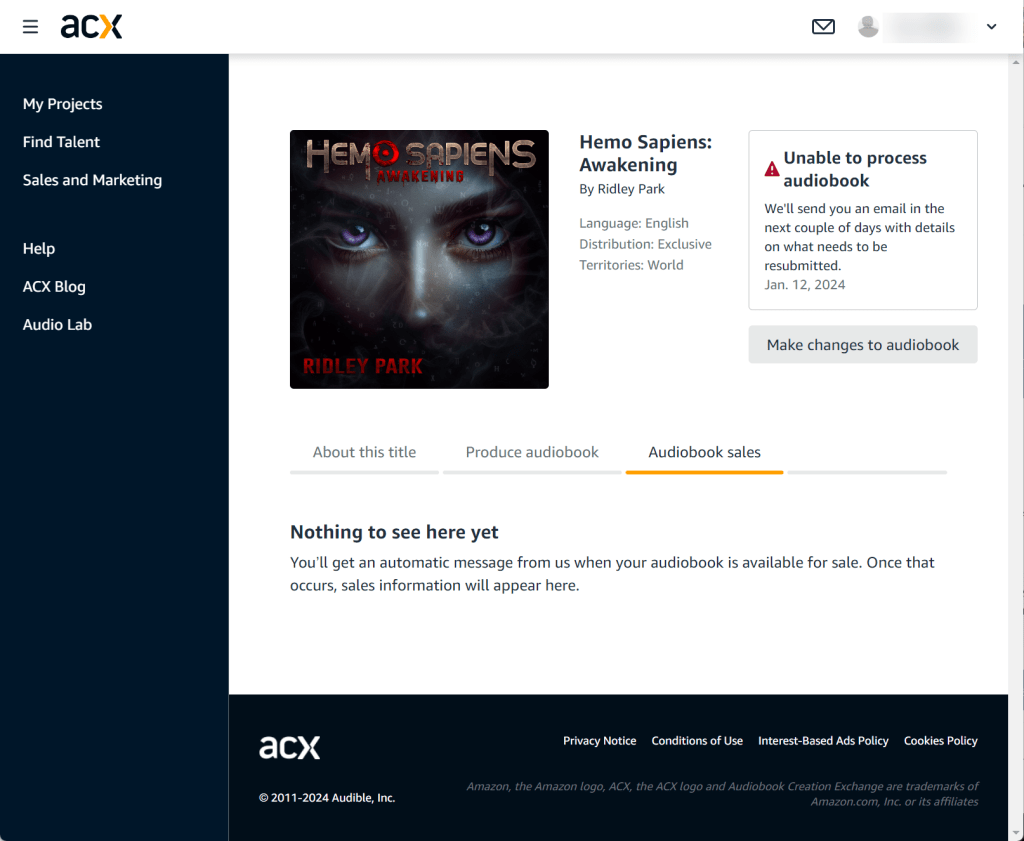
So this happened. I submitted Hemo Sapiens: Awakening as an audiobook, and it was rejected. The site says that they’ll let me know why in a couple days. My question is: if you rejected it, don’t you immediately know why?

I think I know why, but I can’t ‘fix’ the problem if I don’t know what it is. I don’t want to act on an assumption.

I believe they’ll inform me that I can’t use AI-generated narration. This would be odd because they have a programme in Beta where they provide the service of automatically converting the text of a book to audio. To be honest, it doesn’t sound amazing. It appears that they are using their own Amazon Polly, which I like, but you need to babysit it hard. It is very unlikely to sound good without heavy hand-holding. As it is, I hand-held my ElevenLabs AI to make the outcome sound like a professional human.

Audible offers some voiceover actors, but I didn’t like any of them, and they couldn’t compete with my ElevenLabs voice. I can understand that they don’t want to sell audiobooks that sound like Stephen Hawking, but theirs sound closer to him than mine.

On another note, I had to render and upload square cover art. There was a stated restriction disallowing padding a rectangular cover image with space or colour to make it square. I followed this rule, but this is exactly what they do. They take the cover of the book you’re selling through Amazon, and they pad the left and right margins with filler colour. I may append the rationale they provide once I’ve received it. Until them, my audiobook is on hold.

ElevenLabs Subscription

I was very disappointed to discover that characters don’t roll over into a new month’s subscription.

What happens to my subscription and quota at the end of the month?

Your subscription will automatically renew with each billing cycle and your characters will reset.

The unused quota does not roll over as it is a subscription-based service and the quota is an allotment for that month only. The only time where the quota rolls over is if you upgrade your subscription in the middle of an ongoing cycle, in which case the remaining quota will be added to the new cycle.

Italics are mine. Luckily for me, I tend to use most of my characters anyway. Last month I had 300-some-odd left over, but when I checked my balance, I only had the 100,000 for the month. This is what their Help page said.

300 characters is barely two sentences, but I could have, IDK, recorded some chapter titles and save those characters for actual prose.

It’s a good thing I read this. I was thinking of saving up a few months and knocking out an audiobook. For now, that’s not an available option. I’ll need to pay for the next subscription level. #SadPanda

For now, I’ve recorded 11 of 38 chapters JUST for my own editorial process. If in the unlikely scenario a chapter requires no changes, I’ll be ahead of the game. To be honest, I can just rerecord amended passages, but this involves a lot of post-production editing, which I’ve done, but it usually ends up being cheaper to just re-record. #FirstWorldProblems

Reading Aloud

Or is that ‘reading allowed?’ I’m all but done with my first draft of Hemo Sapiens, so I’m recording is chapter by chapter so I can listen to it. Listening uses different cognitive processes beyond the obvious sensory apparatus, so one catches different sorts of factors.

For me as an example, it helps me to capture pacing. When I scan my own work at this stage, I’ve read it so many times, it’s difficult to read critically. I sort of just gloss over the words in a perfunctory manner. Maybe that’s just me, but…

What I do is listen whilst I read along—sort of like in grade school: read silently whilst someone reads aloud. This is what it gets me:

  1. Clumsy phrasing. It felt ok when I wrote it, but doesn’t read particularly well.
  2. Repeat words written nearby. I try to avoid placing the same word in the same paragraph or to close in adjoining paragraphs. In this case, I used and character’s surname name near the end of a paragraph and then at the start at the next, It really caught my ear, so I changed the later one to a subject pronoun.
  3. Spelling. Yep, spelling and grammar checkers still miss things. For me, some of my dialogue it either text-speak, BRB, or truncated, ‘That ain’t for nuttin”, so I often Word to ignore spelling until I’m ready. Though it isn’t necessarily revealed by the audio portion, I tend to track audio word by word, whilst I tend to read in paragraphs.
  4. Typos and wrong words. Listening along yesterday, I noticed that I missed a pronoun change resulting from removing a male character and expanding a female character. A remnant ‘his’ needed to be amended to ‘her’.
  5. Dense (or sparse) paragraphs. This is also about pacing. When listening, one can pick up that a passage just drags unnecessarily. It may need to be written, or it might just need to be broken up or re-punctuated. If it feels too fast that it might give the reader seizures, perhaps toss in a few dialogue tags or descriptors.

Perhaps I could come up with more, but these make my top of mind list.

I use ElevenLabs AI speech synthesis to convert my content from text to speech. I’ve written about my ElevenLabs wish list before. For the plan I use, I get 100,000 characters per month and can exceed that limit by purchasing 1,000 word blocks. I don’t the overage to be cost-effective, so I’d only ever use it in a pinch. The next plan is for a 500,000 word block, but the economics don’t work for me there either. Usually, it’s no big deal. Unless I am using it to narrate a novel, I just wait for the month to roll over and I can pick up where I left off. Fortuitously enough for me, I recorded 11 chapters yesterday before i ran out, and my plan refreshes today, so easy peasy.

ElevenLabs charges by the character, not by the word, which does make sense, but it’s not how I think about writing. I tend to think in terms of words or pages. When they say character count, they mean it—punctuation, quotes, and apostrophes, spaces, and carriage returns. I have discovered ways to reduce spaces, but you need to be careful, because it also uses punctuation to control some elements of prosody and delivery. For example, if you remove all of the commas and full stops, the delivery will be a ramble. For those who still double-space after double stops, this will cost you. Sometimes, when I’m feeling particularly frugal, I remove the carriage returns. They don’t seem to have any effect on the output, and it saves characters. It wouldn’t make for a great reading experience, but the AI doesn’t care.

ElevenLabs Error

It’s no secret that I use ElevenLabs speech synthesis for my stories. I’ve commented on it before, including creating a wish list of feature improvements. Today, I am sharing a couple of examples of a challenge and a simple (enough) workaround.

As I create audio files for Hemo Sapiens: Aftermath, I hear two problems with pronunciation. From a practical perspective, it costs me characters to re-do content. I am given 30,000 characters per month, so repeating passages can throw off my production schedule if I must wait for the next cycle for my characters to reset.

Hemo Sapiens

The first issue is that the text-to-speech engine arbitrarily flips back between the correct and incorrect pronunciation of the word hemo — /ˈhiːməʊ/ versus /ˈhɛməʊ/. In order to ensure it gets it one hundred per cent of the time—since it doesn’t support IPA—, I need to present it as heemo, thereby not only necessitating a re-do but adding a character along the way. To be fair, the IPA version would render nine characters, so there’s that.

Wounds that heal

As I listened to a passage with a homophone, wound, it pronounced the verb form as the noun form. As written, it looks like the top line. To force the correct pronunciation, I had to respell wound as wowned to shift from /wuːnd/ to /waʊnd/ .

  1. Jasmine exhales, releasing some of the tension that had her wound tight.
  2. Jasmine exhales, releasing some of the tension that had her wowned tight.

In my wish list video, I suggest a tagging scheme to remedy this. Of course, I’d hope the tags would not count against the character allotment.

Oh, well. First World problems, eh?